IJEDR1604044 International Journal of Engineering Development and Research (www.ijedr.org) 275
IMPROVED BAT ALGORITHM BASED CLUSTERING
IN WSN
1
Kavita, 2Dr. Ramesh Chand Kashyap 1
Student, 2HOD ECE 1
ECEDepartment
Rayat-Bhara Group Campus, Ropar, India 1
[email protected],[email protected]
ABSTRACT
Clustering in wireless sensor network is an important aspect of research in wireless networks. Clusters in the network can be formed on the basis of either geographical area of the nodes or on the basis of some performance parameters. Also the nodes which form the cluster are either homogenous or heterogeneous in nature. In the proposed approach an objective function is proposed and and the objective function is used for the implementation of Bat Algorithm. The distance between nodes is computed using the Bat Algorithm. The distance is then used for clustering in the network. The results of the proposed approach are then compared with the basic algorithm. The results also verify the algorithm and compared on the basis of performance parameters like residual energy, end to end delay and throughput of the network. In the future other machine learning must be implemented and compared with the existing approach.
Keywords: Clustering, WSN, Bat Algorithm
INTRODUCTION
In WSN, sensor nodes are required with limited energy resources. The major goal of WSN is to gather the information efficiently [1]. These are wireless sensor networks are used in various field such as industrial and consumer applications (precision agriculture, machine health monitoring, etc), military applications (aircraft control, marine environment monitoring) etc. The whole network of wireless sensor network must have capability to work in very ruthless environments. In harsh condition, WSN can‟t be easily scheduled or efficiently managed. Also in this type of condition, network was not feasible at all [2]. Moreover, wireless sensor is energy constrained in these ruthless conditions and their batteries generally not recharged.
IJEDR1604044 International Journal of Engineering Development and Research (www.ijedr.org) 276
Literature Survey
In this paper, Bahmani-Firouzi et al. [1], proposed Dynamic Source routing algorithm. This proposed algorithm is same as data based routing. This algorithm uses a formal logic utilization based system in order to calculate the nodes. These calculated nodes must have to forward a packet to the neighboring node should maintain the gap and angle between two neighboring detector nodes. The result of the proposed algorithm indicates that proposed method has an identical packet delivery magnitude with very less energy consumption.
Ortiz, Antonio M. et al [2] in this paper, the consequences of the variations between the underwater
and terrestrial transmission mediums has been presented. Moreover, the relationship between energy consumption on totally different radio modes has also been presented. They approach a set of recent routing protocols considering factors like water depth and temperature.
Alihodzic, et al. [3] proposed the general underwater sensor network architecture with their sink
placed on the surface of water. A packet in the data based routing involves an area which stores the data of its last forwarder and is updated at every hop.
Salvador Climent et al. [4] proposed EDETA-e (Energy-efficient adaptive graded and robust design enhanced). The proposed EDETA approach is one of the power-aware routing protocol which helps to reduce the consumption of energy. It allocate the nodes in clusters and uses low power modes. Furthermore, the proposed approach provides fault tolerant mechanisms and has time constrained properties.
Seokhoon Yoon [5] proposed the AURP to address the matter of low packet delivery magnitude relation and high energy consumption in an exceedingly multi-hop Underwater Acoustic detector Network. AURP develops controlled quality of multiple Autonomous Underwater Vehicles alike to heterogeneous acoustic communication channels in order to recognize high data delivery magnitude relation. Moreover, proposed protocol provides low consumption of energy.
Wang, Sheng-Shih et al. [6] proposed QELAR (Q-learning-based Routing) in this paper. This
approach is depends on associate degree accommodative, energy-efficient, and lifetime aware routing protocol supported reinforcement learning. QELAR protocol suppose the generic MAC protocols.
Yilmaz, Selim [7], proposed SP-power routing formula that provides the energy dissipation through a
link as metric. Furthermore, a SP-cost routing has been presented and finally proposed a SP-power-cost routing, so as to optimize a mix of energy dissipation and remaining energy state SP-power-cost.
Zhao, Miao et al. [8] proposed a link metric which mixes the transmission energy quantity, the
reception energy quantity, the initial energy state and the remaining energy state of each supply node and therefore destination node. The distributed Bellman- Ford formula was employed in order to build the SPT supported outlined metric.
PROPOSED METHODOLOGY
An objective function is proposed on the basis of parameters depicted below:
IJEDR1604044 International Journal of Engineering Development and Research (www.ijedr.org) 277
𝑅𝑒𝑠𝑖𝑑𝑢𝑎𝑙 𝐸𝑛𝑒𝑟𝑔𝑦 = 𝑇𝑜𝑡𝑎𝑙 𝐸𝑛𝑒𝑟𝑔𝑦 − 𝐸𝑛𝑒𝑟𝑔𝑦 𝑢𝑠𝑒𝑑
Distance between the Nodes: Distance between two nodes communicating with each other at a particular time is calculated. The distance is an important factor as the energy consumed in transmitting a packet directly depends on the distance between the nodes. Distance is calculated using the Euclidean Formula which is given by:
𝐷𝑖𝑠𝑡𝑎𝑛𝑐𝑒 = 𝑥1− 𝑥2 2+ 𝑦1− 𝑦2 2
Normalized Packet Loss Rate: The packet lost while transferring packets from one node to another is also an important factor in detection of congestion. The packets lost in the network are due to mainly two reasons, the first one is the queue length of the node and the second reason is the packet collision in the network. The packet loss rate must be minimized for improving the performance of the congestion detection and control algorithm.
𝑂𝑏𝑗𝑒𝑐𝑡𝑖𝑣𝑒 𝐹𝑢𝑛𝑐𝑡𝑖𝑜𝑛 = √(𝑤1∗ 𝑃𝐿+ 𝑤2∗ 𝑅𝐸+ 𝑤3∗ 𝑑𝑖𝑗)
𝑤𝑒𝑟𝑒 𝑤1, 𝑤2 𝑎𝑛𝑑 𝑤3 𝑎𝑟𝑒 𝑤𝑒𝑖𝑔𝑡𝑠 𝑤𝑖𝑐 𝑠𝑎𝑡𝑖𝑠𝑓𝑦 𝑡𝑒 𝑒𝑞𝑢𝑎𝑡𝑖𝑜𝑛
𝑤1+ 𝑤2+ 𝑤3= 1
𝑎𝑛𝑑 𝑃𝐿 𝑖𝑠 𝑡𝑒 𝑝𝑎𝑐𝑘𝑒𝑡𝑠 𝑙𝑜𝑠𝑡 ,
𝑅𝐸 𝑖𝑠 𝑡𝑒 𝑟𝑒𝑠𝑖𝑑𝑢𝑎𝑙 𝑒𝑛𝑒𝑟𝑔𝑦 𝑎𝑛𝑑 𝑑𝑖𝑗 𝑖𝑠 𝑡𝑒 𝑑𝑖𝑠𝑡𝑎𝑛𝑐𝑒 𝑏𝑒𝑡𝑤𝑒𝑒𝑛 𝑛𝑜𝑑𝑒𝑠
Based on the value of the objective function the bio inspired bat algorithm is used for the calculation of the distance between the nodes in the network.
Bat Algorithm: Mostly, the bat are using the echolocation to some definite degree. For example, micro bats are used example echolocation but mega bats do not use echolocation. Micro bats used types of the sonar is called the echolocation, to detect prey, avoid obstacles, and locate their roosting crevices in the dark.
For simplicity, in our approach, the following approximate or idealized rules were used:
1) All bats use echolocation to sense distance, and they also „know‟ the difference between food/prey and background barriers in some magical way;
2) Bats fly randomly with velocity 𝑣𝑖 at position 𝑥𝑖 with a frequency 𝑓min, varying wavelength 𝜆 and loudness 𝐴0 to search for prey. They can automatically adjust the wavelength (or frequency) of their emitted pulses and adjust the rate of pulse emission r [0, 1], depending on the proximity of their target;
3) Although the loudness can vary in many ways, we assume that the loudness varies from a large (positive) 𝐴0 to a minimum constant value 𝐴min .
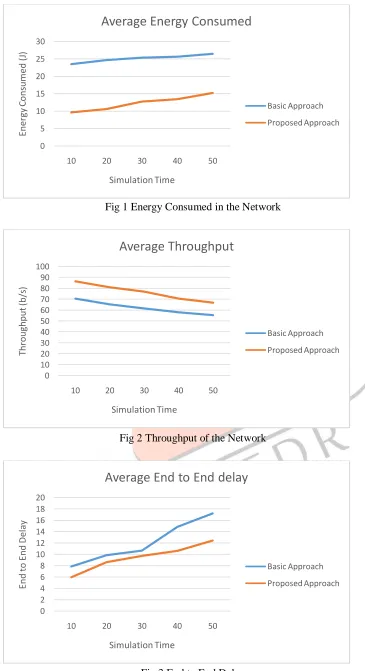
RESULTS AND DISCUSSIONS
IJEDR1604044 International Journal of Engineering Development and Research (www.ijedr.org) 278 Fig 1 Energy Consumed in the Network
Fig 2 Throughput of the Network
Fig 3 End to End Delay
0 5 10 15 20 25 30
10 20 30 40 50
Ene rg y C ons um ed ( J) Simulation Time
Average Energy Consumed
Basic Approach Proposed Approach 0 10 20 30 40 50 60 70 80 90 100
10 20 30 40 50
Thr o ug hpu t ( b/ s) Simulation Time
Average Throughput
Basic Approach Proposed Approach 0 2 4 6 8 10 12 14 16 18 2010 20 30 40 50
End to E nd D el ay Simulation Time
Average End to End delay
Basic Approach
IJEDR1604044 International Journal of Engineering Development and Research (www.ijedr.org) 279
CONCLUSION
Clustering is the most basic operation of research in WSN. It is an important issue of concern in recent years. Many approaches are proposed by the researchers in recent times which uses the clustering an important addition in the network from the point of view of energy consumption. In the present work Bat Algorithm is used for clustering in the network. It is a recursive process which uses iterative steps to performs the computation. The objective function value is calculated for each node in the network and bat algorithm is used for the calculation of distance and the local best after each iteration. The results also show that the proposed approach outperforms the basic approach on the basis of various performance parameters like residual energy, end to end delay and the packet delivery ratio.
REFERENCES
[1] Bahmani-Firouzi, Bahman, and RasoulAzizipanah-Abarghooee. "Optimal sizing of battery energy
storage for micro-grid operation management using a new improved bat algorithm." International
Journal of Electrical Power & Energy Systems 56 (2014): 42-54.
[2] Ortiz, Antonio M., et al. "Fuzzy-logic based routing for dense wireless sensor
networks." Telecommunication Systems 52.4 (2013): 2687-2697.
[3] Alihodzic, Adis, and Milan Tuba. "Improved bat algorithm applied to multilevel image
thresholding." The Scientific World Journal 2014 (2014).
[4] Salvador Climent, Juan Vicente Capella, Nirvana Meratnia and Juan Jos Serrano, “Underwater sensor networks: A new energy efficient and robust architecture”, Sensors, volume 12, pages 704– 731, 2012.
[5] Seokhoon Yoon, Abul K. Azad, Hoon Oh and Sunghwan Kim.“Aurp: An auv-aided underwater routing protocol for underwater acoustic sensor networks”, In Sensors, volume 12, pages 1827–1845, 2012.
[6] Wang, Sheng-Shih, and Ze-Ping Chen. "LCM: a link-aware clustering mechanism for
energy-efficient routing in wireless sensor networks." Sensors Journal, IEEE 13.2 (2013): 728-736.
[7] Yilmaz, Selim, and Ecir U. Kucuksille. "Improved bat algorithm (IBA) on continuous
optimization problems." Lecture Notes on Software Engineering 1.3 (2013): 279-283.
[8] Zhao, Miao, Ji Li, and Yuanyuan Yang. "A framework of joint mobile energy replenishment and
data gathering in wireless rechargeable sensor networks.", IEEE Transactions on Mobile