Article
The Value of Providing Smokers with Free
E-Cigarettes: Smoking Reduction and Cessation
Associated with the Three-Month Provision to
Smokers of a Refillable Tank-Style E-Cigarette
Neil McKeganey, Joanna Astrid Miler andFarhana HaseenCentre for Substance Use Research, Block 4 West of Scotland Science Park, Kelvin Campus, Block 302, Glasgow, G20 OSP; [email protected] (J.A.M.); [email protected] (F.H.)
Corresponding author: [email protected]
Abstract:Despite the uptake of tobacco smoking declining in the UK, smoking is still the leading cause of preventable poor health and premature death. While improved approaches to smoking cessation are necessary, encouraging and assisting smokers to switch by using substantially less toxic non-tobacco nicotine products may be a possible option. To date few studies have investigated the rates of smoking cessation and smoking reduction associated with the free provision of electronic-cigarettes (cigarette) to smokers. In this exploratory study the Blu Pro e-cigarette was given to smokers to assist them in reducing and quitting over a 90 day period. The rates of smoking abstinence and daily smoking patterns were assessed at baseline, 30 days, 60 days and 90 days. The response rate was 87%. After 90 days, the complete abstinence rate was 36.5% from 0% at baseline. Frequency of daily smoking reduced from 88.7% to 17.5% (P<0.001) and median consumption of cigarettes/day from 15 to 5 (P<0.001). The median number of days per month participants smoked also reduced from 30 to 13 after 90-days (P<0.001). On the basis of these results there may be value in smoking cessation services, and other services, ensuring that smokers are provided with e-cigarettes at zero or minimal costs for at least a short period of time.
Keywords: E-cigarettes Smoking Cessation Free Provision
1. Introduction
Despite rates of smoking uptake declining in the western world, tobacco smoking still continues to kill more people, cause more disease, and contribute more to social inequalities in high-income countries than any other preventable factor (1-2). After stopping smoking, the associated health risks diminish substantially in proportion to the period of abstinence with former smokers living longer than those who continue to smoke (3). Quitting smoking at the soonest opportunity is the best action a person can take to improve their health in the medium to long-term (3). Given that most of the 8 million smoking-related deaths projected to occur globally by 2030 will be among current, not prospective smokers (4), developing new effective ways of helping people to quit smoking is a public health imperative.
can take to improve their health, the Royal College of Physicians and Public Health England have both indicated the likely benefit of those smokers who are either unable or unwilling to quit smoking combustible tobacco products to consider switching to using non-tobacco nicotine products. The issue that we address within this paper is whether the encouragement and assistance to smokers to switch to non-combustible tobacco products should include the free provision of those products for at least a restricted period of time.
The Evidence Base on the Positive Role of E-cigarettes in Smoking Cessation
A growing body of evidence is beginning to emerge, suggesting that e-cigarettes can be an effective tool in helping people to quit smoking (1; 5-7). Since 2013 e-cigarettes have been the most common quitting aid for smokers in England, according to Public Health England (5) – with that finding being affirmed in recent data showing that 38.2% of people in the last quarter of 2017 report using an e-cigarette in their recent quit attempt compared with 18% using nicotine replacement therapy (NRT) and 2.8% using varenicline (champix) (1). Regarding the efficacy and effectiveness of cigarettes in quitting smoking, the latest data (1) suggests tank models are superior to cig-alike e-cigarettes. Using a tank model may increase the odds of successfully quitting smoking up to 2.19 times (1).
Studies investigating abstinence rates found that e-cigarettes are helpful in enabling smokers to switch. For example, the Eurobarometer 2017 study (8) about EC use in 28 Member States of the European Union utilised responses from 3,612 participants (current or ex-smokers who at least tried e-cigarettes in the past) and found that 14% of respondents indicated that e-cigarettes had enabled them to stop smoking tobacco entirely. A recent study by Manzoli and colleagues (9) followed-up 236 e-cigarette users (all of whom were ex-smokers), 491 smokers, and 232 dual users for 12 months, and found that 61.9% of the vapers were still abstinent from tobacco smoking, compared with just 20.6% of the smokers and 22.0% of the dual users, again suggesting that e-cigarettes can be effective in helping smokers abstain.
Data from the Eurobarometer 2017 study (8) indicated that 17% of the 3,612 respondents reported a reduction in their tobacco consumption due to the use of e-cigarettes (but not complete cessation). Another study showed reduction in cigarette smoking rates within a 6 week period (10). Our study adds to this literature by reporting both the rates of complete cessation as well as smoking reduction, associated with a 90-day ad libitum use of a tank style e-cigarette in smokers.
2. Methods
As this is an exploratory trial, formal sample calculation was not undertaken. The study recruited 72 adult (18-65 years) smokers from Glasgow U.K. who indicated a willingness to try e-cigarettes as a method of quitting smoking. These respondents agreed to try using an e-cigarette in place of combustible cigarettes for 90 days.
Participants were recruited through a variety of means: an advertisement placed in a local Glasgow newspaper (Glasgow Evening Times); posts on social media accounts belonging to the investigators; local targeted (by postcode) leaflet drop including areas with lower socio-economic status (known to have higher rates of smoking); leaflet distribution in Glasgow city centre; liaison with Human Resource departments of Glasgow-based companies; and word of mouth/snowballing. The particular brand name (Blue Pro) or device type was not indicated in advertisements for the research. Eligibility to participate was determined by satisfaction of six inclusion criteria and 13 exclusion criteria (see Appendix A). In short, we recruited adults (aged 18-65); smoking at least 10 cigarettes/day for at least the past 12 months and who weren’t already regular e-cigarette users (maximum e-cigarette use in the past month was 5 occasions). Participants were required to not have used any NRT or stop smoking medication in the past 30 and 90 days respectively, nor to have had behavioral support to quit smoking in the past 30 days. Pregnant or lactating women were excluded. All potential participants were emailed the study information sheet.
to choose from a range of ,flavors (tobacco, menthol, blueberry, cherry and strawberry mint) and in 3 nicotine strengths (tobacco- 16 mg/ml, 8 mg/ml; menthol- 16 mg/ml, 8 mg/ml; blueberry- 16 mg/ml, 0 mg/ml, cherry- 8 mg/ml, 0 mg/ml and strawberry mint- 8 mg/ml, 0 mg/ml), making 10 flavors x nicotine strength combinations. Disposable mouth tips were used in the training for the purpose of hygiene. At the conclusion of this meeting participants were provided with three 10ml bottles of their preferred combination(s) of e-liquid to begin the study. It was explained to respondents that they would be free to choose from the other flavors and nicotine strengths during the three-month period of the study although it was explained that they should use only Blu flavors within the Blu device provided to them.
Participants received training on how to assemble, charge, fill and puff on the e-cigarette, culminating in having to demonstrate competency and confidence to use the cigarette and e-liquids safely and effectively themselves by assembling and filling up the e-cigarette with e-liquid of their choice, and puffing on it. The investigator alerted the participants to a list of potential health warnings associated with the use of this e-cigarette, issued by the manufacturer, and described the recommended actions in the event of a technical malfunction or adverse health effects. Participants were encouraged to ask questions about the operation and proper use of the Blu Pro e-cigarette throughout this session. While no instruction was given as to how frequently or deeply to puff on the e-cigarette, practicing different puffing styles was encouraged to find the regimen resulting in the most satisfying draw of vapour. Participants were told to try to use their e-cigarette instead of smoking whenever they had a craving for nicotine or an urge to smoke.
Beyond an initial free supply of the Blu Pro Kit and three 10ml e-liquid refill bottles, participants were told to purchase any additional refills from stockists in the community or from online vendors (reimbursed by cheque or bank transfer, up to the value of £30/month/participant (cost of 6 refill bottles), upon presentation of valid receipts)). In the event of a e breakage or malfunction in the e-cigarette provided the research team were able to ensure a rapid replacement or reimbursement where the study participant had purchased a new device. It was explained to study participants that the research team was unable to reimburse the use of other liquids than those manufactured for the BluPro device.
Participants completed an online questionnaire on four occasions – on day 1 (baseline), day-30, day-60 and day-90. On these days, they were to receive an email containing a web-link to an online questionnaire (hosted online on SurveyMethods) and were to complete the questionnaire within three days of receipt of the email. Participants were reimbursed with the value of £20 as a compensation for their time in completing the survey instrument at each follow-up point.
2.1. Ethics Approval
The study design was reviewed by the West of Scotland Research Ethics Committee who judged that the design of the study, including the use of commercially available e-cigarettes, meant that the study could proceed without a full committee assessment.
2.2. Measures
Participants were asked to report the frequency and quantity of cigarette consumption in the past 30 days.
2.2.1. Rate of abstinence
At baseline, all participants were smokers. The ‚abstinence rate‛ was the percentage of those who did not smoke in the last 30 days at the time of the interviews (day-30, day-60, day-90) among those who were smoking before the interviews. Participants were asked ‚In the past 30 days, have you smoked a cigarette, even one or two puffs?‛. Responses categories were ‘Yes’ and ‘No’.
Daily smoking prevalence was assessed by asking ‚Do you now smoke cigarettes?’, possible responses were ‘Everyday’, ‘Some day’ and ‘Not at all’. Participants who responded to ‘Everyday’ were coded as ‘daily smoker’.
2.2.3. Frequency and amount of smoking
Current users of cigarettes were asked to write the ‘number of days’ in response to the question ‚On how many of the past 30 days did you smoke cigarettes?‛. In response to the question ‚On those days that you did smoke‛ respondents were asked to indicate how many cigarettes they typically smoked each day? Use of cigarette per day was then categorised into three levels: light (1-10), moderate (11-20) and heavy (>20) (11).
Baseline characteristics were collected within 3 days of the training session by the study investigator. Demographic data including age, gender, ethnicity, and socio-economic status. Questions relating to smoking history assessed the duration of cigarette smoking (years); age of first cigarette smoked (years); age at which the individual started smoking daily (years) and previous quitting attempts.
Other measures relating to the frequency of use of the e-cigarette; perceived helpfulness; and the use of flavors were also collected.
2.3. Statistics
Given this is a single arm trial, descriptive statistics were used to calculate the rate of abstinence, daily smoking prevalence and frequency and amount of smoking. The primary analyses of outcomes included all enrolled participants who enrolled into the study and completed baseline but follow-up was censored if a participant was lost to follow-up (30 n=7, 60 n=5 and day-90 n=9). An intent-to-treat (ITT) approach with imputations was not applied since this is more appropriate for randomised control trials.
Bivariate associations of smoking behaviors between baseline and following initiating e-cigarette use were assessed with z-tests and χ2 tests for categorical variables. Since data did not
follow normal distribution, non-parametric test (Wilcoxon Signed-Rank Test) was used for continuous variables, and descriptive data presented as median. This exploratory analysis concluded not to proceed with advance models adjusted for confounders. All data was analysed using SPSS version 25.
3. Results
A total of 72 participants were enrolled into the study, out of which 4 were lost to follow-up after baseline, indicating a low attrition rate (5.6%). Out of 72, 71 completed the baseline; 63 participants (87.5%) completed 4 measures (baseline, 30- day, 60-day and 90-day). More than 90% completed 30-day (90.2%, 65/72) and 60-day surveys (93.0%, 67/72); and 87.5% completed 90-day survey. Missing responses for outcome measures across the follow up periods were varied between 6.9% to 12.5%
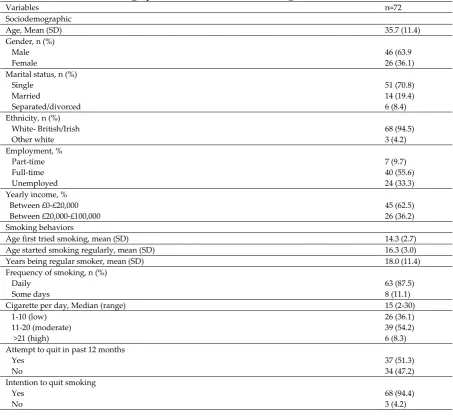
The baseline sociodemographic characteristics and smoking behavior of the participants are presented in Table 1. More than three-quarter (79%) of the participants were <=45 years old (average 35.7 years), ranging from 19 to 59 years. There were more men than women in the study (63.9% vs 36.1%). Most of the participants were British/Irish white (94.5%) and around three-quarter were single (70.8%). More than half of were in full-time employment (56%) and earned less than £20,000 per year (62.5%). Participants varied in their levels of education from no qualifications (11.3%) to Masters-level degree (2.8%) with highest frequencies being those having obtained either an undergraduate university degree (22.5%) or Higher National Certificate / Diploma (25.4%).
Table 1. Baseline Sociodemographic Characteristics and Smoking Behaviors.
Variables n=72
Sociodemographic
Age, Mean (SD) 35.7 (11.4)
Gender, n (%)
Male 46 (63.9
Female 26 (36.1)
Marital status, n (%)
Single 51 (70.8)
Married 14 (19.4)
Separated/divorced 6 (8.4)
Ethnicity, n (%)
White- British/Irish 68 (94.5)
Other white 3 (4.2)
Employment, %
Part-time 7 (9.7)
Full-time 40 (55.6)
Unemployed 24 (33.3)
Yearly income, %
Between £0-£20,000 45 (62.5)
Between £20,000-£100,000 26 (36.2)
Smoking behaviors
Age first tried smoking, mean (SD) 14.3 (2.7)
Age started smoking regularly, mean (SD) 16.3 (3.0)
Years being regular smoker, mean (SD) 18.0 (11.4)
Frequency of smoking, n (%)
Daily 63 (87.5)
Some days 8 (11.1)
Cigarette per day, Median (range) 15 (2-30)
1-10 (low) 26 (36.1)
11-20 (moderate) 39 (54.2)
>21 (high) 6 (8.3)
Attempt to quit in past 12 months
Yes 37 (51.3)
No 34 (47.2)
Intention to quit smoking
Yes 68 (94.4)
No 3 (4.2)
3.1. Abstinence rates after 90 days of ad libitum use of an e-cigarette
All (100%) participants were smoking at baseline. Complete smoking abstinence was achieved by 18.5% (12/65) at day-30; 25.4% (17/67) at day-60; and 36.5% (23/63) at day-90 (Figure 1). Abstinence rates from day-30 were sustained with 72.7% (8/11) participants at day-60, and 81.8% (9/11) at day-90. Among participants who reported smoking abstinence at day-60, 87.5% (14/16) continued to be abstinent at day-90.
0
18.5
25.4
36.5
0
10
20
30
40
Baseline
30 days
60 days
90 days
%
of
p
ar
ti
ci
p
an
ts
Figure 1. Past 30 days smoking abstinence levels.
The changes in abstinence levels at the 3 different time points from baseline to 90 days were tested. The abstinence rate increased from baseline to day-30 point and continued until the end of study at 90 days with significant differences between baseline and the three follow-up points (day-30, day-60 and day-90); P <0.001. However, in relation to the time between follow up points the difference was statistically significant between day-30 and day-90 (18.5% vs 36.5%, P=0.02); but not for day-30 vs day-60 or day-60 vs day-90.
3.2. Prevalence of daily smoking
A total of 22 participants did not respond to daily smoking question on four occasions (baseline n=1, day-30 n=7, day-60 n=5 and day-90 n=9). Out of 71 participants, 63 at baseline reported smoking daily (88.7%) whilst the prevalence of daily smoking significantly dropped within 30 days of Blue Pro use (28.3%) (P<0.001). Differences in daily smoking prevalence from between baseline to both day-60 and day-90 were significant (p<0.001). The declining trend continued until 60 days, then there was an increase from 20.0% to 27.5%. The difference in daily smoking between day-60 and day-90 was not significant. Similarly, there was no further significant change in daily smoking between any other time points (day-30 vs day-60 or day-30 vs day-90) (Figure 2).
Figure 2. Prevalence of daily smoking.
3.3. Cigarettes per day
Participants ranged in their daily cigarette consumption from 2-30 cigarettes per day at baseline, 1-20 at day-30, 1-25 at day-60 and 1-20 at day-90 (Table 2). The median number of cigarettes smoked per day dropped from 15 to 3 at day-30, 4 at day-60 and 5 at day-90; the differences was significant at all three time points from baseline (P<0.001) but not between follow-up time points: day-30 and day-60, day-30 and day-90, and day-60 and day-90. A similar trend was observed when the number of cigarettes was categorised into three groups- low, moderate and high. The low number of cigarettes consumed significantly increased from 36.6% at baseline to 89.2% just after starting Blu Pro for 30 days, and the low number of cigarettes consumption continued for drop in next two months; 84.2% and 82.8% respectively. These differences were significant between baseline and all further time points (p<.001).
88.7
28.3
20
27.5
0
20
40
60
80
100
Baseline 30 days
60 days
90 days
%
of
p
ar
ti
ci
p
an
ts
Table 2. Cigarette use per day.
Cigarette use Baseline (n=71) 30 days (n=37)
60 days (n=38) 90 days (n=29) P value*
Number of cigarette/day
Median (range) 15 (2-30) 3 (1-20) 4 (1-25) 5 (1-20) <0.001 1-10 (low), n (%) 26 (36.6) 33 (89.2) 32 (84.2) 24 (82.8) <0.001 11-20 (moderate), n(%) 39 (54.9) 4 (10.8) 5 (13.2) 5 (17.2)
>=21 (high), n(%) 6 (8.5) 0 (0.0) 1 (2.6) 0 (0.0)
n=71 n=53 n=50 n=40
Number of days smoked, median (range)
30 (3-30) 15 (1-30) 10 (1-30) 13 (1-30) <0.001
*significant from baseline using Kruskal-Wallis H (continuous variables) and Chi-Square (categorical).
3.4. Number of smoking days
Participants who did not reach smoking abstinence, ranged in their cigarette smoking between 3-30 days/month at baseline, 1-30 days/month at day-30, day-60 and day-90 (Table 2). The baseline median number of days in the month that participants smoked (median 30) was significantly higher than at day-30 (median 15), day-60 (median 10) and day-90 (median 13) of the Blu Pro use (P <0.001). Consistent with other outcome measures, these differences did not exist between follow-up time periods- day-30 and day-60, day-30 vs day-90 and day-60 vs day-90.
3.5. Use and acceptance of e-cigarette
The Blue Pro was judged to be acceptable by study participants almost all of whom (98.5%) used Blu Pro in the first 30 days; 95.5% continued to use the BluPro device up to 60 days and 81.0% continued using the Blu Pro until 90 days. Out of 12 participants who stopped using BluPro at day-90, 8 (66.7%) of them neither smoked nor used any other e-cigarette. Overall, less than 10% reported the use of other e-cigarette brands at 90 days follow-up.
Non-tobacco flavors were more popular than exclusive tobacco flavor (56.9% vs 7.7% at day30, 66.2% vs 15.4% at day-60 and 75.9% vs 13.8% at day-90; P=0.013). Use of tobacco flavor significantly dropped from day-30 to day-90 (43.1% to 22.2%, P=0.043). At every data collection point the majority of smoking abstainers used non-tobacco flavors; among 20 abstainers at day-90 (data available), 2 (10.0%) used tobacco flavor whilst the remaining 18 participants (90%) used flavored non-tobacco e-liquids.
All participants found the flavors used were important in helping them to quit or cut down and 92.1% believed that the Blu Pro had helped them to cut down or quit smoking at 90 days. Different nicotine strengths of flavors did not show either a trend or an association with smoking abstinence over time.
Overall, around three-quarter of participants (45/62; 73.8%) reported an intention to use the BluPro e-cigarette for the next month at the end of the study. Among 22 abstainers, 15 (68.2%) expressed a plan to continue BluPro in next month.
Self-reported purchases of liquid refills increased over time - 61% at day-30, 75% at day-60 and 77% at day-90; 10%-25% participants bought >6 refills which costed more than the reimbursement amount (10% at day-30, 25% at day-60 and 22%% at day-90).
In this exploratory study, we have shown that ad libitum use of e-cigarettes supported smokers’ efforts in quitting and reducing smoking over a 90 day period. The abstinence levels increased from baseline to day-30 and continued to rise throughout the study duration (90 days),. The finding suggests that the use of vaping may have additional benefits with longer use – i.e. a proportion of smokers quit smoking within the first month of use, but a larger proportion needed more than 2 months to make the switch and gradually quit over a longer period. After 90 days we observed an abstinence rate of 36.5%. Other studies have reported rates of complete abstinence ranging from 14% (8) to 22.0% (of dual users at baseline) (9) to 61.9% (in vapers at baseline after 12 months follow-up) (9). Our results are not directly comparable however a 36.2% abstinence rate after 3 months is a promising result.
There are some limitations in our study. This was a small, exploratory, uncontrolled, study with a convenience sample and self-reported measures of smoking behavior. As a result, the findings should be interpreted with caution. Our research suggests that there may be benefits in providing smokers with free access e-cigarettes and e-liquids for at least a short-term period. There can be little doubt as to the importance of encouraging and enabling smokers to cease smoking. Whilst the greatest health benefit can be achieved by smokers’ ceasing their smoking and nicotine consumption entirely, nevertheless there are some smokers who wish to continue to use nicotine for at least a period of time. On the basis of this study there is likely to be merit in providing smokers with access to e-cigarettes, letting them explore the various different flavors, and thereafter providing them with the opportunity to utilise these products either alongside or in place of combustible products. As we saw even within a relatively short period of time a significant number of smokers were able to cease smoking entirely over the study period, others were able to reduce the numbers of days they smoked and to reduce the number of cigarettes per day smoked.
Whilst our study has shown that it is possible to facilitate significant behavioral change on the part of smokers as a result of providing them with access to alterative nicotine delivery systems (for at least a short period) an important question becomes one of whether these smokers were able to sustain those changed behaviors over an extended period of time. On the basis of our research it was evident that notable changes in behavior were evident within the first month of being provided with the Blu Pro device and associated e-liquids and were largely maintained throughout the three-month study period. Clearly, we cannot comment on the extent to which the positive reductions in smoking persisted beyond the three-month period over which respondents were provided with free products.
technology of alternative nicotine delivery systems to warrant research that can assess the speed with which different products facilitate that switch and the extent to which different products are able to stimulate a sustained switch from smoking to exclusive vaping.
Author Contributions: NM collaborated in designing the research, analyzing the data and writing up the manuscript for publication. JAM was responsible for the fieldwork and was involved in the analysis and write up. FH was involved in the analysis and write up of the study manuscript.
Funding: The research reported here was funded by Fontem Ventures which is an e-cigarette manufacturer linked to Imperial Tobacco.
Conflicts of Interest: The authors have no conflicts of interest to declare. The funder had no role in the design and conduct of the study; or in the preparation, review, or approval of the manuscript. The authors had full access to all the data in the study and take responsibility for the integrity of the data and the accuracy of the data analysis.
References:
1. McNeill A, Brose LS, Calder R, Bauld L & Robson D (2018). Evidence review of e- cigarettes and heated tobacco products 2018. A report commissioned by Public Health England. London: Public Health England.
2. Peto, R., Lopez, A.D., Boreham, J., Thun, M. Mortality from smoking in developed countries, 1950 to 2010: tobacco-attributed mortality by disease, overall mortality rates and, where possible, trends. 2011. Accessed February 2018 at: http://tobaccocontrol.bmj.com/content/suppl/2012/02/22/tobaccocontrol-2011-050294.DC1/tobaccocontrol-2011-050294-s1.pdf
3. National Academies of Sciences Engineering, and Medicine (2018) Public Health Consequences of E-cigarettes. Washington D.C. The National Academies Press. https://doi.org/10.17226/24952
4. Ratajczak, A., Wojciech, F., Smith, D., Goniewicz, M. (2018) How Close are we to definitively identifying the respiratory health effects of e-cigarettes. Expert Review of Respiratory Medicine vol 12 issue 7 pp549-556
5. World Health Organization (WHO). Encouraging people to stop smoking. Behavioral Science Learning
Modules. Accessed on 8 March 2018 from:
http://www.who.int/mental_health/evidence/stop_smoking_whomsdmdp01_4.pdf
6. Eriksen M, Mackay J, Ross H. The Tobacco Atlas. Fourth Edition. American Cancer Society and World Lung Foundation. 2012.
7. McNeill A, Brose L, Calder R, Hitchman S, Hajek P, McRobbie H. E-cigarettes: An Evidence Update: A Report Commissioned by Public Health England. London: Public Health England; 2015. Accessed
March 2018 at:
https://www.gov.uk/government/uploads/system/uploads/attachment_data/file/457102/Ecigarettes_an_e vidence_update_A_report_commissioned_by_Public_Health_England_FINAL.pdf
8. Royal College of Physicians (2016). Nicotine without smoke: Tobacco harm reduction. London: RCP. 9. McRobbie, H., et al. Electronic cigarettes for smoking cessation and reduction. Cochrane Database
Systematic Review, 2014; 12: CD010216.
10. European Commission. Special Eurobarometer 458 - Attitudes of Europeans towards tobacco and
electronic cigarettes (2017). Accessed from:
http://ec.europa.eu/commfrontoffice/publicopinion/index.cfm/Survey/getSurveyDetail/instruments/SPEC IAL/ surveyKy/2146;
11. Manzoli L, Flacco ME, Fiore M, et al. Electronic cigarettes efficacy and safety at 12 months: cohort study. PLoS ONE2015;10:e0129443. doi:10.1371/journal.pone.0129443
12. Litt MD, Duffy V, Oncken C Cigarette smoking and electronic cigarette vaping patterns as a function of e-cigarette flavourings Tobacco Control Published Online First: 15 September 2016. doi: 10.1136/tobaccocontrol-2016-053223