Article
Exotic Spectra and Lattice Vibrations of Ice X Using
the DFT Method
Lu Jiang, Shu-Kai Yao, Kai Zhang, Ze-Ren Wang, Hui-Wen Luo, Xu-Liang Zhu, Yue Gu and Peng Zhang *
School of Space Science and Physics, Shandong University, Weihai, 264209, China * Correspondence: [email protected]; Tel.: +86-631-568-8751
Abstract: A typical vibrational spectrum in the ice phase has four separate bands: translation, libration, bending and stretching. Ice X, the final ice phase under high pressure, shows an exotic
vibrational spectrum. Theoretically, an ideal crystal of ice X only has one peak at 998 cm-1 for Raman
scattering and two peaks at 450 cm-1 and 1507 cm-1 for infrared absorption in this work. These three
characteristic peaks are indicators of the phase transition between ice VII/VIII and ice X. Despite much experimental and theoretical work on ice X, only this study has clearly indicated these characteristic peaks in the region of the IR band. The phonon density of states shows quite different features than ice VIII, which could be verified by inelastic neutron scattering in the future. The dynamic processes of 15 vibrational normal modes are discussed and the typical hydrogen bonds are missing.
Keywords: ice X, vibrational spectrum, first-principles DFT, Raman scattering, IR absorption
1. Introduction
Water is one of the most abundant materials. It is important for both nature’s balance and human evolution. It is essential in both Earth and planetary sciences to understand the behavior of water over a broad range of thermodynamic conditions and experiments [1]. As the solid state of water, ice has been found in at least 20 formations of crystalline and amorphous phase structures under different temperature and pressure conditions [2-5].
As early as 1972, Holzapfel was the first to predict a high-pressure phase of ice that exists with hydrogen-bonded protons residing in the middle of two symmetrically neighboring oxygen atoms [6]. In 1984, after reporting the results of a Brillouin scattering experiment on solid ice up to 30 GPa,
Polian et al. presented an extension of those results up to 67 GPa [7], which also predicted the new
high-pressure phase (i.e., ice X). Under such high pressure, the orientations of ice X are ordered and its hydrogen atoms lie at symmetric midpoints, leading to the reasonable prediction that the structure is ionic in nature. Despite the different space groups of ice VIII and ice X, their atomic arrangements and lattice constants are very similar. As such, it has been predicted that ice VIII can become ice X
under certain pressures and temperatures [8]. Using infrared (IR) measurements, Goncharov et al.
provided evidence of the phase transition from ice VII/VIII to ice X, beginning at 60 GPa and reaching
a stable stage of at least 210 GPa [9]. They identified one peak at approximately 1500 cm-1 at pressure
above 175 GPa as an indicator of ice X. Their calculations indicate that there are two IR absorption
peaks at 1,508 cm-1 and 450 cm-1 at pressure above 120 GPa.
Two symmetric O-H bonds connect each hydrogen atom in the ice X crystal. Consequently, it is no longer in a molecular phase, but an atomic one [6]. Considerable investigations have been conducted on the physical and chemical properties of ice X [10-14]. However, no inelastic neutron
2 of 6
scattering (INS) experiment has been reported under such high pressure. Marqués et al. conducted a
first-principles study of phonon frequencies [11]. Their density functional theory (DFT) calculations illustrate that ice X is not molecular in character and is linked by soft phonon transitions to ice VIII
(or disordered ice VII) at low pressure and to a putative Pn3m structure at high pressure [11]. In
addition, the calculated phonon frequencies in their work indicate that ice X is a stable phase, but with the pressure decreasing below 110 GPa, the dispersion curve changes significantly. Putrino and
Parrinello theoretically reported a Raman peak at 840 cm-1 [12]. Alexander [13] and Men [14] observed
this peak experimentally at 980 cm-1 and 785 cm-1. However, a unique Raman peak for ice X has not
been proposed. In this study, to clarify the critical indicators of the transition from ice VIII to X, 15 normal vibration modes of ice X are individually analyzed and three vibrational spectra are illustrated for reference to the phase transition.
2. Computational Methodology
Figure 1. Diagram of the k-point and energy cutoff convergence tests. The total energy against k-point separation is shown in (a) and the cutoff convergence is shown in (b). The parameters used in this study are 0.07/Å for the k-point mesh and 830 eV for the energy cutoff.
Using CASTEP [15], a first-principles DFT code, we set up a route map to calculate the geometry and lattice vibrations of the ice X phase. The conventional cell of ice VIII containing eight molecules
was built as a prototype, space group I41/amd. As shown in Figure 1, we first conducted k-point and
energy cutoff convergence tests. As a phase transition occurred in the process of calculation, we defined the k-point separation instead of the k-point mesh. Figure 1(a) shows that the separation of 0.07/Å was sufficient. We set 830 eV as the energy cutoff. Although not a big value, it was appropriate for this study, as shown in Figure 1(b). A hydrostatic pressure ranging from 70 GPa to 140 GPa was applied with a 10 GPa interval. The hydrogen gradually shifted at the midpoint between the two
oxygens as the pressure increased. The structure eventually fully transformed into space group Pn
-3m at 120 GPa. Then, the phonons and IR properties of ice X were calculated to simulate the phonon
density of states (PDOS) and the photon scattering spectra at this pressure. The normal vibration modes were extracted from the property calculation of the polarizability, IR and Raman spectra. The exchange-correlation function of the generalized gradient approximation RPBE [16] was selected for geometrical optimization. As the hydrogen bonding of the RPBE was slightly underestimated, the subsequent vibrational spectrum calculations presented a small blue shift. The energy and SCF
3. Results and Discussion
Figure 2. Three simulated spectra of ice X. IR, Raman and the PDOS are colored in black, red and blue, respectively. The PDOS curve of ice VIII is shown at the bottom for comparison.
Figure 2 illustrates the three simulated spectra (i.e., Raman, IR and INS) of ice X. For comparison, the PDOS of ice VIII is also listed at the bottom. As for the PDOS of ice X, the spectrum could not be divided into four separate regions as with ice VIII. In the ice family, the intramolecular O-H stretching
region occurs above 3000 cm-1. There are no frequencies at this region for ice X, meaning that strong
covalent bonds are missing. The PDOS peaks of ice X below 300 cm-1 are from the acoustic branch
and the band from 400 cm-1 to 1000 cm-1 is from the optic branch. Obviously, the intermolecular
hydrogen bonds are also missing. These features at above 400 cm-1 are similar to the librational bands
of other ice phases. However, the stubborn isolated intramolecular O-H bending peaks at
approximately 1600~1700 cm-1 extend to a broad band. On account of high pressure, ice X
demonstrates metallic properties to some extent. It is unsurprising that the spectrum of ice X is quite different from the spectra of traditional ice phases. The PDOS curve reflects phonons integrated by the entire reduced Brillouin zone. As the signals collected by the INS experiment are proportional to the PDOS, this simulated curve may be verified via INS in the future. In spite of its PDOS complexity, the IR and Raman spectra show very distinct indicators of ice X identification. Our simulations show
that two peaks at 450 cm-1 and 1508 cm-1 are IR active and that only one peak at 998 cm-1 is Raman
active. In the IR study of Goncharov et al., it was obvious to assign a peak at approximately 1500 cm
-1 in the experimental spectrum [9]. However, the lower peak was not reported. Putrino and Parrinello
predicted a Raman peak at 840 cm-1 [12]. However, there were still other Raman peaks in their
theoretical spectrum. Alexander [13] and Men [14] observed this Raman peak at 980 cm-1 and 785 cm
-1, respectively. As vibrational frequencies are very sensitive to pressure, big differences in peak
2 of 6
The periodic structure of ice X is a six-atom primitive cell, which greatly reduces the normal
vibrational modes. Ice X has 3 × 6 − 3 = 15 optic modes. The 15 modes are discussed individually
below.
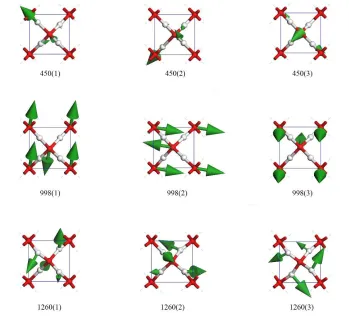
Figure 3. Nine normal vibrational modes at 450 cm-1, 998 cm-1 and 1260 cm-1. Each has three degenerate
states.
Figure 3 presents nine top views of vibrational modes in a primitive cell. The three modes in row 1 are degenerate states in which only hydrogen atoms vibrate. The green arrows indicate the oscillating directions and are proportional to the amplitude in size. To maintain a static center of mass, the collective vibrations are coupled. We use the direction of hydrogen’s biggest amplitude to depict these modes. For the vibration mode at 450(1), the oscillating direction of the biggest hydrogen is along (1,-1,-1). The other two crystal array indices of modes 450(2) and 450(3) are (1,1,1) and (1,1,-1), respectively. Supplementary File 1 illustrates the dynamic process in detail. Figure 2 shows that
this peak is IR active. Through ab initio calculations of the Raman spectra at 125 GPa, Putrino and
Parrinello showed a peak at 390 cm-1 [12]. However, they could not find this peak in their Raman
scattering experiment [12]. We find that this peak is Raman inactive.
Three degenerate states at 998 cm-1 are all oxygen atoms vibrating, whereas the hydrogens remain
Putrino and Parrinello [12] reported the peak at approximately 950 cm-1. Their experimental data
indicate that the peak occurs at 840 cm-1 and agree with our result at 998 cm-1. Supplementary File 2
illustrates the dynamic process in detail. Through his work on Raman spectra at 128 GPa, Alexander
[13] also verified a dominant peak at approximately 980 cm-1.
There are three rotating modes at 1260 cm-1. These modes are similar to the twisting modes in
the librational bands of other ice phases. As shown in Figure 3, the hydrogens oscillate perpendicularly to the O-O line and the four hydrogens rotate around the central oxygen to form a vortex. The rotation axis can be roughly regarded as (1,-1,1), (1,1,1) and (1,1,-1). Supplementary File 3 illustrates the dynamic process in detail.
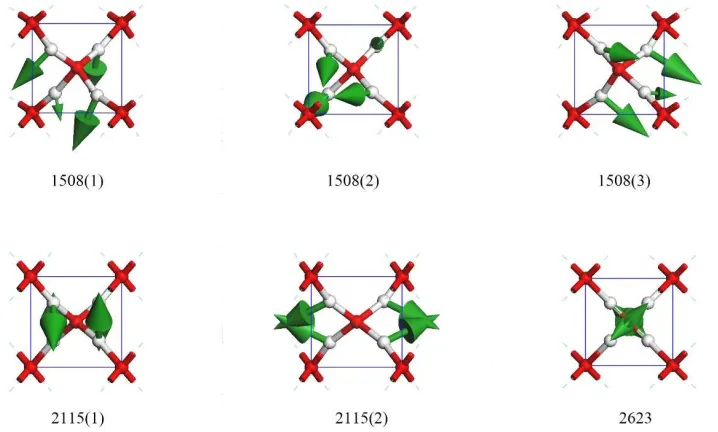
Figure 4. Six normal vibrational modes at 1508 cm-1, 2115 cm-1 and 2623 cm-1. The maximum strength
at 2623 cm-1 is non-degenerate.
Figure 4 shows three bending modes at 1508 cm-1 in which the four O-H-O bonds bend in the same
direction (three are strong and one is weak). These three degenerated modes compose the other peak of IR active. The three directions of degenerate modes at 1508(1), 1508(2) and 1508(3) are approximately equal to (1,1,1), (1,1,-1) and (1,-1,1), respectively. Supplementary File 4 illustrates this process.
Interestingly, there are two degenerate modes at 2115 cm-1 and one isolated mode at 2263 cm-1.
In the case of 2115(1), the two hydrogen atoms oscillate in the opposite direction along (1,1,1), whereas the other two move along (-1,1,1). For 2115(2), the mode can be regarded as one H-O-H bending in the (-1,0,0) direction, whereas the other one vibrates in the (1,0,0) direction. Vibrational
frequency at 2263 cm-1 is a unique mode that possesses maximum strength. In this mode, the four
hydrogen atoms simultaneously vibrate toward the central oxygen. This is a symmetrical motion through the center of inversion and is of course IR and Raman inactive. Supplementary File 5 illustrates the dynamic process of the 2115(1), 2115(2) and 2263 modes via a movie.
4. Conclusions
Fifteen normal vibrational modes of ice X are discussed based on the DFT calculation. The PDOS integrated by dispersion curves showed quite complex features. However, photon scattering
theoretically presented very simple features—one peak at 998 cm-1 for Raman scattering and two
4 of 6
phase transition. Phase transition was observed above 60 GPa. We conclude that the transition region ranges from 60 GPa to 120 GPa. The complex vibrational peaks observed by experiments were from incomplete phase transition in this range. As the vibration frequencies are pressure-dependent, the pressure conditions should be examined when considering the three peaks mentioned above.
Supplementary Materials: The following are available online, Video S1: Dynamic process of three normal modes at 450 cm-1. Video S2: Dynamic process of three normal modes at 998 cm-1. Video S3: Dynamic process of three
normal modes at 1260 cm-1.Video S4: Dynamic process of three normal modes at 1508 cm-1. Video S5: Dynamic
process of two normal modes at 2115 cm-1 and the maximum mode at 2263 cm-1.
Authors’ contributions. L.J. and S.-K.Y. performed simulations and drafted the manuscript. K.Z. and Z.-R.W. assisted structure modeling and data processing. H.-W.L., X.-L.Z. and Y.G. participated discussions. P.Z. conducted simulations, data analysis and edited the manuscript. All the authors gave final approval for publication.
Acknowledgments. The numerical calculations were done on the supercomputing system in the Supercomputing Center, Shandong University, Weihai.
References
1. Caracas, R. Dynamical Instabilities of Ice X. Phys. Rev. Lett. 2008, 101, 085502.
2. Del Rosso, L.; Grazzi, F.; Celli, M.; Colognesi, D.; Garciasakai, V.; Ulivi, L. Refined Structure of Metastable Ice XVII from Neutron Diffraction Measurements. J. Phys. Chem. C 2016, 120, 26955-26959.
3. Del Rosso, L.; Celli, M.; Ulivi, L. Ice XVII as a Novel Material for Hydrogen Storage. Challenges 2017, 8. 4. Falenty, A.; Hansen, T. C.; Kuhs, W. F. Formation and Properties of Ice XVI Obtained by Emptying a Type
sII Clathrate Hydrate. Nature 2014, 516, 231-233.
5. Lobban, C.; Finney J. L.; Kuhs, W. F. The Structure of a New Phase of Ice. Nature 1998, 391, 268-270. 6. Holzapfel, W.B. On the Symmetry of the Hydrogen Bonds in Ice VII. J. Chem. Phys. 1972, 56, 712-715. 7. Polian, A.; Grimsditch, M. New High-Pressure Phase of H2O: Ice X. Phys. Rev. Lett. 1984, 52, 1312-1314. 8. Hirsch, K. R.; Holzapfel, W. B. Effect of High Pressure on the Raman Spectra of Ice VIII and Evidence for
Ice X. J. Chem. Phys. 1985, 84, 2771-2775.
9. Goncharov, A. F.; Struzhkin, V. V.; Somayazulu, M. S.; Hemley, R. J.; Mao, H. K.; Compression of Ice to 210 Gigapascals: Infrared Evidence for a Symmetric Hydrogen Bonded Phase. Science 1996, 273, 218-220. 10. Lu, X. Z.; Zhang, Y.; Zhao, P.; Fang, S. J. Vibrational Analysis of the Hydrogen-Bond Symmetrization in
Ice. J. Phys. Chem. B 2011, 115, 71-74.
11. Marqués, M.; Ackland, G.; Loveday, J. Nature and Stability of Ice X†. High Pressure Res. 2009, 29, 208-211. 12. Putrino, A.; Parrinello, M. Anharmonic Raman Spectra in High-Pressure Ice from Ab Initio Simulations.
Phys. Rev. Lett. 2002, 88, 176401.
13. Goncharov, A. F.; Struzhkin, V. V.; Mao, H. K.; Hemley, R. J. Raman Spectroscopy of Dense H2O and the
Transition to Symmetric Hydrogen Bonds. Phys. Rev. Lett. 1999, 83, 1998-2001.
14. Men, Z.; Fang, W.; Li, D.; Li, Z.; Sun, C. Raman Spectra from Symmetric Hydrogen Bonds in Water by High-intensity Laser-induced Breakdown. Sci. Rep. 2014, 4, 4606.
15. Clark, S. J.; Segall, M. D.; Pickard, C. J.; Hasnip, P. J.; Probert, M. I. J.; Refson, K.; Payne, M. C. First Principles Methods Using CASTEP. Z. Kristallogr. Cryst. Matter. 2005, 220, 567-570.