Proposing an Ecological-Transactional Framework for Exercise Behavior in People with
Disability
Derek A. Crawford, PhD
Department of Health, Human Performance, and Recreation, Pittsburg State University,
Pittsburg, KS
Katie M. Heinrich, PhD
Department of Kinesiology, Kansas State University, Manhattan, KS
Corresponding Author:
Derek A. Crawford, Pittsburg State University, 1701 S. Broadway Avenue, Pittsburg, KS 66762,
Phone: 620-235-4672, Email: [email protected]
Word Count:
The authors have no conflicts of interest to report, financial or otherwise.
ABSTRACT
Lack of physical activity participation for adults with a disability remain a large public health concern. For those with existing, or newly acquired disability, increased sedentary behavior stemming from physical impairments often results in the development of secondary chronic health conditions (e.g., obesity or osteoarthritis) which leads to participation restrictions within major life roles. Without intervention these secondary conditions further increase physical impairment which, in turn, sets these populations up for continuous negative health trajectories over their remaining lifespan. Physical activity can attenuate the development of secondary health conditions and optimize health outcomes within these populations. However, those with disability often do not possess the necessary physical capacity to maintain physically active lifestyles. Therefore, exercise programs specifically designed to increase physical functioning have been identified as a necessary intermediate step to reduce physical limitations prior to adoption of physically active lifestyles. Adoption of exercise program participation remains a difficult task for both the general population and those with disability alike. Based on current rates of physical inactivity, it is clear that traditional health behavior change models do not adequately address the complexity of this issue. This paper highlights some of the limitations within the current health behavior change models as they relate to exercise behavior.
Additionally, a novel conceptual framework is presented for the intent of its incorporation within research and health promotion interventions targeting exercise behavior within disability
populations.
Proposing an Ecological-Transactional Framework for Exercise Behavior in People with Disability
Physical inactivity continues to be a major threat to people with newly acquired, or existing, disability (Carroll, Courtney-long, & Stevens, 2014; Charlifue, Weitzenkamp, & Whiteneck, 1999; Drum, Krahn, Culley, & Hammond, 2005; Durstine et al., 2000; Ipsen, 2006). Current estimates suggest approximately 47% of adults with disability are physically inactive (i.e., participating in no sessions of aerobic activity lasting 10 minutes or longer each week) compared to only 26% of the general population (Carroll et al., 2014). This inactive, sedentary lifestyle places those with disability at a significantly increased risk of developing secondary health conditions (e.g., chronic pain, obesity, or depression) that will place even further strain on their ability to physically function in major life roles such as vocational, recreational, or self-care activities (Charlifue et al., 1999; Rimmer, Chen, & Hsieh, 2011). Promoting physical activity as a means for attenuating negative health outcomes for those with disability has long been a focus of healthcare practitioners. Evidence suggests that this can be an effective strategy, as those with disability who are physically active are 50% less likely to report the presence of chronic disease compared to those who are physically inactive (Carroll et al., 2014).
Unfortunately, within our society, maintaining consistent participation in physical activity programs remains challenging as there are many interconnected barriers for those with disability. The amalgamation of these barriers, generally, results in inaccessible
recreational/fitness facilities filled with exercise professionals ill-equipped to deal with needs those with disability along with little social support from interpersonal relationships (Crawford, Hamilton, Dionne, & Day, 2016; Mulligan, Hale, Whitehead, & David Baxter, 2012; Nary, Froehlich, & White, 2000; Rimmer, Padalabalanarayanan, Malone, & Mehta, 2017). This
societal reality is in stark contrast to the well-trained, well-equipped, and supportive environment that these populations likely accessed during their time in the healthcare system (e.g., physical therapy programs with trained professionals). This contrast is made even more apparent as communication between medical and exercise professionals is rare within the current healthcare model (Gilbert, Yan, & Hoffman, 2010).
With respect to helping people with disability adopt and maintain exercise programs, these issues result in a multi-factorial problem that no current health behavior change or health promotion theory by itself can adequately address. Health promotion interventions attempting to increase exercise participation in these populations will have to address not only the individual and their environment, but also the interactions and connections of institutional and interpersonal related components. The purpose of this paper is to provide a narrative review of current health behavior change theories, highlighting strengths and weakness with respect to changing exercise behavior for people with disability. Additionally, this paper includes the identification, and hypothetical application of, a novel conceptual framework to guide health promotion interventions looking to affect exercise program participation for people with disability.
Traditional Health Behavior Change Theories
Cognitive-based Theory. Many of the early health behavior change models focused on
1975). The main advantage of these continuum models was their usefulness in prediction and explanation of a given health behavior (Schwarzer, Lippke, & Luszczynska, 2011). In addition, these models also required all variables involved in the model to be considered valid which resulted in interventions that were too; a “one-size-fit-all” approach that was often ineffective for specific subgroups.
Recognizing a need for greater specificity within health promotion interventions, stage-based models of health behavior change were developed. The Transtheoretical Model (TTM; (Prochaska & DiClemente, 1983) is the most widely used stage-based model and posited that interventions should be tailored to an individual’s readiness to adopt a behavior change. While this individualization of interventions is the postulated strength of the TTM, others have detailed significant concerns with its practical utility with respect to physical activity and exercise. Key TTM concerns have included that 1) the model relies on accurate determination of an
individual’s stage of change, yet few validated algorithms exist; 2) the influence of external (i.e., environmental) factors are taken into account; and 3) stage progression, the primary outcome of TTM-based interventions, is not consistently associated with actual behavior change (Adams & White, 2005).
Regardless of continuum or stages of change focus, these models predominantly failed to account for potential environmental influences on exercise behavior change. Further, these models suggested that behavior change interventions had predictable outcomes and thus could be fully controlled and planned. Even though nearly all of these models were employed for people with disability, they clearly did not accurately reflect the reality of issues affecting their exercise and physical activity behaviors as evidenced by the continued high prevalence of inactivity and secondary health conditions (Buchan, Ollis, Thomas, & Baker, 2012).
Volition-based Theory. Looking to account for many of the flaws in cognitive-based
theories of health behavior, the Health Action Process Approach (HAPA; (Schwarzer & Renner, 2000) was developed and tested by Raif Schwarzer and colleagues in the early 2000’s. The HAPA promised to be unique in that it would combine the strengths of continuum and stage-based models into one hybrid theory. The central premise of the model was that 1) there was a distinction between pre-intentional motivation processes that preceded the formation of an intention to perform a behavior and 2) post-intentional volition processes that led to the actual behavior being executed (Sniehotta, Scholz, & Schwarzer, 2005).
The HAPA is divided into two distinct phases in which an individual must progress through (i.e., a continuum) in the motivational and volitional phases (Sniehotta et al., 2005). The motivational phase is based on cognitive evaluation of a given health behavior including
constructs such as outcome expectancies and risk perception. Within this phase, an individual can occupy one of two stages: either Non-intenders (i.e., not yet intending to adopt a give health behavior) or Intenders (i.e., the intention is formed, but has not yet acted). Within the volitional phase of the HAPA, the individual has already formed an intention and initiated a given health behavior. Once individuals have progressed to this phase they are now in the stage of Actors and interventions are focused on providing support for maintenance of the desired health behavior (Schwarzer, 2008). Constructs of interest within this stage are action/coping planning along with
maintenance and recovery self-efficacy.
Strengths of the HAPA compared to cognitive-based models are that it 1) asks
et al., 2014), diabetes (Lippke & Plotnikoff, 2012), multiple sclerosis (Chiu, Lynch, Chan, & Berven, 2011), physical impairments (Perrier, Sweet, Strachan, & Latimer-Cheung, 2012), and heart failure (Dohnke, Nowossadeck, & Müller-Fahrnow, 2010). Generally, the HAPA shares weaknesses with the more established cognitive-based models in that it is a much better predictor of behavioral intentions than it is of actual behavior performance. Further, with respect to people with disability, we have shown that inclusion of additional constructs such as disability severity
and environmental barriers improve the predictive validity of this model (Crawford, Terry, Ciro, Sisson, & Dionne, 2018). For these reasons, solely HAPA-based interventions to increase
physical activity or exercise behavior would likely fall short of their desired effects as there are still influential variables (i.e., disability barriers) that are unaccounted for.
Ecological Theory. Taking a more holistic view, ecological models of health behavior
posit that behavior is predicated upon individual, interpersonal, institutional, societal, and policy factors (McLeroy, Bibeau, Steckler, & Glanz, 1988). Under this model, to ensure lasting
behavior change, interventions must incorporate interventions within multiple levels of influence (Stokols, 2000). Currently, interventions based on ecological approaches are widely used in the physical activity literature (James F. Sallis et al., 2006; Spence & Lee, 2003), to the extent that some funding agencies recommend their use within application submissions.
While health-specific ecological models, including the Social Ecological Theory
(Stokols, 1996) and Ecological Model of Health Behavior (J F Sallis, Owen, & Fisher, 2008), are generally praised for their consideration of potential broad determinants of health they are not without their limitations. Of note, these models are designed to act predominately as frameworks. As such, ecological frameworks fail to identify mechanisms through which specific levels (e.g., institutional factors influencing individual factors) could potentially interact to influence
behavior (Buchan et al., 2012). Regardless, for people with disability, there are several external environmental factors that can influence physical activity behavior (Rimmer, Riley, Wang, Rauworth, & Jurkowski, 2004) such as access to medical professionals or ADA compliant exercise facilities, that must be addresses within health promotion interventions looking to increase physical activity participation.
Models of Physical Activity Behavior Change in Disability
Looking to address disability-specific barriers, a few models have been developed specifically to address promoting physically active lifestyles in disability populations. James Rimmer, an influential scientist in the field of rehabilitation research, pioneered the advancement of tailoring health promotion interventions for those with disability. Early on, Dr. Rimmer identified key areas for interventions to address including “1) reduction or prevention of
secondary conditions, 2) improvements in functional health that will allow the person to maintain optimum levels of independence and participation in community activities, and 3) increased access to natural, built, and social environments” (Rimmer & Rowland, 2008, pp. 418). These areas highlight the importance of increasing individual physical capabilities and access to opportunities to be physically active.
Following this line of reasoning, Dr. Rimmer has identified a phenomenon known as the
Disability Associated Low Energy Expenditure Deconditioning Syndrome (DALEEDS)
DALEEDS in those with disability, adoption and maintenance of a physically active lifestyle remains difficult as they often do not possess the necessary physical capacity (i.e., conditioning; cardiovascular or muscular function) a physically active lifestyle demands. For this reason, interventions designed to increase physical activity, without addressing the underlying causes of the sedentary behaviors (i.e., physical deconditioning), are ultimately self-defeating and show few, if any, meaningful changes in behavioral or health outcomes (Melanson, 2018; Wasenius et al., 2014).
Exercise, as a subset of physical activity, can lessen DALEEDS by improving
individuals’ physical conditioning thus allowing them to participate in major life roles; including leisure time or recreational physical activities (Rimmer, Chen, McCubbin, Drum, & Peterson, 2010). Dr. Rimmer’s recent work has proposed a framework whereby those with disability must be supported in their transition from rehabilitation patients to community participants via linking two complimentary allied health fields (Rimmer & Lai, 2017). The Transformative Exercise Framework (TEF) identifies exercise program participation following primary care as a
necessary step in enabling participation in major life roles, and ultimately, minimizing the risk of secondary health conditions and development of chronic disease for people with disability. This framework emphasizes linking healthcare professionals (i.e., rehabilitation practitioners) with community-based exercise professionals to help patients restore physical impairments, improve
physical conditioning, and prevent negative health outcomes. Within this seminal work, the authors also rightly note that the success of their proposed framework will “require sustained adherence and should be viewed as a long-term process of behavior change” and suggest that behavior change strategies should be incorporated based on individual needs (Rimmer & Lai, 2017, pp. 178). However, the strategies Dr. Rimmer puts forth to facilitate adherence to exercise programs are based on the cognitive behavioral theories already reviewed and might be bound by their limitations for persons with disability. Even with potential limitations for long-term
sustainability, the TEF specifies linking rehabilitation care to exercise programs as one specific strategy within these populations (J. Rimmer & Lai, 2017).
An Ecological-Transactional Framework for Exercise Behavior Change in Disability
Based on the reviewed literature we propose three components that warrant inclusion in any model/framework focused on increasing physical activity behavior in people with disability. First, multilevel (e.g., environmental and individual) factors associated with disability must be addressed. Second, structured exercise program participation is likely a necessary antecedent to increasing non-structured physical activity. Third, linking physical rehabilitation care to
community-based exercise programs may be the ideal bridge for intervention to intercept/attenuate negative health outcomes (i.e., DALEEDS or chronic disease).
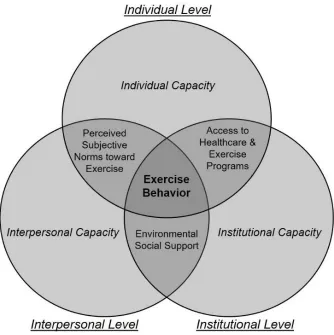
In addition, we recognize that health behavior, in particular physical activity, is a complex and dynamic process. Others have postulated that physical activity takes place in an adaptive system, in which several mediators (e.g., normative beliefs, social support, or exercise preferences) whose unpredictable actions impact other mediators, are all nested within multiple levels of the ecological framework (i.e., individual, institutional, or interpersonal levels)
interactions between ecological levels most likely to affect exercise behavior for those with disability.
Figure 1. An Ecological-Transactional Framework for Exercise in Persons with Disability
Within this framework, the Social Ecological Model (J F Sallis et al., 2008; Stokols, 1996) provides an overarching structure for addressing exercise behavior change at different levels of influence. In addition, to address external determinants of individual disability the World Health Organization’s International Classification of Health, Functioning, and Disability
(ICF; (Stucki, Cieza, & Melvin, 2007) has been integrated into the ecological framework. The ICF identifies disability (i.e., participation restrictions in major life roles) as a multifactorial construct determined by individuals’ physical impairments, activity limitations, personal factors (e.g., motivation), and environmental factors (e.g., social support). The IFC is a tool widely used in rehabilitation fields to both classify determinants of individual disability and design
interventions for care. However, the ICF has had sparse utilization in health promotion research and interventions (Van Der Ploeg, Beek, & Woude, 2004; Van Der Ploeg et al., 2006). In addition, the ICF in health promotion lacks specificity with respect to the order of importance (i.e., prioritization of behavioral targets within interventions) in disability determinants.
Our Ecological-Transactional Framework identifies both the determinants of exercise behavior and their order of importance for people with disability. This model creates “spheres of influence” around exercise behavior. Within these “spheres,” there are proximal (i.e., health & function, institutional access, environmental support, and perceived social norms and
desirability) and distal (i.e., individual, interpersonal, and institutional capacity) influences that likely affect exercise behavior for those with disability. These influences are constantly
challenged by one another and behavior is a function the combined individual and environmental contexts, rather than each alone. The next few paragraphs outline the proximal and distal
influences within the Ecological-Transactional Framework and provide examples of how to implement this model within exercise behavior health promotion interventions for people with disability.
Proximal Influences. Within the present framework we identify three components as
being the proximal determinants of exercise behavior for those with disability including 1) access to institutions that can affect health and functioning (e.g., rehabilitation care or exercise programs), 2) social support within these institutions, and 3) perceived subjective norms with respect to exercise benefits/outcomes. These influences are proximal within this framework as they represent areas of interaction between levels of the ecological model. Access to well-equipped exercise facilities with qualified personnel remains a hurdle (J. H. Rimmer et al., 2017). Social support, from both professionals and other participants, remains a key determinant of exercise adherence for those with and without disability (Crawford et al., 2018; Okun et al., 2003). In addition, the subjective norms toward exercise behavior for those with physical impairments or functional limitations is consistently a major participation predictor (Ahmad et al., 2014). We hypothesize that these proximal influences are the most significant determinants of exercise program adoption and maintenance for people with disability.
Distal Influences. Within the present framework we identify three components as being
distal determinants of exercise behavior for those with disability including 1) individual, 2) interpersonal, and 3) institutional capacity. As distal influences, these only work within one level of the ecological model with no regard for potential interactions with other ecological levels. Here we operationally define individual capacity as the cognitive factors that precede intentions to adopt a specific health behavior. To increase this individual capacity for change we
recommend the incorporation of established behavior change theories such as the ones addressed within this paper. We operationally define interpersonal capacity as the cognitive appraisals of other people within the environment. These people include family, friends, and other members within exercise programs/facilities. Within these people, shifting expectations and attitudes toward those with disability and challenging current subjective norms should be targets for increasing interpersonal capacity. Finally, we operationally define institutional capacity as the ability of institutions (e.g., exercise programs/facilities) to meet the needs for those with disability for a given health behavior. With respect to exercise programs, this refers to whether the individuals leading these programs have the knowledge, skills, and abilities necessary to adapt them based on participants’ disabilities. In addition, in accordance with Rimmer and Lai’s suggestion (J. Rimmer & Lai, 2017), we recommend that increasing institutional capacity should link healthcare practitioners and exercise professionals to facilitate the transition of people with disability from medical patient to exercise participant.
Using the Ecological-Transactional Framework. Health promotion interventions
looking to incorporate the framework presented within this paper should adhere to three
influences within the model. For example, researchers may choose to identify one strategy for each proximal influence or there could be potential for one strategy to affect all proximal
influences. Next, secondary strategies aimed at increasing capacity of distal influences should be incorporated to indirectly affect proximal influences. While most health behavior researchers will automatically gravitate toward incorporation of strategies to influence individual capacity toward exercise participation (i.e., altering cognitive predictors), care should be taken to address all potential distal influences within the framework. As such, secondary strategies should target, at a minimum, one distal influence, but addressing each level within the model may yield superior outcomes. Lastly, proximal influences within this model are hypothesized to represent dynamic and transactional constructs. That is, when capacity changes within one distal influence (e.g., institutional capacity) it could potentially alter interactions with adjacent distal influences (e.g., interpersonal and/or individual capacity). As such, continued adherence to exercise behavior will require repeated assessment and revision of proximal and distal behavioral strategies in an iterative process throughout the behavior change process. With this in mind, if exercise participation decreases in a particular individual, researchers or healthcare practitioners should look to identify what factors (i.e., proximal influences) primarily contribute to the change in behavior and incorporate new strategies to allow the individual to resume participation.
Implications for Health Behavior Research
This paper presents a novel conceptual framework for changing exercise behavior for persons with disability. This conceptual framework capitalizes on the strengths of previous models of health behavior change (e.g., inclusion of both cognitive and environmental factors) while attempting to address their limitations (e.g., reliance on addressing all predictors, lack of specificity, and general lack of transactional perspective). This framework is meant to guide health promotion interventions rather than be tested experimentally as a predictive model of exercise behavior; although this would be welcomed. Its strength lies in its ability to allow researchers and practitioners flexibility in identifying behavioral targets (e.g., what behavioral models/constructs to incorporate within each level) while explicitly declaring an order of importance (i.e., targeting proximal influences holistically and distal influences as needed) of these influences around exercise behavior.
References
Adams, J., & White, M. (2005). Why don’t stage-based activity promotion interventions work?
Health Education Research, 20(2), 237–243. https://doi.org/10.1093/her/cyg105
Ahmad, M. H., Shahar, S., Mohd Fahmi Teng, N. I., Abdul Manaf, Z., Mohd Sakian, N. I., & Omar, B. (2014). Applying theory of planned behavior to predict exercise maintenance in sarcopenic elderly. Clinical Interventions in Aging, 9, 1551–1561.
https://doi.org/10.2147/CIA.S60462
Ajzen, I., & Fishbein, M. (1980). Theory Of Reasoned Action / Theory Of Planned Behavior.
Social Psychology, 2007, 67–98. https://doi.org/10.5771/9783845260341_1
Bandura, A. (1989). Social cognitive theory. In Annals of child development (Vol. 6, pp. 1–60). https://doi.org/10.1146/annurev.psych.52.1.1
Bauman, A. (2005). The physical environment and physical activity: Moving from ecological associations to intervention evidence. Journal of Epidemiology and Community Health,
59(7), 535–536. https://doi.org/10.1136/jech.2004.032342
Buchan, D. S., Ollis, S., Thomas, N. E., & Baker, J. S. (2012). Physical activity behaviour: An overview of current and emergent theoretical practices. Journal of Obesity, 2012.
https://doi.org/10.1155/2012/546459
Carroll, D., Courtney-long, E., & Stevens, A. (2014). Vital Signs: disability and physical activity - United States, 2009-2012. MMWR Morb Mortal Wkley Rep, 63, 407–413.
Charlifue, S. W., Weitzenkamp, D. A., & Whiteneck, G. G. (1999). Longitudinal outcomes in spinal cord injury: Aging, secondary conditions, and well-being. Archives of Physical Medicine and Rehabilitation, 80(11), 1429–1434. https://doi.org/10.1016/S0003-9993(99)90254-X
Chiu, C.-Y., Lynch, R. T., Chan, F., & Berven, N. L. (2011). The Health Action Process Approach as a motivational model for physical activity self-management for people with multiple sclerosis: A path analysis. Rehabilitation Psychology, 56(3), 171–181.
https://doi.org/10.1037/a0024583
Crawford, D. A., Hamilton, T. H., Dionne, C. P., & Day, J. D. (2016). Barriers and Facilitators to Physical Activity Participation for Men with Transtibial Osteomyoplastic Amputation: A thematic Analysis. Journal of Prosthetics and Orthotics, 28(4), 165–172.
https://doi.org/10.18666/TRJ-2016-V50-I4-7635
Crawford, D. A., Terry, R., Ciro, C., Sisson, S. B., & Dionne, C. P. (2018). Examining the Health Action Process Approach model for predicting physical activity in people with back pain. Health Behavior Research, 1(2), 6. Retrieved from
http://search.proquest.com/docview/1712414319?accountid=14701%5Cnhttp://sfx.scholars
Dohnke, B., Nowossadeck, E., & Müller-Fahrnow, W. (2010). Motivation and participation in a phase III cardiac rehabilitation programme: an application of the health action process approach. Research in Sports Medicine (Print), 18(4), 219–235.
https://doi.org/10.1080/15438627.2010.510032
Drum, C. E., Krahn, G., Culley, C., & Hammond, L. (2005). Recognizing and responding to the health disparities of people with disabilities. California Journal of Health Promotion, 3(3), 29–42.
Durstine, J. L., Painter, P., Franklin, B. A., Morgan, D., Pitetti, K. H., & Roberts, S. O. (2000). Physical Activity for the Chronically Ill and Disabled. Sports Medicine, 30(3), 207–219. https://doi.org/10.2165/00007256-200030030-00005
Gilbert, H. V, Yan, J., & Hoffman, S. J. (2010). A WHO Report: Framework for Action on Interprofessional Education and Collaborative Practice. Journal of Allied Health,
39(Supplement 1), 196–197. Retrieved from
http://www.ncbi.nlm.nih.gov/pubmed/21174039%5Cnhttp://scholar.harvard.edu/files/hoffm
an/files/18_-_jah_- _overview_of_who_framework_for_action_on_ipe_and_cp_2010_gilbert-yan-hoffman.pdf?m=1360041856
Ipsen, C. (2006). Health, secondary conditions, and employment outcomes for adults with disabilities. Journal of Disability Policy Studies, 17(2), 77–87.
https://doi.org/10.1177/10442073060170020401
Lippke, S., & Plotnikoff, R. C. (2012). Testing Two Principles of the Health Action Process Approach in Individuals With Type 2 Diabetes. Health Psychology, 33(1), 77–84. https://doi.org/10.1037/a0030182
McLeroy, K. R., Bibeau, D., Steckler, A., & Glanz, K. (1988). Ecological Perspective on Promotion Programs. Health Education Quarterly, 15(4), 351–377.
https://doi.org/10.1177/109019818801500401
Melanson, E. L. (2018). The effect of exercise on non-exercise physical activity and sedentary behavior in adults, 18(Suppl 1), 40–49. https://doi.org/10.1111/obr.12507
Mulligan, H. F., Hale, L. A., Whitehead, L., & David Baxter, G. (2012). Barriers to physical activity for people with long-term neurological conditions: A review study. Adapted Physical Activity Quarterly. https://doi.org/10.1123/apaq.29.3.243
Nary, D. E., Froehlich, K. A., & White, G. W. (2000). Accessibility of Fitness Facilities for Persons with Physical Disabilities Using Wheelchairs. Topics in Spinal Cord Injury Rehabilitation, 6(1), 87–98. https://doi.org/10.1310/B9FH-7X8B-HUBR-3RHN
Okun, M. A., Ruehlman, L., Karoly, P., Lutz, R., Fairholme, C., & Schaub, R. (2003). Social Support and Social Norms: Do Both Contribute to Predicting Leisure-time Exercise?
Parschau, L., Barz, M., Richert, J., Knoll, N., Lippke, S., & Schwarzer, R. (2014). Physical activity among adults with obesity: Testing the health action process approach.
Rehabilitation Psychology, 59(1), 42–49. https://doi.org/10.1037/a0035290
Perrier, M. J., Sweet, S. N., Strachan, S. M., & Latimer-Cheung, A. E. (2012). I act, therefore I am: Athletic identity and the health action process approach predict sport participation among individuals with acquired physical disabilities. Psychology of Sport and Exercise,
13(6), 713–720. https://doi.org/10.1016/j.psychsport.2012.04.011
Ploeg, H. P. Van Der, Beek, A. J. Van Der, & Woude, L. H. V. Van Der. (2004). Physical Activity for People with a Disability: A Conceptual Model. Sports Medicine, 34(10), 639– 649.
Prochaska, J. O., & DiClemente, C. C. (1983). Stages and processes of self-change of smoking: Toward an integrative model of change. Journal of Consulting and Clinical Psychology,
51(3), 390–395. https://doi.org/10.1037/0022-006X.51.3.390
R, S., S, L., & A, L. (2011). Mechanisms of Health Behavior Change in Persons With Chronic Illness or Disability: The Health Action Process Approach (HAPA). Rehabilitation Psychology, 56(3), 161–170. https://doi.org/10.1037/a0024509
Rimmer, J. H., Chen, M.-D., & Hsieh, K. (2011). A Conceptual Model for Identifying, Preventing, and Managing Secondary Conditions in People With Disabilities. Physical Therapy, 91(12), 1728–1739. https://doi.org/10.2522/ptj.20100410
Rimmer, J. H., Chen, M.-D., McCubbin, J. A., Drum, C., & Peterson, J. (2010). Exercise
Intervention Research on Persons with Disabilities. American Journal of Physical Medicine & Rehabilitation, 89(3), 249–263. https://doi.org/10.1097/PHM.0b013e3181c9fa9d
Rimmer, J. H., Padalabalanarayanan, S., Malone, L. A., & Mehta, T. (2017). Fitness facilities still lack accessibility for people with disabilities. Disability and Health Journal, 10(2), 214–221. https://doi.org/10.1016/j.dhjo.2016.12.011
Rimmer, J. H., Riley, B., Wang, E., Rauworth, A., & Jurkowski, J. (2004). Physical activity participation among persons with disabilities: Barriers and facilitators. American Journal of Preventive Medicine, 26(5), 419–425. https://doi.org/10.1016/j.amepre.2004.02.002
Rimmer, J. H., & Rowland, J. L. (2008). Health Promotion for People With Disabilities:
Implications for Empowering the Person and Promoting Disability-Friendly Environments.
American Journal of Lifestyle Medicine, 2(5), 409–420. https://doi.org/10.1177/1559827608317397
Rimmer, J. H., Schiller, W., & Chen, M. De. (2012). Effects of disability-associated low energy expenditure deconditioning syndrome. Exercise and Sport Sciences Reviews, 40(1), 22–29. https://doi.org/10.1097/JES.0b013e31823b8b82
Rogers, R. W. (1975). A Protection Motivation Theory of Fear Appeals and Attitude Change1.
The Journal of Psychology, 91(1), 93–114. https://doi.org/10.1080/00223980.1975.9915803
Sallis, J. F., Cervero, R. B., Ascher, W., Henderson, K. A., Kraft, M. K., & Kerr, J. (2006). AN ECOLOGICAL APPROACH TO CREATING ACTIVE LIVING COMMUNITIES.
Annual Review of Public Health, 27(1), 297–322.
https://doi.org/10.1146/annurev.publhealth.27.021405.102100
Sallis, J. F., Owen, N., & Fisher, E. B. (2008). Ecological models of health behavior. Health Behavior and Health Education: Theory, Research, and Practice.
https://doi.org/10.7326/0003-4819-116-4-350_1
Sameroff, A. (1975). Transactional models in early social relations. Human Development, 18, 65–79. https://doi.org/10.1159/000271476
Schwarzer, R. (2008). Modeling health behavior change: How to predict and modify the adoption and maintenance of health behaviors. Applied Psychology, 57(1), 1–29. https://doi.org/10.1111/j.1464-0597.2007.00325.x
Schwarzer, R., & Renner, B. (2000). Social-cognitive predictors of health behavior: Action self-efficacy and coping self-self-efficacy. Health Psychology, 19(5), 487–495.
https://doi.org/10.1037//0278-6133.19.5.487
Sniehotta, F. F., Scholz, U., & Schwarzer, R. (2005). Bridging the intention-behaviour gap: Planning, self-efficacy, and action control in the adoption and maintenance of physical exercise. Psychology and Health, 20(2), 143–160.
https://doi.org/10.1080/08870440512331317670
Spence, J. C., & Lee, R. E. (2003). Toward a comprehensive model of physical activity.
Psychology of Sport and Exercise, 4(1), 7–24. https://doi.org/10.1016/S1469-0292(02)00014-6
Stokols, D. (1996). Translating social ecological theory into guidelines for community health promotion. American Journal of Health Promotion. https://doi.org/10.4278/0890-1171-10.4.282
Stokols, D. (2000). Social ecology and behavioral medicine: Implications for training, practice, and policy. Behavioral Medicine, 26(3), 129–138.
https://doi.org/10.1080/08964280009595760
Stretcher, V., & Rosenstock, I. M. (1997). The Health Belief Model. Health Behavior and Health Education: Theory, Research and Practice.
https://doi.org/10.1111/j.1365-2648.2010.05450.x
Stucki, G., Cieza, A., & Melvin, J. (2007). The international classification of functioning, disability and health: A unifying model for the conceptual description of the rehabilitation strategy. Journal of Rehabilitation Medicine, 39(4), 279–285.
https://doi.org/10.2340/16501977-0041
Vollenbroek-Hutten, M. M. R., Van Harten, W. H., & Van Mechelen, W. (2006).
Counselling increases physical activity behaviour nine weeks after rehabilitation. British Journal of Sports Medicine, 40(3), 223–229. https://doi.org/10.1136/bjsm.2005.021139
Wasenius, N., Venojärvi, M., Manderoos, S., Surakka, J., Lindholm, H., Heinonen, O. J., … Mälkiä, E. (2014). The effect of structured exercise intervention on intensity and volume of total physical activity. Journal of Sports Science and Medicine, 13(4), 829–835.