THE SYNTAX OF HEAD MOVEMENT A STUDY OF BERBER
by
Jamal Ouhalla
Thesis submitted In fulfillment of the requirements for the degree of Ph.D. in Linguistics
University College London 1988
The Syntax of Head Movement A Study of Berber
ABSTRACT
The thesis investigates the syntactic properties of head-movement processes as well as the structures of phrase] categories. The discussions are based mainly, though not exclusively, on data from Berber, in particular the Taritit dialect spoken in the northern part of Morocco. The theoretical framework adopted is that of Government Binding (GB) as outlined by Chomsky (1981), (1982), (1986a), (1986b) and others.
The first chapter introduces the GB theory and Its modules. The second chapter discusses sentential structure and the properties of head-movement processes involved in the derivation of the surface forms of sentences. The basic properties of the sentential clause in Berber are Investigated in detaiL On the basis of the distribution of clitics and the order of the verbal affixes with respect to the verb the conclusion is reached that the Infl(ection) node needs to be fleshed out in such a way that each of the elements occupying it (AGR(eement), TENSE(TNS) and NEG(ation)) is attributed a full categorial status in the sense of X-bar theory. It is demonstrated that the clausal structure that results from this revision differs with respect to the order of AGE and TNS according to whether the language In question is SVO or VSO. The structures of infinitival clauses, both inflected and unfinflected, as well as small clauses are also investigated in the light of the conclusion mentioned above. Finally, the structural properties of nominal and copular sentences in Berber and other languages are also subjected to an analysis in terms of the same conclusion.
The third chapter investigates the structures of nominal and prepositional phrases, and the head-movement processes involved in their derivation in Berber and other languages. The structure of nominal phrases turns out to be strikingly similar to that of sentential clauses with the slight but significant difference that instead of TNS nominal phrases contain a !40M(inalisation) category. Surface word order variations among languages are discussed In the light of this conclusion. The structure of pre/postpositional phrases is found in some languages to contain an AGR element. The chapter also incorporates an attempt to reclassify the existing categories In terms of a binary division which recognises only two categorial classes, verbal and nominal.
ACKNOWLEDGEMENTS
I am forever grateful to my supervisor Neil Smith, a tru..ly ideal supervisor. I am not going to list all the nice qual ties that he has, and the numerous ways in which he has helped me in my thesis, my academic career, and my personal life for that would take too long. I just want to thank him for his much-needed warmth, kindness, and encouragement.
A number of other people have also contributed to this work in different ways. I wish to thank, in particular, Hagit Borer, Misi Brody, Robyn Carston, Ken Hale, Dick Hudson, Ruth Kempson, Rita Manzini, Ian Press, Deirdre Wilson, and Hhlary Wise.
My friends and peers in London have also been very helpful in many ways. I would like to mention Ahmed Bada, Elabbas Benmamoun, Billy Clark, Aman and Latifa Fakim, Mireia Llinas-Grau, Keba Marinsh, Mohamed Monkaila, Dorota Rychlik, Peter Simpson, Christine Theodoulou, and Chris Wilder.
Abderrafi Benhallam and Abderrahim Jamarl were among the first to teach me Linguistics. I am grateful to them for that. I am also grateful to them for their much-appreciated efforts in helping me do my postgraduate studies.
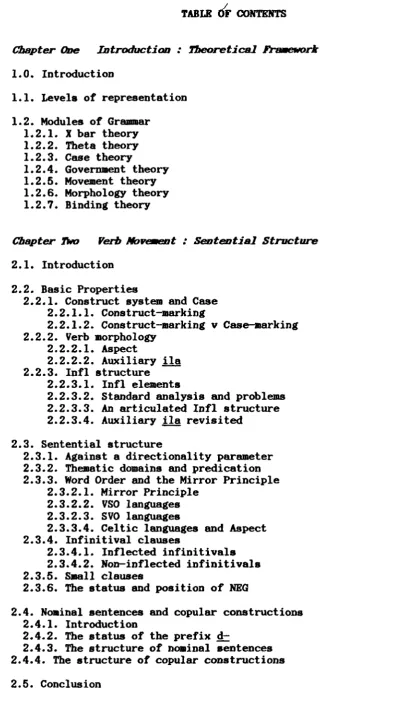
TABLE O'F CONTENTS
Chapter Ova Introduction: Theoretical framework
1.0. Introduction 1
1.1. Levels of representation 1
12. Modules of Grammar 3
1.2.1. X bar theory 3
1.2.2. Theta theory 5
1.2.3. Case theory 7
1.2.4. Government theory 8
1.2.5. Movement theory 13
1.2.6. Morphology theory 14
1.2.7. Binding theory 17
Chapter It.v Verb Mwent : Sentential Structure
2.1. Introduction 19
2.2. Basic Properties 20
2.2.1. Construct system and Case 20
2.2.1.1. Construct-marking 21
2.2.1.2. Construct-marking v Case-marking 26
2.2.2. Verb morphology 28
2.2.2.1. Aspect 28
2.2.2.2. Auxiliary
fl
322.2.3. Infi structure 34
2.2.3.1. mu elements 34
2.2.3.2. Standard analysis and problems 39
2.2.3.3. An articulated Infi structure 41
2.2.3.4. Auxiliary ila revisited 46
2.3. Sentential structure 48
2.3.1. Against a directionality parameter 48
2.3.2. Thematic domains and predication 53
2.3.3. Word Order and the Mirror Principle 59
2.3.2.1. Mirror Principle 59
2.3.2.2. VSO languages 60
2.3.2.3. SVO languages 68
2.3.3.4. Celtic languages and Aspect 71
2.3.4. Infinitival clauses 76
2.3.4.1. Inflected infinitivals 76
2.3.4.2. Non-inflected infinitivals 79
2.3.5. Small clauses 86
2.3.6. The status and position of NEG 92
2.4. Nominal sentences and copular constructions 97
2.4.1. Introduction 97
2.4.2. The status of the prefix 101
2.4.3. The structure of nominal sentences 106 2.4.4. The structure of copular constructions 110
Footnotes 120
Chapter Three Noun ftfovent: The Structure of Nozinal and Frepositonal Phrases
3.1. Introduction 143
3.2. Nominal phrases 144
3.2.1. Basic properties 144
3.2.1.1. Noun morphology in Berber 144
3.2.1.2. Nominal INFLectional elements 149 3.2.1.3. The structure of nominal phrases 152 3.2.1.4. On the nature and function of the complementizer 157
3.2.1.5. Possessor argument 166
3.2.1.6. Derived nominals 171
3.2.2. Nominalisation and auxiliary verbs 176
3.2.2.1. Irish ProgPs 176
3.2.2.2. Participles 180
3.2.3. Word order variation 185
3.2.3.1. Subject-initial languages 185
3.2.3.2. Noun-initial languages 189
3.2.3.3. Romance nominal phrases 198
3.3. Adjectival adverbial and quantified nominal phrases 201 3.3.1. Adjectival and adverbial nominal phrases 202
3.3.2. Quantified nominal phrases 210
3.4. Prepositional phrases 213
3.4.1. The paradigm 213
3.4.1.1. Genuine prepositions 213
3.4.1.2. Disguised adverbial PPs 216
3.4.1.3. The dative and genitive markers 220
3.4.1.4. The coordination morpheme 224
3.4.2. The status and nature of prepositions 227 3.4.2.1. Prepositions and the syntactic features 227
3.4.2.2. Guerssel's analysis 230
3.4.2.3. AGR in PP? 232
3.5. Conclusion 234
Footnotes 236
Chapter four Clitic and Preposition !4wesent: The Structure of Causative Constructions
4.1. Introduction 250
4.2. Basic properties 252
4.2.1. Clitics 252
4.2.1.1. Object-of-V clitics 252
4.2.1.2. Object-of-N clitics 258
4.2.1.3. Object-of-P clitics 262
4.2.2. P+clitic complex 265
4.3. Clitic- and P+cl movement end the ECP 272
4.3.2. Clitic-movement in Berber 276
4.3.2.1. Clitics as heads 276
4.3.2.2. Movement to TNS 279
4.3.2.3. Movement to NEG 283
4.3.2.4. Movement to C 284
4.3.2.5. Dative benefactive and possessor clitics 287
4.3.3. P+cl-movement 290
4.3.4. Clitic-movenient in Romance 293
4.3.4.1. Movement to TNS 293
4.3.4.2. Movement to AGR 295
4.3.4.3. Movement to C 297
4.3.4.4. SubJect clitics 300
4.4. Clitic- and P- climbing and the ECP 303
4.4.1. Discussion 303
4.4.2. Clitic-climbing in causativea 308
4.4.3. The structure of causative constructions 311
4.4.3.1. Romance causatives 311
4.4.3.2. Berber causatives 316
4.4.3.3. A unified account 319
4.4.3.4. Clitic- and P- climbing in causatives 326
4.4.4. Italian perestroika 329
4.4.4.1. Restructuring constructions 329
4.4.4.2. Restructuring as movement 331
4.4.4.3. Clitic-climbing 333
4.4.4.4. Object-preposing 338
4.5. Against the BMC 341
4.6. Conclusion 347
Footnotes 350
GLOSSES
The following is a list of the glosses used in this thesis 1,2,3.. .etc ACC AGR/Agr AOR ASP AUX Cause Conip CS DAT f FS FUT GEN Infl/INFL/I IMPR IRREA ii y n—n NEG NOM NOM p PERF Pred PROG S TNS person accusative agreement aorist aspect auxiliary causative morpheme/verb complementizer
construct state (see 2.2.1. of chapter 2) dative Case marker
feminine free state
future tense marker genitive Case marker inflection
inperfect ive irrealis masculine
neutral AGR (see fn.2 of chapter 2) negation marker nominative Case nominalisation morpheme plural perfect ive predication marker progressive singular tense
With respect to data from languages other than Berber the glosses used are those that appear In the cited sources.
Chapter One
Introduction
Theoretical Framework
1.0. Introduction
The theoretical framework within which the research in this work is
conducted is the Government-Binding theory as It has been developed by
Chomsky (1981), (1982), (1986a), (1986b) and others. In this chapter I will
try to outline the general principles and main concepts of this theory with
the hope that the explanations wifi make the rest of the work reasonably
accessible to those who are not familiar with the theory. As to those who
are familiar with the theory I hope that the cjuetlons raised and the
revisions suggested will prove challenging enough to hold their attention
for the rest of the work.
1.1. Levela of representation
The mainstream GB literature recognizes the levels of analysis
represented In the following diagram :
(1)
PF
LF
(Move-alpha (QR))
S-structure
(Move-alpha)
D-structure
D(eep)-structure is the level at which relations between elements in a
represented by tree diagrams or labelled bracketing. The structural
relations between elements are constrained by the principles of X-bar
theory. The D-structure phrase-markers are mapped onto the
S(urface)-structure level by the rule/principle of Move-alpha where alpha
is a variable that ranges over all existing categories subject to parametric
variation. The S-structure phrase-markers are In their turn mapped onto
the LF (Logical Form) level by a process of Move-alpha called Quantifier
Raising (QR). LF is the interface at which the principles governing
language interact with other modules of the mind/brain. PF (Phonological
Form) is the level at which the constituents of the phrase-markers receive
a phonological representation.
The link between all these levels of representations is the Projection
Principle which guarantees that the lexical properties of lexical items be
preserved throughout the derivation, that is at all levels of representation.
Among the consequences of the Projection Principle is the fact that all
elements that move must leave behind a trace that preserves the position
evacuated.
The diagram above obviously presupposes the existence of a lexicon
which can be thought of as a set of lexical entries which specify, inter
ala, the syntactic, semantic and phonological properties of the lexical items.
The syntactic properties include the categorial specification and the
selections] or subcategorisation properties. The latter specify which
category a certain lexical item takes as complement (e.g. the verb eat takes
a noun phrase as complement). The semantic specification include a
representation of the conceptual content of the lexical item, among other
possible properties. Finally, the phonological specifications include a
The specifications In question have been defined here fairly loosely
and people may differ as to what information should be included in the
lexical entry of lexical elements. People may also differ as to whether to
conceive of the lexicon as a sort of store room where the idosyncrasies of
languages are relegated or as a well defined level of representation with
governing principles and functions similar in status to those which are
assumed to govern other levels of representation.
1.2. Modules of Grammar
1.2.1. I-bar theory
The principles of this theory constrain structural representations in
terms of the following schemata (cf. Chomsky (1986b)) :
(2) a. X'
X X"*
b. X" X"* X'
where * implies zero or more occurrences. X" is a maximal projection, while
X is the head. X' is the projection intermediate between the maximal
projection and the head. X" in (a) is the complement of the head X both of
which constitute the X' projection. X in (b) is the specifier which
together with the head and its complement form the phrasal category. The
order of the head in relation to its complement is fixed by the Head
Parameter. In Head-initial languages (e.g. English, Berber) the head
precedes its complement, while In Head-final languages (e.g. Turkish,
Japanese) the head follows Its complement. The X-bar schemata hold
essentially of D-structure representations.
X-bar theory makes a distinction between lexical and non-lexical
categories. The lexical categories Include the Verb, the Noun, the Adjective
and the Preposition, all of which are distinguished in terms of a feature
the Noun [+ N, - VI, the Adjective [+ N, +V] and the Preposition (or rather adposition) [- N, - VI. The non-lexical categories include the elements that are usually considered to belong under the I(nflection) node ( e.g. AGR(eement), Tense (TNS), NEG(ation) element ...etc) as well as the C(omplementizer). Chomsky (ibid) extends the range of the X-bar schemata above to cover non-lexical categories in addition to the lexical categories. Accordingly, the canonical structure of a clause takes on the following form where OP stands for Complementizer Phrase and IP stands for Inflectional Phrase :
(3) [ci' Spec [c' C En' Spec [p I [VP V NP (PP) I]]]]
The Spec of IP is the canonical subject position, while the Spec of OP is the position occupied by moved wh-phrases.
that they should be assumed as having no feature in common.
In the course of this work I will suggest two major revisions of the X-bar system. First, I will assume that all the elements that are believed to belong under the I node are head categories in their own right with projections that are constrained by the general X-bar schemata in (2) (cf. Pollock (1987)). Secondly, I will assume a feature system which recognisea only two categorial classes, verbal and nominal, which can be formally specified in terms of the feature matrix [-, + N] or [-, + VI (cf. Abney (1987)). Adjectives will be argued to be nominal categories and so will Complementizers and some Adverbs. TNS and the AGH element which assigns
nominative will be argued, together with the verb, to be verbal categories. The AGH element which assigns genitive Case and which occurs in noun
phrases in a number of languages will, however, be argued to be nominal In nature. Elements will be classified on the basis of the nature of the Case they assign and whether their phrasal projections can function as arguments. All categories, including AGR and TNS, are assumed to have
lexical selectional properties which specify the categorial nature of the elements they can take as complements.
1.2.2. Theta theory
theta-roles assumed may vary but it generally Includes "agent", "patient",
"goal", "experiencer" ...et.c. (see Gruber (1965), Fillmore (1968), Jackendoff
(1972)).
Central to theta-theory is the principle that is known as the "Theta
Criterion" which can be formulated as follows (of. Chomaky (1982))
(4) Each term of L.F that requires a theta role (each argument)
Is assigned a theta role uniquely, and each theta role
determined by the lexical properties of a head is uniquely
assigned to an argument.
The Theta Criterion is a "criterion of adequacy for LF", a condition on
assingment of theta-roles by the heads to their complements. Theta-role
assignment is assumed to be constrained by structural conditions.
Theta-roles are assigned from heads situated in specific positions to their
arguments also situated in specific positions. The positions to which theta
roles are assigned are generally known as 9-positions. Positions which are
not assigned a theta-role are known as 9 '-positions. At D-structure all
arguments are In 9-positions. At other levels the Theta Criterion is
satisfied through chain relations. Arguments that move are in a
chain-relation with their trace in their (thematic) D-structure position.
Assuming that arguments which do not move also form (non-movement)
chains the Theta Criterion can be thought of as essentially holding of
chains (cf. Brody (1984), Chomsky (1986a)).
In addition to the theta-roles assumed to be assigned by Verbs, Nouns
and Prepositions to their complements I will assume the existence of a
"functional" theta-role (cf. Abney (1986) & (1987)) assigned by (functional)
heads such as AGR, TNS, C to their complements. We will see that the
existence of this theta-role is crucial for some fundamental relations to
hold. I wifi also assume, along with Baker (1985), that all elements which
Baker formulates this assumption as in (4) below and refers to it as the
Uniformity of Theta Assignment Hypothesis (UTAH) :
(5) Identical thematic relationships between items are
represented by identical structural relationships
between those items at the level of D-structure.
As Baker argues, this hypothesis, in a sense, strengthens further the idea
that D-structure is a direct representation of thematic structures. Notice
that if AGR and TNS are assumed to be categories which assign theta roles
then by virtue of (5) each of them must occupy an independent structural
position at D-structure.
1.2.3. Case theory
This module of grammar is concerned with the assignment of Case to
noun phrases. Case In some languages (e.g. English) is abstract while in
others (e.g. Turkish) it is overt/morphological. The underlying assumption
of Case theory is that noun phrases are required to be Case-marked. There
are two different ways the Case requirement has been formulated in the
literature. One is in the form of a Case Filter which applies at PF to
exlcude noun phrases which are not Case-marked (cf. Rouveret and
Vergnaud (1980)), Chomeky (1981)). The other is in the form of what is
known as the Visibility Hypothesis suggested originally by Aoun (1982). The
latter makes Case-marking follow from theta-marking as a condition for
theta role assingnement. For a noun phrase argument to be visible for
theta-marking, which is obligatory by the Theta Criterion, the noun phrase
has to have Case (cf. Chomsky (1981), (19886a)). I will assume both
Case is assumed to be assigned to noun phrases under government (see below). In Chomsky (1981) only the Verb, the Preposition and tensed INFL are assumed to be Case-assigning categories. In Chomksy (1986a) the Noun and the Adjective are also assumed to be Case-assigning categories. In the same reference1 Chomaky Introduces a distinction between "structural Cases" and "inherent Cases". Structural Cases are the nominative assigned by the AGR element of INFL and the objective assigned by the verb. Inherent Cases are the oblique assigned by Prepositions and genitive assigned by Nouns and Adjectives. Structural Cases are assigned at S-structure while inherent Cases are assigned at D-structure and are associated with theta-marking.
We will see later, however, that the distinction made between structural and inherent Cases breaks down in some cases. In some languages genitive Case-assignment by Nouns must be assumed to be structural, assigned at S-structure under government. We wifi see also that in some languages (some) Prepositions assign genitive Case which, according to the classification mentioned above, Chomsky seems to treat as distinct from oblique Case assumed to be assigned by Prepositions. Case will play a significant role in the third chapter of this work where a binary classification of categories is proposed which makes crucial use of the nature of the Case assigned by the elements under investigation. Accusative and nominative Cases will be considered to be indicative of a verbal nature of their assigners, while the genitive will be considered to be indicative of a nominal nature of Its assigner.
1.2.4. Government theory
relations and processes take place. The definition of government adopted in this work is the one presented in Chomsky (1986b) in terms of the notion of barrier :
(6) A governs B 1ff A rn-commands B and there Is no C, C a barrier for B, such that C excludes A.
This definition incorporates three crucial notions which are "rn-command", "exclusion" and "barrier". These notions are defined as follows, respectively
(7) A rn-commands B 1ff A does not dominate B and every crnax that dominates A dominates B.
(8) A excludes B if no segment of A dominates B. (9) C is a barrier for B 1ff (a) or (b) :
a. C Immediately dominates D, D a Blocking Category for B; b. C is a Blocking Category for B.
The definition of barrier obivously makes use of the notion of "Blocking Category" which is defined as in (10) below :
(10) c is a Blocking Category (BC) for B 1ff C is not L-marked and C dominates B.
The definition of "Blocking Category" In its turn makes use of the notion of L-marklng which is defined as follows :
(11) A L-marks B 1ff A is a lexical category that governs B.
(12) x,
x yp
The X' domain does not count as the rn-command domain of X because X' Is not a maximal projection.
The notion of exclusion on the other hand is based on May '5 (1985) assumption that for an element to be dominated by a certain maximal projection It has to be dominated by all the member nodes of that projection. The assumption is most relevant to adjunction structures. In (13) below, for example, YP is not dominated by XP because YP is dominated by only the upper node of XP which results from the adjunction process
(13) xp
Yp xp x,
x zp
X and ZP, however, are dominated by XP because they are dominated by both member nodes of Xp.
(14) 1P
Y XP
I x,
x zp
Having illustrated how the notions of rn-command and exclusion work let us now turn to what maximal projections in a simple sentence are barriers. Consider the following embedded sentential (CP) structure :
(15) ...V (p C Qp Spec [i' I [vp V NP ]]]]
Now, both VP and IP in this structure are barriers because neither of them is L-marked. The governor of VP Is I which is not a lexical category and therefore does not qualify as an L-marker. The governor of IP, on the other hand, is C which Is also not a lexical category. Both VP and IP are therefore barriers by virtue of condition (b) of the definition of barrier in (7) above. CP, however, is not a BC because it is L-marked by the (matrix) verb governing it. However, because CP immediately dominates IP, which is a BC, OP becomes a barrier by inheritance. In different terms, CP is a barrier by virtue of condition (a) of the definition of barrier in (9) above.
Let us now concentrate instead on the following structure where both VP and IP have been adjoined to, assuming that ad junction to IP of a wh-word is possible :
(16) ...V Ecp C [ip wh- [ip Spec I [vp wh- [VP V NP ]]]]]
Chorneky (1986b) argues that there are two concepts of barrier. The
first is the one discussed above and the second is known as the
"Minimality Condition' which he formulates as in (17) below. (18) is an
extension of the definition of barrier which Chomsky remarks Is relevant to
the theory of government but not to the theory of movement :
(17) ...A...[C ...D...B...
(18) A does not govern B in (17) if C Is a projection of D
excluding A.
(19) C is a barrier for B
if Cis a projection of D, a zero-level
category distinct from B.
In (17) C is a barrier because its head D is a closer governor of B than A.
In different terms, D, strictly speaking C, protects B against government
by A.
Among the conditions that are formulated on the basis of government is
the Empty Category Principle (ECP) which regulates the distribution of
non-pronominal empty categories in that it requires them to be "properly
governed" where proper government is as defined in (21) below. (20) is the
definition of the ECP (cf. Lasnik and Saito (1984))
(20) Non-pronominal
empty categories must be properly governed.
(21) A properly governs B iff A is coindexed with B
and A governs B.
What this definition of the ECP implies is that only antecedent-government
(i.e. government by a coindexed element) can satisfy the ECP to the
exclusion of theta-/lexical- government (i.e. government by a theta-marking
lexical category) (cf. Lasnik and Saito (ibid) and Chomsky (1986b)),
contrary to what is assumed in Chomaky (1981) (1982) and other works
where either lexical- or antecedent- government is assumed to be sufficient
1.2.5. Movement theory
Central to movement theory is the principle of Move-alpha. In principle
Move-alpha can apply freely to move any element to any position over any
distance. However, there are constraints on the application of Move-alpha
as there are constaints on the free application of a number of other
principles in the theory. Among these constraints is, obviously, the ECP
discussed above. As a condition on the successful application of Move-alpha
the ECP requires that the trace left behind be antecedent-governed. In
other words, the ECP requires that no barriers separate the moved element
from its trace. Another constraint on Move-alpha is known as the
Subjacency Condition, sometimes referred to in the context of a theory of
Bounding, which Is basicaly a locality condition on movement. It requires
that an element cannot be moved, in one step, across more than one
bounding node where bounding nodes are assumed to vary from language
to language (cf. Rizzi (1982) Chomaky (1986b)).
Further constraints are imposed by what is known as the Structure
Preserving Hypothesis (cf. Emonds (1976) Chomsky (ibid)). According to this
hypothesis only maximal projections can move to maximal projection
(Specifier) positions, while only head categories can move to head positions.
The Theta Criterion, on the other hand, requires that maximal projections
can only move to non-theta-marked positions (e.g. Spec of IP in passive
and raising constructions and Spec of CP). It follows from the Theta
Criterion that movement to complement positions is illegitimate since it gives
rise to a chain that has two theta-roles. A further crucial constraint on the
application of Move-alpha is the condition that only maximal projections and
heads can be affected, that is can be moved, to the exclusion of single-bar
projections.
adjunction (cf. Chomsky (ibid)). Substitution is the movement of either a maximal projection or a head category to an empty Spec or head position, while adjunction consists in the movement of a maximal projection or a head category and the adjoining of it to a maximal projection or to a head position. I will argue in the course of this work, however, that substitution is not available to head-movement processes even to empty positions. All moved head categories are adjoined to their hosts whether the latter are empty or filled, thus always resulting in complex X-O structures, that is complex head categories.
Movement of head-categories is assumed to be governed by a condition that is known as the Head Movement Constraint and is formulated in Chomsky (ibid) (cf. Travis (1984) and Baker (1985)) as follows, with a minor adjustment bearing on the status of the complementlzer :
(22) Movement of a zero-level category B is restricted to the position of a head A that governs the maximal projection C of B where A theta-governs or L-marks C.
This condition clearly puts a severe locality restriction on head-movement processes, expressing the belief that head categories can only move to the next head position in their structure. Chomsky, however, argues that the HMC is not likely to be a principle of UG because its effects can be made to follow from the ECP. In chapter 4 of this work I wifi argue against the HMC on grounds that are more crucial than the fact that its effects are derivable from the ECP, namely that it makes wrong predictions with respect to some head movement processes.
1.2.6. Morphology theory
the other theories mentioned above are considered to be modules of Grammar. As such the principles of morphology are not confined to certain
specific levels of representation (e.g. Lexicon or PF) but can apply at any level. Baker (ibid) defines the role of morphology theory as involving two tasks : one is to determine whether the X-O structures that result from morphological processes are well-formed with respect to specific languages, and the other is to assign well-formed X-O structures phonological representations. Both tasks can be assumed to be carried out in the lexicon, in the syntax or at PF. It should be clear, however, that the domain of the principles of morphology theory Is the X-O level. Projections beyond the X-O level are the domain of other modules.
As defined above the role of morphology theory seems to be largely determined by language-specific factors given that the possibilities of morphological combination and phonological representation vary between languages. However, I will assume that in addition to these necessary language-specific principles morphology theory contains two principles which have universal validity, both of which are not unfamiliar. One of these principles I will refer to as the Mfix Principle (AP) (cf. Baker (1985)) and the other I will refer to as the Head Opacity Condition (HOC). They are defined as follows, respectively :
(23) The morphological subcategorisation frame of affixes
must be satisfied prior to the S-structure level (cf. Baker (ibid)). (24) The internal structure of X-O categories is opaque to
Move-alpha.
base-generated under independent structural positions by virtue of UTAH, be attached to suitable categories prior to the S-structure level. By suitable category is meant the category that is specified in the morphological subcategorisation frame. We will Bee during the course of this work that there exist in different languages affixal elements which are required to attach to verbal categories while there exist others which are required to attach to nominal categories. (23) can be understood as a well formedness condition on the morphological make-up of elements, a sort of filter which filters out affixes that remain stranded or which are attached to the wrong category. As we will see later the effect that the AP has Is that it forces syntactic head-movement processes which in some cases become instrumental in paving the way for other syntactic relations to hold.
Kayne
(1987))prohibition against traces dominated by an X-O category
follows.
I have disregarded the possibility that Move-alpha could apply to move
affixes inside an X-O category as suggested by Pesetsky
(1985)to solve the
80-called "bracketing paradoxes" raised by examples such as unhappier
which is required by the phonological condition on the comparative -er
element to have the structure [A "'- [A happy -er]], while Its semantic
interpretation implies the structure [A[A un- happy]-er] since the word
means 'more not happy' rather than 'not more happy'. Pesetsky solves the
paradox that arises by assuming that the word in question undergoes a
process of QR (Move-alpha) at LF which moves the comparative affix inside
the X-O structure to a higher (adjoined) position where it has scope over
(where scope is understood in terms of the c-command relation) the prefix
un- and the root happy to yield the appropriate interpretation. If
Pesetsky's analysis is correct then condition (24) should be understood to
mean that Move-alpha cannot extract elements out of an X-O structure. The
possibility that elements can be moved inside an X-O structure is,
accordingly, left open.
1.2.7. Binding theory
This subtheory regulates the relation between anaphors (e.g. himself,
each other), pronominals (e.g. he, pro) and r(eferential)-expressions (e.g.
John, wh-traces) and their antecedents in terms of the notion of "binding".
A is said to bind B if A rn-commands and is coindexed with B. Central to
Binding theory are the Binding Conditions which are formulated an follows
(cf. Chomsky
(1986a)(25) (A) An anaphor is bound in a local domain
(B) A pronominal is free in a local domain
where "local domain" is referred to as Governing Category and is defined as the maximal projection which contains a subject and a governor for A (i.e. anaphor, pronominal or r-expression). Chomsky (ibid) defines Governing Category further as a "complete functional complex" (CFC) by which is meant a maximal projection which contains, obviously, the head (necessary by the principles of X-bar theory), the complements of the head (necessary by the Projection Principle), and a subject whose presence Chomsky assumes to be optional unless required by the principles of predication to license a predicate.
Chapter Two
Verb Movement
Sentential Structure
2.1. Introduction
The purpose of this chapter is to analyse the structure of sentential
clauses. The main argument is that the inflectional elements AGR, TNS and
NEG which are staridardly assumed to belong under I should be treated as
categories In their own right heading projections according to the
principles of X-bar theory. These categories should also be organised in
the sentential structure hierarchically with respect to each other and to
the verb. The attempt to organise them accordingly is based on the
generalisation made by the Mirror Principle (MP) (cf.Baker (1985)) and the
constraint on head-movement imposed by the HMC/ECP.
The ultimate structure that results from the combination of these
observations and principles is fairly articulated compared with the standard
structure, where I is assumed to be the head of the sentence and which
harbours a range of inflectional elements that vary from language to
language. Having postulated the structure in question the rest of the
chapter is spent on pointing out its advantages over its predecessor as in
(3) in the previous chapter. It is shown, for example, that it accounts
fairly naturally for the SVO/VSO variation among languages in terms of the
organisation of the inflectional heads without having to resort to a
"directionality parameter". Other properties which characterise VSO
languages and differentiate them from SVO langQages are shown to fall out
without stipulation.
properties of infinitival clauses, both inflected (as in Portuguese) and non-inflected (as In English). Infinitival clauses in general are found to have a TNS node contrary to the common belief. The difference between inflected and non-inflected infinitives Is explained in terms of the absence v presence of the AGR node (cf. George & Kornfilt (1981)). The structures of small clauses Is argued to be similar to that of infinitival clauses with the difference that In the case of small clauses the predicate is a non-VP category. The latter property Is also argued to characterise so called nominal sentences, i.e. sentences which do not contain a verb, as well as some copular constructions.
2.2. Basic properties
2.2.1. Construct system and Case
The morphological shape of nouns in Berber dialects is to a certain extent determined by their position In a syntactic structure. A noun is said to be in the Construct State (CS) when it functions as object of a preposition or a noun, or as a postverbal subject. Otherwise, it is in the Normal/Free State (FS). The CS/PS alternation is manifest by a corresponding morphological alternation determined
to some extent by the
quality of the sounds which constitute the Initial syllable of the noun.the language, thus consolidating the conclusion reached by the traditional grammarians but for totally different reasons. Before we do that, however, let us see how the morphological make up of nouns is affected by the CS/FS alternation
2.2.1.1. Construct-marking
The morphological variation exhibited by nouns in the CS is largely conditioned by the quality of the segments in their Initial syllable. The pattern that emerges, however, is highly complex, the complexity being the immediate consequence of an intricate interplay between the number-gender morphology and the CS morphology. The task of disentangling them and isolating each and every morpheme and process requires a detailed morphophonological study which is well beyond the scope of this work (I refer the reader to Guerssel (1976) & (1983) for a phonological study of this phenomenon in relation to the Tamazight dialect). I will therefore simplify considerably the facts that are of immediate relevance to the syntactic issues discussed in this work. We will come back to the morphology of nouns in more detail in chapter 3.
Nouns In Berber are specified morphologicaly for number and gender. Masculine nouns are generally vowel-initial while feminine nouns are consonant-initial. The Initial vowel can be any one of the three basic vowels in the language a, i or u, whereas the initial consonant in feminine nouns is generally j, the consonantal sound of the prefix part of the feminine-diminutive marker ta—t :
(1) a. Masc. b. Feminine.
The CS forms are derived from the number-gender inflected forms of the
flOUflB by two different processes :
(2) a. prefixing the vowel u- to nouns with initial a or u, and I- to nouns with initial i;
b. dropping the vowel a of the number-gender prefix ta- in feminine nouns.
Applying these two processes to the examples in (1) yields the following results :
(3) a. Masc. b. Fern.
u-argaz trgazt
u-ahamosh tharnosht
l-ilf tslit
u-ushshn tndint
These forms are then subjected to phonotatic constraints which alter their morphological make-up to the extent that in some cases the Construct morphology is obscured completely1.
manifest morphologicaly by not undergoing any of the processes in (2).
Notice that in order to guarantee that all Construct-governed nouns are in the CS and that all non-Construct-governed nouns are in the FS we have to have a special filter, a well formedness condition on nouns which would apply at PF, presumably, to filter out the offending nouns. We will caU this filter the Construct Condition (CC) and formulate it as follows :
(4) Construct Condition (PF)
a. *NP if NP is [+Construct] (i.e. is In the CS) and is not Construct-governed; or
b. *NP if NP is [-Construct] (i.e. is in the FS) and is Construct-governed.
Let us see how the two clauses of this disjunctive condition apply to derive all and only the well-formed constructions :
(5) a. y-nya x- u-aghyur/*aghyur
3ms-rode on- CS-donkey/FS-donkey "He rode (on) the donkey."
b. taddart n-tslit/*taslit
house GEN-CSbride/FSbride "The house of the bride"
c. y-usid u-ahamosh/*ahamoah idnnat 3ms-came CS-boy/FSboy yesterday "The boy came yesterday."
(6) a. *u-ahamosh/abamoah y-usid idnnat CS-boy/FS boy 3ms-came yesterday "The boy came yesterday."
b. zri-gh *u-ahamosh/abamosh ithyadn saw-is CS-boy/FS-boy last year "I saw the boy last year."
c. *u-hamosh/hmnsh, zri-gh-t ithyadn CS-boy/FS-boy saw-is-him last year "The boy, I saw him last year."
d. *u-ahamosh/ahamosh ay- zri-gh ithyadn CS-boy/FS-boy comp- saw-is last year "It was the boy that I saw last year."
they are in the FS form while they are governed by Construct-governors, P, N and AGR, respectively. The starred examples in (6), on the other hand, are excluded by clause (a) because they are In the CS while they are not governed by a Construct-governor. In (6b) the noun phrase ahamosh is governed by the verb which is not a Construct-governor. In (6a,c&d) ahamosh is without a governor. Notice that the preverbal subject patterns with topicalised and dislocated noun phrases, a fact that should not be surprising once we know that Berber is basicaly a VSO language (see 2.3.3.2. below for details).
The formal mechanism of the Construct system as explained above looks similar to that of a Case system. What is more, in some cases the Construct morphology serves as an indicator of the grammatical function of noun phrases, a function that is traditionally associated with Case-marking in languages with morphological Case. Consider the following examples
(7) a. y-zra u-ahamosh argaz 3ms-saw CS-boy FS-man "The boy saw the man." b. y-zra argaz u-ahamosh
3ms-aaw FS-man CS-boy "The boy saw the man." (8) a. axxam u-amqqran
room CS-Amqqran "Amqqran' s room" b. axxam amqqran
room FS-big "Big room"
have different meanings. In (8a) amggran is the object of the noun axxam; he Is the possessor of the room. In (8b), however, amggran, though a noun phrase, functions like an adjective which modifies the room.
The two noun phrases obviously have different underlying structures which can be respresented, respectively, as follows, assuming that adjectival modifiers are adjoined to NP
(9) a. NP N'
r
N NP
I
I
axxam u-amqqran
b. NP
r
I
I
axxam amqqran
At the surface level it is the Construct morphology which indicates the grammatical function of the noun phrase amggran. When the latter is in the CS, as In (8a), it can only be interpreted as the object of the noun preceding it. When it is in the FS, as in (8b), it cannot be interpreted as the object of the noun preceding it.
2.2.1.2. Construct-markIng v Case-marking
Before we move on to outline and discuss the arguments for not
reducing Construct-marking to Case-marking let us have a look at the Case
system in the language. Generally, Case in Berber is abstract. However,
there exist in the language two elements which have traditionally been
treated as either prepositions or morphological Case-markers. These are the
genitival element n- , in constructions such as (5b) above, and the dative
1- in constructions such as the following :
(10) t-usha asim i-u-argaz
3fs-gave FS-fish DAT-CS-man
"She gave the fish to the man."
We will see in the next chapter that these two elements behave differently
from the true prepositions in the language in important respects, thus
suggesting that they are not genuine prepositions but are probably simply
Case-markers. All other Cases in the language, however, are abstract. This
is not a surprising conclusion if we assume, along with many linguists, that
in English, which also has a generally abstract Case system, the genitival
of is also not a genuine preposition but simply a genitive Case-marker.
One argument relates to the fact that the noun phrases to which the
genitive and the dative markers mentioied above are attached are always
in the CS as can be observed in (5b) and (10). Now if the Construct
morphology was sufficient for the noun phrase to satisfy the Case
requirement on noun phrases ( be it the Case Filter or the Visibility
Hypothesis) there seems to be no reason why the Case-markers should
appear, and obligatorily so.
Another argument is the fact that the distinction made between the
Construct-marking categories and the non-Construct-marking categories
categories and non-Case-marking categories. V is one of the most robust of
all Case-assigning categories, and yet it is a non-Construct-marking
category. Looking at this distinction from a different angle we can
formulate a further argument, namely, that noun phrases which are
governed by non-Construct-governors or are ungoverned (and these
include, remember, direct objects of the verb, preverbal subjects, and
topicalised and dislocated noun phrases) would all fail to satisfy the
Case-requirement.
Ifthe latter is understood In terms of the Case Filter
then all noun phrases which are either governed by a
non-Construct-governor or not governed at all would be excluded,
obviously wrongly. If, on the other hand, the Case-requirement is
understood in terms of the Visibility Hypothesis then It would mean that all
noun phrases in the FS, including the direct object of the verb, would be
unable to receive a theta role, again wrongly.
A further argument is the fact mentioned earlier that the Construct
system does not correspond, historicaly, to a Case system (Penchoen
(1973)), that is it has not evolved as a substitute for a Case system. To
these can be added the fact that in some dialects of Berber the class of
noun phrases that are required to be in the CS differs. For example, it has
been reported that in Taqbaylit, a dialect spoken in Algeria, even direct
objects of the verb are required to be in the CS.
Based on these arguments I will conclude, along with the traditional
Berberist grammarians, that the Construct system is independent of the
Case system and that it should be treated as such (for a similar conclusion
based on relatively different arguments see Guerasel (1987)). As a final
remark It is perhaps important Ø to point out the fact that CS/FS
alternation is disappearing from the speech of the younger generation, and
dialect as has been reported by Boukous (1979). The Construct morphology
will not play a crucial role in the rest of this work except as a useful
diagnostic to determine the categorial nature of lexical items as well as the
underlying structures of certain constructions.
2.2.2. Verb morphology
2.2.2.1. Aspect
The basic verbal oppositions in Berber are aspectual. They mainly
involve the perfective and imperfective. However, verbs generally display
two more distinct Mood forms which are the aorist and the irrealis. The
four forms are articulated by intricate morphophonological variations which
affect the internal structure of verbs and are largely of a
non-concatenative nature. The following paradigm illustrates these
variations with respect to the verbs included which are by no means
representative of the whole paradigm In the language (cf.Guerssel (1986a))
(11)
Aorist
at
ar
ngh
agh
Perfective
uf i/a
an/a
nghi/a
sghi/a
Imperfective
tt-af
tt-ar
nqq
as-gh
Irrealis
ufi
an
nghl/a
sghi/a
"Find'
"Return"
"kill"
"Buy"
The vowel alternation
is determined by the person feature, being the
third person vowel
The perfective and the iniperfective are the most heavily marked for
tense. Besides the aspectual information they carry they also convey
temporal information. The perfective form usually conveys the past while
(12) a. y-8gha iharkuen 3ms-buyPERF shoes "He bought shoes." b. y-ssagh iharkuan
3ms-buyIMP shoes
"He is buying/buys shoes."
The aorist is the least marked with respect to tense. Some linguists (e.g. Penchoen (1973), Bentolila (1981)) have in fact treated it as the unmarked form of the verb.
The aorist occurs typically In clauses which contaim the future tense marker ad- (ad-clauses) :
(13) a. y-tush [ ad- y-sgh iharkusn I 3ms-want to- 3ms-buyAOR shoes "He wants to buy shoes."
b. y-ggur ( ad- y-sgh iharkusn I 3ms-went to- 3ms-buyAOR shoes "He went to buy shoes."
Note that the ad-clauses In these sentences correspond to infinitival clauses in English and other languages. In fact control and purposive clauses in Berber are invariably ad-clauses. These facts, along with others, serve as the basis for the arguments in Ouhalla (1986b) that the aorist form can be treated as a sort of inflected Infinitival of the type that is reported to exist in European Portuguese (Raposo (1987)). The function of ad- in these clauses would then be similar to the function of to in English to-infinitives. The fact that ad-clauses convey the future tense when used in non-control clauses (14a) and as root clauses (14b) can be made
to
follow from Stowell's (1983) assumption that to-infinitivesdo have a tense frame which conveys a possible future (see 2.3.4.1. for details about this point) :
b. ad- y-sgh Iharkuen dudshah to- 3ms-buyAOR shoes tomorrow "He will buy shoes tomorrow."
The lrrealis form, on the other hand, occurs typically in clauses with the negation element ur- (ur-clauses) :
(15) a. ur- y-sgha iharkusn
NEG- 3ms-buyIRREA shoes "He did not buy shoes." b. ur- t-ufi umas
NEG- 3fs-findIRREA her brother "She didn't find her brother."
As is shown by these examples the irrealis form by Itself, like the perfective form, conveys the past. In order to have a negative present or future tense reading it Is the Imperfective and aorist, respectively, forms that are used as shown by the examples below :
(16) a. ur- y-ssagh iharkaun neg- 3ms-IMP shoes "He does not buy shoes." b. ur- ad- y-sgh iharkusn
neg- to- 3ma-buyAOR shoes "He will not buy shoes."
It seems that while the irrealis form can only be used in combination with the negation element the negation element can be used in combination with the imperfective and aorist forms, in addition to the Irrealis form.
irrealis where the tense information is built into the Internal structure of
verbs. In autosegmental terms one can assume that the four forms in (11)
are the result of a mapping process from a common root onto the four
prosodic templates which correspond to the four aspectual/mood forms (cf.
Guerssel (1986a)). If the mapping process is assumed to take place in the
lexicon, given its non-concatenative nature, then it would not be possible
to assume the existence of a syntactic tense feature/node in clauses, an
assumption that is necessary given the role that Tense plays in the syntax
(Ch*iisky (1981)). On the other hand, one can assume that the
aspectual/mood templates are base-generated under a separate tense node
as a sort of bound morpheme , and that the mapping process takes place
subsequent to raising of the root, also understood as a sort of bound
morpheme, to I.
The general framework adopted In this work certainly does not
disallow this possibility. The problem is that given that the process is not
a straightforwad affixational process it is not clear how It can be handled.
As a matter of fact it is not generally clear how the theory of morphology
adopted here can In general handle non-concatenative processes which are
typical of the Semitic languages. My personal opinion is that
non-concat.enative processes should not offer any major problems to the
theory if the consonantal roots and the vocalic tiers on which they are
mapped are assumed to be a special type of affixes which require to be
mapped onto certain specific templates to be interpretable in practicaly the
same way that affixes require to be attached to certain specific categories
to be interpretable. In other words, consonantal roots and vocalic tiers are
as morphologicafly dependent as orthodox affixes and therefore are subject
to the AP. The mapping process is performed by phonological rules which
apply subsequent to raising of the root to the TNS node in I. I will come
2.2.2.2. Auxi1iry ila
The auxiliary verb ila "be" is used In combination with the main verb
mainly in sentences which involve temporal contrastiveness or antecedence
(17) a. ha/ill-n sghi-n lharkusn atchml xdl-gh
AuxPERF/AUXPERF-3p buyPERF-3p shoes when arrived-is
"They had already bought shoes when I arrived."
b. Ba/ill-n uggur-n rux-nnl
Aux-PERF/AuxPERF-3p goPERF-3p time-that
"They had left by that time."
c. ad- ill-n uggur-n rux-nni
to- AuxAOR-3p goPERF time-that
"They will have left by that time."
ila is also used as a main verb in constructions which correspond to
copular constructions in English (see 2.4.4. for a detailed discussion of
copular constructions) :
(18) a. y-lla gi- tendint
3ms-AuxIMP in- town
"He is,1 has been in the town."
b. ad- flu-n gi- tndint dudshsha
to- AuxAOR-3p in- town tomorrow
"They will be In town tomorrow."
The fact that ila infiects for agreement, is marked for aspect/mood, and can
function as a main verb implies that It is actually a verb and not just an
aspect/mood marker. I will therefore assume, for the present moment, that
, when used as an auxiliary or as a main verb Is base-generated under a
separate V node which heads a VP that Is separate from the VP headed by
the main verb (but see 2.4.4. for a radically different view).
The most striking of the properties of ha Is that it Inflects along with
the main verb In the same clause. In many languages, when both an
auriThiry and a main verb are present in a clause it is usually the auxiliary
presence of a single AGR element in the clause which is base-generated under a node (I) that Is separate from the V node. This assumption clearly runs into problems with respect to clauses like those in (16) where there are two AGR elements. In order to get around this problem it is assumed in Ouhalla (1986b) that the AGR element in Berber is not base-generated separately under I but attached to the verb/auxiliary, a conclusion that has been reached independently by Choe (1987) in relation to the Tamazight dialect.
Because the process of affixation of the AGR element to the verb/auxiliary takes place prior to D-structure there is in principle no limit as to the number of AGR elements that can appear in a clause. The complex V+AGR then raises to I in the syntax obligatorily in order to make it possible for AGR to assign nominative to the subject, a process that cannot take place from the D-structure position of V+AGR for lack of rn-command. While this analysis is not Implausible I wifi not adopt it here because it would conflict with some fundamental assumptions that will be made later to account for I structure and the order of the verbal affixes in relation to the verb. I will come back to this point in 2.2.3.4. For reference the AGR paradigm in Berber is given here :
(19) Singular Plural
1. —gh
2. t—t 2. t--m (masculine)
t—mt (feminine)
3. y— (masculine) 3. —n (masculine)
t— (feminine) —nt (feminine)
2.2.3. Infi structure
2.2.3.1. InfI elements
The elements that are standardly assumed to occupy the I node are,
generally, AGH, tense (TNS), the negation element (NEG) and, In English,
Modals. Putting aside AGR for the moment let us consider TNS and NEG. We
saw above that past and present tense are conveyed as part of the
aspectual information of verbs. The future tense, however, is conveyed by
a morphologically distinct element which Is . One can assume that TNS
oppositions in Berber operate on the basis of the feature (+,- FUTURE] in
the same way that TNS oppositions in English are assumed to operate on
the basis of the feature [+,- PAST]. When the value of the TNS feature is
set positively It is realised as ad-. But when it is set negatively it implies
two possibilities (+,- (IM)PERFECTIVE]. Each of the two possibiites
Incorporated into this feature matrix is realised under the I node by the
corresponding vocalic trier, which we are assuming to be a special type of
affix. Taking the position of the future marker ad- as being indicative of
the position of TNS in the clause we now have to provide evidence that the
position held by ad- is really the I position.
One argument can be based on the general assumption that TNS is
base-generated under I, and, in a sense, plays a role In assigning Case to
the subject (Chomsky (1981)). TNS, therefore, has to be in a position from
which it can rn-command and govern the subject. The argument receives
further support from the fact mentioned earlier that ad-clauses in Berber
perform some of the functions that to-infinitives perform in English, with
ad- having a status similar to that of to. Since to is usually assumed to
occupy the I position the assumption that ad- also occupies the I position
becomes only natural. However, the best evidence that ad- occupies the I
language. Since a detailed study of the status of clitics and their
distribution is given in chapter 4 we will content ourselves for the moment
with a brief survey of their main distributional properties.
General)y, citics in Berber can only attach to head elements. Their
placement, however, is governed by a fairly rigid condition which can be
formulated as followa :
(20) Clitic Placement Condition (CPC)
Clitics must attach to the highest head element
In a clause.
What this condition says is that if the C position is filled with a
complementizer then the clitic must attch to it, and not to any other lower
head element in the clause such as the I elements. If, on the other hand,
the C position Is not fified then the citic must attach to the I elements,
and not to the verb. Finally, if the I position is not fified by any element
then the clitic attaches to the verb. The effects of the CPC can be
illustrated by the following examples 2 :
(21) a. u ay-as ghar- y-sgb-n iharkusn ?
who conip-for-him will- n-buy-n shoes
"Who will buy shoes for him ?"
b. tu ay- ghar-as y-sgh-n iharkusn
who comp- will-for-him n-buy-n shoes
c. *u ay- y-sgh-n-aa iharkusn ?
who comp- n-bought-n-for-him shoes
"Who bought shoes for him ?"
In (21a) the C position is fified by the complementizer a y- and the citic is
attached to It. (21b&c) are ungrammatical because the clitic is attached to
the TNS element ghar- in (21b) and to the verb in (21c) while the C
With this much in mind let US consider the following examples :
(22) a. y-tush ad-as y-sgh iharkusn
3ms-wanta to-for-him 3ms-buy shoes "He wants to buy him shoes."
b. y-nna qa ad-as y-sgh ihrkusn
3ms-said that to-for-him 3ma-buy shoes "He said that he would/wifi buy him shoes." c. *y-tush ad- y-sgh-as iharkusn
3mg-wants to- 3ms-buy-for-him shoes d. *y-nna qa ad- y-sgh-aa iharkusn
3ms-said that to- 3ms-buy-for-him shoes
Now, (22c&d)) is, presumably, excluded for the same reasons that (21b&c) above are, namely by the CPC. Assuming that this conclusion is correct, ad- must be in a position that is higher in the clausal structure than the position held by the verb and lower than the C position. This position is not likely to be anything other than I.
Notice, however, that in example (22b) the citic Is attached to the future marker despite the fact that the C position Is filled by a complementizer. This is obviously in violation of the CPC as formulated in (20) and the sentence should consequently be ill-formed, but it is not. The fault lies with the formulation of the CPC. As a matter of fact chtics in Berber generally attach to affixal elements only,so that the CPC should be formulated in such a way that it specifies that the host of the clitic should be an affixal element. This way the complementizer , but not the wh-complementizer !Z, is excluded as a possible host, hence the fact that example (22b) is well-formed3.