International Journal of COPD
Dove
press
O r I g I n a l r e s e a r C h open access to scientific and medical research
Open access Full Text article
effectiveness of water-based liuzijue exercise
on respiratory muscle strength and peripheral
skeletal muscle function in patients with COPD
Weibing Wu1,*
Xiaodan liu2,*
Jingxin liu1
Peijun li1
Zhenwei Wang3
1Department of sports Medicine,
shanghai University of sport, 2school
of rehabilitation Medicine, shanghai University of Traditional Chinese Medicine, 3Department of respiratory
Medicine, Yueyang hospital of Integrated Traditional Chinese and Western Medicine, shanghai, People’s republic of China
*These authors contributed equally to this work
Objects: The purpose of this study was to quantitatively assess the effects of water-based Liuzijue exercise on patients with COPD and compare it with land-based Liuzijue exercise.
Materials and methods: Participants were randomly allocated to one of three groups: the water-based Liuzijue exercise group (WG), the land-based Liuzijue exercise group (LG), and the control group (CG). CG participants accepted no exercise intervention, while training groups performed Liuzijue exercise according to Health Qigong Liuzijue (People’s Republic of China) in different environments for 60-min sessions twice a week for 3 months.
Results: Of the 50 patients enrolled, 45 (90%) completed the 3-month intervention. The CG showed decreased expiratory muscle strength, extensor and flexor endurance ratio (ER) of the
elbow joints and flexor peak torque (PT), total work (TW), and ER of the knee joints (p,0.05).
Both training groups showed improved respiratory muscle strength, which differed from the
CG (p,0.001). In addition, extensor and flexor TW of the elbow joints in the training groups
were increased (p,0.01), and the WG differed from the CG in extensor TW and ER and flexor
TW (p,0.01), while the LG differed from the CG in flexor TW and extensor ER (p,0.05). PT,
PT/body weight (BW), and TW in the knee joint extensor in the training groups were increased
as well (PT and PT/BW: p,0.05, TW: p,0.01), and the WG differed from the CG in terms of
knee joints outcomes, while the LG differed from the CG in flexor TW only (p,0.05).
Conclusion: Water-based Liuzijue exercise has beneficial effects on COPD patients’ respira-tory muscle strength and peripheral skeletal muscle function, and additional benefits may exist in endurance of upper limbs and strength and endurance of lower limbs when compared with land-based Liuzijue exercise.
Keywords: COPD, Liuzijue exercise, water-based exercise, respiratory muscle strength, isokinetic muscle strength, quantitative assessment
Introduction
COPD, which is characterized by persistent respiratory symptoms and limited airflow,
is a preventable and treatable disease.1 As the fourth-leading cause of death in the
world, COPD is primarily a lung disease, but it is associated with extrapulmonary manifestations, such as muscle weakness, pulmonary hypertension, anxiety, depression,
induced exercise capacity impairment, decreased quality of life, and even death.1–3
Pulmonary rehabilitation is an effective method that can significantly improve the
exercise capacity of patients and alleviate the progression of the disease.4,5
Since COPD patients mainly complain of dyspnea, previous research primarily used respiratory training, such as pursed lip breathing and inspiratory muscle training,
to increase muscle strength and respiratory muscles endurance to relieve dyspnea.6–8
Correspondence: Weibing Wu
Department of sports Medicine, shanghai University of sport, heng ren road, no 188, Yang Pu District, shanghai 200438, People’s republic of China Tel +86 21 5125 3319
Fax +86 21 5125 3380 email [email protected]
Journal name: International Journal of COPD Article Designation: Original Research Year: 2018
Volume: 13
Running head verso: Wu et al
Running head recto: Effectiveness of water-based Liuzijue exercise in COPD patients DOI: 165593
International Journal of Chronic Obstructive Pulmonary Disease downloaded from https://www.dovepress.com/ by 118.70.13.36 on 22-Aug-2020
For personal use only.
Dovepress
Wu et al
However, studies have shown that respiratory training does not improve exercise tolerance (6-min walking distance,
6MWD) or maximal oxygen uptake (VO2max),8 although
it improves inspiratory muscle function in COPD patients. This may be attributable to the fact that respiratory
train-ing cannot improve exertion dyspnea in COPD patients.9
However, as the cornerstone of pulmonary rehabilitation, exercise training can significantly improve the exercise
capacity and skeletal muscle function of COPD patients.10–12
Traditional Chinese exercises, such as Tai Chi, Liuzijue, and Yijinjing, which combine the advantages of respira-tory training with skeletal muscle training, can significantly improve the function of respiratory muscles and skeletal muscle, patient exercise capacity, psychological function,
and quality of life.13–16
Liuzijue exercise, which is characterized by diaphrag-matic breathing and pursed lip breathing, is performed by expiration to produce six different sounds, namely, “xu”, “he”, “hu”, “si”, “chui”, and “xi”, and corresponding limb
movements;13 this may be a more suitable intervention for
COPD patients. In addition, using hydrotherapy as an option for exercise training appears to be popular, as evidenced by an increasing number of publications. Moreover, the safety and accessibility of water-based exercise in COPD
patients has been demonstrated.17,18 Compared with
land-based exercise, different intensities of water-land-based exercise have a similar or more significant effect on improving exercise tolerance (6MWD and endurance shuttle walk
test, ESWT) and quality of life for COPD patients.19,20 This
may be explained by the properties of water, such as water turbulence and resistance, which can increase muscle work when moving; buoyancy, which can support BW and reduce mechanical impact on the body; water temperature, which can promote blood circulation; water pressure on the chest and abdomen, which can activate respiratory muscles; and
water flow, which has an effect on skin receptors.21,22
How-ever, it is unclear whether water-based Liuzijue exercise can effectively improve the condition of COPD patients and whether there are additional benefits compared with land-based Liuzijue exercise.
Although there are many studies that have focused on the effects of exercise on dyspnea (Borg score), exercise capacity (6MWD, ESWT, increased shuttle walk test), quality of
life, and psychological function,13,16,20,23 few studies have
focused on the effects of exercise on skeletal muscle func-tion. Hence, the current study was designed to investigate the effects of water-based Liuzijue exercise on upper and lower limb muscle function in COPD patients compared with
land-based Liuzijue exercise using a CON-TREX isokinetic dynamometer.
The aim of the study was to investigate the following: 1) the effectiveness of water-based Liuzijue exercise on pulmonary function, respiratory muscle strength, and upper and lower limb muscle strength in COPD patients; and 2) whether there are additional benefits compared with land-based Liuzijue exercise. It was hypothesized that water-based Liuzijue exercise would produce better respiratory muscle function and skeletal muscle function than land- based Liuzijue exercise after 3 months of intervention.
Materials and methods
study design
A randomized controlled trial was conducted with con-cealed allocation and blinded outcome assessment. Eligible patients were randomly assigned to one of three groups: the water-based Liuzijue exercise group (WG), the land-based Liuzijue exercise group (LG), and the control group (CG). Random assignment was achieved by an independent person who drew sealed numbers produced by a computer before the start of the intervention. Due to the character-istics of the interventions, it was not possible to blind the therapist or participants to their allocation, but the par-ticipants were blinded to the study hypothesis. Outcome measures were performed at baseline and at the end of the exercise program (3 months). All of the participants gave written informed consent to participate, and the study was approved by the Ethics Committee of Yue-Yang Integrative Medicine Hospital affiliated with Shanghai University of Traditional Chinese Medicine (Shanghai, People’s Repub-lic of China).
recruitment of patients
Participants were allocated in a rehabilitation center at Yue-Yang Integrative Medicine Hospital affiliated with Shanghai University of Traditional Chinese Medicine between March 2015 and March 2016.
The inclusion criteria were the following: diagnosed with COPD based on the Global Initiative for Chronic Obstruc-tive Lung Disease (GOLD) guidelines (forced expiratory
volume in the first second [FEV1]/forced vital capacity [FVC]
,0.7);24 clinically stable in the past 4 weeks; of either sex and between the age of 40 and 80 years; volunteer to partici-pate; and have not exercised regularly for at least 6 months before the study (at least twice a week). Patients were excluded if they presented with an exacerbation of the disease; with physical comorbidities that prevented them from
International Journal of Chronic Obstructive Pulmonary Disease downloaded from https://www.dovepress.com/ by 118.70.13.36 on 22-Aug-2020
Dovepress effectiveness of water-based liuzijue exercise in COPD patients
performing exercise; with exercise-limiting cardiovascular or neuromuscular diseases; with restricted physical activity; or they were not suitable for an assessment of muscle strength of the limbs.
study interventions
All of the subjects continued their prescribed medical treatments. Participants in the CG did not perform any exercise intervention, while the WG and LG attended two 60-min sessions a week of supervised exercise led by the same experienced instructor for 3 months. Before formal intervention, patients were provided with three sessions weekly for 2 weeks to study the actions and the breathing methods of Liuzijue from a specialized instructor. During
the study period, the pamphlet of Liuzijue Qigong25, video
of Liuzijue, and exercise record manual were assigned to patients to study and record exercise. Patients were asked to record their exercise program, including metrics such as time, intensity, frequency, and exercise site. Participants were encouraged to exercise at an intensity of 4–6 on the modified Borg scale for dyspnea and perceived exertion
(somewhat strong to strong/very strong).26 In addition,
exercise in water and on land were matched for intensity and duration. Training intensity was measured 3 times during each exercise session, and if the intensity was below 3, the patients were encouraged to increase their intensity through adjustment of their range of motion and posture. All of the patients performed exercise while being monitored by a respiratory physician in order to avoid adverse effects related to exercise training.
land-based liuzijue exercise program
The LG participants performed exercise from 9:00 to 10:00 a.m. in the Rehabilitation Center of Yue-Yang Inte-grative Medicine Hospital. The exercise program consisted of three parts: 1) warm-up, when the trunks and limbs were stretched for 10 min; 2) Liuzijue exercise, when an intact Liuzijue exercise usually took 12–15 min to complete at the usual pace, 40 min Liuzijue exercise was performed by patients; and 3) cool down, when exercise was performed to adjust breathing and relax the muscles for 10 min.
Water-based liuzijue exercise program
WG participants performed at 1:00–2:00 p.m. in the ther-mostatic swimming pool of Shanghai University of Sports from June to September 2017. The intervention program was similar to the land-based Liuzijue exercise program, but
it was performed in a pool heated to 32°C±2°C. The level
of water immersion of standing exercise was self-selected and always between the xiphisternum and clavicles of each participant. Patients were asked to enter the swimming pool 1 h after meals and maintain a quiet and conscious condition. After entering the pool, participants performed adaptive train-ing taught by an instructor to adapt to the water temperature and relax their breathing. In addition, a lifeguard was in attendance during all of the exercise sessions to aid in any unforeseen medical emergencies. The exercise program was similar to that followed by the LG.
Outcome measures
All of the outcomes, including pulmonary function, respi-ratory muscle strength, and upper and lower limb muscle strength, were measured at baseline and study completion (3 months). The primary outcome measures were respiratory muscle strength and skeletal muscle function. The secondary outcome measure was pulmonary function. All of these data were measured or recorded at baseline and within 7 days of the end of the intervention.
Pulmonary function tests
Pulmonary function was measured using a spirometer (Masterscreen-PFT, Jaeger, Germany) by trained personnel in the pulmonary function room of the Shanghai Pulmonary Hospital affiliated with Tongji University according to the
guidelines of the American Thoracic Society.27 The best of
the three readings was documented, with values that varied no more than 5% of the highest value.
respiratory muscle strength
Respiratory muscle strength was determined according to maximal inspiratory pressure (PImax) and maximal expira-tory pressure (PEmax) using a spirometer (Masterscreen-PFT, Jaeger, Germany) by trained personnel in the pulmonary function room of the Shanghai Pulmonary Hospital affiliated
with Tongji University according to standard protocols.28
PImax measurements required patients to inhale to the maximum extent. At the beginning of the test, the patients took several calm breaths, and when the patient exhaled to the level of functional residual volume, the instrument immediately blocked the airway and the patient was asked to complete the inhale duration of 3 s. The stable inhalation pressure readings were recorded, and the measurement was conducted at least 3 times, with the highest result being used for analysis; the interval between two consecutive measure-ments was at least 1 min. The PEmax measurement process was similar to that of the PImax process to a certain degree.
International Journal of Chronic Obstructive Pulmonary Disease downloaded from https://www.dovepress.com/ by 118.70.13.36 on 22-Aug-2020
Dovepress
Wu et al
PEmax measurements required patients to exhale to the maximum extent. At the beginning of the test, the patients took several calm breaths, and when the patient inhaled to the level of total lung volume, the instrument immediately blocked the airway, and the patient was asked to complete the exhale duration of 3 s. The stable exhalation pressure readings were recorded, and the measurement was conducted at least 3 times, with the highest result used for analysis; the interval between two consecutive measurements was at least 1 min. The variation in test values was required to be ,20%.
COn-TreX isokinetic muscle function test
Isokinetic assessments of muscle function were performed on the CON-TREX isokinetic dynamometer (CON-TREX, Physiomed, Germany) by the same experimenter at the Sport and Health Science Exhibition Hall of Shanghai University of Sports according to the manufacturer’s recom-mendations. The isokinetic muscle strength test evaluates dynamic strength, and reliability was established, with the data output objectively reflecting the functional condition
of certain muscle groups.29 This test evaluates four sets of
muscles consisting of upper and lower limb muscle groups (elbow extension, elbow flexion, knee extension, and knee flexion).
Elbow joints: participants sat on the chair of the machine in an upright position, and the advanced upper limb was assessed. To minimize extraneous body movements during muscle contractions, straps were applied across the chest and pelvis. The alignment between the dynamometer rotational axis and the elbow joint rotational axis (humeral lateral condyle) was checked at the beginning of the trial. In addi-tion, the end resistance pad was placed 2–3 cm above the wrist. Then, the patients were asked to perform flexion and extension 2–3 times to determine the range of motion and to become familiar with the test procedure.
Knee joints: participants sat on the chair of the machine in an upright position, and the advanced lower limb was assessed. To minimize extraneous body movements during muscle contractions, straps were applied across the chest, pelvis, and mid-thigh. The alignment between the dynamom-eter rotational axis and the knee joint rotational axis (knee joint fibula capitulum) was checked at the beginning of the trial. The end resistance pad was placed 2–3 cm above the ankle. Then, the patients were asked to perform flexion and extension 2–3 times to determine the range of motion and to become familiar with the test procedure.
Isokinetic concentric contraction mode was used, and
performed at two angular velocities: 60°/s and 180°/s. At the
angular velocity of 60°/s, patients were asked to perform
maximal flexion and extension 5 times, and at the angular
velocity of 180°/s, patients were asked to perform maximal
flexion and extension for 30 consecutive repetitions. The participants were given verbal encouragement by the
inves-tigator. Parameters were recorded at 60°/s, including peak
torque (PT, N m) generated from the highest of five maximal contractions as the maximal muscular strength, and relative PT was obtained by the ratio of peak torque to body weight (PT/BW, N m/kg) and can be used for comparison between
individuals. Parameters were recorded at 180°/s, including
total work (TW, J) measured with 30 consecutive repetitions, which was presented as peripheral muscular endurance. The muscle endurance ratio (ER) was obtained by the ratio of the TW of post 15 repetitions to the TW of pre 15 repetitions and used for muscular consecutive repetition contraction capacity.
statistical analyses
The data were analyzed using SPSS (version 23.0; IBM Corporation, Armonk, NY, USA). The normality of the data and homogeneity of variance were tested before statistical
analysis. Continuous variables were presented as mean ± SD
or mean ± standard error of the mean (SEM), while categorical
variables were described as frequencies (%). For continuous variables to satisfy normality and variance homogeneity, paired t-tests were used to perform analyses of within-group differences, and one-way analysis of variance and multiple comparisons with a Bonferroni test were used to analyze intergroup differences. Otherwise, a nonparametric Kruskal– Wallis test was used to analyze the intergroup differences. For categorical variables, the chi-square test was employed. A p-value of ,0.05 was considered to be significant.
Results
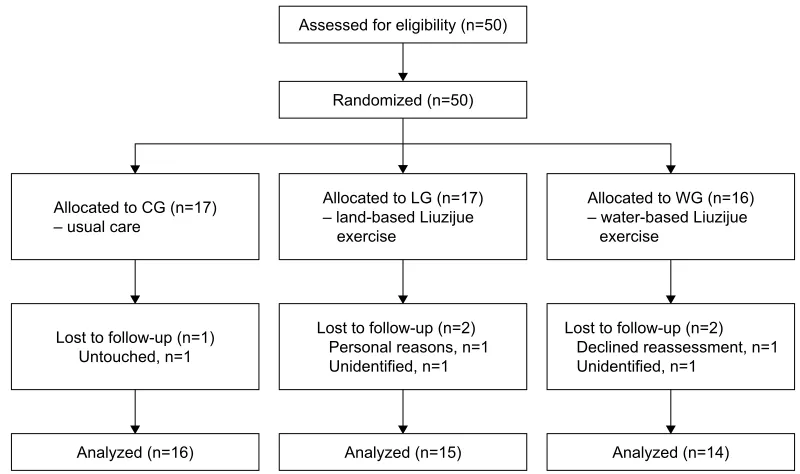
The 50 enrolled COPD patients were randomly assigned to three groups: 16 in the WG, 17 in the LG, and 17 in the CG. After a 3-month intervention, a total of 45 (90%) COPD patients completed the program and were included in the analyses (Figure 1). Groups were similar at baseline (Table 1).
In relation to pulmonary function, none of the three
groups showed changes in FEV1%pred and FEV1/FVC
postintervention (Figure 2), and no significant difference was observed among the three groups after training (Table 2; Figure 3). While training groups exhibited a statistical intra-group difference in respiratory muscle strength after the
exer-cise program (Figure 4), that is, PImax in the LG (4.01±1.4
vs 4.46±1.18 kPa) and WG (4.03±1.34 vs 5.68±1.51 kPa)
International Journal of Chronic Obstructive Pulmonary Disease downloaded from https://www.dovepress.com/ by 118.70.13.36 on 22-Aug-2020
Dovepress effectiveness of water-based liuzijue exercise in COPD patients
and PEmax in the LG (4.9±1.17 vs 6.57±1.73 kPa) and
WG (4.84±1.88 vs 6.61±2.72 kPa), CG showed a significant
decrease in PEmax ( p=0.022). The intergroup comparison
showed that LG and WG had significantly increased PImax and PEmax compared to CG ( p,0.01).
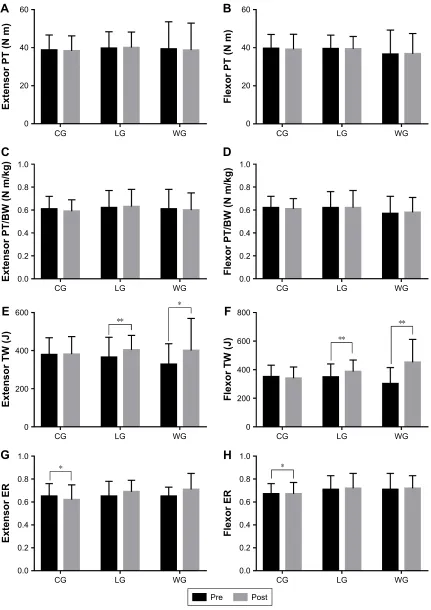
The parameters, which evaluated the muscle function of elbow joints, are shown in Table 3. There was no difference in extensor and flexor PT and PT/BW after 3 months in all of the groups (Figure 5). Extensor and flexor TW were increased
significantly in the training groups (LG: p=0.008 and p=0.001,
respectively; WG: p=0.031 and p,0.001, respectively), while
flexor TW in the CG showed a decreasing trend. In addition, the LG had significantly increased flexor TW compared to
the CG (p=0.016), and the WG had significantly improved
extensor and flexor TW compared to the CG (p=0.004 and
p,0.001, respectively). Extensor and flexor ER exhibited no difference in the training groups after a 3-month
inter-vention, but they decreased statistically in the CG (p=0.035
and p=0.048, respectively). In addition, the training groups
compared to the CG had a significant difference in extensor
ER (p=0.012 and p=0.006, respectively).
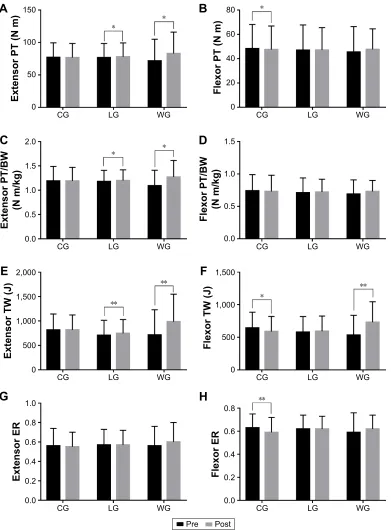
The parameters used to evaluate the muscle function of the knee joints are shown in Table 4. After 3 months of inter-vention, extensor PT and PT/BW in the training groups were
increased significantly (extensor PT in the LG [76.62±21.86
vs 77.98±21.33] and WG [71.55±33.42 vs 82.92±33.00]
and extensor PT/BW in the LG [1.18±0.23 vs 1.20±0.22]
and WG [1.09±0.32 vs 1.27±0.34]), while the flexor PT
was significantly decreased in the CG (p=0.036; Figure 6).
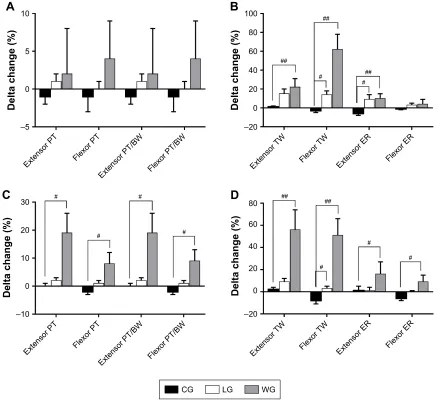
An intergroup comparison showed a significant difference in the extensor and flexor PT and PT/BW between the WG and CG (p,0.05; Figure 7). In addition, the extensor TW in the training groups was increased significantly, and the
flexor TW was increased in the WG (p=0.009), while the
flexor TW in the CG was decreased statistically significantly
(p=0.031). An intergroup comparison showed that the
exten-sor and flexor TW and ER had significantly improved in the WG when compared to the CG (p,0.05), and only flexor
/RVWWRIROORZXSQ 8QWRXFKHGQ
$QDO\]HGQ $OORFDWHGWR&*Q ±XVXDOFDUH
$VVHVVHGIRUHOLJLELOLW\Q
5DQGRPL]HGQ
/RVWWRIROORZXSQ 3HUVRQDOUHDVRQVQ 8QLGHQWLILHGQ
$QDO\]HGQ $OORFDWHGWR/*Q ±ODQGEDVHG/LX]LMXH H[HUFLVH
/RVWWRIROORZXSQ 'HFOLQHGUHDVVHVVPHQWQ 8QLGHQWLILHGQ
$QDO\]HGQ $OORFDWHGWR:*Q ±ZDWHUEDVHG/LX]LMXH H[HUFLVH
Figure 1 Study flow diagram.
Abbreviations: Cg, control group; lg, land-based liuzijue exercise group; Wg, water-based liuzijue exercise group.
Table 1 Baseline characteristics of participants
Characteristics CG (n=16) LG (n=15) WG (n=14) p-value
age (years) 66±8 65±8 65±11 0.96
sex (male/female) 12/4 12/3 9/5 0.62
BMI (kg/m2) 24±3 23±4 23±3 0.73
FeV1%pred 59±17 55±17 59±22 0.77
FeV1/FVC (%) 60±8 60±18 62±14 0.86
Years of COPD 12±4 13±4 12±4 0.79
COPD stage 0.63
grade I 2 (12.50) 2 (13.33) 3 (21.43) grade II 9 (56.25) 10 (66.67) 9 (64.29) grade III 3 (18.75) 3 (20.00) 2 (14.28)
grade IV 2 (12.50) 0 0
Notes: Data are expressed as mean ± sD or n (%). One-way analysis of variance was used to compare the age, BMI, FeV1%pred, and FeV1/FVC among groups, and
the chi-square test was used to compare sex and COPD stage among groups. The
significance level was set at p,0.05.
Abbreviations: %pred, percentage of predicted values; BMI, body mass index;
Cg, control group; FeV1, forced expiratory volume in the first second; FVC, forced
vital capacity; lg, land-based liuzijue exercise group; Wg, water-based liuzijue exercise group.
International Journal of Chronic Obstructive Pulmonary Disease downloaded from https://www.dovepress.com/ by 118.70.13.36 on 22-Aug-2020
Dovepress
Wu et al
TW in the LG compared to the CG showed a statistically
significant difference (p=0.032).
Discussion
The present study demonstrated that water-based Liuzijue exercise can improve respiratory muscle strength, extensor and flexor endurance of the elbow joints, and maximum muscle contraction strength and endurance capacity of the knee joints in patients with COPD. Furthermore, it seems that water-based Liuzijue exercise has more significant effects on the muscle function of the knee joints in COPD patients when compared with the land-based Liuzijue exercise.
Studies have shown that even mild dyspnea in COPD patients significantly reduced physical activity (combined with a reduction in 6MWD and a more pronounced lower
diffusion capacity of carbon monoxide),30 and the reduction
in physical activity further exacerbated the condition of the patients, leading to worsened symptoms, muscle weakness, and decreased exercise capacity, even impacting the rate of
decline in lung function.31,32 GOLD (version 2017)1 states
that COPD patients should accept pulmonary rehabilita-tion with exercise as the primary component to improve respiratory symptoms, quality of life, physical activity, and participation in daily activities, and the safety applied to different disease grades of COPD patients has been con-firmed. However, conventional exercise training requires equipment, an exercise location, and medical personnel to supervise its safety, which poses a heavy burden on patients’ families and health resources. Therefore, this study adopted traditional Chinese exercise with Liuzijue exercise, which is easy to learn and not limited by location and equipment. As a low-intensity aerobic exercise, the effectiveness and safety of Liuzijue exercise applied to COPD patients have
also been confirmed.13 In addition, this study examined
Liuzijue exercise in an aquatic environment as applied to the rehabilitation of patients with COPD to investigate whether the aquatic element can bring additional benefits. The safety of the water environment in the rehabilitation of COPD patients, even with physical comorbidities, has also
100
80
60
CG
FE
V1
%pred
LG WG
40
20
0
100
80
60
CG
FE
V1
/FVC (%
)
LG WG
40
20
0
Pre Post
Figure 2 Pulmonary function before and after the 3-month intervention.
Notes: Data are expressed as mean ± sD. no differences were observed between the groups at baseline and after the intervention. Within-groups comparison was made by the paired-sample t-test.
Abbreviations: %pred, percentage of predicted values; Cg, control group; FeV1, forced expiratory volume in the first second; FVC, forced vital capacity; LG, land-based
liuzijue exercise group; post, postintervention; pre, preintervention; Wg, water-based liuzijue exercise group.
Table 2 Comparisons of group changes (%) in pulmonary function and respiratory muscle strength
Variables CG (n=16) LG (n=15) WG (n=14) p-value
Pre Post ∆changes (%) Pre Post ∆changes (%) Pre Post ∆changes (%)
FeV1%pred 59±17 57±14 −0.03±0.02 55±17 57±16 0.05±0.04 59±22 60±22 0.05±0.06 0.177
FeV1/FVC (%) 60±7.57 57±14 −0.03±0.06 60±18 57±13 0±0.05 62±14 60±15 −0.03±0.02 0.911
PImax (kPa) 4.23±1.11 4.24±1.05 0.01±0.02 4.01±1.4 4.46±1.18* 0.15±0.05## 4.03±1.34 5.68±1.51* 0.49±0.11## ,0.001
Pemax (kPa) 5.05±1.43 4.93±1.44* −0.02±0.01 4.9±1.17 6.57±1.73** 0.35±0.05## 4.84±1.88 6.61±2.72* 0.75±0.43## ,0.001 Notes: Pre and post data are expressed as mean ± sD, ∆changes (%) = ([post − pre]/pre) ×100, and expressed as mean ±seM. Within groups was compared by the paired-sample t-test, one-way analysis of variance was used to compare the changes of FeV1/FVC between groups, and the nonparametric Kruskal-Wallis test was used to compare
the changes of respiratory muscle strength and FeV1%pred between groups. *p,0.05, comparisons are significant within groups. **p,0.01, comparisons are significant within
groups. ##p,0.01, group changes (%) comparison are significant between the control group and the intervention group.
Abbreviations: %pred, percentage of predicted values; Cg, control group; FeV1, forced expiratory volume in the first second; FVC, forced vital capacity; LG, land-based
liuzijue exercise group; Pemax, maximal expiratory pressure; PImax, maximal inspiratory pressure; post, postintervention; pre, preintervention; Wg, water-based liuzijue exercise group.
International Journal of Chronic Obstructive Pulmonary Disease downloaded from https://www.dovepress.com/ by 118.70.13.36 on 22-Aug-2020
Dovepress effectiveness of water-based liuzijue exercise in COPD patients
been demonstrated and studies have shown that patients prefer to exercise in water because exercise in water reduces
discomfort.17,33 Although the blood pressure and vital
capac-ity of COPD patients decreased to some extent and the Borg score slightly increased during exercise in water, vital signs, such as heart rate, respiration rate, and oxygen saturation, did not change significantly; there was no significant discomfort
or adverse events during exercise.18 Similar to previous
stud-ies, patients with COPD in this study were highly compli-ant and did not experience adverse events associated with intervention, further confirming the feasibility and safety of this program.
The current study corroborates the results from previous
studies:34,35 neither of these interventions significantly
improved FEV1%pred and FEV1/FVC% in patients with
COPD. In contrast, studies have shown that both low-intensity land-based exercise and water-based exercise
significantly increase FEV1 in COPD patients.19 This may be
explained by the higher baseline FEV1%pred level in patients
enrolled in the present study having less improvement. In addition, the present outcomes corroborate previous results
of water exercise intervention19 that land-based Liuzijue
exercise and water-based Liuzijue exercise can significantly improve respiratory muscle strength in patients with COPD, and a water environment did not bring additional effects. Respiratory muscle training alone can significantly improve
respiratory muscle strength in COPD patients,8 but when
combined with aerobic exercise, it has an additional effect
on improving PImax.35 Beneficial effects obtained may be
attributed to the following: the improvement in the shape of
±
±
'HOWDFKDQJH
)(9SUHG )(9)9&
±
'HOWDFKDQJH
3,PD[ 3(PD[
&* /* :*
Figure 3 Changes of pulmonary function and respiratory muscle strength after the 3-month intervention.
Notes: Delta changes (%) = ([post − pre]/pre) ×100, and they are expressed as mean ± seM. Between-group comparisons used the one-way analysis of variance or the nonparametric Kruskal–Wallis test and are expressed as a p-value. The level of significance was set at p,0.05, and ##p,0.01 means it was significant when compared to the
control group.
Abbreviations: %pred, percentage of predicted values; Cg, control group; FeV1, forced expiratory volume in the first second; FVC, forced vital capacity; LG, land-based
liuzijue exercise group; Pemax, maximal expiratory pressure; PImax, maximal inspiratory pressure; Wg, water-based liuzijue exercise group.
Pre Post
10
8
6
CG
PEmax (kPa
)
LG WG
4
2
0 8
6
4
CG
Plmax (kPa
)
LG WG
2
0
*
*
*
** *
Figure 4 respiratory muscle strength before and after the 3-month intervention.
Notes: Data are expressed as mean ± sD. no differences were observed between the groups at baseline. Within-groups comparison was made by the paired-sample t-test.
*p,0.05, comparisons were significant within groups. **p,0.01, comparisons were significant within groups.
Abbreviations: Cg, control group; lg, land-based liuzijue exercise group; Pemax, maximal expiratory pressure; PImax, maximal inspiratory pressure; post, postintervention;
pre, preintervention; Wg, water-based liuzijue exercise group.
International Journal of Chronic Obstructive Pulmonary Disease downloaded from https://www.dovepress.com/ by 118.70.13.36 on 22-Aug-2020
Dovepress
Wu et al
the rib cage, accessory respiratory muscle function, electro-myogram fatigability of the diaphragm, and the increase in the proportion of type I fibers and size of type II fibers in
the external intercostal muscles.8,36 Although there was no
significant difference in PImax between the LG and the WG in this study, the data showed a trend of greater improvement in the WG. This may be explained by the characteristic of water applying pressure on the chest and abdomen of the patients, increasing the resistance to inhalation and further activating the inspiratory muscle. However, respiratory muscle strength did not improve, while improved specific airway conductance in COPD patients with Liuizjue exercise
has been found.13 Larger samples and long-term intervention
should be carried out in clinical studies to further confirm whether a water environment can confer additional benefits on respiratory muscle strength in COPD patients.
Studies have shown that skeletal muscle dysfunction (declined skeletal muscle strength and endurance compared with healthy sedentary controls) exists in patients with mild
COPD, even before respiratory symptoms are present.37,38
Muscle atrophy appears as a major cause of decreased
skeletal muscle strength,39 while the circumference of the
upper and lower limbs can strongly predict COPD mortality
compared to BMI.40 Similarly, skeletal muscle dysfunction
as an independent risk factor can predict mortality in patients
with COPD,41 and it is closely related to reduced physical
activity, exercise capacity, and quality of life.42 Therefore,
skeletal muscle function is an important component of the comprehensive condition of COPD patients. A variety of methods and techniques can be used to assess skeletal muscle function. Of these, one-repetition measurement (1 RM), which assesses dynamic skeletal muscle strength, and hand-grip strength, which assesses isometric muscle contractile strength, are commonly used in COPD patients and have good
reliability and validity.43 These methods are simple and do not
require expensive equipment, but they are vulnerable to the subjective awareness of the participants. Alternatively, com-puterized dynamometers with demonstrated good test–retest
reliability, as well as safety and accuracy,29 can be used to
assess the dynamic skeletal muscle function in patients with COPD. Therefore, this study used the CON-TREX isokinetic dynamometer to assess the skeletal muscle function of the elbow and knee joints in patients with COPD.
This study showed that no significant difference was found in the muscle strength of elbow joints (expressed by extensor and flexor PT and PT/BW) after 3 months of training, while muscle endurance improved significantly (expressed by extensor and flexor TW). These results
Table 3
Comparisons of group changes (%) in muscle function of elbow joints
Variables CG (n = 16) LG (n = 15) WG (n = 14) p -value Pre Post ∆ changes (%) Pre Post ∆ changes (%) Pre Post ∆ changes (%)
extensor PT (
n m) 38.75 ± 7.93 38.31 ± 7.89 − 0.01 ± 0.01 39.73 ± 8.64 40.07 ± 8.17 0.01 ± 0.01 39.3 ± 14.33 38.7 ± 14.23 0.02 ± 0.06 0.109
Flexor PT (
n m) 39.69 ± 7.28 39.19 ± 7.89 − 0.01 ± 0.02 39.53 ± 7.07 39.4 ± 6.54 0 ± 0.01 36.6 ± 12.65 36.8 ± 10.67 0.04 ± 0.05 0.438
extensor PT/BW (
n m/kg) 0.61 ± 0.11 0.59 ± 0.1 − 0.01 ± 0.01 0.62 ± 0.15 0.63 ± 0.15 0.01 ± 0.01 0.61 ± 0.17 0.6 ± 0.15 0.02 ± 0.06 0.109
Flexor PT/BW (
n m/kg) 0.62 ± 0.1 0.61 ± 0.09 − 0.01 ± 0.02 0.62 ± 0.14 0.62 ± 0.15 0 ± 0.01 0.57 ± 0.15 0.58 ± 0.13 0.04 ± 0.05 0.438
extensor TW (
J) 378.55 ± 88.98 381.13 ± 92.59 0.01 ± 0.01 365.47 ± 104.57 403.64 ± 76.42** 0.15 ± 0.05 328.04 ± 108.16 400.5 ± 168.76* 0.22 ± 0.09 ## 0.004
Flexor TW (
J) 350.55 ± 81.39 340.36 ± 78.92 − 0.03 ± 0.02 348.64 ± 91.36 387.14 ± 80.21** 0.14 ± 0.04 # 301.54 ± 113.75 451.71 ± 160.72** 0.62 ± 0.16 ## , 0.001 extensor er 0.65 ± 0.11 0.62 ± 0.13* − 0.06 ± 0.02 0.65 ± 0.13 0.69 ± 0.1 0.09 ± 0.05 # 0.65 ± 0.08 0.71 ± 0.14 0.1 ± 0.05 ## 0.002 Flexor er 0.67 ± 0.09 0.67 ± 0.1* − 0.01 ± 0.01 0.71 ± 0.12 0.72 ± 0.13 0.03 ± 0.02 0.71 ± 0.14 0.72 ± 0.11 0.04 ± 0.05 0.11 Notes: Pre and post da ta are expressed as mean ± s D, ∆ changes (%) = ([post − pre]/pre) × 100, and they are expressed as mean ± se M. Within-groups comparison was made by the paired-sample t -test and the nonparametric Kruskal–Wallis test was used to compare the changes of elbow joints muscle function between groups. * p , 0.05, comparisons were significant within groups. ** p , 0.01, comparisons were significant within groups. #p , 0.05, group changes (%) comparison
was significant between the control group and the intervention group.
##p
,
0.01, group cha
nges (%) comparison was significant between the control group and the int
ervention group. Abbreviations: BW, body weight; C g , control group; er , endurance ratio; lg , land-based liuzijue exercise group; post, postintervention; pre, preintervention; PT, peak torque; TW, total work; W g , water-based liuzijue exercise group.
International Journal of Chronic Obstructive Pulmonary Disease downloaded from https://www.dovepress.com/ by 118.70.13.36 on 22-Aug-2020
Dovepress effectiveness of water-based liuzijue exercise in COPD patients
3UH 3RVW
&*
/*
([WHQVRU371P
:* &*
/*
)OH[RU371P
:*
$
%
&*
/*
([WHQVRU7:-:*
&*
/*
)OH[RU7:-:*
(
)
&*
/*
([WHQVRU(5
:*
&*
/*
)OH[RU(5
:*
*
+
&*
/*
([WHQVRU37%:1PNJ
:* &*
/*
)OH[RU37%:1PNJ
:*
&
'
Figure 5 Muscle function of elbow joints before and after the 3-month intervention.
Notes: (A–D) Within-groups comparisons in CG, LG, and WG of the elbow extensor and flexor PT and PT/BW to reflect the changes of muscle strength after intervention;
(E–H) Within-groups comparisons in CG, LG, and WG of the elbow extensor and flexor TW and ER to reflect the changes of muscle endurance after intervention. Data
are expressed as mean ± sD. no differences were observed between the groups at baseline. Within-groups comparisons were made with the paired-sample t-test. *p,0.05,
comparisons were significant within groups, **p,0.01, comparisons were significant within groups.
Abbreviations: BW, body weight; Cg, control group; er, endurance ratio; lg, land-based liuzijue exercise group; post, postintervention; pre, preintervention; PT, peak
torque; TW, total work; Wg, water-based liuzijue exercise group.
International Journal of Chronic Obstructive Pulmonary Disease downloaded from https://www.dovepress.com/ by 118.70.13.36 on 22-Aug-2020
Dovepress
Wu et al
Table 4
Comparisons of group changes (%) in muscle function of knee joints
Variables CG (n = 16) LG (n = 15) WG (n = 14) p -value Pre Post ∆ changes (%) Pre Post ∆ changes (%) Pre Post ∆ changes (%)
extensor PT (
n m) 77.01 ± 22.46 76.74 ± 21.73 0 ± 0.01 76.62 ± 21.86 77.98 ± 21.33* 0.02 ± 0.01 71.55 ± 33.42 82.92 ± 33.00* 0.19 ± 0.07 # 0.041
Flexor PT (
n m) 48.31 ± 19.84 47.50 ± 19.39* − 0.02 ± 0.01 47.03 ± 20.76 47.08 ± 18.49 0.01 ± 0.01 45.47 ± 20.99 47.66 ± 16.89 0.08 ± 0.04 # 0.024
extensor PT/BW (
n m/kg) 1.19 ± 0.30 1.19 ± 0.28 0 ± 0.01 1.18 ± 0.23 1.20 ± 0.22* 0.02 ± 0.01 1.09 ± 0.32 1.27 ± 0.34* 0.19 ± 0.04 # 0.041
Flexor PT/BW (
n m/kg) 0.74 ± 0.25 0.73 ± 0.25 − 0.02 ± 0.01 0.71 ± 0.23 0.72 ± 0.20 0.01 ± 0.01 0.69 ± 0.22 0.73 ± 0.17 0.09 ± 0.04 # 0.028
extensor TW (
J) 816.46 ± 326.02 817.64 ± 305.62 0.02 ± 0.02 705.89 ± 308.43 745.98 ± 283.58** 0.09 ± 0.03 712.14 ± 516.47 983.58 ± 563.44** 0.56 ± 0.18 ## 0.002
Flexor TW (
J) 643.64 ± 240.87 589.78 ± 230* − 0.08 ± 0.03 579.53 ± 238.67 593.47 ± 232.71 0.03 ± 0.02 # 532.63 ± 304.65 731.09 ± 312.8** 0.51 ± 0.15 ## , 0.001 extensor er 0.56 ± 0.18 0.55 ± 0.15 0.01 ± 0.04 0.57 ± 0.16 0.57 ± 0.15 0.01 ± 0.03 0.56 ± 0.20 0.60 ± 0.20 0.16 ± 0.11 # 0.027 Flexor er 0.63 ± 0.12 0.59 ± 0.13** − 0.06 ± 0.02 0.62 ± 0.12 0.62 ± 0.11 0 ± 0.01 0.59 ± 0.17 0.62 ± 0.12 0.09 ± 0.06 # 0.02 Notes: Pre and post data are expressed as mean ± sD, ∆ changes (%) = ([post − pre]/pre) × 100, and they are expressed as mean ± se M. Within-group comparisons were made by the paired-sample t -test, one-way analysis of variance was used to compare the changes of extensor er between groups and post hoc multiple compa risons were performed using Bonferroni test, and the nonparametric Kruskal–Wallis test was used to compare others between groups. * p , 0.05, comparisons are significant within groups. ** p , 0.01, comparisons are significant within gro ups. #p , 0.05, group changes (%) comparison was significant between the control group and the intervention group. ##p , 0.01, group changes (%)
comparison was significant between the control group and the intervention group. Abbreviations:
BW, body weight; C g , control group; er , endurance ratio; lg , land-bas ed liuzijue exercise group; post, postintervention; pre, preintervention; PT, peak torque; TW, total work; W g , water-based liuzijue exercise group.
indicated that land-based Liuzijue and water-based Liuzijue exercise can improve the muscle endurance of the elbow
joints, which is consistent with a previous study.37 Generally,
skeletal muscle function in the upper and lower limbs was significantly decreased in COPD patients, with the excep-tion of upper limb endurance, which may be attributed to the continual recruitment of upper limb muscles to support
ventilation and daily activities.37 In the present study, patients
in the CG exhibited decreased extensor and flexor ER after the 3-month intervention, and significant differences in extensor ER and flexor TW were found when compared to the LG. A significant difference in extensor ER and exten-sor and flexor TW was found when compared to the WG. Additionally, the improvement in extensor TW (15%) of LG was equal to the minimal clinical importance difference
value,38 while the improvement of extensor TW (22%) and
flexor TW (62%) of the WG was significantly greater. The improved upper limb muscle endurance may be explained by the fact that these muscles were not being trained to the maximum extent during physical activity.
Consistent with a previous study of skeletal muscle dys-function, which commonly exists in lower limb muscles in
COPD patients,44 this study showed that flexor strength (PT)
and endurance (TW, ER) of the knee joint were significantly decreased in the CG patients. Meanwhile, extensor muscle strength (PT, PT/BW) and endurance (TW) of the knee joint were significantly increased in the LG and WG patients. Although the exercises were different, the results were
con-sistent with previous studies,37,38,45 indicating that Liuzijue
exercise has a significant effect on improving extensor function of the knees in COPD patients. As for flexor func-tion, TW was significantly increased in the WG only, and an intergroup comparison showed a significant difference in flexor strength and endurance between the WG and CG, while there was only a significant difference in TW between the LG and CG. Considering the clinical value, 15% of the minimal improvement in muscle strength was applied to the comparison. The present results exhibited that water-based Liuzijue exercise provides a clinical improvement in muscle strength (extensor PT and extensor PT/BW, 19%) and endur-ance (extensor TW, 56%; flexor TW, 51%; extensor ER, 16%) of the knee joint, while land-based Liuzijue exercise did not. The results showed that water-based Liuzijue exer-cise may have additional benefits to the muscle function of the knee joints than land-based Liuzijue exercise. This may be ascribed to the semiflexed position of the knees during Liuzijue exercise, which induces greater stimulation on the extensor of the knee. In addition, water-based exercise can
International Journal of Chronic Obstructive Pulmonary Disease downloaded from https://www.dovepress.com/ by 118.70.13.36 on 22-Aug-2020
Dovepress effectiveness of water-based liuzijue exercise in COPD patients
Pre Post
150
* *
100
CG
Extensor PT (N m)
LG WG
50
0
Extensor PT/B
W
(N m/kg
)
2.0
* *
1.5
CG LG WG
1.0
0.5
0.0
Extensor TW (J
) 2,000
**
**
1,500
CG LG WG
1,000
500
0
Extensor ER
1.0
0.8
CG LG WG
0.6
0.4
0.2
0.0
A
C
E
G
1.5
1.0
CG
Flexor PT/B
W
(N m/kg
)
LG WG
0.5
0.0
Flexor TW (J
)
1,500
1,000
CG LG WG
500
0
*
**
Flexor ER
0.8 **
0.6
CG LG WG
0.4
0.2
0.0 80
60
*
40
CG
Flexor PT (N m)
LG WG
20
0
B
D
F
H
Figure 6 Muscle function of knee joints before and after the 3-month intervention.
Notes: (A–D) Within-groups comparisons in CG, LG, and WG of the knee extensor and flexor PT and PT/BW to reflect the changes of muscle strength after intervention;
(E–H) Within-groups comparisons in CG, LG, and WG of the knee extensor and flexor TW and ER to reflect the changes of muscle endurance after intervention. Data are
expressed as mean ± sD. no differences were observed between the groups at baseline. Within-groups comparisons were made with the paired-sample t-test. *p,0.05,
comparisons were significant within groups. **p,0.01, comparisons were significant within groups.
Abbreviations: BW, body weight; Cg, control group; er, endurance ratio; lg, land-based liuzijue exercise group; post, postintervention; pre, preintervention; PT, peak
torque; TW, total work; Wg, water-based liuzijue exercise group.
provide greater resistance to limb movement on the premise of supporting BW, which may be one of the reasons why water-based Liuzijue exercise can further improve skeletal muscle function. Furthermore, aerobic metabolism is the
energy source used to sustain physical activity in water, and water can promote peripheral blood circulation, which may explain why water-based Liuzijue exercise can further improve skeletal muscle endurance.
International Journal of Chronic Obstructive Pulmonary Disease downloaded from https://www.dovepress.com/ by 118.70.13.36 on 22-Aug-2020
Dovepress
Wu et al
([WHQVRU37 ±
$
'HOWDFKDQJH
([WHQVRU37%: )OH[RU37%:
)OH[RU37
([WHQVRU 7: ±
%
'HOWDFKDQJH
([WHQVRU(5 )OH[RU(5
)OH[RU 7:
([WHQVRU 7: ±
'
'HOWDFKDQJH
([WHQVRU(5 )OH[RU(5
)OH[RU 7:
([WHQVRU37 ±
&
'HOWDFKDQJH
([WHQVRU37%: )OH[RU37%:
)OH[RU37
&* /* :*
Figure 7 Changes of elbow and knee joints of muscle function after 3-month intervention. Muscle function of elbow joints are shown in A and B, while knee joints are
shown in C and D.
Notes: Delta changes (%) = ([post − pre]/pre) ×100, and they are expressed as mean ± seM. Between-group comparisons used the one-way analysis of variance or the nonparametric Kruskal–Wallis test and are expressed as a p-value. The level of significance was set at p,0.05, and #p,0.05 and ##p,0.01 mean it was significant when
compared to the Cg.
Abbreviations: BW, body weight; Cg, control group; er, endurance ratio; lg, land-based liuzijue exercise group; post, postintervention; pre, preintervention; PT, peak
torque; TW, total work; Wg, water-based liuzijue exercise group.
The main advantage of this study was the quantitative assessment of the effects of exercise on pulmonary function, respiratory muscle strength, and isokinetic muscle strength in COPD patients. Second, the study uses Liuzijue exercise, one of the traditional Chinese exercises, as an intervention in which the intensity is low and suitable to various condi-tions of COPD patients. Hydrotherapy, one of the emerging interventions in recent years, has become widely popular in COPD patients. Hence, the results of this study have high reliability and repeatability, and the intervention program has extensive field to be applied. However, this study did not assess the clinically related indicators of COPD patients, while previous studies have shown that the improvement of
skeletal muscle function is closely related to clinical indi-cators, such as exercise capacity, quality of life, and even
survival in patients with COPD.46 Additionally, the
promo-tion of Liuzijue exercise may be limited by different cultural backgrounds. However, tai chi, another form of traditional Chinese exercise, has been applied in the field of fitness and rehabilitation of elderly people across the world.
Conclusion
The results of this study demonstrated that Liuzijue exercise and water-based Liuzijue exercise can significantly improve respiratory muscle strength, muscle endurance of elbow joints, and muscle strength and endurance of knee joints in
International Journal of Chronic Obstructive Pulmonary Disease downloaded from https://www.dovepress.com/ by 118.70.13.36 on 22-Aug-2020
Dovepress effectiveness of water-based liuzijue exercise in COPD patients
COPD patients. Water-based Liuzijue exercise has an addi-tional effect on improving extensor endurance of elbow joints and muscle function of knee joints. Therefore, long-term and regular practice of water-based Liuzijue exercise should be an alternative rehabilitation for COPD patients. Further studies should be conducted to comprehensively assess the effects of water-based Liuzijue exercise in patients with COPD.
Acknowledgments
This study was supported by Key Laboratory of Exercise and Health Sciences of Ministry of Education, Shanghai University of Sport, the national fitness project of General Administration of Sport of China (Nos 2015B077 and 2017B021), the research project of the Fitness Qigong Administrative Centre of General Administration of Sport of China (QG2017057), the “Qi Kang” young innovative talents project of School of Rehabilitation Medicine, Shanghai University of Traditional Chinese Medicine, and National Natural Science Foundation of China (No 81472163).
Disclosure
The authors report no conflicts of interest in this work.
References
1. Global initiative for chronic obstructive lung disease (GOLD): Global strategy for the Diagnosis, Management and Prevention of chronic obstructive pulmonary disease [homepage on the Internet]. 2017 report. Available from: http://www.goldcopd.com. Accessed July 23, 2017. 2. Cielen N, Maes K, Gayan-Ramirez G. Musculoskeletal disorders in
chronic obstructive pulmonary disease. Biomed Res Int. 2014;2014: 9657–9664.
3. Decramer M, Janssens W, Miravitlles M. Chronic obstructive pulmo-nary disease. Lancet. 2012;379(9823):1341–1351.
4. Arnardóttir RH, Sörensen S, Ringqvist I, Larsson K. Two different training programmes for patients with COPD: a randomised study with 1-year follow-up. Respir Med. 2006;100(1):130–139.
5. Güell MR, Cejudo P, Ortega F, et al. Benefits of long-term pulmonary rehabilitation maintenance program in patients with severe chronic obstructive pulmonary disease. Three-year follow-up. Am J Respir Crit
Care Med. 2017;195(5):622–629.
6. Spahija J, de Marchie M, Grassino A. Effects of imposed pursed-lips breathing on respiratory mechanics and dyspnea at rest and during exercise in COPD. Chest. 2005;128(2):640–650.
7. de Araujo CL, Karloh M, Dos Reis CM, Palú M, Mayer AF. Pursed-lips breathing reduces dynamic hyperinflation induced by activities of daily living test in patients with chronic obstructive pulmonary disease: a randomized cross-over study. J Rehabil Med. 2015;47(10):957–962. 8. Ramirez-Sarmiento A, Orozco-Levi M, Guell R, et al. Inspiratory
muscle training in patients with chronic obstructive pulmonary disease: structural adaptation and physiologic outcomes. Am J Respir Crit Care
Med. 2002;166(11):1491–1497.
9. Larson JL, Covey MK, Wirtz SE, et al. Cycle ergometer and inspiratory muscle training in chronic obstructive pulmonary disease. Am J Respir
Crit Care Med. 1999;160(2):500–507.
10. Mador MJ, Bozkanat E, Aggarwal A, Shaffer M, Kufel TJ. Endurance and strength training in patients with COPD. Chest. 2004;125(6): 2036–2045.
11. Ortega F, Toral J, Cejudo P, et al. Comparison of effects of strength and endurance training in patients with chronic obstructive pulmonary disease. Am J Respir Crit Care Med. 2002;166(5):669–674. 12. Iepsen UW, Munch GD, Rugbjerg M, et al. Effect of endurance versus
resistance training on quadriceps muscle dysfunction in COPD: a pilot study. Int J Chron Obstruct Pulmon Dis. 2016;11:2659–2669. 13. Xiao CM, Zhuang YC. Efficacy of Liuzijue Qigong in individuals with
chronic obstructive pulmonary disease in remission. J Am Geriatr Soc. 2015;63(7):1420–1425.
14. Chan AW, Lee A, Suen LK, Tam WW. Tai chi Qigong improves lung functions and activity tolerance in COPD clients: a single blind, randomized controlled trial. Complement Ther Med. 2011;19(1):3–11. 15. Zhang M, Xv G, Luo C, Meng D, Ji Y. Qigong Yi Jinjing promotes pul-monary function, physical activity, quality of life and emotion regulation self-efficacy in patients with chronic obstructive pulmonary disease: a pilot study. J Altern Complement Med. 2016;22(10):810–817. 16. Chan AW, Lee A, Suen LK, Tam WW. Effectiveness of a Tai Chi
Qigong program in promoting health-related quality of life and per-ceived social support in chronic obstructive pulmonary disease clients.
Qual Life Res. 2010;19(8):653–664.
17. McNamara RJ, McKeough ZJ, McKenzie DK, Alison JA. Accept-ability of the aquatic environment for exercise training by people with chronic obstructive pulmonary disease with physical comorbidities: additional results from a randomised controlled trial. Physiotherapy. 2015;101(2):187–192.
18. Perk J, Perk L, Bodén C. Cardiorespiratory adaptation of COPD patients to physical training on land and in water. Eur Respir J. 1996; 9(2):248–252.
19. de Souto Araujo ZT, de Miranda Silva Nogueira PA, Cabral EE, de Paula Dos Santos L, da Silva IS, Ferreira GM. Effectiveness of low-intensity aquatic exercise on COPD: a randomized clinical trial.
Respir Med. 2012;106(11):1535–1543.
20. Wadell K, Sundelin G, Henriksson-Larsén K, Lundgren R. High intensity physical group training in water-an effective training modality for patients with COPD. Respir Med. 2004;98(5):428–438.
21. McNamara RJ, McKeough ZJ, McKenzie DK, Alison JA. Water-based exercise training for chronic obstructive pulmonary disease. Cochrane
Database Syst Rev. 2013;(12):CD008290.
22. Lotshaw AM, Thompson M, Sadowsky HS, Hart MK, Millard MW. Qual-ity of life and physical performance in land- and water-based pulmonary rehabilitation. J Cardiopulm Rehabil Prev. 2007;27(4):247–251. 23. Cortopassi F, Castro AA, Porto EF, et al. Comprehensive exercise
training improves ventilatory muscle function and reduces dyspnea perception in patients with COPD. Monaldi Arch Chest Dis. 2009;71(3): 106–112.
24. Global initiative for chronic obstructive lung disease (GOLD): Global Initiative for Chronic Obstructive Lung Disease: Pocket guide to COPD diagnosis, management, and prevention [homepage on the Internet]. 2013 report. Available from: http://www.goldcopd.com. Accessed September 23, 2014.
25. Si QR. [Six-Character Formula]. In: Health Qigong Liuzijue. Beijing, China: Peking Sport University Press. 2013. P.2–71. [Chinese] 26. Borg GA. Psychophysical bases of perceived exertion. Med Sci Sports
Exerc. 1982;14(5):377–381.
27. Miller MR, Crapo R, Hankinson J, et al. General considerations for lung function testing. Eur Respir J. 2005;26(2):319–338.
28. American Thoracic Society/European Respiratory Society. ATS/ERS Statement on respiratory muscle testing. Am J Respir Crit Care Med. 2002;166(4):518–624.
29. Maffiuletti NA, Bizzini M, Desbrosses K, et al. Reliability of knee extension and flexion measurements using the Con-Trex isokinetic dynamometer. Clin Physiol Funct Imaging. 2010;27(6):346–353. 30. Van Remoortel H, Hornikx M, Demeyer H, et al. Daily physical activity in
subjects with newly diagnosed COPD. Thorax. 2013;68(10):962–963. 31. Hernández M, Zambom-Ferraresi F, Cebollero P, Hueto J, Cascante JA,
Antón MM. The relationships between muscle power and physical activity in older men with chronic obstructive pulmonary disease.
J Aging Phys Act. 2016;25(3):360–366.
International Journal of Chronic Obstructive Pulmonary Disease downloaded from https://www.dovepress.com/ by 118.70.13.36 on 22-Aug-2020
International Journal of COPD
Publish your work in this journal
Submit your manuscript here: http://www.dovepress.com/international-journal-of-chronic-obstructive-pulmonary-disease-journal
The International Journal of COPD is an international, peer-reviewed journal of therapeutics and pharmacology focusing on concise rapid reporting of clinical studies and reviews in COPD. Special focus is given to the pathophysiological processes underlying the disease, intervention programs, patient focused education, and self management protocols.
This journal is indexed on PubMed Central, MedLine and CAS. The manuscript management system is completely online and includes a very quick and fair peer-review system, which is all easy to use. Visit http://www.dovepress.com/testimonials.php to read real quotes from published authors.
Dovepress
Dove
press
Wu et al
32. Garcia-Aymerich J, Lange P, Benet M, Schnohr P, Antó JM. Regular physical activity modifies smoking-related lung function decline and reduces risk of chronic obstructive pulmonary disease: a population-based cohort study. Am J Respir Crit Care Med. 2007;175(5): 458–463.
33. McNamara RJ, McKeough ZJ, McKenzie DK, Alison JA. Water-based exercise in COPD with physical comorbidities: a randomised controlled trial. Eur Respir J. 2013;41(6):1284–1291.
34. Rodrigues SL, Viegas CADA, Lima T. Efetividade da reabilitação pulmonar como tratamento coadjuvante da doença pulmonar obstrutiva crônica [The effectiveness of the pulmonary rehabilitation program as an ancillary treatment for chronic obstructive pulmonary disease]. J De
Pneumol. 2002;28(2):65–70. Portuguese.
35. Wang K, Zeng GQ, Li R, et al. Cycle ergometer and inspiratory muscle training offer modest benefit compared with cycle ergometer alone: a comprehensive assessment in stable COPD patients. Int J Chron
Obstruct Pulmon Dis. 2017;12:2655–2668.
36. Charususin N, Dacha S, Gosselink R, et al. Respiratory muscle function and exercise limitation in patients with chronic obstructive pulmonary disease: a review. Expert Rev Respir Med. 2018;12(1):67–79. 37. Clark CJ, Cochrane LM, Mackay E, Paton B. Skeletal muscle strength
and endurance in patients with mild COPD and the effects of weight training. Eur Respir J. 2000;15(1):92–97.
38. Chen Y, Niu M, Zhang X, Qian H, Xie A, Wang X. Effects of home-based lower limb resistance training on muscle strength and functional status in stable COPD patients. J Clin Nurs. 2018;27(5–6): e1022–e1037.
39. Malaguti C, Napolis LM, Villaça D, Neder JA, Nery LE, Dal Corso S. Relationship between peripheral muscle structure and function in patients with chronic obstructive pulmonary disease with different nutritional status. J Strength Cond Res. 2011;25(7):1795–1803.
40. Ho SC, Wang JY, Kuo HP, et al. Mid-arm and calf circumferences are stronger mortality predictors than body mass index for patients with chronic obstructive pulmonary disease. Int J Chron Obstruct Pulmon
Dis. 2016;11(1):2075–2080.
41. Passey SL, Hansen MJ, Bozinovski S, McDonald CF, Holland AE, Vlahos R. Emerging therapies for the treatment of skeletal muscle wast-ing in chronic obstructive pulmonary disease. Pharmacol Ther. 2016; 166:56–70.
42. Sue DY. Peripheral muscle dysfunction in patients with COPD: compar-ing apples to apples? Chest. 2003;124(1):1–4.
43. Robles PG, Mathur S, Janaudisfereira T, Dolmage TE, Goldstein RS, Brooks D. Measurement of peripheral muscle strength in individuals with chronic obstructive pulmonary disease: a systematic review.
J Cardiopulm Rehabil Prev. 2011;31(1):11–24.
44. Rabinovich RA, Vilaró J. Structural and functional changes of peripheral muscles in chronic obstructive pulmonary disease patients. Curr Opin
Pulm Med. 2010;16(2):123–133.
45. Nyberg A, Lindstrom B, Rickenlund A, Wadell K. Low-load/high-repetition elastic band resistance training in patients with COPD: a randomized, controlled, multicenter trial. Clin Respir J. 2015;9(3): 278–288.
46. Maltais F, Decramer M, Casaburi R, et al; ATS/ERS Ad Hoc Com-mittee on Limb Muscle Dysfunction in COPD. An official American Thoracic Society/European Respiratory Society statement: update on limb muscle dysfunction in chronic obstructive pulmonary disease.
Am J Respir Crit Care Med. 2014;189(9):e15–e62.
International Journal of Chronic Obstructive Pulmonary Disease downloaded from https://www.dovepress.com/ by 118.70.13.36 on 22-Aug-2020

![Figure 3 Changes of pulmonary function and respiratory muscle strength after the 3-month intervention.Notes: Delta changes (%) = ([post − pre]/pre) ×100, and they are expressed as mean ± seM](https://thumb-us.123doks.com/thumbv2/123dok_us/8152959.1359727/7.612.129.503.523.671/figure-changes-pulmonary-function-respiratory-strength-intervention-expressed.webp)