ISSN 2348 – 7968
Analyzing the performance of a 10 Gb/s DPSK Multicast
overlaid WDM-PON Architecture using numerous modulation
techniques
Harpal Singh( Student), Harjinder Singh ( Assistant professor)
Department of Electronics and Communication, Punjabi University, Patiala, India
Abstract
In this paper , we demonstrate a tactics to pave multicast data on a wavelength-division – multiplexed passive optical network (WDM-PON) when the point-to-point data is delivered .By superimposing the Differential phase – shift keying (DPSK) multicast signal onto various point-to- point signals namely return-to-zero (RZ) , nonreturn-to-zero (NRZ) and differential quadrature phase-shift keying (DQPSK). Comparing all the three formats with respect to their BER (Bit Error Rate) , Received Power and Extinction Ratio. The limits of extinction ratio , to obtain the good demodulation of the signal have been observed. We successfully rolled out the WDM-PON with 10 Gb/s downstream point-to-point signals and 10 Gb/s multicast signal.
Keyword: WDM , PON , DPSK , RZ , NRZ , DQPSK , BER.
1. Introduction
WDM-PON leverages fiber and passive wavelengths to provide the most scalable, cost effective, and future proof solution available to address the capacity, security, and distance capabilities that service operators require while leveraging the benefits of a passive infrastructure. All these factors combine to make WDM-PON poised to become the disruptive next-generation access solution. The TDM-PON has many drawbacks such as video traffic was inefficient and it was not of high definition and differentiated multimedia services. The multicasting of the signal can easily be achieved by delivering the less power by in WDM-PON.
There are several approaches to send the data from optical line terminal (OLT) towards optical network unit (ONU) especially when the data is send to both the business and the residential users such as Optical Burst Switch Network (OBS) but it may take longer time for an end host to detect and then recover from burst dropping occur at WDM-PON layer another one is by using the power splitter that technique is also not efficient as laser is replaced by light emitting diode (LED) which take the system to the bulk of limitations such as non coherency of the system and less precise wavelengths are produced by it . So the technique here that is used to multicast the signal is orthogonal modulation with point-to-point signal.
Orthogonal modulation is the scheme to make the system carrying the high capacity and long- haul in the high speed optical transmission system.The technique of orthogonality may be achieved by superimposing the multicast signal onto the point-to-point signal.
In this letter, we come up with the WDM-PON architecture with superimposing the multicast signal based on differential phase-shift keying (DPSK) on various modulation formats such as return-to-zero (RZ) , nonreturn-to-zero (NRZ) and differential quadrature phase-shift keying (DQPSK) orthogonal modulation. The data that is to be sent is encoded by using DPSK and overlay on the point-to-point channels which are modulated with different modulation schemes. Here we compared the above mentioned modulation techniques on the basis of their bit error rate (BER) , received power at the optical network unit as well as set the extinction ratio for all the above techniques .The comparison is taken with the respect of DPSK multicast signal such as DPSK/RZ ,DPSK/NRZ , DPSK/DQPSK .The limits of the extinction ratio foe all the three techniques is obtained so that the point-to-point signal as well as multicast signal can easily be demodulated with acceptable values of bit error rate (BER) and values of eye closure. The fiber bragg grating is also taken into use to avoid the dispersion certainly it works like as dispersion compensator and band filter in the optical line terminal (OLT). In this way the downstream multicasted signal could easily be transmitted on the downstream wavelength channel which is corroborated by using 10 Gb/s point-to-point data as well as 10 Gb/s multicast data.
2. System Architecture
ISSN 2348 – 7968 generator provides the input to the two NRZ pulse
generators by changing the phase by using the phase changer, then as similar to RZ and NRZ modulation it is fed to the two LiNb Mach-Zehender intensity modulator where the laser source is connected to both modulators.
Fig. 1. Proposed WDM-PON architecture with multicast overlay.
In this way the point-to-point RZ/NRZ/DQPSK signals get generated then from all the channels the input is given to WDM MUX to the downlink. Now the DPSK signal is to be generated similar as the DQPSK is generated without changing the phase of the inputs. The DPSK multicast signal is overlay on the RZ/NRZ/DQPSK point-to-point signal. Since the both signals are orthogonal to each other now they get transmitted through the optical fiber. The operational amplifier is used to amplify the signal. By using the WDM DEMUX the all optical network units get their signals. Here we use the photodetector to detect the received signal and low pass bessel filter to attenuate the undesired frequencies and to pass the desired frequencies. In the case of DQPSK reception the Mach- Zehender Inferometer is applied by providing the delay of 2s.The multicast signal is received by then downstream DPSK receiver and then signal gets regenerated by using the 3R regenerator .The both signals multicast signal and point-to-point signal received on different receivers simultaneously. The required parameters are analyzed by using various visualizers.
3. Simulation Setup
Verifying the performance of the expected model, we experimentally intended the multicast WDM-PON architecture based on the setup shown in the Fig. 1 .In all
the three modulation schemes the consideration which is taken are same. Firstly, at the OLT the continuous- light wave source at 1552.52 nm with 0 dBm power and linewidth of 10 MHz is fed to the Mac- Zehender intensity modulator. The RZ/NRZ/DQPSK modulated at a 10 Gb/s of pseudo-random binary sequence generator (PRBS) as considered as the point-to-point downstream signal. The extinction ratio (ER) of intensity modulator is kept as limited between the range of 1 - 2 dB and > 9 dB so as to get the both superimposed and point-to-point signal on the receiver side demodulated and received appropriately by keeping the extinction ratio of the Mac- Zehender intensity modulator of DPSK constant as well as high relatively as compared to the extinction ratio of the point-to-point signal. As here we have taken the extinction ratio of 20 dB of the DPSK intensity modulator. On the other hand if we kept the extinction ratio between the range of 3 – 9 dB the both signals multicast signal as well as the point-to-point signal would suffer from the fluctuations and thus signals may not get demodulated properly at the optical network units.
Fig. 2(a) elucidates the eye diagrams of 10 Gb/s downstream DQPSK data with extinction ratio of 1 dB and signal get demodulated. properly and Fig. 2(b). depicts the eye diagram of 10 Gb/s downstream DQPSK data with extinction ratio of 5 dB and signal not get demodulated. Fig. 2(c) depicts the eye diagram of 10 Gb/s downstream NRZ data with extinction ratio of 1 dB and signal get demodulated properly and Fig. 2(d). reveals the eye diagram of 10 Gb/s downstream NRZ data with extinction ratio of 5 dB and signal not get demodulated. Fig. 2(e) reveals the eye diagram of 10 Gb/s downstream RZ data with extinction ratio of 1 dB and signal get demodulated properly and Fig. 2(f). shows the eye diagram of 10 Gb/s downstream RZ data with extinction ratio of 5 dB and signal not get demodulated and get fluctuations in the signal.
ISSN 2348 – 7968
Fig. 2. Eye diagrams of (a) 10 Gb/s downstream DPSK/DQPSK with extinction ratio (ER) kept at 1dB to 2 dB and > 9 dB, (b) 10 Gb/s downstream DPSK/DQPSK with extinction ratio (ER) kept between range of 3 dB to 9dB, (c) 10 Gb/s downstream DPSK/NRZ with extinction ratio (ER) kept at 1dB to 2 dB and > 9 dB, (d) 10 Gb/s downstream DPSK/DQPSK with extinction ratio (ER) kept between range of 3 dB to 9dB, (e) 10 Gb/s downstream DPSK/RZ with extinction ratio (ER) kept at 1dB to 2 dB and > 9 dB, (f) ) 10 Gb/s downstream DPSK/RZ with extinction ratio (ER) kept between range of 3 dB to 9 dB.
The various parameter that are to be changed to obtain the appropriate results and simulations during the simulation setup that are mentioned in the given table. To check the parameters refer to Table 1.
Table 1. Parameters used in simulation program
Parameter Value
Optical Transmitter (CW Laser)
Power Input 0 dB
Wavelength 1552.52 nm
Laser linewidth 10 MHz
Mach-Zehender Intensity Modulator
Extinction Ratio 2 , 5 , 20 dB Fiber Bragg Grating
Effective Length 1.45
Legth 2 nm
Optical Link
Length 40 km
Attenuation 0.2 dB/km
Dispersion 16.75 ps/nm/km
Optical Receiver (PIN)
Responsivity 1 A/W
4. Result and Discussion
The results of simulations are obtained by using software OptiSystem 7.0 and MATLAB to analyze the characteristics of the proposed system.
ISSN 2348 – 7968
Fig. 3. BER v/s Received Power measurements of all the three modulation formats with overlay of DPSK signal in case of (a) downstream signal at multicast, (b) downstream signal at point-to-point.
Fig. 3(b) reveals the bit error rate (BER) measurements of all the three point-to-point signals. As shown in the graph of multicasting case as the received power is increasing the BER is decreasing, the BER declines more in the case of DPSK/DQPSK followed by RZ and then NRZ. On the other hand if we look at the case of point-to-point the DPSK/NRZ possesses the lowest BER of 10-17 and RZ and DQPSK have the same BER obtained at -16dB to -12dB range of power. So DPSK/NRZ is more demodulated and accurately obtained at ONU side in case of pint-to-point as compared in the case of multicasting.
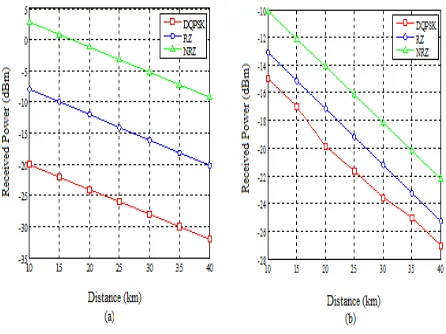
Fig. 4. Received Power v/s Distance measurements of all the three modulation formats with overlay of DPSK signal in case of (a) downstream signal at multicast, (b) downstream signal at point-to-point.
Fig. 4(a). shows the relation between distance and the optical received power in the case of multicast signal regarding all the three modulation techniques whereas Fig. 4(b). depicts the relation between distance and the
optical received power in the case of point-to-point signal regarding all the three modulation techniques. This shows that as the distance between OLT and ONU decreases the optical power get raised. The power received at ONU in case of DPSK/NRZ is higher as compared to RZ and DQPSK in case of the multicasting. On the other hand in the case of point-to-point signal transmission the DPSK/NRZ is at the apex with -10 dB at the distance of 40 km. Hence the highest power we achieved in the case of DPSK/NRZ in both multicast and point-to-point transmission when the transmitted power is kept at 0 dB. F ig. 5(a). elucidates the kinship between extinction ratio and bit error rate (BER) power in the case of multicast signal regarding all the three modulation techniques whereas Fig. 5(b). depicts the relation between extinction ratio and the bit error rate (BER) in the case of point-to-point signal regarding all the three modulation techniques. The extinction ratio (ER) of intensity modulator is kept as limited between the range of 1 - 2 dB and > 9 dB so as to get the both superimposed and point-to-point signal on the receiver side demodulated and received appropriately by keeping the extinction ratio of the Mac- Zehender intensity modulator of DPSK constant as well as high relatively as compared to the extinction ratio of the point-to-point signal. As here we have taken the extinction ratio of 20 dB of the DPSK intensity modulator. On the other hand if we kept the extinction ratio between the range of 3 – 9 dB the both signals multicast signal as well as the point-to-point signal would suffer from the fluctuations and thus signals may not get demodulated properly at the optical network units.
Fig. 5. Extinction Ratio v/s BER measurements of all the three modulation formats with overlay of DPSK signal in case of (a) downstream signal at multicast, (b) downstream signal at point-to-point.
ISSN 2348 – 7968 get demodulated properly at the ONU and the lowest BER
is observed in case of RZ that is 10-13 at 18 dB extinction ratio. DPSK/DQPSK has lower chance of being demodulated even at higher extinction ratios as compared to other two modulation schemes. On the other hand in the case of point-to-point transmission the signal gets more accurately demodulate as the BER in this case goes to approximate up to 10-27 when the extinction ratio is kept at 18 dB in the case RZ following by NRZ and then DQPSK. Hence DPSK/RZ signal gets demodulated properly as compared to other two in both the cases of multicasting and point-to-point.
.
5. Conclusion
In the nutshell, we proposed the WDM-PON architecture which comprising of the multicasting as well as point-to-point transmission of the signal by applying various modulation techniques namely RZ , NRZ and DQPSK by overlaying the DPSK signal. Thus we have set the limits of the extinction ratio to get genuine demodulation of the signal and visualized the response of BER by varying the distance between OLT and ONU moreover we analyzed that signal gets more appropriately demodulate in the case of point-to-point transmission as weighing to multicasting transmission.
References
[1] E. S. Son, K. H. Han, J. K. Kim, and Y. C.
Chung, “Bidirectional WDM passive optical network for simultaneous transmission of data and digital broadcast video service,” J. Lightw. Technol., vol. 21, no. 8, pp.1723–1727, Aug. 2003.
[2] J. H. Moon, K. M. Choi, and C. H. Lee, “Overlay of broadcasting signal in a WDM-PON,” in Opt. Fiber Commun. Conf. and Nat. Fiber Opt. Eng. Conf. (OFC/NFOEC 2006), Anaheim, CA, Paper OTHK8.
[3] M. Khanal, C. J. Chae, and R. S. Tucker,
“Selective broadcasting of digital video signals over a WDM passive optical network,” IEEE Photon.Technol. Lett., vol. 17, no. 9, pp. 1992– 1994, Sep. 2005.
[4] C. A. Chan, M. Attygalle, and A. Nirmalathas, “Provision of independent services in WDM passive optical networks using closely separated dual baseband channels,” in Opt. Fiber Commun. Conf. and Nat. Fiber Opt. Eng. Conf. (OFC/NFOEC 2007), Anaheim, CA, Paper JWA48.
[5] N. Deng, C. K. Chan, L. K. Chen, and C. Lin, “A WDM passive optical network with centralized light sources and multicast overlay,” IEEE Photon. Technol. Lett., vol. 20, no. 2, pp. 114– 116, Jan. 15, 2008.
[6] P. P. Iannone, K. C. Reichmann, and N. J. Frigo, “High-speed point-to-point and multiple broadcast services delivered over a WDM passive optical network,” IEEE Photon. Technol. Lett., vol. 10, pp. 1328–1330, Sept. 1998.
[7] U. Hilbk, T. Hermes, J. Saniter, and F.-J. Westphal, “High capacity WDM overlay on a passive optical network,” Electron. Lett., vol. 32,
no. 23, pp. 2162–2163, 1996. [8] T. Y. Kim and S. K. Han, “Reflective SOA-based
bidirectional WDM-PON sharing optical source for up/downlink data and broadcasting transmission,” IEEE Photon. Technol. Lett., vol. 18, no. 22, pp. 2350–2352, Nov. 15, 2006.
[9] M. Khanal, C. J. Chae, and R. S. Tucker,
“Selective broadcasting of digital video signals over a WDM passive optical network,” IEEE Photon.Technol. Lett., vol. 17, no. 9, pp. 1992– 1994, Sep. 2005.
[10] C. A. Chan, M. Attygalle, and A. Nirmalathas, “Provision of independent services in WDM passive optical networks using closely separated dual baseband channels,” in Opt. Fiber Commun. Conf. and Nat. Fiber Opt. Eng. Conf. (OFC/NFOEC 2007), Anaheim, CA, Paper JWA48.
[11] N. J. Frigo, P. P. Iannone, P. D. Magill, T. E. Darcie, M. M. Downs, B. N. Sesai, U. Koren, T. L. Koch, C. Dragone, H. M. Presby, and G. E. Bodeep, “A wavelength-division multiplexed passive optical network with cost-shared components,” IEEE Photon. Technol. Lett., vol. 6, no.11, pp. 1365–1367, Nov. 1994.