Available Online atwww.ijcsmc.com
International Journal of Computer Science and Mobile Computing
A Monthly Journal of Computer Science and Information Technology
ISSN 2320–088X
IJCSMC, Vol. 4, Issue. 3, March 2015, pg.158 – 164
RESEARCH ARTICLE
Mobile Based Campus Information
Retrieval Android Application
Ankit Bansal
1, Ajit Rana
2, Akhil Bansod
3, Prafulla Baviskar
4¹
Department of Computer Science Savitribai Phule Pune University, India²Department of Computer Science Savitribai Phule Pune University, India
³Department of Computer Science Savitribai Phule Pune University, India
4Department of Computer Science Savitribai Phule Pune University, India
1
[email protected]; 2 [email protected]; 3 [email protected]; 4 [email protected]
Abstract— Android is an open source mobile operating system based on Linux with Java support. It comes
under free and open source software licenses. As per initial quarter Report of the year 2014, 900 million people are using Android based devices worldwide and 76.6% of all smart phone market is occupied by android based smart phones. In a real world scenario, such as college campus, the information is in the form of notice, hand-written manual, verbal message, is being spread among the students. Today it is of the essence to not only use the predictable forms of statement, but also new forms such as cell phone technology, for faster and easier communication among the students. The android based Mobile Campus is developed to provide students with information regarding library books availability, any placement activities, general notices, and important notices regarding all departments. This Mobile Campus application includes functionality such as locating current location of users, showing college campus map, route direction of college and gives small description & contact information of important places like hospital and ambulance near campus of emergency purpose. This information should be provided to students in a cost efficient mode. So to accomplish the same, we have developed this application, where students can admittance this information by means of their Android mobile phone. The approach of communication is Android. Students need not line up near notice board / log on to college website for any of the above-mentioned details.
Keywords— Android, MVC Architecture, JSON, Web Services, Information Retrieval
I. INTRODUCTION
As most of us are aware, most of the smart phones and tablets nowadays are running on Android platform which is open source and this platform provides developer to create any application as needed. Mobile based Campus Information Retrieval [11] is Android platform based mobile application is used to create an efficient environment and make sure that student and teachers can admittance information at any time. On campus Information System helps the students and lecturers to find and access information, based on ad-hoc basis; they only need an Android-based smart phone. Android is an Open Google mobile platform which provides better suppleness, Easy to Develop User Interface and Rapid Application Development with rich API collection. It is mixture of C, C++ and Java languages.
Based on Model View Controller (MVC)[1] Architecture Mobile Based Campus Information Retrieval can be developed into multiple platforms like Apple ios, windows phone, Blackberry, Symbian so further to multiple clients.
II. PROBLEM STATEMENT
Design And Develop A Complete, Integrated Android Based Mobile Campus Application To Provide Students With Information Regarding Departmental Details, Library Books Details, Placement Activities, General Notices, College Administration Details, Hostel Details, Transportation Details And Admission Details. This Information Should Be Provided To Students In A Cost Effective Way.
III.EXISTING SYSTEM
The Existing system for in majority of the college campus for maintaining the records and other information is annual process. Taking existing system keen on deliberation, it can be found that the student has to regularly interact with the office personally, concise on the necessities they anticipate and so on. All these require more employment and time. The information collected may be conflicting, superfluous and getting in touch with a remote Student will become unfeasible. There would be lack of follow-ups and co-ordination. As the system is manual, the chances of errors are more. There may be chance to happen selection process to occur at more than one place, with regard to the existing system it would be hilarious to maintain records on venue, batches etc. Students used to write their complaints on a cheat and were supposed to add to the complaints box. That may or may not be reviewed.
A. The limitation of existing system:
Requires many departments to handle variety of tasks and involves lot of paper work. No proper assignment of responsibilities would be there.
There is no automation and centralization of records.
Low and dragging access to records and details on employees. Loss of records is likely to occur, as it is paperwork.
Accumulation of records as organization extends. Becomes more difficult as task becomes more complex.
Difficulty in establishing and developing organizational capabilities of commitment, competence and coordination.
Inability in understanding the benefits of increased organizational and managerial effectiveness.
IV.PROPOSED SYSTEM
The proposed system for Campus Information retrieval is fully an automated one using Wireless Android. In the proposed system, the Student online can Register the details and requirements put forward by them for TPO requirements. In proposed system, the student can download the study material such as question bank, assignment questions, tutorials, notices, etc, students can get directions to college location based[5]. The proposed system is a centralized one, by which the data One-click email, college map, ERP, latest News redundancy can be avoided; furthermore the coordination between different departments becomes much easier. Principally the system provides high security for all its data.
A. The need of proposed system:
Easy updating of information Provides online registration facility
Status of processing can be verified and identified at any stage of process Efficient allocation of resources
Ensures timeline management
V. ARCHITECTURE
A. Model View Controller(MVC)
Architectural MVC (Model-View-Controller) will be used in making a project application that aims to develop great software that will be easy to maintenance and repair as well as giving additional code or reducing code. In the process of developing academic management information system based android platform, each layer in the architectural of MVC (Model-View-Controller)[2] will be implemented differently such as MySQL[7] database serves as a model, based on the Android platform will be the user interface view, and JSON web service as a controller. Below is a general description of the system of academic management information system that has been built using the implementation of the MVC architecture (Model-View-Controller)[10] in which each element has a role in making each of these applications.
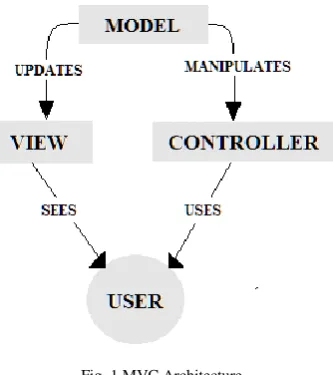
Model View Controller as it is generally called MVC, is a software design pattern used for developing various web applications which are widely used nowadays. A MVC pattern is made up of the following three parts:
Fig. 1 MVC Architecture
1) Model: This is the lowest level of the pattern which is responsible to maintain the data. The model is a
component that is used to retrieve information from the database/data sources. Functions contained in the Model will be called by the Controller. Campus Information Retrieval System applications that serve as a model here is the database where the database used is MySQL. This is a database program that accesses the network so it can be used for the application of Multi User. MVC is popular design pattern as it separates the business logic from the graphical user interface layer and supports partition of concern. All the requests from user are received by the controller for the application and then works with the Model to prepare the data preferred by the View. The data that is prepared by the Controller is used by the View to generate a final respectable rejoinder.
The database roles are:
Receive and generating query parameters sent by the web services (Using HTTP). Executing queries raised.
To send the results of queries back to the web service using JSON object and server side scripting.
2) View - View is responsible for User Interface, displaying all or a portion of the data that is required to
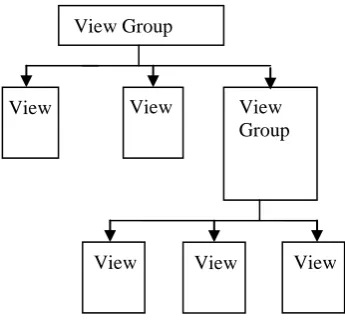
the user. View is a module that is responsible for the data presentation and GUI to the user. View displays the data acquired by Controller. In campus information retrieval Applications development that act as view here is the user interface based on platform android mobile application. User Interface on android built using objects from View and View Group. Development Base to make User Interface on Android platform is the View. The object of the View that serves as a user interface is determined as Widget. View class is responsible to serve as base to subclass widgets, which offers the entire user interface objects such as text fields and buttons. View Group class handles subclass basic layout, which offers various kinds of layout architecture.
The role of the android device applications are:
Layout setting for the application which will be made in xml format.
Fig. 2 Architecture of Android User Interface
3) Controller – It is the software code that controls the connections between the Model and View.
Controller is a component that serves to invoke a function in the model and send the results via the View, Controller also taking input from the user which would then be processed by the Model. JSON (JavaScript Object Notation)[8] is a data swap format that is lightweight so that it will be easier to be read and written by the user, it will also be able to be translated and generated by the computer. JSON is an independent text format which applies common language and not requires any special language programming.
JSON (JavaScript Object Notation) using the following form:
Object is a pair of name / value which is not classified. Object begins with the symbol "{" (open brace) and ends with "}" (curly braces). Each name is followed by a ":" (colon) and any name / value pairs separated by "," (comma).
Array is a collection of in series value. Array begins with "[" (open bracket) and ends with "]" (square brackets lid). Each value is separated by "," (comma).
Web Service Role is
Receive variable input from the application GUI page; compile them into parameters that will form a query. Calling a stored procedure or function, while sending queries compiler parameters.
Catch the query execution results delivered by the model / database.
Regulate the process of presenting the information to be sent to the component view.
B. Information Retrieval Algorithms
1) Retrieval Algorithm: The main task in information retrieval [9] is to retrieve exact information from
documents or databases. We can differentiate the algorithms based on speed and extra memory required. Sequential text scanning: It sequentially scans the document. The running time is directly proportional to the size of the text, for example, in string searching.
Text Indexing: The ―index‖ (based on different algorithms used) of the document is indexed, which is used to speed up the search. The index size is generally proportional to the database size, and the searching time of text is sub linear to the size of the text as in inverted files.
Generic Searching Problem is as follows: Given a string t (the text), a regular expression q (the query), and information (optionally) obtained by pre-processing the sample and/or the text, the dilemma consists of verdict whether tє∑*qє∑*(q for short) and obtaining several or all of the following information:
The location where an occurrence (or specifically the initial, the greatest, etc.) of q exists. Formally, if tє∑*qє∑*(q for short), to find position m >= 0 such that to tє∑ (from 0 to m) qє∑*. For example, the first occurrence is defined as the least m that fulfils this condition.
The number of occurrences of the text pattern in the document.
All the places where the pattern occurs (the set of all possible values of m). Generally, the complexities of these problems are different.
The efficiency of retrieval algorithms is crucial, since we look ahead to them to solve on-line queries with a petite respond instant. This need has triggered the performance of retrieval algorithms in many different ways: by parallel machines, by hardware, and so on. As generic searching algorithm is NP Complete so system can be said NP Complete.
2) Filtering Algorithms: These algorithms are such that the text given by the user in search field is the
input and a filtered or processed version of the text is the output send as parameter to the model. This is a usual alteration in IR, to reduce the size, simplify searching, remove illegal or not important words from the text, and/or to convert the text to standardize formats.
View Group
View View
The common filtering operations are:
Most common words are removed using a list of stop words; Uppercase letters changed to lowercase letters;
Special/Illegal symbols are removed and sequences of spaces reduced to one space; Dates and numbers are transformed to a standard format;
Word stemming (removing prefixes and/or suffixes); Automatic extraction of keywords;
Word ranking.
These filtering operations may have some disadvantages. Any query, before communicating the database, must be filtered; and, it is time consuming task to search for common words, special symbols, or uppercase letters, and to decide the text that is mapped to the same required internal format.
3) Indexing Algorithms: The indexing is to build a data structure that will allow fast searching of the text
from the large set of documents. There are several types of indices, based on different information retrieval approaches, e.g. signature files, B+ Trees tries, inverted index files, and so on.
Nearly all types of indices are based on some kind of tree or hashing data structure. Possibly the main exceptions are the clustered data structures, and Direct Acyclic Word Graph (DAWG), that represents all likely sub words of the text to be partitioned by means of a linear amount of space which is based on automata theory. Typically, before indexing, the text is filtered. Figure 3 shows the complete process for the text.
Fig. 3: Text pre-processing
The pre-processing time required to make the index is amortized by using it in searches. For example, if to build the index requires O (n log n) time, we can expect to query the database at least O (n) times to amortize the pre-processing cost. In this case, we add O (log n) pre-pre-processing time to the total query time.
C. Mathematical Representation
In most of the modules the data will retrieved from server, for this the student or admin has to login it to server where the data from database will search and authenticate to user. When user login then various notices/information will be retrieved automatically and some as required through database. This information should retrieve fast and should retrieve according to its priority so generic search algorithm and index algorithm will be used for efficient searching. Let S be the system describing problem of Mobile Based Campus Information Retrieval System.
S= {U, AD, AS, M}; Where,
U= {U0, U1, U2…Un| 0 < n < K};
Where, U is a set of users (Guest/Students), AD= {AD0, AD1, AD2 …ADn|0 < n < K}; Where AD is Admin (Teachers),
AS= {AS0, AS1, AS2 …ASn|1 < n < K}; Where AS is Application Server
M= {L, D, M, G, Lr, E, T}; Where L=library access module D = Dinning module M = Mailing module
G = Maps module
Lr = Learning Room module E = Emergency module T = Transport module
Use case pulling details: S = {I, C, O}
Where, I =represents input to the system,
C= is Credentials required to pull the information, O= is Output provided by the system.
Input:
I= {D, KP}
Where, D is a set of Data, Filtering operations
KP is a set of Knowledge based patterns. C = {U, Pa}
Where, U – Username of Admin/viewer Pa – Password of Admin/viewer Output:
O = {Pd, KP} Where,
Pd is a set of processed data,
KP is a set Responded Knowledge based patterns. Initial Condition:
AS= {AS0, AS1, AS2 …ASn|1 < n < K}; U= {U0, U1, U2…Un| 0 < n < K};
AD= {AD0, AD1, AD2 …ADn|0 < n < K}; Success:
D=
D= {D1, D2, D3… Dn}; O= {Pd, KP, N};
Where, N – notifications to the user Failure:
D= ; O=
D. Performance and Correctness Measure
Several different procedures for evaluating the performance of information retrieve systems have been developed. All familiar procedures described assume a truth concept of relevancy: every document is identified to be either relevant or non-relevant to a particular uncertainty. In reality uncertainty may be not well-posed and there can be different types of relevancy.
1) Precision: It is the portion of the documents reclaim that are relevant to the user's information need.
Precision=| {relevant documents} ∩ {retrieved documents}| / |{retrieved documents}|
Precision is equivalent to positive predictive value in binary classification. Precision takes all retrieved documents into account. It can also be evaluated at a given cut-off rank, taking concern only the highest results returned by the system.
2) Recall: Recall is the fractions of the documents that are relevant to the query that are successfully
retrieved. Recall=| {relevant documents} ∩ {retrieved documents}| / |{ relevant documents}|
Recall is generally called sensitivity in binary classification. So it can be seen as the probability that a relevant document is retrieved by the user. It is insignificant to achieve recall of 100% by returning all documents in response to any query. Therefore recall alone is not enough, but it needs to measure the number of non-relevant documents also, for instance by computing the precision.
3) Fall-out: Fallout is the proportion of non-relevant documents that are retrieved, out of all non-relevant
documents available. Fallout =| {non-relevant documents} ∩ {retrieved documents}| / | {non relevant documents}|. In binary classification, fall-out is closely related to specificity and is equal to (1-specificity). It can be looked at as the probability that a non-relevant document is retrieved by the query. It is insignificant to achieve fall-out of 0% by returning no documents in response to all queries.
VI.CONCLUSIONS
Therefore in the real world scenario, such as college campus, the information in the form of notices, handwritten manuals, oral communication, can be directly communicated through the android devices and can be made available for the students, teachers directly for their android devices and the maintenance of application will be easier in later future because of the use of architectural MVC which separates the major works in the development of an application such as data management, mobile user interface display and web service which will be the controller to make sure for fast and efficient maintenance of application.
ACKNOWLEDGEMENT
REFERENCES
[1] Ni L. P. Pravina Utpatadevi, A. A. K. Oka Sudana, A. A. Kt. Agung Cahyawan, , ―Implementation of MVC (Model-View-Controller) Architectural to Academic Management Information System with Android Platform Base‖ International Journal of Computer Applications, vol. 57, no. 8, 1-6, November 2012, doi: 10.5120/9131-3313.
[2] Hyun Jung La, Soo Dong Kim, ‖Balanced MVC Architecture for Developing Service-Based Mobile Applications‖, IEEE e-Business Engineering (ICEBE), pp 292-299, 10-12 Nov. 2010, doi:10.1109/ICEBE.2010.70.
[3] Fiawoo, S.Y.; Sowah, R.A. ―Design and development of an Android application to process and display summarised corporate data‖ IEEE 4th International Conference Adaptive Science & Technology (ICAST), 25-27 Oct. 2012, pp 86-91, doi: 10.1109/ICASTech.2012.6381072.
[4] Sunguk Lee, Pohang, Korea‖Creating and Using Databases for Android Applications‖ International Journal of Database Theory and Application Vol. 5, No. 2, June, 2012.
[5] Xianhua Shu, Zhenjun Du ; Rong Chen ―Research on Mobile Location Service Design Based on Android‖, IEEE Wireless Communications, Networking and Mobile Computing, pp 1-4, 24-26 Sept. 2009, doi: 10.1109/WICOM.2009.5302615
[6] http://id.wikipedia.org/wiki/MVC [7] http://en.wikipedia.org/wiki/MySQL
[8] Boci Lin, Yan Chen; Xu Chen; Yingying Yu ―Comparison between JSON and XML in Applications Based on AJAX‖, Computer Science & Service System (CSSS), pp 1174-1177, 11-13 Aug. 2012, doi: 10.1109/CSSS.2012.297.
[9] Jinal H tailor, Gaurang k Panwala ―Performance Based Study and Comparative Analysis of Various Algorithms and Techniques In Information Retrieval‖, International Journal of Advanced Networking Applications.
[10] Daecon, John. 2009. Model-View-Controller (MVC) Architecture. [11] http://en.wikipedia.org/wiki/Information_retrieval.
[12] Begun, D. A. (2011). ―Amazing Android Apps For Dummies‖, Wiley Publishing, Inc, Indiana. [13] M. L. Murphy, ―Android Programming Tutorials.‖ Commons Ware, LLC, 2011.