International Journal of Computer Science and Mobile Computing
A Monthly Journal of Computer Science and Information Technology
ISSN 2320–088X
IJCSMC, Vol. 4, Issue. 6, June 2015, pg.892 – 900
RESEARCH ARTICLE
On Battery Energy Consumption in IEEE 802.15.4
for Wireless Sensor Networks with and without
Guaranteed Time Slots
Sukhvinder S Bamber
Department of Computer Science & Engineering, Panjab University SSG Regional Centre, Hoshiarpur, Punjab, India
Abstract— The main objective of this paper is to minimize the battery energy consumption in 802.15.4 for Wireless Sensor Networks (WSNs). This paper presents the simulation results of three scenarios: with Guaranteed Time Slot (GTS), Mixed and Without GTS for Fully Functional Devices (FFDs) and Reduced Functional Devices (RFDs). It is revealed that battery energy consumption is reduced to minimum in case of GTS enabled devices as compared to the non GTS devices.
Keywords — GTS, FFD, RFD, IEEE 802.15.4, WSN, Battery Energy Consumed;
I. INTRODUCTION
Most of those research studies have typically focused on evaluation/improvement of some characteristics of the standard protocol either analytically or by simulation. [1] addresses the performance evaluation of IEEE 802.15.4 GTS mechanism, and it is a research effort aiming at assessing IEEE 802.15.4/ZigBee protocol as a candidate technology within the ART-Wise framework. [2] describes the most important features of the IEEE 802.15.4 protocol that are relevant for WSNs, and discusses the ability of this protocol to fulfill the different requirements of WSNs and to resolve inherent paradoxes involving power-efficiency, timeliness guarantees and scalability issues. Sharath et al. [5] have classified and compared the GTS allocation and scheduling algorithms in IEEE 802.15.4 for WSNs. Authors of [6] have proposed a Multi-Factor Dynamic GTS Allocation Scheme (MFDGAS) to improve the utilization of GTS bandwidth. Also this MFDGAS scheme determines allocation of GTS by taking the data size, delay time and the utilization of GTS time slot into consideration. In [7] Naoki Hayashi and Shigemasa Takai have proposed a modified version of the standard IEEE 802.15.4 protocol where each agent communicates through a PAN coordinator with a superframe structure. Feng Xia et al. [8] have implemented an Adaptive and Real-Time GTS Allocation Scheme (ART-GAS) to provide differentiated services for devices with different priorities, which guarantees data transmissions for time sensitive and high-traffic devices. In [9] Feng Wang et al. have first analyzed the performance of the contention access period (CAP) specified in the IEEE 802.15.4 standard by integrating the discrete-time Markov chain models of the node states and the channel states. Then a modified CAP is analyzed, which could significantly improve the performance of the system. In [10] J. M. Cano Garcia and E. Casilari have presented an empirical study of the effects of the channel occupation on the consumption of actual IEEE 802.15.4/ZigBee motes. The study is focused on the current demanded by a sensor node in a simple beaconless star topology when the CSMA contention algorithm introduces idle times in the activity of the radio transceiver. Jonathan Edwards et al. [11] have proved the divergence between calculated, simulated and experimental results at higher throughput. Experimental results also highlight the limitations of the MoteWorks framework with regard to channel throughput measurements. [13] provides a methodology, based on the network calculus formalism, for evaluating the performance of real-time applications using GTS mechanism in one IEEE 802.15.4 cluster. [14] authors have synchronized a ZigBee cluster-tree network by proposing collision-free beacon frame scheduling algorithms. Authors of [15] evaluate the performance of slotted CSMA/CA in case of broadcast transmissions. [16] proposes two alternative models for the service curve provided by a GTS allocation, and derive the corresponding delay bounds, in addition to that expression of the duty cycle as a function of delay bound is also derived. [18] contributes an accurate Markov chain model based analytical model for evaluating IEEE 802.15.4 CSMA/CA. [19] investigates the reason of dropping a packet and then revising the original specifications with the minimum modification to enhance its reliability in 802.15.4. In [20 - 25] authors have worked on the performance investigations, evaluation and analysis of IEEE 802.15.4. [26] aims to access different parameter settings of the protocol with some basic queuing strategies (FIFO and Priority Queuing) for each traffic priority. [28] models a WSN in a cluster-tree topology, with a given number of nodes, a given number of routers, and a given depth, and provided that a minimum service is guaranteed to every node and a router and then answers: what are the delay bounds for flow originating from nodes at a given depth in the WSN, and what are the minimum resource requirements in each router? [29] represents the most relevant characteristics of the IEEE 802.15.4 protocol, in the context of WSNs. [31]
The main contribution of this paper is the comprehensive evaluation and analysis of IEEE 802.15.4 for converting it into WSN from the simple WPAN at the cost of performance. Three different scenarios: With GTS (all GTS enabled nodes), Without GTS (All non GTS nodes) and Mixed (GTS & non GTS nodes) have been developed. Performance parameters are evaluated and analyzed at Fully Functional Device (FFD) and Reduced Functional Device (RFD) at physical, MAC and application layers of IEEE protocol stack.
This paper is outlined as: Section [I] gives the brief introduction of the IEEE 802.15.4/ZigBee and extensive literature survey. Section [II] constitutes the system description which contains node model, process model, and parametric tables of the model. Section [III] shows the results and discussions derived from the experiments carried out on different 802.15.4 scenarios. Finally Section [IV] concludes the paper.
II. SYSTEMDESCRIPTION
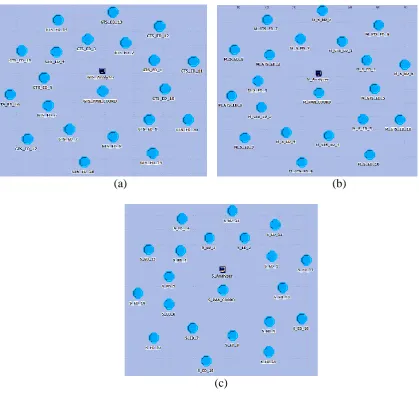
The simulation model implements physical and medium access layer defined in IEEE 802.15.4 standard. The OPNET® Modeler has been used for developing three different variants of 802.15.4 i.e. With GTS – which contains all Guaranteed Time Slot (GTS) enabled nodes, Without GTS - which contains nodes that can handle unacknowledged non GTS traffic, Mixed – which consists of With GTS and Without GTS nodes to handle both type of traffic.
(a) (b)
Fig. 1(a) shows the With GTS scenario which contains one PAN Coordinator, one Analyzer and twenty End Devices (all GTS enabled). Similarly Fig. 1(b) shows Mixed scenario which contains one PAN Coordinator, one Analyzer and twenty End Devices (ten GTS enabled and ten non GTS). Fig. 1(c) shows Without GTS scenario which contains one PAN Coordinator, one analyzer and twenty End Devices (all non GTS). PAN Coordinator is a FFD which manages functioning of the whole network. Analyzer is a routing device which routes the data between PAN coordinator and the End Devices. End Devices are the RFDs that communicate to the PAN Coordinator in Peer to Peer mode and can support both GTS and non GTS traffic.
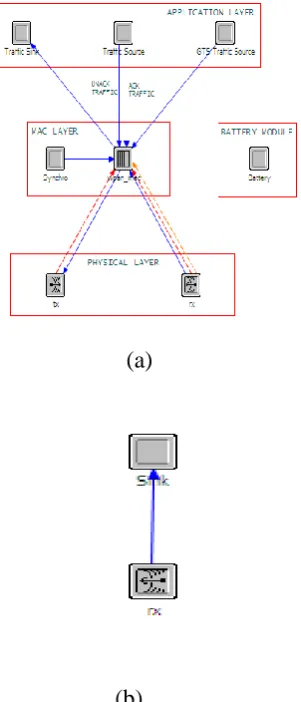
Fig. 2 shows the node models for the 802.15.4 WPAN devices used for modeling three different scenarios. PAN Coordinator, GTS and Non GTS End Device have the same node model as shown in Fig. 2 (a) while the node model for analyzer is depicted in Fig. 2 (b).
(a)
(b)
Fig. 2: Node Model (a) PAN Coordinator, GTS and Non GTS end device (b) Analyzer
in an unbounded buffer and based on slotted CSMA/CA algorithm are transmitted to the network during the active Contention Access Period (CAP). This layer is also responsible for the generation of beacon frames and synchronizing the network when a given node acts as a PAN Coordinator. Finally is the topmost application layer which is responsible for generation and reception of traffic consists of two data traffic generators (i.e. Traffic Source and GTS Traffic Source) and one traffic sink. The traffic source generates acknowledged and unacknowledged data frames transmitted during CAP. GTS traffic source can produce acknowledged and unacknowledged time-critical data frames using GTS mechanism. The traffic sink module receives frames forwarded from lower layers. Fig. 2(b) shows the node model for the analyzer which consists of sink and a radio receiver.
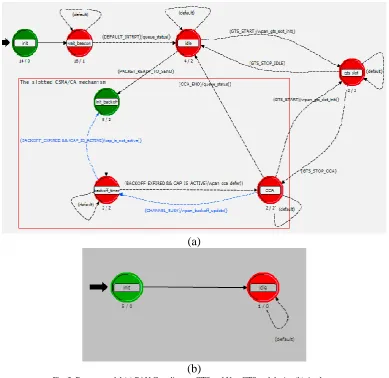
Corresponding process models for PAN Coordinator, GTS End Device, Non GTS End Device and analyzer that deals with each and every operation on the data are depicted in Fig. 3:
(a)
(b)
Fig. 3: Process model (a) PAN Coordinator, GTS and Non GTS end device (b) Analyzer
sensing the medium and transfer of data, CCA - for interrupt processing. Similarly Fig. 3(b) shows the process model for analyzer which consists of init and idle states. Basically the process model explains how the data is sent from the generating node to the PAN Coordinator, taking into consideration the availability of PAN Coordinator as it has to communicate with the other similar nodes.
Here three different Scenarios have been created in which total number of nodes is same but with different number of GTS and Non GTS nodes. Appropriate values have been given to the different parameters in different scenarios. For example: Maximum Size Data Unit (MSDU) Interarrival Time is exponential (2) for all type of devices in all scenarios; Similarly destination MAC Address for PAN Coordinator is Broadcast and for End Device is PAN Coordinator.
III.RESULTSANDDISCUSSIONS
Simulation has been carried out for three different scenarios of 802.15.4 for WSNs: With GTS, Mixed (With & Without GTS nodes) and Without GTS. In this section the results have been presented and discussed for the battery energy consumed at the FFD i.e. PAN Coordinator and RFD i.e. End Device.
A. Battery Energy Consumed at the FFD
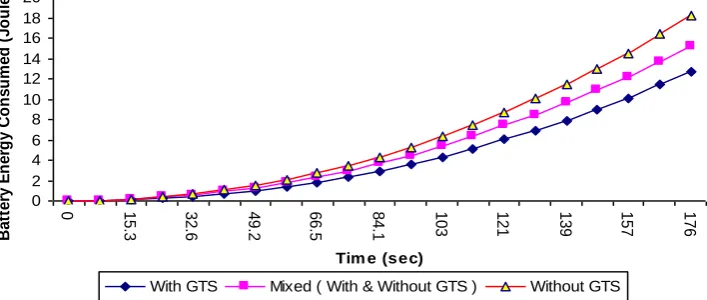
Fig. 4 shows that the battery energy consumed is 18.19463, 15.17164 and 12.68574 joules respectively for without GTS, mixed and with GTS scenarios at the PAN coordinator. It is observed that minimum energy is consumed in case of with GTS scenario because in case of with GTS scenario all nodes are GTS enabled and whenever the data is to be transmitted, enough bandwidth is reserved in advance for that particular data transmission to provide Guarantee of Service (GoS) and data to be transmitted suffers least from delays, retransmission attempts, transmission failures ([30], [31]). Also it has been observed that battery energy consumed is maximum in case of without GTS scenario as in case of without GTS scenario all nodes support ordinary traffic (i.e. non GTS) and PAN coordinator being FFD receives data from all the nodes in the 802.15.4 wireless personal area network (WPAN), since there is no bandwidth reservation for any type of data, it suffers from delays, jitters, comparatively more retransmission attempts and more transmission failures as a result of which more battery energy is consumed as compared to with GTS and mixed GTS scenarios which contain GTS feature ([30], [31]).
0 2 4 6 8 10 12 14 16 18 20 0 1 5 .3 3 2 .6 4 9 .2 6 6 .5 8 4 .1
103 121 139 157 176
Tim e (sec)
B a tt e ry E n e rg y C o n s u m e d ( J o u le s )
With GTS Mixed ( With & Without GTS ) Without GTS
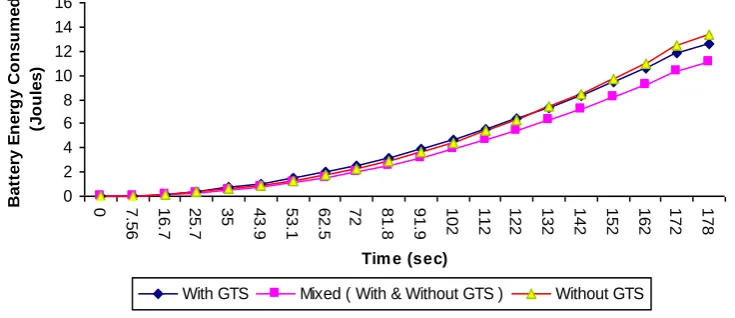
Fig. 5 below indicates that the battery energy consumed is: 13.34305, 12.59223 and 11.09392 joules respectively for without GTS, with GTS and mixed scenarios at the End Device. It is observed that minimum energy is consumed in case of mixed scenario as it is a combination of GTS and non GTS nodes and is responsible for handling its own traffic only, so depending on the type of data, it can decide whether to make the bandwidth reservations or not which further reduces the delays in getting the channel access ([30], [31]). It has also been observed that battery energy is consumed maximum in case of without GTS scenario as it is a End Device and is responsible for its own traffic only and there is no bandwidth reservation for any type of data, it suffers from delays, jitters, comparatively more retransmission attempts and more transmission failures as a result of which more battery energy is consumed as compared to with GTS and mixed GTS scenarios which contain GTS feature ([30], [31]).
0 2 4 6 8 10 12 14 16 0 7 .5 6 1 6 .7 2 5 .7 35 4 3 .9 5 3 .1 6 2 .5 72 8 1 .8 9 1 .9
102 112 122 132 142 152 162 172 178
Tim e (sec)
B a tt e ry E n e rg y C o n s u m e d (J o u le s )
With GTS Mixed ( With & Without GTS ) Without GTS
Fig. 5: Battery Energy Consumed at End device
From the Fig. 4 & 5 is observed that if we make bandwidth reservations for any type of traffic in advance then comparatively less battery energy is consumed as data is quickly transmitted from the transmitter to the receiver because of bandwidth (channel) reservation in advance. Variations in the minimum energy consumed at the PAN coordinator and End Device is because PAN coordinator is FFD and handles traffic from whole of the network while End Device is a RFD responsible for its own traffic only so comparatively less traffic, less collisions, less retransmission attempts required and also lesser transmission failures.
IV.CONCLUSIONS
the End Device is to be taken into consideration then combination of GTS enabled and non GTS devices should be preferred. Further it is concluded that in 802.15.4 if all nodes are non GTS, it results in more consumption of battery energy.
REFERENCES
[1] P. Jurcik, A. Koubaa, M. Alves, E. Tovar, Z. Hanzalek, “A Simulation Model for the IEEE 802.15.4 protocol: Delay/Throughput Evaluation of the GTS Mechanism”, Modeling, Analysis, and Simulation of Computer and Telecommunication Systems, 2007. MASCOTS '07. 15th International Symposium, 24-26 Oct. 2007.
[2] A. Koubaa, M. Alves, and E. Tovar, “IEEE 802.15.4: a Federating Communication protocol for Time-sensitive Wireless Sensor Networks”, Sensor Networks and Configurations: Fundamentals, Techniques, Platforms and Experiments, Springer – Verlag, Germany, 2007.
[3] ZigBee Specifications, http://www.zigbee.org/
[4] IEEE 802.15.4 OPNET Simulation Model, http://www.open-zb.net
[5] Sharath Rao, Saksham Keshri, Daivik Gangwar, Praveen Sundar and Geetha V., “A Survey and Comparison of GTS Allocation and Scheduling Algorithms in IEEE 802.15.4 Wireless Sensor Networks”, Conference on Information and Communication Technologies, IEEE, 2013.
[6] Ching-Li Ho, Cheng-Han Lin, Wen-Shyang Hwang and Shen-Ming Chung, “Dynamic GTS Allocation Scheme in IEEE 802.15.4 by Multi-Factor”, International Conference on Intelligent Information Hiding and Multimedia Signal Processing, Computer Society, 2013.
[7] Naoki Hayashi and Shigemasa Takai, “A GTS Scheduling for Consensus Problems over IEEE 802.15.4 Wireless Networks”, European Control Conference (ECC), Zürich, Switzerland, 2013.
[8] Feng Xia, Ruonan Hao, Jie Li, Naixue Xiong, Laurence T. Yang and Yan Zhang, “Adaptive GTS allocation in IEEE 802.15.4 for real-time wireless sensor networks”, Journal of Systems Architecture, Elsevier, 2013.
[9] FengWang, Dou Li and Yuping Zhao, “On Analysis of the Contention Access Period of IEEE 802.15.4 MAC and its Improvement”, Wireless Pers Commun, Springer, 2012.
[10] J. M. Cano Garcia and E. Casilari, “An Empirical Evaluation of the Consumption of 802.15.4 / ZigBee Sensor Motes in Noisy Environments”, International Conference on Networking, Sensing and Control, IEEE, 2011.
[11] Jonathan Edwards, Frédéric Demers, Marc St-Hilaire and Thomas Kunz, “Comparison of ns2.34‟s ZigBee/802.15.4 Implementation to Memsic‟s IRIS Motes”, IEEE, 2011.
[12] A. Cunha, A. Koubaa, R. Severino, and M. Alves, “Open-ZB: an open-source implementation of the IEEE 802.15.4/Zigbee protocol stack on TinyOS”, International Conference on Mobile Ad-hoc and Sensor Systems (MASS „07), IEEE, 2007.
[13] A. Koubaa, M Alves, and E Tovar, “GTS Allocation Analysis in IEEE 802.15.4 for Real-Time Wireless Sensor Networks”, International Workshop on Parallel and Distributed Real-Time Systems (WPDRTS „06), Greece, 2006.
[14] A. Koubaa, M Alves, M. Attia and A. V. Nieuwenhuyse, “Collision-Free Beacon Scheduling Mechanisms for IEEE 802.15.4/Zigbee Cluster-Tree Wireless Sensor Networks”, HURRAY-TR – 061104, Nov 2006. [15] A Koubaa, M Alves, and E. Tovar, “A Comprehensive Simulation Study of Slotted CSMA/CA for IEEE
802.15.4 Wireless Sensor Networks”, International Workshop on factory Communication Systems (WFCS „06), IEEE, 2006.
[16] A. Koubaa, M. Alves and E. Tovar, “Energy/Delay Trade-off of the GTS Allocation Mechanism in IEEE 802.15.4 for Wireless Sensor Networks”, HURRAY – TR – 060103, Jan. 2006.
[17] Yu-Kai Huang, Ai-Chun Pang, and Tei – Wei Kuo, “AGA: Adaptive GTS Allocation with Low Latency and Fairness Considerations for IEEE 802.15.4”, IEEE, 2006.
[18] Zhijia Chen, Chuang Lin, Hao Wen, and Hao Yin, “An Analytical Model for Evaluating IEEE 802.15.4 CSMA/CA protocol in Low-rate wireless application”, Advanced information Networking and Applications Workshops, IEEE, 2007.
[19] Changle Li, Huan-Bang Li, and Ryuji Kohno, “Reliability Evaluation and Enhancement of IEEE 802.15.4 Slotted Contention Scheme”, IEEE, 2008.
[20] Mohsin Hameed, henning Trsek, Olaf Graeser and Juergen Jasperneite, “Performance Investigation and Optimization of IEEE 802.15.4 for Industrial Wireless sensor Networks”, IEEE, 2008.
[21] Jin – Shyan Lee, “Performance Evaluation of IEEE 802.15.4 for Low-Rate Wireless Personal Area Networks”, IEEE transactions on Consumer Electronics, IEEE, 2006.
Improvement for IEEE 802.15.4 Contention Access Period”, WCNC, IEEE, 2006.
[24] K. Zen, D. Habibi, A. Rassau and I. Ahmad, “Performance Evaluation of IEEE 802.15.4 for Mobile Sensor Networks”, IEEE, 2008.
[25] Jin – Shyan Lee, “An Experiment on Performance Study of IEEE 802.15.4 Wireless Networks”, IEEE, 2005.
[26] A. Koubaa, M. Alves, B. Nefzi and Ye-Qiong Song, “Improving the IEEE 802.15.4 Slotted CSMA/CA MAC for Time-Critical Events in Wireless sensor Networks”, International Workshop on Real-Time Networks (RTN „06), Germany, 2006.
[27] A. Koubaa, M. Alves, and E. Tovar, “Lower Protocol Layers for Wireless Sensor Networks: A Survey”, HURRAY – TR – 051101, Nov, 2005.
[28] A. Koubaa, M. Alves, and E. Tovar, “Modelling and Worst-Case Dimensioning of Cluster-Tree Wireless Sensor Networks”, Real-Time Systems Symposium (RTSS „06), IEEE, 2006.
[29] A. Koubaa, M. Alves, and E. Tovar, “IEEE 802.15.4 for Wireless Sensor Networks: A Technical Overview”, HURRAY – TR – 050702, Jul. 2005.
[30] Petr Jurick, Anis Koubaa, “The IEEE 802.15.4 OPNET Simulation Model: Reference Guide v2.0”, Technical Report, 2007.