Scholarship@Western
Scholarship@Western
Electronic Thesis and Dissertation Repository
7-15-2016 12:00 AM
A Digital Game Maturity Model
A Digital Game Maturity Model
Saiqa Aleem
The University of Western Ontario
Supervisor
Dr. Luiz Fernando Capretz
The University of Western Ontario
Graduate Program in Electrical and Computer Engineering
A thesis submitted in partial fulfillment of the requirements for the degree in Doctor of Philosophy
© Saiqa Aleem 2016
Follow this and additional works at: https://ir.lib.uwo.ca/etd
Part of the Other Electrical and Computer Engineering Commons
Recommended Citation Recommended Citation
Aleem, Saiqa, "A Digital Game Maturity Model" (2016). Electronic Thesis and Dissertation Repository. 3833.
https://ir.lib.uwo.ca/etd/3833
This Dissertation/Thesis is brought to you for free and open access by Scholarship@Western. It has been accepted for inclusion in Electronic Thesis and Dissertation Repository by an authorized administrator of
Game development is an interdisciplinary concept that embraces artistic, software engineering, management, and business disciplines. The growth of the digital game industry is enormous and gaining importance day by day. This growth imposes severe pressure and a number of issues and challenges on the game development community. In addition to functional and technological requirements, game development includes other factors that are equally important to the success of any game project. Game development is considered as one of the most complex tasks in software engineering. Hence, for successful development of good-quality games, the game developers must consider and explore all related dimensions as well as discussing them with the stakeholders involved.
This research facilitates a better understanding of important dimensions of digital game development methodology. The increased popularity of digital games, the challenges faced by game development organizations in developing quality games, and severe competition in the digital game industry demand a game development process maturity assessment. Consequently, this study presents a Digital Game Maturity Model to evaluate the current development methodology in an organization. The objective is first to identify key factors in the game development process, then to classify these factors into target groups, and eventually to use this grouping as a theoretical basis for proposing a maturity model for digital game development. In doing so, the research focuses on three major stakeholders in game development: developers, consumers, and business management.
The framework of the proposed model consists of assessment questionnaires made up of key
ii
Keywords
Digital game, game business performance, game development process, developers, consumers, game players, maturity model, empirical analysis, process assessment, game
iii
Dedicated to My Family
iv
Acknowledgments
First and above all, all praise goes to Allah Almighty, who is most merciful and beneficent. I am very thankful to Almighty Allah, most Gracious, who in His infinite mercy has guided and granting me the capability to proceed successfully to complete this PhD work. It would not have been possible without His guidance and blessings.
I would like to express my sincere gratitude to my Supervisor, Dr. Luiz Fernando Capretz, for the continuous support of my PhD study and related research, for his patience,
motivation, and immense knowledge. His guidance helped me throughout the research and writing of this thesis. I could not have imagined having a better advisor and mentor for my PhD study. I appreciate all his contributions of time, ideas, and guidance as well as funding to make my PhD experience productive and stimulating.
I want to express my sincere thanks to Dr. Faheem Ahmed for trust, insightful discussion, and offering valuable advice, for his support during the whole period of the study, and
especially for the hard questions, which encouraged me to widen my research from various perspectives.
Besides my supervisor, I would like to thanks Dr. Arif Raza for his insightful comments and guidance during the writing process.
My sincere thanks also go to Western University of Ontario for providing me excellent opportunities and research facilities to conduct my research work and to contribute to the research world in a positive manner.
I would also take this opportunity to thank all the survey participants who used their precious time to participate in this research. Their sincere responses have helped me conduct this research in an objective manner.
v
vi
Table of Contents
Abstract ... i
Dedicated to My Family ... iii
Acknowledgments... iv
Table of Contents ... vi
List of Tables ... xii
List of Figures ... xiv
List of Appendices ... xvi
List of Abbreviations and Symbols... xvii
Chapter 1 ... 1
1 Introduction ... 1
1.1 Game Development Process ... 2
1.2 Research Objective ... 4
1.3 Research Motivation ... 5
1.4 Problem Statement ... 7
1.5 Research Paradigm and Method ... 8
1.6 Research Questions ... 12
1.7 Contribution to Knowledge... 13
1.8 Thesis Structure ... 14
Chapter 2 ... 16
2 Research Background... 16
2.1 Digital Games Concepts ... 16
2.2 Traditional Software Development vs Game Development ... 17
2.2.1 Digital Game Development ... 17
vii
2.3.2 Game Development Assessment and Maturity Models ... 27
Chapter 3 ... 29
3 Literature Review ... 29
3.1 A Systematic Review of the GDLC ... 29
3.1.1 Related Work ... 30
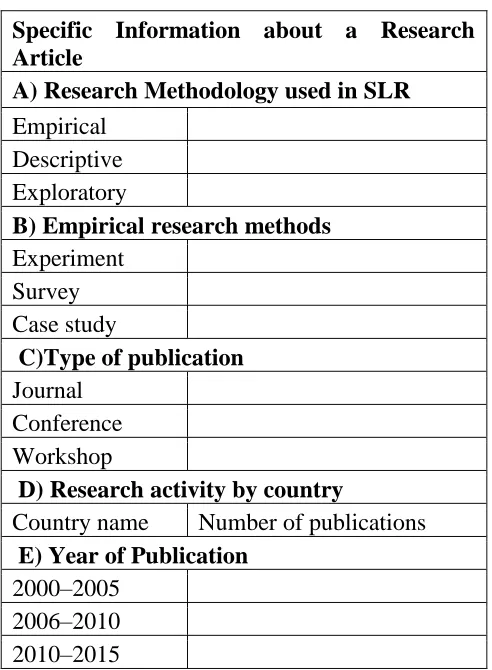
3.2 Review Methodology ... 31
3.2.1 Selection of Topic and Research Questions... 31
3.2.2 Review Team Formation... 32
3.2.3 Establishment of Review Procedure ... 33
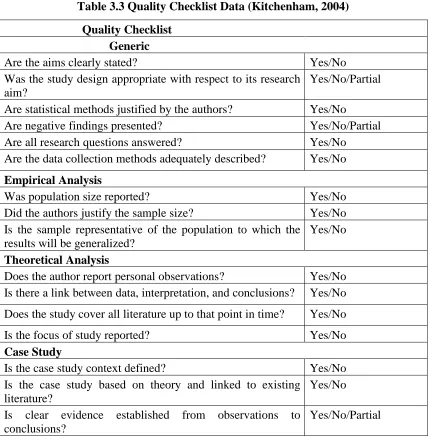
3.2.4 Quality Criteria ... 35
3.2.5 Defining Coverage Criteria ... 35
3.3 Results ... 40
3.4 Discussion ... 42
3.4.1 GDLC Research Intensity ... 43
3.4.2 GDLC Research Topics ... 45
3.4.3 GDLC Research Approach ... 58
3.4.4 GDLC Empirical Research Methods ... 59
3.5 Threats to external validity ... 60
3.6 Conclusion ... 60
Chapter 4 ... 62
4 Developer Perspective for Game Development: An Empirical Investigation ... 62
4.1 Research Motivation for Inclusion of the Developer’s Perspective ... 63
4.2 Literature Review of the Factors ... 64
4.2.1 Team Configuration and Management ... 64
viii
4.2.4 Game Asset Management ... 70
4.2.5 Quality of Game Architecture ... 72
4.2.6 Game Test Management ... 73
4.2.7 Programming Practices ... 75
4.3 Research Model ... 77
4.4 Research Methodology ... 78
4.4.1 Measuring Instrument ... 82
4.4.2 Reliability and Validity Analysis ... 83
4.4.3 Data Analysis Techniques... 84
4.5 Data Analysis and Results ... 85
4.5.1 Phase I of Hypothesis Testing ... 85
4.5.2 Phase II of Hypothesis Testing ... 87
4.5.3 Phase III of hypothesis testing ... 88
4.6 Research Model Testing ... 89
4.7 Discussion ... 89
4.7.1 Limitations of the study ... 95
4.8 Conclusion ... 96
Chapter 5 ... 97
5 Business Perspective on Game Development: An Empirical Investigation ... 97
5.1 Research Motivation ... 98
5.2 Literature Review... 99
5.2.1 Customer Satisfaction and Loyalty ... 100
5.2.2 Market Orientation ... 101
5.2.3 Innovation ... 102
ix
5.2.6 Monetization Strategy ... 105
5.2.7 Brand Name Strategy ... 106
5.3 Research Model and Hypotheses ... 107
5.4 Research Methodology ... 109
5.4.1 Measuring Instrument ... 111
5.4.2 Reliability and Validity Analysis ... 111
5.4.3 Inter-rater Agreement Analysis... 113
5.4.4 Data Analysis Techniques... 113
5.5 Data Analysis and Results ... 114
5.5.1 Phase I of Hypothesis Testing ... 114
5.5.2 Phase II of Hypothesis Testing ... 115
5.5.3 Phase III of Hypothesis Testing ... 116
5.6 Research Model Testing ... 117
5.7 Discussion ... 117
5.7.1 Limitations and Threats to External Validity... 122
5.8 Conclusion ... 123
Chapter 6 ... 125
6 Consumer Perspective for Game Development: An Empirical Investigation ... 125
6.1 Research Background ... 125
6.1.1 Digital Game Consumer Perspective: Related Work... 127
6.2 Literature Review and Proposed Hypotheses ... 129
6.2.1 Consumer Engagement ... 129
x
6.2.5 Socialization ... 135
6.3 Research Model ... 135
6.4 Research Methodology ... 137
6.4.1 Measuring Instrument ... 138
6.4.2 Reliability and Validity Analysis ... 140
6.4.3 Data Analysis Techniques... 141
6.5 Data Analysis and Results ... 142
6.5.1 Phase I of Hypothesis Testing ... 142
6.5.2 Phase II of Hypothesis Testing ... 142
6.5.3 Phase III of Hypothesis Testing ... 143
6.6 Research Model Testing ... 144
6.7 Discussion ... 145
6.7.1 Limitations and Threats to External Validity... 147
6.8 Conclusion ... 148
Chapter 7 ... 149
7 A Digital Game Maturity Model ... 149
7.1 Main Audience for a DGMM ... 149
7.2 General Scope of a DGMM ... 151
7.3 Configuration of a DGMM ... 152
7.4 Framework of a DGMM ... 153
7.4.1 Ad-Hoc (Level I)... 155
7.4.2 Opportunistic (Level II) ... 159
7.4.3 Consistent (Level III) ... 164
7.4.4 Organized/Predictable (Level IV) ... 170
xi
7.6 Rating Method ... 181
7.7 Case Studies ... 183
7.7.1 Assessment Methodology ... 183
7.7.2 Organization “A” ... 184
7.7.3 Organization “B” ... 186
7.7.4 Inter-Rater Agreement Analysis ... 188
7.8 Discussion ... 189
7.8.1 Limitations of the Study... 191
7.9 Conclusion ... 191
Chapter 8 ... 193
8 Research Implications ... 193
8.1 Research Contribution ... 194
8.2 Conclusion ... 195
8.3 Future Work ... 197
References ... 199
Appendices ... 220
xii
List of Tables
Table 1.1 Research Methodology ... 9
Table 3.1 Reviewer's Involvement in SLR Tasks ... 34
Table 3.2 Publication-Specific Data ... 34
Table 3.3 Quality Checklist Data (Kitchenham, 2004) ... 36
Table 3.4 Results Found in Each Data Source ... 37
Table 3.5 Empirical Methods ... 39
Table 3.6 GDLC Classification of Topics (Kai and Card, 2000) ... 39
Table 3.7 Type of Citation and Per Year Research Activity ... 40
Table 3.8 Number of Publications by Publisher ... 41
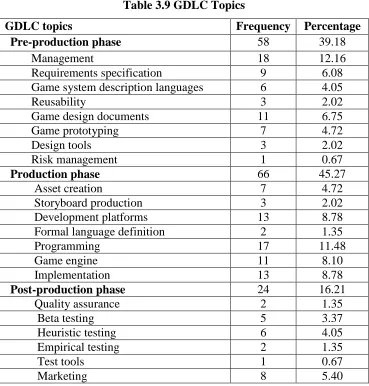
Table 3.9 GDLC Topics ... 41
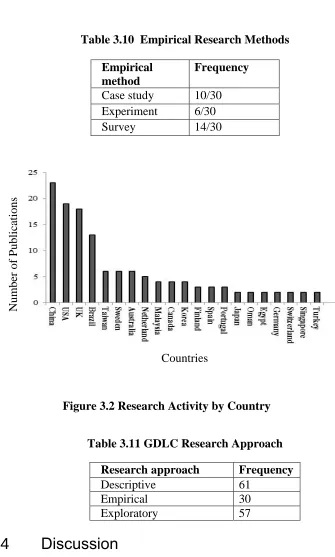
Table 3.10 Empirical Research Methods ... 42
Table 3.11 GDLC Research Approach ... 42
Table 4.1 Identified Factors from Developer’s Perspective ... 65
Table 4.2 Cronbach’s Alpha Coefficient and PCA of Seven Variables………..84
Table 4.3 Hypothesis Testing Using Parametric and Non-Parametric Correlation coefficients. ... 86
Table 4.4 PLS Regression Results for Hypothesis Testing ... 87
Table 4.5 Linear Regression Analysis of the Research Model ... 88
Table 5.1 Cronbach’s Alpha Coefficient and PCA of Seven Variables ... 112
xiii
Coefficients. ... 115
Table 5.4 PLS Regression Results for Hypothesis Testing ... 117
Table 5.5 Linear Regression Analysis of the Research Model ... 117
Table 6.1 Cronbach’s Alpha Coefficient and PCA of Five Variables ... 140
Table 6.2 Hypothesis Testing using Parametric and Non-Parametric Correlation Coefficients. ... 143
Table 6.3 PLS Regression Results for Hypothesis Testing. ... 143
Table 6.4 Linear Regression Analysis of the Research Model. ... 145
Table 7.1 Configuration of a DGMM. ... 153
Table 7.2 DGMM Framework ... 155
Table 7.3 Performance Scale ... 181
Table 7.4 Rating Thresholds. ... 183
Table 7.5 Summary of Case Study Assessment Results ... 184
xiv
List of Figures
Figure 1.1 Game Development Process ... 3
Figure 1.2 Research Phase I: Empirical Investigation of Factors ... 10
Figure 1.3 Research Phase II: Development of Digital Game Maturity Model ... 11
Figure 1.4 Research Phase III: Application of Digital Game Maturity Model ... 11
Figure 2.1 Different Roles in DGI ... 19
Figure 2.2 Elements other than Software Development involved in Game Development ... 23
Figure 3.1 Study Selection Process ... 37
Figure 3.2 Research Activity by Country ... 42
Figure 3.3 Increase in GDLC Research Activity ... 44
Figure 3.4 Research Activity by Continent... 44
Figure 3.5 GDLC Research Topics. ... 45
Figure 3.6 GDLC Research Approaches ... 58
Figure 3.7 Empirical Research Approaches. ... 59
Figure 4.1 Research Model ... 78
Figure 4.2 Distribution of Respondents by Continent ... 79
Figure 4.3 Total Game Development Duration of Particular Game Projects Considered by Respondents. ... 80
Figure 4.4 Number of Respondents Based on Their Role in the Development Process. ... 80
Figure 4.5 Percentage of Development Methodologies used by Respondents ... 81
xv
Figure 5.3 Percentage of Respondents by Organization Size ... 110
Figure 6.1 Research Model ... 136
Figure 6.2 Percentages of Respondents by Region ... 138
Figure 6.3 Percentages of Respondents for Each Game Platform Used ... 139
Figure 6.4 Percentages of Respondents Based on the Game Genres They Play ... 139
Figure 7.1 Three Main Audiences for a DGMM. ... 150
Figure 7.2 Scope of a DGMM. ... 151
Figure 7.3 Organization “A” DGMM Level 3 Responses ... 185
Figure 7.4 Responses for Game Design Strategy Dimension Process Activities for all levels of DGMM of Organization A ... 186
Figure 7.5 Organization “B” Responses at Level 2 ... 187
Figure 7.6 Responses for Game Design Strategy Dimension process activities for all levels of DGMM of Organization B. ... 188
xvi
List of Appendices
Appendix I……….………220
Appendix II………239
Appendix III……….. ………243
Appendix IV………. 247
Appendix V……….. 251
xvii
List of Abbreviations and Symbols
ACM Association for Computing Machinery
AI Artificial Intelligence
AM Asset Management
AOSE Agent Oriented Software Engineering
API Application Programming Interface
CIBM Customer-Integrated Business Model
CMM Capability Maturity Model
CMMI Capability Maturity Model Integration
CRM Customer Relation Management
DGI Digital Game Industry
DGMM Digital Game Maturity Model
DML Development Maturity Level
DPA Development Process Activity
DPR Development Performance Rating
ESI European Software Institute
EU Ease of Use
FFA Fun Factor Analysis
GED Game Engine and Development
xviii GQM Goal Question Metrics
GP Game Prototyping
GN Game development activity Number
GDPAs Game Development Process Activities
GML Game Maturity Level
H Hypothesis
HCI Human Computer Interaction
I Innovation
IEEE Institute of Electrical and Electronics Engineers
ISO/IEC International Organization for Standardization/ International Electro-technical Commission
JME Java Micro Edition
J2ME Java 2 Micro Edition
KPAs Key Process Areas
MO Market Orientation
MDP Message Driven Pojo
M3G Mobile 3D Graphics
MIT Massachusetts Institute of Technology
ML Maturity Level
xix MS1 Maintenance Support
MS2 Monetization Strategy
MVC Model View Controller
NA Number of Applicable Statement
NES Nintendo Entertainment Systems
OGRE Object-Oriented Graphic Rendering Engine
PC Personal Computer
PCA Principal Component Analysis
PLS Partial Least Square
P2P Peer-2-Peer
PHEG Playability Heuristic for Educational Games
PAEG Playability Assessment of Educational Games
PT Passing Threshold
QA Quality Architecture
QEF Quantitative Evaluation Framework
ROCA Resource Oriented Client Architecture
RPG Role Playing Game
RQs Research Questions
xx RMM Requirement Management Modelling
RUP Rational Unified Process
S Statement
SN Statement Number
SC Stakeholder Collaboration
SE Software Engineering
SEI Software Engineering Institute
SLR Systematic Literature Review
SPICE Software Process Improvement and Capability dEtermination
TCM Team Configuration Management
TM1 Test Management
TM2 Time to Market
UAT User Acceptance Testing
UML Unified Modelling Language
WWW World Wide Web
XP eXtreme Programming
2D 2 Dimensional
Chapter 1
1
Introduction
With the rapid advancement of computer technology, the significance of software engineering is increasing in our daily lives. It affects every aspect of our lives today, including working, living, learning, and education. Digital games are a popular mode of entertainment and an important technology application which have become increasingly accepted by people of all ages. The tremendous growth rate of the digital game market makes it obvious that game technology is easily accessible and has become more convenient (SUPERDATA, 2015; Newzoo, 2015). As a result, more and more people
like to play games and have become motivated to design their own games. Furthermore, the game industry is so innovative that any technological advances either in hardware or software are applied to games before being adopted by other scientific fields (McShaffry, 2003; Rhyne et al., 2000). This remarkable growth of the digital game industry is
capturing everyone’s attention and also contributing to economic growth on a national
level.
Digital game development is a complex task that requires real-time and high-quality performance. A number of game development tasks like real-time audio playback, high display frame rate, and fast processor response have an impact on game performance. Game programming is another difficult task that requires expert programmers dealing with thousands of lines of code. The variety of multi-disciplinary tasks, the low level of programming, and the large size of programs demand straightforward documentation, flexible design, and sustainable implementation. These will also help to ensure effective collaboration among the various development groups and to expedite future
developments. Consequently, game developers need best practices guidelines and an assessment model to deal with the challenges they face in carrying out current processes. Ultimately, this will help them to improve current practices and will enable them to achieve high quality levels.
No study to date has directly addressed the assessment and improvement of the digital game development process to produce high-quality games, which would be ultimately beneficial for any country’s economy. Process maturity models such as CMM (Paulka et
al., 1993) and CCMI (Lisandra & Roberto, 2003) proposed by researchers in the past can be used to assess maturity level of software development processes, but they provide guidelines only from a general perspective. However, game development is different from traditional software development and faces many specific challenges, discussed in detail in Chapter 2. Researchers so far have focused mostly on the technical aspects of game development, without considering improvements to the game development process. Other important perspectives on digital games also need to be captured, such as those of business, developers, and consumers. This effort will ultimately help to assess the maturity level of game development processes in an organization and provide guidelines to improve them. It would ultimately be beneficial to digital game performance in the market.
1.1
Game Development Process
(storyboarding, design, refinement of animations, artificial intelligence, video production, scenarios, sound effects, marketing, and finally sales) besides technological and
functional requirements (Keith, 2010). This inherent diversity leads to a greatly fragmented domain from the perspectives of both underlying theory and design
methodology. The digital game literature published in recent years has focused mainly on technical issues. Issues of game production, development, and testing reflect only the general state of the art in software engineering. Pressman (2001) stated that a game is a kind of software that entertains its users, but game development faces many challenges
and issues if only a traditional software development process is followed (Kanode & Haddad, 2009; Petrillo et al., 2009).
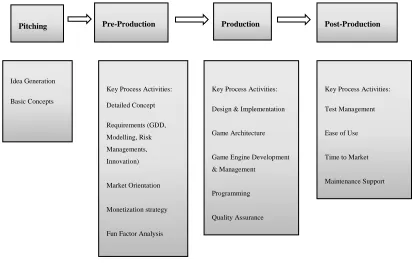
Figure 1.1 shows the general phases of the game development process and a related list of key process activities.
In traditional software engineering, the development phase usually involves activities like application design and implementation, and the production phase is when the software
Pitching Pre-Production Production Post-Production
Idea Generation
Basic Concepts
Key Process Activities:
Detailed Concept
Requirements (GDD, Modelling, Risk Managements, Innovation)
Market Orientation
Monetization strategy
Fun Factor Analysis
Key Process Activities:
Design & Implementation
Game Architecture
Game Engine Development & Management
Programming
Quality Assurance
Key Process Activities:
Test Management
Ease of Use
Time to Market
Maintenance Support
actually runs and is ready for use. However, in the Game Development Life Cycle
(GDLC), the production phase includes the development process, which is the pre-production phase of the software engineering process, and the pre-production phase of software engineering is actually the post-production phase of the GDLC (Bethke, 2003). Therefore, the GDLC is different from the traditional software engineering process, and many researchers (Kanode & Haddad, 2009) have studied the challenges faced by this domain. The most prominent observation made in these studies is that to address the challenges faced by the GDLC, more rigorous software engineering strategies must be
used. However, the proposed GDLCs by many researchers (Ramadan & Wadyani, 2013; Hendrick, 2009; McGrath, 2011; Bethke, 2003) do not ensure the quality of the
development process. Hagan et al. (2014) published a systematic literature review of software process models used for game development. They concluded that agile and hybrid approaches are used for game development by most organizations. They also reported that Scrum (Kanode & Haddad, 2009), Kanban (Polk, 2011), Rapid
Development Application (RAD) (Birchall & Gatzidis, 2013), XP (Musil et al., 2010), and incremental (Kanode & Haddad, 2009) methodologies are used by game
development organizations but no proper software process improvement initiatives were adopted. Managing game development has become a much harder process that anyone could have initially imagined, and because of the fragmented nature of the domain, no clear picture of its advancement can be found in the literature.
1.2
Research Objective
The main objective of this research is to investigate digital game process maturity from different stakeholders’ perspectives. The study focused on the following points:
1. Identification of factors that may contribute to digital game maturity assessment.
2. For purpose of digital game process assessment, a Digital Game Maturity Model (DGMM) is presented by using key factors as a measuring instrument.
Empirical investigation helped to identify key factors that have a positive influence or impact on game business performance and the development process. After key factors had been identified from different stakeholders’ perspectives, a research model is
developed to establish the relationship between these identified factors and improvements in game performance and the development process. To provide a digital game
development assessment methodology, the identified key factors from the empirical investigation are used as a measuring instrument to develop a Digital Game Maturity Model. The structure of a Digital Game Maturity Model is composed of assessment
frameworks based on identified stakeholder’s perspectives such as business, developers, and consumers. The developed model is then used to assess the current status or maturity of digital game development process by describing the assessment approach and
conducting case studies. The methodology for assessing the game development maturity profile, once the individual perspective assessment results had been obtained, became an integral feature of a Digital Game Maturity Model. The proposed model will help
management and development team such as developers, designers, artists, and project managers to carry out assessments of their development practices and find ways to improve them.
1.3
Research Motivation
SECOR (2012) reported that the digital game industry, especially video games, will generate world-wide revenues of up to US $86.8 billion by 2016. It is clearly
Lack of research in this area has also provided a motivation to select this domain. Hagan
et al. (2014) performed a systematic literature review of game development processes. They addressed three research questions:
“What are the software process models in game development?”
“What are the software process improvement (SPI) initiatives used in game development?”
“What factors influence the adoption of software process models and SPI in game development?”
A systematic literature review demonstrated that most development companies used mixed, agile, or ad-hoc approaches and that no proper SPI initiatives were adopted. They also highlighted the importance of developing best-practice models for game
development. Actually, most of the literature related to game development is found in the grey literature such as magazines, developer blogs, game development groups, and web sites of game companies. This observation lends added importance to investigating what is actually happening in game development. Vargas et al. (2014) performed a systematic mapping study on the quality of serious games. They investigated the particular quality characteristics of serious games and the methods used to investigate quality. The quality characteristics extracted from their research were effectiveness, efficiency, satisfaction, freedom from risk, and context coverage. They also identified product quality
characteristics and revealed that no studies were found for compatibility, resource utilization, maintainability, and maturity assessment of games. They also suggested the urgent need for a quality assurance method that can evaluate game quality from the early stages of development and can be applied to any game.
The proposed digital game maturity model would capture various stakeholders’
make correct decisions. This research is exceedingly beneficial to the digital game industry and also fills the research gap of concise game development process improvement guidelines and process assessment tools.
1.4
Problem Statement
The DGI has shown economic potential in both the entertainment and software industries (PWC Global Media, 2011). Organizations involved in the game development business are facing strong competition and high consumer expectations because more development companies are entering the digital game industry every day. Rapid and continual changes in technology and intense competition not only affect the business, but also have a great impact on development activities. Because the industry has high economic potential and generates million-dollar projects, it sets high standards for game performance and exerts strong pressure on organizations. To deal with this strong competition and high pressure, game development organizations must continuously assess their activities and adopt a proper evaluation methodology. Use of a proper assessment methodology will help the organization identify its strengths and weaknesses and provide guidance for
improvement. However, the fragmented nature of the game development process requires
a comprehensive evaluation strategy which has not yet been entirely explored.
An assessment framework is therefore proposed here to develop a comprehensive strategy for game development and a performance maturity model. The maturity scales are identified by initial frameworks for each perspective: business, developers, and consumers. The important steps in the digital game performance assessment framework can be described as follows.
Research problem - I: Identification of factors that make a direct or indirect contribution
to maturity assessment of digital games.
Research problem (i): Framework to evaluate the developer’s perspective factors
in digital game development and performance.
Research problem (ii): Framework to evaluate the business perspective factors in
Research problem (iii): Framework to evaluate the consumer perspective factors
in digital game development and performance.
Research problem - II: Development of a Digital Game Maturity Model for the game
development process and its performance in an organization.
Research problem (i): Maturity scales for digital game performance.
Research problem (ii): Assessment questionnaire for digital game performance.
Research problem (iii): Rating methodology for digital game performance.
Research problem - III: Application of a Digital Game Maturity Model to assess the
current state of game development organizations.
Research problem (i): Definition of assessment methodology.
Research problem (ii): Conducting case studies.
Research problem (iii): Results interpretation based on assessment data.
1.5
Research Paradigm and Method
The main objective of this research is to develop a maturity model for digital game performance assessment that could assess the current state of an organization. The three identified research problems were categorized into three research phases based on their
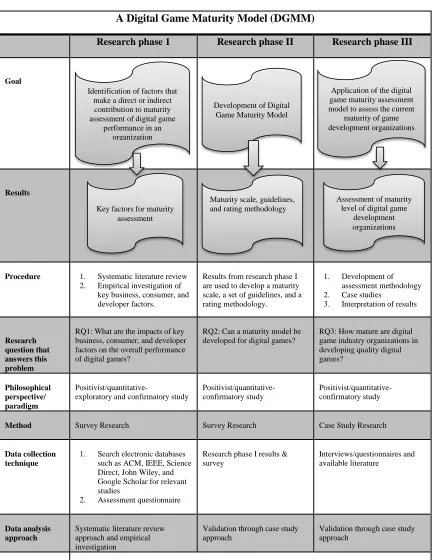
dependencies. Table 1.1 depicts the research methodology for all three phases of this research. Figures 1.2, 1.3, and 1.4 further illustrate all the steps under each research phase and the research plan used to develop a digital game maturity model for the game
Table 1.1 Research Methodology
A Digital Game Maturity Model (DGMM)
Research phase 1 Research phase II Research phase III
Goal
Results
Procedure 1. Systematic literature review 2. Empirical investigation of
key business, consumer, and developer factors.
Results from research phase I are used to develop a maturity scale, a set of guidelines, and a rating methodology.
1. Development of assessment methodology 2. Case studies
3. Interpretation of results
Research question that answers this problem
RQ1: What are the impacts of key business, consumer, and developer factors on the overall performance of digital games?
RQ2: Can a maturity model be developed for digital games?
RQ3:How mature are digital game industry organizations in developing quality digital games?
Philosophical perspective/ paradigm
Positivist/quantitative-
exploratory and confirmatory study
Positivist/quantitative- confirmatory study
Positivist/quantitative- confirmatory study
Method Survey Research Survey Research Case Study Research
Data collection technique
1. Search electronic databases such as ACM, IEEE, Science Direct, John Wiley, and Google Scholar for relevant studies
2. Assessment questionnaire
Research phase I results & survey
Interviews/questionnaires and available literature
Data analysis approach
Systematic literature review approach and empirical investigation
Validation through case study approach
Validation through case study approach
Empirical source Available literature and assessment questionnaire for digital game industry organizations. Key factors for maturity
assessment Identification of factors that
make a direct or indirect contribution to maturity assessment of digital game
performance in an organization
Application of the digital game maturity assessment model to assess the current
maturity of game development organizations
Assessment of maturity level of digital game
development organizations Development of Digital
Game Maturity Model
The research problems identified in Section 1.4 were addressed by providing appropriate solutions. A comprehensive literature review is also included in this research
methodology and helped in defining maturity level scales based on identified key factors in digital game development. A Digital Game Maturity Model is used to assign the organization a maturity profile that will help it determine and monitor its strengths and weaknesses in the activities currently performed during the game development lifecycle. It will also help the organization improve the quality and productivity of its development process. Overall, the proposed model will make it possible to assess the effectiveness of
development processes in an organization and help it predict the performance of its digital games in the market.
Figure 1.2 illustrates the research plan used to address research problem 1 and its sub-problems as identified in Section 1.4.
Solution of research problem I: Identification of factors that make a direct or indirect contribution to the maturity assessment of digital game performance.
Literature review of the
digital game development
process domain to help
identify factors that
contribute to assessing
maturity level.
Empirical investigation of key business factors
Empirical investigation of key developer factors
Empirical investigation of key consumer factors
Development of a research model based on key factors
Questionnaire preparation and survey administration to perform key factors assessment Statistical analysis of business
perspectives
Development of a research model based on key factors
Questionnaire preparation and survey administration to perform key factors assessment Statistical analysis of
developer perspectives
Development of a research model based on key factors
Questionnaire preparation and survey administration to perform key factors assessment Statistical analysis of consumer
perspectives
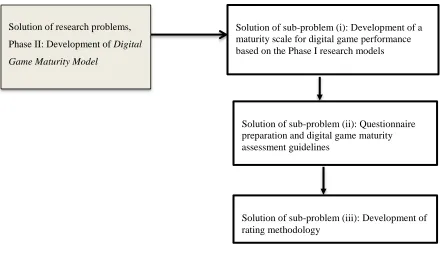
Figure 1.3 illustrates the stages of phase II of the research plan used to address problem solutions in this phase.
Figure 1.4 illustrates the phase III stages of the research plan used to address problem solutions in this phase.
Solution of research problem phase III: Application of digital game maturity assessment model to assess the current maturity of game development organizations
Solution of sub-problem (iii): Interpretation of results of assessment data
Solution of sub-problem (ii): Conducting case studies
Solution of sub-problem (i): Development of assessment methodology
Solution of research problems,
Phase II: Development of Digital Game Maturity Model
Solution of sub-problem (i): Development of a maturity scale for digital game performance based on the Phase I research models
Solution of sub-problem (ii): Questionnaire preparation and digital game maturity assessment guidelines
Solution of sub-problem (iii): Development of rating methodology
Figure 1.3 Research Phase II: Development of Digital Game Maturity Model
1.6
Research Questions
As discussed before, game development organizations have been facing strong pressure to gain and retain competitive advantage. They need to identify different ways to control budgets, reduce time to market, and improve quality. This research introduces the first
Digital Game Maturity Model for game development processes. In the digital game development field, no studies have been done that directly address the issue of process improvement and assessment. This provided the motivation to propose the Digital Game Maturity Model due to the many challenges faced by organizations in the game
development process, including i) lack of research in this area, ii) lack of development processes and good practices, and iii) lack of an assessment model.
Therefore, this research attempts to find answers to a series of research questions (RQs) to fill the research gap in game development process assessment. The answers to the research questions provided a comprehensive methodology for assessing the game development process. The answers to the research questions will also help organizations build the capability to identify gaps and bottlenecks in their current processes. The following questions constitute the theme of this research:
RQ-1: Is it possible to differentiate clearly between the software development process and the game development process?
RQ-2: Are there any frameworks for the assessment of game development processes?
RQ-3: What are the areas of game development that particularly need researchers’ attention?
RQ-4: What are the key factors that influence the game development process from a developer’s perspective?
RQ-5: Can key game development factors for game projects be identified from a business perspective?
RQ-7: How can assessment of game development processes be performed within a game development organization?
RQ-8: Can specific scales be developed to represents the maturity level of game development practices in a game development organization?
RQ-9: What are the future implications of the development of a DGMM?
1.7
Contribution to Knowledge
The main objective of this research is to assess the current maturity level of organizations in the digital game industry by proposing a Digital Game Maturity Model. This research has highlighted three major research problems in assessing the maturity level of digital game development processes. This research has focused mainly on providing solutions to these identified research problems. The main goal of this PhD research is to fill an
important research gap by providing guidelines and an assessment methodology for the digital game industry through addressing the highlighted issues. The major contributions and milestones of this thesis are as follows:
1. Development of innovative assessment framework for DGI.
2. Identification of factors (from literature review) that directly or indirectly
contribute to the maturity assessment and an assessment of critical success factors (CSFs) from different stakeholder’s perspective (developers, consumer and business). This step provides the experimental validation of the developed model.
3. Development of a Digital Game Maturity Model for digital game industry organizations using maturity assessment scales, assessment questionnaires, and a rating methodology for digital game performance.
evaluation purpose and also creates a roadmap for future game development process assessment efforts.
1.8
Thesis Structure
The organization of this thesis is based on five articles that have been published or are under review in various reputed software engineering journals. Accordingly, these articles are cited in the corresponding chapters. Chapter 2 contains a detailed discussion on research background related to game development, its different components and challenges. A summary of related work is also provided. Chapter 3 then provides a systematic literature review of the game development life cycle (GDLC).
Chapter 4 presents an empirical investigation that examines the CSFs for improving game development from a developer’s perspective. Exploring diverse developers’ preferences for digital game development will provide a significant benefit to improve the
development process by generating valuable insights. The study conducted and reported in this chapter can enhance our understanding of the developer’s perspective as a factor in digital game success. Consequently, game development organizations can use these CSFs to address issues in game development and eventually enable quality improvement of the
resulting game. Therefore, this empirical investigation provides a justification for including the identified CSFs as a measuring instrument for maturity assessment of the game development process.
As highlighted earlier, game development organizations are facing high pressure and competition in the digital game industry. Business has become a crucial dimension, especially for game development organizations. Accordingly, Chapter 5 investigates empirically the influence of key business factors on the business performance of games. This is the first study in the game development domain that demonstrates the
Finally, this study should enable game development teams to improve their understanding of the relationship between key business factors and their impact on game development.
One of the important game development choices is to consider the consumer perspective to produce quality digital games. Accordingly, Chapter 6 attempts to provide a better understanding of the consumer’s perspective as a factor in digital game success. It focuses mainly on an empirical investigation of the effect of consumer factors on the digital game development process and finally on the quality of the resulting game. This research study investigates empirically the influence of consumer key factors on digital
game development. The results provide evidence that game development organizations must deal with multiple key consumer factors to remain competitive and handle high pressure in the digital game industry.
In Chapter 7, a DGMM is presented. A DGMM facilitates a better understanding of the important dimensions of digital game development methodology. The model framework consists of assessment questionnaires, a performance scale, and a rating method. The assessment questionnaires contain factors selected from a literature review and from three empirical investigations carried out based on three stakeholder’s perspectives: developer, consumer, and business. The main goal of the questionnaires is to collect information about current processes and practices. In general, this research contributes towards formulating a comprehensive and unified strategy for game development maturity evaluation. Two case studies are conducted and their assessment results reported. These demonstrate the maturity level of current development practices in two organizations.
Finally, Chapter 8 concludes this thesis and provides a summary of the research contribution of this dissertation in the area of game development. This chapter also discusses future research directions in game development process assessment.
Chapter 2
2
Research Background
This chapter provides relevant particularities of digital games and development processes. This chapter also aims to differentiate between the traditional software engineering process and the game development process. Moreover, this chapter presents challenges of game development process along with a comprehensive overview of available software and digital game maturity assessment models.
2.1
Digital Games Concepts
Now that the DGI has reached the point that it rivals other well-established entertainment industries such as music and cinema. As a result, the digital gaming business has grown enormously, has made billions of dollars in profit, and has started to mature over time (Petrillo & Pimenta, 2010). The game development process has also had an impact on the industry, which now counts on special methodologies and mature processes for its
development, ultimately leading to an enhanced game development process.
The origins of computer games for home users lie in the 1980s. At that time, major computers included the Commodore 64, Sinclair ZX Spectrum, and Amstrad 464, which had slow 8-bit processors with limited memory. All available computers at that time came with largely the same hardware resources. This simplified the development
requirements greatly, and developers worked directly on the machines. Consequently, programmers verified the speed of developed games directly and determined whether or
not it met requirements. Another consequence of limited memory and resources was that developers had to use every clock cycle and every bit of memory to make the best game possible. Therefore, they directly programmed the available hardware, a practice that gave birth to the term, “writing directly to the metal”.
easy procedure, and different series of machines had different hardware. Therefore, platform independence was also an issue. After years and years of game development, new operating systems, hardware, and programming languages were introduced and gave birth to the modern-day game development process.
The DGI is highly innovative and dynamic. As a result, in many situations, new advances in hardware and software are directly applied to games before appearing in any other domain. Consequently, digital games support a wide variety of platforms and cover a variety of game genres (Ampatzoglou & Stamelos, 2010). The following section explores
differences between traditional software development and game development process.
2.2
Traditional Software Development vs Game
Development
This section focuses on providing an overview of game development process and intends to describe the essential differences and gaps between the traditional software
development process and the game development process.
2.2.1 Digital Game Development
The digital game development process is influenced by software development methodologies. However, game development teams’ roles are very much unlike traditional software development teams. The game development team is made up of creative and artistic members, each of whom might perform more than one role at the same time (Bates, 2004). The modern game development process is more complex because of team size and requirements and complex coding needs. Despite these
characteristics, digital game development requires an iterative process with a short analysis phase and a long creative or design phase (Redavid & Adil, 2011). The
following section focuses on describing the various elements involved in the game development process and the phases of game development in general.
2.2.1.1
Game Development Team
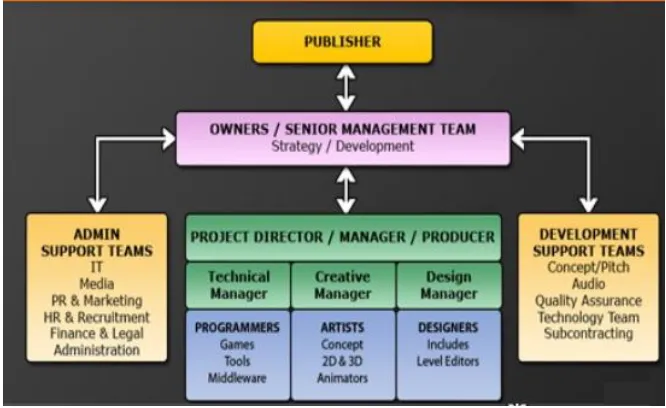
digital game industry such as publisher, owner or senior management, admin support team include IT, media, PR marketing, finance, legal administration, project
director/manager/producer and finally development team. However, to carry out game development, following are the required roles that often participate in the process.
Design team: This is made up of a lead designer, game designers, storywriters/ script
writers, and content or level designers (Liming & Vilorio, 2011). Mainly, these are responsible for game launch and the development of game design documents.
Programming team: The team is composed of a multiplayer network programmer, a lead
programmer engineer or tools programmer, an artificial intelligence (AI) programmer, a user interface programmer, and a graphics programmer (Liming & Vilorio, 2011). They are responsible for implementation of all technical aspects by selecting an appropriate game architecture, special features, and delivery platforms, considering implementation implications, and realizing the conceptual design (Bates, 2004).
Assets/Visual art creation team: Often composed of an art director, a lead artist, a
concept artist, a modeller, a 2D concept artist, a 3D model builder, a 3D character builder or animator, a 3D cut scene artist, an art technician, and a level builder (Liming &
Vilorio, 2011). This team is responsible for the creation of all visual art assets, which give a finished look to the developed game.
Audio team: This team can be formed by involving a sound/audio engineer and a
Figure 2.1 Different Roles in DGI
(adapted from: http://www.slideshare.net/iTawy/introduction-to-game-development-55854080).
Testing team: These play an important role in the game development process to ensure
game quality. The team is made up of a test lead and testers (internal or external). To carry out testing, they perform different activities involving a test plan, identification of incidents and risks, and feedback to the programmers.
The DGI does not use formal software engineering principles effectively for game development because these are not completely suitable for their projects (Bates, 2004). However, game development is considered to intersect with software engineering (Ampatzoglou & Stamelos, 2010) and to share common challenges and problems (Petrillo et al. 2009; Petrillo and Pimienta, 2010). This overlap makes SE principles a potential medium to tackle game development issues as well (Redavid & Adil, 2011).
2.2.1.2
Development phases
The common phases of the game development lifecycle can be described as follows.
Concept Phase: This phase involves idea generation for a new game project, high-level
Pre-production Phase: The main objective of this phase is to define the production path, perform game design, develop the project plan, and produce the initial prototype.
However, this phase is equivalent to the requirements phase of traditional software development, and the game design document is the final artifact of this phase.
Production phase: Game implementation is performed during this phase with the help of
the programming and asset creation team. This phase is longer than the pre-production phase.
Post-production phase: This involves testing of the final game. Testing is very
important for game development, and most of the time, it requires “black box testing” (Nidhra & Jagruthi, 2012), which makes it different from traditional software testing (Redavid & Adil, 2011; Kasurinen, 2012).
2.2.1.3
Game Development Methodologies
Software engineering (SE) refers to the application of engineering principles to software development by following a systematic approach (ISO/IEC and IEEE Computer Society, 2014). A systematic SE approach to software development is carried out by using various specialized methodologies. These methodologies are used to plan, control, and structure various development processes by following specific life cycles with clear
responsibilities, phases, iterations, and outputs (ACM, 2006). A number of software development methodologies are available. Hence, industries and organization need to investigate carefully each available approach or framework to find the one that best fits their development culture and ultimate goals.
Moreover, Kanode and Haddad (2009) stated that an important incorrect assumption has been made that game development follows the waterfall method. More recently,
researchers have agreed that it must follow the incremental model because it combines the waterfall method with an iterative process. Petrillo et al. (2009) reported a major
single answer. Few researchers have explored GDLC practices and then tried to answer questions like, “what are the phases of the GDLC?” Blitz Game Studio (2014) proposed
six phases for the GDLC, including pitch (initial design and game concept), pre-production (game design document), main pre-production (implementation of game
concepts), alpha (internal testing), beta (third-party testing), and finally the master phase (game launch). Hendrick (2009) proposed a five-phase GDLC consisting of prototype (initial design prototype), pre-production (design document), production (asset creation, source code, integration aspects), beta (user feedback), and finally the live phase (ready
to play). McGrath (2011) divided the GDLC into seven phases: design (initial design and game design document), develop/redevelop (game engine development), evaluate (if not passed, then redevelop), test (internal testing), review release (third-party testing), and finally release (game launch). Another GDLC proposed by Chandler (2010) consisted of four phases: pre-production (design document and project planning), production
(technical and artistic), testing (bug fixing), and finally post-production (post-release activities). The latest GDLC proposed in 2013 by Ramadan and Widyani (2013) was based on the four GDLCs previously described. They proposed six phases, including initiation (rough concept), pre-production (creation of game design and prototype), production (formal details, refinement, implementation), testing (bug reports, refinement testing, change requests), beta (third-party testing), and finally release (public release).
A GDLC is different from a traditional software development engineering process, and all phases of the proposed GDLC can be combined into three main phases:
pre-production, pre-production, and post-production. The pre-production phase includes testing the feasibility of target game scenarios, including requirements engineering marketing strategies; the production phase involves planning, documentation, and game
implementation scenarios with sound and graphics. The last phase post-production involves testing, marketing, and game advertising. The major difference in software
development and game development is in the design phase because design of game may undergo major change in late development. The other differences are content
exclusive; it seems that traditional SE does not fully support game development activities and provide process assessment procedures (Penzenstadler et al., 2012).
From the above discussion, it can be easily concluded that game development process is different from traditional software engineering development process. Kasurinen et al.
(2013) argued that current software engineering knowledge is unable to bridge the gap between software engineering and certain aspect of game development. The overall development process to produce a game includes art, audio and gameplay other than software development discussed above. In the game development process, the content
and production activities are performed in tandem with the development and engineering activities. Further, it is well agreed that the game development process is a
multidisciplinary activity that involves the merging of creative and technical talent to bring a concept to life, where the main activities can be categorized into content and production, and engineering at each phase of the development process.
Moreover, sometime game development organizations reduce their development process due to of high competition and extreme market demand so they can be first to market (Kaitilla, 2014). This reduction of the development process definitely affects game quality. Because of these types of complex project-management tasks, the game
development process diverges from traditional software development. Therefore, it has become important now to investigate the challenges or issues faced by game development organizations in developing good quality games.
2.3
Challenges in Game Development Assessment
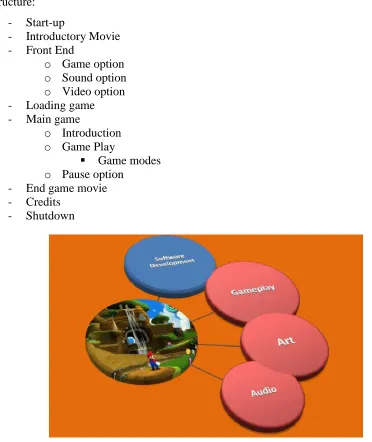
Digital games are different from movies and other software. Interactivity is the main feature that makes games different from movies, whereas the content of the game as a medium is what makes it different from other software. The final important feature of games is the fun factor. Digital games are developed for several platforms simultaneously with different architectures and are performance-sensitive. Most of the times, reusability and maintainability are not considered important for game development. However, a game engine may be reused, but most of the time, application code is not reused.
depicts the main elements of digital games. Typically, any game has the following structure:
- Start-up
- Introductory Movie - Front End
o Game option
o Sound option
o Video option - Loading game - Main game
o Introduction
o Game Play
Game modes
o Pause option - End game movie - Credits
- Shutdown
Figure 2.2 Elements other than Software Development involved in Game
Development
(adapted from http://www.slideshare.net/AhmedSaker/game-development)
software development, user experience is measured to ensure quality, and a project is
considered successful if delivered within budget and on schedule. An important question
here is how to measure the fun factor in games, which makes assessment of the game
development process challenging. Some measures are available in SE, but they are not
very applicable to game development because the later is driven by innovation.
A number of development methodologies are available, which can be followed as discussed above. Game development projects are usually a kind of large-scale software project involving large numbers of team members from diverse disciplines. Murphy-Hill
et al. (2014) mentioned that the game development process is highly agile and creative in nature, which makes development activities and methods more iterative. Therefore, these methods do not strictly meet SE standards and practices.
Many researchers have discussed game development challenges. Petrillo et al. (2009) surveyed the problems faced by game development organizations. The problems identified were categorized into four groups: scheduling problems, quality problems, budget problems, management and business-related problems. The overall game development process was considered to combine both an engineering process and the creation of artistic assets. Ramadan and Widyani (2013) compared various game
development strategies from a management perspective, and some researchers (Lee et al., 2006; Ayyad & Massod, 2010; Pena, 2011) have proposed frameworks for game
development. To manage the development life cycle effectively, guidelines based on best practices are required. Petrillo and Pimenta (2010) highlighted the presence of agile practices in game development processes. Tschang (2003) and Petrillo et al. (2009) highlighted the issues in the game development process and its differences from
traditional software development practices. Management of development-team members and their interaction is critically important in this aspect. Hullett et al. (2011; 2012) have provided data analytics and empirical analysis of the game development process and
discussed issues of interdisciplinary team involvement. Best practices in game development must consider certain elements such as staying on budget, timing and
maturity model specific to the game development process is still needed to measure these processes for better management and high performance.
Profitable game development is another challenging endeavour. Every year, over 15,000 games are published and compete for player’s attention and time (Isbister & Schaffer, 2008). This competitiveness of the global market and the high cost of developing good-quality games are reasons for the digital game industry to improve its development processes.
The following section discusses general software development assessment maturity
models and available game development maturity models.
2.3.1 General Software Development Assessment and Maturity
Models
Humphrey (1990) described a software process as a set or order of organizational activities that can be controlled by various entrance and exit criteria imposed by
machines, humans, and methods. The actual objective of software process assessment is to develop a high-quality software product within budget and on schedule that meets the needs of its stakeholders. Fuggetta (2000) provided a broad description of the software development process, specifying that it should contain software product development, deployment, and maintenance as well as organizational policies and structures, human activities, and the functionalities and technologies used in the process. The software process maturity level of an organization can be assessed by its ability to define, manage, measure, and control the software development process. Assessment of the software process maturity of an organization has emerged as a popular and vital research area in software engineering. Assessment determines the current status of software development
processes and has become an essential activity for targeting software process
The capability maturity model (CMM) (Paulka et al., 1993) was proposed by the SEI and has been adopted by most organizations in the software industry to perform software assessment. The CMM encompasses five maturity levels, ranging from the initial level 1 to the optimized level 5. Excluding level 1, each level is made up of key process areas (KPAs) and serves as an objective to achieve a certain maturity level. Each KPA has a certain set of features, and if these are collectively achieved, then the goal of the KPA has been accomplished. CMM concepts have also been included in CMMI (Lisandra & Roberto, 2003) over time to integrate various disciplines like integrated process and
product development, software engineering, system engineering, and supplier sourcing. The BOOTSTRAP (Simila et al., 1994) methodology has also been used to perform process assessment of organizations by identifying their weaknesses and strengths and offering improvement guidelines. BOOTSTRAP is also made up of five levels, but divides the process area into technology, organization, and methodology. Software Process Improvement and Capability dEtermination (SPICE) (Emam & Melo, 1997) describes a process assessment reference model for process capability assessment. SPICE is also based on CMM, but has six maturity levels with a set of nine documents.
Furthermore, the family of ISO-9000 standards is helpful for setting up a quality
management system within an organization for software maintenance and development, as well as for other purposes. ISO-9000-3 can be used to apply ISO-9001 to software supply, development, and maintenance. It also provides guidelines for documentation, responsibility, corrective actions, and software development audits to fulfil ISO-9000 requirements (Parzinger et al., 2001). ISO-12207 (Singh, 1996) provides a framework for improving software engineering and management by grouping broader classes such as primary, support, and organizational activities. ISO/IEC 15504 (Zahran, 1998) provides guidance for software process assessment concepts and addresses the two contexts of process capability determination and process improvement. In addition, some of the
approaches (Kerzner, 2005; Crawford, 2002; Murray & Ward, 2006) used for project management maturity models based on CMM have been explored in this context.
digital game development process is different from traditional software development. Its three perspectives have been identified: business, developers and consumers. The
software process assessment approaches discussed above cannot be directly used to assess digital game development processes and performance. The proposed approaches and maturity models in the literature capture only the software process aspect of product development. CMMI can be used to assess the general software process. Various
researchers in different domains, such as software product lines (Ahmed & Capretz, 2010) and usability of open software systems (Raza et al., 2012) have proposed other
maturity models. The proposed models cover the broader aspects of software products by including additional dimensions/ perspectives in the maturity assessment process. To assess digital game maturity, it is necessary to cover, not only the general perspective, but also other important perspectives that directly or indirectly contribute to the performance or maturity of digital games in the market. However, for the digital game development process and its performance assessment, no comprehensive method has been proposed that helps an organization to identify its strengths and weaknesses in the various activities performed during game development.
2.3.2 Game Development Assessment and Maturity Models
Digital game process assessment is a very new area of research, and not much work has been reported in this area. Currently, there is no prescribed and systematic way of measuring the maturity level of a digital game development process. According to de Boer et al. (2003), gamification is the application of game design and game mechanics to motivate and engage people to achieve their targets. They proposed a game maturity model that focuses on using gamification or applied gaming within an organization to gain competitive advantage. The proposed model was based on four perspectives: i) value, ii) process, iii) coverage, and iv) type, with each perspective having five levels.
Lee et al. (2006) examined the ISO 12207 (Pressman, 1999) and RUP (Lisandra & Roberto, 2000) standards and proposed a game software development process that was applicable to small and medium-sized companies. By conducting panel interviews with practical game developers from the game industry, they identified a set of core elements of game development software and performed requirements analyses for different game genres. The proposed game design process model elaborated inputs and outputs for each activity. The empirical study focused only on the processes of game development and did not cover broader aspects.
Gorschek et al. (2011) discussed the process maturity model for market-driven products from the management and requirements engineering perspectives only. The proposed model contained 70 practices, and the interdependencies among them were divided into five process areas. The dependencies among the various practices were defined in the form of AND, OR, REQUIRES, and value-based operators, but they remain to be explored in further detail. Digital games are also a market-driven product, and the proposed model will be helpful in the pre-production phase to address the need to determine and improve process maturity. However, the model is limited to the requirements engineering phase, and its validation remains to be explored.
In short, it can be observed that general software assessment models are not suitable for direct application to game development process assessment. Moreover, in the digital game development field, no studies have been published that directly address the issue of process improvement and assessment. Therefore, this research aims to propose a DGMM
Chapter 3
3
Literature Review
1Game development process differs from the traditional software development process because it involves interdisciplinary activities. Software engineering techniques are still important for game development because they can help developers to achieve
maintainability, flexibility, lower effort and cost, and better design. This chapter presents state-of-the-art research on the game development software engineering process and highlights areas that need further consideration by researchers. In this study, a systematic literature review methodology based on well-known digital libraries is used. The largest number of studies has been reported for the production phase of the GDLC, followed by the pre-production phase. In contrast, the post-production phase has received much less research activity than the pre-production and production phases. The results of this study suggest that the GDLC has many aspects that need further attention from researchers; this especially includes the post-production phase.
3.1
A Systematic Review of the GDLC
Creation of any game involves cross-functional teams including designers, software developers, musicians, script writers, and many others. Entertainment Software Association (2014; 2015) reports have highlighted the latest trends in the digital game industry. Game development careers have currently become highly challenging, dynamic, creative, and profitable (Liming & Vilorio, 2011). The ability to handle complex
development tasks and achieve profitability does not happen by chance, but rather a common set of good practices must be adopted to achieve these goals.