© 2014, IJCSMC All Rights Reserved
110
Available Online atwww.ijcsmc.com
International Journal of Computer Science and Mobile Computing
A Monthly Journal of Computer Science and Information Technology
ISSN 2320–088X
IJCSMC, Vol. 3, Issue. 8, August 2014, pg.110 – 117
RESEARCH ARTICLE
FAST DATA COLLECTION IN TREE
BASED WIRELESS SENSOR NETWORK
Seema
1, Mr. Mukesh Singla
21
M.Tech Student, Vaish College of Engineering, Rohtak, Haryana (India)
[email protected]
2
Assistant Professor, Vaish College of Engineering, Rohtak, Haryana (India)
[email protected]
ABSTRACT: We investigate the following fundamental question - how fast can information be collected from a
wireless sensor network organized as tree? To address this, we explore and evaluate a number of different
techniques using realistic simulation models under many-to-one communication paradigm known as
converge-cast. We first consider time scheduling on a single frequency channel with the aim of minimizing the number of
time slots required (schedule length) to complete a converge-cast. Next, we combine
scheduling with
transmission power control to mitigate the effects of interference, and show that while power control helps in
reducing the schedule length under a single frequency, scheduling transmissions using multiple frequencies is
more efficient. We give lower bounds on the schedule length when interference is completely eliminated, and
propose algorithms that achieve these bounds. We also evaluate the performance of various channel assignment
methods and find empirically that for moderate size networks of about 100 nodes, the use of multi-frequency
scheduling can suffice to eliminate most of the interference. Then, the data collection rate no longer remains
limited by interference but by the topology of the routing
© 2014, IJCSMC All Rights Reserved
111
INTRODUCTION
A wireless sensor network (WSN)
consists of spatially distributed autonomous sensors to monitor physical or
environmental conditions to cooperatively pass their data through the network to a main location. The development
of wireless sensor networks was motivated by military applications such as battlefield surveillance, today such
networks are used in many industrial and consumer applications, such as industrial process monitoring, control, and
machine health monitoring. The WSN is built of nodes from a few to several hundreds or even thousands, where in
each node is connected to one (or sometimes several) sensors.
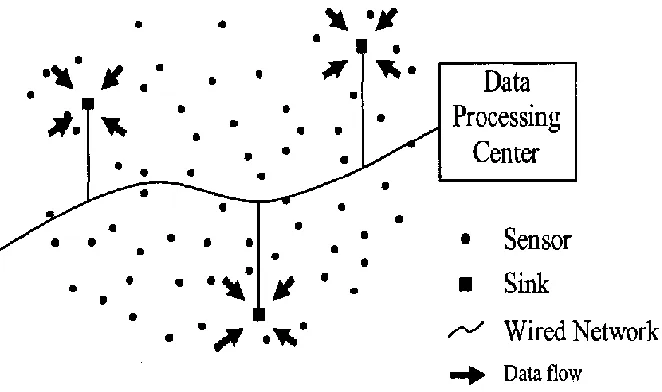
Figure 1: wireless sensor network architecture
Converge-cast ,namely, the collection of data from a set of sensors toward a common sink over a tree -based routing topology, is a fundamental operation in wireless sensors networks .In many applications ,it is crucial to provide a guarantee on the d elivery time as well as increase the rate of such data collection. For instance, in safety and mission-critical applications where sensor nodes are deployed to detect oil/gas leak structural damage, the actuators and controllers need to receive data from all the sensors within a specific deadline, failure of which lead to unpredictable and catastrophic events. This falls under the category of one shot data collection .On the other hand
applications
such as permafrosting monitoring require periodic and fast data delivery over long periods of time, which falls under the category of continuous data collection.We study two types of data collection: 1) aggregated converge- cast where packets are aggregated at each hop, and 2) raw data converge-cast where packets are individually relayed toward the sink. For periodic traffic it is well known that contention free medium access control (MAC)protocols such as Time Division Multiple access (TDMA)are better fit for fast data collection, since they can eliminate collisions and retransmissions and provide guarantee on the completion time. In this work we conside r a TDMA framework and design polynomial-time heuristics to minimize the schedule length for both type of converge-cast.
We study aggregated converge cast in the context of periodic data collection where each source node generates a packet at th e beginning of every frame, and raw data converge cast for one shot data collection where each node has only one packet to send. We assume that size of each packet is constant. Our goal is to deliver these packets to the sink over the routing tree as fas t as possible .More specifically , we aim to schedule the edges ET of T using a minimum number of time slots while respecting the following constraints :
1. Adjacency constraint : Two edges cannot be scheduled in the same time slot if they are adjacent to each other. This constraint is due to the half-duplex transceiver on each node which prevents it from simultaneous transmission and reception .
© 2014, IJCSMC All Rights Reserved
112
TDMA Scheduling of converge cast
1. Periodic converge cast:
we consider the scheduling problem where packets are aggregated. Data aggregation is a commonly used technique in WSN that can eliminate redundancy and minimize the number of transmissions, thus saving energy and improving network lifetime
We first consider aggregated convergecast when all the interfering links are eliminated by using transmission power control or multiple frequencies. Although the problem of minimizing the schedule length is NP-complete on general graphs, we show in the following that once interference is eliminated, the problem reduces to 1 on a tree, and can be solved in polynomial time. To this end, we first give a lower bound on the schedule length, and then propose a time slot assignment scheme that achieves the bound.
Theorem 1: If all the interfering links are eliminated, the schedule length for aggregated converge cast is lower bounded by d(T), where T is the maximum node degree in the routing tree d(T).
2.
One Shot Raw Data Converge cast :In this section, we consider one-shot data collection where every sensor reading is equally important, and so aggregation may not be desirable or even possible. Thus, each of the packets has to be individually scheduled at each hop en route to the sink. Here the edges could be scheduled multiple times and there is no pipelining.
We now describe a time slot assignment scheme called Local-Time Slot Assignment, which is run locally by each node at every time slot. The key idea is to: 1) schedule transmissions in parallel along multiple branches of the tree, and 2) keep the sink busy in receiving packets for as many time slots as possible. Because the sink can receive from the root of at most one top-sub tree in any time slot, we need to decide which top-sub tree should be made active. We assume that the sink is aware of the number of nodes in each top-sub tree. Each source node maintains a buffer and its associated state, which can be either full or empty depending on whether it contains a packet or not. Our algorithm does not require any of the nodes to store more than one pack et in their buffer at any time. We initialize all the buffers as full, and assume that the sink’s buffer is always full for the ease of explanation.
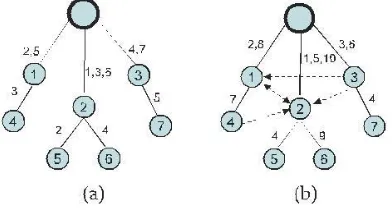
Figure. 2 Raw-data converge cast using algorithm Local-Time slot Assignment: (a) Schedule length of 7 when all the interfering links are removed. (b) Schedule length of 10 when the interfering links are present.
Theorem 2: If all the interfering links are eliminated, the schedule length for one-shot raw-data converge-cast is lower bounded by max(2nk -1,N), where nk is the maximum number of nodes in any top sub-tree of the routing tree, and N is the number of
sources in the network
EXISTING SYSTEM
© 2014, IJCSMC All Rights Reserved
113
DISADVANTAGES
Getting delay in packet delivery.
These algorithms are quite complex to ensure the precise queue length ordering of links. .
overhead for message exchanges
PROPOSED SYSTEM
In proposed system, we have used the distance formula to find minimum distance from source node .By using formula, we get to know which neighbour node is at minimum hop distance from source node ,
DISTANCE FORMULA: Given two points (x1,y1) and (x2 ,y2 ) distance between the points is given by the formula
First ,we will calculate the distances from source node to all neighbour nodes ,whose distance is minimum , that will be chosen for sending the data. With the help of transmission power control and multichannel scheduling ,data can be sent to desti nation node as soon as possible. Fast data collection with the goal to minimize the schedule length for aggregated converge cast has been studied by us in we experimentally investigated the impact of transmission power control and multiple frequency channels on the schedule length Our present work is different from the above in that we evaluate transmission power control under realistic settings and compute lower bounds on the schedule length for tree networks with algorithms to achieve these bounds. We also compare the efficiency of different channel assignment methods and interference models, and propose schemes for constructing specific routing tree topologies that enhance the data collection rate for both aggregated and raw-data converge cast.
ROLE OF CLUSTERS : Naturally ,grouping sensor nodes into clusters has been widely adopted to satisfy the above scalability objective and generally achieve high energy efficiency and prolong network lifetime in large-scale WSN environments. The corresponding hierarchical routing and data gathering protocols imply cluster-based organization of the sensor nodes in order that data fusion and aggregation are possible, thus leading to significant energy savings. In the hierarchical network structure each cluster has a leader, which is also called the cluster head (CH) and usually performs the special tasks referred above (fusion and aggregation), and several common sensor nodes(SN)as members. The cluster formation process eventually leads to a two-level hierarchy where the CH nodes form the higher level and the cluster-member nodes form the lower level. The sensor nodes periodically transmit their data to the corresponding CH nodes.
Impact of Transmission Power Control
:© 2014, IJCSMC All Rights Reserved
114
Multichannel Scheduling
:
Multichannel communication is an efficient method to eliminate interference by enabling concurrent transmissions over differe nt frequencies.
1.Tree Based Multichannel Protocol(TBMP)
2.Joint Frequency Time Slot Scheduling(JFTSS)
3.Receiver Based Channel Assignment(RBCA)
figure 3 .Scheduling with multi channels for aggregated converge-cast (a)Schedule generated with JFTSS (b) Schedule generated with TMBP (C)Schedule generated with RBCA
JFTSS offers a greedy joint solution for constructing a maximal schedule, such that a schedule is said to be maximal if it meets the adjacency and interfering constraints, and no more links can be scheduled for concurrent transmissions on any time slot a nd channel without violating the constraints
TMCP is a greedy, tree-based multichannel protocol for data collection applications. It partitions the network into multiple sub-trees and minimizes the intra tree interference by assigning different channels to the nodes residing on different branches starting from the top to the bottom of the tree.
RBCA . In this type, the children of a common parent transmit on the same channel. Every node in the tree, therefore, operates on at most two channels, thus avoiding pair wise, per-packet channel negotiation over-heads.
SIMULATION AND RESULT
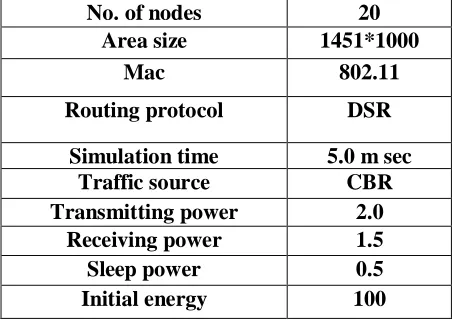
The simulation is done with the help of NS-2 (v-2.34) network simulator. The implementation of the protocol
has been done using C++ language in the backend and TCL language in the frontend on the fedora Linux
operating system.
No. of nodes
20
Area size
1451*1000
Mac
802.11
Routing protocol
DSR
Simulation time
5.0 m sec
Traffic source
CBR
Transmitting power
2.0
Receiving power
1.5
Sleep power
0.5
Initial energy
100
© 2014, IJCSMC All Rights Reserved
115
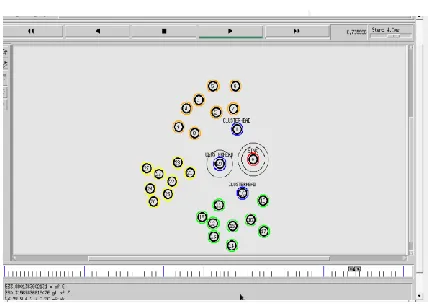
Figure 4 configuration of nodes
Figure 5 Analyzing neighbour nodes
© 2014, IJCSMC All Rights Reserved
116
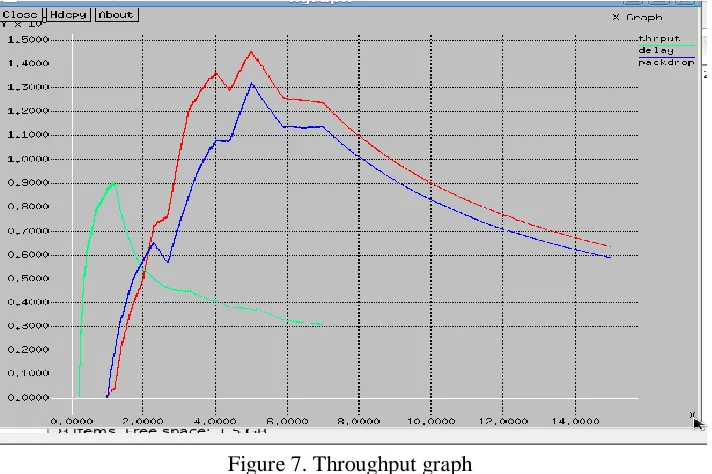
Figure 7. Throughput graph
This throughput x graph count all the received application packets in a network such that we can calculate the
network throughput
CONCLUSION
In this paper, we studied fast converge cast in WSN where nodes communicate using a TDMA protocol to minimize the schedule length. We addressed the fundamental limitations due to interference and half-duplex transceivers on the nodes and explored techniques to overcome the same. We found that while transmission power control helps in reducing the schedule length, multiple channels are more effective.
We also observed that node-based (RBCA) and link-based (JFTSS) channel assignment schemes are more efficient in terms of eliminating interference as compared to assigning different channels on different branches of the tree (TMCP). Once interfere nce is completely eliminated, we proved that with half-duplex radios, the achievable schedule length is lower bounded by the maximum degree in the routing tree for aggregated converge cast, and for raw-data converge cast. Using optimal converge cast scheduling algorithms, we showed that the lower bounds are achievable once a suitable routing scheme is used. Through extensive simulations, we demonstrated up to an order of magnitude reduction in the schedule length for aggregated, and a 50 percent reduction for raw-data converge cast.