Creation of a Magnetic Driven Gate for THz Rays
Denis Zyatkov1, 2, *, Vladimir Balashov1, Vasiliy Yurchenko1, 2, Elena Fakhrutdinova1, Valery Svetlichnyi1, Zahar Kochnev1, Anastasia Knyazkova1, 3, Yury Kistenev1, 3, and Alexey Borisov1, 3
Fakchrutdinova on Fakhrutdinova
Abstract—In this paper, magnetic fluids based on iron oxide Fe3O4 and 5BDSR alloy were obtained. Magnetic particles were obtained by nanosecond pulsed laser ablation. The preparation of the magnetic fluid was carried out by mechanical and ultrasonic stirring in a solution of polymethylphenylsiloxane. It is shown that under the influence of an external magnetic field, the spectral properties of the magnetic fluid of the 5BDSR alloy correspond to characteristics that can be used to create a magnetic gate.
1. INTRODUCTION
Interest in terahertz waves (0.1–10 THz) has increased significantly due to their unique properties. Penetrating properties and ability of THz radiation to identify substances make it possible to use in spectroscopy, communication infrastructure, medical diagnostic equipment, safety, etc. The creation of inexpensive devices and systems operating at THz frequencies is an urgent task. Previous studies have shown the possibility of controlling the parameters of electromagnetic waves by orienting nanotubes in a polymer in the frequency range of THz [1, 2]. However, it is more preferable to use non-mechanically controlled materials in quasi-optical paths. One of the alternative magneto-optical materials can be a magnetic fluid controlled by an external magnetic field. The magneto-optical properties of such fluids have been extensively studied in the optical frequency range, but until recently, little has been studied in the terahertz frequency range.
Magnetic fluids (MF) are artificially formed and specially structured mediums with unique electrical and magnetic properties. These properties should be understood as specific values of the physical parameters of the medium: the magnetic permeabilityμ, spatial structuring, depending on the size and shape of magnetic particles, the possibility of controlling medium parameters as a result of external influences. High mobility of magnetic particles in the liquid ensures their strong sensitivity to magnetic fields [3, 4]. Magneto-optical effects arising from the interaction of THz radiation with matter not only lead to a change in the dispersion curves of the absorption coefficient and the refractive index, but also lead to the appearance or change of the optical anisotropy of the medium (the structure of the magnetic fluid changes) [5–7]. The application of a magnetic fluid will allow the construction of passive elements of a terahertz technique with tunable characteristics of the magnetic fluid itself, which can be controlled by including an external magnetic field [8, 9].
Well-known and well-proven materials for magnetic fluids, including the THz spectral range, are iron oxides [10–12]. At the same time, the search for new materials with improved magnetic properties is actual. Of particular interest is the study of the possibility of using in THz a range of magnetic fluids based on particles from the 5BDSR alloy. This amorphous soft magnetic alloy has a high induction at low
Received 23 September 2018, Accepted 21 March 2019, Scheduled 8 April 2019 * Corresponding author: Denis Olegovich Zyatkov ([email protected]).
coercive force, low losses of magnetization reversal at high frequencies, close to zero magnetostriction, high magnetic permeability, which depends on the thermomagnetic treatment method and can reach a value of 50000, as well as a high electrical resistivity. 5BDSR alloy is produced at the Asha Metallurgical Plant (Russia), and it is an analogue of Finemet alloys (Japan).
One of the methods that has been intensively developed in recent years and can be used to produce nanoparticles (NPs) of various types, including magnetic ones, is pulsed laser ablation (PLA) [13, 14]. Important advantages of the PLA method include the absence of precursors, the possibility of ablation of a wide range of materials, and (in some cases) the good preservation of the initial composition of the material when ablating complex targets, for example, alloys [15, 16].
The purpose of this work is to investigate the effect of a magnetic field on the transmission of magnetic fluids prepared on the basis of ultrafine powders obtained by pulsed laser ablation in a gas (PLAG).
2. EXPERIMENTAL
2.1. Samples of Magnetic Powder for the Preparation of Magnetic Fluid
This paper conducted research of a magnetic fluid on the basis of magnetic nanoparticles (NPs) of iron oxide of different structures and amorphous soft magnetic 5BDSR alloy. Magnetic nanoparticles were obtained by pulsed laser ablation in a gas (PLAG). NPs of iron oxides were obtained by PLAG in air at atmospheric pressure, and the ablation of 5BDSR alloy was carried out in the environment of argon also at atmospheric pressure. NPs were obtained using the focused radiation of an Nd:YAG laser (1064 nm, 7 ns, 20 Hz, 150 mJ). Methods of obtaining nanoparticles by pulsed laser ablation of iron in the air, their composition, structure and morphology, magnetic properties at the room temperature were previously investigated in detail and described in [17]. Ablation of 5BDSR alloy was carried out on the same equipment in similar experimental conditions.
NPs obtained from the 5BDSR alloy were used further in the initial form. X-ray phase analysis of these nanoparticles has shown that as a result of ablation they remained predominantly X-ray amorphous, as initial alloy. According to data of the transmission electron microscopy, the particles have a spherical shape with an average size distribution of 8–10 nm, as well as a few of larger particles with a diameter of up to 50 nm.
NPs obtained via ablation of the iron target were further subjected to thermal treatment at 300 and 500◦C. According to previous studies, the initially obtained by PLAG of iron particles in air predominantly had structure of magnetite (Fe3O4). The sample contained layered structures (including twisted ones) and spherical monocrystalline particles. As a result of annealing, the particles changed the structure and were enlarged. The magnetic powder annealed at 300◦C was presented by a mixture of magnetite, maghemite and hematite phases. After annealing at 500◦C, the powder was presented hematite phase α-Fe2O3 only. A photograph of the external view of magnetic powders is presented in Fig. 1.
Figure 1. Powders of iron oxide and 5BDSR alloy.
powder obtained from the 5BDSR alloy — Fe alloy.
2.2. Preparation of a Magnetic Fluid
In experimental studies, magnetic fluids based on a polymethylphenylsiloxane (PFMS-4) containing Fe 0, Fe 300, Fe 500 and Fe alloy particles were used. The size of the magnetic particles was from 12 to 15 nm. The concentration of magnetic powder Fe 0, Fe 300, Fe 500 in PFMS-4 does not exceed 5 and 10 weight percent. The concentration of the magnetic powder Fe alloy in PFMS-4 does not exceed 2,5 and 5 weight percent. Preparation of the magnetic fluid was carried out by mechanical and ultrasonic mixing.
For further use, we introduce the following designation: magnetic fluid on the basis of iron oxide annealed at 500◦C we will designate as MF 500; on the basis of iron oxide annealed at 300◦C-MF 300; on the basis of the initial sample of iron oxide we will designate as MF 0; on the basis of magnetic powder obtained from the 5BDSR alloy we will designate as MF alloy.
Polymethylphenylsiloxane (PFMS-4) has sufficient viscosity which provides additional sedimenta-tion stability of the colloid, and PFMS-4 is transparent in the THz frequency range (Fig. 2).
400 600 800 1000
, mkm 0
0.2 0.4 0.6 0.8
I
THz signal air THz signal PFMS-4
Figure 2. Intensity spectra of the THz signal passing through the air and THz signal passing through PFMS-4 with a thickness of 3 mm.
2.3. The Method of Investigation and the Experimental Installation
To investigate the magneto-optical properties of magnetic fluids in the THz frequency region, a disassembled measuring cell (Fig. 3(a)) made of ABS plastic with a center hole of 10×10 mm2 was specially designed and printed on a 3D printer. These holes were closed with fluoroplastic plates 0.5 mm thick, since the fluoroplastic well passes THz radiation (Fig. 3(b)). The working volume of the magnetic fluid in the cuvette is 3×10×10 mm3.
400 600 800 1000
, mkm
0 0.1 0.2 0.3 0.4
I
THz signal air THz signal fluoroplastic
(a) (b)
location No. 1 location No. 2 location No. 3
(a) (b) (c)
Figure 4. Location of the Helmholtz coils to create a magnetic field, 1 — the direction of the THz signal; 2 — cuvette with a magnetic fluid; 3 — Helmholtz coils.
The research of magnetic fluids was carried out on a THz spectrometer (T-Spec EXPLA). Helmholtz coils were used to create the magnetic field (Fig. 4).
3. RESULT AND DISCUSSION
The description of the MF 0, MF 300, and MF 500 samples with a concentration of magnetic powder of 5 and 10% and MF alloy with a concentration of 2.5 and 5% is given in Section 2.2. Before a THz transmission spectra study, the magnetic fluids were disordered by an ultrasonic bath. They were placed in the way of the THz signal, and the corresponding intensity spectrum was registered. Further, we began to influence the sample by the magnetic field. The magnetic field was created by applying electric current to the Helmholtz coils. The corresponding spectra were registered at the formation of the signal after a 20 seconds influence of magnetic field.
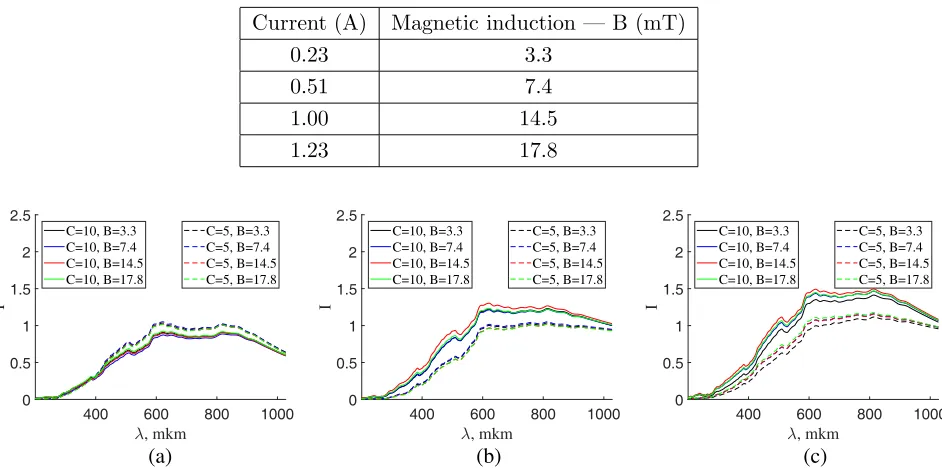
Figure 5 shows the THz spectra of the intensity of MF 0, MF 300 and MF 500 with particle concentrations of 5% and 10% obtained by the action of an external magnetic field created by a direct current of 0.26, 0.51, 0.76, 1, and 1.23 A, which corresponds to a magnetic field of the Helmholtz coils equal to 3.8, 7.4, 11, 14.5, and 17.8 mT, respectively (Table 1).
The location No. 3 of the Helmholtz coils corresponds to Fig. 4(c). It can be seen from the spectra obtained that the strongest response to the effect of an external magnetic field from a series of magnetic fluids based on iron oxide particles was for MF 300, which corresponds to the preliminary conclusions
400 600 800 1000
, mkm
0 0.5 1 1.5 2 2.5
I
C=10, B=3.3 C=10, B=7.4 C=10, B=14.5 C=10, B=17.8
C=5, B=3.3 C=5, B=7.4 C=5, B=14.5 C=5, B=17.8
400 600 800 1000
, mkm
0 0.5 1 1.5 2 2.5
I
C=10, B=3.3 C=10, B=7.4 C=10, B=14.5 C=10, B=17.8
C=5, B=3.3 C=5, B=7.4 C=5, B=14.5 C=5, B=17.8
400 600 800 1000
, mkm
0 0.5 1 1.5 2 2.5
I
C=10, B=3.3 C=10, B=7.4 C=10, B=14.5 C=10, B=17.8
C=5, B=3.3 C=5, B=7.4 C=5, B=14.5 C=5, B=17.8
(c) (b)
(a)
Table 1. The ratio of the current and the created magnetic induction.
Current (A) Magnetic induction — B (mT)
0.23 3.3
0.51 7.4
1.00 14.5
1.23 17.8
400 600 800 1000
, mkm 0 0.5 1 1.5 2 2.5 I C=10, B=3.3 C=10, B=7.4 C=10, B=14.5 C=10, B=17.8 C=5, B=3.3 C=5, B=7.4 C=5, B=14.5 C=5, B=17.8
400 600 800 1000
, mkm 0 0.5 1 1.5 2 2.5 I C=10, B=3.3 C=10, B=7.4 C=10, B=14.5 C=10, B=17.8 C=5, B=3.3 C=5, B=7.4 C=5, B=14.5 C=5, B=17.8
400 600 800 1000
, mkm 0 0.5 1 1.5 2 2.5 I C=10, B=3.3 C=10, B=7.4 C=10, B=14.5 C=10, B=17.8 C=5, B=3.3 C=5, B=7.4 C=5, B=14.5 C=5, B=17.8 (c) (b) (a)
Figure 6. Spectra of THz signal intensity passing through MF 300 when the Helmholtz rings are located: (a) No. 1, (b) No. 2, (c) No. 3. HereC is the concentration (%),B — magnetic field induction (mT).
400 600 800 1000
, mkm 0 0.5 1 1.5 2 2.5 I C=2.5, B=3.3 C=2.5, B=7.4 C=2.5, B=14.5 C=2.5, B=17.8 C=5, B=3.3 C=5, B=7.4 C=5, B=14.5 C=5, B=17.8
400 600 800 1000
, mkm 0 0.5 1 1.5 2 2.5 I C=2.5, B=3.3 C=2.5, B=7.4 C=2.5, B=11 C=2.5, B=14.5 C=5, B=3.3 C=5, B=7.4 C=5, B=11 C=5, B=14.5
400 600 800 1000
, mkm 0 0.5 1 1.5 2 2.5 I C=2.5, B=3.3 C=2.5, B=7.4 C=2.5, B=11 C=2.5, B=14.5 C=5, B=3.3 C=5, B=7.4 C=5, B=11 C=5, B=14.5 (c) (b) (a)
Figure 7. Spectra of THz signal intensity passing through MF alloy when the Helmholtz rings are located: (a) No. 1, (b) No. 2, (c) No. 3. HereC is the concentration (%),B — magnetic field induction (mT).
of [17], based on data on the coercivity (Hc) and saturation magnetization (Ms). We note that in the case of arrangements Nos. 1 and 2 of Helmholtz coils corresponding to Figs. 4(a) and 4(b), the situations were identical, that is, the most suitable object of investigation from magnetic fluids based on iron oxide is MF 300.
Figures 6 and 7 show THz intensity spectra of MF 300 with particle concentrations of 5% and 10%, and MF alloy with particle concentrations of 2.5% and 5% obtained by exposure of an external field to magnetic fluid created by a direct current of 0.26, 0.51, 0.76, 1, and 1.23 A for various arrangements of Helmholtz coils (Fig. 4).
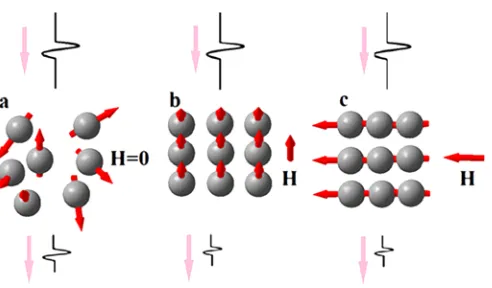
Figure 8. Formation of chain aggregates as a function of the direction of the magnetic field.
the THz signal intensity. In the case of the arrangement of the Helmholtz coils 1 or 2, with the increase in the magnetic field, the THz signal strength increases, and in the case of the Helmholtz coils 3, the intensity of the THz signal decreases.
The resulting magnetic fluid based on 5BDSR alloy has unique optical properties of liquids. In the absence of an external magnetic field, it is optically homogeneous and under the action of an external magnetic field to acquire the properties of a uniaxial crystal with a very strong optical anisotropy. The cause of strong optical anisotropy may be the orientation of chain aggregates in a magnetic field (Fig. 8) [18–21].
4. CONCLUSION
In this work we used nanoparticles with different characteristics which were obtained by nanosecond laser ablation of an iron target. Among magnetic fluids based on oxides, the best result was shown by MF 300. In this liquid, the nanoparticles were annealed at 300◦C, and it had the optimum phase composition and structure.
The formation of chain aggregates and their reorientation in a magnetic fluid owing to change in the vector of magnetic induction THz, radiation undergo dichroism. This absorption arises from the reorientation of particles in consequence of changes in the external magnetic field.
Since our investigations were carried out in weak magnetic fields, iron oxides did not form a chain structure, which explains the slight change in THz signal intensity. However, for an MF alloy, an increase in the magnetic field led to a significant change in the THz signal.
Thus, the MF alloy is a more controllable external magnetic field compared with magnetic fluids based on iron oxides and is an effective agent for using this magnetic fluid in THz electronics, for example, as a magnetic gate.
ACKNOWLEDGMENT
This study was supported by Russian Science Foundation (RSF) (project No. 18-19-00268).
REFERENCES
1. Dunaevskn, G. E., V. I. Suslyaev, V. A. Zhuravlev, A. V. Badin, K. V. Dorozhkin, M. A. Kanygin, O. V. Sedelnikova, L. G. Bulusheva, and A. V. Okotrub, “Electromagnetic response of anisotropic polystyrene composite materials containing oriented multiwall carbon nanotubes,” 2014 39th
International Conference on Infrared, Millimeter, and Terahertz Waves (IRMMW-THz), 12, 2014.
3. Zyatkov, D., A. Yurchenko, and V. Yurchenko, “Detection of the change of a magnetic field in the environment by magnetic fluid,”J. Phys.: Conf. Ser., Vol. 881, 012037, 2017.
4. Chen, Y., Q. Han, T. Liu, X. Lan, and H. Xiao, “Optical fiber magnetic field sensor based on single-mode-multimode-single-mode structure and magnetic fluid,” Optics Letters, Vol. 38, No 20, 3999–4001, 2013.
5. Zyatkov, D., A. Yurchenko, V. Balashov, B. Yurchenko, and A. Borisov, “Spectral characteristics of magnetic fluid with particles of different dimensions in the terahertz frequency range,” 2017
Progress In Electromagnetics Research Symposium — Spring (PIERS), 2707–2711, St. Petersburg,
Russia, May 22–25, 2017.
6. Yannopapas, V., S. H. L. Klapp, and S. D. Peroukidis, “Magneto-optical properties of liquid-crystalline ferrofluids,”Optical Materials Express, Vol. 6, No. 8, 2681–2688, 2016.
7. Pei, L., H. Pang, X. Ruan, X. Gong, and S. Xuan, “Magnetorheology of a magnetic fluid based on Fe3O4 immobilized SiO2coreshell nanospheres: Experiments and molecular dynamics simulations,”
RSC Adv., Vol. 7, 8142–8150, 2017.
8. Polley, D., A. Ganguly, A. Barman, and R. K. Mitra, “Polarizing effect of aligned nanoparticles in terahertz frequency region,” Optics Letters, Vol. 38, No. 15, 2754–2756, 2013.
9. Huisman, T. J., R. V. Mikhaylovskiy, A. V. Telegin, Yu. P. Sukhorukov, A. B. Granovsky, S. V. Naumov, Th. Rasing, and A. V. Kimel, “Terahertz magneto-optics in the ferromagnetic semiconductor HgCdCr2Se4,” Appl. Phys. Lett., Vol. 106, 132411, 2015.
10. Chen, S., F. Fan, S. Chang, Y. Miao, M. Chen, J. Li, X. Wang, and L. Lin, “Tunable optical and magneto-optical properties of ferrofluid in the terahertz regime,” Optics Express, Vol. 22, No. 6, 6313–6321, 2014.
11. Liu, X., L. Xiong, X. Yu, S. He, B. Zhang, and J. Shen, “Magnetically controlled terahertz modulator based on Fe3O4 nanoparticle ferrofluids,” J. Phys. D: Appl. Phys., Vol. 51, No. 10, 105003, 2018.
12. Shalaby, M., M. Peccianti, Y. Ozturk, and R. Morandotti, “Terahertz Faraday rotation in a magnetic liquid: High magneto-optical gure of merit and broadband operation in a ferrofluid,”
Appl. Phys. Lett., Vol. 100, No. 24, 241107, 2012.
13. Zhang, D., B. Gokce, and S. Barcikowski, “Laser synthesis and processing of colloids: Fundamentals and applications,” Chem. Rev., Vol. 117, No. 5, 3990–4103, 2017.
14. Svetlichnyi, V. A., A. V. Shabalina, I. N. Lapin, D. A. Goncharova, D. A. Velikanov, and A. E. Sokolov, “Characterization and magnetic properties study for magnetite nanoparticles obtained by pulsed laser ablation in water,” Applied Physics A, Vol. 123, No. 12, 2017.
15. Sukhov, I. A., G. A. Shafeev, V. V. Voronov, M. Sygletou, E. Stratakis, and C. Fotakis, “Generation of nanoparticles of bronze and brass by laser ablation in liquid,”Applied Surface Science, Vol. 302, 79–82, 2014.
16. Jakobi, J., S. Petersen, A. Menndez-Manjn, P. Wagener, and S. Barcikowski, “Magnetic alloy nanoparticles from laser ablation in cyclopentanone and their embedding into a photoresist,”
Langmuir, Vol. 26, No 10, 6892–6897, 2010.
17. Svetlichnyi, V. A., A. V. Shabalina, I. N. Lapin, D. A. Goncharova, D. A. Velikanov, and A. E. Sokolov, “Study of iron oxide magnetic nanoparticles obtained via pulsed laser ablation of iron in air,” Applied Surface Science, Vol. 462, 226–236, 2018.
18. Pyanzina, E., “Bidisperse ferrofluids with chain aggregates: Microstructure and macroscopic properties,” Magnetohydrodynamics, Vol. 49, No. 3/4, 297–300, 2013.
19. Zakinyan, A., Y. Dikansky, and M. Bedzhanyan, “Electrical properties of chain microstructure magnetic emulsions in magnetic field,” Journal of Dispersion Science and Technology, Vol. 35, 111–119, 2014.
20. Rousan, A., H. M. El Ghanem, and N. Yusuf, “Faraday rotation and chain formation in magnetic fluids,”IEEE Transactions on Magnetics, Vol. 25, No. 4, 3121–3124, 1989.