Scholarship@Western
Scholarship@Western
Electronic Thesis and Dissertation Repository
12-14-2015 12:00 AM
Security Protocol Suite for Preventing Cloud-based
Security Protocol Suite for Preventing Cloud-based
Denial-of-Service Attacks
Service Attacks
Marwan M. Darwish
The University of Western Ontario
Supervisor
Dr. Abdelkader Ouda
The University of Western Ontario
Graduate Program in Electrical and Computer Engineering
A thesis submitted in partial fulfillment of the requirements for the degree in Doctor of Philosophy
© Marwan M. Darwish 2015
Follow this and additional works at: https://ir.lib.uwo.ca/etd
Part of the Computer Engineering Commons
Recommended Citation Recommended Citation
Darwish, Marwan M., "Security Protocol Suite for Preventing Cloud-based Denial-of-Service Attacks" (2015). Electronic Thesis and Dissertation Repository. 3392.
https://ir.lib.uwo.ca/etd/3392
This Dissertation/Thesis is brought to you for free and open access by Scholarship@Western. It has been accepted for inclusion in Electronic Thesis and Dissertation Repository by an authorized administrator of
(Thesis format: Monograph)
by
Marwan Darwish
Graduate Program in Electrical and Computer Engineering
A thesis submitted in partial fulfillment of the requirements for the degree of
Doctor of Philosophy
The School of Graduate and Postdoctoral Studies The University of Western Ontario
London, Ontario, Canada
Abstract
Cloud systems, also known as cloud services, are among the primary solutions of the
information technology domain. Cloud services are accessed through an identity authentication
process. These authentication processes have become increasingly vulnerable to adversaries
who may perform denial-of-service (DoS) attacks to make cloud services inaccessible. Several
strong authentication protocols have been employed to protect conventional network systems.
Nevertheless, they can cause a DoS threat when implemented in the cloud-computing system.
This is because the comprehensive verification process may exhaust the cloud resources and
shut down cloud’s services. This thesis proposes a novel cloud-based secure authentication
(CSA) protocol suite that provides a smart authentication approach not only for verifying the
users’ identities but also for building a strong line of defense against the DoS attacks. CSA
protocol suite offers two modules, CSAM-1 and CSAM-2. The decision of which module of
CSA to be utilized depends on the deployment nature of the cloud computing.
CSAM-1 is designed to prevent external risks of DoS attacks in private and community cloud
computing. CSAM-1 utilizes multiple techniques that include the client puzzle problem and
utilization of unique encrypted text (UET). Therefore, these techniques can distinguish
between a legitimate user’s request and an attacker’s attempt.
CSAM-2 is designed to prevent internal risks of DoS attacks in public and hybrid cloud
computing. CSAM-2 combines an extended unique encrypted text (EUET) application, client
puzzle problem, and deadlock avoidance algorithm to prevent DoS risks that occur from inside
cloud computing systems. The authentication process in both modules is designed so that the
cloud-based servers become footprint-free and fully able to detect the signs of DoS attacks.
The reliability and scalability of these two modules have been measured through a number of
experiments using the GreenCloud simulation tool. The experiments’ results have shown that
the CSA protocol suite is practically applicable as a lightweight authentication protocol. These
experiments have verified the ability of the CSA to protect the cloud-based system against DoS
attacks with an acceptable mean time to failure while still having the spare capacity to handle
Keywords
Cloud Computing, Denial-of-Service (DoS) Attack, Network Security, Authentication
Acknowledgments
First of all, I thank God for giving me the ability to achieve my goals. I would like to thank my
lovely parents and my lovely family (my wife and my two daughters) for their support and
encouragement in my life.
I would like to thank my supervisor Prof. Abdelkader Ouda for his guidance and advice during
my Ph.D. program. His academic expertise helped me to improve my research skills. His
support and motivation gave me the confidence and the strength to accomplish my goals.
I acknowledge my former supervisor Prof. Luiz Capretz for his guidance and advice during
my Ph.D. program.
I would like to thank Dr. Arif Raza for his valuable comments and suggestions on my final
version of the thesis.
I acknowledge King Abdulaziz University and the Cultural Bureau of Saudi Arabia in Canada
Table of Contents
Abstract ... ii
Acknowledgments... iv
Table of Contents ... v
List of Tables ... viii
List of Figures ... ix
List of Appendices ... xii
List of Abbreviations ... xiii
Chapter 1 ... 1
1 Introduction ... 1
1.1 Research Motivation ... 1
1.2 Research Objectives ... 4
1.3 Research Methodology ... 5
1.3.1 Defender Protocol Suite Design ... 5
1.3.2 Security and Performance Validation ... 6
1.4 Main Thesis Contributions ... 7
1.5 Thesis Structure ... 8
Chapter 2 ... 9
2 Background and Literature Review ... 9
2.1 Cloud Computing ... 9
2.2 Denial-of-Service Attacks ... 10
2.3 Literature Review... 16
2.3.1 DoS Defense Techniques ... 16
2.3.4 Review Summary ... 28
Chapter 3 ... 30
3 Cloud-Based Secure Authentication Module 1 (CSAM-1) Protocol for Private and Community Cloud Computing ... 30
3.1 Registration Protocol ... 32
3.2 Identification and Authentication Protocol ... 34
3.3 Discussion ... 38
Chapter 4 ... 40
4 Cloud-Based Secure Authentication Module 2 (CSAM-2) Protocol for Public and Hybrid Cloud Computing ... 40
4.1 Registration Protocol ... 42
4.2 Identification and Authentication Protocol ... 44
4.3 Service Management and Allocation Protocol ... 46
4.4 Host Session and Authentication Protocol ... 50
4.5 Discussion ... 51
Chapter 5 ... 53
5 Security and Performance Validation ... 53
5.1 Security Validation ... 53
5.1.1 Security Validation of the CSA Protocol Suite via a Cost-Based Model Approach ... 53
5.1.2 Security Validation and Formal Verification of the CSA Protocol Suite via SVO Logic ... 56
5.2 Performance Validation ... 64
5.2.1 Knapsack Puzzle Performance Validation ... 65
5.2.2 Performance Evaluation of the Google OAuth 2.0 Protocol Implementation ... 67
6 Conclusions and Future Work ... 80
6.1 Summary of Contributions ... 80
6.2 Future Work ... 83
References ... 84
Appendices ... 89
List of Tables
Table 2.1: Types of DoS attacks on cloud systems ... 18
Table 2.2: Literature review summary ... 29
Table 3.1: Notations of the CSAM-1 protocol ... 31
Table 4.1: Notations of the CSAM-2 protocol ... 41
Table 5.1: Validation of the CSA protocol suite via a cost-based model approach ... 55
Table 5.2: Notations of the SVO ... 57
Table 5.3: Task parameters obtained from the Linux benchmark experiment ... 71
Table A.1. VM load with different processes ... 89
Table A.2. VM memory load with different processes ... 90
List of Figures
Figure 2.1: Architecture of cloud computing service models ... 9
Figure 2.2: IP spoofing attack ... 12
Figure 2.3: (a) Normal three-way handshake; (b) SYN flooding attack ... 13
Figure 2.4: Smurf attack ... 14
Figure 2.5: Ping of death attack ... 15
Figure 2.6: Land attack ... 16
Figure 2.7: External and internal cloud-based DoS attacks ... 17
Figure 2.8: Mutual authentication protocol ... 20
Figure 2.9: Example of social authentication icons (Darwell, 2013) ... 22
Figure 2.10: Overview of the OAuth 2.0 protocol ... 23
Figure 2.11: Authorization process of Google's OAuth 2.0 for web server applications ... 25
Figure 3.1: CSAM-1 protocols ... 32
Figure 3.2: Registration protocol in CSAM-1 ... 32
Figure 3.3: UET structure in CSAM-1 ... 33
Figure 3.4: Cloud_user (lookup) database table structure ... 33
Figure 3.5: Adaptive-based identification and authentication protocol in CSAM-1 ... 36
Figure 4.1: CSAM-2 protocols ... 40
Figure 4.2: User registration protocol in CSAM-2 ... 43
Figure 4.5: Service allocation protocol in CSAM-2 ... 47
Figure 4.6: (a) Service request algorithm for the user; (b) safety algorithm ... 48
Figure 4.7: ACL structure ... 49
Figure 4.8: Service host lightweight authentication protocol in CSAM-2 ... 50
Figure 5.1: Authentication processes of CSAM-1 and CSAM-2 ... 60
Figure 5.2: Additional authentication processes of CSAM-2 ... 62
Figure 5.3: Response times of the requester (in seconds) with various numbers of combination items ... 66
Figure 5.4: VM load with multiple requests per second ... 68
Figure 5.5: VM memory load with multiple requests per second ... 69
Figure 5.6: VM storage load with multiple requests per second ... 69
Figure 5.7: AES encryption VM load ... 72
Figure 5.8: AES encryption VM memory load ... 72
Figure 5.9: AES encryption VM storage load ... 73
Figure 5.10: AES decryption VM load ... 73
Figure 5.11: AES decryption VM memory load ... 74
Figure 5.12: AES decryption VM storage load ... 74
Figure 5.13: SHA-512 hashing VM load ... 75
Figure 5.14: SHA-512 hashing VM memory load... 75
Figure 5.17: Generating random number VM memory load ... 77
Figure 5.18: Generating random number VM storage load ... 77
Figure 5.19: Comparison of VM load (the same graph is represented in tabular form in
appendix A – Table A.1) ... 78
Figure 5.20: Comparison of VM memory load (the same graph is represented in tabular form
in appendix A – Table A.2) ... 78
Figure 5.21: Comparison of VM storage load (the same graph is represented in tabular form
List of Appendices
List of Abbreviations
ACL Access Control List
AES Advanced Encryption Standard
API Application Program Interface
CPU Central Processing Unit
DDoS Distributed Denial of Service
DNS Domain Name System
DoS Denial of Service
HCF Hop Count Filtering
HIP Host Identity Protocol
HTTP Hypertext Transfer Protocol
IaaS Infrastructure as a Service
ICMP Internet Control Message Protocol
IP Internet Protocol
IPSec Internet Protocol Security
MIPS Million Instructions Per Second
OSI Open Systems Interconnection
PaaS Platform as a Service
RAM Random Access Memory
SaaS Software as a Service
SVO Syverson & Van Oorschot
TCP Transmission Control Protocol
TLS Transport Layer Security
UDP User Datagram Protocol
UMTS Universal Mobile Telecommunications System
URL Uniform Resource Locator
VM Virtual Machine
Chapter 1
1
Introduction
Security and reliability are important in the cloud computing environment. This is
especially true today because denial-of-service (DoS) attacks constitute one of the largest
threats to Internet users and cloud computing services. DoS attacks target the resources of
these services, thereby lowering their ability to provide optimum usage of the network
infrastructure. Owing to the nature of cloud computing, the methodologies for preventing
or mitigating DoS attacks are quite different compared to those used in conventional
networks. This chapter discusses the motivation and objectives of this research. It
additionally explains the research methodology and the main contributions. Finally, this
chapter describes the structure of the thesis.
1.1
Research Motivation
Addressing DoS attacks for all service models in cloud systems is a major challenge owing
to the difficulty of distinguishing an attacker’s attempt from a legitimate user’s request,
even though the requests originate from different distributed machines. DoS attacks affect
all cloud system service models—Infrastructure as a Service (IaaS), Platform as a Service
(PaaS), and Software as a Service (SaaS)—and can occur from outside or from inside the
cloud environment.
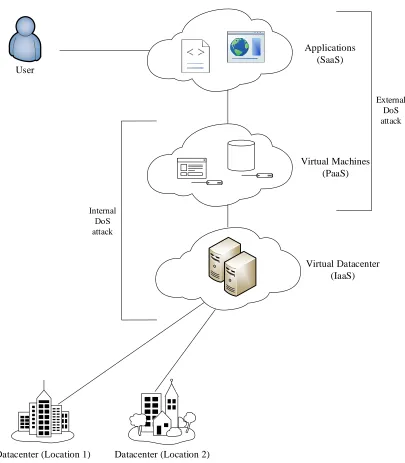
External cloud-based DoS attacks are initiated from outside the cloud environment and
target cloud-based services. These attacks occur from outside the cloud system and target
SaaS and PaaS models. This type of attack affects the availability of services.
Internal cloud-based DoS attacks raise from the cloud system itself, such as within the PaaS
or IaaS model. This attack type can occur in several ways. For example, the attacker may
exploit the trial period of the cloud service of a vendor. Consequently, an authorized user
within the cloud environment can internally launch a DoS attack on the victim’s machine.
Moreover, sharing infected virtual machine (VM) images can allow an attacker to control
and utilize the infected VMs to execute an internal DoS attack on the targeted machine
The case scenarios that demonstrate how internal and external DoS attacks affect
cloud-computing systems are described as follows.
1. Case Scenario-1 E-mall Company External DoS Attack.
E-Mall Company, which provides a web-based e-commerce service to their visitors and
members, decided to move to a cloud-based hosting service. They agreed to migrate
their service to Whatchamacallit Elastic Compute Cloud (WEC2) and utilize the
Whatchamacallit Elastic Block Store (WEBS) service for their data storage. However,
three months after the implementation of the cloud service, the E-Mall service became
unavailable to their members and visitors for more than 16 hours. Neither could E-Mall
Company control the circumstances nor could they address the cause of the
unavailability of the service. They contacted Whatchamacallit support and were
informed, “that E-Mall Company had somehow exhausted all its available bandwidth.”
E-Mall Company notified the Whatchamacallit support representative that their records
indicated that only 150 transactions had been processed and that only 1,050 users were
online when the services terminated. After some time, E-Mall Company was intimated,
“that their bandwidth was consumed by the flood of innumerable User Datagram Protocol (UDP) packets that were targeted at their IP.” This attack caused
approximately 16 hours of service unavailability. Consequently, the E-Mall Company
incurred the following costs:
- Owing to the nature of cloud computing and based on the WEC2 service
agreement, the E-Mall Company was responsible for the bandwidth usage
consumed during the DoS attack. The average cost of the bandwidth usage was
$0.10 per GB.
- The web-based e-commerce system was unavailable resulting in a loss of
approximately $50,000 worth sale transactions.
2. Case Scenario-2 E-mall Company Internal DoS Attack:
The second scenario is an internal DoS attack that occurred at the E-Mall Company
of E-Mall Company was unable to access the WEBS to store or retrieve data. The
response they received was, “that multiple transactions were performed on the data
storage system triggering an extended communication response time with the
database.” E-Mall Company “observed that their logs indicated that database
transactions occurred at average levels when compared to their transaction volumes
over the previous three months.” Following an investigation by Whatchamacallit, “it
was discovered that a flood of TCP SYN connection requests affected the data-storage
service.” WEBS service is an internal service and is not related directly to the customers’ systems. Therefore, the second attack, which affected the data-storage
system, occurred through another virtual machine in the WEC2 environment.
Whatchamacallit explained “that the second DoS attack differed from the first attack
in that it was an internal DoS attack. It was mentioned that an owner of another virtual
server within the cloud environment caused seven other virtual machines to flood the
WEBS service concurrently by sending forged requests. Therefore, the WEBS response
time was extremely slow during the attack.” As a result, E-Mall Company reported the
following losses:
- E-Mall Company lost approximately $6,000 worth sales transactions because
of the unavailability of the data for two hours.
- E-Mall Company lost 1,000 customers because the customers were frustrated
by the effects of the internal DoS attack. They were not able to browse the
E-Mall services as easily as they could browse for the services of other competing
firms.
Owing to the above challenges, defending cloud-computing systems against the different
types of DoS attacks is an important research issue. The defense objective is to maintain
cloud system availability and avoid the attacks’ overloaded resource usage, which can
cause financial losses. Accordingly, this research strives to:
- Develop methods to effectively protect cloud-based systems against external DoS
attacks using strong authentication protocols that are targeted to external DoS
- Develop an approach to effectively defend cloud-based systems against internal
DoS attacks by employing strong authentication protocols that are targeted to
internal DoS attacks.
In addition, this research analyzes and validates the proposed cloud-based authentication
protocol suite against both external and internal DoS attacks. The full scope of research
objectives are described in the following section.
1.2
Research Objectives
The main goal of this thesis is designing and developing a novel cloud-based authentication
protocol suite to securely authenticate the cloud user and to prevent risks of external and
internal DoS attacks. The research objectives established to achieve the research goal are
as follows:
1. Investigate DoS attacks in conventional networks and then identify DoS attacks in
cloud-computing systems. The tasks for achieving this objective are to:
- Explore the risks of DoS attacks.
- Study existing types of DoS attacks in conventional network systems.
- Examine existing defense mechanisms against DoS attacks in conventional
network systems.
- Evaluate the ability of cloud-computing systems to detect DoS attacks.
- Identify and categorize all possible types of DoS attacks in cloud-computing
systems.
2. Investigate, propose, and validate a protocol suite that defends the cloud-based system
against external DoS attacks. The tasks to achieve this objective are to:
- Design a cloud-based authentication protocol to defend the system against
external DoS attacks.
- Analyze and validate the security and performance of the proposed cloud-based
authentication protocol.
3. Investigate, develop, and validate a defender protocol suite against internal DoS
attacks. The following tasks to accomplish this objective are to:
- Analyze and validate the security and performance of the proposed cloud-based
authentication protocol.
1.3
Research Methodology
This section describes the methodologies that are applied in this research to design and
develop the cloud-based authentication protocol suite that defends against external and
internal DoS attacks. The proposed cloud-based authentication protocol suite can not only
detect internal DoS threats, but it can also defend the system against external DoS attackers.
In addition, the developed protocol satisfies the following security requirements:
- Multilevel adaptive technique that determines the efforts of the protocol
participants.
- Ability to identify a legitimate user’s requests prior to heavy authentication.
- Footprint-free core protocol.
- Formal validation of the protocol.
- Experimental validation of the protocol.
1.3.1
Defender Protocol Suite Design
The identity authentication protocol is believed to have become increasingly susceptible to
attackers who use DoS techniques. A cloud-based authentication protocol that securely
authenticates a cloud user and effectively prevents DoS attacks on the cloud-computing
system is needed. In this thesis, we propose a cloud-based DoS-resistance protocol suite
that securely authenticates cloud users. This protocol is designed such that the cloud server
is required to do lightweight computation work without the need to store any data during
the authentication process. In addition, it requires the cloud user to do a process that is
computationally expensive.
To realize the Meadows cost-based approach (Meadows, 2001), this protocol suite
considers a “subset sum” problem as a “client puzzles” technique (Juels & Brainard, 1999)
(Chapters 3 and 4). A “subset sum” problem is a kind of cryptographic knapsack problem,
and it is not only a strong one-way function, but it also has a flexibility property to be
on the size of the knapsack (the total number of its items, n) and on the number of items
(the subset sum size, m) involved in puzzle solution. If the number of items n is small, then
an exhaustive search for the solution is practical. Also, if the number of m is small
compared to n, then a solution can be found in a reasonable time. Consequently, by
adjusting the values of n and m, determining the difficultly level of the knapsack problem
and hence the cost-based approach can be adaptively realized. Therefore, the proposed
cloud-based DoS-resistance protocol suite has the ability to be configured such that the
more sensitive the services requested are, the greater the computation cost required from
the requester is. In other words, greater computation cost can be achieved by asking the
requester (client) to perform an expensive operation, such as solving an expensive subset
sum puzzle. The responder (cloud server) should conduct inexpensive to medium-cost
operations, such as generating subset sum puzzle elements, checking the solution, or
decryption operations.
A banker’s (Dijkstra, 2002) algorithm is also implemented in the second module of the
proposed protocol to control the allocation of services and to prevent the risk of an internal
DoS attack on a specific service host or virtual machine (Chapter 4).
1.3.2
Security and Performance Validation
To validate the security requirements of an identity authentication protocol, it is important
to analyze the proposed protocol via two different models. Therefore, the proposed
authentication protocol is formally analyzed via Syverson & Van Oorschot (SVO) logic
(P. F. Syverson & Van Oorschot, 1994) to validate its security requirements (Section 5.1.2).
The proposed protocol is also validated via a cost-based model approach (Meadows, 2001)
to ensure that it is invulnerable to DoS attacks (Section 5.1.1).
In addition, to validate the performance of the proposed protocol, experiments are
conducted to assess the ability of the protocol to serve as a DoS defender tool. The dynamic
programming algorithm is our tool to solve and assess the computational cost of both
participants (client and cloud server) involved in the subset sum problem. We were able to
subset sum solution’s complexity (Section 5.2.1). This makes our protocol adaptive enough
to protect different levels of sensitive services.
The GreenCloud simulator (Kliazovich, Bouvry, & Khan, 2012)was used to validate the
proposed protocol implementation in terms of their ability to prevent DoS attacks. A real
Linux OS was configured to collect real data regarding the properties of the high-level
computational processes of the proposed protocol. These data include the number of
million instructions per second (MIPS), the input size, the output size, and storage size of
each process. The collected data were used in the simulation as the input parameters for
simulating the protocol’s processes. Furthermore, a virtual machine (VM) was configured
as a cloud server in the simulation in order to execute the computational processes of the
protocol under extreme conditions. Then, VM data were collected from the simulation tool,
including the VM load, VM memory load, and VM storage load (Section 5.2.3). Finally,
the analysis results from the collected VM data were compared to the analysis results from
a widely used authorization protocol in the Internet (Sections 5.2.2 and 5.2.3). The main
contributions of this thesis are detailed in the following section.
1.4
Main Thesis Contributions
This thesis focuses on designing and developing a novel authentication protocol suite to
securely authenticate the cloud user and to prevent external and internal risks of DoS
attacks. Research contribution can be mainly summarized as follows:
- A taxonomy of existing DoS attacks and defenses on cloud-computing systems.
- An investigation and design of a defender authentication protocol suite against
external cloud-based DoS attacks.
- An investigation and design of a defender authentication protocol suite against
internal cloud-based DoS attacks. In addition to the performance validation of the
proposed authentication protocol.
- A security validation of the proposed authentication protocol suite against
cloud-based DoS attacks.
- A performance evaluation of a widely used cloud-based authorization framework
The research contributions of this thesis have been published in journals and conference
proceedings in the areas of information security and cloud security. Therefore, these
contributions have been peer-reviewed by experts in the field.
1.5
Thesis Structure
The thesis structure is outlined as follows:
Chapter 2 provides an overview of cloud-computing technology and DoS attacks.
In addition, it provides a literature review of existing cloud-based DoS attacks and
defenses. Furthermore, the ability of a cloud-computing system to defend against
DoS attacks using an existing authentication protocol is also provided in this
chapter.
Chapter 3 presents and discusses the proposed cloud-based secure authentication
module 1 (CSAM-1) protocol suite that is used to defend against external DoS
attacks.
Chapter 4 presents and discusses the proposed cloud-based secure authentication
module 2 (CSAM-2) protocol suite that is employed to defend against internal DoS
attacks.
Chapter 5 describes a security and performance validation of the proposed protocol.
It provides formal verification of the protocol via SVO logic, as well as security
validation using a cost-based model. In addition, it provides an analysis of a puzzle
technique that is implemented in the proposed protocol suite. Furthermore, it
provides an evaluation of a widely used existing authorization framework. Finally,
it provides a performance validation of the proposed protocol suite.
Chapter 2
2
Background and Literature Review
This chapter overviews the cloud computing in general and the related DoS attacks. It
presents an in-depth security analysis of DoS attacks in cloud computing. Finally, it
presents a literature review of the existing authentication protocols on cloud computing
and their ability to defend against DoS attacks.
2.1
Cloud Computing
Cloud computing is the utilization of hardware and software to provide services to end
users over a network, such as the Internet (Mell & Grance, 2011). It includes a set of VMs
that simulates physical computers and provides services, such as operating systems and
applications. However, configuring virtualization in a cloud-computing environment is
critical when deploying a cloud-computing system.
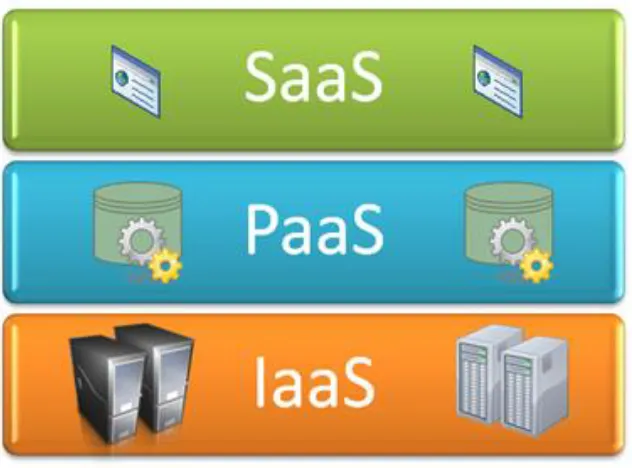
Figure 2.1: Architecture of cloud computing service models
A cloud-computing structure relies on three service models (Mell & Grance, 2011): IaaS,
bandwidth, and storage. PaaS builds on IaaS and provides end users with access to the
operating systems and platforms that are required for building and developing applications,
such as databases. SaaS provides end users with access to software applications.
Furthermore, cloud computing can be implemented using different deployment models, as
described below (Mell & Grance, 2011):
- Private Cloud: This cloud model is deployed to be used by a single organization.
This deployment model could be owned, operated, and managed by the
organization itself or by a third party exclusively for the organization. It can be
located on or off the organization.
- Community Cloud: This cloud model is deployed to be used by multiple
organizations that have shared interests such as government organizations. This
deployment model could be owned, operated and managed by one or more
organizations in the community or by a third party exclusively for the community.
It can be located on or off the organizations.
- Public Cloud: This cloud model is deployed to be used by general public. This
deployment model could be owned, operated, and managed by, for example, a
business or an academic organization. It is located in a cloud provider.
- Hybrid Cloud: This deployment model is a combination of two or more different
deployment models (such as private, community, or public) that communicate
together to allow application and data portability. It is to be noted that the hybrid
cloud in this research is considered as a combination of the public model and either
private, community, or both (private and community) models.
2.2
Denial-of-Service Attacks
DoS attacks are a major security risk in the cloud-computing environment, where resources
are shared by many users. A DoS attack targets resources or services to attempt to render
them unavailable by overloading system resources with substantial amounts of spurious
critical resources, such as memory, CPU processing space, or network bandwidth, to make
them unreachable to end users by blocking network communication or denying access to
services.
DoS attacks are becoming increasingly more sophisticated. Many websites and large
companies have been targeted by these attacks. The first DoS attack was reported in 1999
(Nazario, 2008). In 2000, large resource companies, such as Yahoo, Amazon, CNN.com,
and eBay, were targeted by DoS attacks, and their services were stopped for hours
(Neumann, 2000). Register.com was targeted by a DoS attack in 2001. It was the first DoS
attack to use domain name servers (DNSs) as reflectors (Dittrich, Mirkovic, Reiher, &
Dietrich, 2004). In 2002, a service disruption was reported at 9 of 13 DNS root servers on
account of a DNS backbone DoS attack. This attack type reoccurred in 2007 and disrupted
two DNS root servers (Arora, Kumar, & Sachdeva, 2011). In 2007, a DoS attack was
executed by thousands of computers targeting more than 10,000 online game servers
(Arora et al., 2011). In 2008, a DoS attack targeting Wordpress.com resulted in 15 minutes
of service denials (Patel & Borisagar, 2012). In 2009, GoGrid, a cloud-computing provider,
was targeted by a massive DoS attack that affected approximately half of the thousands of
customers of the provider. In 2009, Register.com was again targeted by a DoS attack. In
the same year, several social networking sites, including Facebook and Twitter, were
targeted by various DoS attacks. Many websites were affected by DoS attacks in 2010,
including the Australian Parliament House website, Optus, Web24, Vocus, and the website
of Burma’s main Internet provider. In 2011, Visa, MasterCard, PayPal, and PostFinance
were targeted by a DoS attack that aimed to support the WikiLeaks founder (Patel &
Borisagar, 2012). In the same year, the site of the National Election Commission of South
Korea was targeted by a DoS attack.
Furthermore, thousands of infected computers were used in a DoS attack that targeted the
Asian E-Commerce Company in 2011 (Patel & Borisagar, 2012). In 2012, the official
website of the office of the vice-president of Russia was unavailable for 15 hours owing to
a DoS attack (Patel & Borisagar, 2012). In the same year, many South Korean and United
States (US) websites were targeted by DoS attacks. Godaddy.com websites reported
other financial institutions became targets of a DoS attack. As evidenced by the above
cases, the volume of DoS attacks is rapidly increasing. Moreover, these attacks are
targeting major companies, which are consequently incurring significant global financial
losses.
DoS attacks, such as those above, include different types of techniques. These techniques
and their effects are outlined below.
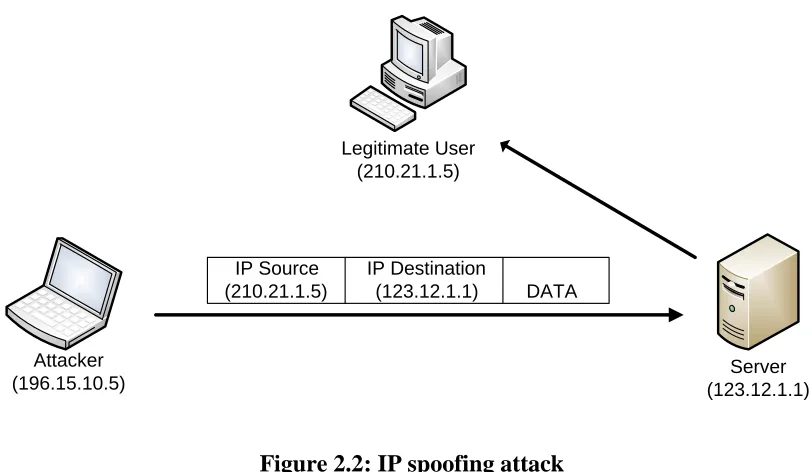
Server (123.12.1.1) Legitimate User
(210.21.1.5)
Attacker (196.15.10.5)
IP Source IP Destination (210.21.1.5) (123.12.1.1) DATA
Figure 2.2: IP spoofing attack
IP spoofing attack: In an Internet Protocol (IP) spoofing attack, packet transmissions
between the end user and cloud server are intercepted. Their headers are modified so
that the IP source field in the IP packet is forged by using either a legitimate IP address
or an unreachable IP address, as shown in Fig. 2.2. Consequently, the server responds
to the legitimate user machine, thereby affecting that machine, or the server is unable
to complete the transaction to the unreachable IP address, which affects the server
resources. Tracing such an attack is difficult because of the forged IP address in the IP
Hacker
Legitimate User Server
Legitimate User
SYN
SYN-ACK
ACK
SYN
Hacker SYN -ACK
SYN
Server
Server Server
(b)
(a)
k
l
j
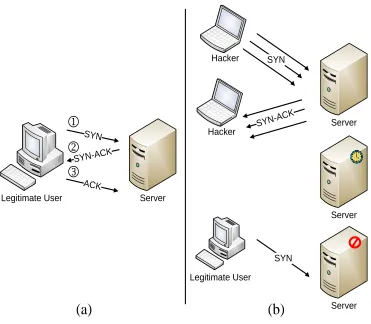
Figure 2.3: (a) Normal three-way handshake; (b) SYN flooding attack
SYN flooding attack: A Transmission Control Protocol (TCP) connection starts with
a three-way handshake, as shown in Fig. 2.3(a). A typical three-way handshake
between a legitimate user and the server begins by sending a connection request from
the legitimate user to the server in the form of a synchronization (SYN) message.
Subsequently, the server acknowledges the SYN message by returning a request
(SYN-ACK) to the legitimate user. Finally, the legitimate user sends an ACK request to the
server to establish the connection. SYN flooding occurs when the attacker sends
innumerable packets to the server but does not complete the three-way handshake
process. Consequently, the server waits to complete the process for all of those packets.
This prevents the server from processing legitimate requests, as shown in Fig. 2.3(b).
Moreover, SYN flooding can be executed by sending packets with a spoofed IP
attack, the attacker sends a packet with the predicted sequence number of an active
TCP connection with a spoofed IP address. Thus, the server is unable to reply to that
request, thereby affecting the performance of the cloud system because of extensive
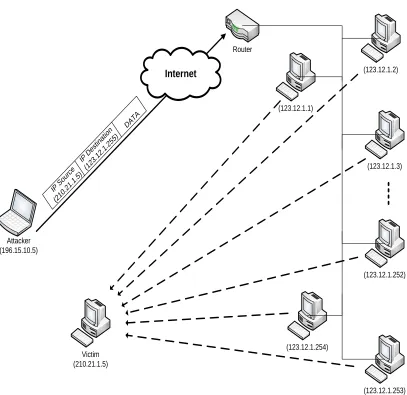
resource consumption. Router Attacker (196.15.10.5) (123.12.1.1) (123.12.1.3) (123.12.1.252) (123.12.1.254) (123.12.1.2) (123.12.1.253) Victim (210.21.1.5) IP Sou rce IP Des tinat ion (21 0.21 .1.5 ) (1
23.1 2.1. 255) DA TA Internet
Figure 2.4: Smurf attack
Smurf attack: In a smurf attack, the attacker sends many Internet Control Message
Protocol (ICMP) echo requests. These requests are spoofed so that their source IP
IP address, as shown in Fig. 2.4. Therefore, the victim is flooded with broadcasted
addresses. In the worst case scenario, the number of hosts who reply to the ICMP echo
requests is excessively large.
Buffer-overflow attack: In a buffer-overflow attack, an attacker sends executable code
to the victim to exploit the buffer-overflow vulnerability. Consequently, the attacker
can completely control the victim machine. The attacker can subsequently either harm
that machine or use the infected machine to perform an internal cloud-based DoS
attack.
Server (123.12.1.1) Attacker
(196.15.10.5)
Packet size 90,000 bytes
Figure 2.5: Ping of death attack
Ping of death attack: In the ping of death attack, the attacker sends an IP packet larger than the IP protocol limit, which is 65,535 bytes, as shown in Fig. 2.5. Processing an
oversized packet affects both the victim machine within the cloud system and the cloud
Victim (123.12.1.1) IP Source IP Destination
(123.12.1.1) (123.12.1.1) DATA
Figure 2.6: Land attack
Land attack: This attack uses the Land.c program to send forged TCP SYN packets with the victim’s IP address in the source and destination fields, as shown in Fig. 2.6.
The machine receives the request from itself, which crashes the system.
Teardrop attack: This type of attack uses the Teardrop.c program to send invalid
overlapping values of IP fragments in the header of TCP packets. The victim machine
in the cloud system will crash in the re-assembly process.
2.3
Literature Review
2.3.1
DoS Defense Techniques
DoS attacks in cloud-computing environments can be externally or internally initiated, as
shown in Fig. 2.7. An external cloud-based DoS attack is launched from outside the cloud
system and targets the cloud’s services to disrupt their availability. Therefore, an external
DoS attack can affect the SaaS and PaaS models. On the other hand, an internal
cloud-based DoS attack originates from inside the cloud system, primarily in the IaaS and PaaS
models. These attacks can take various forms. For example, an attacker can take advantage
of the free trial periods of some cloud service providers. Hence, an authorized user of the
Figure 2.7: External and internal cloud-based DoS attacks
Based on an investigation of the major types of DoS attacks, we derive a taxonomy of
based DoS attacks, as illustrated in Table 2.1. Our classification is focused on
cloud-computing aspects, such as a cloud-based type of attack, as well as on recommended
practical defense mechanisms and the drawbacks of each mechanism.
Datacenter (Location 2) Datacenter (Location 1)
User
Virtual Datacenter (IaaS) Applications
(SaaS)
Virtual Machines (PaaS)
Table 2.1: Types of DoS attacks on cloud systems
Attack Cloud-based Type Recommended Practical Defense Mechanism
Limitation
IP Spoofing
External
Internal
- Hop Count Filtering (HCF) in the PaaS model (Wang, Jin, & Shin, 2007)
- The attacker can build his/her own IP2HC mapping to avoid HCF
External
Internal
- Trust-based approach in the IaaS model (Gonzalez, Anwar, & Joshi, 2011)
- Another compatible solution should be proposed to detect IP spoofing in distribution routers
SYN Flooding
External
Internal
- SYN cache approach in the
PaaS model (Lemon, 2002) - Increase in latency
External
Internal
- SYN cookies defense approach in the PaaS model (Lemon, 2002)
- Lowers the performance of the cloud system
External
Internal
- Reduces the time of SYN messages received in the PaaS model
- Some of the legitimate ACK packets could be lost
External
Internal
- Filtering mechanism in the IaaS model
- Not reliable due to the limited use of this method
External
Internal
- Firewall mechanism in the IaaS model
- May affect the performance of the networking system in the cloud
External
Internal
- Active monitoring mechanism in the IaaS model (Schuba et al., 1997)
Smurf Attack
External
Internal
- Configuring VMs in the PaaS model
External
Internal
- Configuring network resources in the IaaS model
Buffer Overflow
External
Internal
- Prevented when writing a source code mechanism in the SaaS model (Fu & Shi, 2012)
- Time consumption
External
Internal
- Performs the array bounds checking mechanism in the SaaS model (Fu & Shi, 2012)
- Decreases resource performance in the cloud
External
Internal
- Runtime instrumentation mechanism in the SaaS model (Fu & Shi, 2012)
- Not reliable
External
Internal
- Analyzes the static and dynamic code mechanism in the SaaS model (Fu & Shi, 2012)
- Not reliable
Ping of Death
External
Internal
- May not currently affect any cloud service model; however, the attack could be developed in the future
Land.c
External
Internal
- May not currently affect any cloud service model; however, the attack could be developed in the future
Teardrop.c
External
Internal
2.3.2
Cloud Computing Authentication and Authorization Protocols
The identity authentication process is considered the principal gateway to cloud-based
services. Therefore, these gateways have become increasingly susceptible to adversaries
who may use DoS attacks to permanently close these gateways. Numerous authentication
protocols exist that can verify identities and protect conventional networked applications.
However, these authentication protocols may themselves introduce DoS risks when used
in cloud-based applications. This risk introduction could occur on account of the utilization
of a heavy verification process that can consume the cloud resources and disable the
application service.
This section provides an example of one of these protocols. In addition, some of the
proposed authentication protocols utilized in cloud computing are presented. Furthermore,
the OAuth 2.0 protocol, which is a widely used authorization protocol for cloud systems,
is described. Finally, the Host Identity Protocol (HIP), which is a DoS-resistant
authentication protocol in conventional network systems, is explained.
Figure 2.8: Mutual authentication protocol
User session request, R
clientR
server, [{R
client, g
bmod p}
client]
server[{R
server, g
amod p}
server]
clientAn example of authentication protocols that can independently introduce internal DoS risks
is shown in Fig. 2.8. The goal of this protocol is to cross-authenticate the user and server.
This protocol uses the ephemeral Diffie-Hellman key exchange (Diffie & Hellman, 1976),
where a, b, p, and g are the values of Diffie-Hellman, as shown in Fig. 2.8. In this protocol,
once the server receives a request from a user, the server begins generating the secret value,
b. Subsequently, the server computes the exponential value, gb mod p. Moreover, the server
encrypts the nonce of the user and the exponential value via the user public key. Finally,
the server digitally signs the encrypted message. All of these processes are executed by the
server, which consumes considerable resources without determining whether the request is
legitimate. This mutual authentication, which is vulnerable to the DoS attack, is similar to
the two-way authentication version of the Transport Layer Security (TLS) protocol
(Dierks, 1999).
Another example of a protocol that independently introduces DoS risk is Kim et al.’s
protocol (Kim, Fujioka, & Ustaoğlu, 2009), which aims to securely authenticate the key
exchange between participants. In this protocol, once the server receives the first message,
the server begins computing an exponential value and generates the key. Accordingly, the
server resources can become exhausted by the initial requests.
Many authentication protocols have been proposed for the cloud-computing environment.
However, they do not protect against DoS attacks. Yassin et al. (A. A. Yassin, Jin, Ibrahim,
Qiang, & Zou, 2013) proposed an authentication process that uses a one-time password for
mutual authentication of the user and cloud server. Although Yassin et al.’s authentication
scheme defends against replay attacks, it cannot defend against DoS attacks. Other
cloud-based authentication protocols for DoS prevention have been proposed (e.g., Choudhury et
al. (Choudhury, Kumar, Sain, Lim, & Jae-Lee, 2011), Hwang et al. (Hwang, Chong, &
Chen, 2010), Jaidhar (Jaidhar C. D, 2012), and Tsaur et al. (Tsaur, Li, & Lee, 2012)). These
protocols use a smart card reader for the authentication process. Therefore, the cloud users
should use a card reader device for each authentication by the cloud server. Additionally,
the scheme of Yassin et al. (A. a. Yassin, Jin, Ibrahim, & Zou, 2012) recommends the use
Figure 2.9: Example of social authentication icons (Darwell, 2013)
Furthermore, the OAuth 2.0 authorization framework was developed by Hardt in 2012
(Hardt, 2012) as an improvement on the previous OAuth 1.0 protocol (Hammer-Lahav,
2010). Currently, it is implemented as an authorization framework (as OAuth) by many
vendors, such as Facebook, Google, Twitter, LinkedIn, and Yahoo (Boyd, 2012), as shown
in Fig. 2.9. This protocol was developed to control third-party client accessibility to HTTP
services. For instance, assume that a user would like to play the Angry Birds game and post
the score and screenshots on his/her Facebook account. In this scenario, the user must give
the Angry Birds app access to his/her Facebook account so the app can obtain the user’s
information and post the game score on the user’s behalf. By employing OAuth, this can
be done in such a way that, when the app needs to access any Facebook services (i.e.,
posting), OAuth will redirect the user back to the Facebook login screen to login into the
user’s Facebook account. In this case, the user gives his/her username and password to
Facebook itself, not to the Angry Birds app. Facebook will then ask whether the user wants
to authorize this app. It will then create an access token that works like a password. This
token only allows the app to access the user’s Facebook account information and post the user’s score when needed.
Thus, the OAuth 2.0 protocol permits a third-party client, such as an application, to access
a server’s resources (user profile information) with rules and permissions in a way that avoids exchanging the user’s credentials. The OAuth 2.0 protocol participants are as
Client: An application (e.g., Angry Birds app) that uses an application program
interface (API) (Siriwardena, 2014) to access the resource owner’s (user’s) protected
resources (profile) with his/her authorization.
Resource owner: The user of the application who grants access to his/her protected
resources (profile) that are available on the resource server (e.g., a Facebook user
profile server).
Resource server: The server (Facebook user profile server) that hosts the protected
resources of the user (his/her profile). Typically, this server provides the API and hosts,
and protects the user’s data (profile).
Authorization server: The server that receives the resource owner’s (user’s)
permissions to generate the access token and then sends it to the client (Angry Birds
app). Therefore, the client can access the protected resources (user’s profile). The
authorization server (Facebook server) can be the same as the resource server
(Facebook user profile server).
Figure 2.10: Overview of the OAuth 2.0 protocol User
Resource Server Authorization Server
Resource owner
3 Authorization Grant
As shown in Fig. 2.10, the OAuth 2.0 protocol works as follows:
1. The client (Angry Birds app) sends an authorization request to the resource owner
(user).
2. The resource owner (user) sends an authorization grant to the client (Angry Birds
app). However, the type of authorization granted is determined based on the
authorization request received from the client. Examples of authorization grant
types are as follows:
Authorization code grants: In this type of grant, the resource owner (user)
grants an authorization code to the client (Angry Birds app) after an
authorization server (Facebook server) authorizes the resource owner. The
client uses this authorization code and therefore does not need the credentials
of the resource owner. An authorization code grant is a secure type of grant.
Implicit grants: This type of grant is implemented on the client (Angry Birds
app) using software language so that the access token is immediately given to
the client. Although the implicit grant reduces the protocol overhead, it may
introduce security threats.
Resource owner password credential grants: For this type of grant, the
access token is given to the client (Angry Birds app) using the credentials of the
resource owner (username and password). This grant type can be implemented
when the resource owner (user) completely trusts the client.
Client credential grants: This type of grant can be implemented to limit access to the server’s secure resources, such as Facebook user profiles. Therefore, it
can be implemented when the client (Angry Birds app) is the owner of the
secure resource (Facebook user profiles) or when the client has been granted
permission to access the secure resource in the past.
3. The client (Angry Birds app) sends the received authorization grant to the
authorization server (Facebook server) to obtain an access token.
4. The authorization server (Facebook server) authenticates the client (Angry Birds
app) and validates the authorization grant. It then issues an access token that will
client. This access token is used instead of the standard username and password
authentication. The access token has an expiration time. Once it expires, an optional
refresh process can be implemented by reapplying the third step of the protocol.
5. The client (Angry Birds app) sends the received access token to the resource server
(Facebook user profile server) so that it may access the secure resource (user’s
profile data).
6. The resource server (Facebook user profile server) validates the access token and
then allows the client (Angry Birds app) to access the resource (user’s profile data).
For instance, the client could share the game’s achievements of the user on his/her
Facebook timeline.
Figure 2.11: Authorization process of Google's OAuth 2.0 for web server
applications
However, if the OAuth 2.0 protocol is not securely implemented, the protocol could
introduce security breaches into the system, such as in Google’s implementation of the
OAuth 2.0 protocol (Google Developers, 2014). This implementation of the OAuth 2.0
protocol for web server applications was developed so that Google’s API could be
implemented in web server applications and frameworks, such as game applications. As
Google servers
1: Request token
3: Authorization code
4: Exchange code for token
5: Token response
6: Use token to call Google API 2: User login & consent
shown in Fig. 2.11, the authorization process of the implemented protocol works as
follows:
1. The web server application (app) requests the token.
2. The user is redirected to the uniform resource locator (URL) that is assigned by
Google. This URL contains some information, such as access type.
3. Google servers perform the authentication task. Once Google servers authenticate
the user, the web server application (app) receives the authorization code.
4. To obtain an access token, the web server application (app) exchanges the user’s
data and obtains an authorization code with the Google servers. To enable future
offline access, the web server application receives the refresh token first; this token
information is then exchanged with the Google servers to obtain the access token.
5. The Google servers send the access token to the web server application (app).
6. The web server application (app) uses the received token to call Google’s API.
For offline access, in this implementation, the refresh token is stored on the web application
server’s storage device for future communication. The stored refresh token remains valid
until it is revoked by the user (Google Developers, 2014). These stored data can lead to
security flaws that exhaust the storage resources of the web servers, as detailed in Section
5.2.2.
The Host Identity Protocol (HIP) (Moskowitz, Nikander, Jokela, & Henderson, 2008) is an
example of an authentication protocol that is used to identify a DoS attack on a
conventional network. However, this protocol cannot be implemented in the application
layer to defend against external DoS attacks. This is because HIP is based on the host
identity on the network layers in the Open Systems Interconnection (OSI) reference model.
Moreover, it is configured and controlled at an operating system level. Furthermore, any
authentication protocol that is based on IP address verification, such as the Internet
Protocol Security (IPSec) protocol, makes it difficult to hide the identity of the participants.
HIP solves the DoS-SYN flooding attack that was presented in Section 2.2 by creating
additional processing to establish a new TCP connection between two participants. This
reverse a hash function. Consequently, the puzzle-solving process forces the user to
complete some computational operations. Verifying the puzzle solution is a short operation
on the server side.
2.3.3
Authentication Protocol Validation
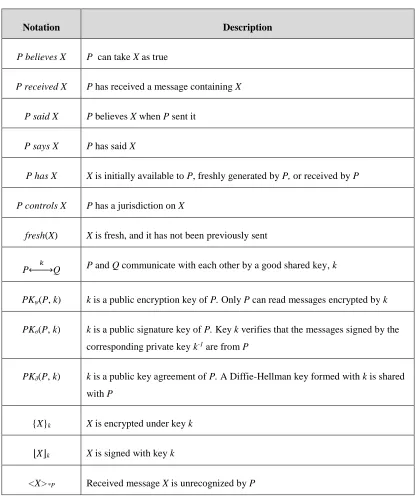
Burrows, Abadi, and Needham (BAN) proposed a belief logic (Burrows, Abadi, &
Needham, 1989) to analyze the security requirements of authentication protocols.
Subsequently, logic by Syverson and Van Oorschot (SVO) (P. F. Syverson & Van
Oorschot, 1994) was introduced as an extension model to address some of the limitations
of BAN. SVO uses some of its own notations in addition to those used in BAN. The
analysis steps of any authentication protocol using SVO (P. Syverson & Cervesato, 2001)
are as follows:
1) Initial assumption: An assumption of the initial status of the protocol.
2) Received message assumption: An assumption regarding the messages each party
receives when the protocol is completed in a trusted fashion.
3) Comprehension assumption: An assumption regarding what the receiver believes,
and what parts of the received message are unknown.
4) Interpretation assumption: An assumption of how each party interprets the received
messages.
5) Derivation: It derives the analysis goals using the previous assumptions.
For further security validation, any protocol design in general should be investigated in
terms of its vulnerability to DoS attacks using the cost-based model approach proposed by
Meadows (Meadows, 2001). This approach aims to prevent DoS attacks during the
authentication process. It depends on the exhausted resource costs of the participants. The
cost-based model approach logically demonstrates the effectiveness of the protocols in
preventing DoS attacks. The computation cost is defined as the total resource usage cost of
the requester (user) and responder (server) when both participate in the authentication
protocol. The cost is computed during the process until a DoS attacker is detected and is
prevented from participating. The total cost of the requester is the total estimated cost of
authentication process ends. However, the total cost of the responder is the total estimated
cost of each operation during the authentication process until the requester is determined
to be either a legitimate requester or attacker.
Meadows (Meadows, 2001) proposed the categories of inexpensive, medium, and
expensive for an operation’s cost. This approach assumes that the exponential, signature
check, and signature operations performed during an authentication process are expensive.
The pre-calculated exponential value, and the encryption and decryption operations are
medium cost. Any other operations are inexpensive.
2.3.4
Review Summary
The literature review on DoS-aware cloud-based authentication protocols is summarized
Table 2.2: Literature review summary
Proposed Protocol DoS awareness Implementation environment
Uses third-party
device
OAuth 2.0 (Hardt, 2012) Based on the implementation
Conventional network and cloud
computing
No
HIP (Moskowitz et al., 2008) Yes Conventional
network No
Yassin et al. (A. A. Yassin, Jin,
Ibrahim, Qiang, & Zou, 2013) No Cloud computing No
Choudhury et al. (Choudhury et al.,
2011) Yes Cloud computing
Yes (smartcard reader)
Hwang et al. (Hwang et al., 2010) Yes Cloud computing Yes (smartcard reader)
Jaidhar (Jaidhar C. D, 2012) Yes Cloud computing Yes (smartcard reader)
Tsaur et al. (Tsaur, Li, & Lee, 2012) Yes Cloud computing Yes (smartcard reader)
Yassin et al. (A. a. Yassin, Jin,
Ibrahim, & Zou, 2012) Yes Cloud computing
Yes (fingerprint scanner)
Based on the implications of the above literature review summary, an authentication
protocol suite against DoS attacks is herein proposed that works in the cloud-computing
environment. Moreover, it considers the security requirements of the authentication
Chapter 3
3
Cloud-Based Secure Authentication Module 1 (CSAM-1)
Protocol for Private and Community Cloud Computing
In this chapter, the first module of the proposed cloud-based secure authentication
(CSAM-1) protocol suite to defend against external DoS attacks is presented. The CSAM-1 protocol
is developed so that the total computational cost of the user side is greater than the resource
operations cost of the cloud-based server when they jointly participate in the authentication
process. The main objective of the CSAM-1 protocol is to defend against external DoS
attacks. Therefore, CSA can be implemented and configured in private and community
cloud computing because the infrastructure and platforms in these deployment models are
secured by the organizations. On the other hand, in public and hybrid cloud computing
models, different infrastructures are communicated together. Thus, there is no guarantee
that all infrastructures have the same security level. The solution to this problem is
addressed in Chapter 4. Table 3.1 shows the notations that are used in the CSAM-1 protocol
Table 3.1: Notations of the CSAM-1 protocol
Notation Description
Cloud_user Cloud user/client
Cloud_server Cloud server/service provider
Cloud_user ID (CUID) Cloud_user ID
Unique encrypted text (UET) Unique encrypted text; the key of the UET is known only by cloud_server
Session key (SK) Session key
A A set of random integers of the server challenge function
S A subset sum of the server challenge functions
B A binary vector representing the challenge function solution
Rcloud_server The nonce that is generated by cloud_server
T Timestamp
KX Secret key of X
MK Master secret key of cloud_server
Tag An encryption of timestamp and cloud user ID by master secret key of cloud_server
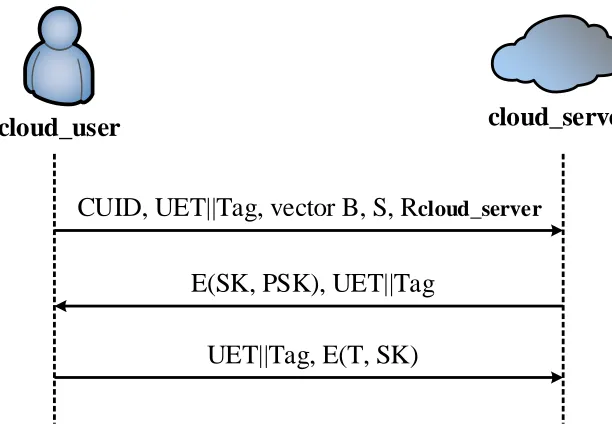
CSAM-1 consists of two protocols, as shown in Fig. 3.1. The first protocol is used for the
registration process, which is an agreement process between the participants (cloud_user
and cloud_server) about specific shared information. Thus, the participants can use that
information during the operation of the second CSAM-1 protocol. The second protocol is
an adaptive-based identification and authentication protocol that works against DoS
attacks. This protocol is developed based on the cost-based model approach. In addition,
this protocol is used for the authentication process, which includes all operations that occur
cloud_server can confirm the identity of cloud_user and then completes the authentication
process, or it can detect and then prevent an intruder in the case of a DoS attack.
Figure 3.1: CSAM-1 protocols
3.1
Registration Protocol
In the CSA registration protocol, cloud_user and cloud_server share the required identity
data to register cloud_user in the cloud_server database.
Figure 3.2: Registration protocol in CSAM-1
New request includes cloud_user information
Request confirmation data
Response to confirmation data
UET||Tag, CUID
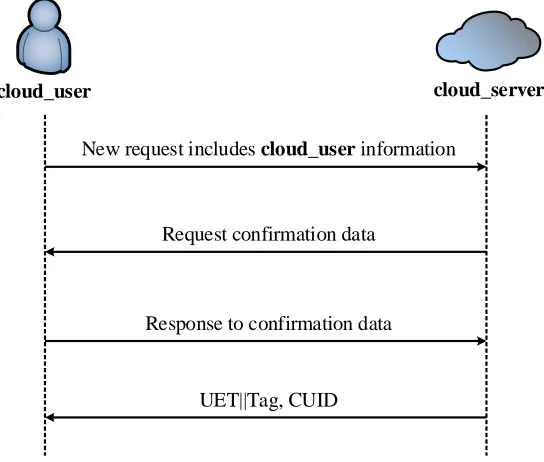
As shown in Fig. 3.2, the registration process begins when cloud_user submits all the
required information to cloud_server. This information includes the first name, last name,
organization name, email address, and any other information that is required by the cloud
service provider. Cloud_server validates the received information, stores it in a database,
and then sends a validation email message to cloud_user to confirm cloud_user’s
information. If cloud_user does not confirm his/her information after a specific amount of
time, cloud_server deletes cloud_user’s information. After validation, cloud_server
activates cloud_user’s account. At the same time, cloud_server generates a CUID and a
UET. This UET is encrypted by cloud_server’s master key (MK), which is known only
by cloud_server.
Figure 3.3: UET structure in CSAM-1
As shown in Fig. 3.3, the UET contains cloud_user information and other information that
is created by cloud_serverduring the processes of the CSA protocols, such as the CUID,
last session key, and last timestamp. The UET is a piece of information that is not stored
on cloud_server; rather, it is sent to the requesting cloud_user.
Figure 3.4: Cloud_user (lookup) database table structure
To identify cloud_user and to avoid the risk of DoS attacks,cloud_server generates a tag
that contains a timestamp (T) and CUID that are both encrypted by cloud_server’s MK.
Cloud_server then adds CUID and tag information to cloud_user’s table in its database
(referred to as the lookup table), as shown in Fig. 3.4. It should be noted that the number
of entities in the lookup table depends on the number of confirmed registered cloud_users.
CUID
Last SK
Last T
Tag = E ( T + CUID, MK )
In the next step, cloud_server sends UET along with the tag to cloud_user. Once
cloud_user receives the required data from cloud_server, both cloud_user and
cloud_server agree upon the pre-shared key. The pre-shared key is created using a key
derivation function and a shared secret. Cloud_user and cloud_server agree upon the key
derivation function and a shared secret at the end of the registration protocol, which is
exchanged via a secure channel in a very restricted environment. This approach is the same
approach of the pre-shared key (PSK) agreement that used in the UMTS and WPA2
protocols (Southern, Ouda, & Shami, 2013). Consequently, cloud_user stores the UET
and a pre-shared key for a future authentication process. Cloud_server stores PSK in the
lookup table.
Even if cloud_user is registered to cloud_server, cloud_user cannot access the services
available through cloud_server unless cloud_server identifies and authenticates
cloud_user. To perform the identification and authentication protocol that is ready to
defend against external DoS attacks, CSAM-1 provides an outer shield to the authentication
protocol. This helps in distinguishing legitimate cloud_users from DoS attackers. The
CSA-adaptive based identification and authentication protocol is designed to provide this
outer shield as described in the following section.
3.2
Identification and Authentication Protocol
The adaptive-based identification and authentication protocol utilizes the cost-based model
approach. Before applying the computational power of the authentication protocols in the
server side, users are asked to prove their sincere commitment for receiving the
cloud_server services. This validation of commitment can be achieved by any technique
that can force the users to utilize a significant amount of computational power before the
servers utilize them in order to confirm their genuine requests. Currently, “client puzzles”
is a common technique that realizes the cost-based model approach (Juels & Brainard,
1999).
In this research study, a technique based on a one-way function is proposed to realize the
cost-based model approach. A cryptographic knapsack problem has been chosen because