Enhancing the Performance of DYMO Routing
Protocol in Manets
Vangala.Vaishnavi
& Dr. S. Pallam Setty
1
Computer Science and Systems Engineering, Andhra University College of Engineering,
Visakhapatnam
2
Computer Science and Systems Engineering, Andhra University College of Engineering,
Visakhapatnam
Abstract
:
In MANETs, nodes move around arbitrarily nodes may join and leave at any time and the topology is dynamically changing. Therefore routing is challenging problem in MANET because of the dynamic topology. Due to this problem link failure and route failure takes place. Therefore QOS routing is problem in MANETS.AODV is on demand reactive routing protocol, but drawback of AODV is doesn’t support scalability then it support small area networks. AODV v2 that is DYMO (Dynamic MANET Organization) supports larger networks. Again the problem is it doesn’t support smaller networks. The project contains a survey of implementing challenges to support scalability. In this project we investigating the impact of simulation time, Network size and offered load on the performance of both AODV and DYMO. By varying the NTT (node traversal time) we found that NTT=20Ms supports both smaller and larger networks. The drawback of DYMO is solved. The evaluation showed results, compared with AODV, DYMO and modified DYMO. Therefore our modified DYMO supports scalability.
.Keywords: AODV, DYMO, NTT
1. Introduction
MANET [1] [2] is a collection of wireless nodes that create a dynamic wireless network among them without any infrastructure. Ad-hoc is a communication mode that allows nodes to directly communication with each other without a router. In Latin, ad-hoc means “for that special purpose”. In ad hoc networks, nodes do not start out common with the topology of their networks; instead, they have to discover it. The basic idea is that a new node may announce its presence and should listen for announcements broadcast by its neighbours. Each node learns about nodes nearby and how to reach them and may announce that it, too, can reach them. An ad-hoc network can be sub-divided into two classes. In Static ad-hoc network the positions of a node may not change once it has become part of the network. In the mobile ad hoc network, nodes can
directly communicate with all the other nodes within their radio ranges; whereas nodes that not in the direct communication range use intermediate node(s) to communicate with each other. In these two situations, all the nodes that have participated in the communication the direct communication range use intermediate node(s) to communicate with each other. In these two situations, all the nodes that have participated in the communication automatically form a wireless network, therefore this kind of wireless network can be viewed as mobile ad hoc network. A Mobile Ad hoc Network (MANET) is a system of wireless mobile nodes that dynamically self organize in arbitrary and temporary network topology.
2. Routing Protocol
A Mobile Ad hoc Network (MANET) is a wireless mobile node that dynamically self organizes in random and temporary network topologies. People and vehicles will be internet worked in areas while not a pre existing communication infrastructure or once the utilization of that type of infrastructure needs a wireless extension. In the mobile ad hoc network, nodes can communicate directly with all the other nodes within their radio ranges; whereas nodes that not in the direct communication range use neighbouring nodes to communicate with each other. The need for mobility in wireless networks caused the creation of the MANET working group within The Internet Engineering Task Force (IETF) for developing steady IP routing protocols for both static and dynamic topologies. In a MANET, mobile nodes have the capacity to accept and route traffic from their neighbors towards the destination, i.e., they act as routers as well as hosts. As the network grows, and coupled with node mobility, the challenges linked with self configuration of the network become more obvious. More frequent connection disconnections and reconnecting place an energy constraint on the mobile nodes. Ad hoc routing protocols are refined with mechanisms to cope with the dynamic nature of MANET.
Ad Hoc on Demand Distance Vector (AODV) routing protocol is a reactive protocol. It has been derived from DSDV. DSDV issues broadcasts to announce every change in overall connectivity of ad hoc network and local movements have global effects. AODV avoid these problems. AODV [3] [4] is able to provide unicast, multicast and broadcast communication ability
(i) Route Discovery:
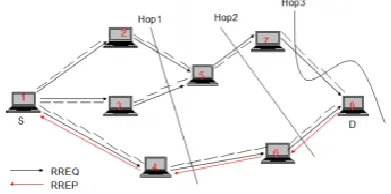
AODV discovers routes as and when necessary &does not maintain routes from every node to every other. Routes are maintained just as long as necessary. When a node wishes to send a packet to some destination, it checks its routing table to determine if it has a current route to the destination. If yes, forwards the packet to next hop node. If no, it initiates a route discovery process Route discovery process begins with the creation of a Route Request (RREQ) packet -> source node creates it. The packet contains source nodes IP address, source nodes current sequence number, destination IP address, destination sequence number and broadcast ID. Broadcasting is done via Flooding. When the RREQ is received by a node that is either the destination node or an intermediate node with a fresh enough route to the destination, it replies by unicasting the route reply (RREP) towards the source node. As the RREP is routed back along the reverse path, intermediate nodes along this path set up forward path entries to the destination in its route table and when the RREP reaches the source node, a route from source to the destination established.
Figure1. Propagation of Route Request (RREQ) packet and Route Reply (RREP) packet.
Source specifies the complete path to the destination in the packet header. All the intermediatory nodes simply forwards the packet to the next node as specified in the packet header. This means that intermediate nodes only need to keep track of their neighbouring nodes to forward data packets. The DSR protocol is composed of two main mechanisms that work together to allow the discovery and maintenance of source route in the ad hoc network.
(ii) Route Maintenance:
A route established between source and destination pair is maintained as long as needed by the source. When a link break in an active route is
detected, the broken link is invalid and a RERR message is sent to other nodes. The affected source node may then choose to either stop sending data or reinitiate route discovery for that destination by sending out a new RREQ message.
(b) DYMO (Dynamic MANET On Demand) Routing Protocol: DYMO is not a new protocol but an improvement of basic AODV routing protocol and easier to implement. It operates similar to AODV. It is intended for use by mobile nodes in wireless, multihop networks. DYMO [5][6] determines unicast between DYMO routers within the network in an on-demand fashion, offering improved convergence in dynamic topologies. The basic operations of the DYMO protocol are route discovery and route maintenance. In networks with a large number of routers, it is best suited for sparse traffic scenarios. In each DYMO router, minimal state routing is maintained and therefore it is applicable to memory constrained devices. In this protocol only routing information relative to active sources and destinations is maintained. The routing algorithm in DYMO may be operated at layers other than the network layer, using layer-appropriate addresses. For operation at other layers only modification of the packet/message format is required. To ensure predictable control overhead, DYMO router’s rate of packet/message generation should be limited. The protocol is suitable for scalability. However, it is yet to be explored for its functionality.
(i) Route Discovery
A source node issues a RREQ if it wants a route to any particular destination. Each intermediate node that receives the route request packet records the route to the source node. When the destination node receives the RREQ it unicasts a RREP packet to the source node. Each intermediate node that receives the RREP packet records a route to the target node. After sending a RREQ, source node wait up to RREQ_WAIT_TIME for route creation and send another RREQ if it does not receive any RREP message. To avoid excessive overheads in route discovery process source uses binary exponential back off. Next time it generates a RREQ, it waits for twice of the previous wait time. This process continues up to a total RREQ_TRIES. Waiting data packets remain in buffer and dropped if route to the desired destination is not obtained within the maximum number of RREQ_TRIES [6][7]
.
(ii) Route Maintenance
time has been expired the packet cannot be forwarded and RERR message is generated. In the second phase, when the route towards a certain destination is unknown, RERR messages are generated for notification of the involved nodes. Upon receiving a RERR, a node deletes the specified route.
3. Methodology
To evaluate the performance of AODV and DYMO routing protocols in Manets we have three types of methodologies.
They are
1. Simulation or Emulation 2. Experimental
3. Mathematical
Simulation was chosen, as experimental methodology was not practicable and mathematical methodology is highly restrictive. The research method was to evaluate, collection of the results, and the results were analyzed and compared with those from the work, conclusions were drawn from evaluations of the identified.
4. Simulation Environment
Parameters values
Area 1000*1000
Nodes 20, 40, 60, 80, 100
Mobility Model Random way point
MAC Layer IEEE 802.11
Simulation Time 300, 600, 900, 1200 , 1500
Energy Model Generic
Internet Protocol IPv4 and IPv6
5. Result And Discussion
To evaluate the performance of routing protocols, the following metrics are considered:
Throughput: Throughput is the ratio of number of packets sent and total number of packets. The greater value of throughput means the better performance of the protocol.
Average End To End Delay: End to end delay or one way delay refers to the time taken for a packet to be transmitted across a network from source to destination.
Average Unicast Jitter: A network with constant latency has no variation (or jitter). Packet jitter is expressed as an average of the deviation from the network mean latency. However, for this use, the term is imprecise. The standards-based term is packet delay variation.
(a). Impact of network work size on the performance of AODV and DYMO routing protocol.
Here in this we perform so many simulations by varying number of nodes for both AODV and DYMO routing protocol.
Here after performed so many simulations the results obatained that the DYMO routing protocol supports larger networks and supports QoS model (IPV6 protocol).
Therefore By performing different simulations on AODV routing protocol for network layer protocols (IPV4 and IPV6) by varying number of nodes the results obtained that the AODV supports best effort model (IPV4) for QoS model its performance is less. DYMO routing protocol supports larger networks and supports QoS model (IPV6 protocol).
(b). Investigating the impact of offered load on the performance of AODV routing protocol
Here we perform the many simulations for AODV routing protocol by varying the number of nodes and verify that how its performance at different loads
.
Therefore for AODV routing protocol the results obtained as,
For load=100, the average end to end delay is low at 20 nodes, the through put is high at 40 nodes. And average unicast jitter is low at 80 nodes for network layer (IPV4).
For load=200, the average end to end delay is low at 60nodes, the through put is high at 100 nodes. And average unicast jitter is low at 60 nodes for network layer (IPV4).
For load=300, the average end to end delay is low at 60nodes, the through put is high at 80 nodes. And average unicast jitter is low at 60 nodes for network layer (IPV4).
For load=400, the average end to end delay is low at 20nodes, the through put is high at 80 nodes. And average unicast jitter is low at 20 nodes for network layer (IPV4).
For load=500, the average end to end delay is low at 60nodes, the through put is high at 100 nodes. And average unicast jitter is low at 60 nodes for network layer (IPV4).
Here we performed so many simulations by varying simulation times, network layer protocols (IPV4 and IPV6), different network sizes of AODV routing protocol. The results obtained as, Here AODV routing protocol for IPV4 at simulation time 300sec it gives better performance than compared to simulation time 600sec.
Here DYMO routing protocol for IPV6 at simulation time 600sec it gives better performance than compared to simulation time 300sec.
By the results obtained, the AODV has scalability problem that is it supports for small area networks and doesn’t support for the large area networks and also for low simulation times the AODV performance [5] is better than compared with high simulation times. And the DYMO doesn’t support for small area networks [8][9][10].
In order to overcome this, we performed simulations by varying number of nodes and node traversal times. At node traversal time 20 the routing protocols AODV and DYMO gives better performance that is DYMO supports for both small and large area networks, than compared AODV the DYMO performance is better at NTT=20. And also performed so many simulations by varying number of nodes and node traversal time. For node traversal time 20
The list of below figures for comparing AODV and DYMO
Figure 2: A graph for comparing DYMO and AODV for ipv4 and average end to end delay Here the throughput is high for AODV routing protocol in the case of IPV4.
Figure 3:A graph for comparing DYMO and AODV for ipv4 and throughput
Here the throughput is high for AODV routing protocol in the case of IPV4.
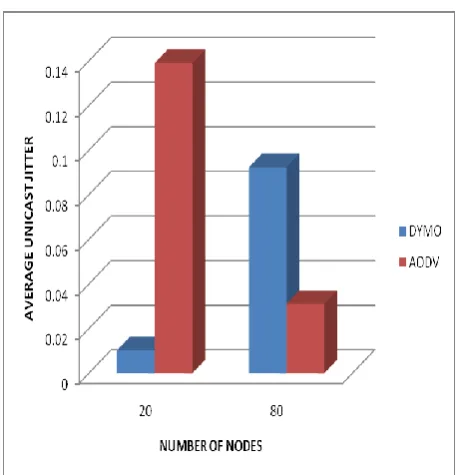
Figure 4: A graph for comparing DYMO and AODV for ipv4 and average unicast jitter
Figure 5: for comparing DYMO and AODV for ipv6 and average end to end delay
Here the average end to end delay is low at DYMO routing protocol for IPV6.
.
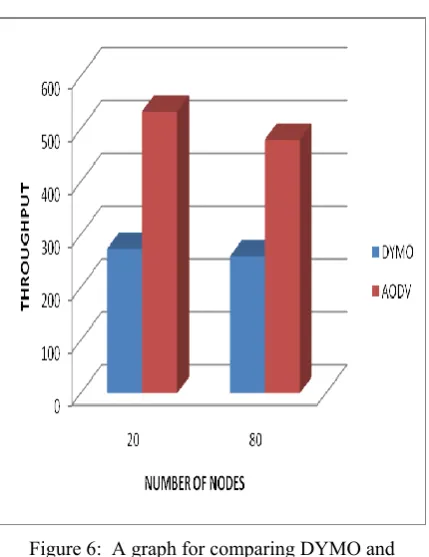
Figure 6: A graph for comparing DYMO and AODV for ipv6 and throughput
Here the throughput is high at AODV routing protocol for IPV6.
Figure 7:A graph for comparing DYMO and AODV for ipv6 and average unicast jitter
Here the average unicast jitter is low at DYMO routing protocol for IPV6.
DYMO routing protocol supports larger networks that is its performance is low at smaller networks and high at larger network size. By varying NTT (Node Traversal Time) that for NTT=20ms its performance is better than compared defacto DYMO routing protocol [11].
And the simulations performed for optimal node traversal time for both AODV and DYMO routing protocols of IPV4 and IPV6.
Here in this the DYMO of IPV6 and optimal nod traversal time is gives better performance than AODV routing protocol.
6. Conclusion
The AODV routing protocol has scalability problem. The attempt has been made to analyze the impact of number of nodes, simulation time, offered load and node traversal time, on the performance of AODV and DYMO routing protocols.
From the simulation results, it is observed that, AODV routing protocol performs better for small networks than large networks and DYMO is performs efficiently for large networks rather than small networks.
AODV routing protocol performs better for low simulation time and DYMO is performs efficiently for high simulation time.
AODV routing protocol performs better when offered load is low.
REFERENCES
[1] Sunil Taneja and Ashwani Kush “A Survey of Routing Protocols in Mobile Ad Hoc Networks”, International Journal of Innovation, Management and Technology, Vol. 1, No. 3, August 2010 ISSN: 2010-0248
[2] Thodeti Srikanth, Dr.V.B.Narsimha “Simulation-based approach to performance study of routing protocols
in MANETs and ad-hoc Networks”, IJCSNS
International Journal of Computer Science and Network Security, VOL.11 No.9, September 2011.
[3] Neha Aggarwal, Teglovy Singh Chohan, Karamveer Singh, Rajan Vohra, Dr.Shalini Bahe, “Relative Analysis of AODV & DSDV Routing Protocols for MANET based on NS2”. International Conference on Electrical, Electronics and Optimization Techniques (ICEEOT)-2016.
[4] Rahul Patel1 Anjuman Ranavadiya2 Shreya Patel, “A Survey Paper on AODV Routing Protocol for
MANET”. (IJSRD) International Journal for
Scientific Research & Development| ISSN (online): 2321-0613,Vol. 2, Issue 10, 2014.
[5] Jogendra Kumar “Comparative Performance Analysis of AODV, DSR,DYMO,OLSR and ZRP Routing Protocols in MANET Using Varying Pause Time” International Journal of Computer Communications and Networks, Vol. 2, No. 4, Article 4, Publication date: December 2012.
[6] Elizabeth Belding-Royer, Ian Chakeres, David Johnson, and Charlie Perkins. “DYMO dynamic MANET on-demand routing protocol. In Rebecca Bunch, editor, Proceedings of the Sixty-First Internet Engineering Task Force”, Washington, DC,USA, November 2004. IETF.
[7] Chakeres, I. D. and Perkins, C. E. 2006. Dynamic MANET on-demand (DYMO) routing protocol. IETF. Internet-Draft Version 6. October.
[8] Charles E. Perkins, Elizabeth M. Royer, Samir R. Das and MLahesh K. Marina, “Performance Comparison of Two On-Demand Routing Protocols for Ad Hoc
Networks”, IEEE Personal Communications,
February 2001.
[9] Dilpreet, Kaur, Naresh Kumar, “Comparative Analysis of AODV, OLSR, TORA, DSR and DSDV Routing Protocols in Mobile Ad-Hoc Networks”,‖ in International Journal of Computer Network and Information Security(IJCNIS), vol. 5, no.3, pp.39, 2013.
[10] Elizabeth Royer, and Chai Keong Toh, (1999), “A Review of Current Routing Protocols for Ad Hoc
Mobile Wireless Networks,” IEEE Personal
Communications, pp 46-55.
[11] P. Johansson, T. Larsson, N. Hedman, B. Mielczarek,
M. Degermark, (1999), “Scenario-based
Performance Analysis of Routing Protocols for