Available Online atwww.ijcsmc.com
International Journal of Computer Science and Mobile Computing
A Monthly Journal of Computer Science and Information Technology
ISSN 2320–088X
IJCSMC, Vol. 4, Issue. 2, February 2015, pg.83 – 87
RESEARCH ARTICLE
Need for Coaching Engineering
Students in Application Development at
an Early Stage at the University
Prof. F.W.Jesudas, Dr. S.Nagarajan
Department of Information Technology, Hindustan University, India
Department of Information Technology, Hindustan University, India
[email protected] ; [email protected]
---
ABSTRACT
---The current crop of students has to be prepared for assignments in industry. ---They will have no time to get trained in industry and they have to be vigorously trained at the University itself. Hence there is a dire need to revise the teaching and learning models.
Keywords- Students, Application development, mobile phones, projects, computers
I.
Introduction
As the world progresses and goes towards the future at a break neck speed there is a realization that there are umpteen numbers of inventions and new applications every day. So many new developments are available with the least cost or at a minimal cost. There is a conscious effort made by everybody to reduce the cost of everything from Airplanes to Apples. In this scenario it is imperative that the students at the University learn the skill to either improve what is there already or invent a new product or application.
II.
Requirements of the Student
[5]” Engineering students coming directly from high school are difficult to motivate to learn pure theoretical issues such as calculus and physics, especially when we talk about undergraduate engineering students, who do not expect to continue their education higher than to a Bachelor of Engineering. At the same time, and for the same reason, the fail rate in mathematics and physics is very high during the first two semesters.” This was the reason why we need to change the structure of our education and combine the theory with practical projects.
III.
Mobile Phones
The advent of mobile phones gives a very realistic example. Initially the phones were very standalone devices and there was no way anybody would have written applications for it. The manufacturers took care of the complete system and there was no way any third party person would have modified it. But as the mobile phones evolved into something computer like, people realized that there will be enormous amount of new applications which could be written for these phones. There is no way the manufacturer could have written all the programs which the mobile phone was capable of using. Neither had he the time nor the people nor the capability and imagination to do it. Hence there arose a big need for people to augment the programs and enhance the capability of the mobile phones.
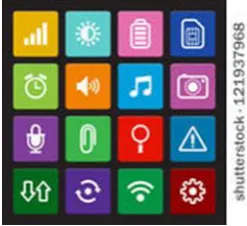
Fig 1. Android mobile screen
IV.
Applications for android phones
Thus the mobile phone companies made tools available which could be effectively used to create more and more apps. At present both Apple and Samsung have millions of programs for their phones and the number of applications goes on increasing day by day. Students have to be Tech Savvy and learn to create apps as early as possible in their University career, even as early as the first year of Engineering Education. They have to be very good at imagination and know how to program in different languages, use various tools in their apps developments. If they are not able to use their imagination and try to write the programs or use the tools to create the picture on the wall they fail miserably. A stage has been reached and the interviewer during the campus recruitment may as well ask whether the student has the track record of making applications and posting in goggle or Apple talk. The recruitment may very well be based on the number of Android or apple applications the student has made. Along with the mark sheet the student may have to take one big trolley to carry them along. This attitude of the recruiter may be very perplexing for the teacher and student alike.
V.
Replacement OF Subjects With The Modern Tools
The teachers have to be on the lookout for modern tools like Android development tools, instead of teaching java. They have to teach rational rose instead of visual studio. So whatever is directly able to create applications have to be introduced in the syllabus instead of old technology like java and visual basic.
VI.
Project Work – Methodology
The Bachelor and Master Degree students in their final semester are asked to do a project relevant to their field of study and present it to the University to finish their studies. This fulfils the course requirement and the students get their degrees provided they have no arrears and are qualified to get the degree. This process has been going on for so many decades that all those who have got an engineering degree have done some project work or other. Those who have not completed a project to the satisfaction of the college would not be allowed to get a degree. And there are cases where the students who could not get the project work done have not been given degrees.
VII.
Project Methodology
While the introduction talks about the importance of students project work which is equally important to the student and the University there are very few guidelines available for this important work apart from the earlier works done by the senior students available in the University. The students are also initially in a careless mode and do not attach any degree of importance in the beginning. As it nears the end they really get worried and then they concentrate fully on the project and get it done somehow and in a disorderly fashion.
VIII.
Real World Story
[3] “From a student's perspective, the standard computer science curriculum can effectively develop fundamental software design principles and techniques, but may struggle to fully prepare students for professional practice. Real-world projects require many skills that are challenging to foster in the classroom, including the ability to implement large applications, interact professionally with others, and independently learn new concepts. Undergraduate programs have attempted to develop these abilities through capstone classes and by encouraging participation in co-ops and internships. At Ohio State University, nearly a dozen students have attempted to foster these abilities by doing long-term, real-world, large-scale, commercial-grade software development projects. The first such project recently released an iPhone-based, stadium-centric infotainment application to end-users in time for the 2010 football season. This paper, whose first author is an undergraduate computer science student, captures, from a student's perspective, the educational benefits of ongoing and real-world projects over the more traditional approaches. Following an examination of the educational impacts of these projects relative to the impacts of co-ops, internships and capstone classes, results suggest that long-term, real world projects are a valuable and synergistic component of an undergraduate education in computer science.” [2]” Project-based Learning, widely used in higher education as well as in elementary schools and middle schools in China recent years, seems to be one of the most effective methods for teaching and it is believed that students can develop kinds of skills especially the social skills by encouraging collaborative work amongst students. Nevertheless, the value of this approach is limited to the way it is used and carried out by teachers and students”
IX.
CORRECT METHODOLOGY
The aim of this article is to tell the students about some of the important methodology they should apply and the important criteria which must be in their mind while they select the project. The guidance is for students of IT branch only. One may ask a question ―why only IT and not any other branch. Even though project work is done by all college and University students the guidelines are very varied and it is impossible to cover them all in any article. Hence this article only tries to convey some of the methodology to be applied by IT students, when they take up project work. This article does not purport to be the be all and end all for IT student’s project work, and it only gives some advice for them.
The project management methodology comprises five stages and all major projects go through a review process before moving from one stage to the next.
These guidelines can be implemented within a waterfall, agile or hybrid approach to achieve outcomes. The steps are
1)Proposed project: In this the project title and a brief narrative of the project is a must.
2) In choosing a project it is a must that it has got some social relevance to the society at large. Remember that to study in a University is still a privilege in India and only about 15 % of the population gets to study in University. Hence the duty of the student is to give back something to the society, as this beginning will enable the students to become good members of the society who will care for others. Hence each student should always think whether his project fulfills some social needs especially for the poor people.
3) Resource planning: The students should plan their resources which they can devote for the project and those who can afford should plan for a bigger project with lot of hardware etc.
4) Project Execution: It is not enough that the project is done for the project sake. The project should be one which can be with the student for the rest of their life to be talked in interviews and job placements. The student should not do the project in a haphazard way that the student will be ashamed to show it to his future boss.
5) High degree of interaction with the guide and project review committee. It is necessary for the student to have a very high degree of interaction with the guide who can guide the student from the initial stages. It should not be the practice of the student to meet the guide only when the student get into some trouble.
6) Project should be managed within the correct time and resources.
7) IT students should have some programming and some hardware components to give a realistic feel to the project and also show their talents in all the fields they have studied.
8) Embedded system projects should be strongly considered as one of the fields they can shine is embedded systems.
9) Cloud and Cyber Security fields are of very recent origin and they can be considered if the project is of futuristic nature.
X.
Conclusion
I will only add that the project is a show case of the student and it represents all that the student is capable of in their life.
If these principals as stated above are followed I am sure we will be able to make the student industry ready and give them a lot of confident to develop applications and also be entrepreneurial.