Available online: https://edupediapublications.org/journals/index.php/IJR/ P a g e | 2672
A New Improved Statistical Algorithm for Image Noise reduction
By Dr Anita Pati, Sudhir Kumar Sagar, Priti Rani Rajvanshi
Institute of Management Studies Noida
Abstract
: Many filtering algorithms have good noise reduction methods regardless the time complexity. This paper proposed a statistical algorithm which use correlation of the image to develop the filtering function. The correlating function applies filtering mask over the image to reduce the degradation. It can calculative resize the mask according to noise levels of the mask. The statistical histogram method is also introduced in the searching process of the median value. Experimental results show that the algorithm reduces the noise a much as possible and retains the detailed pixel value of the image. The complexity of the algorithm is decreased and efficiency of filtering function has been improved.
Available online: https://edupediapublications.org/journals/index.php/IJR/ P a g e | 2673 references [4] and [5]. The subsequent work [6] of the paper further simplified complexity to O (n(1+logn n) /2). Based on the calculations study, this paper proposed two improvements to the median filtering algorithm:
(i) To improve the noise-reducing performance, the mask may be adaptively resized according to noise levels of the mask;
(ii) According to the median filtering theory, we only require quickly find the median value of the filtering mask, and not to rank all the pixels of the filtering mask. Therefore, the statistical histogram is introduced in the searching process of the median value to speed up the searching process.
Median Filtering Theory: It is totally based on statistics. It is non linear method used in signal processing as well as Image processing. here the noisy value of the digitized image is replaced by the median value of neighborhood pixels. The pixels of the image are ranked according to their gray levels and the median value og the group pixels is stored and replaced in place of noise value.the median filtering output is g(x,y)=med{f(x-I,y-j),i,jÍ€ W},where f(x,y),g(x,y) are the original image and output image respectively.W is the 2-dimensional mask, the mask size is m×m order and m is commonly odd like 3×3 and 5×5 etc, the mask shape may be linear, square, circular etc.
The Noise reducing performance of the median filter: as it is a non linear filter its mathematical analysis is relatively complex for the image with random noise.For an image with zero mean noise under normal distribution, the noise variance of the median filtering is approximately.
σ2med=1/4nf2(n)= (σi2/n+π /2-1).π/2 ………..(1)
Where σi2 is the input noise power (the variance), n is the size of median filtering mask, f(n) is the function
of noise densityand the noise variance of average filtering is σ2
0 =1/n σi2 ……….(2)
Comparing (1) and (2) the statistical filtering method depends on two things; the size of the mask and the distribution of the image.The median filtering performance of random noise reduction is better than the average filterimh performance, but to the impulse noise especially narrow pixels are farther apart and the width is less than n/2, the mdian filter is very effective.the median filtering performance should be improved if median filtering is attached with average filtering or double derivative filtering algorithm, can resize the mask according to the noise density.Based on this an improved denoising algorithm(median filtering technique) is proposed.
3. Improved Median Filtering Algorithm
Available online: https://edupediapublications.org/journals/index.php/IJR/ P a g e | 2674 central value of the mask, n is the size of the mask. The adaptive filtering requires two steps: Step 1: adaptively resizing the mask (1) Initialization: let n 3 ; (2) Computation: 1 medA min, 2 medA max (3) Judgment: if A ! 01 and A 02 , then turn to the step 2; if not, then enlarge the size of the mask, let n×n2 and turn to (2). Step 2: median filtering. B. Improvements of the median algorithm Because the average filter has better performance for filtering random noises, we combine the median filter with the average filter to certain size of the filtering mask. The improved method
Improved method:
For the natural image, neighboring pixels has strong correlation. The gray value of each pixel is quite close to neighboring pixels, and the edge pixels have the same property also. If the value of a pixel is greater or less than the value in the neighborhood, the pixel is contaminated by the noise; otherwise, the pixel is an available pixel. In the reducing-noise process, we sequentially check each pixel, if the value of a pixel is greater than the average value in the mask, then we judge that the pixel is contaminated by then noise and replace it with the median value of the mask; otherwise, we retain the original value of the pixel unchanged. This method not only reduces the computation time, but also retains the details of the image as far as possible. The original value of the pixel is replaced with the median value in the mask, and the next process of computation the average value may make full use of the new value of the pixel. This forms alternative process; it not only decreases the time complexity but improves noise reducing effect much better way.
e.g:reducing noise of the pixel(i,j) where moving window size is 3×3.
If f-average>0 then the median valueisf’(i,j).
If f’(i,j) <f(i,j),then f’(i,j) is the noise.By the conventional algorithm , the average and median value of pixel)I,j+1) arerespectively.
Average={f(i-1,j)+…f(i,j)+f(i,j+1)+…+f(i+1,j+2)}/9
Median={f(i-1,,j)+….+f’(I,j)+f(I,j+1)+…+f(i+1,j+2)}.
If f(I,j) is replaced by the factor of improved algorithm f(I,j) the average and median value are respectively.
Average=f(i-1,j)+…+f’(i,j)+f(i,j+1)…+f(i+1,j+2)}.
Available online: https://edupediapublications.org/journals/index.php/IJR/ P a g e | 2675 1.The mask slides over the image , overlaps centre of the mask with the pixel on the image to serch the centre element f(i,j).
2.To read the values of the corresponding pixels of the mask.
3.To compute the average value of the mask.
4.to compare the value of the pixel with average, if value of each pixel is greater than average then searching median value and let f(i,j)=median value; otherwise original value of the pixel unchanged.
5.Repating step4 until i=j=n.
Fast computation of median value The complexity of the algorithm is mainly divided by the calculation of median value on above steps.This paper introduces histogram to improve searching speed of the median value.the method requires steps below.
1.To compute the gray histogram hist[i] (0<i<G where G=range of gray of n×n,find the median value med and record less than median value(ltmed) .Consider the pixel value which is less than median value.
2.To let the left row shift out of the histogram if value of shifting out pixels is less than median then ltmed-1.
3.To let the right now shift the histogram if the value of shifting out pixels is more than median then ltmed+1.
4.If ltmed<,N/2 then repeat med+1, ltmed+hist[ltmed] until ltmed=N/2.
(5) If ltmed>N/2,then repeat med-1,ltmed-hist[ltmed] until ltmed=N/2.
6.To return the median value.
The improved algorithm has two improvements compared to the conventional median filtering
algorithm. One is to make the number of the compared pixels equal to N by using the historical
information of the sliding mask and value of each pixel compares with original median value of mask.Another is to decrease the complexity of median algorithm.
C.Analysis of Complexity of Algorithm:
Available online: https://edupediapublications.org/journals/index.php/IJR/ P a g e | 2676 integer. By using the statistical histogram method to find the median value, the required maximum numberis N, and the complexity of the algorithm is approximately O (N).
Table 1. Comparison of the complexity of three algorithms:
Size Of Mask The standard median filtering algorithmN lnN
The fast median filtering alg based on average N(1+ln N)/2
The improved
algorithm in the paper
3×3 20 7 7
5×5 84 50 26
7×7 192 129 48
9×9 356 221 80
11×11 577 351 120
According to TABLE I, the computation complexity of the improved algorithm is obviously
4. Simulation Experiments
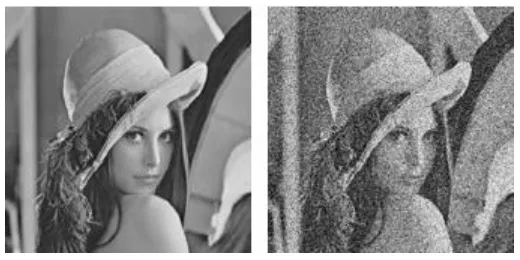
Experiment 1: comparative experiment among the standard median filtering algorithm, the fast medianfiltering algorithm based on average and the improved algorithm in the paper.10%, 35%, and 45% density impulse noises are respectively added to the original image of Lena. WithVC++6.0, results of the comparative experiment as shown in fig-1.
Figure:
Available online: https://edupediapublications.org/journals/index.php/IJR/ P a g e | 2677
Experiment 2: low signal to noise ratio experiment.60%, 70%, and 80% density impulse noises are respectively added to the original image of Lena.
Results of the improved algorithm in the paper are shown.
Performance estimation:
The effect of the image noise reduction may estimated by the subjective visual effect or the objectiveestimation method. The paper takes the peak signal to noise ratio (PSNR) and the signal to noise ratio (SNR)as the performance estimation standard.Suppose an original image is jif ),( and its size is u NM , the processed image is jif ),( OUT and its size is u NM , where ,...,2,1,,...,2,1 NjMi , then we have
MSE=(1/M×N) summation i=1 to m summation j=1 to n(fout-f(i,j)2
PSNR=10 log( a2max/MSE)(dB)
SUM=summation i-1 to m summation j=1 to n=3 f(i,j)2 /summation i=1 to m summation j=1 to
n(fout(I,j)-f(I,j)2
M ∑ i=1
N ∑ j=1
f(i,j)2
___________________
M ∑ i=1
N ∑ j=1
(fout(i,j)-f(i,j)2)
sum =
Available online: https://edupediapublications.org/journals/index.php/IJR/ P a g e | 2678 Where a max=2k-1, k denotes the number of pixel binary bit. If k=8 then a max=255.The results of two
experiments are shown below in table II.
Experimental results show that the performance of this algorithm is better than standard median filtering algorithm and fast median filtering algorithm is based on average.Specially with low SNR(signal to noise ratio) this improved algorithm has more advantages.
Table II: Comaparison of 3 algorithms.
Noise Density The standard median filtering algorithm
PSNR(dB) SNR(dB)
The first median filtering algorithm based on average
The improved
algorithm in the paper
PSNR(dB) SNR(dB) 10% 31.2439 25.5618 31.3804 25.6983 32.1180 26.1059 35% 28.7432 22.0611 28.8262 22.1441 31.8541 25.1720 45% 16.9419 11.2598 17.3371 11.6550 30.5521 23.8699 60% ---- __ __ __ 28.5861 21.6371 70% ---- __ __ __ 27.2651 20.3307 80% ---- __ __ __ 26.1206 19.1103
5.Conclusion: The paper proposed an improved median filtering algorithm for image noise reduction. It can adaptively resize the mask according to noise levels of the mask. Combined the median filtering with the average filtering, the improved algorithm can reduce the noise and retain the image details better. The statistical histogram is introduced to improve the searching speed of the median value and the correlationof image has been fully used. Thus, the complexity of the improved algorithm is decreased to O (N).Experimental results show that the improved algorithm can well do with the relationship between the effect of the noise reduction and the time complexity of algorithm.Thats why it has a good application prospect in Digital Image processing as well as signal processing.
References.
[1].Guohong Liu, Wenming Guo, "Application of improved arthmetic of median filtering denoising, Computer Engineeringand Applications," 2010, vol.46, no.10, pp.187-189.
[2] Xiaokai Wang, Feng Li, "Improved adaptive median filtering," Computer Engineering and Applications, 2010, vol.46, no.3, pp. 175-176.
Available online: https://edupediapublications.org/journals/index.php/IJR/ P a g e | 2679
[4] Qinghua Huang, Heqin Zhou, Huanqing Feng, "A fast and effective algorithm of pulse noise filtering for imaging data,"Computer Engineering and Applications, 2002, no. 17, pp. 113- 114, 210.
[5] T S Huang, G T Tang, "A fast two- dimensional median filtering algorithm," IEEE Trans Acoustics, Speech, and SignalProcessing, 1979, vol.27, no. 1, pp. 13- 18.
[6] Chubin Wu, "The fast algorithm of medium filtering based on mean," Journal of Jiangsu Teachers University ofTechnology, 2006, vol.12, no.6, pp. 102-106.
[7] Tingbiao Chen, Liangzheng Xia, "Digital image processing," Beijing: Posts & Telecommunications Press, 1994.
[8] Ayman A Aly and Abdallah A. Alshnnaway “an Edge Detection and Filtering
Mechanism of Two Dimensional Digital objects Based on Fuzzy inference, World Academy of Science Engineering and Technology 53,2009. .