ISSN 2286-4822 www.euacademic.org
Impact Factor: 3.1 (UIF) DRJI Value: 5.9 (B+)
Role of School Libraries in Education: Case of
Eastern Ethiopia
Dr. T. MATHEW MOLY Assistant Professor Department of Information Science College of Computing and Informatics
Haramaya University, Ethiopia
Abstract:
Studies are lacking in Ethiopia regarding the role of libraries in school. This study help to throw some light to the contribution and also the problems faced by school libraries in Ethiopia. In addition this study will create an awareness among students and teachers about the role of libraries in their teaching and learning environment.
Key words: School Libraries-Ethiopia, Education and School libraries, School library services, Teaching and learning-School libraries, Lifelong learning-School libraries.
Introduction
opportunities for lifelong learning, literacy enhancement, informed citizenship, recreation, creative imagination, individual research, critical thinking, and ultimately, empowerment in an increasingly complex world. Over all school libraries assist in attaining academic excellence.
Background of the study
Bush (2002) mentioned that books, information technology and school librarians who are part of the schools’ professional team are basic ingredients for student achievement. She also said that a good library launches young children on a journey of exploration and discovery, teaching them how to ask questions and find answers. And the wonderful thing is that once you learn to use a library, the doors to learning are open to you throughout your life. These words of Mrs. Bush shows the importance of school libraries for children.
though distant in space are the splendid library of the College of Agriculture at Alemaya near Harar(22,000 volumes) and the Public Health College Library at Gondar (7,000 volumes). Although these libraries were intended for the use of staff and students of the university, borrowing facilities were also granted to any responsible member of the public on application.
It is very clear from the above information that even in 1967 itself some studies were undertaken regarding the library facilities. But these studies were concentrated in the field of higher education. For life long learning library use is necessary and at the same time library use habit should be developed in the school itself. Daniel (2004) observed that the library remains the power house of educational institution and that an education institution without a library is like a motor car without an engine and a body without a soul. Smith (2002) opines that the school library is the backbone of functional education without which academic excellence cannot be acheived. Obviously speaking, both the library and the school are inseparable twins that one ceases to function well without the other. However, even in this information era some of the schools in Ethiopia has been functioning wthout libraries.
Statement of the problems
helping the young generation to have access to the right information at the right time.
Objective of the study
The major objective of this study was to find out the role of libraries in the empowerment of school children in Ethiopia.
Specific objectives
To find out the existence of libraries in schools and the resources available in them.
To have an idea about the organization of documents and their access in school libraries.
To enquire about students awareness regarding the importance of library in their education.
To know where do the students look for information and what purpose they make use of the libraries
To find out the use of library by students and how do they rate different facilities of the library.
To see student´s level of satisfaction in the use of their school library
Population of the study
Ten School libraries from Harar, Alamaya and Dire Dawa were taken for this study.
Sample of the study
Methodology:
Personal observation and unstructured interview method was used to collect data from the school libraries. Based on the existence of libraries structured questionnaire was distributed to 60 students each in three selected schools. Information was gathered from 8th, 9th and 10th grade students about the use of libraries. 20 students from each grade were selected using simple ramdom sampling method.
Limitation of the study
This study covers only ten schools. User study was conducted only in three schools. Due to limitation of time, money and also other responsibilities the researcher was not able to visit many more schools of Ethiopia. The Schools in urban areas like Addis Ababa may provide different result than this study.
Review of literature
Acccording to the International Society for Technology in Education (ISTE) Libraries support the curriculum, promote literacy development, and foster lifelong reading habits among children through the development of carefully selected print collections and the infusion of educational technology. American Association of School librarians (2009) mentioned that 21st century school library programs continue to undergo momentous changes that have heightened the importance of technology and evidence-based learning. The focus has moved from the library as a confined place to one with fluid boundaries that is layered by diverse needs and influenced by an interactive global community. Guiding principles for school library programs must focus on building a flexible learning environment with the goal of producing successful learners skilled in multiple literacies.
creating schools that enable students to learn through vast resources and multiple communication channels. Teachers cannot do this alone. School librarians are primary agents in schools for 21st century learners.
Murdoch (1968) expressed that the school has the primary responsibility for instruction and guidance of children and youth in the community in the use of libraries. The program of library instruction directed by the school librarians has the broad purposes of teaching library skills adaptable to all types of libraries and for encouraging pupils to use libraries for continuing self-education. School librarians, teachers, and public librarians should cooperate in planning instructional programs in the use of libraries for educational and recreational purposes. Even after 45 years this ideas hold good in case of school libraries.
The first school library in Ethiopia was established in the Tafari Makonnen School in 1925, most were founded after the Italian occupation, when major secondary schools were equipped with book collections. Problems plague school libraries today: cramped quarters in overextended buildings; severe shortage of books in English (the language of instruction in secondary schools); inadequate, often outdated, collections; and lack of professional staff. These problems cannot be adequately addressed until the country grapples with the dramatic increase in school enrollment and the need for more schools. From 1974/75–1985/86, primary school enrollment increased two–and–one–half times to nearly 2.5 million students; during that same time the number of junior and senior secondary schools nearly doubled (Ofcansky, 1993).
was often no more than a few shelves of outdated and worn-out material and inadequately staffed (Montagnes, 2001).
The Federal Ministry of Education and Youth Development in 1992 came up with minimum standards for school libraries in Nigeria based on the facts that students without access to supplementary reading materials as provided for in a library will be seriously handicapped. His academic success will be based largely on his ability to memorize lecture notes. On the other hand, the student with access to a good school library can learn and be judged on his own skill in clarifying problem collecting information relative to its solution and formulating conclusion. This student will have acquired the foundation for independent, purposeful and life-long learning. (Busayo, 2011)
According to Baird (1994) school libraries are very essential to -
• give students knowledge (both general knowledge and specific information from set textbooks)
• provide explanations
• satisfy students’ curiosity and interest in life
• offer art, craft, music, dance and cultural information.
From the review of literature it is very clear that school libraries have a special place not only in providing knowledge but also the overall empowerment of the student life.
Data Analysis and Discussion
library is not sufficient to hold the documents and also to provide seating facilities for the students. In Harar too out of five schools visited by the researcher four schools were having libraries. In Alemaya out of two school visited only one school had library. Other one even though it was more than 50 years old just now constructing a building to start a library.
Present situations in Ethiopian school libraries
Personal visit and observation is an important method to gather information from the library. The data recieved from personal observation and also unstructured interview was analysed here with the help of tables.
Table 1: Information regarding existence of Library, Librarian, his/her qualification and working time of the library
Is there any Library?
Yes No
6 (60%) 4 (40%)
Librarian to manage the library
Yes No
6 (60%) -
Librarian´s qualification
10th 12th 12th and
Diploma
Degree
- 4 (66.67%) 2 (33.33%) -
Library opening hours
8.30 a.m to 12 noon
2.00 p.m to 4.00 p.m
3.00 p.m to 5.30 p.m
6 (100%) 4 (66.67%) 2 (33.33%)
professional librarians to acquire, organize and disseminate information.
The libraries were opened in the morning from 8.30 to 12 noon which constitutes 3 and 1/2 hours opening. Where as in the afternoon four school library is opened only for 2 hours and remaining two opened for 2 and 1/2 hours. One of the school principals informed that the students were free to use the library even after the school hours. If the libraries are opened only at working time the students won´t be able to access information from the library as they have to attend their classes. It is necessary for the libraries to be opened before the class hours, during lunch break and also even after the class hours.
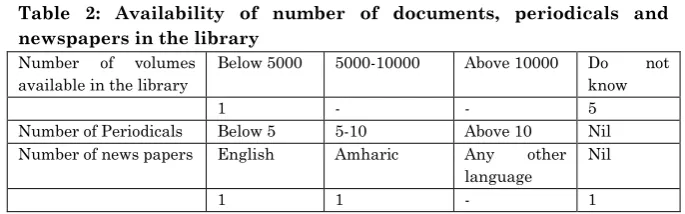
Table 2: Availability of number of documents, periodicals and newspapers in the library
Number of volumes available in the library
Below 5000 5000-10000 Above 10000 Do not know
1 - - 5
Number of Periodicals Below 5 5-10 Above 10 Nil Number of news papers English Amharic Any other
language
Nil
1 1 - 1
In five of the school libraries under study librarians were not able to say the total volumes and number of titles available in the library. There was no accession register maintained in the library. Where as in one of the school´s elementary school library had library incharge who was keeping the documents in the library according to subjects and he informed that there are 3000 documents available in that particular library. This indicates the responsibility of library staff in maintaining the documents in the library.
they are very important in different field of study. The study made in Pensylvania school libraries(Pensylvania State Board of Education, 2011) has also revealed that almost three-fourths of libraries subscribe to 20 or fewer magazines and newspapers, and 14% of the libraries have no magazine or newspaper subscriptions.
Only one library was getting both English and Amharic newspapers. This is a major drawback of school libraries as newspapers provide current information to the students and this also will help the students to be aware of economical, political, social and cultural situation of the country.
Moreover to know about the world and its environment, a child helps himself through reading books, newspapers and other magazines. It is the responsibility of the librarian and school authorities to make it available to the school children.
Reference resources
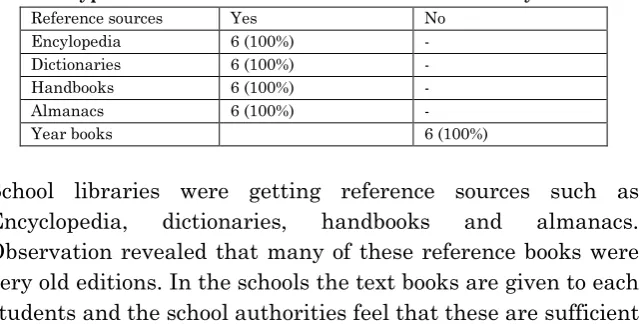
A reference resource is something that one refers back to for information. Common examples are dictionaries, encyclopedias, and thesauri. These are tools that people want on hand to find quick information, to check a fact, or to gain background knowledge of a topic.
Table 3: Types of reference sources available in the library
Reference sources Yes No
Encylopedia 6 (100%) -
Dictionaries 6 (100%) -
Handbooks 6 (100%) -
Almanacs 6 (100%) -
Year books 6 (100%)
for the students to get knowledge. To get retrospective information it is very essential for school libraries to provide good reference resources to its users.
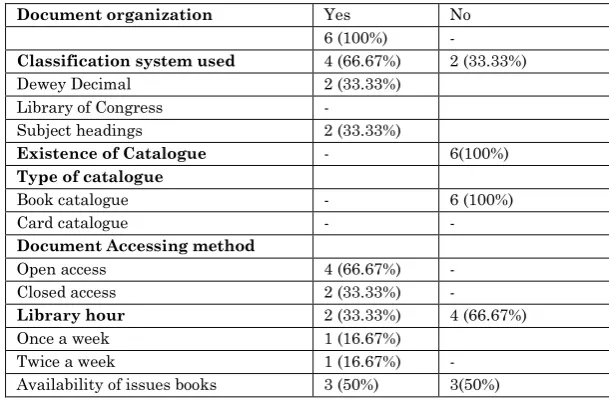
Table 4: Organization of material, Method of access and inclusion of library hours in the class schedule.
Document organization Yes No
6 (100%) -
Classification system used 4 (66.67%) 2 (33.33%)
Dewey Decimal 2 (33.33%)
Library of Congress -
Subject headings 2 (33.33%)
Existence of Catalogue - 6(100%)
Type of catalogue
Book catalogue - 6 (100%)
Card catalogue - -
Document Accessing method
Open access 4 (66.67%) -
Closed access 2 (33.33%) -
Library hour 2 (33.33%) 4 (66.67%)
Once a week 1 (16.67%)
Twice a week 1 (16.67%) -
Availability of issues books 3 (50%) 3(50%)
Documents are organized to facilitate for easy retrieval and access. The users are able to find out the availability of necessary document with the help of catalogue and classification numbers assist the users to find the location of the documents in the shelves.
Observation revealed that 2 (33.33%) of the libraries were using Dewey Decimal Classification Scheme. At the same time many books were without classification numbers. In other school librararies no classification system were followed. Documents were just kept on the basis of subject and also forms.
document. It reveals to the user the holdings of a particular library.
Interviewing the library staff helped to understand open access method was used to get the document from the shelves in 4 (66.67%) libraries. The users were free to go to the shelves for browsing the documents and to make their own selection. Whereas in 2 (33.33%) library closed access was used where user have to request for the books and it will be searched, retrieved and disseminated by the library staff.
2 (33.33%) of the school were given library hour in their class schedule. That too for once or twice in a week. One of the school allowed their students to visit the library during leisure hours and also after school hours. There is a need to provide library hour in the school schedule so that students can get enough time to make use of the information available in the libray.
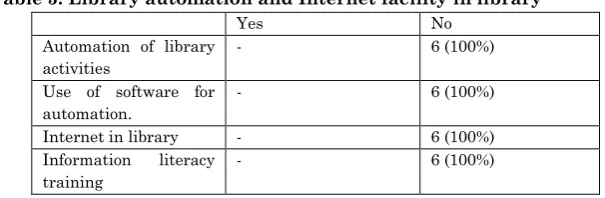
Table 5: Library automation and Internet facility in library
Yes No
Automation of library activities
- 6 (100%)
Use of software for automation.
- 6 (100%)
Internet in library - 6 (100%)
Information literacy training
- 6 (100%)
Observation and unstructued interview by the researcher found that Information literacy training was not given to the users by the library staff. Students may not be able to make use of the materials in the library unless the library staff explain to them how to make use of the catalogue? What is the function of classification numbers and how to make use of it to locate documents in the library? etc. Especially in school libraries the students should be given training in the use of different information sources. Librarian can assist the students in the use of modern information technologies to access information.
Use of library facilities by school students
Without the user study one cannot make any conclusion about the use of library facilities by its users. So structured questionnaires were distributed in three of the selected schools. The responses of the students were analysed to see how far libraries were helping the student community by providing access to library materials.
Table 6: Grades of the respondents
Grade 8th 9th 10th Total
Questinnaire distributed
60 60 60 180
Number of
Respondents
53 (88.33%) 51 (85%) 54 (90%) 158 (87.78%)
Total 180 questionnaires were distributed in three schools to 8, 9 and 10 grade students. 158 (87.78%) filled questionnaires were returned to the researcher.
Table 7: Requirement to use the library
Use library for assignment, exams, study etc
Yes No
97 (61.39%) 61 (38.61)
of the respondents make use of the library for preparing assignment, exams and study. Where as 38.61% said they do not use the library for the above mentioned purpose. Study made by Udog-Ilomechine (2008) also shows that 81% of the students use the library.
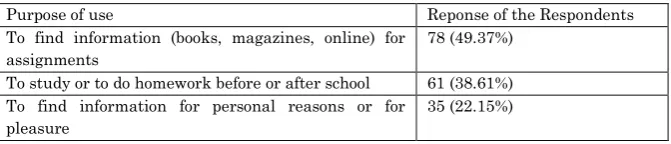
Table 8: Purpose of using the library
Purpose of use Reponse of the Respondents
To find information (books, magazines, online) for assignments
78 (49.37%) To study or to do homework before or after school 61 (38.61%) To find information for personal reasons or for
pleasure
35 (22.15%)
Students may visit the library for various purposes. Table 8 reveals that 78 (49.37%) use the library to find information from books and magazines to prepare assignments. Where as 61 (38.61%) make use of the library for study purposes and remaining 35 (22.15%) mentioned that they use the library to find information for personal reasons or for pleasure. To make use of the materials in the library they should be qualitative and current. At the same time students should have time to read the documents from the library. May be the information found in the library is not updated and up to the mark of requirement and moreover students lack time to read the documents may be the reasons for poor use of the library for the assignments, study and entertainment.
Table 9: Visits to the library
Ofenness in visiting the library
Once per day 21 (13.29%)
Once per week 63 (39.87%)
Once per month 14 (8.86%)
Rarely 60 (37.98)
visit once in a month. The number of students who visit the library daily is very less. This may be due to lack of time or the library does not provide materials of interest to the students and also reading text book alone provide necessary information to the students.
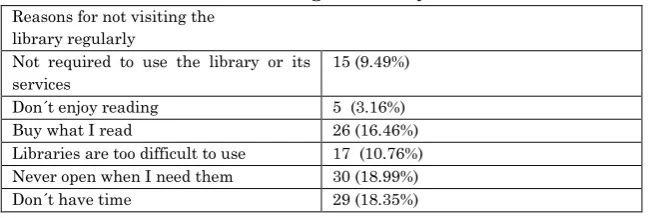
Table 10: Reasons for not visiting the library often
Reasons for not visiting the library regularly
Not required to use the library or its services
15 (9.49%)
Don´t enjoy reading 5 (3.16%)
Buy what I read 26 (16.46%)
Libraries are too difficult to use 17 (10.76%) Never open when I need them 30 (18.99%)
Don´t have time 29 (18.35%)
Table 10 gives an idea about the reasons for not visiting the library by students. 30 (18.99%) mentioned that libraries were not opened when they need it. Where as 29 (18.35 %) felt that they had no time to visit the library and 26 (16.46%) buy what they read. 17 (10.76%) of the students consider it was difficult to use the library and at same time 15 (9.49%) felt that it was not required to use the library or its services and only 5 (3.16%) do not enjoy reading. If the library is kept open during break time students may get time to visit the library. Many of the students may be interested only to read their text book to pass the exams rather than reading other materials to improve their knowledge. Students should be taught in information literacy so that it will be easy for them to understand the way documents are organized in the library and make use of it in more better way.
Table 11: Importance of library
Importance of libraryfor personal and school work
Very important- can´t do without them 57 (36.08%) Somewhat important- only use
occasionally
Table 11 clearly expresses the importance of library for personal and school work. 94 (59.49%) of the respondents considered library as some what important and only use occasionally. Where as 57 (36.08%) opined that libraries were very important and cannot do without them. Only 8 (5.0%) felt it is not important and never used the libraries. There is a need to create awareness among students about the value of school library. Instead of textbook based learning the students should be encouraged to seek information from the library for assignments and other school works. This will make them more dependable on library resources.
Table 12: Currency of information found in the library
Information found in the library are -
Up to date 41 (25.95%)
Too old 75 (47.47%)
Undecided 42 (26.58%)
Table 12 reveals about the currency of information found in the library. According 75 (47.47%) felt that the information found in the libraries were too old. Where as 41 (2.95%) mentioned that the information found are upto date and the remaining 42 (26.58%) were undecided about the information found in the libraries. School libraries should equip themselves with current information otherwise students may not have any interest in using school libraries.
total book collections with an average copyright age within the past twenty-five years( Guidelines for Pennsylvania School Library Programs, 2011)
Table 13: Performance rating of the library
Rating the performance of the library
Excellent 12 (7.6%)
Good 87 (55.06%)
Poor 35 (22.15%)
Very poor 24 (15.19%)
The respondents were asked to rate the performance of the library. Here 87 (55.06%) felt it is good and 35 (22.15%) rated the performance of the library as poor and 24 (15.19%) rated as very poor. Only 12 (7.6%) mentioned it as excellent. Unless and until the school libraries provide to its users with current information and also better services the users may not be happy.
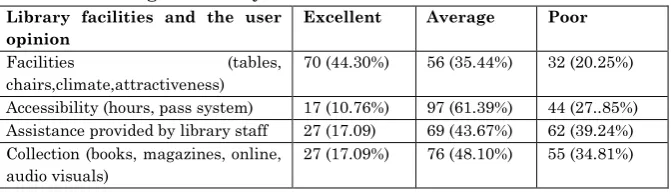
Table 14: Rating the library based on facilities
Library facilities and the user opinion
Excellent Average Poor
Facilities (tables,
chairs,climate,attractiveness)
70 (44.30%) 56 (35.44%) 32 (20.25%) Accessibility (hours, pass system) 17 (10.76%) 97 (61.39%) 44 (27..85%) Assistance provided by library staff 27 (17.09) 69 (43.67%) 62 (39.24%) Collection (books, magazines, online,
audio visuals)
27 (17.09%) 76 (48.10%) 55 (34.81%)
Table 15: Rating the library services
Opinion regarding Library services
Adequate for my needs 11 (6.96%) Very helpful/knowledgeable 33 (20.89%)
Good 46 (29.11%)
Need improvement 32 (20.25%)
Poor 28 (17.72%)
Very poor 8 (5.06%)
The respondents were asked to rate the services in the libraries. 46 (29.11%) mentioned it as good and 33 (20.89%) opined that it was very helpful. At the same time 32 (20.25%) feel that there was a need to improve library services.
Here those who said there was a need to improve the library services were asked to mention what type of improment they expect. Most of the respondents expressed that there is a need to get new and recent documents in the library, space problem should be solved and also to provide internet access in the school libraries.
The respondents who rated the library services as very poor were asked why it is very poor? They explained that library timing and also the documents which were available in the library were not good.
Table 16: Simplicity of check in and check out system
Simplicity of Material Check in Check out system
Yes 50 (31.65%)
No 69 (43.67%)
Haven´t checked out any materials 39 (24.68%)
Table 17: Satisfaction regarding library hour
Library hour and user satisfaction
Yes 57 (36.08%)
No 101 (63.92%)
Table 17 reveals about the respondents satisfaction regarding library hour and it clearly shows that more than half of the respondents are not satisfied with the library hour. In almost all school libraries are kept open during the class time and if there is no library hour in the class schedule libraries are not accessible to the students. Study conducted by Spreadbury, H and Spiller, D. (1999) shows that there are problems about access to school libraries, since many pupils only have opportunities to visit during breaks and lunch hours, and at both times there are other attractions – not least, the need to eat. The problems are compounded by the minimal staffing of many school libraries. Only 28% of pupils were happy with the existing opening hours.
Table 18: Locations where the students look for information other than the school library
Other locations used by the students to find information
Public library 37 (23.42%)
Home 45 (28.48%)
Friends 40 (25.32%)
Other 36 (22.78%)
Those who used other location were asked to mention about the other source and most of the respondents said that they use internet to gather information. Some students may having internet facility at home and others may be using from internet cafe.
Suggestions given by the respondents
The researcher was asked the student repondents to give their suggestions to improve the library and the responses were
- Update the library with new books and journals
The number of volumes should be increased to meet the needs of the students
Provide library hour so that students will have time to make use of the libraries
Keep the library open during the lunch break and also on Saturdays
Avoid using library for other purposes like staff room.
Internet access should be provided in the libraries.
Students should be given training in using the library.
Findings of the study
Findings are drawn from the analysis of the data collected from the students. Which are as follows:
40% of the schools are lacking libraries.
66.67% of the School libraries are managed by untrained personnels and the remaining 33.33% has only diploma or some short training.
There are no proper record keeping and also registers are not kept in most of the school libraries.
Catalogues are not prepared for the documents in the libraries .
Open access is not provided in almost 66.67% of the school libraries.
Library hour is included in the class schedule only 33.33% of the schools under study.
Book lending services were provided in 50% of the school libraries.
Library activities were not automated and also no internet facilities available in any of the school libraries.
Majority of the students (61.39%) make use of the library for assignments, study and for examinations.
Students visit to the library is mostly once in a week (39.87%) or rare (37.98%).
The main reasons for not using the library was due to lack of time and also the library was not opened when the students needed it.
59.49% of the students feel that the libraries were some what important for them,
47.47% of the respondents felt that the materials available in the libraries were too old.
The overall performance of the libraries are good but on the basis of facilities they are average.
The services given by the libraries too were not that satisfactory.
The users (62.92) were not satisfied with the library working hour.
Many students are making use of other services outside the library for information mainly home, friends, internet cafe and public libraries.
Recommendations
Policy makers in the country should make sure that every school in the country should have a well equiped library.
The authorities should appoint professional staff in the school libraries. School librarian should have at least BSc degree in Information science. That will help them to organize the library in a better way and to retrieve the information to meet the needs of the user community.
The school librarians should prepare proper record of the documents available in the library. Accession register should be maintained in the library which will help to know the number of documents available.
Librarians should organize the documents by making use of classification schemes and also catalogue should be maintained for the easy retrieval and access to information.
Open access method should be followed and that will help the users to find the documents in their feild of study.
There is a need to weed out the old and worn out materials from the library and at the same time to make the collection good to meet the needs of the users.
Library should be kept open not only at the school hours but also whenever the students are free.
School library services should be improved and also there is a need to create awareness among the school children about the importance of the library. Use of library should be encouraged by the teachers.
Conclusion
On the whole school libraries plays an important role in the teaching and learning. It supports the lifelong learning activities and in developing reading habits among the school children. It helps the students to develop their strength and pursue their aspirations. It is the duty of the school authorities to encourage the young children and show interest in their academic, social and personal attitudes. To achieve this aim the school children should be directed in the right path. Libraries can provide knowledge to the young minds and show them how to reach out to their goals and attain their dreams. Even in the right choice of career libraries can assist the user community. Modern educational system calls for a shift from what teachers teach to focus on what student learn. Even though it encourages lifelong learning it does not have systematic program in using the libraries for self development and growth. In developed countries school libraries empower the children in their overall development. Developing countries like Ethiopia has a long way to travel to achieve this goal.
BIBLIOGRAPHY:
American Association of School Librarians. (2009). Empowering learners: guidelines for school library media programs. Chicago: American Library Association.
Baird, Nicola. (1994). Setting up and running a school library. London: Heinemann.
Busayo, Isaac Oluwadare. (2011). The school library as a foundational step to childrens´effective reading habits.
Library Philosophy and Practice, Online.
Daniel, C.I.(2004). Efforts/Activities at schools’ level by Principals, Headmasters, PTA to support provision of library services in school : the case of Abuja Federal Capital Territory. Nigerian School Library Journal 5(1), Online.
Guidelines for Pennsylvania School Library Programs. (2011). Harrisburg: Office of Commonwealth Libraries. Accessed June 18. http://pa.webjunction.org/pa-schoolguidelines/-/articles/content/116271282
Havighurst, Robert J. (1967). "Educational Changes: Their Implications for the Library," ALA Bulletin, 61,537-543 Krolak, Lisa. (2005). Paper commissioned for the Education For
All (EFA) Global Monitoring Report 2006, Literacy for Life”.
Kuhlthau, Carol Collier(2009). Guided inquiry: school libraries in the 21st centruy. School Libraries Worldwide, 16,17-28.
Montagnes, Ian. (2000). “World Education Forum Dakar. Textbooks and learning material 1990-99” Accessed July 20.
http://unesdoc.unesco.org/images/0012/001234/123487e.p df
Murdock, Faith T. (1968). The relationship of the school library to the young adult librarian in the public library.
Library Trends, 183-190
Neuman, Susan. (2002). “The Role of school libraries in elementary and secondary education”. Accessed June 18. http://www.laurabushfoundation.com/Neuman.pdf. Ofcansky, Thomas, and LaVerle, Berry, (1993) Eds. Ethiopia: A
Country Study. 4th ed. Washington: Department of the Army.
Pensylvania State Board of Education. (2011). Pensylvania School library study: findings and recommendations. Pensylvania: State Board of Education.
Smith, D.(2001). Massachusetts reaches out and spreads the word about library media centres. Book Report 14,10-11 Spreadbury, Helen and Spiller, David. 1999. Survey of
secondary school library users. Loughborough: Library & Informatin Statistics Unit (LISU).
The International Society for Technology in Education (ISTE). (2011). The role of school librarians in promoting the use of educational technologies. Library Media Connection, 29,19.