Available online: https://edupediapublications.org/journals/index.php/IJR/ P a g e | 2927
A New Approach For Image Denoising By Motion Estimation
And Patch-Based Method
1
Masool Baba Fakruddin,
2B.Balachandrudu
1M.Tech Student DECS, Dept. of ECE, SSSISE, Affiliated to JNTUA , Andhra Pradesh, India
2Assistant Professor in Dept. of ECE, SSSISE, Affiliated to JNTUA , Andhra Pradesh, India
Abstract: Techniques for noise removal in digital images
comprise transform thresholding, local averaging, patch based methods and variational techniques. Image fusion is not directly of interest in the removal of noise but in a more general restoration of the image, that is, deblurring, increase of detail or even of resolution. The key of these approaches is the use of a global registration, more robust to noise, blur and color or compression artifacts and, additionally, providing subpixel accuracy. These global registration techniques usually rely on feature matching, for example SIFT, and on a parametric registration, either using an affinity or an homography. The viewfinder alignment performs such a registration by an affine function, with the important characteristic of
being extremely fast. A novel image sequence denoising
algorithm is presented in the proposed approach takes advantage of the self similarity and redundancy of adjacent frames. The algorithm is inspired by fusion algorithms, and as the number of frames increases, it tends to a pure temporal average.
Index Terms—patch processing, optical flow, non-local means, motion compensation.
I. INTRODUCTION
Denoising is any signal processing method, which reconstructs the signal from a noisy one. Its goal is to preserve the useful information by removing unnecessary noise. Video denoising is actually process of removing noise from the original video signal, where noise reduction in image can be performed through the frame individually and between the frames. Different denoising methods make different presumptions, depending upon the picture and the kind of picture. Typical noise types are analog and digital. Analog noise includes film artifacts, VHS artifacts, and Radio channel artifacts. Digital type
Available online: https://edupediapublications.org/journals/index.php/IJR/ P a g e | 2928 as occluded or visible either with a direct threshold on the
residual or with a more elaborate probabilistic model.
II. RELATED WORK
In literature survey, the previously developed techniques for video denoising are discussed with their advantages and disadvantages. lmed Ben Dhaou and lrek Defee presented the paper, „DVC decompression with denoising for picture quality improvement‟, in which they explained how the digital video cassette for real time video recording applications. Also it is described that how noise can be decreased by digital post-filtering using the approach of wavelet denoising. The basic version of wavelet denoising is implemented and applied to the DVC, so as to get much higher quality of video. The disadvantage of this approach is that at low-light conditions, the picture quality is degraded even if the denoising algorithm is applied
Daniel Pak-Kong Lun and Tai-Chiu Hsung presented a paper on, 'Image Denoising wavelet transform modulus sum'. The research explained the WTMM approach that is wavelet transform modulus maxima to decrease blocking effect of decoded image sequence. SN ratio is increased with this approach and ultimately increased in the quality of image .
Rakesh Dugad and Narendra Ahuja, presented a paper as 'Video Denoising by Combining Kalman and Wiener Estimates', in which a computationally quick fast scheme for video denoising is presented. spatial redundancy and adaptive edge-preserving Wiener filter are combined using averaging to get denoised frame. IPSNR that is improvement in PSNR compared to the PSNR of corresponding noisy frame gets us a comparison for deriving the increment in denoising
J. Abbas, M Domariski presented the paper, 'median-based filters with predication error processing for video restoration', in which median based filters are used for denoising of video color sequences. Implementation uses the concept of prediction of pixel value using non-liner filter and then its comparison with corrupted input image. Achievement is to check the improvements respectively in efficiency of video sequence denoising for both twodimensional and three-dimensional filters for motion compensation. As per the results error prediction
processing leads to better results than the classic median-based filters. Computational cost is very less
Peter Rieder and Gunter Scheffler presented a paper on, 'New Concepts on denoising and sharpening of video signals'. Concepts in this paper leads to sharpening of images with separating noise from the video.LTI that is Luminance Transition Improvement, Contrast adaptive peaking and CTI that is Chrominance Transition Improvement algorithms are developed in the mentioned approach. The algorithms used can be efficiently and practically realized in hardware. Sharpness and optimum quality are the key aspects for achievements
Y. H Lohl, L. Y. Chew and U. Chan presented a paper on, 'Multi-processor denoising of weak video signals in strong noise'. Approach is based on the algorithms, Least square estimation and best Linear unbiased estimation. Practical processing was achieved using DSPs and videos with low SNR values. Practically more efficient multiprocessing algorithms and techniques are used to denoise more noisy videos. Technique is efficient for the signal system when the system has weak video signal.
III. EXISTING SYSTEM
In the literature, image fusion is not directly of interest in the removal of noise but in a more general restoration of the image, that is, deblurring, increase of detail or even of resolution. The key of these approaches is the use of a global registration, more robust to noise, blur and color or compression artifacts and, additionally, providing subpixel accuracy.
These global registration techniques usually rely on feature matching, for example SIFT, and on a parametric registration, either using an affinity or an homography. The viewfinder alignment performs such a registration by an affine function, with the important characteristic of being extremely fast.
DISADVANTAGES OF EXISTING SYSTEM
The general approach is the use of an homography. It must be noted that an homography is valid only for planar scenes or if the optical center is not modified.
IV. PROPOSED SYSTEM
Available online: https://edupediapublications.org/journals/index.php/IJR/ P a g e | 2929 algorithms in the sense that it tends to a fusion algorithm
as the temporal sampling of the sequence gets dense and the motion estimation or global registration is able to perfectly register the frames and no occlusions are present.
As this is an ideal scenario, our algorithm compensates the failure of these requirements by introducing patch comparison and denoising in an adapted PCA based transform. Unlike VBM4D the motion estimation used by our algorithm relies on the optical flow constraint (OFC), that is, we suppose that the color of each pixel remains constant along its trajectory through the sequence. The optical flow is used to warp adjacent frames and not only for compensating neighborhoods. Thus, the subpixel accuracy improves the patch comparison and averaging. Results in motion estimation are far from being totally satisfactory, there are many unsolved issues as occlusions, non translational motions, non color constancy, etc. Despite these limitations, we will show that OFC algorithms are a useful tool for denoising.
ADVANTAGES
An extensive comparison with the state-of-the-art
methods illustrates the superior performance of the
proposed approach, with improved texture and detail
reconstruction
V. SYSTEM ARCHITECTURE:
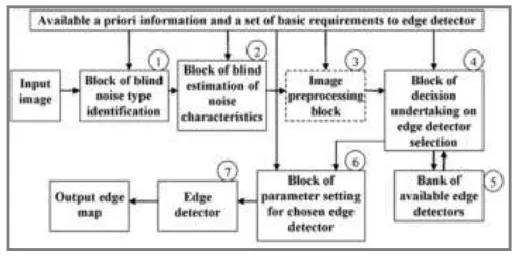
Fig 1: Flow Diagram.
VI. IMPLEMENTATION
Image Acquisition:
In this module, first we develop the Image Acquisition module. The initial module does the process of Pre-processing steps. The Input Video are acquired from Gallery. Then video is converted into frames for further process. These output frames
are used as the input for the next modules, for the evaluation of our proposed model.
Motion Compensation:
In this stage, motion compensation is done by motion
estimation. First, the optical flow between I k and adjacent
frames in a temporal neighborhood is computed and used for
warping these frames onto I k. If registration was accurate and
the sequence free of occlusions, a temporal average in this
aligned data would be optimal, even if the noise reduction
would slowly decrease as 1/M, where M is the number of
adjacent frames involved in the process. Generally, this will not be the case, inaccuracies and errors in the computed flow and the presence of occlusions make this temporal average likely to blur the sequence and have artifacts near occlusions. The proposed approach tends to solve these limitations. Occlusions are detected depending on the divergence of the computed flow:
negative divergence values indicate occlusions. Additionally,
the color difference is checked after flow compensation. A
large difference indicates occlusion, or at least failure of the
color constancy assumption. We combine both criteria for a
pixel x=(x, y) and the computed flow between I0 and I1. These occluded points having a negative divergence of the flow and a large color difference after flow compensation are located near the discontinuities of the motion field. In this patch wise motion compensated is performed.
Denoising:
In this stage, Denoising is performed. After extract the motion compensation between noised i and i+1frame, PCA is applied in motion compensated frames. Use of PCA for patch denoising preserves fine and texture details.
Performance Analysis:
In this module, we show the graph results for the Performance analysis module. We show the performance analysis results for 1) PSNR for Noise Frames 2) PSNR for Motion Estimated Frames and 3) PSNR for Denoised Frames. Peak signal-to-noise ratio, often abbreviated PSNR, is an engineering term for the ratio between the maximum possible power of a signal and the power of corrupting noise that affects the fidelity of its representation. Because many signals have a very wide dynamic range, PSNR is usually expressed in terms of the logarithmic decibel scale. PSNR is most commonly used to
measure the quality of reconstruction of lossy
compression codecs (e.g., for image compression). The signal in this case is the original data, and the noise is the error introduced by compression. When comparing compression
codecs, PSNR is an approximation to human perception of
Available online: https://edupediapublications.org/journals/index.php/IJR/ P a g e | 2930
indicates that the reconstruction is of higher quality, in some cases it may not. One has to be extremely careful with the range of validity of this metric; it is only conclusively valid when it is used to compare results from the same codec (or codec type) and same content.
VII. SIMULATION RESULTS
Fig 2:
Fig 3:
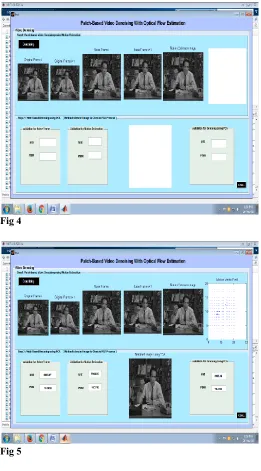
Fig 4
Available online: https://edupediapublications.org/journals/index.php/IJR/ P a g e | 2931
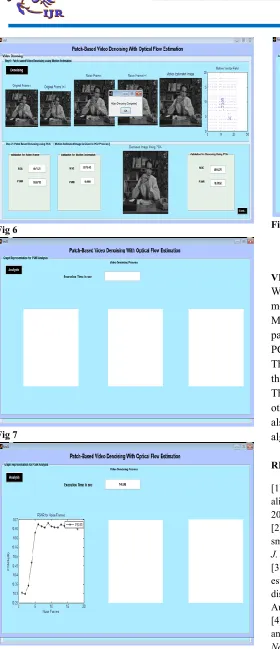
Fig 6
Fig 7
Fig 8
Fig 9
VIII. CONCLUSION
We presented a novel denoising algorithm combining motion estimation and patch based denoising algorithms. Motion compensation permits the use of spatio-temporal patches for a more robust comparison while the use of PCA for patch denoising preserves texture and details. The comparison with state-of-the-art algorithms illustrates the gain on performance of the proposed approach. The next step is the extension of the current algorithm to other type of noise models, including correlated noise but also compression artifacts of video standard compression algorithms.
REFERENCES
[1] A. Adams, N. Gelfand, and K. Pulli, “Viewfinder
alignment,” Comput. Graph. Forum, vol. 27, pp. 597–606, Apr.
2008.
[2] L. Alvarez, P.-L. Lions, and J.-M. Morel, “Image selective
smoothing and edge detection by nonlinear diffusion. II,” SIAM
J. Numer. Anal., vol. 29, no. 3, pp. 845–866, 1992.
[3] L. Alvarez, J. Weickert, and J. Sánchez, “Reliable estimation of dense optical flow fields with large
displacements,” Int. J. Comput. Vis., vol. 39, no. 1, pp. 41–56,
Aug. 2000.
[4] A. Ayvaci, M. Raptis, and S. Soatto, “Occlusion detection
and motion estimation with convex optimization,” in Proc. Adv.
Neural Inf. Process. Syst., 2010, pp. 100–108.
[5] C. Ballester, L. Garrido, V. Lazcano, and V. Caselles, A
Available online: https://edupediapublications.org/journals/index.php/IJR/ P a g e | 2932
Notes in Computer Science), vol. 7476. Berlin, Germany: Springer-Verlag, 2012, pp. 31–40.
[6] J. Boulanger, C. Kervrann, and P. Bouthemy, “Space-time
adaptation for patch-based image sequence restoration,” IEEE
Trans. Pattern Anal. Mach. Intell., vol. 29, no. 6, pp. 1096– 1102, Jun. 2007.
[7] T. Brox, A. Bruhn, N. Papenberg, and J. Weickert, “High accuracy optical flow estimation based on a theory for
warping,” in Proc. 8th Eur. Conf. Comput. Vis., 2004, pp. 25–
36.
[8] T. Brox and J. Malik, “Large displacement optical flow:
Descriptor matching in variational motion estimation,” IEEE
Trans. Pattern Anal. Mach. Intell., vol. 33, no. 3, pp. 500–513, Mar. 2011.
[9] A. Buades, B. Coll, and J.-M. Morel, “A review of image
denoising algorithms, with a new one,” Multiscale Model.
Simul., vol. 4, no. 2, pp. 490–530, 2005.
[10] A. Buades, B. Coll, and J.-M. Morel, “A non-local
algorithm for image denoising,” in Proc. IEEE Comput. Soc.
Conf. Comput. Vis. Pattern Recognit., vol. 2. Jun. 2005, pp. 60– 65.