Standalone Voice/IP Gateway
Model MVP800
PN 82088350 Revision A MultiVOIP 800 (Model MVP800)
This publication may not be reproduced, in whole or in part, without prior expressed written permission from Multi-Tech Systems, Inc. All rights reserved.
Copyright © 2001, by Multi-Tech Systems, Inc.
Multi-Tech Systems, Inc. makes no representations or warranties with respect to the contents hereof and specifically disclaims any implied warranties of merchantability or fitness for any particular purpose. Furthermore, Multi-Tech Systems, Inc. reserves the right to revise this publication and to make changes from time to time in the content hereof without obligation of Multi-Tech Systems, Inc. to notify any person or organization of such revisions or changes.
Record of Revisions
Revision Description
A Manual released. Covers MVP800 Proprietary Mode (6/20/01) only software version 2.01.
Patents
This Product is covered by one or more of the following U.S. Patent Numbers: 6151333, 5757801, 5682386. Other Patents Pending.
TRADEMARKS
Trademarks of Multi-Tech Systems, Inc.: MultiVOIP, Multi-Tech and the Multi-Tech logo.
Windows is a registered trademark of Microsoft Corporation in the United States and other countries.
Multi-Tech Systems, Inc. 2205 Woodale Drive Mounds View, Minnesota 55112 (763) 785-3500 or (800) 328-9717
Fax 763-785-9874 Tech Support (800) 972-2439
Contents
Introduction ... 4
Related Documentation ... 4
Installing Your MultiVOIP ... 5
Configure and Install your Host MultiVOIP ... 5
Configure your Client MultiVOIPs ... 6
Deploy the VOIP Network ... 6
Unpacking Your MultiVOIP ... 7
Safety Warnings ... 8
Cabling Your MultiVOIP ... 8
E&M Jumper Block Positioning Procedure ... 10
Configuring Your Host MultiVOIP ... 12
Configuring Your Client MultiVOIPs ... 27
Deploying the VOIP Network ... 37
Limited Warranty ... 40
Technical Support ... 40
Contacting Technical Support ... 41
Introduction
Welcome to Multi-Tech's new standalone Voice/IP Gateways, which allow analog voice and fax communication over an IP network. The MultiVOIP model number MVP800 has eight voice/fax channels. Multi-Tech’s new voice/fax over IP gateway technology allows voice and fax communication to ride, with no additional expense, over your existing IP network, which has traditionally been data-only. To access this free voice and fax communication, all you have to do is connect your MultiVOIP to your telephone equipment, and then to your existing Ethernet LAN. Once configured, the MultiVOIP then allows voice and fax to travel down the same path as your traditional data communications.
The MVP800 is designed with eight voice/fax channels, 10M bps Ethernet LAN interface, and command port.
System management is provided through the command port using bundled Windows® software, which provides easy-to-use configuration menus and online Help.
Figure 1. MultiVOIP
Related Documentation
The MultiVOIP manuals are intended to be used by a qualified VOIP Administrator (one that has both telephony and
networking experience). This Quick Start Guide provides the necessary information for a qualified administrator to unpack, cable, load software, and configure the host and client units for proper operation.
Introduction
System CD with your MVP800. The User Guide provides in-depth information on the features and functionality of Multi-Tech’s MultiVOIP. The User Guide is provided in .pdf format on the system CD and is also available from our Web site.
The User Guide is produced using Adobe AcrobatTM. To view
or print your copy of a user guide, install Acrobat ReaderTM on
your computer. The Acrobat Reader is included on your System CD or is available as a free download from Adobe’s Web site at http://www.adobe.com.
Launch the Reader and select the .pdf file from the CD. Viewing and printing a user guide from the web also requires that you have the Adobe Acrobat Reader loaded on your system. The MultiVOIP User Guide is also available on Multi-Tech’s Web site at http://www.multitech.com.
From the Multi-Tech homepage, click Support | Manuals |
MultiVOIP and choose the appropriate User Guide to download
the .pdf file.
Installing Your MultiVOIP
configures the unit and builds the Phone Directory Database that will reside in the Host unit.
Configure your Client MultiVOIPs
The next step is to configure the MultiVOIPs designated as “Client” units. The Client units can be another MVP800 or MVP400 unit or a MultiVOIP 200 Series. Again, unique LAN IP addresses, subnet masks, and Gateway IP addresses are assigned, and each Voice/Fax channel is configured for the appropriate channel interface type. When this is done, the Phone Directory Database option is set to Client, and the IP address of the Host MultiVOIP is entered. Once all client units are configured, the process moves on to Phase 3.
Deploy the VOIP Network
The final phase of installation is deployment of the network. Through the first two phases, the VOIP administrator controls configuration, so when the Client MultiVOIPs are sent to their remote sites, the remote site administrators need only to connect the units to their LAN and telephone equipment. A full Phone Directory Database (supplied by the Host MultiVOIP) will be loaded into their unit within minutes of being connected and powered up.
Cabling
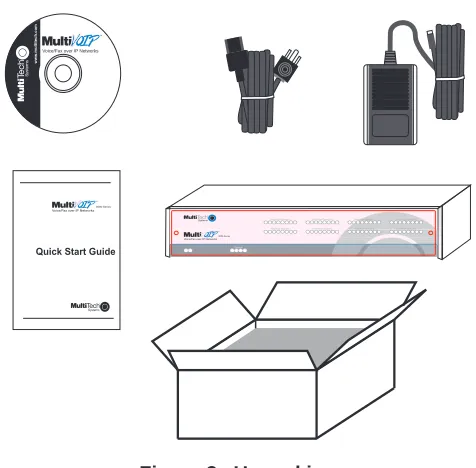
Unpacking Your MultiVOIP
Remove all items from the box.
www
.multitech.comVoice/Fax over IP Networks
Cabling Your MultiVOIP
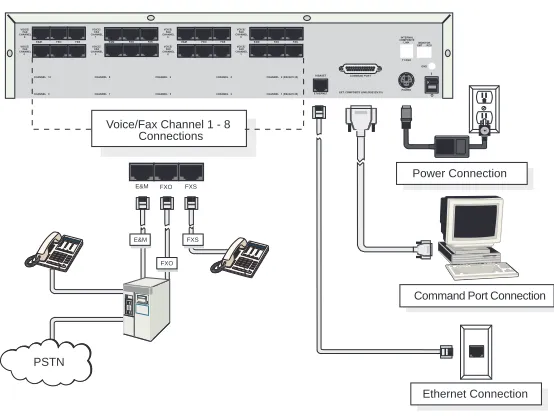
Cabling your MultiVOIP involves connecting the host MultiVOIP to your LAN and telephone equipment.
If you are connecting any Voice/Fax Channel to an E&M trunk other than type 2, perform the E&M Jumper Block Positioning procedure, which immediately follows the Cabling Procedure, before performing the Cabling Procedure.
1. Connect one end of the power supply to a live AC outlet
and connect the other end to the MultiVOIP as shown in Figure 4. The power connector is a 7-pin circular DIN connector.
E&M FXO FXS E&M FXO FXS E&M FXO FXS VOICE/ FAX CHANNEL 8 VOICE/ FAX CHANNEL 4 VOICE/ FAX CHANNEL 7 VOICE/ FAX CHANNEL 3 VOICE/ FAX CHANNEL 6 VOICE/ FAX CHANNEL 2 VOICE/ FAX CHANNEL 5 VOICE/ FAX CHANNEL 1
CHANNEL 10 CHANNEL 9
CHANNEL 8 CHANNEL 7
CHANNEL 6 CHANNEL 5
CHANNEL 4 CHANNEL 3
CHANNEL 2 (RS232/V.35) CHANNEL 1 (RS232/V.35)
10BASET ETHERNET
COMMAND PORT EXT. COMPOSITE LINK (RS232/V.35) POWER
I O
GND T1 DSU
MONITOR XMT RCV INTERNAL COMPOSITE LINK E&M FXO FXS
Ethernet Connection Command Port Connection Power Connection FXS FXO E&M FXS E&M FXO PSTN
Voice/Fax Channel 1 - 8 Connections
Figure 4. Cable Connections
2. Connect the MultiVOIP to a PC by using the DB-9 to DB-25
Cabling
3. Connect a network cable to the ETHERNET 10BASET
connector on the back of the MultiVOIP. Connect the other end of the cable to your network.
4. If you are connecting a station device such as an analog
telephone, a fax machine, or a Key Telephone System (KTS) to your MultiVOIP, connect one end of an RJ11 phone cord to the Voice/Fax Channel 1 FXS connector on the back of the MultiVOIP and the other end to the station device.
If you are connecting a PBX extension to your MultiVOIP, connect one end of an RJ11 phone cord to the Voice/Fax
Channel 1 FXO connector on the back of the MultiVOIP
and the other end to the PBX extension.
If you are connecting an E&M trunk from a telephone switch to your MultiVOIP, connect one end of an RJ45 phone cord to the Voice/Fax Channel 1 E&M connector on the back of the MultiVOIP and the other end to the trunk. Refer to the User Guide for E&M pin assignments.
E&M Jumper Block Positioning Procedure
A jumper block exists for each voice/fax channel. The jumper block is to the right of each set of channel jacks. The jumper block contains 8-pairs of pins. The jumper plug fits over three pairs of pins on the jumper block. The E&M type number is labeled on the pc board. The jumper plug needs to be centered on the E&M type number. Perform the following procedure to change E&M jumper position.
1. Ensure that power is removed from the MultiVOIP.
2. Remove the front panel by loosening the two Phillips
quarter-turn screws, and remove the four Phillips screws on the back and the four Phillips screws on the bottom.
3. Slide the top cover back off the chassis to expose the rear
panel.
4. To change a jumper position, lift the jumper plug up off the
jumper block and move to the new position, ensuring that the center jumper is centered on the E&M type number.
4
2 (Default)
1,3
5
5. Change the jumper position for each voice/fax channel
that is connecting to an E&M trunk that is not a type 2. If you have two voice/fax channel boards in your unit and you need to change the jumpers on the second board, remove the six screws from the top board and disconnect the ribbon cable from the top board.
6. Slide the top cover back on to the chassis.
Cabling
Phillips quarter-turn screws and replace the four Phillips screws on the back and the four Phillips screws on the bottom.
8. If you are using a Magix 400 E&M Tie Card, connect the
ground pin to the chassis ground screw as shown.
PIN NO. 6 3 1 4 5 2 1 2 3 4 5 6 7 8 PIN NO. Male Male MVP 400/800
Connection Magix 400 E&M 4Wire Tire Card
M MOUTH CONTROL E EAR CONTROL T1 TIP 1 RECEIVE R RING TRANSMIT T TIP TRANSMIT R1 RING 1 RECEIVE CHASSIS GROUND SCREW UNUSED
M I N P U T E O U T P U T T 1 4 - W I R E O U T P U T R 4 - W I R E I N P U T , 2 - W I R E T 4 - W I R E I N P U T , 2 - W I R E R 1 4 - W I R E O U T P U T S G ( S I G N A L G N D ) O U T P U T S B ( S I G N A L B A T T E R Y O U T P U T
Configuring Your Host MultiVOIP
The following software loading procedure does not provide every screen or option in the loading process. The
assumption is that a technical person with a thorough knowledge of Windows and the software loading process is doing the installation. Additional information on the MultiVOIP software is provided in the User Guide supplied with your MultiVOIP.
If you are installing a MultiVOIP behind a firewall, you need to add the following UDP ports to your firewall.
Q.931 Signaling, Ch1[900] Q.931 Signaling, Ch2 [902] Q.931 Signaling, Ch3[904] Q.931 Signaling, Ch4 [906] Q.931 Signaling, Ch5[908] Q.931 Signaling, Ch6 [910] Q.931 Signaling, Ch7[912] Q.931 Signaling, Ch8 [914] Status [5000]
Ch1 RTP [5004] Ch1 RTCP [5005] Ch2 RTP[5006] Ch2 RTCP [5007] Ch3 RTP[5008] Ch3 RTCP [5009] Ch4 RTP[5010] Ch4 RTCP [5011] Ch5 RTP[5012] Ch5 RTCP [5013] Ch6 RTP[5014] Ch6 RTCP [5015] Ch7 RTP[5016] Ch7 RTCP [5017] Ch8 RTP[50018] Ch8 RTCP [5019]
Refer to your firewall user documentation to enter and open these ports.
1. Verify that your MultiVOIP 800 has been properly cabled
and that the power is turned on.
2. Insert the MultiVOIP 800 System CD into your CD-ROM
Software Installation
If the Multi-Tech Installation CD window does not display automatically, click My Computer, then right click the CD
ROM drive icon, click Open, and then click the Autorun
icon.
3. When the Multi-Tech Installation CD dialog box displays,
click the Install Software icon.
Click Next to continue.
5. Follow the on-screen instructions to install your MultiVOIP
software.
You may choose the Destination Location of your
MultiVOIP software or you can choose to select the default destination by clicking Next.
If you click Browse, you can choose from several folders. It is recommended to choose the default destination.
6. The following dialog box selects the COM port of your PC
Software Installation
Click OK to continue.
7. The Setup Complete dialog displays.
Click Finish to continue.
8. The following message displays:
10. In the Ethernet group, enter the IP Address, Subnet
Mask, and Gateway Address, unique to your IP LAN.
The IP address is your unique LAN IP address, and the Gateway address is the IP address of the device connected to the Internet/Intranet.
Click OK when you are finished.
11. The Channel Setup dialog box displays. The Channel Setup dialog boxes define the channel interface, voice coder, fax parameters, and regional telephone parameters for each channel.
Configure each channel for the type of interface you are connecting to. Channel 1 displays by default in the Select
Channel list. To change the channel number, select the
channel number you want to configure from the Select
Channel list.
Software Installation
panel of the MultiVOIP.
If you are connecting a station device such as an analog telephone, a fax machine, or a Key Telephone System (KTS) to the Voice/Fax connector on the back of the unit,
FXS (Loop Start) will most likely be the correct Interface
option most of the time .
If the station device uses ground start, then choose the
FXS (Ground Start) option. Refer to the device’s user
documentation.
If you are using an extension from your PBX, then choose the FXO option. Check with your in-house telephone personnel to verify connection type.
If you are connecting to an E&M trunk on your PBX, then choose E&M option.
dialing a phone number. The default setting is 5. In the
Inter Digit Time box, enter the maximum amount of time
in milliseconds that the unit will wait before mapping the dialed digits to an entry in the Phone Directory Database. If too much time elapses between digits and the wrong numbers are mapped, you hear a rapid busy signal. If this happens, hang up and dial again. This option is available for all interface types. In the Flash Timer box, enter the time, in milliseconds, for the duration of flash hook signals output on the FXO or FXS interface.
To dedicate a local voice/fax channel to a remote voice/fax channel, (so you will not have to dial the remote channel) select the Auto Call Enable check box. Enter the phone number of the remote VOIP in the Phone Number box.
For FXO-to-FXO communications, you can enable a specific type of FXO Disconnect: current loss, tone
detection, or silence detection. Check with your
in-house phone personnel to verify the preferred type of disconnect to use. For tone detection, you can select from the lists either one or two tones that will cause the line to disconnect. The person hanging up a call must then hit the key or keys that will produce those tones. For
silence detection, select One Way or Two Way, then set
the timer for the number of seconds of silence before disconnect. The default value of 15 seconds may be shorter than desired for your application.
The FXS Options control how the selected channel interacts with answering machines. If the Current Loss check box is selected, the local VOIP hangs up when the electrical current is lost. The remote VOIPs must also be confirgured for current loss. The Ring Count box
contains the number of rings before the caller hears a fast Busy signal. If this happens, hang up and try again. The default setting is 8 rings.
Software Installation
channel’s configuration to any other channel by clicking
Copy. Everything on the Interface tab will be copied to
the other channel.
13. Repeat the above steps to configure the interface type for each voice/fax channel.
The Voice/Fax tab displays the parameters for the voice coder, faxing, and DTMF gain.
14. To change the voice coder, select the channel from the
Select Channel list, then select the new voice coder entry
Note: Only change the DTMF gain under the direction of
Multi-Tech Technical Support.
16. The Fax group enables you to send and receive faxes on the selected voice/fax channel. You can select the maximum baud rate for faxes from the list in the Fax group. If you do not plan to send or receive faxes on a given voice/fax channel, you can disable faxes in the Fax group.
Note: After configuring a given channel, you can copy that
channel’s configuration to any other channel by clicking
Copy. Everything on the Voice/Fax tab will be copied to
the other channel.
17. The Billing/Security tab displays the parameters for automatic disconnection, billing options, and dialing options.
Software Installation
19. The Call Authentication option enables password protection for outbound and inbound calls on the selected voice/fax channel. If you enable password protection on inbound or outbound calls, you need to also enter a password of up to 14 numeric characters in the Password box.
20. The Automatic Disconnect option limits call duration to the number of seconds entered in the Disconnect After box. The default value of 180 seconds can be changed to any other value up to 65,535 (roughly 18.2 hours).
If your country/region is not the default USA, click the
Regional tab and proceed to step 21. Otherwise, proceed
to step 22 to begin building your phone directory database. 21. To change the Tone Pairs on the Regional tab, select your
following steps.
The MultiVOIP configured as a “Host” will contain the host database. The host database has the phone numbers of all the MultiVOIP’s available for communication on an IP network. This database is downloaded to each Client MultiVOIP as it comes online.
Click Add to begin building your phone directory database. 24. The Add/Edit Phone Entry dialog displays.
In the Station Information group, enter the unique phone number of the local device connected to Channel 1 in the
Software Installation
25. The Description is optional, but can be useful in
associating the channel to the extension. If you want, enter a description of your local phone number. This description identifies the phone number you entered in the previous step.
26. The Permit Hunting option lets the answering MultiVOIP roll over to its second channel if the first channel is busy. Click Permit Hunting if you want the calls to roll over to a second voice/fax channel. (The calls will only roll over within an individual MultiVOIP; for example, if all of a MultiVOIP’s lines or channels are busy, the next call will not hunt to another MultiVOIP.)
Note: The Host MultiVOIP must have a static IP address
that the remote MultiVOIP can reference to obtain a downloaded copy of the host phone directory database. 27. In the MultiVOIP Identification group, enter the IP
address of the Host MultiVOIP in the IP Address box. For example, 204.22.122.118. Then obtain the 12-digit Node ID# (0008005xxxxx) from the ID plate on the back panel of the MultiVOIP and enter this number in the Ethernet
Node ID box.
28. Click OK and you are returned to the Phone Directory
Database dialog box, which now includes phone number
101 with its IP address, channel number, and description.
29. Click Add and the Add/Edit Phone Entry dialog box displays again.
30. Enter the phone number for the remote MultiVOIP in the
Station Information group Phone Number box. For
Software Installation
31. Enter a description for the remote MultiVOIP phone number for Channel 1 in the Description box.
Note: If the remote MultiVOIP is located behind a proxy
server that uses a dynamically assigned IP address, select
Dynamic (disabling Static IP Address) and leave the IP
Address box blank. The Host MultiVOIP will learn the IP address when it is contacted by the remote MultiVOIP.
32. Enter the IP address of the remote MultiVOIP in the IP
Address box in the MultiVOIP Identification group (e.g.,
Note: If only Channel 1 is active, you must enter two
phone numbers. The first number is the local MultiVOIP phone number for Channel 1, and the second number is the remote MultiVOIP phone number for Channel 1.
34. When you have finished, click OK to download the setup configuration to the MultiVOIP.
35. The Checking dialog box displays.
Click OK to proceed.
36. After the setup is written to the MultiVOIP, the unit is rebooted.
Software Installation
38. Windows 3.1 users - you are returned to your Program Manager where the MultiVOIP Program Group and Program Item (Windows icons) have been created.
Windows 95/98/NT/2000 users - you are returned to your
desktop.
Configuring Your Client MultiVOIPs
The client MultiVOIPs can be another MVP800 or MVP400 unit or a MultiVOIP 200-series.
If your client MultiVOIP is an MVP400 or MVP800, perform the following software loading procedure.
If your client is a MultiVOIP 200-series, connect your command port cable and power up the unit according to the cabling procedure in the MultiVOIP 200-series Quick Start. Then configure the unit as a client per the Installing Your MultiVOIP Software section in the MultiVOIP 200-series Quick Start.
If you are installing a MultiVOIP behind a firewall, add the following UDP ports to your firewall.
1. Disconnect the pc from the command port of the Host MultiVOIP and connect it to the command port on the Client MultiVOIP.
2. Windows 3.1 users - from the Program Manager, double-click the MultiVOIP Configuration icon in the MultiVOIP Program Group. The main menu displays.
Windows 95/98/NT/2000 users - from your desktop, click Start | Programs I MultiVOIP 800 v. 301E I Download Factory Defaults. The following dialog box displays:
Click OK.
3. The IP Protocol Default Setup dialog box displays.
The default Frame Type is TYPE_II. If this does not match your IP network, select the Frame Type from the Frame
Software Installation
4. In the Port Address group, enter the IP Address and IP
Mask. In the Gateway Address group, enter the gateway
IP address for the client unit.
The IP address is your unique LAN IP address, and the Gateway address is the IP address of the device connected to the Internet/Intranet.
Click OK when you are finished. The main menu displays.
5. From the main menu, click Voice Channels and the
Channel Setup dialog box displays. The Channel Setup
If you are connecting a station device such as an analog telephone, a fax machine, or a Key Telephone System (KTS) to the Voice/Fax connector on the back of the unit,
FXS (Loop Start) will likely be the correct Interface option
most of the time.
If the station device uses ground start, then choose the
FXS (Ground Start) option. Refer to the device’s user
documentation.
If you are using an extension from your PBX, then choose the FXO option. Check with your in-house telephone personnel to verify connection type.
If you are connecting to an E&M trunk on your PBX, select the E&M option.
If the E&M interface is selected, the E&M Options group is enabled. Check with your in-house phone personnel to determine if the signaling is Dial Tone or Wink and if the connection is 2-wire or 4-wire. If Wink signaling is used, then the Wink Timer is enabled with a default of 250 milliseconds. The range of the Wink Timer is from 100 to 350 milliseconds. Consult with your local in-house phone personnel for this timer setting. If the Pass Through check box is selected, a continuously open E&M voice path is established between two channels to pass voice packets. Available if the Dial Tone option is selected and auto-dialing is set up for the two channels that will be doing pass-through. This is useful for Public Address systems.
If you choose an FXO or FXS interface, the Dialing Options Regeneration group is enabled. Check with your in-house telephone personnel to verify whether your local PBX dial signaling is Pulse or DTMF (tone). Set the Regeneration option accordingly. In the Max Dial Digits box, enter the maximum number of digits allowed when dialing a phone number. The default setting is 5. In the
Software Installation
in milliseconds that the unit will wait before mapping the dialed digits to an entry in the Phone Directory Database. If too much time elapses between digits and the wrong numbers are mapped, you hear a rapid busy signal. If this happens, hang up and dial again. This option is available for all interface types. In the Flash Timer box, enter the time, in milliseconds, for the duration of flash hook signals output on the FXO or FXS interface.
To dedicate a local voice/fax channel to a remote voice/fax channel, (so you will not have to dial the remote channel) select the Auto Call Enable check box. Enter the phone number of the remote VOIP in the Phone Number box.
For FXO-to-FXO communications, you can enable a specific type of FXO Disconnect: current loss, tone
detection, or silence detection. Check with your
in-house phone personnel to verify the preferred type of disconnect to use. For tone detection, you can select from the lists either one or two tones that will cause the line to disconnect. The person hanging up a call must then hit the key or keys that will produce those tones. For
silence detection, select One Way or Two Way, then set
7. Repeat the above steps to configure the interface type for each voice/fax channel.
The Voice/Fax tab displays the parameters for the voice coder, faxing, and DTMF gain.
8. To change the voice coder, select the channel from the
Select Channel list, then select the new voice coder entry
from the Voice Coder list.
If you changed the voice coder, ensure that the same voice coder is used on the voice/fax channel you are calling. Otherwise, you will always get a busy signal. 9. If you selected the FXO interface and are using touchtone
dialing, you can set up the DTMF gain (or output level in decibels - dB) for the higher and lower frequency groups of the DTMF tone pair. Make your selections from the lists in the DTMF Gain group. In the Duration box, enter the DTMF tone duration in milliseconds. 100 is entered by default.
Note: Only change the DTMF gain under the direction of
Software Installation
10. The Fax group enables you to send and receive faxes on the selected voice/fax channel. You can select the maximum baud rate for faxes from the list in the Fax group. If you do not plan to send or receive faxes on a given voice/fax channel, you can disable faxes in the Fax group.
Note: After configuring a given channel, you can copy that
channel’s configuration to any other channel by clicking
Copy. Everything on the Voice/Fax tab will be copied to
the other channel.
13. The Call Authentication option enables password protection for outbound and inbound calls on the selected voice/fax channel. If you enable password protection on inbound or outbound calls, you need to also enter a password of up to 14 numeric characters in the Password box.
14. The Automatic Disconnect option limits call duration to the number of seconds entered in the Disconnect After box. The default value of 180 seconds can be changed to any other value up to 65,535 (roughly 18.2 hours).
If your country/region is not the default USA, click the
Regional tab and proceed to step 15. Otherwise, proceed
to step 16 to begin building your phone directory database. 15. To change the Tone Pairs on the Regional tab, select your
specific country or region from the Country/Region list.
Software Installation
16. Click OK after the download is complete. Click Start | Programs| MultiVOIP 800 v. 301E | MultiVOIP
18. Click OK and you are returned to the main menu.
19. Click Download Setup to write the new configuration to the client unit. The Save Setup dialog displays.
20. Select the Save Current Setup as User Default
Configuration check box, then click OK. After the setup
is written to the MultiVOIP, the unit reboots.
21. Check that the BTG LED on the MultiVOIP is off after the download is complete. This may take several minutes as the MultiVOIP reboots.
22. You are returned to the main menu. Your MultiVOIP is operational at this time.
Software Installation
Deploying the VOIP Network
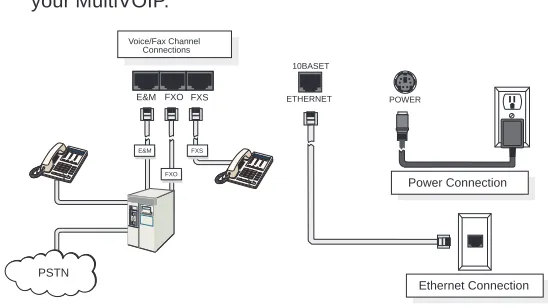
Deploying the VOIP network involves the VOIP Administrator developing the VOIP Dialing Directory and deploying the preconfigured client MultiVOIPs to their remote sites. The remote site administrators need only connect power to the preconfigured MultiVOIP, connect it to their Ethernet LAN and predefined telephone equipment, and then wait for the phone directory database to be downloaded.
The client units can be another MVP800 or MVP400 unit or a MultiVOIP 200-Series. Therefore, the deployment procedure for the remote site administrator may be more general, so you may need to refer to the Cable Connection Figure in the appropriate Quick Start. Perform the following procedure to deploy your VOIP Network.
VOIP Administrator
1. Establish your VOIP Dialing Directory based on your
Remote Site Administrator
3. Unpack your MultiVOIP.
4. Connect one end of the power supply to a live AC outlet
and connect the other end to the Power connection on your MultiVOIP. FXS E&M FXO PSTN Ethernet Connection Power Connection 10BASET ETHERNET POWER Voice/Fax Channel Connections
E&M FXO FXS
Figure 5. Remote Site Cable Connection
5. Connect a network cable to the ETHERNET 10BASET
connector on the back of your MultiVOIP.
6. If you are connecting a station device such as an analog
telephone, a fax machine, or a Key Telephone System (KTS) to your MultiVOIP, connect one end of an RJ11 phone cord to the Voice/Fax Channel 1 FXS connector on the back of the MultiVOIP and the other end to the station device.
If you are connecting a PBX extension to your MultiVOIP, connect one end of an RJ11 phone cord to the Voice/Fax
Channel 1 FXO connector on the back of the MultiVOIP
and the other end to the PBX extension.
Software Installation
on the back of the MultiVOIP and the other end to the trunk phone jack. Refer to the MultiVOIP User Guide for E&M pin assignments.
7. Repeat the above step to connect the remaining telephone
equipment to each Voice/Fax Channel on your MultiVOIP.
8. Turn on power to the MultiVOIP by placing the ON/OFF
switch on the back panel to the ON position. Wait for the BOOT LED on the MultiVOIP to go off before proceeding. This may take a couple of minutes.
Limited Warranty
Multi-Tech Systems, Inc. (“MTS”) warrants that its products will be free from defects in material or workmanship for a period of two years from the date of purchase, or if proof of purchase is not provided, two years from date of shipment. MTS MAKES NO OTHER WARRANTY, EXPRESSED OR IMPLIED, AND ALL IMPLIED WARRANTIES OF MERCHANTABILITY AND FITNESS FOR A PARTICULAR PURPOSE ARE HEREBY DISCLAIMED. This warranty does not apply to any products which have been damaged by lightning storms, water, or power surges or which have been neglected, altered, abused, used for a purpose other than the one for which they were manufactured, repaired by the customer or any party without MTS’s written authorization, or used in any manner
inconsistent with MTS’s instructions.
MTS’s entire obligation under this warranty shall be limited (at MTS’s option) to repair or replacement of any products which prove to be defective within the warranty period, or, at MTS’s option, issuance of a refund of the purchase price. Defective products must be returned by Customer to MTS’s factory transportation prepaid.
MTS WILL NOT BE LIABLE FOR CONSEQUENTIAL DAMAGES AND UNDER NO CIRCUMSTANCES WILL ITS LIABILITY EXCEED THE PURCHASE PRICE FOR
DEFECTIVE PRODUCTS.
Technical Support
Software Installation
Contacting Technical Support
Country By E-mail By telephone
France: [email protected] (33) 1-64 61 09 81
India: [email protected] (91) 124-340778
U.K.: [email protected] (44) 118 959 7774
U.S. & Canada: [email protected] (800) 972-2439
Rest of World: [email protected] (763) 785-3500
Internet:
http://www.multitech.com/support
Please have your product information available, including model and serial number.
FCC Declaration
NOTE: This equipment has been tested and found to comply