Copyright 0 1983 by the Genetics Society of America
LENGTH MUTATIONS IN HUMAN MITOCHONDRIAL DNA
R. L. CA” A N D A. C. WILSON
Department of Biochemistry, University of California, Berkeley, California 94720 Manuscript received March 1,1983
Revised copy accepted April 19,1983 ABSTRACT
By high-resolution, restriction mapping of mitochondrial DNAs purified from 112 human individuals, we have identified 14 length variants caused by small additions and deletions (from about 6 to 14 base pairs in length). Three of the 14 length differences are due to mutations a t two locations within the D loop, whereas the remaining 11 occur at seven sites that are probably within other noncoding sequences and at junctions between coding sequences. In five of the nine regions of length polymorphism, there is a sequence of five cytosines in a row, this sequence being comparatively rare in coding DNA. Phylogenetic analysis indicates that, in most of the polymorphic regions, a given length mutation has arisen several times independently in different human lineages. The average rate at which length mutations have been arising and surviving in the human species is estimated to he many times higher for noncoding mtDNA than for noncoding nuclear DNA. The mystery of why vertebrate mtDNA is more prone than nuclear DNA to evolve by point mutation is now compounded by the discovery of a similar bias toward rapid evolution by length mutation.
ARLY studies of genetic variation among mitochondrial DNAs (mtDNAs) of
E
different individuals and species of animals seemed to show that nearly all
of the mitochondrial mutations compatible with survival were base substitutions
(BROWN
1981). Only in the
D
loop was there evidence for length mutations, i.e.,
additions and deletions of bases (UPHOLT
and DAVID
1977; CREWS
et al. 1978;
BROWN and WRIGHT
1979; HAYASHI
et
al. 1979; FAURON
and WOLSTENHOLME
1980; WALBERG
and CLAYTON
1981; FERRIS,
WILSON
and
BROWN
1981;
BROWN
and
SIMPSON
1981; Greenberg et al., 1982). This picture, which contrasted with
that for fungal mtDNA, began to change when base sequences from different
animal species became available. By then, it was evident that distantly related
species also differed by small length mutations at many sites outside the D loop
(BIBB
et al. 1981; ANDERSON
et al. 1982; BROWN
et al. 1982; CLARY
et al. 1982).
We now report the results of a search for length differences in a series of
closely related mtDNAs from different human individuals. Initial restriction
studies of human variation in mtDNA revealed about 55 different polymor-
phisms, and all of these were attributed to base substitutions (POTTER
et
al. 1975;
BROWN
1980; GILES
et al. 1980; CASE
and WALLACE
1981; DENARO
et al. 1981). A
more extensive survey brought the total to about 165 (CANN,
BROWN
and WILSON
1982), all of which were provisionally attributed to base substitution. Closer
700
R. L. CANN A N D A. C. W I L S O Nscrutiny of the fragment patterns, using large numbers of size standards made
available by the complete base sequence for mtDNA of one human individual
(termed the Cambridge sequence), has allowed us to detect a new class of length
polymorphism at several sites outside the D loop. This paper describes the
length variants, their location in the mitochondrial genome and their incidence
in human populations. Finally, we discuss their possible significance for our
understanding of the driving force for mtDNA divergence.
MATERIALS AND M E T H O D S
Human mtDNA: mtDNA was isolated to high purity from placenta, liver and tissue culture cells by methods described previously (BROWN, GEORGE and WILSON 1979). All tissue was collected from donors in accordance with the National Institutes of Health guidelines established for protection of human subjects. The 112 samples included in this study had the following broad racial distribution: 12 Australian aborigines, 19 individuals of African descent, 35 individuals of Asian descent and 46 individuals from Europe, North Africa or the Middle East.
Restriction mopping and gel electrophoresis: All samples in this study were mapped for restriction site polymorphisms with 12 restriction enzymes: Alul, AvuII, DdeI, FnuDII, HaeIII, HhaI, HinfI, HpaI, HpaII, MboI, Rsal and TaqI. Reactions were carried out under conditions specified by the supplier (New England Biolabs or Bethesda Research Laboratories). Each individual was mapped at approximately 352 sites. Of the individuals examined in this analysis, 21 had been initially compared for restriction fragment differences (BROWN 1980). These samples were included in a more extensive analysis for evidence of molecular polymorphisms at a n additional 121 sites. Details of all restriction site polymorphisms detected will appear in a separate publication (R. L. CA N N , W. M. BROWN and A. C. WILSON).
Fragments were labeled at the ends with '"P as described by DROIJIN and SYMONS (1979) and modified by BROWN (1980). After this step they were run into either 3.5% acrylamide or 1.2% agarose vertical gels for separation. Autoradiography was performed on vacuum-dried gels using Kodak X-
Omat RP film and an intensifying screen at -70".
Denaturing gel conditions were used to verify length mutations in fragments. Urea w a s added to a 3.5% acrylamide gel solution so that the final concentration was 7 M. Samples were treated as
usual for labeling but were dissolved in a final loading buffer containing 90% formamide, heated for 3 min at 90' in a temperature bloc, and quick chilled on dry ice before loading.
Mapping strategy: Our approach takes advantage of the fact that one human mtDNA has been completely sequenced (ANDERSON et al. 1981). Any human drawn a t random can be expected to differ from this known sequence by three or four base substitutions per kilobase (kb) on the average (BROWN 1980; CA", BROWN and WILSON 1982; AQUADRO and GREENBERC 1983). Maps for restriction sites in humans of unknown sequence can be derived by comparing their fragment patterns with that predicted from the published DNA sequence. Using this technique, we can detect and rapidly map sites to within a few base pairs (bp) for a large number of individuals without recourse to the double digestion method (DANA, SACK and NATHANS 1973) which had traditionally provided the best approach to rigorous restriction mapping. The high degree of sequence homology among human mtDNAs makes the mapping of single digests with respect to the Cambridge sequence both accurate (to 2 bp) and convenient. (By contrast, it is virtually impossible with the double-digestion method to map the large number of fragments produced by restriction enzymes that recognize a specific sequence of 4 hp.)
RESULTS
HUMAN MTDNA LENGTH MUTATIONS
701
I 278 Constant Sites
165 Variable Sites
F V L IQM WANCY SD K G R HSL E TP
t
,
I I I I I,
I I I I I I I I I0 2 4 6 8 10 12 14 16 Kb
Human Mitochondrial DNA
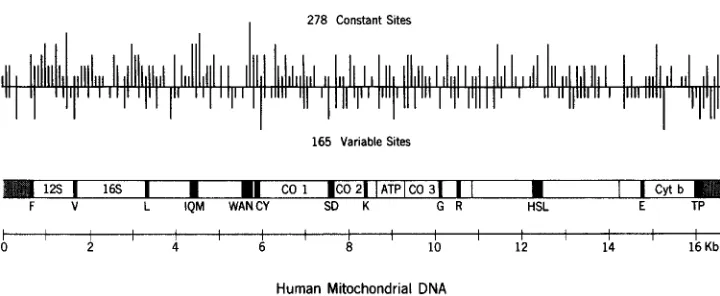
FIGURE 1.-Locations of cleavage sites and functional regions in human mtDNA. The 16,569-bp circular genome sequenced by ANDERSON et al. (1981) is drawn in linear form. The major bar shows the regions of known function: 22 tRNA genes, each represented by a single letter and black shading, two rRNA genes (12s and 16s) and 13 genes coding for proteins, eight of which are unidentified and five of which are known, namely, three cytochrome oxidase subunits (CO 1, 2 and 3), one ATPase subunit (ATP) and cytochrome b (Cyt b). Diagonal lines represent the large noncoding region, extending from 16,024 to 576 bp. The upper panel shows the locations of cleavage sites found in mtDNAs from 112 humans with the aid of 12 restriction enzymes. Vertical lines below the horizontal line show the variable sites, i.e., those present in some but not all of the 112 mtDNAs. The vertical lines above the horizontal line show those sites present in all of the human mtDNAs examined. Height of the vertical lines is proportional to the number of sites found within an 80-bp segment.
sites are invariant, i.e., present in all 112 of the human mtDNAs sampled. The
remaining 165 sites are variable, i.e., present in only some of these human
mtDNAs. Further details as to the locations, nature and geographic distribution
of these sites will appear elsewhere
(R. L.
C A N N ,W.
M.
BROWN
and
A.
C.
WILSON).
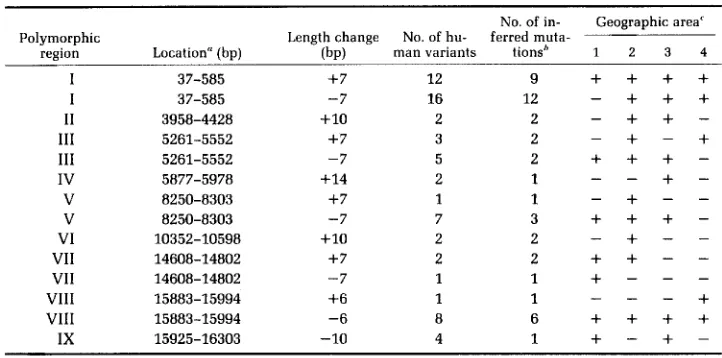
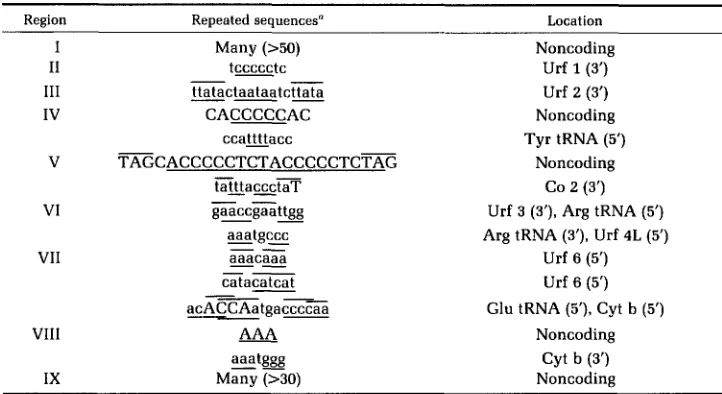
Length polymorphisms: Our survey of
112
humans revealed length polymor-
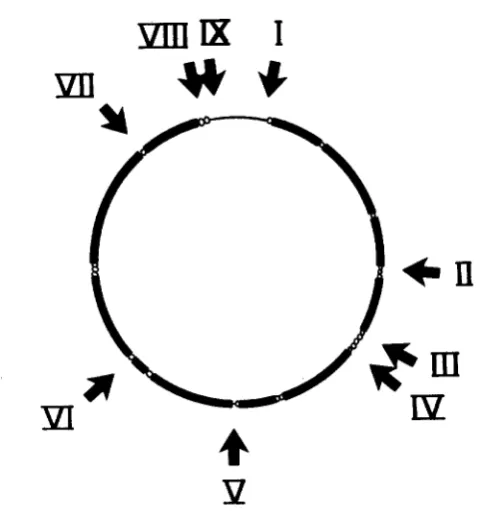
phisms in nine regions of the mtDNA molecule. The locations of these regions,
designated
I-IX,
are given in Table
1
and Figure
2.
The short deletions and
additions occurring in these regions range in size from about 6 to
14
bp (see
Table 1).
702
R . L. CANN A N D A. C. WILSON TABLE 3Length mutations in mitochondrial DNA of 112 humans
Polymorphic Length change
region Location" (buI (hu)
No. of in- Geographic area'
man variants tions" 1 2 3 4
No. of hu- ferred muta-
I I I1 111 111 IV V V VI VI1 VI1 VI11 VI11 IX 37-585 37-585 3958-4428 5261-5552 5261-5552 5877-5978 8250-8303 8250-8303 10352-10598 14608-14802 14608-14802 15883-15994 15883-15994 15925-16303 +7 -7 +10 +7 -7 +14 +7 -7 +10 +7 -7 +6 -6 -10 12 16 2 3 5 2 1 7 2 2 1 1 8 4
9
+ + + +
12 -+ + +
2 -
+ + -
+ - +
22
+ + + -
+ -
11 - + -
-3
+
+
+
-2 -
+ - -
2
+ + - -
1 + - --+
16
+
+
+
+
1
+ -
+ -
-
-
--
_
-"bp locations are numbered as in ANDERSON et 01. (1981).
bThe number of inferred mutations is estimated by phylogenetic analysis as exemplified in Figure 5 for the deletion of seven base pairs at site I and the addition of seven base pairs at the same site.
'The four aboriginal geographic areas are as follows: (1) Sub-Saharan Africa; (2) China plus Vietnam, the Philippines and Tonga; (3) Australia; (4) Europe plus North Africa and Western Asia.
134 bp long. Sample
2resembles sample 3 in this respect (see legend, Figure 3).
Since this mobility difference was reproducible and did not disappear with
longer digestion, it could be attributed to a deletion of 7 bp or to an alteration in
secondary structure caused by substitution or modification of a base.
When the experiment was repeated under denaturing conditions, the same
mobility difference was seen, which implies that secondary structure is not the
cause of the mobility difference. A deletion of about 7 bp from the region giving
rise to the 141-bp fragment,
i.e., the region between 8250 and 8391 bp, is,
therefore, implicated.
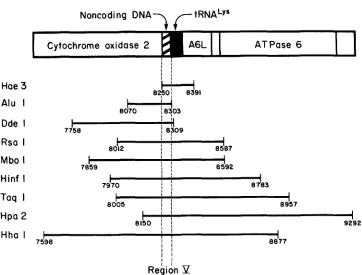
This suggestion was confirmed by examining the same region with eight
additional restriction enzymes, as illustrated in Figure 4. Two of these enzymes,
AluI and DdeI, produced a fragment embracing this region and having a size
less than 552 bp. In each case, the individuals with the postulated 7-bp deletion
exhibited a fragment that was smaller by about
7bp than that produced by
individuals with a conventional fragment size. The remaining six enzymes
produced fragments that were too big for reliable detection of a size change of
7
bp (see Figure 4). The variable region must be one common to the three
fragments that show the shift, namely, the region from 8250 to 8303. In this
region, there is a noncoding segment, from 8270 to 8290 bp, which separates the
cytochrome oxidase
2gene from the lysine tRNA gene; this is considered to be
the most likely location for the deletion (see
DISCUSSION).HUMAN MTDNA LENGTH MUTATIONS
703
4
9
FIGURE
2.-Nine regions of length polymorphism in human mtDNA. The solid bars refer to genes specifying proteins or ribosomal RNA, the empty circles to transfer RNAs and the thin line to the large noncoding region from 16,024 to 576 bp. Arrows show the approximate locations of the nine polymorphic regions, labeled I-IX. For further information about these locations, see Table 1 and Figure 1.1).
In five of the regions (I, 111, V, VI1 and VIII) both additions and deletions
were demonstrated. In all cases, it appears probable that the length changes
have taken place in
or
near noncoding DNA, but, as will be evident from Table
1,
exact localization has not been achieved and the possibility that such changes
have occurred in tRNA genes, the carboxy termini of unidentified reading
frames (specifically Urfs
1, 2
and
3),
or even at the amino terminus in the case
of urf
6
is not excluded (see Table 3).
DISCUSSION
Direct repeats: Some of these length mutations may result from the existence
of short, directly repeated sequences in
or
near noncoding regions. In region V,
for example, there is a tandemly repeated, noncoding sequence of
9
bp in the
Cambridge mtDNA and (by inference from the maps) in most human mtDNAs,
as follows: ACCCCCTCT ACCCCCTCT. An addition or deletion of one of these
repeats could be expected by slipped mispairing during replication or repair
(JONESand
KAFATOS
1982).
The observed addition and deletions of about
7
bp
in this region agree, within the error of measurement
(3
bp), with this expecta-
tion.
704
R. L. CANN ANDA.
C. WILSON TABLE 2HoeIII sites in four humon mtDNAs"
Variant sites
Common sites Presence of sites
Positions (bp) Position 1 2 3 C
-
322 4481 7886 9438 1484
+
+
1463 4563 8250 10364 3090
+
+
+
+
2173 4848 8391 10689 38422567 5226 8572 12301 6425
+
+
+
+
3146 5261 8838 12979 6957+
+
3315 5837 8994 13051 9553
+
+
+
+
3412 6027 9025 13957 10725+
3427 6260 9266 15047 13702+
3607 6383 9294 15152 151723849 7197 9342 15883 16517
+
3958 7497 9411 164564428
"The four mtDNAs compared include the three (1-3) whose Hoe111 fragments are displayed in Figure 3 plus (C) the Cambridge mtDNA whose complete base sequence is known (ANDERSON et al.
1981).
-
- -
- -
- - -
- - -
- - -
- - -
-
+
-
between the CAC sequences could generate additions or deletions of
1
to
6
bp
(as illustrated by
JONESand
KAFATOS
1982), but it would be hard to account for
the observed 14-bp addition by one slipped mispairing event.
Information about the occurrence
of tandemly and nontandemly repeated
sequences at other regions of length polymorphism appears in Table
3.
A
notable feature is the run of five cytosines which occurs not only in region IV
and V but also in regions
I, I1 and IX in or near noncoding regions. Additional
evidence suggesting that CCCCC is correlated with length variation in mtDNA
of primates comes from comparisons of the tRNA serineAGY
gene in apes and
humans
(BROWN
et
al.
(1982), where the only length mutation seen in a 896-bp
segment is localized to this sequence. This CCCCC sequence is also present in
the repeat reported in the
5'
flanking region of the human insulin gene, a region
highly polymorphic in length
(BELL,
SELBY
and RUTTER
1982), as well as in
regions of yeast mtDNA which undergo frequent length changes (BALDACCI
and
FIGURE 3.-Restriction fragments of mtDNA from three humans. This shows an autoradiograph of a 3.5% polyacrylamide gel containing end-labeled fragments of three human mtDNAs digested with the restriction enzyme HoeIII. The gel size was 40 X 15 X 0.08 cm, and the running time was
14 hr at 4.5 MA in a buffer containing Tris (0.05 M), boric acid (0.05 M) and EDTA (0.001 M) at pH 8.3
H U M A N MTDNA LENGTH MUTATIONS
I 2 3
nnn
1611-
Y r a
-16111141-
b"y
-1141 1090' '1090576.573
-
@# w4
-
576.573gz?$
W U -523394 389, J394. 389 373:374
-
364
-
BFfd
1:7684.~~~
325- M w Y -325 3 0 0 - - 3 0 0190- -190 181,180
-
-
181.180169
-
-
169r!
a
123
-
115-
If
8
11:
;
109-
105' 1)
97- I
-
9782-
c.
(I) -82a
-72I:-
r
'6961-
A
-6135
-
31' 28' 27-705
IS-
L
A
=:;
-7
706
R . L. CANN A N D A . C. WILSONNoncoding DNA
1
r t R N A L Y S
Hae
3
Alu
I
I
Cytochrome oxidase
2
A 6 L
ATPase
6
I
'H
8250! 8391 8070 I 8303
I
I fI !
7758
!
8jO9Ode
I
Rsa
I
Mbo
I
8dl2 i: I l 85L7
I
I !i 1 8 592
I
7859
! I
Hinf
I
Taq
I
Hpa
2
I
I !I !
7970 1I ; 1 87L3
t
I
8005 8957
I !
9292
Region
P
FIGURE 4.-Mapping of length mutations in region V of human mtDNA. The DNA shown, spanning from 7598 to 9292 bp, contains part of the cytochrome oxidase 2 gene, a noncoding region (cross-hatched), the lysine tRNA gene (solid black), an unidentified reading frame (A6L), the partially overlapping ATPase 6 gene, and a portion of the cytochrome oxidase 3 gene (ANDERSON et
al. 1981). The nine restriction fragments shown include region V, in which deletions and additions of 7 bp have been found. These mutations cause readily detectable changes in the electrophoretic mobility of the two smallest fragments, produced by the enzymes Hoe111 and AIuI, barely detectable changes in the DdeI fragment and undetectable changes in the larger fragments.
BERNARDI
1982). However, it is also clear that some
of the regions of length
polymorphism do not contain obvious candidates for slipped mispairing in
noncoding regions. Further assessment of the role of repeated sequences in
generating mtDNA length mutations will require the sequencing of these regions
from variant individuals.
HUMAN MTDNA LENGTH MUTATIONS
707
TABLE 3
Direct repeats in regions of length polymorphism
Region Repeated sequences” Location
I I1 I11 IV V
VI
VI1
VI11
IX
Many ( X O )
t-tc
ttatactaataatcttata
- - -
CACCCCCACccattJacc K i a ~ S T g a S g a a B
wtgcl2-c aaacaaa cata-
a c A C C A a t g a c B
AAA
--
aaatggg Many (>30)
TAGCACCCCCTCTACCCCCTCTAG
- -
- -
- -
- -
Noncoding Urf l(3’) Urf 2 (3‘) Noncoding Tyr tRNA (5’)
Noncoding
Urf 3 (3‘), Arg tRNA (5’)
Arg tRNA (3’), Urf 4L (5’) Urf 6 (5’)
Urf 6 (5’) Glu tRNA (5’). Cyt b (5’)
Noncoding Cyt b (3’) Noncoding
CO 2 (3‘)
“In the light strand of the human mtDNA whose sequence has been reported (ANDERSON et 01.
1981). Capital letters are for noncoding sequences; lower case letters refer to sequences specifying tRNAs or polypeptides. Tandem repeats are underlined; nontandem repeats are overlined; only sequences of more than two contiguous bases are considered. The list includes only those in, or within 20 bp of, a noncoding region or an intergenic junction.
...
1 0 1 . . 0 0 0 0 0 0 0 . ~ 6 ~ A ~ ~ ~ . ~ ~ ~ ~ ~ ~ . ~ ~ ~ . ~ ~ ~ ~ ~ ~ ~ ~ ~ A ~ ~ A ~ ~ A A . ~ ~ ~ ~ * ~ ~ ~ ~ ~ ~ ~ ~ ~ ~ ~ ~ . * ~ ~ ~ . ~ ~ ~ . ~ ~ ~ * . ~ a a . . ~ . . . . * . . ~ ~ . A ~ . . .FIGURE 5.-Multiple occurrences of deletions and additions during divergence of 110 human mitochondrial lineages. This tree was derived by the parsimony method (FARRIS, 1970 FERRIS, WILSON and BROWN 1981) from 89 informative characters, of which we attribute 10 to length mutations and 79 to base substitutions. Details about these base substitutions will appear in a separate publication (R. L. CA”, W. M. BROWN and A. C. WILSON). The following symbols designate individuals of different racial heritages:
A,
Australian; A, Asian; 0, African and 0, European, North African or Middle Eastern, as defined in the legend of Table 1. The heavy lines show 12 lineages that have independently experienced a deletion of about 7 bp in region I of the mitochondrial genome. The dotted lines show nine lineages that have independently experienced a n addition of about 7 bp in region I.708 R. L. C A N N A N D A.
C.
WILSONsequence data, one of the three sites of length polymorphism examined in the
D loop exhibited parallelism, and this study dealt with only seven types of
mtDNA (AQUADRO
and GREENBERG
1983).
These phylogenetically based estimates of the incidence of length changes
give limited support to the idea that length polymorphisms are due only to short
repeated sequences. The correlation between number of inferred mutations
(Table
1)
and the incidence of short repeated sequences in noncoding DNA is
approximate at best. The implication is that other factors may be required to
account fully for the incidence of length variation.
Incidence of length mutations in nuclear a n d chloroplast
DNA:
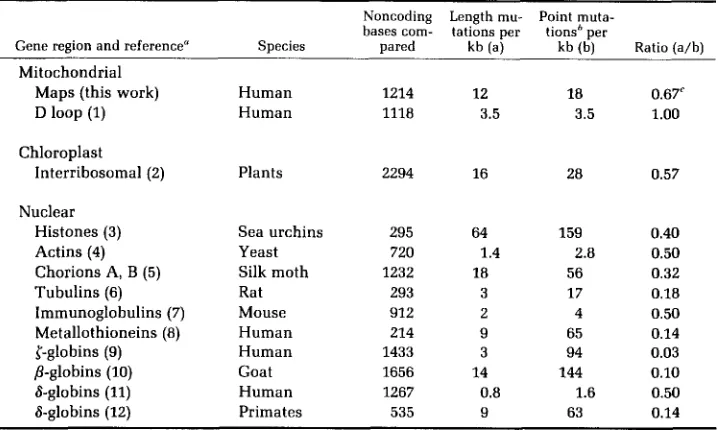
The incidence
of length change in mtDNA may be compared with that in chloroplast and
nuclear DNA. Table
4
presents a summary of results for noncoding regions,
from which it is evident that the ratio of length mutation to point mutation is at
least as high (0.67 to
1.0)
for mtDNA as for other types of DNA (mean for
nuclear DNA,
0.28;
mean for chloroplast DNA, 0.57). When this conclusion is
considered, it is worthwhile to note that the estimate of 0.67 for mtDNA is based
on restriction mapping, whereas all of the other estimates in Table
4come from
DNA sequencing. The mapping approach is likely, w e suggest, to underestimate
the incidence of length changes because it is probably poor at detecting the
smallest of them. From the mtDNA sequence comparisons made by ANDERSON
et
al.
(1982), it is clear that additions and deletions of one or two bases are
frequent. So, the proposal that noncoding regions of mtDNA experience a high
ratio of length to point mutational change seems sound.
Rates
oflength change in evolution: Since point mutations are known to
accumulate five to ten times more rapidly in mtDNA than in nuclear
or
chloroplast DNA (BROWN,
GEORGE
and WILSON
1979; BROWN et al. 1982), the
absolute rate at which length mutations accumulate in noncoding regions of
mtDNA probably exceeds that in nuclear or chloroplast DNA by a large factor
also. The implication is that whatever forces are responsible for the high rate of
point mutational evolution in mtDNA are also elevating the rate of length
change in this same molecule.
HUMAN MTDNA LENGTH MUTATIONS
709
TABLE 4
Incidence of length and point mutations in noncoding DNA ~~
Noncoding Length mu- Point muta- bases com- tations per tionsh per
Gene region and reference" Species pared kb (a) kb (b) Ratio (a/b) Mitochondrial
Maps (this work) Human 1214 12 1 8 0.67'
D loop (1) Human 1118 3.5 3.5 1.00
Chloroplast
Interribosomal (2) Plants 2294 16 28 0.57
Nuclear
Histones (3) Sea urchins 295 64 159 0.40
Actins (4) Yeast 720 1.4 2.8 0.50
Chorions A, B (5) Silk moth 1232 18 56 0.32
Immunoglobulins (7) Mouse 912 2 4 0.50
Metallothioneins (8) Human 214 9 65 0.14
{-globins (9) Human 1433 3 94 0.03
&globins (11) Human 1267 0.8 1.6 0.50
&globins (12) Primates 535 9 63 0.14
Tubulins (6) Rat 293 3 17 0.18
P-globins (10) Goat 1656 14 144 0.10
"References: (1) GREEENBERG, NEWBOLD and SUGINO 1983; (2) TAKAIWA and SUGIURA 1982;
(3) BUSSLINGER, RUSCONI and BIRNSTIEL 1982; (4) NELLEN et al. 1981; (5) JONES and KAFATOS 1982;
( ~ ) L E M I S C K H A and SHARP 1982; ( ~ ) O L L O and ROUGEON 1982; @) K A RIN and RICHARDS 1982; (9) PROUDFOOT, GIL and MANIATIS 1982; (10) SCHON et al. 1981; (11) KIMURA et al. 1982; (12) MARTIN, VINCENT and WILSON 1983.
bT o avoid saturation effects, attention is confined in these calculations to sequences differing at fewer than 16% of the bases compared.
'This calculation assumes that all the length mutations are in noncoding DNA. Since it is not certain that these mutations are confined to noncoding regions in human mtDNA, a n alternative calculation was made for the regions in which the length mutations have been localized (see Table
1). For these regions, which sum to 2229 bp, the ratio of length mutations to point mutations is 0.50.
We thank E. BLACKBURN, W. BROWN, S. CARR, B. CHAPMAN, A. J . CLARK, M. GEORGE, M. HAMMER, helpful discussion and valuable comments. We also thank S. ANDERSON, D. CLAYTON and B. GREENBERG for sharing information prior to publication and R. SPRITZ for revised information about human delta globin sequences.
K. HELM-BYCHOWSKI, R. HIGUCHI, E. PRAGER, W. RUTTER, V. SARICH, R. T. WHITE and E. ZIMMER for
LITERATURE CITED
ANDERSON, S., A. T. BANKIER, B. G. BARRELL, M. H. L. DEBRUIJN, A. R. COULSON. J. DROUIN, I. C. EPERON, D. P. NIERLICH, B. A. ROE, F. SANGER, P. H. SCHREIER, A. J. H. SMITH, R. STADON and I.
G. YOUNG, 1981 Sequence and organization of the human mitochondrial genome. Nature 290:
ANDERSON, S., M. H. L. DEBRUIJN, A. R. COULSON, F. SANGER and I. G. YOUNG, 1982 The complete sequence of bovine mitochondrial DNA: conserved features of the mammalian mitochondrial genome. J. Mol. Biol. 156: 683-717.
AQUADRO, C. F. and B. D. GREENBERG, 1983 Human mitochondrial DNA variation and evolution: analysis of nucleotide sequences from seven individuals. Genetics 103: 287-312.
710
R. L. CANN AND A . C. WILSONBALDACCI, G. and G. BERNARDI, 1982 Replication origins are associated with transcription initiation BELL, G. I., M. J. SELBY and W. J. RUTTER, 1982 The highly polymorphic region near the human BIBB, M. J., R. A. VAN ETTEN, C. WRIGHT, M. W. WALBERG and D. A. CLAYTON, 1981 Sequence and
sequences in the mitochondrial genome of yeast. EMBO J. 1987-994.
insulin gene is composed of simple tandemly repeating sequences. Nature 295: 31-35. gene organization of mouse mitochondrial DNA. Cell 26 167-180.
genome in Rattus norvegicus and Rattus rattus. Genetics 9 7 125-143.
BROWN, G. G. and M. V. SIMPSON, 1981 Intra- and interspecific variation of the mitochondrial BROWN, G. G. and M. V. SIMPSON, 1982 Novel features of animal mtDNA evolution as shown by sequences of two rat cytochrome oxidase subunit 2 genes. Proc. Natl. Acad. Sci. USA 7 9 3246- 3250.
BROWN, W.
M.
and J . W. WRIGHT, 1979 Mitochondrial DNA analyses and the origin and relative BROWN, W. M., 1980 Polymorphism in mitochondrial DNA of humans as revealed by restriction BROWN, W. M., 1981 Mechanisms of evolution in animal mitochondrial DNA. Ann. N.Y. Acad. BROWN, W. M., M. GEORGE, J R . and A. C. WILSON, 1979 Rapid evolution of animal mitochondrial BROWN, W. M., E. M. PRAGER, A. WANG and A. C. WILSON, 1982 Mitochondrial DNA sequencesof primates: tempo and mode of evolution. J. Mol. Evol. 1 8 225-239.
BUSSLINGER, M., S. RUSCONI and M. L. BIRNSTIEL, 1982 An unusual evolutionary behavior of a sea urchin histone gene cluster. EMBO J. 1: 27-33.
CANN, R. L., W. M. BROWN and A. C. WILSON, 1982 Evolution of human mitochondrial DNA: a preliminary report. p. 157. In: Human Genetics, part A: The Unfolding Genome, Edited by B. BONNE-TAMIR, P. COHEN and R. N. GOODMAN. Alan R. Liss, New York.
CASE, J. T. and D. C. WALLACE, 1981 Maternal inheritance of mitochondrial DNA polymorphisms in cultured human fibroblasts. Somatic Cell Genet. 7: 103-108.
CLARY, D. 0.. J. M. GODDARD, S. C. MARTIN, C. M-R. FAURON and D. R. WOLSTENHOLME, 1982 Drosophila mitochondrial DNA: a novel gene order. Nucleic Acids Res. 10: 6619-6637. CREWS, S., D. OIALA, J. POSAKONY, J. NISHIGUCHI and G. ATARDI, 1978 Nucleotide sequence of a region of human mitochondrial DNA containing the precisely identified origin of replication. Nature 277: 192-198.
Studies of simian virus 40 DNA part 7: a cleavage map of the SV40 genome. J. Mol. Biol. 7 8 363-376.
DENARO, M., H. BLANC, M. J. JOHNSON, K. H. CHEN, E. WILMSEN, L. L. CAVALLI-SFORZA and D. C. WALLACE, 1981 Ethnic variation in Hpa 1 cleavage patterns of human mitochondrial DNA. Proc. Natl. Acad. Sci. USA 7 8 5768-5772.
DROUIN, J. and R. H. SYMONS, 1979 Cloning of human mitochondrial DNA. pp. 471. In: ICN-UCLA Symposium Proceedings on Extrachromosomal DNA, Vol. 15, Edited by D. CUMMINGS, P. BORST, I . DAVID, S. WEISSMAN and C. F. FOX. Academic Press, New York.
age of parthenogenetic lizards (genus Cnemidophorus). Science 203 1247-1249. endonuclease analysis. Proc. Natl. Acad. Sci. USA 77: 3605-3609.
Sci. 361 119-132.
DNA. Proc. Natl. Acad. Sci. USA 76: 1967-1971.
DANNA, K. J., G. H. SACK, J R . and D. NATHANS, 1973
FARRIS, J. S., 1970 Methods for computing Wagner trees. Syst. 2001. 19: 83-92,
FAURON, C. M.-R. and D. R. WOLSTENHOLME, 1980 Intraspecific diversity of nucleotide sequences within the adenine
+
thymine-rich region of mitochondrial DNA molecules of Drosophila mauritiana, Drosophila melanogaster and Drosophila simulans. Nucleic Acids Res. 8 5391- 5410.Evolutionary tree for apes and humans based on cleavage maps of mitochondrial DNA. Proc. Natl. Acad. Sci. USA 78: 2432-2436.
HUMAN MTDNA LENGTH MUTATIONS
711
GILES, R. E., H. BLANC, H. M. CANN and D. C. WALLACE, 1980 Maternal inheritance of human mitochondrial DNA. Proc. Natl. Acad. Sci. USA 7 7 6715-6719.
GREENBERG, B. D., J. E. NEWBOLD and A. SUCINO, 1983 Intraspecific nucleotide sequence variability surrounding the origin of replication in human mitochondrial DNA. Gene 21: 33-49.
HAYASHI, J. I., H. YONEKAWA, 0. GOTOH, Y. TACASHIRA, K. MORIWAKI and T. H. YosInA,
1979 Evolutionary aspects of variant types of rat mitochondrial DNAs. Biochim. Biophys. Acta 564: 202-211.
JONES, C. W. and F. C. KAFATOS, 1982 Accepted mutations in a gene family: evolutionary diversification of duplicated DNA. J . Mol. Evol. 19: 87-103.
KARIN, M. and R. I. RICHARDS, 1982 Human metallothionein genes: primary structure of the metallothionein-2 gene and a related processed gene. Nature 299 797-802.
KIMURA, A., E. MATSUNACA, Y. OHTA, T. FUJIYOSHI, T. MATSUO, T. NAKAMURA, T. IMAMURA, T. YANASE and Y. TAKAGI, 1982 Structure of cloned &globin genes from a normal subject and a patient with &thalassemia: sequence polymorphisms found in the &globin gene region of Japanese individuals. Nucleic Acids Res. 1 0 5725-5732.
LEMISCKHA, I. and P. A. SHARP, 1982 The sequences of a n expressed rat a-tubulin gene and a pseudogene with a n inserted repetitive element. Nature 300 330-335.
MARTIN, S . L., K. A. VINCENT and A. C. WILSON, 1983 Rise and fall of the delta globin gene. J. Mol. Biol. 164. 513-528.
MIYATA, T., H. HAYASHIDA, R. KIKUNO, M. HASECAWA, M. KOBAYASHI and K. KOIKE, 1982 Molecular clock of silent substitution: at least six-fold preponderance of silent changes in mitochondrial genes over those in nuclear genes.
J.
Mol. Evol. 19 28-35.The nucleotide sequences of the actin genes from Saccharomyces carlsbergensis and S. cerevisioe are identical except for their introns. J. Mol. Appl. Genet. 1: 239-244.
OLLO, R. and F. ROUGEON, 1982 Mouse immunoglobulin allotypes: post duplication divergence of y2a and y2b chain genes. Nature 296 761-763.
POTTER, S., J, E. NEWBOLD, C. A. HUTCHINSON and M. H. EDCELL, 1975 Specific cleavage analysis of mammalian mitochondrial DNA. Proc. Natl. Acad. Sci. USA 7 2 4496-4500.
PROUDFOOT, N.
I.,
A. GIL and T. MANIATIS, 1982 The structure of the human zeta-globin gene and a closely linked, nearly identical pseudogene. Cell 31: 553-563.SCHON, E. A.,M. L. CLEARY, J. R. HAYNES and J. B. LINCREL, 1981 Structure and evolution of goat
y,Pp and r-globin genes: three developmentally regulated genes contain inserted elements. Cell TAKAIWA, F. and M. SUCIURA, 1982 Nucleotide sequence of the 16s-23s spacer region in a n rRNA
UPHOLT, W. B. and I. B. DAVID, 1977 Mapping of mitochondrial DNA of individual sheep and WALBERC, M. W. and D. A. CLAYTON, 1981 Sequence and properties of the human KB cell line and NELLEN, W., C. DONATH, M. MOOS and D. GALLWITZ, 1981
27: 359-369.
gene cluster from tobacco chloroplast DNA. Nucleic Acids Res. 1 0 2665-2676.
goats: rapid evolution in the D loop region. Cell 11: 571-583.
mouse L cell D-loop regions of mitochondrial DNA. Nucleic Acids Res. 9 5411-5421.