EVIDENCE FOR TWO TYPES O F ALLELIC RECOMBINATION IN YEAST1
FRED SHERMAN2 AND HERSCHEL ROMAN
Department of Genetics, University of Washington, Seattle, Washington
Received October 16, 1962
T
is now well established that recombination can occur between allelic mutantsI
of independent origin. Allelic recombination differs, however, from classical crossing over in that it is frequently nonreciprocal and has a lower than expected correlation with the exchange of outside markers. The relationship of nonrecipro- cal to reciprocal recombination is not yet understood (cf. ROMAN 1963). Models have been suggested which ascribe different mechanisms to the two types of recombination (STADLER 1959; ST. LAWRENCE 1959), or a common mechanism to both (FREESE 1957; PRITCHARD 1960). In either case, it is generally thought that nonreciprocal recombination is the result of an interaction between DNA molecules at a time when replication is occurring.The present study deals with allelic recombination in diploid yeast cells under- going sporulation. It had previously been shown (ROMAN 1956) that the fre- quency of allelic recombination rises sharply during meiosis compared with the frequency in mitotically dividing cells, In theory, there should be one cycle of DNA replication during meiosis of yeast. It was our purpose to see if we could determine the period of replication and to find if this period could be correlated with the time of occurrence of allelic recombination.
METHODS A N D MATERIALS
Yeast cultures: The diploid culture, D-45, of Sacchmom yces cerevisiae was constructed from mutant strains obtained from DRS. R. K. MORTIMER and D. C.
HAWTHORNE.
D-45 carries the recessive isoleucine heteroalleles is, and is5 and is therefore isoleucine-requiring. Allelic recombination is detected in D-45 by screening on isoleucineless medium for revertant isoleucine-independent cells. D-45 is heterozygous for a number of other markers on the same chromosome as the isoleucine locus (Chromosome V, HAWTHORNE and MORTIMER 1960). Their disposition and map distances are as follows:urs th,
+
is, tr,+
+
0isb 1 5
+
hi,
3 4
1 Supported in part from funds from National Institutes of Health Grant E-328.
2 Public Health Service Postdoctoral Fellow of the National Cancer Institute. Present ad- dress: Department of Radiation Biology, University of Rochester School of Medicine and Dentistry, Rochester, New York.
urs, th3, hi, and tr, being recessive genes for uracil, threonine, histidine, and tryptophan dependence, respectively. D-45 is also heterozygous for the recessive genes ad, (adenine dependence; Chromosome XII) and canv (canavanine resist- ance; chromosome unknown). The block in adenine sythensis due to ad2 results also in the production of a red pigment. As discussed further below, the red color and canavanine resistance are used as independent indicators of the occurrence of meiosis in the sporulating culture.
Media: The following were used in this investigation: YPD-One percent Bacto-Yeast extract, two percent Bacto-Peptone, and two percent dextrose; SC-
A synthetic complete medium identical with Bacto-Yeast Nitrogen Base medium enriched with 10 mg/l uracil, adenine sulfate, and arginine, 60 mg/l leucine and isoleucine, 300 mg/l threonine, two percent dextrose, and 1.5 percent agar;
Isoleucineless, histidineless, etc.-SC medium minus isoleucine, histidine, etc. ;
Canavanine medium-% medium minus arginine and supplemented with 60 mg/l canavanine sulfate; Sporulation medium-A liquid medium containing 0.3 percent sodium acetate and 0.02 percent raffinose (POMPER, DANIELS and
MCKEE 1954).
Techniques: To prepare the cells for sporulation, approximately 100 cells per ml of YPD were grown for two days at 25°C until early stationary phase, about 1.5
x
I O 8 cells/ml. After washing, the cells were resuspended in sporulation medium at a concentration of 3 x 10' cells/ml and incubated at 25 rt 0.5"C with forced aeration by means of a bubbler tube. At various intervals aliquots were withdrawn and appropriate dilutions were plated on SC, isoleucineless, and canavanine media. The viable cell count per ml, as determined by plate counts, remained constant throughout the sporulation cycle. I n some experiments, the cells were examined cytologically by MISS VIRGINIA C. BUCHTA (1959) using the method of GANESAN and SWAMINATHAN (1958), for evidence of nuclear division and stage of meiosis.R E S U L T S A N D DISCUSSION
GANESAN, HOLTER and ROBERTS (1958) have found that cells exposed to sporulation medium for a relatively short time revert to vegetative growth when supplied with nutrient medium. After a certain time i n sporulation medium, however, the cells become committed to meiosis and will undergo sporulation even if removed to nutrient medium. The irreversible stage in meiosis has been correlated with the onset of the first meiotic division.
ALLELIC RECOMBINATION IN YEAST 25 7
frequency with which asci were produced. It was found that the fraction of canavanine-resistant colonies was the same as the fraction of asci in the culture tested. Thus, the canavanine marker does serve as an indicator of the extent of sporulation in a culture and, by extension, of the frequency of cells committed to meiosis when cells are removed from the sporulation medium at various times during the cycle.
The frequency of canavanine-resistant colonies has also been correlated with the frequency of cells undergoing meiosis, as determined by cytological obser- vation. The cells of a sporulating culture were classified as uninucleate, binu- cleate, tetranucleate, or as asci if mature spores were present (GANESAN et al.
1958). The uninucleate cells were assumed to be uncommitted to meiosis and
capable of resuming diploid mitotic division when returned to nutrient medium. After eight hours in sporulation medium, one percent of the cells were binucleate, 0.3 percent were tetranucleate, and none had mature spores. Substantial fre- quencies of asci did not appear until 14 hours and at this time they comprised
50 percent of the committed cells (binucleate or later). After 20 hours of sporu- lation, the great majority of the committed cells were now asci, predominantly four-spored. A more detailed report of these cytological findings has been given by
BUCHTA
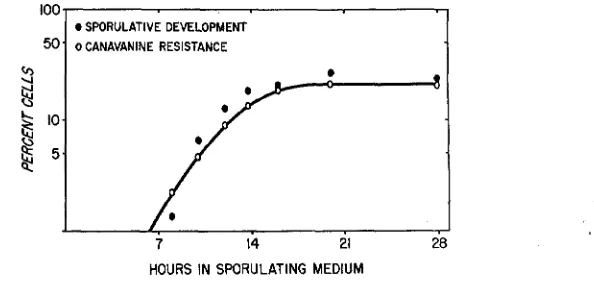
(1959). As can be seen in Figure 1, the frequency of canavanine- resistant colonies agrees with the frequency of committed cells, thus further establishing the efficacy of the canavanine marker as an indicator of meiosis in asporulating culture. Similar results were obtained when red colony color, due to the recessive gene ad,, was used as the indicator.
The frequency of allelic recombination at the isoleucine locus was measured at intervals after exposure to sporulation medium by plating on isoleucineless medium for revertants to isoleucine independence. As shown in Figure 2, the curve of increase in the frequency of isoleucine-independent cells differs from that of canavanine-resistant cells in two respects: (1) the frequency of reversion to isoleucine independence begins to rise sharply before there is a similar rise in
50.
0 SPORULATIVE DEVELOPMENT o CANAVANINE RESISTANCE
7 14 21 28
HOURS IN SPORULATING MEDIUM
FIGURE 1.-The percentage of cells in a sporulating culture which give rise to canavanine- resistant colonies and which are binucleate or later in development, 8s determined cytologically-
I . . . .
.
I k0 ' 4 8 12 16 20 50
HOURS IN SPORULATION MEDIUM FIGURE 2.-The frequency of canavanine- resistant and isoleucine-independent colonies from a sporulating culture of a diploid yeast
which is heterozygous for canavanine re-
sistance ( c a n r / + ) and heteroallelic for iso- leucine dependence jis,/isb).
0 5 10 15 2
HOURS IN SPORULATION MEDIUM
FIGURE 3.-The frequency of allelic re-
combination of is,/isb during sporulation of Strain D-45. Result indicated as Experiment 2
is from Figure 2. Note the inflection of the curves a t ten to 12 hours.
the frequency of canavanine-resistant cells, and (2) there is a second rise in the frequency of revertants at about 12 hours of the sporulation cycle (Figures 2 and 3 ) . This second rise, which accounts for about half of the total number of revertants, has been verified in three independent experiments, of which two are shown i n Figure 3. No such discontinuous response has been found for the fre- quency of canavanine-resistant cells. The proportional increase of the canav- anine-resistant cells seems to follow more closely the second rise of isoleucine- independent cells.
W e conclude from these results that allelic recombination may occur at two separate times in a sporulating yeast culture. Further evidence for this con- clusion was obtained by streaking a culture of D-45 on isoleucineless plates after
0 , 8 , and 20 hours in sporulation medium, and examining the resulting revertant
ALLELIC RECOMBINATION IN YEAST 259 TABLE 1
Percentage of IS (allelic recombinants from isa/isb) with recombination of outside markers, after various times of exposure to sporulation medium
Phenotypes
Hours in
-
Percent IS withsporulation Fraction of No. of colonies outside marker
medium IS colonies Ploidy tested hi- tr- hi-ur- recombination
0 1.9 x 10⁻⁵ 100% 2n 96 0 5 0 5.2
8 54 x 1 0 - 5 99% 2n 114 4 0 1 (red) 4.4
20 270 x 10-5 15% 2n
85% In 94 See Table 2 70
. . . .not tested. . . . . , . . .
TABLE 2
Genotypes of hploid isoleucine-independent colonies obtained from a culture (0-45)
exposed to sporulation medium for 20 hours
~ ~ ~~~~ ~
Genotypes Number obtained
~
Original outside-marker disposition:
th,
+
tr%? 1+
hi,+
25Recombinants for outside markers:
hi, 9
+
th,
+
+
+
+
:
57 294
The skewed distribution of parental and recombinant genotypes is consistent with KAKAX'S (1961) conclusion that is, is located to the left of is,. Thus a single exchange between is, and is, would account for the predominant class among the others would require two or more exchanges in the region th,--tr,.
as yet uncommitted to sporulation is like that observed with ultraviolet-irradia- tion in its relatively low frequency of outside-marker homozygosis (ROMAN and
JACOB
1958). This frequency, however, is deceptive as an indicator of the amount of outside-marker recombination among revertants. A true estimate requires the isolation of the chromosome for isoleucine independence and the determination of its genotype with respect to the other markers. This has been accomplished byKAKAR (1961) by the dissection of asci from diploid revertant cells and the analysis of their contents. He has found that about one-third of the revertant chromosomes show recombination in the hi,-tr, region. Thus, outside marker recombination accompanies allelic recombination about half as often in uncom- mitted diploid cells as in diploid cells which have become committed to sporu- lation, and both frequencies of recombination are higher than the crossover fre- quency between hi, and tr, in a random spore population.
a partial test of this hypothesis, we have attempted to ascertain the time of DNA replication i n a sporulating culture of yeast by measuring the incorporation of tritiated thymidine added to the sporulation medium. Cells were removed at intervals after exposure to tritiated thymidine and were treated to extract unin- corporated thymidine. The cells were then hydrolyzed in 70 percent perchloric acid and the thymine in the hydrolysate was separated by paper chromatog- raphy. Not all of the radioactive label was found to be incorporated in thymine. Although the exact kinetics of DNA synthesis during sporulation therefore remains unknown, it was found that thymidine incorporation ceases before the onset of the second rise in the frequency of allelic recombination. The first rise doses, however, occur during the interval of incorporation and the result is there- fore consistent with hypothesis.
S U M M A R Y
Allelic recombination (gene conversion) has been studied in a diploid strain at various stages of sporulation. A first rise in the frequency of allelic recombi- nation occurs in cells which have not become committed to meiosis and therefore remain diploid after removal from sporulation to nutrient medium. The first rise is also correlated with the interval during which DNA replication takes place, as indicated by the incorporation of tritiated-thymidine. A second rise. which accounts for about half of the recombinants finally obtained, comes at a time when the cells have become committed to undergo meiosis, and is correlated with a relatively high frequency of outside-marker recombination. The hypoth- esis is proposed that allelic recombination can take place at two different times, the first during DNA replication, the second after replication is completed and during chromosomal pairing.
L I T E R A T U R E CITED
BUCHTA, V. C., 1959 Cytology of sporulation in Saccharomyces cereuisiae Hansen. Master’s
FREESE, E., 1957 The correlation effect for a histidine locus of Neurospora crassa. Genetics
GANESAN, A. T., H. HOLTER, and C. ROBFXTS, 1958 Some observations on sporulation in
GANESAN, A. T., and M. S. SWAMINATHAN, 1958 Staining the nucleus in yeasts. Stain
HAWTHORNE, D. C . , and R. K. MORTIMER, 1960 Chromosome mapping in Saccharomyces:
KAKAR, S . N., 1961 Studies at the isoleucine locus in Saccharomyces. Ph.D. thesis. University
POMPER, S., K. M. DANIELS, and D. W. MCKEE, 1954 Genetic analysis of polyploid yeast.
PRITCHARD, R. H., 1960 Localized negative interference and its bearing on models of gene thesis. University of Washington, Seattle.
42: 671-684.
Saccharomyces. Compt. Rend. Trav. Lab. Carlsberg 31 : 1-6.
Technol. 33: 115-131.
centromere-linked genes. Genetics 4 5 : 1085-1 1 IO.
of Washington, Seattle.
Genetics 39 : 343-355.
ALLELIC RECOMBINATION IN YEAST 261
Studies of gene mutation in Saccharomyces, Cold Spring Harbor Symp. Quant. Biol. 21: 175-185.
Gene conversion in fungi. Methodology in Basic Genetics. EXted by W. J. BURDETTE.
Holden-Day, Inc., San Francisco.
A comparison of spontaneous and ultraviolet-induced allelic recombination with reference to the recombination of outside markers. Cold Spring Harbor Symp. Quant. Biol. 23: 155-160.
Gene conversion at the nic-2 locus of Neurospora crmsa in crosses between strains with normal chromosomes and a stain carrying a translocation at the locus.
(Abstr.) Genetics 44: 532; Records Genet. Soc. Am. 28: 92.
STADLER, D. R., 1959 The relationship of gene conversion to crossing over in Neurospora.
Proc. Natl. Acad. Sci. U.S.,45: 1625-1629.
ROMAN, H. 1956
1963
ROMAN, H., and F. JACOB, 1958