The NRC ESSI Simulator
B. Jeremi´c1, A. Kammerer2, N. Tafazzoli1, B. Kamrani1, 1University of California, Davis, California, U.S.A.
2U.S. Nuclear Regulatory Commission, Washington, DC, U.S.A.
Email of corresponding author:[email protected]
ABSTRACT
The NRC ESSI (Earthquake-Soil-Structure Interaction) Simulator is a software, hardware and
documen-tation system for high fidelity, high performance, time domain, nonlinear, 3D, finite element modeling and simulation of earthquake-soil/rock-structure interaction of Nuclear Power Plants (NPPs). The NRC ESSI Simulator consists of three components, namely the NRC ESSI Simulator Program (software, aka
ESSI-Program), the NRC ESSI Simulator Computer (hardware, aka ESSI-Computer), and the NRC ESSI Simulator Notes (documentation, aka ESSI-Notes)
Presented in this short paper is a brief description of the NRC ESSI Simulator System, together with the
modeling and simulation philosophy that underlies the development.
The NRC ESSI Simulator System
The NRC ESSI Simulator System is designed to provide regulators and designers with a tool for high fidelity
numerical prediction of seismic response of Nuclear Power Plants (NPPs). Users (regulators, designers, etc.) use the ESSI-Program, using computational resources provided by the ESSI-Computer to investigate seismic (and dynamic in general) behavior of NPPs. In addition to providing modeling and simulation
capabilities, available through the ESSI-Program and ESSI-Computer, significant effort is undertaken to develop documentation material, with special emphasis on user education.
The NRC ESSI Simulator System is available in public domain (using various public domain licenses) and can be obtained fromhttp://sokocalo.engr.ucdavis.edu/~jeremic/NRC_ESSI_Simulator/. Each of the three components of the NRC ESSI Simulator System is briefly described below.
The NRC ESSI Simulator Program. The ESSI-Program is a 3D, (material) nonlinear, dynamic finite element program specifically developed for high fidelity modeling and simulation of Earthquake Soil/Rock
Structure Interaction problems for NPPs on ESSI-Computer. The NRC ESSI Program is based on a number of public domain numerical libraries that are compiled and linked together to form the executable program. Significant effort is devoted to development of verification and validation procedures (described briefly
below), as well as on development of extensive documentation (ESSI-Notes). ESSI-Program is in the public domain and is licensed through the GNU Lesser General Public License (Free Software Foundation, Inc., 2007).
(Bielak et al., 2003; Yoshimura et al., 2003; Jeremi´c et al., 2011). Use of DRM allows application of real
3D, inclined seismic motions that feature both body (P and S) and surface (Rayleigh and Love) waves into material nonlinear soil/rock-structure NPP finite element models. Dynamic input waves can represent seismic (real earthquakes) and/or synthetic (constructed frequency sweeps) waves propagating through the
soil/rock-structure system. Displacement proportional energy dissipation, resulting from material nonlin-ear effects is accurately taken into account by using a number of realistic elastic-plastic models for solids and structures. Accurate modeling of energy dissipation (resulting from soil/rock, structural and
compo-nent inelastic behavior, damage) allows analysts (regulators, designers, etc.) to gain detailed understanding of the dynamic (seismic or synthetic) response of an NPP soil/rock-structure system. The ESSI-Program
uses Plastic Domain Decomposition (PDD) method (Jeremi´c and Jie, 2007, 2008; Jeremi´c et al., 2009) for high performance, parallel computations on heterogeneous parallel computers, such as the ESSI-Computer, described below.
The NRC ESSI Simulator Computer. The ESSI-Computer is a distributed memory parallel computer, based in part on a Beowulf concept (Sterling et al., 1995; Ridge et al., 1997) and more recent
develop-ments of heterogeneous clusters of clusters and Graphical Processing Units (GPUs). Compute nodes are Shared Memory Parallel (SMP) computers (of multiple generations), that are connected, using high speed network(s), into a Distributed Memory Parallel (DMP) computer. Such heterogeneous parallel computers
do impose additional burden on program development. However, complexity imposed by designing and maintaining a heterogeneous system, permitting multiple generation (performance) computer nodes, and multiple generation (bandwidth and latency) networks, pays off by longevity of investment in hardware
(Sterling et al., 1998). Expanding the system based on needs and funding situation benefits from hetero-geneity of the system as new compute nodes (off-the-shelf PC component and network(s)) can be chosen by
their performance and price and not restricted by homogeneous hardware requirements.
It is important to note that while the Computer is specially developed and is optimized for ESSI-Program, a wide range of DMP and/or SMP computers can be used for this purpose as well, although
ESSI-Program runs most efficiently on the ESSI-Computer and its clones.
The NRC ESSI Simulator Notes. The ESSI-Notes are a set of (a) lecture notes on theory and formula-tion background, verificaformula-tion, validaformula-tion and practical examples for modeling and simulaformula-tions of NPP ESSI
problems. In addition to that, ESSI-Notes incorporate detailed ESSI-Program API (Application Program-ming Interface). Format of ESSI-Notes will be similar to to that of current lecture notes developed at UCD
by Jeremi´c et al. (2011). Education of users (analysts, regulators, designers, decision makers, etc.) is of utmost importance for proper modeling and simulations, resulting in dedication of a significant effort to the development of ESSI-Notes and accompanying educational material and activities (lectures, short courses,
etc.). ESSI-Notes are in public domain and are licensed under a Creative Commons Attribution-ShareAlike 3.0 Unported License. Publication and distribution of ESSI-Notes relies on electronic media (on-line), and
Verification and Validation.
Developing a strong assurance of fidelity of numerical predictions of the seismic response of NPP
soil/rock-structure systems relies heavily onVerification and Validation(V&V) procedures. Verification and vali-dation procedures are the primary means of assessing accuracy in modeling and computational simulations
(Roache, 1998; Oberkampf et al., 2002; Oberkampf, 2003; Oden et al., 2005; Babuˇska and Oden, 2004; Oden et al., 2010a,b). Verification is the process of determining that a model implementation accurately represents the developer’s conceptual description and specification. Verification provides evidence that the
model is solved correctly. It is essentially a mathematics issue. Validation, on the other hand, is the process of determining the degree to which a model is an accurate representation of the real world from the
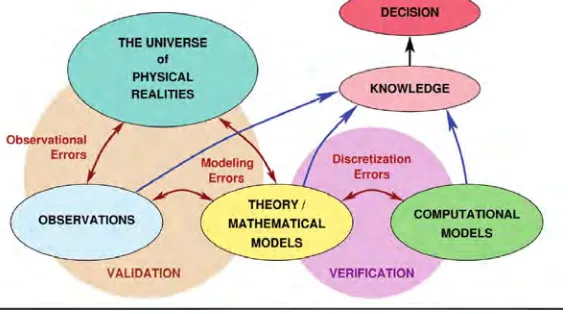
perspec-tive of the intended uses of the model. Validation provides evidence that the correct model is solved. It is essentially a physics issue. V&V procedures are the tools with which we build confidence and credibility in numerical predictions resulting from modeling and computational simulations. Figure 1 shows role of
verification and validation in modeling and simulating real world NPPSSSs. It is very important to note that
Figure 1: Schematic representation of role of verification and validation in relation to the real behavior and
decision making process (after Oden et al. (2010a,b)).
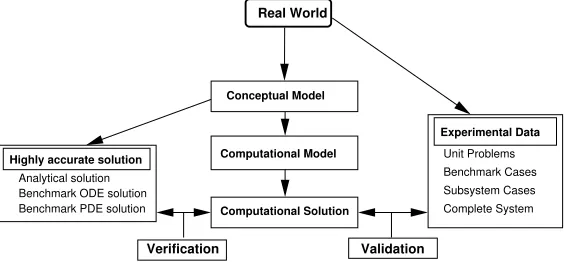
a tight coupling exists between each of the phases of modeling and simulation process shown in Figure 1. Figure 2 shows a more detailed view of relationship of verification and validation to the developed
compu-tational solution. It is also important to note that verification procedures include software quality assurance practices, which are based on an extensive (fully and semi–) automatic test suite (eg. regression testing, white and gray box testing, static and dynamic testing, etc.).
The main motivation for performing verification stems from the simple question: “how much can you trust model implementations?” Validation, on the other hand can be motivated by the question: “how much
can your trust numerical simulations?” Both questions can be summarized by the question: “how good are our numerical predictions in simulating dynamic behavior of soil/rock-structure NPPs?”. The NRC ESSI Simulator system will feature an extensive set, currently under development, of Verification and Validation
Real World
Benchmark PDE solution Benchmark ODE solution Analytical solution
Complete System Subsystem Cases Benchmark Cases Unit Problems Highly accurate solution
Experimental Data Conceptual Model
Computational Model
Computational Solution
Validation Verification
Figure 2: Schematic representation of relationship between verification and validation (based on Oberkampf et al. (2002)).
ACKNOWLEDGMENT
Work presented here was funded in part by the U.S.-NRC. Such support is much appreciated.
References
Babuˇska, I. and J. T. Oden (2004, Sept). Verification and validation in computational engineering and science: basic concepts.Computer Methods in Applied Mechanics and Engineering 193(36-38), 4057–4066.
Bielak, J., K. Loukakis, Y. Hisada, and C. Yoshimura (2003). Domain reduction method for three–dimensional earth-quake modeling in localized regions. part I: Theory. Bulletin of the Seismological Society of America 93(2), 817– 824.
Cunningham, H. G. (1994). Wikiwikiweb, a web–system for web pages that anyone can edit. http://http://c2.
com/cgi/wiki?WikiWikiWeb/.
Free Software Foundation, Inc. (2007, 29th. June). Gnu lesser general public license, ver. 3. published online: http://www.gnu.org/copyleft/lesser.html.
Jeremi´c, B. and G. Jie (2007). Plastic domain decomposition method for parallel elastic–plastic finite element compu-tations in gomechanics. Technical Report UCD–CompGeoMech–03–07, University of California, Davis. available
online:http://sokocalo.engr.ucdavis.edu/~jeremic/wwwpublications/CV-R24.pdf.
Jeremi´c, B. and G. Jie (2008). Parallel soil–foundation–structure computations. In N. L. M. Papadrakakis, D.C. Charmpis and Y. Tsompanakis (Eds.),Progress in Computational Dynamics and Earthquake Engineering. Taylor and Francis Publishers.
Jeremi´c, B., G. Jie, M. Preisig, and N. Tafazzoli (2009). Time domain simulation of soil–foundation–structure inter-action in non–uniform soils.Earthquake Engineering and Structural Dynamics 38(5), 699–718.
Jeremi´c, B., Z. Yang, Z. Cheng, G. Jie, K. Sett, M. Taiebat, M. Preisig, N. Tafazzoli, and P. Tasiopoulou (1989– 2011). Lecture notes on computational geomechanics: Inelastic finite elements for pressure sensitive materials.
Technical Report UCD-CompGeoMech–01–2004, University of California, Davis. available online at: http:
//sokocalo.engr.ucdavis.edu/~jeremic.
Oberkampf, W. L., T. G. Trucano, and C. Hirsch (2002, October 22-23). Verification, validation and predictive capabil-ity in computational engineering and physics. InProceedings of the Foundations for Verification and Validation on the 21st Century Workshop, Laurel, Maryland, pp. 1–74. Johns Hopkins University / Applied Physics Laboratory.
Oden, J. T., I. Babuˇska, F. Nobile, Y. Feng, and R. Tempone (2005, February). Theory and methodology for estimation and control of errors due to modeling, approximation, and uncertainty. Computer Methods in Applied Mechanics and Engineering 194(2-5), 195–204.
Oden, T., R. Moser, and O. Ghattas (2010a, November). Computer predictions with quantified uncertainty, part i.
SIAM News, 43(9).
Oden, T., R. Moser, and O. Ghattas (2010b, December). Computer predictions with quantified uncertainty, part ii.
SIAM News, 43(10).
Ridge, D., D. J. Becker, P. Merkey, and T. Sterling (1997). BEOWULF: Harnesing the power of parallelism in a
Pile–of–PCs. InProceedings, IEEE Aerospace.http://cesdis.gsfc.nasa.gov/beowulf/papers.html
Roache, P. J. (1998). Verif ication and Validation in Computational Science and Engineering. Albuquerque, New Mexico: Hermosa Publishers. ISBN 0-913478-08-3.
Sterling, T., D. J. Becker, D. Savarese, J. E. Dorband, U. A. Ranawake, and C. V. Parker (1995). BEOWULF: A parallel workstation for scientific computations. InProceedings of the International Conference on Parallel on Parallel Processing.http://cesdis.gsfc.nasa.gov/beowulf/papers.html
Sterling, T., T. Cwik, D. Becker, J. Salmon, M. Warren, and B. Nitzberg (1998). An assessment of Beowulf-class computing for NASA requirements: Initial findings from the first NASA workshop on beowulf-class clustered
computing. InProceedings, IEEE Aerospace.http://www.beowulf.org/papers/index.html