D. C. SHREFFLERl
California Institute of Technology, Pasadena
Received November 18, 1963
WO genetically determined differences in serum pre-albumin components Thave been detected by starch gel electrophoresis. I n swine, two electropho- retically different types have been observed (KRISTJANSSON 1963). I n mice, the presence or absence of a pre-albumin component having esterase activity has been shown to be under genetic control (PETRAS 1963). The present paper documents another inherited difference i n a pre-albumin component of mouse serum, un-
related to that reported by PETRAS. Starch gel electrophoresis reveals that this pre- albumin is present in the sera of some inbred strains of mice, but not of others.
MATERIALS A N D METHODS
Animals: The following inbred strains were employed: A/HeJ, A/J, AKR/J, BALB/cJ, CEA/J, C3H/HeJ, C57BL/6J, C57BL/10J, DBA/1 J, DBA/2J, RF/J, WB/Re, WC/Re.
Serum samples: Blood specimens were obtained from the ventral tail artery. Serum was used fresh, or after storage for up to three years at -20'. Stored sera showed no evident changes in the pre-albumin component.
Starch gel e2ectrophore.k A slight modification of SMITHIES' ( 1955) horizontal method was employed. The pH of the gel buffer was 9.0 instead of 8.6, and its molarity was decreased to approximately 75 percent of that recommended by the manufacturer (Connaught Medical Laboratories, Toronto) for the particular lot of hydrolyzed starch. After electrophoresis the gels were sliced horizontally and stained with Amido Black lOB, or, f o r special studies, with certain specific stains for enzymatic activities (LAWRENCE, MELNICK and WEIMER 1960), or binding properties (GIBLETT, HICKMAN and SMITHIES 1959; BLUMBERG and ROBBINS 1960).
RESULTS
Figure 1 shows the three pre-albumin phenotypes detected on starch gel electro- phoresis with a protein stain. These are designated Pre-a, indicating the presence of the pre-albumin component in greatest concentration, Pre-0, indicating absence of any detectable protein at this position, and Pre-ao, indicating an intermediate concentration of the component. The concentrations of the pre-albumin com- ponent in sera from inbred and hybrid females are consistently lower than
in
sera from the corresponding males. The Pre-ao type of serum from the F, hybrid male is indistinguishable from that of a mixture of equal amounts of sera from males of the two parental strains. The Pre-ao type of the F, hybrid female serum is identical to that of a mixture of sera from females of the parental strains. These
1 Present address: Department of Human Genetics, University of Michigan Medical School, Ann Arbor.
630 D. C. SHREFFLER
1
2
3
4
5
6
FIGURE 1.-Pre-albumin phenotypes. ( 1 ) Female C57BL/lOJ (Pre-o); (2) Female (C57BL/
1OJ X DBA/W)F, (Pre-ao); (3) Female DBA/W (Pre-a); (4) Male C57BL/10J (Pre-0); ( 5 ) Male (C57BL/lOJ x DBA/W)F, (Pre-ao); (6) Male DBA/2J (Pre-a). The Pre-a band is indicated by an arrow where present.
three phenotypes, and only these three, can be discriminated in segregating gener- ations. The phenotypes are usually discrete and repeatable; however, the distinc- tion between Pre-a and Pre-ao is sometimes difficult, and occasionally the Pre-ao type may be misclassified as Pre-0, because the concentration of the Pre com- ponent is too weak to be detected. This is especially true in females. In the genetic studies to be presented, in any instance of doubt a new specimen was taken from the animal in question and tested.
Thirteen inbred strains were surveyed and classified as follows: Pre-a- AKR/J, RALR/cJ, CRA/J, DBA/I J, DRA/2J,
RF/J
and WR/Re; Pre-0-A/HeJ, A/J, C57RL/6J, C57RL/lOJ, C3H/HeJ and WC/Re.TABLE 1
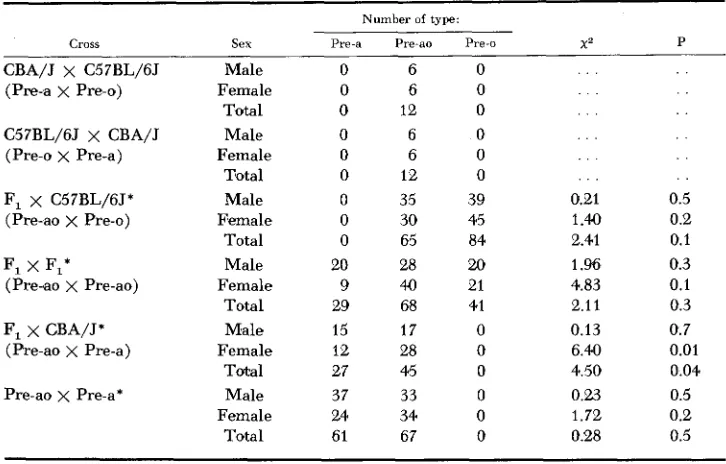
Distribution of pre-albumin phenotypes among F , hybrids and second generation segregants
~~
Number of type
Cross Sex Pre-a Pre-ao Pre-o x 2 P
CBA/J x C57BL/6J
(Pre-a x Pre-o)
C57BL/6J x CBA/J
(Pre-o x Pre-a)
F, x C57BL/6Jt
(Pre-ao x Pre-0)
F, x F,*
(Pre-ao x Pre-ao)
F, x CBA/J* (Re-ao x Pre-a)
Pre-ao x Pre-a*
Male Female Total Male Female Total Male Female Total Male Female Total M'ale Female Total Male Female Total
0 6 0
0 6 0
0 12 0
0 6 0
0 6 0
0 12 0
0 35 39
0 30 45
0 65 84
20 28 20
9 40 21
29 68 41
15 17 0
12 28 0
27 4.5 0
37 33 0
24 34 0
61 67 0
. . .
. . .
0.21 1.40 2.41
1
.w
4.83 2.1 1 0.13 6.40 4.50 0.23 1 . 7 2 0.28 . . . . 0.5 0.2 0.1 0.3 0.1 0.3 0.7 0.01 0.04 0.5 0.2 0.5Reciprocal crosses pooled
were all tested at the same time, and were not identified as to cross m t i l after classification. Consequently, the fact that no unpredicted classifications occurred in any cross is of some significance. However, particularly among females the segregation ratios are rather aberrant. Although the deviation from expected is significant only in the backcross to CBA/J, it is consistently in the same direction. This is presumed to be due to the low concentration of the Pre component among females, resulting i n misclassification of some Pre-a individuals as Pre-ao, and some Pre-ao as Pre-o.
Further data on the inheritance of this trait were obtained from another cross produced by mating noninbred Pre-a animals to C57BL/6J (Pre-o)
,
with the F,off spring then crossed to DBA/BJ (Pre-a)
.
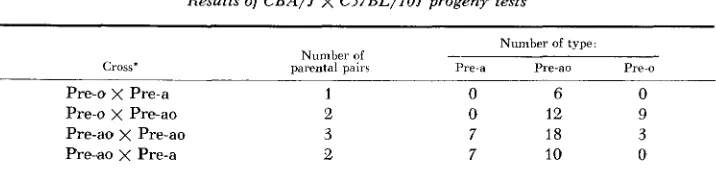
In this study, the progeny were care- fully tested and retested and compared with controls for each sex. These data, presented in the last row of Table 1, fit somewhat better with expectations, al- though an excess of Pre-ao females was again observed.Table 2 contains data on the progeny of matings between selected F, and back- cross offspring from the CBA/J x C57BL/6J crosses. These parental animals were repeatedly tested to establish with certainty the correct classification for each. In each of these progeny tests, all of the expected phenotypes and only the expected phenotypes were observed, confirming the typings of the 16 parental animals.
632 D. C. SHREFFLER
TABLE 2
Results of CBA/J x C57BL/101 progeny tests
Number of type: Number of -
Cross' parental pairs Pre-a Pre-an Pre-o
Pre-a x Pre-a 1 0 6 0
Pre-a
x
Pre-aa 2 0 12 9Pre-ao x Pre-ao 3 7 18 3
Fr*ao x Pre-a 2 7 10 0
* Reciprocal crosses pooled.
inbred strains of the Pre-a phenotype, and Pre", occurring in the Pre-o strains, at a n autosomal locus, Pre, denoting serum pre-albumin type.
Markers in a number of linkage groups were also segregating in the crosses studied. Most of the animals classified for pre-albumin type were also classified for the other traits. The data are summarized in Table 3. In all cases, males and
TABLE 3
Segregation of Pre relatiue to other loci
Cross' Numbers of progeny X Z P
Diffuse H b Single H b Pre-an Pre-u Pre-ao Pre-o
PreO Hbl Preo Hbl
P r B Hbz
x -
Preo Hbl 16 21 14 19 0.01 0.9Trf-ab Trf-b Pre-ao Pre-a Pre-ao Pre-a
x - 24 2,l 24 24 0.10 0.7
Intense Dilute
Preo Trfb Pre" Trfa P r B Trfa Pre" Trfa
Pre-ao Pre-a Prc-ao Pre-a
Preo D Preu d
Pr&d x - Pre'Ld 29 25 19 20 0.23 0.6
Agouti Nom-agouti Pre-an Pre-a Pre-ao Pre-o
Preo a PreO a
Pr@ A
x -
PreO a 13 17 17 23 0.01 0.9Black Brown Pre-ao Pre-a Pre-an Pre-a
PreO B Pre(8b
22 23 26 22 0.26 0.6
K X P X
ss-IlL ss-I,
PI-e-a0 Pre-a Pre-an Pre-a
17 6 22 16 1.58 0.2
Es Type 1-11 Es l y p e I
Pre-ao Pre-o Pre-ao Pre-o
PreO Esl PreO Esl
Pr@ E S ~ X- PreO E S ~ 18 17 22 22 0.02 0.8
females from reciprocal crosses were analyzed separately, but no differences were noted, so the data have been pooled to conserve space. The data indicate that the Pre locus is not closely linked to H b (linkage group I), Trf (11) (SHREFFLER 1963), a (V)
,
b (VIII), orSs
(IX) ( SHREFFLER and OWEN 1963), or to the Eslocus (POPP 19S2) which has not yet been assigned to a linkage group.
Nothing positive is yet known about physiological function of the Pre com- ponent. It has no esterase, oxidase, acid or alkaline phosphatase or leucyl-amino- peptidase activity detectable by specific stains of the starch gels. T h e lack of esterase activity of the Pre component, as well as a difference in distribution among inbred strains, excludes any direct relationship between the Pre variant and the pre-albumin esterase variant reported by PETRAS ( 1963). Autoradiogra- phy revealed no iron-binding, tested by addition of Fej9C1, to the serum, and no thyroxine-binding, tested with 1131-thyr~xine. The latter was tested because it has been shown that in some species a thyroxine-binding globulin is present in the serum which migrates as a pre-albumin on starch gel electrophoresis (BLUMBERG and ROBBINS 1960). The protein has no lipid content detectable by staining with Sudan Black. Because it is such a minor component, it has not thus far been pos- sible to detect the component by two-dimensional starch gel-paper electrophoresis, or by immunoelectrophoresis.
DISCUSSION
Owing to the difficulties in classification, the evidence presented for genetic con- trol by a pair of alleles at a single autosomal locus is not as conclusive as might be desired. The deviations in the data could reflect a selective advantage of the Pre-ao and perhaps the Pre-o types, but are probably due to a few misclassifica- tions of female progeny. The results of the progeny tests indicate that dependable classification can be achieved, however.
The precise nature of the difference between the Pre-a and Pre-o types is un- known. The Pre-o serum may contain a homologous protein of lower mobility which is buried beneath the major pre-albumin, or the albumin, or it may com- pletely lack the protein. The trait may not be particularly useful for genetic or biochemical studies with the present starch gel technique for detection and classi- fication. A more sensitive method would be desirable. Attempts to characterize the protein further are continuing, and a n effort to develop an immunoelectro- phoretic method for classification is in progress.
This work was supported in part by Public Health Service Grant %86-C2 and in part by
U. S. Atomic Energy Commission Contract A T ( 0 4 4 - 4 1 . A few of the studies reported here were done at the Department of Human Genetics, University of Michigan Medical School, supported by U. S. Atomic Energy Commission Contract AT(IlI-I)-M5. Personal support to the author from three National Science Foundation predoctoral fellowships is gratefully acknowl- edged. The 1131-thyroxine for autoradiography was generously provided by DR. E. A. CARR, JR. d the University of Michigan Medical Schwl. The advice, interest, and criticism d PROFESSOR
634 D. C . S H R E F F L E R
S U M M A R Y
A difference among inbred strains of mice in the presence or absence of a minor serum pre-albumin component has been detected by starch gel electrophoresis. Genetic studies indicate that the difference is determined by an autosomal locus, Pre, with a pair of alleles, Prea and PreO, controlling respectively the presence or apparent absence of the component. The Pre locus does not appear to be in link- age groups I, 11, V, VIII, or IX.
L I T E R A T U R E C I T E D BLUMBERG, B. S., and J. ROBBINS, 1960
GIBLEIT, E. R., C. G. HICKMAN, and 0. SMITHIES, 1959 KRISTJANSSON, F. K., 1963
LAWRENCE, S. H., P. J. MFLNICK, and H. E. WEIMER. 1960
Thyroxine-serum protein complexes: Single dimension
Serum transferrins. Nature 197: 705.
Genetic control of two pre-albumins in pigs. Genetics 48: 1059-1063.
A species comparison of serum proteins and enzymes by starch gel electrophoresis. Proc. Soc. Expl. Biol. Med. 105: 5 72-5 75.
Natl. Acad. Sci. U.S. 50: 112-116.
gel and paper electrophoresis studies. Endocrinology 67 : 368-378.
PETRAS, M. L., 1963
POPP, R. A., and D. M. POPP, '1962
SHREFFLER, D. C., 1W3
SHREPFLER, D. C., and R. D. OWEN, 1963
SMITHIES, O., 1955
Genetic control of a serum esterase component in M u s musculus. Proc.
Inheritance of serum esterases having different electro- phoretic patterns. J. Heredity 53: 11 1-1 14.
Linkage of the mouse transferrin locus. J. Heredity 54: 127-129. A serologically detected variant in mouse serum:
Zone electrophoresis in starch gels: Group variations in the serum proteins Inheritance and association with the histocompatibility-2 locus. Genetics 48 : 9-25.