DNA FROM
NLAIZE
WITH AND WITHOUT B CHROMOSOMES: A COMPARATIVE STUDYMARY-DELL CHILTON AND BRIAN J. McCARTHY*
Departments of Microbiology and Genetics, University of Washington, Seattle, Washington 98195
Manuscript received March 19, 1973 Transmitted by DAVID SCHLESSINGER
ABSTRACT
DNA preparations from 5B and OB maize seedlings are indistinguishable in their buoyant density distribution in CsCl gradients. Their renaturation kinetics are identical a t several stringency criteria. DNA competition studies fail to detect any component in 5B DNA redundant sequences which is lack- ing in OB DNA. Homologous and heterologous duplexes formed between 5B and OB DNA have virtually identical melting profiles. The DNA of B chromo- somes is concluded to be very closely related to that of A chromosomes.
I N
addition to the twenty standard or A chromosomes present in diploid maize nuclei, various numbers of supernumary heterochromatic B chromosomes oc- cur in many strains(RANDOLPH
1941). The appearance of the plant is not visibly affected by the presence of as many as ten B chromosomes, although higher num- bers result in decreased fertility and vigor, increased cell size and abnormal seed development (RANDOLPH 1941). The anomolous male transmission of B chromo- somes has been ascribed to mitotic nondisjunction in the second microspore divi- sion (ROMAN 1947).A dramatic difference was reported in the base composition of seed DNA from 4B and
OB
strains (VAN SHAIK andPITOUT
1966), but this was not confirmed by later investigations ofthe
buoyant density and base composition of leaf DNA (RINEHART and SANSING 1966;PITOUT
and VAN SCHAIK 1968), which showedno measurable differences in either parameter. By contrast, the DNA of two separate B-chromosome-containing populations of grasshoppers, Myrmeleotettix maculatus, has been found to contain a substantial fraction of low GC satellite not present in non-B-containing populations (GIBSON and HEWITT 1970). This satellite apparently differs among populations of grasshoppers and is not homolo- gous to main band DNA (GIBSON and HEWITT 1972).
The failure of B chromosome DNA in maize to appear obviously foreign by base compositional criteria leaves open the question of its genetic origin. The present investigation was undertaken in the hope that a detailed comparison of DNA bouyant density distribution, DNA renaturation kinetics and DNA/DNA duplexes formed between 5B and OB maize DNA’s might reveal small differences
* Present addiess: Department of Biochemistry, University of California, School of Medicine, San Francisco, California 94122.
which earlier investigations had failed to detect. Such differences might be ex- ploited to separate o r enrich for B chromosome DNA, which could then be char- acterized by hybridization to various potentially related plant DNA’s.
MATERIALS A N D METHODS
Seed stocks: Plants used in these experiments were grown from 5B and OB maize seeds generously provided by DR. J. KERMICLE, Department of Genetics, University of Wisconsin. Seeds were of inbred W22 substrains with and without B chromosomes of Black Mexican sugary origin. B chromosomes were introduced into W22 by backcrossing repeatedly. DR. KERMICLE determined the number of B chromosomes in the parent plant which was self-pollinated to pro- duce our seed stock. I n addition, MR. JAMES NISHITANI, Department of Botany, University of Washington, confirmed the average number of B chromosomes (and their absence in the non-B- containing plants) by cytological examination of squashes of microsporocytes at the pachytene stage. This additional check on the seed stocks was performed because of the negative results of attempts to detect DNA differences, described below.
Growth of plants and labeling of D N A : Seeds were surface-sterilized by soaking for t w o minutes in 1’% sodium hypochlorite solution. They were transferred to sterile petri dishes con- taining dampened filter paper and 2 m l of 10% Captan suspension, a garden fungicide. The Captan suspension was sterilized by exposure to germicidal UV light with shaking.
Seeds which germinated were transferred to sterile beakers. Those to be labeled (batches of 18 plants) were given 500 pC H3 thymidine or 5 mC P32 (neutralized with sterile tris buffer) in
a minimal volume of water for 6-9 days. Unlabeled plants were grown on dampened sterile perlite.
The specific activity of H3 DNA isolated was 7500-8800 cpm/pg; that of P32 DNA was 1700
cpm/pg. Batches of 18-20 plants typically yielded 50-15Opg of DNA when harvested 14 days after sowing. In preparative CsCl gradients containing 20 pg of labeled DNA, the radioactivity was found to track with the OD,,, profile, indicating that the radioactive precursor was incorpo. rated into plant DNA, not that of contaminating bacteria (BENDICH 1972).
D N A isolation: Batches of 15-30 plants were cut up (discarding seeds) and frozen at -80°C i n a Revco freezer. A 4-6” mortar with pestle was precooled to -80°C and used to reduce the frozen plant material to fine powder (about 5 minutes of grinding). The powder was shaken into a beaker containing 10 ml redistilled phenol (equilibrated with water and adjusted to p H 7.8 with NaOH solution) and 10 ml of 0.15 M NaC1,O.l M EDTA, p H 8,1% sodium dodecyl sulfate. This mixture was allowed to warm to room temperature with stirring and was stirred for 10 minutes longer. The aqueous phase was separated by centrifugation and DNA was wound out after addition of 2 volumes of ethanol. The DNA was redissolved in 3 ml of 0.1 X SSC (SSC is 0.15 M NaC1, 0.015 M sodium citrate) and dialyzed against 0.1 x SSC to remove phenol. The solution was adjusted to 1 x SSC, treated with RNase as described by MARMUR (1961), phenol extracted, and the DNA was wound out once more. After one further phenol extraction and winding out, the DNA solution (1 ml) was dialyzed exhaustively against 0.1
x
SSC to remove phenol and the solution was stored in a deep freeze.CsCl density gradient centrifugation: The DNA solution was diluted to 4.00 ml with 0.1 X SSC, and to it was added 5.1 g. CsCl (Optical Grade Powder, Harshaw Chemical Company). The solution was placed i n a cellulose nitrate centrifuge tube which fits the Spinco 40 rotor. Heavy mineral oil was introduced through the screw hole until the tube was filled. The sealed tube was centrifuged in a 4 0 rotor for S 7 2 hours at 20°C. Fractions were collected from the bottom of the gradient after piercing with a syringe needle.
$B A N D OB M A I Z E D N A 607
be uniform, and small circles punched from the big filter gave reproducible hybridization results. The estimate of DNA bound per little filter is based on the assumption that all the applied DNA binds under these conditions.
Filter hybridization reactions were performed as previously described ( MCCONAUGHY and
MCCARTHY 1968).
DNA renaturation and melting curve determinatiom DNA renaturation reactions were per- formed in various mixtures of formamide and 4
x
SSC at 37°C. By varying the concentration of formamide, the renaturation conditions can be made to mimic the stringency of any desired higher temperature aqueous reaction conditions (MCCONAUGHY, LAIRD and MCCARTHY 1969). When a very small volume of reaction mixture was prepared, e.g. in the experiment described in Figure 5 below, the formamide was weighed out to increase the accuracy of composition of the reaction mixture. When small volumes of solutions were to be incubated for long times, aliquots were sealed i n disposable 10 or U) pl pipets before denaturation and incubation.Duplex formation was followed by the hydroxylapatite assay as previously described (GROUSE, CHILTON and MCCARTHY 1972). Two kinds of hydroxylapatite were used in the course of this investigation, Biorad HTP and Clarksen, the latter of which gave better column flow rate but several degrees higher T m values in melting curves (cf. Figures 4 and 5 ) .
RESULTS
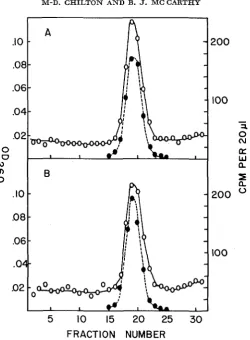
Buoyant density studies: Examination of the buoyant density of
5B
andOB
DNA (three different preparations of each) in analytical CsCl gradients usingMyxococcus xanthus DNA as density marker ( p = 1.728) failed to reveal any reproducible differences in density distribution, confirming the findings of RINE-
HART and SANSING (1966). The density distributions were further analyzed by
preparative CsCl gradient analysis of mixtures of 25 pg unlabeled OB with 1 pg
H3
5B
(Figure IA) and 25 pg unlabeled5B
with 1 pgH3
OB
DNA (FigureIB).
In the former, the radioactivity tracks perfectly with theOD,,,
profile; in the latter, the slight shift of radioactivity toward higher density is not significant be- cause the radioactivity in this preparation appeared at a slightly greater density than its own OD,,, in a control gradient (not shown). Such slight disparities in plant DNA preparations may be due to variable incorporation of label into chloro- plast or mitochondrial DNA.DNA filter competition studies: Several attempts were made to detect filter- bound DNA duplexes formed with
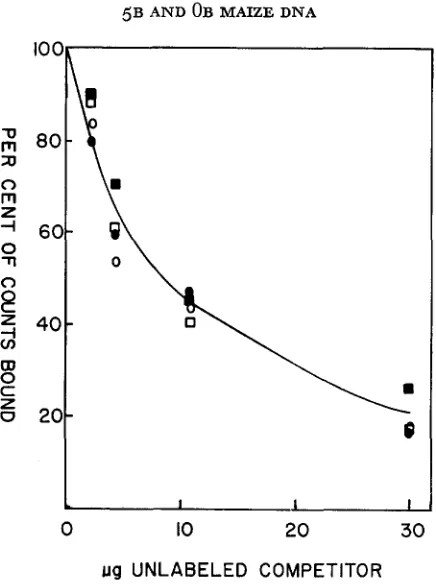
5B
DNA which could not be competed byOB
DNA. Under filter-bound DNA reaction conditions, only the redundant portionof the genome is able to react; isolated unique sequences of labeled mouse DNA do not give measurable reaction with mouse DNA filters over a period of six days. Thus this experiment asks specifically whether any unusual component is con- tributed by
5B
DNA to the redundant sequences of the plant.2 0 0
100
-
a0 (U
e
Wn 0
0
N
m
0
2 0 0
100
5 IO 15 20 25 30 FRACTION NUMBER
FIGURE 1.-Comparison of distribution of 5B and OB maize DNA in CsCl equilibrium density gradients. A mixture of 25 p g unlabeled and 1 pg labeled DNA was centrifuged to equilibrium in CsCl as described in the text. In separate gradients of the labeled DNA's alone (not shown), radioactivity was measured throughout the gradient and all TCA insoluble radioactivity was found in a single symmetrical band which tracked with the OD,,, of the sample.
A:
B :
0 = OD,,, of the fraction to which 0.1 ml H,O was added
= cpm per 20 p l of the diluted fraction, as measured by TCA precipitation.
H3 5B plus unlabeled OB DNA H3 OB plus unlabeled 5B DNA
D N A renaturation kinetics: The renaturation kinetics of OB and
5B
DNA as measured by the hydroxylapatite assay were indistinguishable over the range studied for three different DNA renaturation conditions in formamide, corre- spondingtolow (60°C, 1 X SSC), intermediate (75"C, 1 x SSC) andhigh (84"C,1 x SSC) stringency. Renaturation kinetics displayed as
BRITTEN
and KOHNE'S(1968) Cot plot are shown in Figure 3 .
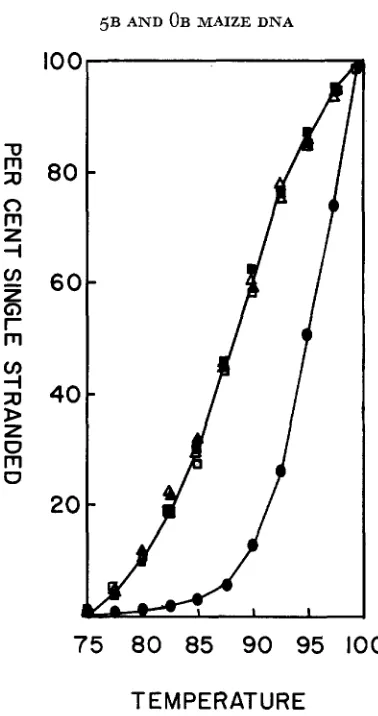
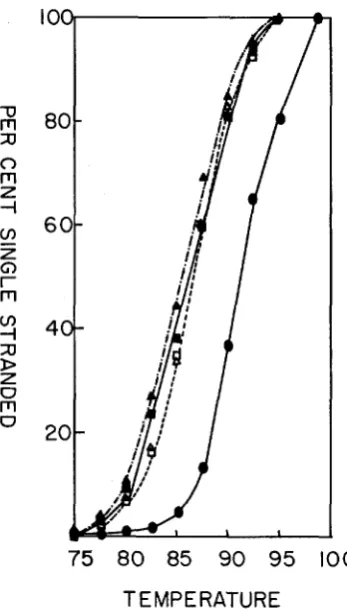
Melting of homologous and heterologous duplexes: Thermal dissociation pro- files were measured for duplexes made from the four possible combinations of
5 B A N D OB M A I Z E D N A 609
0 IO 20 30
ug UNLABELED COMPETITOR
FIGURE 2.-Competition curves for homologous and heterologous filter duplexes us. 5B and
OB DNA. Filters containing 3 pg unlabeled DNA and 5B maize were incubated with 0.4 pg labeled DNA which was a 1 :1 mixture of H3 OB DNA and P32 5B DNA. Various concentrations
of competing 5B o r OB unlabeled DNA were included in the incubation mixture, 0.21 ml total volume, 28.6% formamide, 2
x
SSC. Filters were incubated at 46°C for 48 hours. These reaction conditions are calculated to be similar in stringency to 60"C, 2 x SSC. At zero competitor, 9.2%of the P32 DNA bound while 17.4% of the H3 DNA bound. The preferential binding of OB DNA
in this experiment was not reproducible; when H3 OB and H3 5B DNA were compared, the opposite difference was found.
W P32 5B us. 5B
P325B us. OB 0 H3 OBvs.5B 0 H3 0Bus.OB
Cot
FIGURE 3.-Renaturation kinetics of 5B and OB maize DNA. Renaturation kinetics were followed by the hydroxylapatite assay. Labeled DNA was degraded to low molecular weight by 33 minute depurination (GROUSE, CHILTON and MCCARTHY 1972). Reaction mixtures were all incubated at 37°C following denaturation of the DNA sample at 100°C. The three reaction mixtures were calculated to mimic in stringency 60", 75" and 84°C in 1 x SSC, respectively.
E OB, 44.5% formamide, 4 x SSC.
0 5B, 44.5% formamide, 4 x SSC.
A OB,
64% formamide, 4x
SSC. A 5B, 64% formamide, 4x
SSC. OB, 78% formamide, 4 x SSC.0
5B, 78% formamide, 4 x SSC.at the longer incubation time. In a duplicate experiment (not shown), four Cot =
1 samples were prepared and radioactivity and OD,,, melting profiles were measured. In all cases, the radioactivity and OD,,, gave identical results. This substantiates that the label of the DNA samples is largely in nuclear maize DNA and yields results representative of the total genome, not plasmid DNA.
DISCUSSION
The results of several types of analysis of native and homologous and heterolo- gous renatured duplexes of
5B
andOB
maize DNA fail to reveal convincing differ- ences ascribable to the presence of foreign DNA sequences inB
chromosomes. In5B A N D OB MAIZE D N A 61 1
100
-U
80
0
m
z
--I
60
2
r
0m
v)
D
z
0m
0
40
20
7 5
80
85
90
95
100
T
EM
PER AT
U
R
E
FIGURE 4.-Thermal dissociation profiles of homologous and heterologous duplexes formed a t low Cot. Mixtures of 40 pg unlabeled plus 0.2 fig labeled 33-minute depurinated DNA in 2 m l of
641% formamide, 4
x
SSC were denatured 2nd incubated at 37°C for 4 hrs 38 min. (Cot = 1 ) . The samples were about 66% duplex by hydroxylapatite assay. Samples were allowed to adsorb to hydroxylapatite columns at 60°C in 0.12 M phosphate buffer (BRITTEN and KOHNE 1968) and were eluted with the same buffer at increasing temperatures. Radioactivity was measured in the effluent by TCA precipitation.H3 5B
+
unlabeled 5BA
H3 5B+
unlabeled OB0 H3 OB
+
unlabeled 5BA H3 OB
,+
unlabeled OB native 5B (standard)gated: buoyant density in CsCl, general renaturation kinetics, or melting behavior
of renatured duplexes formed at low and high Cot.
Although B chromosomes contribute a considerable fraction of DNA to the 5B
nucleus, their influence on the Cot curve would be difficult to detect unless B-DNA were very unusual (e.g., all redundant or all unique). The influence of added
B
75
80 85
9095
100TEMPERATURE
FIGURE 5.-Thermal dissociation profiles of homologous and heterologous duplexes formed at high Cot. Mixtures of 100 pg unlabeled plus 0.5 #g labeled 33-minute depurinated DNA in 0.05 m l of 64% formamide, 4
x
SSC, were denatured and incubated a t 37°C for 1 7 days (Cot =8900). The samples were 97% duplex by hydroxylapatite assay. Samples were allowed to adsorb to hydroxylapatite columns at 60°C in 0.12 M phosphate buffer and were eluted with the same buffer at increasing temperatures. Radioactivity was measured i n the effluent by TCA precipi- tation.
II H3 5B
f
unlabeled 5BA
H3 5B f unlabeled OB0 H3 OB f unlabeled 5B A H3 OB f unlabeled OB
Native 5B DNA (standard)
for 5B DNA the changes produced would be small. Two kinds of change are expected: an increase in the observed Cot,/, of the A-DNA sequences because they are diluted with B-DNA, and the appearance of a faster-renaturing component due to the multiple copies of B-DNA. The expected increase in Cots of A unique sequences in 5B DNA is 1.25-fold, because per mg of DNA, 5B has only 80%
5 B AND OB MAIZE D N A 613
5B nucleus would contain five copies of B-DNA for every two copies of A-DNA, an enrichment of 2.5-fold for 22% of the DNA.
If
instead the 5B chromosomes are assumed identical to one pair of A chromosomes, an enrichment of 3.5-fold for about 30% of the DNA is produced. The presence of a 22-30% component of the unique sequences renaturing 2.5-3.5 times faster than the remainder would be extremely difficult to detect. The sensitivity of the measurements is limited because only a minority of the DNA renatures as unique sequences, even under very stringent conditions of renaturation. Detection of these alterations in the Cot curve should be feasible if DNA from strains with much higher numbers ofB
chromosomes were studied. The percentage of faster renaturing material would be increased and in addition there would be an increase in the factor by which its Cot ‘/z changes from that ofA
chromosome unique sequences. Materials were not available to us to exploit this approach.Although the experiments described in this paper failed to detect any definite differences between OB and 5B DNA, some inference can be drawn concerning the relatedness of B chromosome DNA to A chromosome DNA. The renaturation kinetics (Figure 3 ) show that B-specific DNA contains mostly redundant sequen- ces, since no increase in the proportion of unique sequences is observed in 5B DNA compared to OB DNA. The redundant B-specific sequences must be able to cross-react completely with A-specific redundant sequences, as shown by the competition curves of Figure 2. However, no lower melting component is detect- able in heterologous renatured redundant duplexes (Figure 4). The redundant sequences of B and A chromosomes therefore must cross react and appear indis- tinguishable. This finding is difficult to evaluate at present, for very few data are available concerning the relatedness of redundant DNA’s of plants. Comparison of barley, rye, oats and wheat DNA (BENDICH and MCCARTHY 1970) show in general a A Tm of 3-7” for heteroduplexes compared to homoduplexes. We can conclude that the B chromosomes of maize bear a closer evolutionary relation- ship to A chromosomes than do these monocots to one another. Exactly how close the relationship is can only be evaluated by a systematic study of the Tm of redundant heteroduplexes formed from maize DNA and the DNA from a series of closely related plants.
The authors thank DR. HERSCHEL ROMAN, DR. JERRY KERMICLE and DR. CHARLES LAIRD for contributing to this work through rewarding discussions. W e are very much indebted to MR.
JAMES NISHITANI for determining chromosome numbers in our plants, and to DR. JERRY
KERMICLE for generous contribution of seeds.
This research was supported by N.S.F. Research Grant GB-6099.
LITERATURE CITED
AYONOADU, U. W. and H . REES, 1971
BENDICH, A. J., 1972
BENDICH, A. J. and B. J. MCCARTHY, 1970
The effect of B chromosomes on the nuclear phenotype in
Effects of contaminating bacteria on the radiolabeling of nucleic acids
DNA comparisons among barley, oats, rye and wheat. root meristems of maize. Heredity 27: 365-383.
from seedlings: False DNA “satellites.” Biochim. Biophys. Acta 272: 494-503.
BRITTEN, R. J. and D. E. KOHNE, 1968 DENHARDT, D. T., 1966
GIBSON, I. and G. HEWITT, 1970
Repeated sequences in DNA. Science 161: 529-540. A membrane filter technique f o r detection of complementary DNA. Biochem. Biophys. Res. Commun. 23: 641-646.
Isolation of DNA from B chromosomes in grasshoppers. Nature
225: 67-68. -, 1972 Interpopulation variation in the satellite DNA from grass- hoppers with B chromosomes. Chromosoma 38: 121-138.
GROUSE, L., M.-D. CHILTON and B. J. MCCARTHY, 1972 Hybridization of ribonucleic acid with unique sequences of mouse deoxyribonucleic acid. Biochemistry 11 : 798-805.
MARMUR, J., 1961 A procedure for the isolation of DNA from microorganisms. J. Mol. Biol. 3:
208-218.
MCCONAUGHY, B. L., C. D. LAIRD and B. J. MCCARTHY, 1969 Nucleic acid reassociation in formamide. Biochemistry 8 : 32893295,
MCCONAUGHY, B. L. and B. J. MCCARTHY, 1968 Related base sequences in DNA of simple and complex organisms. I. DNA/DNA duplex formation and the incidence of partially related base sequences in DNA. Biochem. Genetics 2: 37-53.
Deoxyribonucleic acid from black Mexican sweet corn. South African Journal of Science 64: 25-29.
Genetic characteristics of the B chromosomes in maize. Genetics 26:
Unpublished results cited in PITOUT and VAN SCHAIK, 1968. Mitotic nondisjunction in the case of interchanges involving B-type chro-
Base composition of DNA from maize with hetero- PITOUT, M. J. and VAN SCHAIR, 1968
RANDOLPH, L. F., 1941
RINEHART, K. and N. SANSING, 1966 ROMAN, H. L., 1947
VAN SCHAIK, N. and M. J. PITOUT, 1966 608-631.
mosomes in maize. Genetics 32: 391-409.