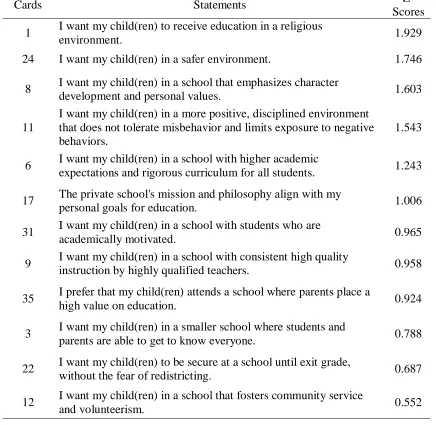
The availability of school choice options has increased the schools’ accountability to both parents and students. This study’s purpose was to gain a deeper understanding of the subjectivity of the school choice decision process that private school parents undergo. Q methodology was utilized to explore this decision process. Research literature was reviewed and led to the development of statements addressing influential factors on school choice decisions. These statements were printed, and thirty-five private school parents sorted these statements based on the factors’ influence on their school choice decision. Post-sort
interviews further explored the subjectivity of the decision process. The Q sorts were factor analyzed to determine the statistical correlations between the statements. Three emerging factors surfaced as distinct preferred school environments by private school parents. Data analysis explored these factors and a name for each factor was assigned based on the
strongest influential statements. These three factors included a Developing the Whole Child Environment, a Strong, Academic Environment, and a Safe Environment with Like Peers. Findings presented numerous factors that influence school choice decisions. Data also provided information regarding perceived strengths and weaknesses of both public schools and private schools. The findings directed implications for both public and private school administrators and policymakers. These implications can help drive school reform
by
Tara Wooten Parker
A dissertation submitted to the Graduate Faculty of North Carolina State University
in partial fulfillment of the requirements for the degree of
Doctor of Education
Educational Administration and Supervision
Raleigh, North Carolina 2015
APPROVED BY:
_______________________________ _______________________________
Dr. Matt Militello Dr. Kevin Brady
Committee Chair Committee Vice-Chair
_______________________________ _______________________________
DEDICATION
BIOGRAPHY
Tara Parker is a native of Greenville, North Carolina. She was the youngest of three children born to Dan and Phyllis Wooten. Tara graduated from J.H. Rose High School, and attended East Carolina University for her undergraduate degree. In 1999, Tara graduated Magna Cum Laude from East Carolina University with a degree in Exercise and Sports Science and a Concentration in General Science. She also completed the requirements to become a Certified Athletic Trainer. Although Tara never intended on a career in education, professional opportunities guided her into the public school sector.
ACKNOWLEDGMENTS
Thank you to my professors at North Carolina State University for challenging me to break away from my comfort zone. With my three previous degrees, I remained in this comfort zone by attending the same university. By giving me the opportunity to attend North Carolina State University, you helped challenge my perceptions of education and develop a much broader base of understanding.
Dr. Militello was my assigned advisor when I entered the program. I had no idea how much that random assignment would impact my personal and professional growth. Thank you for introducing me to Q methodology. I gained an appreciation for the subjectivity of decisions, and I truly feel that the combination of quantitative and qualitative data helped me understand the depth of that subjectivity. Thank you for making the dissertation process manageable. I had no doubt I could achieve my goal once I started working with you. Even though you are always traveling, you were never too busy to help me. You have truly been a great mentor!
Dr. Brady, your support and reassurance over the past three years have been
instrumental in my personal and professional development. You were quick to challenge my limited educational experience, but you did so in a respectful manner. You are the one that truly opened my eyes to school choice options and made me realize that the educational world is so much larger than I knew. Although I have not taken your advice to enter the world of academia, I hope that you realize that you have made a lasting impression on me.
before. You helped me remove the blinders, and I now see that every district has their own political challenges. Our discussions have made me a much stronger administrator.
Dr. Hicks, your support and guidance truly helped me embrace all aspects of school leadership. Our discussions helped me develop the ability to choose which battles to fight. I have also strengthened my ability to accept others for their strengths and support their
weaknesses. I appreciate your willingness to listen and provide perspective on the challenges that I faced. I have experienced the best administrative preparation possible with your
support.
Throughout the past three years, I encountered many students that helped challenge me along the way. I appreciate all of your support and guidance. To my partner in crime throughout my coursework, Francemise Kingsbury, you have provided more support and motivation than you could realize. I wish you the best in your own dissertation process and your career.
For this research study, I asked 35 participants to provide time and honest feedback regarding their school choice decision. Without these participants, this study would not have been possible. I appreciate all of your time and willingness to help me through this process. You provided great insight and a few laughs as you reflected back on your school choice decision.
pursuing my degree. Also, to my Delta Chapter family, I greatly appreciate your support and encouragement along the way.
I have many colleagues that have helped me along the way. To my Pitt County Schools family, thank you for allowing me the opportunity and flexibility to complete this milestone in my life. David Jenkins, thank you for agreeing to be my internship supervisor and providing guidance and support over the past three years. To the Health Sciences Academy staff, Tammy, Casey, and Jan, I greatly appreciate all of your support and
willingness to make this possible. There were many mornings where I am sure you could tell I had only slept for a few hours, but you never mentioned how tired I must have looked.
My dad, Dan Wooten, who passed away when I was ten years old. Even though you are not here, you are still a tremendous source of inspiration for me.
My mom, Phyllis Wooten, for her unwavering support of my educational, personal, and professional growth. As I grew up, you instilled that I could do anything I wanted. During the past three years, you have continuously helped us with the kids’ schedules and making sure that I was able to juggle having a career, being a mom, and being a full time student. You have always been there to support my endeavors, and I love you for that. I am sure that you are tired of reading rough drafts. Congratulations, the rough drafts are done!
done. I could not have excelled without your support. My diploma will not only represent my accomplishments, but also your commitment to help me reach this goal.
My children, Lee, Danielle, and Lauren, who have cheered for me throughout this entire process. You knew that mom was going to miss games, performances, and other events; however, you never complained. I love all of you more than you can imagine. I hope that my accomplishment will show you that you can accomplish anything you desire.
TABLE OF CONTENTS
LIST OF TABLES……….... xiv
LIST OF FIGURES………. ... xvii
CHAPTER 1: INTRODUCTION……….……… 1
Background of the Study………. 1
Statement of the Problem……… 4
Purpose of the Study………... 8
Research Questions………. 8
Definition of Terms………. 8
School Choice……… 8
Private School……… 9
Public School………. 10
Significance of the Study……… 10
Significance for Public School Administrators………. 11
Significance for Private School Administrators……….... 11
Significance for Policymakers………... 12
Overview of Methodology……….. 12
Conceptual Framework………... 14
Classical Decision Theory………. 14
Rational Choice Theory………. 15
School Choice Decision Conceptual Framework……….. 18
Organization of the Study………... 19
Chapter Summary……… 21
CHAPTER 2: LITERATURE REVIEW………. 22
Introduction………. 22
The Role of Education……… 23
Public Schools: Developing an Education for All……….. 24
Public Schools: Perceptions of Strengths and Weaknesses……… 26
Private Schools……… 32
Private Schools: Perceptions of Strengths and Weaknesses………... 36
The Difference Between Public School and Private School………... 38
Comparison of Academic Performance and Educational Attainment……… 39
Comparison of Organizational Structure……… 43
Comparison of Demographics……… 45
Public vs. Private: Which School Sector is Better? ………... 46
School Choice………. 49
School Choice: Benefits and Concerns………... 51
Choice Process……… 58
Reasons for Selecting Private School………. 60
Demographics of Choosers: Who Chooses Private School……… 69
Research Question 1………...……… 73
Research Question 2………...…… 74
Research Question 3………... 75
Chapter Summary……… 75
CHAPTER 3: METHODOLOGY………... 77
Introduction………. 77
Selecting the Methodology………. 77
Q Methodology………... 77
The Concourse Theory: Development of the Q Sample………. 80
Site Selection……….. 86
Sample Selection………. 88
Data Collection………... 89
Phase I: Quantitative Data Collection………...………. 89
Phase II: Qualitative Data Collection……… 90
Data Analysis……….. 91
Phase I: Quantitative Data Analysis...………...………. 91
Phase II: Qualitative Data Analysis...……… 92
Validity and Reliability………... 94
Subjectivity Statement……… 96
Limitations of the Study………. 99
Chapter Summary……… 101
CHAPTER 4: FINDINGS………..……… 103
Introduction………. 103
Correlation Matrix……….. 104
Factor Analysis……… 104
Humphrey’s Rule……… 107
Factor Loadings………... 108
Confounding Factor Loadings……… 110
Factor Arrays: Participant Viewpoints……… 111
Factor One: Developing the Whole Child Environment……… 111
Factor Two: Strong Academic Environment………. 121
Factor Three: Safe Environment with Like Peers……….. 132
Consensus Statements………. 140
Distinguishing Statements………... 142
Correlation Between Factor Arrays and Research Questions………. 145
Research Question 1...……… 146
Research Question 2…..……… 149
Research Question 3………... 152
Chapter Summary……….... 154
CHAPTER 5: DISCUSSION AND IMPLICATIONS……… 156
Findings and the Literature………. 159
Making the School Choice Decision……….. 161
Managing the School Choice Decision……….. 167
Findings and the Conceptual Framework for School Choice Decisions………. 171
Environment………... 173
Experiences……… 178
Public School Characteristics………. 180
Convenience and Limitations……… 182
Availability of Options………... 184
Cognitive Factors………... 184
School Choice Decision………. 188
Implications………. 188
Implications for Policymakers………... 188
Implications for Public School Administrators……….. 189
Implications for Private School Administrators...……….. 192
Implications for Researchers………. 194
Chapter Summary………... 197
Epilogue……….. 200
REFERENCES……..………. 208
APPENDICES……...………. 220
Appendix B: Concourse Development Online Survey……….. 244
Appendix C: Questions for Concourse Clarity……….. 249
Appendix D: Preliminary Q Sample for Clarity Pilot……… 250
Appendix E: Consent for Interviews……….. 256
Appendix F: Consent for Card Sort……… 258
Appendix G: Card Sort Instructions……….. 260
Appendix H: Post Sort Interview Questions……….. 261
Appendix I: Sample Coding Matrix for Participant Interviews………. 263
Appendix J: A priori Codebook………. 265
LIST OF TABLES
Table 1.1 Summary of Research Publications………….………... 5
Table 1.2 Historical Frequency of School Choice Theses and Dissertations in ProQuest Database..………... 6
Table 1.3 Influential Factors in School Choice Decisions……….. 19
Table 2.1 Assigned Grades Based on Perceptions of Public School Quality, 2013... 30
Table 2.2 Private School Enrollment in the United States, 2013……….... 34
Table 2.3 Comparison of Academic Performance and Programs in Public and Private Schools………...……….…... 40
Table 2.4 Popular Reasons to Desire a Private School Education………. 66
Table 2.5 Frequency Distribution of Reasons for Private School Choice………….. 68
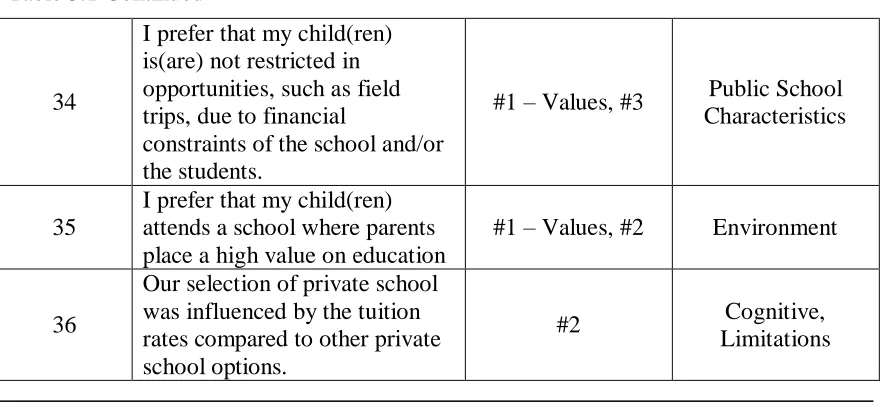
Table 3.1 Q Sample Statements for Q Sort………. 82
Table 3.2 Calculations for 95% and 99% Confidence Intervals………. 92
Table 3.3 Strategies to Increase Validity and Reliability……… 95
Table 4.1 Correlation Matrix Between Sorts (truncated)……… 105
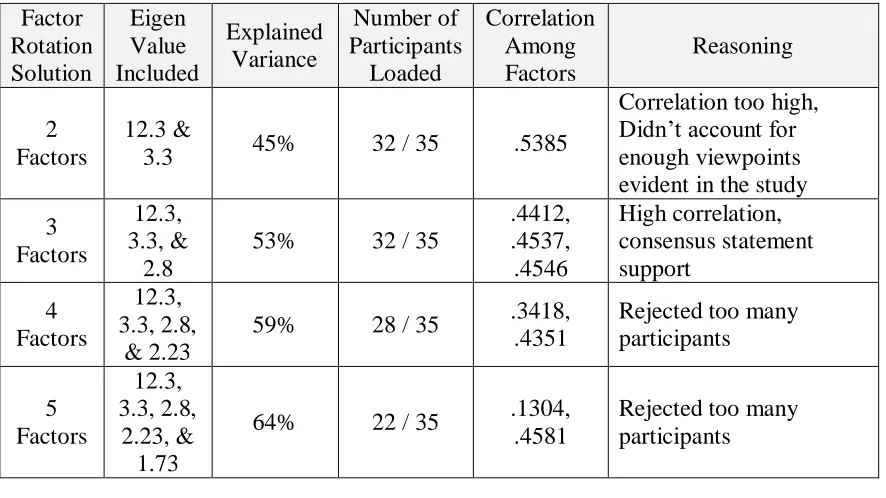
Table 4.2 Information Used to Determine the Factor Rotation……….. 106
Table 4.3 Correlations Between Factor Scores………... 107
Table 4.4 Humphrey’s Rule……… 108
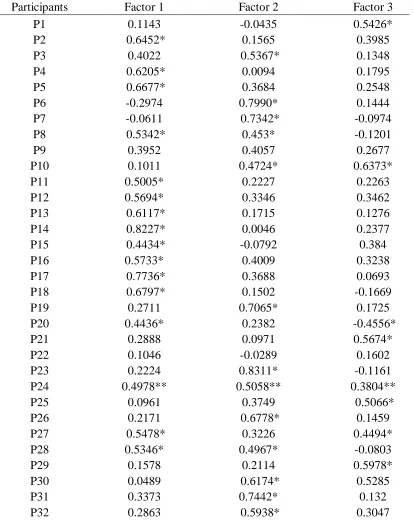
Table 4.5 Factor Matrix Using Participants’ Q Sorts (Loadings)………... 109
Table 4.6 Participants Loading Significantly on Factor One……….. 112
Table 4.8 Factor One: High-Positive and High-Negative Statements……… 116
Table 4.9 Participants Loading Significantly on Factor Two...……….. 122
Table 4.10 Factor Two: Normalized Factor Scores………...…... 123
Table 4.11 Factor Two: High-Positive and High-Negative Statements……… 126
Table 4.12 Participants Loading Significantly on Factor Three………...……… 133
Table 4.13 Factor Three: Normalized Factor Scores……… 133
Table 4.14 Factor Three: High-Positive and High-Negative Statements………..…… 137
Table 4.15 Consensus Statements………. 140
Table 4.16 Distinguishing Statements for Factor One……….. 143
Table 4.17 Distinguishing Statements for Factor Two………. 144
Table 4.18 Distinguishing Statements for Factor Three………... 145
Table 4.19 Research Question 1 Statements: Factor Scores with Corresponding Ranks………... 146
Table 4.20 Research Question 2 Statements: Factor Scores with Corresponding Ranks………... 149
Table 4.21 Research Question 3 Statements: Factor Scores with Corresponding Ranks………..…... 153
Table 5.1 Environment: Q Sample Statements………... 176
Table 5.2 Experiences: Q Sample Statements………. 179
Table 5.3 Public School Characteristics: Q Sample Statements………. 181
Table 5.5 Availability of Options: Q Sample Statements………... 185
Table 5.6 Cognitive Factors: Q Sample Statements………... 187
Table 5.7 Recommendations to Improve Public Schools………... 191
Table 5.8 Researcher’s High-Positive and High-Negative Statements………... 201
LIST OF FIGURES
Figure 1.1 Triadic Model of Social Cognitive Theory………. 17
Figure 1.2 Conceptual Framework for School Choice Decisions……… 20
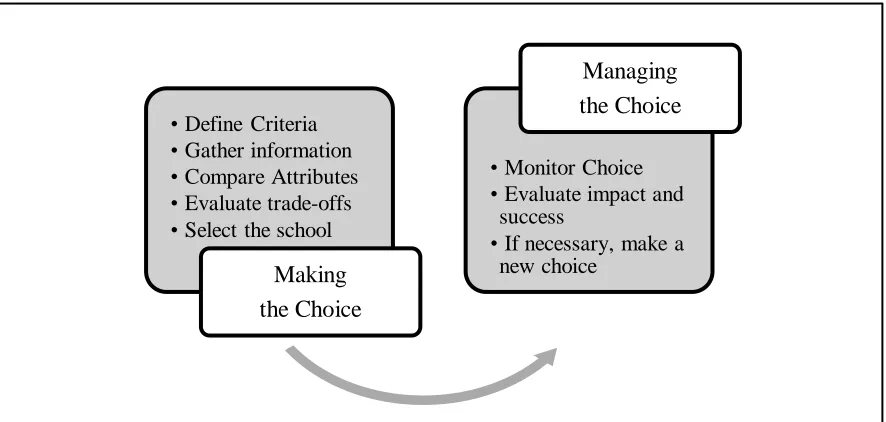
Figure 2.1 School Choice Decision Process………. 59
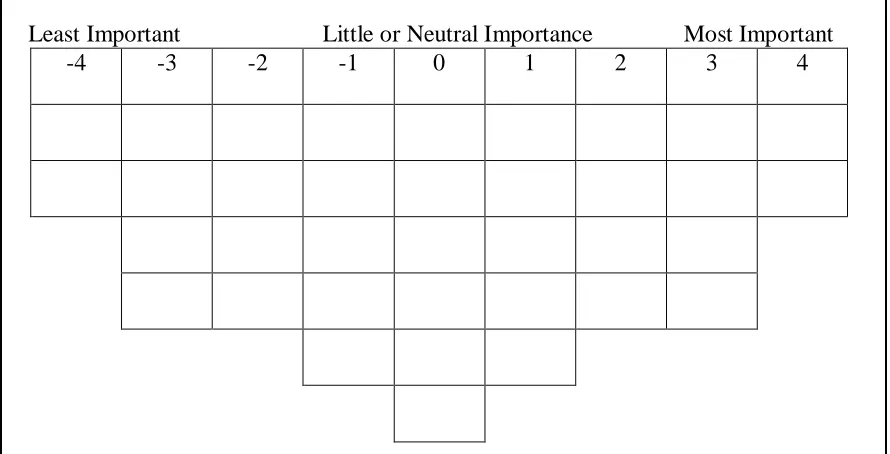
Figure 3.1 Q Sort Distribution Matrix……….. 90
Figure 4.1 Scree Plot of Eigen Values………. 107
Figure 4.2 Factor One Model Sort……… 116
Figure 4.3 Factor Two Model Sort………... 126
Figure 4.4 Factor Three Model Sort………. 136
CHAPTER 1: INTRODUCTION
America is an egocentric society where people want options and opportunities. Even introverted individuals prefer the ability to choose among options as opposed to being directed toward a path. School choice programs allow parents to exercise the democratic right to choose. Parents are given the freedom to select their child‟s educational environment from available options. This choice can be derived from parent experiences, perceptions of schools, and other contributing factors. As a result, parents feel empowered and confident that they are providing the best opportunity to their child. Schools are also impacted by school choice programs. The competitive market created by school choice is expected to drive innovation and school improvement, resulting in stronger schools overall. However, critics voice numerous concerns that school choice will only increase segregation and social stratification. School administrators must acknowledge the perceived weaknesses of public schools in order to develop school reform initiatives that improve weaknesses. Reform efforts must target and improve these weaknesses, or schools will be affected by students exercising school choice decisions.
Background of the Study
Education originated as a public good, benefiting the society as a whole.
skills, such as reading and arithmetic, instigated progressive changes to the purpose of education. Labaree (2011) summarized this progression as “over time the public mission of American schools shifted from keeping the faith, to preserving the republic, to stimulating the economy, and finally to promoting social opportunity” (p. 381). The main purposes of education that developed over time include democratic equality, social efficiency, and social mobility. Both democratic equality and social efficiency were centered on education as a public good. Democratic equality promotes citizenship and equal access, while social efficiency develops one‟s ability to function successfully in our social world (Chubb & Moe, 1990; Labaree, 1997). However, the inclusion of social mobility began the perception of education as a private good (Labaree, 1997).
Social mobility can be simply defined as the ability to get ahead (Labaree, 1997). Students today must learn how to position themselves for the greatest gain. The current competitive environment, focusing on grade and award attainment, pressures students to be the best. Students are frequently more concerned with class rank, grades, and test scores, rather than acquired knowledge. This competitive pressure translates to the parents, forcing them to explore and critically analyze advantageous opportunities to help their child gain an edge over other students. Parents want to provide their children with every advantage available, and widespread concerns of public education are challenging a parent‟s trust in public school. Therefore, many parents are enrolling their children in private schools.
school and the public school system, private school enrollment decreased. However, criticism and doubt regarding America‟s public education system has impacted private
school enrollment over the past 60 years. The Soviet launching of Sputnik in the 1950s started concerns regarding the level of education being provided. Then, the 1980s publication of A Nation at Risk sparked further concerns reporting that America‟s public schools were mediocre (Chubb & Moe, 1990). School reform initiatives have been implemented to address performance and concerns of inferiority; however, improved standards and accountability measures have not provided satisfying results. School choice initiatives were also introduced as a method of creating competition and market pressures in education.
School choice has redefined school improvement and reform in America (Wilson, 2008). This competitive market theory holds the schools directly accountable to both the parents and students. Parents have the ability to avoid underperforming or unattractive schools, creating a threat of student exit (Anderson & Serritzlew, 2006; Lankford &
Wyckoff, 2001). School choice options require school reform initiatives that address parent preferences and perceived weaknesses of the school in order to prevent student transfer (Harrison, 2005; Levin, 1990; Ogawa & Dutton, 1994). Ineffective reform will result in parental exploration of school choice alternatives.
Parental expectations and perceptions drive school choice decisions; however, there is no formal process to obtain accurate information regarding school options. Critics are
choice decisions. Critics are also concerned about the negative impact that school choice has on the public school sector. The primary fear of school choice is a loss of the high achieving students, leaving only low performing students in the public schools (Cullen, Jacob, & Levitt, 2005). Public school advocates fear this exit will lead to losses in funding, resources, and parental involvement (Lankford & Wyckoff, 2001). There is concern that the autonomous private school environment will undermine the efforts to desegregate the United States and offer equality for all students. Private school curriculum does not follow the same guidelines as public school, and the focus on democratic values may not be a primary goal (Witte, 1990). Also, students will have unequal opportunities, promoting an increased social stratification.
Statement of the Problem
impacts from the exit of high achieving students and involved parents. The fear of school choice impacts has ignited research in school choice decisions.
School choice is a popular research topic for parents, schools, school administrators, and politicians. The ProQuest database of published theses and dissertations yielded 873,110 titles when the term “school choice” was searched. The Academic Search Complete database yielded a total of 51,163 published journal articles on school choice. Additional search phrases were explored, including private school choice, school choice factors, private school versus public school, why private school, and is private school better. Table 1.1 provides a quantitative summary of available research. School choice research has increased drastically over the past several decades. Table 1.2 displays the increase in ProQuest Database theses and dissertation publications over the past five decades.
Table 1.1
Summary of School Choice Research Publications Private School Choice
Search Entry ProQuest Database: Theses and Dissertations
Academic Search Complete: Journal
Articles
Private School Choice 514,275 3,171
School Choice 873,110 51,163
School Choice Factors 824,565 6,719
Private School vs. Public School 343,083 565
Why Private School 519,173 1,867
There is a large variation of school choice explanations and findings. The main strands in school choice research literature include the different types of choice schools, the impact of school choice, the relationship between school choice and parental involvement,
Table 1.2
Historical Frequency of School Choice Theses and Dissertations in the ProQuest Database
and the reasons that parents select particular schools (Yang & Kayaardi, 2004). International differences in school choice programs were also explored. School choice in the United States empowers the parents as the decision makers; whereas, other countries empower schools by allowing student recruitment to improve schools (Jennings, 2010). The research literature also provided contradictory findings, which highlighted gaps and limitations of previous research studies.
0 50000 100000 150000 200000 250000 300000 350000 400000
Private School Choice
School Choice
School Choice Factors
Private School vs. Public School
Why Private School
This study addressed gaps and limitations of previous research to develop a deeper
understanding of the private school choice decision process. Wilson (2010) expressed a gap in researching the actual choice process. The majority of school choice research
quantitatively analyzes the characteristics of schools and parent reasons for school choice; however, an understanding of the subjective impact of values, personal experiences,
preferences, and peers is lacking (Davis, 2011; Gibson, 2011; Lauen, 2007; McClain, 2010). The primary framework utilized in school choice research was the Rational Choice Theory. This theory focuses primarily on outcomes instead of process. Also, this theory ignores irrational influences, such as emotions, beliefs, and culture, which play a pivotal role in parental choice decisions (Oliveira, 2007).
There is no single explanation of why parents prefer private school. A
comprehensive understanding of why parents are leaving public schools is crucial for school reform. Without this understanding, public schools will not be able to effectively compete with the private school sector. Witte (1990) explained that unsatisfied parents will “choose exit over voice and loyalty” (p. 40). Therefore, public school administrators must determine why parents are selecting alternative school options. School leaders that improve perceived weaknesses through reform have a greater chance of keeping students enrolled and
Purpose of the Study
The purpose of this Q methodology study was to better understand the school choice decision process of private school parents. What impact do one‟s home and community have on school choice decisions? What role do personal experiences of a parent or the child play in the decision to select private school over public school? Are there public school policies or procedures that are causing parents to choose private school? This study explored the school choice decision process by analyzing parent preferences and influential factors. Understanding these preferences and the decision process is crucial for administrators to develop targeted reform efforts utilizing parent voice instead of exit.
Research Questions
1. How do personal experiences and values impact a parent‟s decision to select private school over public school?
2. How does one‟s environment impact a parent‟s decision to send their child to select private school over public school?
3. How do current public school policies and procedures impact a parent‟s decision to select private school over public school?
Definition of Terms School Choice
limitations; however, the right to choose still exists. School choice options include private school, homeschooling, and public school choice. This research study will focus solely on private school choice decisions and traditional public schools. This study does not include charter schools, magnet schools, or other public school choice options.
Private School
Private schools are “educational institutions run independently of the government” (Friedman Foundation for Educational Choice, 2013, p. 4). As described by Baker, Han, Keil, and Broughman(1996), there are three main categories of private schools. These categories include Catholic, non-Catholic religious, and independent, non-sectarian schools. Within Catholic schools, there are parochial, diocesan, and private sector schools. Non-Catholic religious schools include Conservative Christian, affiliated, and unaffiliated religious schools. The independent, non-sectarian schools are separate from any religious affiliation or organization. The majority of United States private schools have a religious affiliation. Other private schools may center on a particular instructional method,
educational philosophy, specialized curriculum, or programs for individuals with special needs (Friedman Foundation for Educational Choice, 2013; U.S. Department of Education, 2009).
either as a for-profit or non-profit organization. Since these schools do not have the financial support from a sponsoring organization, tuition for independent, non-sectarian schools is normally higher than parochial schools.
Public School
Public schools are defined by Wilson (2008) as educational institutions that are “publically funded, accessible, and accountable” (p. 5) institutions that are “seen as engines of access, integration, and equity” (p. 5). These schools are supported through federal, state, and local funding. Public schools are managed by agencies or committees of elected or appointed members (The Organization for Economic Cooperation and Development, 2003). Significance of the Study
Understanding the school choice process is of prime importance for all school administrators, public and private, and policymakers. Both public and private school
administrators need to know the influential factors and how parents perceive schools relative to those factors (Parker, Cook, & Pettijohn, 2007). Parent decisions are not always
determined by quantitative data, such as test scores and climate surveys. Parents utilize other resources, such as peer influence, personal experiences, and overall perceptions to drive their school choice decision. These influential factors are not always easily identifiable by
Significance for Public School Administrators
Public school administrators must understand both the positive and negative perceptions of public schools. Crucial decisions are being made based on these opinions. More than 75% of parents who select private school attribute their frustration with public school as a deciding factor (Martinez, Thomas, & Kemerer, 1994). Parent preferences in programming are also important. Specialized programs for students can impact parent decisions. Public administrators need to understand these perceptions and preferences to identify areas needed reform. They can also involve parents in the reform process, resulting in improved parent satisfaction and climate. Involved parents are more likely to keep their child in the public school sector.
Significance for Private School Administrators
The information collected through this study can also be significant for private school administrators. These administrators will gain a deeper understanding of what makes their school more attractive than other school options. Information gained through this study provides important characteristics and programs from a parent perspective. Effective
Significance for Policymakers
Significance for policymakers was not the primary goal for this study; however, there were findings associated with school reform. The majority of public choice schools, such as charter and magnet schools, are a result of unsatisfied parents in a school district. This study provides a snapshot of parental preferences that are not being satisfied in the public school sector. This understanding of perceived public school weaknesses can be used to target reform efforts. Also, policymakers can create initiatives that could encourage private school parents to reconsider their choice decisions.
Overview of Methodology
Q methodology was used to analyze the subjective viewpoints of parents who have chosen to enroll their child in private school. William Stephenson introduced Q
(2012) explained, “a well-delivered Q study reveals the key viewpoints extant among a group of participants and allows those viewpoints to be understood holistically and to a high level of qualitative detail” (p. 4).
As McKeown and Thomas (2013) described, there are five main sequential steps in a Q methodology study. First, a concourse is developed, and a collection of representative statements are selected as the Q sample. Once the Q sample is determined, participants for the research study are selected. Then, the participants are asked to sort the Q sample by ranking the statements based on the condition of instruction provided by the researcher. Once the Q sorts are completed, the researcher must compare the individual sorts and analyze the data. Finally, the data must be interpreted to determine relationships. As summarized by McKeown and Thomas (2013)
Rather than focusing on the placement of individual statements, an effort is made to examine the patterns of meaning within the broader contextual constellation provided by a given factor array, with attention given to the relevance of such patterns to existing or emerging theories and propositions. (p. 6)
Conceptual Framework
There are several influential factors that drive school choice decisions. A large percentage of school choice research utilizes Rational Choice Theory as a theoretical
framework to explore parent choices; however, there are substantial weaknesses when using this theory for school choice decisions. Several decision theories were reviewed as possible frameworks for this study; however, only three were considered to provide relevant
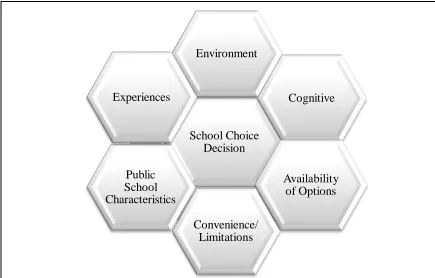
components of the school choice decision process. These theories include the Classical Decision Theory, Rational Choice Theory, and Social Cognitive Theory. Each theory included weaknesses that eliminated them as a potential primary framework; therefore, relevant components and strengths from each of these theories were combined to create the School Choice Decision Conceptual Framework (Figure 1.2) utilized for this study.
Classical Decision Theory
perceived importance, eliminating some information that should be considered. According to Dietrich (2010), people rely more on positive previous experiences, knowledge, and expected observations. Negative experiences increase avoidance of similar situations. Also,
information appearing uncertain, or in conflict with expectations, is frequently dismissed. Rational Choice Theory
The majority of school choice research is framed through the Rational Choice Theory (RCT), which is defined by Friedman and Hechter (1998) as a decision making process in which individuals “act with the express purpose of attaining ends that are consistent with their hierarchy of preferences” (p. 202). This theory explains that rational choices, driven by a sufficient amount of information, determine behaviors (Friedman & Hechter, 1998;
Hooker, 2013). The rational assumption of school choice decisions is that parents select the strongest academic schools based on achievement data (Lubienski & Lubienski, 2014). Critics argue that RCT cannot be used to frame school choice because there are other significant factors contributing to parents‟ decisions.
There has been disagreement regarding RCT to explain school choice decisions. RCT assumes that individuals consider all relevant information. Also, individuals are assumed to act rationally in any decision making process (Oliveira, 2007). As explained by Wilson (2010), RCT “cannot account for the socially and culturally situated nature of parental choice” (p. 54). Also, Denzin (1990) explained that “rational choice theorists have
conditions of uncertainty, and information accessed or considered. Friedman and Hechter (1988) also criticized the use of RCT by saying, “social outcomes dependent on unstable,
weak, or variable preferences – consumer behavior, for example – are by this token poor subjects for rational choice analysis” (p. 214). Personal beliefs and expectations conflict with the RCT framework. Also, emotions are one of the largest conflicts with the RCT framework.
As explained by Wilkins (2011), “emotion is characterized as ephemeral and unstable to the extent that it skews and bypasses the „reasoning process‟ resulting in irrational action or „bad‟ choice” (p. 361). Numerous research studies support the notion that emotions heavily influence perceptions, judgments, behaviors, and choices (Denzin, 1990; Dietrich, 2010; Friedman & Hechter, 1988; Gutnik et al., 2006; Wilkins, 2011). As explained by Frith and Singer (2008), unpleasant feelings, trust, contextual framing, and social interactions can cause a parent to make an irrational decision. This interaction with one‟s social environment can directly impact a parent‟s perceptions and preferences (Kearl, 2008).
Social Cognitive Theory
In SCT, decisions are seen as complex processes. Individuals must evaluate their options through both cognitive and affective domains prior to making a decision (Redmond, 2013). Experiences and education build a contextual knowledge that impacts decisions. Environmental factors, such as social networks, cultural beliefs, and/or religious beliefs, also have the ability to impact decisions. As explained by Redmond (2013), the three SCT factors are not equal in strength or running concurrently. Information is continuously being
acquired after a decision has been executed, which may lead to a new decision process. This process demonstrates the continuous triadic cycle of SCT.
Figure 1.1. Triadic model of Social Cognitive Theory
Source: Wood, R., & Bandura, A. (1989). Social Cognitive Theory of Organizational Management. The Academy of Management Review, 14(3), 361. doi:10.2307/258173
Critics caution the use of the SCT framework when decisions can be impacted by economic conditions. According to Pajares (2002), SCT does not allow the impact of economic conditions, such as socioeconomic status, education level, and family structure, to be factored into human behaviors. Pajares (2002) claims that these economic conditions
Cognitive
impact one‟s aspirations, beliefs, and emotional states. Due to the subjectivity of school choice decisions, economic conditions should be considered as influential factors. Therefore, SCT should not be used as the only theoretical framework in school choice research. The conceptual framework for this study was developed as an extension of the triadic model presented by Wood and Bandura (1989).
School Choice Decision Conceptual Framework
There is no simple explanation of what factors influence school choice decisions. As explained by Lacireno-Paquet and Brantley (2008), “parental choice for schools does not happen in a vacuum. It happens in multiple social, political, and cultural environments” (p. 19). McCarthy (2007) adds that historical contexts and experiences can also impact school choice decisions. Other factors, such as parents‟ goals, financial resources, stability, and availability of school choice options can also play a role in school choice decisions
(McClain, 2010). With these numerous factors impacting school choice decisions, a more comprehensive conceptual framework must be considered.
Table 1.3
Influential Factors in School Choice Decisions
Organization of the Study
In Chapter 1, a general overview is provided of the research study. This overview provides background information and an explanation of the problem researched, the purpose
Influential Factors Description Examples
Cognitive
Any factual information that a parent has accessed Knowledge about education
and schools
Achievement data, teacher qualifications,
demographics, specific training or expertise in education
Environment
External influences on parent choices
The environment of the school
Social networks, family beliefs, family dynamics, safety, school climate
Experiences
Influence based on actions or experiences of the parents of the child
Personal educational experience, child‟s previous educational experiences
Availability of Options
Schooling options available other than traditional public schools
Private, charter, magnet schools, open enrollment
Convenience/Limitations
Any reason that restricts a selection or provides incentive for a selection
Location of the school relative to work or home, costs of alternatives, transportation
Public School Characteristics
Any policy or procedure, directed by federal, state, or local levels, that can be considered a component of the public school
Figure 1.2 Conceptual Framework for School Choice Decisions
of the research study, research questions explored, and the significance of the study for school administrators and policymakers. Chapter 1 also includes a brief explanation of Q methodology and the conceptual framework that guided the study. Chapter 2 provides a detailed description of both private schools and public schools. This description includes the history, development, characteristics, perceived strengths, perceived weaknesses, and a comparison of both sectors. The concept of school choice is also explained, including reasons why parents choose a private school over a public school, which parents seem to execute school choice options, and the potential impacts that these choices have on the schools. Chapter 3 provides a detailed description of Q methodology and the methods that
School Choice Decision Environment
Cognitive
Availability of Options
Convenience/ Limitations Public
School Characteristics
used in this study. Chapter 4 explores the findings and analyzes the data. This analysis provides a connection between the findings and the research questions. Chapter 5 provides a discussion utilizing research literature and the Conceptual Framework for School Choice Decisions. As a conclusion, implications for policymakers, school administrators, and future researchers will be explored.
Chapter Summary
CHAPTER 2: LITERATURE REVIEW Introduction
The purpose of this chapter is to review literature pertaining to the current study. This study intends to gain a deeper understanding of why parents choose to pay for private school for their child. In order to gain this understanding, one must understand a variety of aspects of both public and private schools. This literature review begins with an explanation of the role of education, followed by sections that further explore the areas of public school, private school, and school choice:
Public School Private School School Choice The Choice Process
Comparison of Public and Private Schools
Parents‟ Reasons for Executing School Choice Options Demographics of School Choosers
Effects of Competition from School Choice
charter schools, this review of literature will center primarily on the choice process of selecting between public and private schools.
The Role of Education
There are controversial perspectives regarding the purpose of education. Basic literacy and math have been important in all educational sectors throughout history; however, the needs of our country increasingly dictate the necessary role of education. The role of education has transformed from a focus of local beliefs and religion to a broader role of creating globally productive citizens. This transition introduced a variety of beliefs on how we reach that finished product.
As shared by Peterson (1998), “the purpose of education is to teach more than math and reading; it is also to prepare citizens for a democratic society” (p. 10). Many people feel that schools need to operate as a public good and develop individuals with basic democratic values, moral values, civic responsibility, and a voice of conscience (Ausbrooks, 1997; Labaree, 2011). Schools must also prepare for the workforce and develop the students‟
social skills. Graduates must be prepared to navigate the social world that they will encounter in their adult lives (Wilson, 2008). If our schools do not meet these goals, the expected result is citizens that are not productive, not responsible, and cannot function successfully in our society (Ausbrooks, 1997). Public opinion shared expanded perspectives on what should be the focus and role of education today.
meaningful goal setting, and collaboration. There is concern that schools are not focusing on the development of these skills. Respondents expressed that students needed to know how to motivate others, foster creativity, promote well-being, and build personal character (Bushaw & Lopez, 2013). Schools should also offer opportunities for career guidance, college
preparation, and other extracurricular activities that will further develop the student (Lauen, 2007). Labaree (1997) expresses that these new expected roles of education are promoting education as a private good versus a public good. The promotion of social mobility is the most recent shift in historical public school development.
Public Schools: Developing an Education for All
In Colonial America, education was the responsibility of the parents, and children learned from community members. The first documented formal education was in 1647. The Massachusetts Bay Colony required all towns and villages with at least 50 citizens to hire a schoolmaster. This individual was responsible for reading and writing education for all of the children (Carnegie Foundation for the Advancement of Teaching, 1992).
Schooling was a local responsibility and education was simple. The focus was on topics that people thought were interesting and useful (Chubb & Moe, 1990). Education was
all, regardless of wealth or religion, the idea of the common school was developed (Wilson, 2008).
The common school was proposed in 1837 by public school education proponent Horace Mann. Mann was appointed the Secretary of the Massachusetts Board of Education (Warder, n.d.). Mann, a pioneer for public education, proposed “the common school, a free, universal, non-sectarian, and public institution, was the best means of achieving the moral and socioeconomic uplift of all Americans” (Warder, n.d., para. 4). In his proposal, Mann fought for public funding for these educational institutions with a goal to unite the various classes of citizens and develop culturally competent, moral, and democratic citizens (Warder, n.d.; Wilson, 2008). The common school‟s central focus was the development of on
democratic values and good citizens. Educational institutions were used to shape America by promoting citizenship and social obligation (Carnegie Foundation for the Advancement of Teaching, 1992). Even with a similar mission for all common schools, there was no centralized control (Chubb & Moe, 1990; Wilson, 2008). The idea of the common school expanded throughout America, igniting the foundation of an American public school system (Labaree, 2011; Wilson, 2008).
focus shifted from teaching to focusing on the students, and higher academic achievement standards were introduced (Ausbrooks, 1997; Chubb & Moe, 1990; Wilson, 2008). Today‟s public school systems are the result of these initiatives and modifications of the education system.
Public Schools: Perceptions of the Strengths and Weaknesses
The formation of American public education was due to “perceived failures in how schools were suited to respond to social and economic upheaval” (Lubienski & Lubienski, 2014, p. 3). Educational leaders were attempting to address the perceived weaknesses of independent schools and prepare all students to be productive citizens when they created common schools. All students were to receive a free, high quality education from highly qualified teachers, and this education would give them all of the necessary knowledge and skills to successfully enter the diverse world as workers and leaders. The number of private schools decreased after the inception of public school, demonstrating that parents preferred the public education option (Carpenter & Kafer, 2012). However, recent perceptions of public schools are different. Public education is now described as “seemingly been in a chronic state of crisis” (Lubienski & Lubienski, 2014, p. 3), and negative occurrences have promoted public education as a failing system.
however, there was “growing frustration among ordinary citizens about what they perceived to be the deterioration of their schools” (Chubb & Moe, 1990, p. 7). Concern was heightened
with the 1983 publication of A Nation At Risk: The Imperative for Educational Reform. This report, published by The National Commission on Excellence in Education, described
schools as mediocre, and the overall message was that the United States education system had fallen behind. The overall understanding was that “the academic quality of the public schools was unacceptably low” (Chubb & Moe, 1990, p. 6). Statistics illustrated a decrease in academic achievement levels and an inability to use higher order thinking skills. As a result, businesses and the military were reporting increased costs and extended remediation for new employees. This report signaled alarms in the areas of our country‟s economic development and national security (Hoffer, 2009). Once again, a call for reform and a commitment for improvement were initiated by the federal government; however, critics believe that these government initiatives and political influence negatively impact public education (Chubb & Moe, 1990; Hoffer, 2009).
Varying levels of political powers have had influence over education throughout history. Chubb and Moe (1990) described the impact of politics during public school development by stating
There was greater focus on control and power than success of the educational institutions (Chubb & Moe, 1990). The public school sector is dominated by government restrictions, political groups, labor unions, and poor funding (Benveniste, Carnoy, & Rothstein, 2003). This bureaucratic structure limited individual school autonomy and created a fear of instability for school initiatives and programs (McClain, 2010). The individual school‟s ability and resources to address specific parent and student interests was limited. This inability to cater to individual preferences and needs increases parental concern‟s regarding public schools. Parents fear that their children are not receiving the best education possible.
The current perception is that public schools are not providing that high quality education for all students (Parker, et al., 2007). Academic achievement in the United States is low when compared internationally. The United States graduation rate is hovering
between 60-70%, and only approximately 60% of all high school graduates can read at grade level. Also, achievement gaps are present between different ethnicities and socioeconomic classes (Lubienski & Lubienski, 2014). In a comparison of math achievement scores in 1995, America was ranked last among 12 “industrial peer” countries (Peterson, 1998). This comparative data indicates major areas of concern with public education‟s ability to prepare our students for the future.
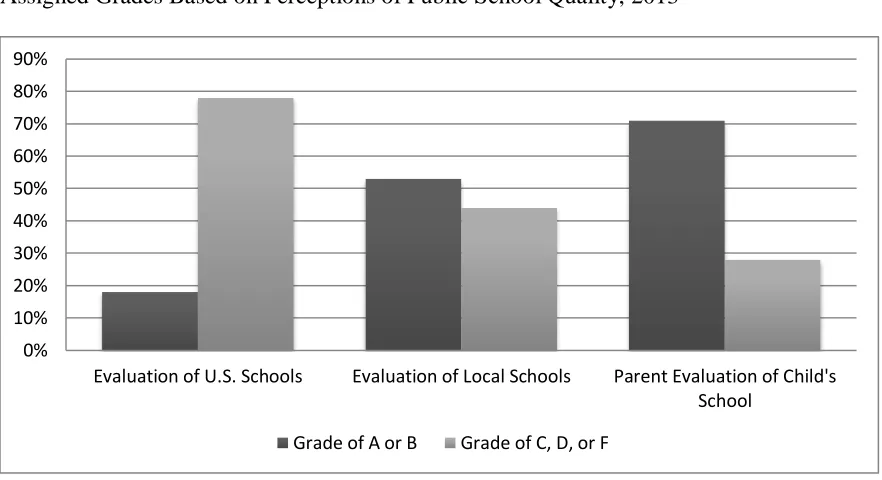
trust in public administration, only 37% of Americans report being satisfied with public education (Bushaw & Lopez, 2013). According to the Gallup (2013) poll on Education Historical Trends, dissatisfaction with public schools has been higher for the past eight years than satisfaction. Only 18% of Americans would give the public school sector a grade of an A or a B, while 53% would assign them a C, indicating average performance. This national data is alarming, but local data appears to be more favorable of public schools.
Americans appear to have a more favorable perception of schools in their local area. When questioned about local schools only, the percentage of A and B grades increased to 53% of respondents (Bushaw & Lopez, 2013). While this dissatisfaction alarms public school officials, data collected from current parents appeared more positive. The responses
indicated that 75% of parents reported being satisfied with public education, 47% of parents would rate their child‟s education as good or excellent, and 71% of parents would assign their child‟s school a grade of an A or a B average (Bushaw & Lopez, 2013; Jones, 2012). Table 2.1compares the assigned grades for public schools nationally, locally, and from current parents. This data suggests a need for public school reform to improve satisfaction, and perceived weaknesses must be identified to direct these reform efforts.
Table 2.1
Assigned Grades Based on Perceptions of Public School Quality, 2013
Source: Bushaw, W. J., & Lopez, S. J. (2013). Which way do we go? Phi Delta Kappan, 95(1), 9–25. doi:10.1177/003172171309500104
(Parker et al., 2007). Many parents do not feel that public schools have effective parental involvement and collaboration with parents, which is necessary for student success
(McClain, 2010). Data reveals that parents feel safer with their children in public school than they do in their neighborhood; however, safety is still a frequent concern among parents. Concerns are centered mainly on the behavior of other students and ineffective discipline strategies (Bushaw & Lopez, 2013). Other areas of concern released in the Gallup (2013) poll include overemphasis on sports and standardized testing, teacher quality, and limited emphasis on specific subject area.
0% 10% 20% 30% 40% 50% 60% 70% 80% 90%
Evaluation of U.S. Schools Evaluation of Local Schools Parent Evaluation of Child's School
The curriculum concerns of public education include a lack of rigor and decreased focus on basic character education and democratic values. Overall, this results in a lack of social skill development (Benveniste et al., 2003). Parents also feel that public schools have started to cover topics that many deem as inappropriate, such as sex education and providing birth control to students (Peterson, 1998). The impact of politics on education drives many of the curriculum concerns. Topics such as school finance, recent budget cuts, testing mandates, and No Child Left Behind (NCLB) legislation are common concerns. Many people feel that conflicting political agendas will continue to mandate new initiatives and continue to decrease individual school autonomy. This decrease in autonomy limits a school‟s ability to reform to meet current needs and preferences of their students and parents (Chubb & Moe, 1990). For example, only 22% of Americans believe that the increase in standardized testing has led to improved academic performance. Another political initiative, NCLB, has been blamed for decreasing academic achievement in public schools by 33% of Americans (Bushaw & Lopez, 2013, Gallup, 2013). Parents have demonstrated
dissatisfaction with political initiatives by moving their child to private school, avoiding standardized testing requirements.
perceive public school as detrimental to their child‟s education, they will exit the public sector for a stronger educational environment.
Private Schools
Private schools were in existence in many parts of the United States prior to the creation of public schools (Green, 1993). These private schools were primarily for the elite and privileged citizens, while the lower class citizens were educated by their community. Religious institutions began opening parochial schools for their church members in order to provide religious education. These parochial schools allowed more diverse students the opportunity to attend private school, resulting in increased private school enrollment.
As far back as the Colonial period, the Catholic church preferred that parish members attend a Catholic school. These schools initially charged tuition; however, the Catholic church provided funding for parish members with financial need. Catholic schools began to expand across the nation, and an official Catholic Education System was developed by the Catholic church. In the nineteenth century, Catholic parochial schools were opened, funded completely by the Catholic Church. This system eliminated the tuition fee for parish
and the church was forced to close the smaller schools. These changes eliminated the requirement for all parish members to attend Catholic schools, resulting in a decrease of enrollment (Marks, 2009). Once public schools were developed, the private sector decreased in enrollment overall due to the competition of a free education; however, there have been periods of time where parents show a preference for private education.
According to Benveniste et al. (2003), there was a peak in private school enrollment in 1965, with approximately six million students enrolled. This high enrollment continued into the 1970s, and the south experienced a higher growth of private school enrollment as a result of school integration (Benveniste et al., 2003; Ravitch, 2010). As Ravitch (2010) explained, “public officials in some Southern states embraced a new form of choice. They encouraged the creation of private schools to accommodate white students who did not want to attend an integrated school” (p. 114). These schools were commonly called “segregation academies” (Ravitch, 2010, p. 114). There was also a greater interest in private schools in the 1980s as a result of the increased concern with America‟s public schools. These two
incidents caused the most recent peaks in private school enrollment.
Approximately 10% of all elementary and secondary students in the United States attend private school, with more than three-fourths of these students in elementary and middle grades (Aud, Wilkinson-Flicker, Kristapovich, Rathbun, Wang, & Zhang, 2013; Hoffer, 2009). Table 2.2 provides a comparison of private school enrollment from 1995 to 2010. Parker et al. (2007) predicted that the percentage of students enrolled in private school will remain constant regardless of increasing school choice alternatives. Demographically, in 2013, private schools were comprised primarily of Caucasian students (approximately 79.2%) and 18.2% minority students (National Association of Independent Schools [NAIS], 2013).
Table 2.2
Private School Enrollment in the United States, 2013
Source: Aud, S., Wilkinson-Flicker, S., Kristapovich, P., Rathbun, A., Wang, X., and Zhang, J. (2013). The Condition of Education 2013 (NCES 2013-037). U.S. Department of
Education, National Center for Education Statistics. Washington, DC. Retrieved from http://nces.ed.gov/pubsearch
5,000,000 5,200,000 5,400,000 5,600,000 5,800,000 6,000,000 6,200,000 6,400,000
According to Broughman and Swaim (2013), approximately 70% of the private schools in 2011-2012 provided their students with a regular education program. Other education programs included were Montessori, special education, early childhood, and special or alternative programming. The average student-teacher ratio was 10.7 for private schools. This ratio is much lower than the public school student-teacher ratio. Private schools were present in all areas of the United States; however, they were more prevalent in cities. The majority of the private schools in 2011-2012 were coeducational, with only 4% that were single-sex settings. In considering academic outcomes, private schools reported that 98% of the high school seniors in the fall of 2010 graduated within a year, and 64% of the private school graduates in 2010-2011 attended a four-year college or university in the fall of 2011 (Broughman & Swaim, 2013).
The majority, 68%, of private schools has a religious affiliation, and Catholic schools are the most prevalent (Gutnik, et. al, 2006; Hoffer, 2009; Parker et al., 2007). The religious private schools educate approximately 80% of the private school student population
private schools, and there are a higher percentage of black students in non-Catholic religious schools. There was no measurable difference in the percentage of white and Pacific Islander students when comparing different religious schools; however, there was an increase in both groups in Catholic schools versus independent, non-sectarian schools (Aud et al., 2013). Private Schools: Perceptions of the Strengths and Weaknesses
Private schools must continuously recruit new students and offer opportunities that entice families to attend. According to a study by Parker et al. (2007), the private schools utilize marketing that targets a higher socioeconomic and more educated population. Although the financial obligation was only a concern to approximately 45% of the participants, from both the public and private school sector, families that reported higher income levels were more attracted to the specific opportunities that private schools offered (Parker, et al., 2007). The overall perception of the private school sector is more positive than the public school sector. According to the Education Historical Trends poll (Gallup, 2013), 78% of America felt that independent private schools were either good or excellent, and 69% felt that religious and parochial private schools were good or excellent. Percentages of parents who have children that are currently in school were slightly higher. When rating their child‟s specific school, 80% of independent private school parents and 72% of religious and parochial private school parents rated their schools as good or excellent. These ratings are a result of the perceived strengths of the private school sector.
involvement, effective communication with parents, increased levels of college admissions, a safe and disciplined environment, moral and values education, a commitment to community service, and strong extracurricular opportunities (Kennedy, 2013). These strengths do not exist in all private schools because they “do not have to be all things to all people” (Chubb & Moe, 1990, p. 55). However, there must be substantial benefits to increase parent
satisfaction and justify tuition expenses (Chubb & Moe, 1990). In school choice decisions, parents can shop for the specific characteristics that they perceive as the most important. Parental satisfaction is higher at private schools many times because parents selected the school based on their personal preferences. Weaknesses are frequently ignored as a means of justifying choice decisions; however, if weaknesses lead to dissatisfaction, parents may withdraw their child from private school.
Parents have tremendous influential power over the private school sector. There must be evidence that the advertised benefits of attending a private school are a reality (Parker et al., 2007). Without this fulfillment of promises, parents would not be as willing to select private school. The ability to leave a school due to dissatisfaction requires schools to
constantly meet parent expectations. Chubb and Moe (1990) shared, “the perceived value of private school must far outweigh that of public school if they are to win students” (p. 34). This constant pressure to please parents increases the overall satisfaction of private schools. Also, the school‟s ability to individually select their student population provides parents with
parent satisfaction, opponents express concerns with the impact on the overall demographic environment of schools.
Critics fear that private school choice will reintroduce segregation in educational settings. Families from lower socioeconomic classes are less likely to attend private schools due to the expense and transportation barriers (Bomotti, 1996; Parker et al., 2007). Many of the private schools also lack the ability to offer a wide range of curriculum options at
different levels, causing all students to be tracked on the same path (Ravitch, 2010). Students are expected to fit the school‟s expectations, or they will not be allowed to attend the school. Also, a lack of resources and smaller school size also hinders the ability to offer a wide variety of extracurricular activities (Alt & Peter, 2002; Bomotti, 1996). One other negative aspect of private school choice is the elitist perception of private school students and their families. Many of the private school students are considered to be self-centered, conceited, and spoiled (Lubienski & Lubienski, 2014; Parker et al., 2007). This social divide causes greater stratification among socioeconomic classes and has become a critical argument against school choice initiatives.
The Difference Between Public School and Private School
these categories vary among schools, generalized comparisons help parents understand the overall differences between school sectors.
Comparison of Academic Performance and Educational Attainment When attempting to determine the effect of the private school setting, there is
difficulty in attempting to control the impact of the socioeconomic factors (Bast & Walberg, 2004). As Hoffer (2009) expressed, there are many studies that report private school students are performing at a higher level; however, not all studies controlled the impact of students‟ backgrounds or previous performance levels. Academically, studies have reported
conflicting results on whether or not private schools are better than public schools. Table 2.3 summarizes various research studies and their findings relative to academic performance and academic programs.
The general assumption is that private school is a better educational environment than public school. Although private school students display higher achievement scores,
graduation rates, college admissions, and career performance, Lubienski and Lubienski (2014) argue that private schools are not more effective than public schools. This argument is based on the ideal that private school students enter the educational setting with advantages from their socioeconomic backgrounds and family influence.
Table 2.3
Comparison of Academic Performance and Programs in Public and Private Schools Researcher/Author Results of Comparison
Ausbrooks (1997)
Instructional programs are more similar than different Main variance was emphasis of spiritual/religious values in
religious private schools Benveniste et al.
(2003)
Few differences in school programs
Main determinants of variation were social, cultural, and economic background of parents, not school sector Elder & Jepson
(2014)
Higher academic achievement in Catholic schools is a result of student differences, not impacts from the schools
Figlio & Stone (1997)
Non-religious private are higher achieving than public Religious outperform public in minority demographic only Private are more efficient because of lower per pupil
expenditures Krommendyk (2007)
Teacher satisfaction and autonomy in private religious school is higher than in public school
Less discipline problems in private religious schools
Lubienski & Lubienski (2014)
School sector – relatively small role in predicting achievement
When adjustment is made for demographics, private achievement means are not significantly higher
Public math achievement higher in 4th grade than Catholic Public is more effective than Catholic and at least as effective
as other private in raising student achievement Noell (1982)
When controlling for selection bias, there is no significant difference in academic performance between difference school sectors
Parker et al. (2007) Academic achievement is only slightly higher in private Stevans & Sessions
(2000)
No significant difference in achievement in any minority group in different school sectors
Urban, white students increase achievement in private, but less than 0.1 standard deviation
Wenglinksy (2007)
Students in both sectors had similar achievement,
postsecondary enrollment percentages, and job satisfaction Private students exhibited higher Scholastic Aptitude Test
minority groups, with the exception of minimal increases with white, urban private school students. Parker et al. (2007) indicated that private schools perform slightly higher than public school. Wenglinksy (2007) shared that private school students have higher achievement scores on the Scholastic Aptitude Test (SAT); however, there were no
significant differences in achievement, percentages of students who enroll in postsecondary education, and overall job performance and satisfaction. Two research studies indicated that public schools are also capable of producing higher student achievement (Elder & Jepsen, 2014; Lubienski & Lubienski, 2014). Fourth grade math achievement in public school was higher than private school, and the average academic achievement in private school is not significantly higher when the impact of student and family demographics are controlled (Lubienski & Lubienski, 2014). Elder and Jepsen (2014) reported that Catholic school students demonstrate a negative growth in math scores. These students experience a decrease of between two percent and four percent in their math achievement between kindergarten and eighth grade (Elder & Jepsen, 2014). Many of the researchers and authors shared
explanations, limitations, and questions to enhance their findings.