WITHIN THE STRUCTURAL GENE AT THE WAXY LOCUS IN MAIZE
CRAIG S. ECHT AND DREW SCHWARTZ
Department of Biology, Indiana University, Bloomington, Indiana 47405
Manuscript received March 8, 1981
Revised copy received July 27, 1981
ABSTRACT
Minimal limits for the structural gene at the waxy locus have been set by investigatioris of the protein product of the gene. An altered protein is produced by four of the waxy mutants including BS, a controlling-element mutation. All are similar to wild type in molecular weight as determined by electro- phoresis in SDS acrylamide gels. At least three of the five wx controlling- element mutations studied have been shown t o lie within the limits of the structural gene.
HE
waxy locus on chromosome 9 in maize controls the production of amylose T i n the endosperm (WEATHERWAX 1922), pollen (DEMEREC 1924) and em- bryo sac (BRINK 1925), Starch produced in endosperm that carries theWx
allele is composed of about 25% amylose and 75% amylopectin, but homozygous wx endosperm contains only amylopectin ( SPRAGUE, BRIMHALL andHIXON
1943). There are more than 30 wx alleles available for analysis, and in an ingenious study, NELSON (1968) prepared a fine-structure map of the locus. A thorough analysis of this locus, however, requires the isolation of theWx
gene product and the determination of the effects of the various mutations onWx
gene expression.The effects of the controlling elements at the locus (MCCLINTOCK 1951, 1956, 1965) are of special interest. These are transposable genetic elements that are capable of altering gene expression. Insertion of a controlling element in or near a gene locus can reduce or eliminate expression of that gene. Subsequent transposi- tion or alteration of the element can result in full o r partial recovery of gene ex- pression. A thorough review of controlling elements in maize was given by
FINCHAM
and SASTRY (1974). NELSON demonstrated that recombination occurs between all five of the wx controlling-element alleles tested (NELSON 1968,1976) and questioned their analogy to the operator element of an operon as proposed by MCCLINTOCK (1961), since they are not located at either extreme of the locus. However, he pointed out that, “Probably no decision as to whether the similarities are basic can be made until we examine the product (the protein) produced in the uninhibited state as compared to the product or lack thereof in the controlling element mutants” (NELSON 1968). FINCHAM and SASTRY (1974) also noted the need to determine whether the various wx alleles result in qualitative or quanti-2
76 C. S. ECHT A N D D. SCHWARTZtative changes of the gene product. As they point out, it was not absolutely cer- tain that the locus, as mapped by NELSON, was the structural gene for the W x gene product since all or some of the mutants may lie in a n external control region.
The only assay previously employed for the W x gene product has been the measurement of starch-granule-bound nucleoside diphosphate (NDP) sugar- starch glucosyl transferase activity, which is nearly absent in w x endosperm (NELSON and RINES 1962; NELSON, CHOUREY and CHANG 1978). Since the transferase activity varies linearly with W x gene dosage (TSAI 1974), it is as- sumed that the transferase is the W x gene product. Isolation of the transferase and its analysis at the protein level would make it possible to determine whether a certain mutant phenotype results from an absence of the enzyme, decreased synthesis, or production of an altered o r inactive form. Also, the potential would exist to determine the limits of the structural gene within the fine-structure map, the precise nature of the various w x mutations and the mode of action of the controlling elements in bringing about the mutant phenotype. W e report here the isolation of the protein encoded by the W x gene and the characterization of various wx alleles with respect to their effects on gene expression.
MATERIALS A N D METHODS
Stocks: The conventional alleles tested were: W X ~ , B, B I , B2, B6, B7, B8, BL2, BL3, C, C I , C2, C3, C4, C31, C34, P , H , H21, I , L, M , P60, R, STONOR and 90. The C allele was used as the standard wx allele throughout this study. The wx controlling-element alleles used were
B 3 ( M p = A c ) , B4(Ds), m - I ( D s ) , m-b(Ds), m-8(Spm) and two stable m-1 revertants, S5 and S15. The wx alleles used in this study were obtained from OLIVER NELSON and from the Maize Genetics Cooperation Stock Center.
Protein assay and extraction: Presence or absence of the Wx protein was determined by electrophoresis of starch-granule-bound proteins on sodium dodecyl sulfate (SDS) polyacrylamide gels (LAEMMLI 1970). The gels in the figures are 10% acrylamide and were stained with Coo-
massie Blue, except where silver staining (OAKLEY, KIRSCH and MORRIS 1980) is indicated. Densi- tometric measurements of the stained gels were performed on a Quick Scan R & D densitometer (Helena Laboratories).
Starch granules from immature endosperm were isolated from 20-day-old (20d) kernels that had been frozen and stored at -20". For SDS extraction, the pericarp and embryo were re- moved and the endosperm was homogenized in buffer A (0.055 M Tris, p H 6.8, 2.3% SDS, 5%
2-mercaptoethanol (BME), 10% glycerol) with a mortar and pestle. The suspension was filtered through a layer of Miracloth and centrifuged a t 15,600
x
g for one min. The pellet was washed by resuspension and centrifugation 3 times with buffer A, twice with distilled water and twice with acetone. The starch granules were then dried in uucuo. 0.01 gm of the granules was mixed with 0.1 ml of buffer A and heated in a boiling water bath for one min. The gelled solution was cooled and an additional 0.2 ml of buffer A was added with stirring. The slurry was centrifuged and the supernatant used for electrophoresis.Molecular weight determination was performed in a SDS-urea-phosphate polyacrylamide gel system (STRAUSS and KAESBERG 1970), as modified by using 10% acrylamide and 7 M urea. The upper and lower resevoir buffers were 0.1 M sodium phosphate, pH 7.6, with 0.1% SDS.
Isoelectric focusing: Denaturing isoelectric focusing was performed in slab gels by the method of O'FARREL (1975), using pH 3.5-10 and pH 5-8 ampholines (LKB) mixed in equal parts. Im-
colored layer, which overlays the starch granule pellet, was removed. The starch granules were resuspended and washed 3 times with distilled water, twice with acetone and then dried in
uucuo. 0.04 g m of starch granules was suspended i n 0.3 ml of a solution containing 9.5 M urea, 5% BME and 2% Nonidet P-10 (Particle Data Laboratories). After shout one min, when the starch had gelled, 0.6 ml of a cold solution of 1% ampholine carriers (pH 3.5-10, LKB) was admixed. The slurry was centrifuged and the supernatant used for isoelectric focusing.
RESULTS
The
Wx
protein:SDS
extracts of starch granules from 20d W x / W x / W x endo- sperm contain only four proteins as visualized on polyacylamide gels (Figure 1). There is a single major protein and three minor proteins of higher molecular weight. The major protein, termed the W x protein, comprises about 85% of the total heat-extractable, starch-granule-bound proteins as determined by densitom- etry.SDS
extracts of starch granules from 20d waxy endosperm have the same three minor proteins, but the W x protein is completely missing (Figure 1) i n 25 of the 29wx
mutants that produce no amylose. This difference betweenWx
andwx
endosperm was seen in all the developmental stages analyzed, from 12 days to maturity, as well as betweenWx
and wx pollen. By mobility comparisons with molecular weight markers. the size of the Wx protein was estimated to be about 60,000 daltons (Figure 2). SDS extracts of whole endosperm of 20dW x
1 2
1 2
,
-
92.5K-
6 6 . 2 K 4 5 K-
31 K 21.5 K14.4 K
FICURR 1.-Proteins extracted from starch granules of Pod Wx and wx endosperm. Arrow indicates the W x protein. The SDS acrylamide gel was silver stained. (Left.)
278 C. S. ECHT A N D D. SCHWARTZ
and
wx
kernels were compared to see whether the W x protein was present else- where in the cell and not starch-granule bound in wx endosperm and whether the wx mutation affected any other endosperm proteins.No
differences betweenWx
andwx
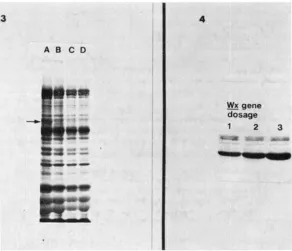
endosperm proteins are observed unless the extracts are heated to swell the starch granules and release the W x protein (Figure 3). Thus, theW x
allele is associated with a major starch-granule-bound protein.
The amount of Wx protein is correlated with the dcsage of the W x allele. One, two and three doses of Wx in the triploid endosperm show a progressive increase in Wx protein levels (P'igure 4). The minor proteins do not appear to vary with the dosage.
The wx alleles: Thirty-three wx alleles were screened for the presence of the W x protein. Of the 26 conventional wx allelic mutants, where there is no evi- dence for the involvement of transposable controlling elements, four
(R,
C32,90 andwz")
have a W x protein (Figure 5 ) and the rest completely lack the protein. The amount of W x protein in90
andwz"
is strikingly reduced. The conventional mutants all lack amylose and stain red with iodine-potassium iodide(IKI),
exceptFIGURE 3.-Whole endosperm proteins and the effect of heating on extraction of the W x protein from starch granules. Lanes A and C are from Wz and lanes B and D are from wz endo- sperm. 20d endosperms were mascerated in buffer A (MATWIALS A N D METHODS). The preparations loaded in lanes A and B were heated i n a boiling water bath to swell the starch granules. The preparations loaded i n lanes C and D were not heated. Note that the W x protein is observed only in the heated W z sample (arrow). (Left.)
do not vary with the dosage of the Wz gene (Right.)
FICURI: 5.-Electrophoretogram of allelic forms of the Wx protein. (a) The alleles included ore WZ, wx, B3, C31, R, 90, w p , S5 and S15.. The wz allele, which does not specify a WX protein, is included for comparison. Alleles Wx, wx, R3, C31 and 90 are in a W22 genetic back- ground: nlleles R and wtQ are in an M14 genetic background. S15 is homozygous for ue (amylose extender), which is responsible for the difference in the minor protein banding and for the increased amount of the Wx protein. All samples are from 2Od endosperms. The gel was stained with Coomassie Blue. (b) Silver-stained electrophoretogram of Wx proteins specified by W x and
m-8. Both alleles ore i n the W22 background. The low level of Wx protein in m-8 requires the highly sensitive silver stain for detection. Six times the volume of sample was loaded for m-8
as for Wx.
for uu?, which has about 9% of the normal amylose levels
(BRIMHALL,
SPRAGUE
and SASS 1945) and stains a lavender color with
IKI.
A m o n g the five
wx
controlling-element alleles mapped byNELSON
(1968, 1976) B3, the Mp mutant, produces about the normal level ofW x
protein and, in the Spm mutant m-8, the protein is greatly reduced (Figure 5 ) . The m-8 ker- nels analyzed lacked the Spm regulator element that causes transposition. In these kernels, a very low level of amylose is produced by the endosperm(MCCLINTOCK
1961). No
W x
protein was seen in m-I, m-6 and B4, which are Ds-controlled mutants. Along with B3, these also lack amylose starch. Interestingly, S5 and S25,both stable waxy revertants that were derived from m-2 and no longer respond to Ac
(NELSON,
personal communication), resemble WT' in having low amylose levels. as determined byIKI
staining, but seem to have full levels ofW x
protein ( F i p r e 5 ) .Electrophoretic characterizatidn: No differences could be detected between the molecular weights of any of the allelic Wx proteins, as they all migrated to the same position in SDS acrylamide gels (Figure 5). However, differences between the allelic
W x
proteins were revealed by isoelectric focusing. The Wx proteins from n3,R,
C32 and 90 differ in their migrations in isoelectric focusing from theW x
protein produced by theWx
allele and from each other (Figure 6). TheW x
proteins fromWP,
S5 andSI5
have the same migrations in isoelectric focus-ing as does the protein from
Wx.
I t has not yet been possible to obtain isoelectric focusing data for m-8.DISCUSSION
280 C. S. ECHT A N D D. SCHWARTZ
1 2 3 4 5 6 7 8 9
a - - -
-
FIGURE 6.--Isoelectric focusing gel of Wx proteins specified by various alleles of the W z
gene. The basic end is toward the top of the gel. Lane 1, W r ; lane 2, an equal mixture of samples from W z and R3 (the R? Wx protein is slightly more acidic than the W r one); lane 3, B3: lane 4
an equal mixture of samples from W x and R; lane 5, R ; lane 6, Wz/C31 heterozygote; lane 7,
C31; lane 8, 90; lane 9, an equal mixture of samples from W z and 90. The faint band below the w x protein seems to be a modified form of the protein since it is missing in wz and its migration is correlated with that of the major form of the Wx protein in the various alleles.
mutants that do not produce any amylose in their endosperm or pollen. The level of Wx protein progressively increases within increasing dosage of the W x allele, while the other starch-bound proteins remain unchanged. Some
wx
alleles specify Wx proteins that differ in charge from that specified by theW x
allele.The procedures employed for extraction of the W x protein preclude measure- ment of enzymatic activity, but the Wx protein is almost certainly the starch- granule-bound
NDP
sugar-starch glucosyl transferase. Both the transferase ac- tivity(TSAI
1974)
and the amount of Wx protein increase with increasing dosage of theWx
gene. Furthermore, the waxy phenotype is characterized by both a significant reduction of starch-granule-bound transferase activity(NELSON
and RINES1962;
NELSON,
CHOUREY and CHANG1978)
and by a loss of theW x
protein in the majority of cases. The four cases where no amylose is produced. but the WX protein is present(R,
B3, C32 and90),
are examples of mutants that produce inactive transferases. The residual transferase activity found in waxy starch granules is due to a second bound transferase that has a much lowerK ,
than that specified by theWx
gene(NELSON,
CHOUREY
andCHANG
1978).
This activity may be specified by one of the minor starch-granule-bound proteins that are found in both W x andwx
endosperm.Significant reductions of the Wx protein are seen in alleles 90 and wx" (Figure
5 ) . These reductions cannot be accounted for by differences in genetic back- ground, as
Wx,
R3, C32 and 90 are in the W22 background, but only in 90 is the protein reduced. Both w P and R are in theM14
background, butR
does not differ fromWx.
B3 and C32 in the amount of W x protein present. The reductions ob- served thus appear to be allele specific. The high level of Wx protein in the S15;ae material is probably due to ae, since the mutation has been shown to in-crease the amount of extractable Wx protein (unpublished results).
NELSON
used thewx
alleles to construct a fine-structure map of the locus(NET,-
SON1968;
NELSON
1976),
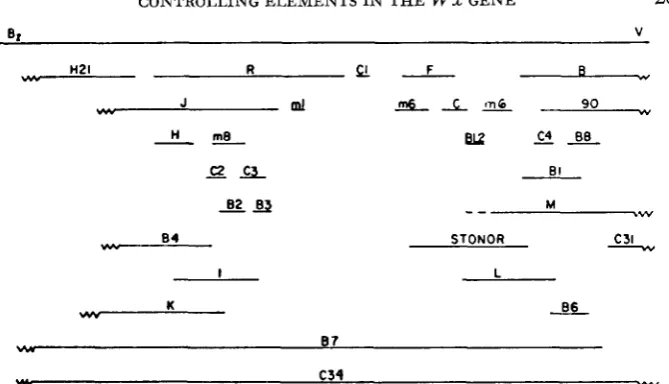
but the map does not delineate the structural and regu-Bf V
H21 R ! 2 F
B
w J In! &L2& 90
c4 Be
U
- -
W
H me
- -
AzsL
BI*W
M
-
82 BJ.- -
w 84 STONOR
-
c31I L
Hh, K 86
FIGURE 7.--Fine-structure map of LUX locus, reprinted from NELSON (1976). Overlapping of lines indicates no detectable recombination between the alleles (< 1.5 x 10⁻⁵ recombination
frequency). Bz and V are flanking markers o n the chromosome.
sites of the controlling-element mutations. Are they in the structural or the ex- ternal regulatory portions of the locus?
The results presented in this paper establish that the structural gene must ex- tend from the sites of the mutations 90 and C31 at the proximal end of the locus (relative to the centromere) to B3 and R in the distal half. A mutation is con- sidered to be in the structural gene if it results in the formation of an altered pro- tein. The Wx proteins specified by these four mutants differ from that specified by the W s allele in that all are enzymatically inactive, since no amylose is pro- duced. Also, the Wx proteins from B3, R, C31 and 90 differ in charge, as deter- mined by isoelectric focusing. Thus, the mutations must involve the structural gene. Control tests with 10 unrelated inbred lines showed no differences in the isoelectric migration of their Wx proteins. so that it is unlikely that such differ- ences are due to natural polymorphisms.
The controlling elements associated with the m-1, m-6 and B3 mutations are clearly situated within the limits of the structural gene. B3 specifies an altered protein, and m-1 and m-6 map between B3 on the left and C31 and 90 on the right. The situation with regard to m-8 and B4, which are closely linked to but lie to the left of B3, is not quite so certain. Neither recombine with the R mutation, which makes an altered Wx protein, but the position of R is not precisely mapped (Figure 7).
282 C . S . E C H T A N D D. S C H W A R T Z
Reversion by transposition of
Ds
presumably involves excision and removal of the controlling element from the affected locus. However, the excision of Ds is not always precise and can leave the gene in a stable, but altered, form such that the protein product of the reverted gene differs from that produced prior to theDs
insertion into the locus (DOONER andNELSON
1979). This appears to be the case with the two stable revertants of m-I, S5 and S I 5 . They are only partially revertant in that they make reduced amounts of amylose. The fact that they show the full amount of Wx protein is further evidence that the Ds element of the m-1 mutation is located within the structural gene. If the alteration in m-I OC- curred i n a regulatory portion of the locus and repressed gene activity so that no Wx protein was produced, the release of repression by transposition would be expected to result in the synthesis of a fully active protein and W x amylose levels. The mutant phenotypes produced by B4, m-2, m-6 and m-8 are the result of the absence or drastic reduction of the amount of the Wx protein and are not due to the production of a n inactive protein, as is the case forB3.
I n the mutants where the Wx protein is absent o r reduced, the transcription. translation or RNA processing may be defective so that no or little protein is synthesized. Alter- nately, a mutant protein may be formed that cannot enter the amyloplast o r bind to the starch granule, or does so inefficiently. The latter alternative would require that the unbound protein be unstable and readily degraded since no pro- teins are observed in whole endosperm SDS extracts of the mutants that are not also seen in similar extracts fromWx
endosperm.The NDP sugar-starch glucosyl tranferase is tightly bound to the starch granule, and the question can be raised as to whether the enzyme is bound to the amylose or amylopectin moiety. FRYDMAN and CARDINI (1 967) presented evi- dence for the binding of the enzyme to amylopectin in potato and pea. The re- sults reported in this paper indicate that, in maize, the enzyme specified by the
Wx
gene can also bind to the amylopectin of the starch granule even though this gene appears to be involved only in the synthesis of amylose, and amylopectin production is not affected in mutants that lack the active enzyme. Mutants B3,90, C31 and R all lack amylose. but there is a strong binding of the Wx protein to the starch granules.
By identifying those
wx
alleles that produce structurally altered proteins it has been possible to set minimal limits to the structural gene on the fine-structure map. With this information, it can be seen that at least three of the wx controlling- element mutations, B3, m-2 and m-6, certainly lie within the limits of the struc- tural gene. Further biochemical studies with the Wx proteins associated with the wx controlling-element mutants should be important in the analysis of the action of eukaryotic transposable elements and gene action i n general.W e thank OLIVER NELSON for providing some of the alleles used in this study. This research was supported by Public Health Service Training Grant #S2 and National Science Foundation Grant PCM 79-21230.
Note Added in Proof:
showed that it behaves as a stable waxy mutant resulting from transposition of the M p element away from the ux locus. In this respect it is similar t o the S5 and SI5 stable mutants recovered from m-I. In contrast to the B3 (M14) allele, which produces no Wx protein, possesses activator activity and shows a low frequency of reversion t o Wx in the endosperm, B3 (W22) produces the normal amount of an altered, inactive W x protein and exhibits neither activator activity nor any sign of reversion. A recombinational analysis, performed according to the method of NELSON
(1968), reveals no detectable recombination between the two B3 alleles. These results support the proposition that the M p element of B3 is located within the limits of the wx structural gene. If its site were outside the coding region of the wx gene, the Wx protein of B3 ( W B ) produced after transposition of the M p element away from the wx locus should be enzymatically active and synthesize amylose.
LITERATURE CITED
BRIMHALL, B., G. F. SPRACUE and J. E. SASS, 1945
BRINK, R. A., 1925
DEMEREC, M., 1924 A case of pollen dimorphism in maize. Am. J. Bot. 11: 461-464. DOONER, H. K. and 0. E. NELSON, 1979
A new waxy allele in corn and its effect on
Mendelian ratios and the gametophyte generation i n angiosperms. Genetics the properties of the endosperm starch. J. Am. Soc. Agron. 37: 937-9M.
10: 359-388.
Heterogeneous flavonoid glucosyltransferns:~ in purple derivatives from a controlling element-suppressed bronze mutant in maize. Proc. Natl. Acad. Sci. U. S. 76: 2369-2371.
Controlling elements in maize. Ann. Rev. Genetics Studies on the biosynthesis of starch: 11. Some proper- ties of the adenosine diphosphate glucose: starch glucosyltransferase bound to the starch granule. J. Biol. Chem. 242: 312-317.
Cleavage of structural proteins during the assembly of the head of
bacteriophage T4. Nature 227: 680-685.
Chromosome organization and genetic expression. Cold Spring Harbor Symp. on Quant. Biol. 16: 13-47.
-
, 1956 Controlling elements and the gene. Cold Spring Harbor Symp. on Quant. Biol. 21: 197-216.-
, 1961 Some parallels between gene control systems in maize and in bacteria. Am. Naturalist 95: 265-277. 1965 The control of gene action in maize. Brookhaven Symp. Biol. 18: 162-184.NELSON, 0. E., 1968 The waxy locus in maize. 11. The location of the controlling element alleles. Genetics 60: 507-524. ---, 1976 Previously unreported W X heteroalleles. Maize Genetics Coop. Newsletter 50: 109-113.
Eiochem. Biophys. Res. Comm. 9: 297-300.
glucosyl transferase activity of wx starch granules. Plant Phys. 62 : 383-386.
detecting proteins in polyacrylamide gels. Anal. Biochemistry 105 : 361-363.
Chem. 250: 4007-4021.
FINCHAM, J. R. S. and G. R. K. SASTRY, 1974 FRYDMAN, R. B. and C. E. CARDINI, 1967
8 : 15-50.
LAEMMLI, U. K., 1970
MCCLINTOCK, B., 1951
__
,
NELSON, 0. E., and H. W. RINES, 1962
NELSON, 0. E., P. S. CHOUREY and M. T. CHANG, 1978
OAKLEY, B. R., D. R. KIRSCH and N. R. MORRIS, 1980
OFARREL, P. H., 1975
The enzymatic deficiency i n the W Q X ~ mutant of maize.
Nucleoside diphosphate sugar-starch
A simplified ultrasensitive silver stain for
High resolution two-dimensional electrophoresis of proteins. J. Biol.
Selection and characterization of a controlling element a t the Adhl locus
A mutable allele a t the Adhl locus of maize. Genetics OsTERntAN, J. C., 1979
of Zea Mays L. Ph.D. Thesis, Indiana Univ., Bloomington, Indiana. OSTERMAN, J. C. and D. SCHWARTZ, 1979
284 C. S. ECHT A N D D. SCHWARTZ
STRAUSS, E. C. and P. KAESBERG, 1970
SPRAGUE, G. F., B. BRIMHALL and R. M. HIXON, 1943
TSAI, C. Y., 1974
WEATHERWAX, P., 1922
Acrylamide gel electrophoresis of bacteriophage QB:
Some effects of the waxy gene in corn on
The function of the W a x y locus in starch synthesis in maize endosperm. Electrophoresis of the intact virions and of the viral proteins. Virology 42: 437-4.52.
properties of the endosperm starch. J. Am. Soc. Agron. 35: 81 7-822.
Biochem. Genetics 11 : 83-96.
A rare carbohydrate in waxy maize. Genetics 7: 568-572.