A preliminary version of this paper appears inAdvances in Cryptology – ASIACRYPT 2002, Lecture Notes in Computer Science, Y. Zheng ed., Springer-Verlag, 2002. This is the full version.
Secure Channels based on Authenticated Encryption
Schemes: A Simple Characterization
Chanathip Namprempre∗
August 29, 2002
Abstract
We consider communication sessions in which a pair of parties begin by running an au-thenticated key-exchange protocol to obtain a shared session key, and then secure successive data transmissions between them via an authenticated encryption scheme based on the session key. We show that such a communication session meets the notion of a secure channel protocol proposed by Canetti and Krawczyk [9] if and only if the underlying authenticated encryption scheme meets two new, simple definitions of security that we introduce, and the key-exchange protocol is secure. In other words, we reduce the secure channel requirements of Canetti and Krawczyk to easier to use, stand-alone security requirements on the underlying authenticated encryption scheme. In addition, we relate the two new notions to existing security notions for authenticated encryption schemes.
Keywords: Secure channels, authenticated encryption, security notions.
∗
Contents
1 Introduction 3
2 Definitions 5
2.1 Preliminaries . . . 5
2.2 Secure Channels per Canetti and Krawczyk [9] . . . 8
2.3 From KE and Authenticated Encryption Schemes to Channel Protocols . . . 9
3 Simple Characterizations of Authenticated Encryption Schemes for Secure Chan-nels 10 4 SINT-PTXT and IND-CCVA are Necessary and Sufficient 12 5 Understanding Secure Channels through SINT-PTXT and IND-CCVA 13 5.1 Privacy Notions . . . 15
5.2 Integrity Notions . . . 15
5.3 Comparing Privacy Notions to Integrity Notions . . . 16
5.4 Discussion . . . 17
A Adversary Actions 19 B Description of the send∗ and incoming∗ Activations 20 C Proofs that SINT-PTXT and IND-CCVA are Necessary and Sufficient 20 C.1 Proof of Lemma C.1 . . . 21
C.2 Proof of Lemma C.2 . . . 24
C.3 Proof of Lemma C.3 . . . 25
1
Introduction
We consider communication sessions in which a pair of parties begin by running an authenticated key-exchange (KE) protocol to obtain a sharedsession key, and then secure successive data trans-missions between them via an authenticated encryption scheme, a shared-key-based encryption scheme whose goal is to provide both privacy and authenticity, based on the session key. Many popular Internet protocols follow this structure [1, 14, 11, 21]. One reason is that it minimizes com-putationally intensive public-key cryptography by using more efficient symmetric-key cryptography for the bulk of the communication.
At Eurocrypt 2001, Canetti and Krawczyk presented security definitions for protocols of this form [9]. They refer to such protocols asnetwork channel protocols (orchannel protocols for short). In their work, they derive a realistic adversarial model from [2] and formulate security definitions using a mixture of both simulation-based and indistinguishability-based approaches. The former allows them to realistically and naturally capture the security properties of channel protocols and the settings in which the protocols are deployed. The latter allows them to prove security of the protocols with relative ease. The result is the notion of secure channels, a notion that captures the desired security properties of the communication channels themselves, rather than those of the components used in constructing them, namely the underlying authenticated encryption schemes. In contrast, most existing work has traditionally focused on security properties of encryp-tion schemes. Examples include indistinguishability noencryp-tions for asymmetric encrypencryp-tion schemes pioneered in [16] and adapted to symmetric-key settings in [3], non-malleability notions defined in [13, 3] and refined in [8], and integrity notions defined in [18, 5, 19]. Due to the simplicity and ease of use of these definitions, this approach has proved fruitful and has become the standard way to prove security of encryption schemes.
Our work uses this traditional approach to investigate security properties of the authenticated encryption schemes underlying channel protocols. In particular, our goal is to address the following question. Suppose one takes a “secure” KE protocol and combines it with an authenticated encryp-tion scheme as described above to obtain a channel protocol. What are the necessary and sufficient conditions on the underlying authenticated encryption scheme for the resulting channel protocol to be a secure channel per [9]? The answer to this question will allow us to analyze security of channel protocols in a modular fashion: first consider the underlying KE protocol and the under-lying authenticated encryption scheme separately, then determine whether the former is “secure” and whether the latter meets the necessary and sufficient conditions. If both are affirmative, then the channel protocol in question is a secure channel. Not only does this approach simplify protocol analysis, but the necessary and sufficient conditions also help distill exactly the security properties of authenticated encryption schemes that are needed to obtain secure channels. This understanding can help guide cryptographers in designing future schemes for building secure channels.
Krawczyk has already made some progress in this direction in [19]: he provides a neces-sary condition for a class of authenticated encryption schemes, namely those constructed via the “Authenticate-then-Encrypt” method,1 to yield a secure channel, assuming that the underlying KE protocol is “secure.” Our goal is to provide both necessary and sufficient conditions that are easy-to-use and can be applied to any authenticated encryption schemes, as opposed to schemes of a certain form. To this end, we use the traditional approach of defining security since it yields definitions that are simple and relatively easy to use.
1
Security model of Canetti and Krawczyk. In [9], Canetti and Krawczyk use the adversarial model of [2]: an adversary is in control of all message delivery and the execution of the protocol. In particular, once the setup phase of the protocol is completed, all parties in the system simply wait for activations from the adversary. Possible activations include sending messages, receiving messages, and establishing a session. Messages are delivered solely by the adversary under either of the following models: the Authenticated-links Model (AM) and the Unauthenticated-links Model (UM). Both models allow the adversary to drop messages and to deliver them out of order. In the former, an adversary cannot inject messages and must deliver messages without modifications. In the latter, it can inject fabricated messages and modify messages before delivering them. Section 2.1 describes the security model of [9] in more detail.
Canetti and Krawczyk also present a security definition for KE protocols based on the approach of [6] in this adversarial model. Intuitively, they consider a KE protocol to be secure if, when the two parties involved in the exchange complete the protocol, (1) they arrive at the same session key, and (2) it is hard for an adversary to distinguish the session key from a random value chosen from the distribution of keys generated by the protocol.
Secure channels. Canetti and Krawczyk define a secure channel as a channel protocol that is both a secure (network) authentication protocol and a secure (network) encryption protocol. The definition of the former uses a simulation-based approach: a protocol secure in this sense must emulate ideal message transmissions where the notion of emulation amounts to computational in-distinguishability of protocol outputs. To this end, [9] defines asession-based message transmission (SMT) protocol, a protocol that does nothing more than its name suggests. For example, to estab-lish a session, a party simply records in its output that a session has been estabestab-lished. To send a message, a party simply puts the message in the message buffer and records in its output that the message has been sent.
The definition of secure encryption protocols applies an indistinguishability-based approach similar to the “find-then-guess” game in [3] (which in turn is an adaptation of semantic security of [16] into the symmetric setting) in this adversarial model. Specifically, the protocol is run in the UM against an adversary which, at some point during the run, chooses a session it wishes to break. The rest of the run closely follows the standard find-then-guess game with a few important exceptions. See Section 2.2 for details.
Capturing the essence of secure channels. Following [9], we define atransform to specify how the channel protocols considered in this paper are generated: given a KE protocolπand an au-thenticated encryption schemeAE, we associate with them a channel protocolNC=NetAE(π,AE) obtained by applying the transform to π and AE. This transform is defined in Section 2.3. We focus on protocols constructed via this transform. Our goal is to find simple necessary and sufficient conditions on the underlying authenticated encryption scheme such that the protocol is a secure channel, assuming that the KE protocol is secure. We define two simple notions: SINT-PTXT and IND-CCVA. The former (resp. the latter) is a necessary and sufficient condition on the un-derlying authenticated encryption scheme such that the channel protocol is a secure authentication (resp. encryption) protocol. In effect, this reduces the secure channel requirements of Canetti and Krawczyk to easier to use, stand-alone security requirements on the underlying authenticated encryption scheme.
Technical issue. The notion of secure authentication protocols captures reasonable authenticity guarantees such as resistance against replay attacks and forgeries. Therefore, to determine if a channel protocol provides authenticity when these attacks are of concern, one needs simply deter-mine whether the protocol is a secure authentication protocol. However, due to a technical issue arisen from the notion of secure encryption protocol per [9], the same cannot be said regarding privacy. In particular, there exists a channel protocol that clearly does not provide semantic secu-rity [16] (i.e., partial information about transmitted messages may be leaked) and yetis provably a secure encryption protocol. Arguably, however, this technical issue does not arise in many practical protocols, including the popular SSH, SSL, and TLS. Consequently, the notion of secure encryption protocol can still be applied to these protocols to obtain meaningful results regarding their privacy guarantees. Section 5 discusses this issue in more detail.
Future work. Canetti and Krawczyk have recently proposed an alternative notion for secure channels that implies their secure channel notion of [9]. This new notion is called universally composable secure channels [10]. It provides strong composability guarantees, which means that its security guarantees hold even if the channel protocol is used in combination with other protocols. Thus, a natural research direction is to determine whether we can use the same approach taken here to derive simple necessary and sufficient conditions for an authenticated encryption scheme to yield a universally composable secure channel.
2
Definitions
2.1 Preliminaries
Since the authenticated encryption schemes considered in [9] have stateful decryption algorithms, we modify the standard syntax of symmetric authenticated encryption schemes, which assumes that decryption algorithms are stateless [3], to allow for stateful decryption algorithms. We also explicitly specify the syntax of a message-driven protocol based on [2, 9] and restate the security model of [9] in more detail here.
Syntax of (symmetric) authenticated encryption schemes. A (symmetric) authenticated encryption scheme AE = (K,E,D) consists of three algorithms. The randomized key generation algorithm K takes as input a security parameter k∈Nand returns a key K; we write K ← KR (k). Theencryption algorithmE could be randomized or stateful. It takes the keyKand aplaintext M
to return aciphertextC; we writeC ← ER K(M). ThedecryptionalgorithmDcould be deterministic, and it could be either stateless or stateful. It takes the key K and a stringC to return either the corresponding plaintextM or the symbol⊥; we writex← DK(C) wherex∈ {0,1}∗∪ {⊥}. Above, a randomized algorithm flips coins anew on each invocation, and a stateful algorithm uses and then updates a state that is maintained across invocations.
Since the decryption algorithm is allowed to be stateful here, the usual correctness condition, which requires that DK(EK(M)) = M for all M in the message space, is replaced with a less stringent condition requiring only that decryption succeed when the encryption and decryption processes are in synchrony. More precisely, the following must be true for any keyKand plaintexts
M1, M2, . . .. Suppose that both EK and DK are in their initial states. For i= 1,2, . . ., let Ci =
(messages that arrive out of order can have arbitrary decryptions under this requirement!).2 The goal here is to ensure that as many encryption schemes as possible can be analyzed under the security notions of interest.
Syntax of message-driven protocols. A message-driven protocol NC = (IG,B,I, x, l, n, r, activation list) consists of three algorithms, four positive integer parameters, and a list ofactivations that can be invoked on a party along with instructions on how the party should handle them. Let
k ∈ N be the security parameter. The parameter n specifies the upper bound of the number of parties in the system. The randomized input generation algorithm IG takes as inputs k and an
x-bit string and returns n strings (x1, . . . , xn). The randomized bootstrapping algorithm3 B takes as inputskand anl-bit string and returnsn+ 1 strings (I0, . . . , In). For each partyPi, the possibly randomizedinitialization algorithm I takes as inputs I0, Ii, xi, and an r-bit string. Executing the initialization algorithm may cause the party to update itsinternal state, to generate outputs to be appended to its local output, and/or to produce messages to be sent to other parties.
Message-driven protocol execution [9]. Let k ∈N be the security parameter. A protocol
NC= (IG,B,I, x, l, n, r,activation list) is executed against an adversary as follows. First, random coins forIG,B,andI are generated, andIG andBare executed. Then, each partyPi executes the initialization algorithmI giving it appropriate inputs as described above. When the initialization algorithm completes, the party waits for incoming activations. Finally, the adversary is run using
k, I0,and as many random coins as it needs. The adversary takes over and activates any parties it wishes to at this point.
Upon receiving an activation, a party executes the corresponding algorithm as specified in
activation list. Again, the result of the execution may be internal state updates, local output generation, and/or outgoing messages. In the last case, the party appends the message in the message buffer Malong with its source, destination, and, in the case of a session-based protocol, the associated session. As an example, upon receiving a “send” activation from the adversary, a party finds the algorithm for handling a send activation in its activation list and executes the algorithm. This typically involves encrypting the message, appending the ciphertext (along with its source, destination, and session ID) to M, and recording the event (e.g., a record to the effect “sent M to P within session s”) in the party’s local output.
Protocol output. The output of a running protocol is the concatenation of the cumulative local outputs of all the parties, together with the output of the adversary. Furthermore, since all actions of the adversary are recorded in the local outputs, they are part of the protocol output.
Session-based message-driven protocols [9]. A session-based message-driven protocol de-fines at least two activations: establish-session andexpire-session. They specify how each party can establish a session between itself and another. We denote by (P, P0, s) a session defined by the initiating partyP, the responding partyP0, and the session IDs. The two partiesP andP0 are said to play the roles of aninitiator and a responder, respectively. Two identical sessions (i.e., identical session IDs, participating parties, and their respective roles) from the point of view of the initiator and the responder are called matching sessions. In other words, if in an execution of a protocol an initiating party P has a session (P, P0, s) and a responding party P0 has a session (P, P0, s), then we say that the two sessions are matching. The defining feature of session-based protocols is
2
Recall thatsyntax andsecurity notion are two separate concepts. Apparently “insecure” schemes such as one that allows arbitrary decryptions for messages that arrive out-of-order are in fact legitimate encryption schemes, i.e. they follow the syntax defined here. However, they are not secure under integrity notions, for instance.
3
that individual sessions are maintained separately from one another even when they are established between the same pair of parties.
Key-exchange protocols. A key-exchange (KE) protocol is a session-based message-driven protocol that specifies how two parties can establish a shared session key to be used during a session. Upon an establish-session activation, a party triggers a sub-protocol to establish a session with another party. This sub-protocol will likely result in further activations such as message sends and receipts. Once the sub-protocol completes, the two parties write on their outputs the resulting session key and mark the entry as “secret.” Note that, although potentially confusing, the term “key-exchange protocol” is commonly used in the literature to refer to this sub-protocol rather than the entire protocol. Upon an expire-session activation of a particular session, the party erases the corresponding session key from its output and any internal state it may have (e.g., its memory) and terminate the session. Notice that this means that a session can be unilaterally expired. The goal of this activation is to allow KE protocols to provideperfect forward secrecy of sessions, a property that past session keys remain secret even after long-term keys are compromised [17, 12].
Network channel protocols. A network channel protocol (or a channel protocol for short) is a session-based message-driven protocol with two additional activations: send andincoming. They specify what a party running the protocol should do to send and to receive a message.
Power of an adversary. When interacting with parties executing a session-based message-driven protocol, an adversary is allowed to access the contents of each party’s local output except those marked as “secret.” It can also perform the followingactions: party activation,party corruption,
session-state reveal, andsession-output reveal. In addition to these actions, an adversary against a KE protocol can also perform a session-key revealaction against a party to obtain a session key. A session is consideredexposed if it belongs to a corrupted party, has been subjected to asession-state reveal, asession-output reveal, asession-key reveal, or has a matching session that has been exposed. For completeness, we include a detailed description of these actions in Appendix A.
Authenticated and unauthenticated links models. In the Authenticated-links Model (AM), the adversary can perform all of the actions mentioned above. Furthermore, all message delivery is performed byA: to deliver a message in the message bufferM, the adversaryAremoves it fromMand activates the receiving party with the message as an incoming message. We empha-size that A can deliver messages in any arbitrary order and can drop messages from M entirely. However, it cannot deliver messages that are not inM, and when it does deliver a message, it must do so without any modifications to the message. On the other hand, in the Unauthenticated-links Model (UM), not only can a UM adversary perform all of the actions permitted to an AM adver-sary, but it can also deliver messages that are not inMor modify messages inMbefore delivering them.
cho-sen and~xis generated viaIG(k, r0). We denote by UNAUTH
π,Uthe ensemble{UNAUTHπ,U(k)}k∈N.
2.2 Secure Channels per Canetti and Krawczyk [9]
In [9], Canetti and Krawczyk define a secure channel as a channel protocol that is both a (secure) authentication protocol and a (secure) encryption protocol. For authentication protocols, their approach is to first define a protocol considered ideal as a message authentication protocol called theSMT protocol. A channel protocol is considered a secure authentication protocol if it emulates the SMT protocol in the UM. Below, we present the concept of protocol emulation, the SMT protocol, and the definition of secure authentication protocols in Definition 2.1, Construction 2.2, and Definition 2.3, respectively.
Definition 2.1 [Protocol Emulation[2, 9]] Let π, π0 be message-driven protocols. We say that
π0 emulates π in the UM if, for any UM adversary U, there exists an AM adversary A such that AUTHπ,A and UNAUTHπ0,U are computationally indistinguishable.
Construction 2.2 [SMT Protocol[9]] The protocolSMTis a session-based message-driven pro-tocol with the following activations: establish-session, expire-session, send, and incoming. Upon an establish-session activation, a party records the event accordingly in its output. Upon an
expire-session activation, a party checks that the session exists, marks the session as expired, and records the event accordingly in its output. When a party receives a send activation involving a message, a partner, and a session ID, it checks that the session is established and is not expired. If so, it sends the given message to its partner via the specified session. Then, it records the event accordingly in its output. Finally, upon an incoming activation, a party checks that the session is established and is not expired. If so, it records the event accordingly in its output.
Definition 2.3 [Network Authentication Protocol Security[9]] A protocol is considered to be a secure authentication protocol if it emulates theSMTprotocol in the UM.
In defining secure encryption protocols, [9] adapts the indistinguishability-based approach to a multi-party computation setting. We present their security definition here. In what follows, the activation send∗(P, Q, s, Mb) has the same effects as send(P, Q, s, Mb) except that the party
Q merely records the fact that a message is sent but not the actual contents of the message, i.e., P records the entry “sent a message to Q within session s”. Similarly, the activation
incoming∗(Q, P, s, C, Mb) has the same effects asincoming(Q, P, s, C) except that, if the decrypted message of C is equal to Mb, then Q merely records the fact that a message is received but not the actual contents of the message Mb, i.e., Q records the entry “received a message from P
within session s”. For completeness, these two activations are defined in detail in Appendix B. Let b be a bit. In the experiment below, an adversary U runs in the UM, and its goal is to break one session of its choice by performing an action called test-session against the session and then doing what it can to guess the bitb. OnceU picks a session, say (P, Q, s), it outputs a pair of messages, say (M0, M1). The sender P is then activated to send Mb. However, if P records in its local output at this point that it sends Mb, then U can easily win the game by simply looking at
P’s output. Therefore,P is activated withsend∗(P, Q, s, Mb), rather than a regularsendactivation. The rest of the run continues in the same way as before except that now the receiving party of the tested session uses incoming∗(Q, P, s, C, Mb) to handle incoming messages. The reason for this is the following: ifQ records all decryptions of incoming ciphertexts, U can easily determine the bit
ciphertext, then seeing what Qwrites on its output. The activationincoming∗ prevents this trivial attack.
Unfortunately, the game in its present form allows U to easily win via another trivial attack. Suppose the tested session is (P, Q, s). First, U picks any message M, activates P with a send
activation to send M toQvia s, and outputs the challenge message pair (M, M0) whereM 6=M0. As a result of the send activation, P encrypts M to obtain a ciphertext C and appends C to the message buffer. Now, U activates the receiver Q with the ciphertext C as an incoming message from P via session s. If Qdoes not record the decrypted message, then C corresponds to M, and thus b = 0. Otherwise, C corresponds to M0, and thus b = 1. Therefore, to prevent this trivial attack, [9] requires that an adversary never ask for an encryption of a particular message more than once. This requirement can be easily implemented using counters. For example, the encryption algorithm can prepend an internal counter to the input message before encrypting the resulting string to obtain the ciphertext. In fact, the use of this mechanism is common in practical Internet protocols including SSH [21], SSL [14], and TLS [11]. Definition 2.4 below describes the security of network encryption protocols more precisely.
Definition 2.4 [Network Encryption Protocol Security[9]] Letk∈N. LetNC= (IG,B,I, x, l, n, r,activation list) be a channel protocol. Let U be a UM attacker, and let rU: N → N be the function specifying the upper bound of the running time ofU in terms ofk. Consider the following experiment:
Experiment ExpindNC-,Une-b(k)
r0 R
← {0,1}x;r00 R
← {0,1}l; r 0
R
← {0,1}rU(k)
(x1, . . . , xn)← IG(k, r0) ; (I0, . . . In)← B(k, r00) For i= 1, . . . , n do ri
R
← {0,1}r; start P
i on (I0, Ii, xi, ri)
RunU on input (k, I0, r0), carrying outU’s actions as specified inNC
. When U submitstest-session(Pi, Pj, s0) and outputs (M0, M1) — ActivatePi with send∗(Pi, Pj, s0, Mb)
. Continue carrying outU’s actions as specified inNC except — Whenever U activates Pj withincoming(Pj, Pi, s0, C),
ActivatePj withincoming∗(Pj, Pi, s0, C, Mb) instead UntilU halts and outputs a bit d
Outputd
Above, it is required that U submit only one test-sessionquery and that it not expose the tested session thereafter. Furthermore, for the tested session, we require that U never invoke send acti-vations involvingM0 or M1 and also never invoke send activations involving a particular message more than once. We define the advantage of the adversary via
AdvindNC,U-ne(k) = Pr[ExpindNC-,Une-1(k) = 1 ]−Pr[ExpindNC-,Une-0(k) = 1 ].
The channel protocol NC is said to be a secure encryption protocol in the UM if the function AdvindNC-,Une(·) is negligible for any UM adversary U whose time-complexity is polynomial in k.
2.3 From KE and Authenticated Encryption Schemes to Channel Protocols
Construction 2.5 [Transform [9]] Let π = (IG,B,I, x, l, n, r,activation list) be a KE protocol, and letAE = (K,E,D) be an authenticated encryption scheme. We associate withπandAEa chan-nel protocolNAE=NetAE(π,AE) = (IG,B,I, x, l, n, r,alist) wherealistcontains the activations in
activation list together with the following activations.
1. establish-session(Pi, Pj, s,role): This triggers a KE-session under π within Pi with partner Pj, session IDs, androle ∈ {initiator,responder}. If the KE-session completes,Pi records in its local output the entry “established session s with Pj” and the generated session key marked as “secret.” Otherwise, no action is taken.
2. expire-session(Pi, Pj, s): If the session (Pi, Pj, s) exists at Pi, the party Pi marks the session as expired and erases the session key. Then, Pi records in its local output “expired session s
with Pj”. Otherwise, no action is taken.
3. send(Pi, Pj, s, M): The party Pi checks that the session (Pi, Pj, s) has been completed and not expired. If so, it computesC ← ER K(M) using the corresponding session keyK, puts (Pi, Pj, s, C) in the message bufferM, and records “sent M to Pj within session s” in the local output. Otherwise, no action is taken.
4. incoming(Pj, Pi, s, C): The party Pj checks that the session (Pi, Pj, s) has been completed and not expired. If so, it computesM ← DK(C) under the corresponding session keyK. IfM 6=⊥, then Pj records “received M from Pi within session s”. Otherwise, no action is taken.
3
Simple Characterizations of Authenticated Encryption Schemes
for Secure Channels
We propose two new security notions for authenticated encryption schemes: SINT-PTXT (for strong integrity of plaintexts) and IND-CCVA (for indistinguishability against chosen-ciphertext attacks with verification). The goal is to capture the necessary and sufficient properties of the authenticated encryption scheme such that, once the transform per Construction 2.5 is applied to the scheme and a KE protocol, the resulting channel protocol is a secure channel, assuming that the KE protocol “securely implements” the key generation algorithm of the authenticated encryption scheme. We postpone a precise definition of the term in quotes to Section 4. In what follows, we usex←R f(y) to denote the process of running a possibly randomized algorithmf on an inputyand assigning the result to x. IfA is a program, A⇐ x means “return x toA.” The time-complexity referred to in our definitions is the worst case total execution time of the entire experiment, plus the size of the code of the adversary, in some fixed RAM model of computation. Also, oracles corresponding to stateful algorithms maintain their states across invocations.
First, we capture the notion of a secure authentication protocol with SINT-PTXT. Recall that a protocol is considered a secure authentication protocol if it emulates the SMT protocol in the UM where SMTis an ideal session-based message transmission protocol. Under theSMTprotocol in the AM, when a party sends a message M to another party, the message M is simply put on the buffer. Since the adversary is operating in the AM, it can drop messages but cannot modify or inject messages. Therefore, a secure authentication protocol must ensure that each sent message is received at most once (i.e., replay attacks are unsuccessful), and that its contents are left intact.
a message that is not in the multisetT, i.e., the message is not one of those waiting to be received, then it wins.
Definition 3.1 [SINT-PTXT] Let AE = (K,E,D) be an authenticated encryption scheme. Let
k∈N. LetAbe an adversary with access to two oracles. Consider the following experiment. Experiment ExpsintAE,A-ptxt(k)
K← KR (k) ; T ← ∅ // T is a multiset RunAEK(·),DK(·)(k)
Reply toEK(M) as follows:
C← ER K(M) ; T ←T ∪ {M}; A⇐C Reply toDK(C) as follows:
M ← DK(C)
IfM =⊥Then A⇐M
Else IfM ∈T Then T ←T − {M}; A⇐M
Elsereturn 1 UntilA halts
Return 0
We define the advantage of the adversary via
AdvsintAE,A-ptxt(k) = Pr[ExpsintAE,A-ptxt(k) = 1 ].
The schemeAE is said to beSINT-PTXT secure if the functionAdvsintAE,A-ptxt(·) is negligible for any adversaryA whose time-complexity is polynomial in k.
Now, we capture the notion of a secure encryption protocol. To capture an adversary’s ability to obtain encryption and decryption of messages and ciphertexts of its choice, we give it access to an encryption oracle EK(·) and a decryption oracle DK(·). The definition follows that of [9] closely and straightforwardly. Let b ∈ {0,1}. Recall that, in the definition of secure encryption protocol per [9], once the adversary outputs a challenge message pair (M0, M1), the receiver of the tested session does not record the decrypted message if it is equal to the secret message Mb. Therefore, we capture this through an oracle denoted by DK(·, Mb). This oracle is the same as the standard decryption oracleDK(·) except the following. If a given ciphertext decrypts toMb, then the oracle
DK(·, Mb) returns a special symbol±. Otherwise, it returns the decrypted message. Additionally, since an adversary in the definition per [9] cannot obtain encryptions of a particular message more than once, we also impose the same restriction on the adversary in our experiment.
Definition 3.2 [IND-CCVA] Let AE = (K,E,D) be an authenticated encryption scheme. Let
b∈ {0,1}andk∈N. LetAbe an adversary that has access to three oracles. Consider the following experiment.
Experiment ExpindAE-,Accva-b(k)
K← KR (k)
(M0, M1, st)←AEK(·),DK(·)(k,find)
C← ER K(Mb)
d←AEK(·),DK(·,Mb)(k,guess, C, st)
Returnd
that A never query EK(·) on M0 orM1 and also never query EK(·) on a particular message more than once. We define theadvantage of the adversary via
AdvindAE-,Accva(k) = Pr[ExpindAE-,Accva-1(k) = 1 ]−Pr[ExpindAE-,Accva-0(k) = 1 ].
The scheme AE is said to be IND-CCVA secure if the function AdvindAE-,Accva(·) is negligible for any adversaryA whose time-complexity is polynomial in k.
4
SINT-PTXT and IND-CCVA are Necessary and Sufficient
Our results use Definition 4.1 below. It describes how a key generation algorithm of an authenti-cated encryption scheme should relate to a KE protocol of a channel protocol based on the authen-ticated encryption scheme. In particular, the KE protocol should “implement” the key generation algorithm, meaning that two parties that have completed the KE protocol with each other should end up with the same key which in turn should be drawn from the distribution generated by the key generation algorithm. The definition, which is adapted from [9], captures this property more precisely via the following game. Let k ∈N be the security parameter. Let Π be a session-based message-driven protocol that includes a KE protocolπas a sub-protocol, and letU be a UM adver-sary running against Π. The adveradver-sary U can carry out actions specified in Π plus one additional activation, namely atest-session-keyquery, against at most one unexpired and unexposed session s
whose KE portion is completed. From this point on,U is not allowed to expose the tested session. Once U perform a test-session-key query, a bit b is chosen at random. If b = 0, then U receives the session key for s. Otherwise, it receives a value r ← KR (k). The adversary wins if it correctly guesses the bitb.
Definition 4.1 [Securely Implementing a Key Generation Algorithm via a Key Ex-change Protocol.] Let k ∈ N be the security parameter. A KE protocol π is said to securely implementa key generation algorithmKin the UM during the run of a protocol if, for any adversary
U in the UM,
— When an uncorrupted party completes π with another uncorrupted party, they both arrive at the same session key, AND
— U wins the game above with probability no more than 1/2 plus a negligible function ofk. We present our main results here. They state that, respectively, SINT-PTXT and IND-CCVA are necessary and sufficient for the notions of network authentication and network encryption of Canetti and Krawczyk [9]. We present the theorems and their proof ideas below. The full proofs in detail are in Appendix C. For brevity, we write X ≈s Y when the ensembles X and Y
are statistically indistinguishable. Note that statistical indistinguishability implies computational indistinguishability.
Theorem 4.2 [Given a secure KE, SINT-PTXT ⇔ Secure Authentication Protocol] Let AE = (K,E,D) be an authenticated encryption scheme, and let π be a KE protocol. Let
NAE=NetAE(π,AE) be the associated channel protocol as per Construction 2.5. Suppose thatπ
securely implementsK in the UM during the run ofNAE. Then,AE is SINT-PTXT secure if and only if NAE is a secure authentication protocol.
AUTHSMT,A s
≈UNAUTHNAE,U. The crux of this proof is essentially the same as that of Theorem 12 of [9], and thus, we do not discuss it further.
For the “only if” direction, we show that, given any sint-ptxt adversary F against AE, we can construct a UM adversary U against NAE such that, for any AM adversaryA against SMT, AUTHSMT,A 6
s
≈UNAUTHNAE,U as follows. The adversary U starts two parties P1 and P2. Then, it activates P1 with establish-session(P1, P2, s,initiator) and runs F. Whenever F submits an en-cryption query EK(M), the adversary U activates the party P1 with send(P1, P2, M, s). Similarly, whenever F submits a decryption query DK(C), the adversary U activates the party P2 with
incoming(P2, P1, C, s). Recall that a successful sint-ptxt adversary F can essentially replay a mes-sage or forge a ciphertext the decrypts to a previously-unseen mesmes-sage. Since such actions are not allowed in the AM, there can be no AM adversaries that can generate the global output that is statistically indistinguishable from that generated by U.
Theorem 4.3 [Given a secure KE, IND-CCVA ⇔ Secure Encryption Protocol] Let
AE = (K,E,D) be an authenticated encryption scheme, and let π be a KE protocol. Let NAE =
NetAE(π,AE) be the associated channel protocol as per Construction 2.5. Suppose that πsecurely implements K in the UM during the run of NAE. Then, AE is IND-CCVA secure if and only if
NAE is a secure encryption protocol.
We sketch the proof for each direction of the “if and only if,” assuming throughout thatπ securely implementsK. For the “if” direction, we show that, given any ind-ne adversaryU againstNAE, we can construct an ind-ccva adversaryAagainstAE such that A’s success probability is no less than that of U divided by the total number of sessions established by U over its run. The adversary
A simply simulates U as in the experiment ExpNAEind-ne,U-b(k) (where b is a bit) with one exception: during the find phase,A chooses a session at random and uses its oracles to encrypt and decrypt messages in this session. IfU submits atest-sessionquery on the chosen session and outputs a pair of test messages, Adoes too. (Otherwise, Aaborts.) Then, Aenters itsguess phase and continues the simulation exactly as before. It halts and outputs whatU outputs. Sinceπsecurely implements
K, the adversaryA correctly simulatesU. Thus, it succeeds if U does.
For the “only if” direction, we show that, given any ind-ccva adversary A against AE, we can construct an ind-ne adversary U against NAE such that U’s success probability is no less than that of U using a similar technique as before: U establishes a session between two parties, then runs A, answering its encryption and decryption queries by makingsend and incoming activations respectively for the session. Finally, U halts and outputs what A outputs. Since π securely implements K, the adversaryU correctly simulates A. Thus, it succeeds if Adoes.
5
Understanding Secure Channels through SINT-PTXT and
IND-CCVA
We explore the new notions by taking the standard approach of relating them to familiar notions. Since the two notions are necessary and sufficient for secure channels, the knowledge we gain from this exercise is applicable to secure channels as well. In our comparisons, we use the following terminology. SupposeX andY are security notions. We say thatX implies Y if any scheme secure underX is secure under Y. We say thatX doesnot imply Y if there exists an encryption scheme that is secure under X but is insecure under Y. We say that A is equivalent to B ifA implies B
privacy integrity
IND-CCA IND-CCVA
IND-CPA
SINT-PTXT INT-CTXT
INT-PTXT
[4] [5]
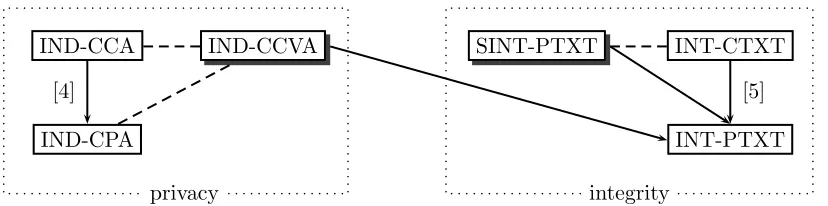
Figure 1: Relations among notions of symmetric encryption: An arrow from a notion X
to a notion Y denotes that X is strictly stronger than Y. A dashed line between a notion X
and a notion Y denotes that the two notions are incomparable. The relations established in other papers are annotated with the corresponding citations. For simplicity, only interesting relations are shown here. We emphasize that the existing notions in this figure (those in unshadowed frames) are variants of the standard notions in the literature. In particular, the oracles here maintain states across invocations.
In this section, we discuss relations among notions of symmetric encryption as summarized in Figure 1. Our strategy for showing that X implies Y is the standard reduction approach: given an adversary that successfully breaks the scheme under the notion Y, construct an adversary that successfully breaks the scheme under the notion X. To show that X does not imply Y, we start with a scheme secure underX, then modify it to obtain a scheme that remains secure underX but is insecure under Y.
The standard privacy notions we consider here are indistinguishability under chosen-plaintext and adaptive chosen-ciphertext attacks (IND-CPA and IND-CCA). The original definitions of these notions were in the asymmetric setting [16, 15, 13, 20] but can be “lifted” to the symmetric setting using the encryption oracle based template of [3]. We use the “find-then-guess” definitions per [3] throughout our discussions here. In particular, for both notions, an adversary A plays a game in which it is to “find” a pair of challenge messages (M0, M1), obtain the ciphertext corresponding to the encryption of one of the challenge messages, and then “guess” a bit indicating to which challenge message the ciphertext corresponds. For IND-CPA, A is given access to an encryption oracle throughout the game. For IND-CCA,A is given access to both an encryption oracle and a decryption oracle throughout the game. (This notion is also known as IND-CCA2 [4].)
The integrity notions considered here are integrity of plaintexts [5] and integrity of ciphertexts [7, 18, 5]. An adversary attacking a scheme under these notions is given access to two oracles: a standard encryption oracle and a verification oracle— an oracle that returns a bit indicating whether the given ciphertext is valid, i.e., whether it decrypts to ⊥. An adversary succeeds in breaking a scheme under the INT-PTXT notion if it can forge a ciphertext that decrypts to a “new” message, i.e., a message that has not been submitted to the encryption oracle before. Similarly, it succeeds in breaking a scheme under the INT-CTXT notion if it can forge a “new” and valid ciphertext, i.e., a valid ciphertext that has not been returned by the encryption oracle.
that, this modification notwithstanding, the relations among existing notions shown in [4] and [5] remain the same. It is also easy to see that any schemes secure under the original definitions are secure under the definitions with this modification. Henceforth, we use the original names to refer to the modified definitions.
Now we justify all relations among the six notions shown in Figure 1 although the figure only shows some of them. We group the justifications of the relations into three categories: those for relations among privacy notions, those for relations among integrity notions, and those for relations across the two categories. Not all of the relations are interesting. Nonetheless we include them all here for completeness. We conclude this section with a brief discussion.
5.1 Privacy Notions
IND-CCA 6=⇒ IND-CCVA. We show that IND-CCA does not imply IND-CCVA. The idea here
is to construct an encryption scheme for which there exists a valid ciphertext whose decryption is known but the ciphertext itself is never produced. This allows an ind-ccva adversary to submit a valid ciphertext to the decryption oracle without the help of the encryption oracle and to then use the decryption oracle’s response to its advantage. In more detail, given an IND-CCA secure scheme SE, we construct a scheme SE0 as follows. The key generation remains the same. The encryption algorithm prepends a bit 0 to all ciphertexts. The decryption algorithm strips the first bitboff of the input ciphertext. Ifb= 0, then it returns the decryption of the rest of the ciphertext. Otherwise, it returns a single bit 0. It is easy to see that SE0 is IND-CCA secure. (In fact, this is shown in the proof of Proposition 3.3 in [5].) However,SE0 is not secure under IND-CCVA. An adversary can simply output a pair of bits (0,1) as the challenge messages then request for the decryption of the ciphertext 10. If the oracle’s response is ±, then it outputs 0. Otherwise, it outputs 1. It wins with probability one.
IND-CCVA6=⇒IND-CPA. Recall that, in the definition of secure encryption protocols, an ind-ne
adversary U is not allowed to submit send activations involving a particular message more than once for the tested session. This translates into a similar restriction for ind-ccva adversaries since IND-CCVA is necessary and sufficient for the notion of secure encryption protocols. Unfortunately, under this restriction, one can show that there exists a stateless and deterministic encryption scheme secure under IND-CCVA. An example of such a scheme is presented in Appendix D. Now, it is well-known that stateless deterministic encryption schemes are not secure under the standard privacy notions. Furthermore, it is easy to see that they are not secure under the variant of the privacy notions with stateful oracles considered here. Consequently, this means that IND-CCVA does not imply IND-CPA and IND-CCA.
IND-CPA 6=⇒ IND-CCVA. Since IND-CCA does not imply IND-CCVA and since IND-CCA
implies IND-CPA, we have that IND-CPA does not imply IND-CCVA.
IND-CCVA 6=⇒ IND-CCA. Since IND-CCVA does not imply IND-CPA and since IND-CCA
implies IND-CPA, we have that IND-CCVA does not imply IND-CCA.
5.2 Integrity Notions
SINT-PTXT =⇒ INT-PTXT. The reasoning behind this relation is simple. If an adversary can
INT-PTXT6=⇒SINT-PTXT.To show this relation, we simply use a stateless scheme secure under INT-PTXT. Being stateless, it is thus insecure under SINT-PTXT. An example of a scheme we can use for this purpose is a stateless scheme constructed via the encrypt-then-MAC composition4 as defined and shown in [5] to be INT-PTXT secure if the underlying MAC and encryption schemes are secure. Note that this does not contradict the result in [9] since the encrypt-then-MAC composition defined there is stateful.
INT-CTXT6=⇒SINT-PTXT.The reason is similar to the previous case. Consider stateless schemes
constructed via the encrypt-then-MAC composition as defined and shown in [5] to be INT-CTXT secure if the underlying MAC and encryption schemes are secure (the security assumption on the MAC here is stronger than in the case of INT-PTXT security above). Being stateless, however, they are not secure under SINT-PTXT.
SINT-PTXT 6=⇒INT-CTXT. Consider a scheme secure under SINT-PTXT. It is easy to see that
adding a redundant bit to every ciphertext generated via this scheme yields a scheme that is insecure under INT-CTXT (ciphertexts can now be easily forged) but is still secure under SINT-PTXT (the underlying messages are unaffected and so will still be hard to forge).
5.3 Comparing Privacy Notions to Integrity Notions
No integrity notions imply privacy notions. We show a simple scheme secure under all of the
integrity notions but does not provide any privacy. The scheme uses a secure MAC scheme to obtain INT-PTXT and INT-CTXT in a straightforward manner. Furthermore, to ensure SINT-PTXT, it also uses an internal counter. To ensure that it does not provide privacy, we transmit each plaintext message as part of the ciphertext. In more detail, consider the scheme SE defined as follows. Both encryption and decryption algorithms maintain internal counter. To encrypt a message, the encryption algorithm increments its internal counter, prepends the counter to the message, MAC the resulting string, and finally outputs the message and the resulting tag. To decrypt a ciphertext, the decryption algorithm increments its internal counter, computes the MAC of the concatenation of its counter and the message portion of the ciphertext, compares the resulting MAC to the tag part of the ciphertext, and outputs the message if they match. It is easy to see that SE is secure under SINT-PTXT as well as INT-PTXT and INT-CTXT, assuming that the underlying MAC is secure. Furthermore, since messages are transmitted in the clear, SE clearly does not provide any privacy.
No privacy notions imply SINT-PTXT.We know that schemes with stateless decryption algorithms
are not SINT-PTXT secure. However, there are plenty of schemes with stateless decryption algo-rithms secure under IND-CCA and IND-CPA. Furthermore, the scheme in Appendix D shown to be secure under IND-CCVA also has a stateless decryption algorithm.
Neither IND-CCA nor IND-CPA imply INT-PTXT or INT-CTXT. This is implied by the fact
that IND-CCA does not imply INT-PTXT shown in [5].
IND-CCVA=⇒ INT-PTXT. LetAE be an authenticated encryption scheme. Suppose that there
exists an int-ptxt adversary A. In particular,A can forge a ciphertextC of a message M that has not been previously encrypted, i.e., it can generate C on its own without ever submitting M to
4
the encryption oracle. Then, we construct an ind-ccva adversaryA0 as follows. First,A0 forges the ciphertext C corresponding to a message M in the find stage, outputs (M, M0) whereM 6=M0 as the challenge message pair, then submitCto the decryption oracle in the guess stage. If it receives the special symbol±as a response, then it returns 0. Otherwise, it returns 1. Thus,A0 is successful ifA is successful.
IND-CCVA6=⇒ INT-CTXT.The reasoning behind this relation is simple. SupposeSE is a scheme
secure under IND-CCVA. Consider a scheme SE0 that is almost identical to SE except that its encryption algorithm appends to all ciphertexts a bit that is ignored by the decryption algorithm. It is easy to show that SE0 remains IND-CCVA secure. However, it is clearly insecure under INT-CTXT.
5.4 Discussion
First, we comment that, as Figure 1 shows, SINT-PTXT is reasonably strong: it implies INT-PTXT but not the stronger notion of INT-CTXT. Also, an integrity notion, specifically INT-PTXT, turns out to be necessary for IND-CCVA, a privacy notion.
Being a necessary and sufficient characterization of secure encryption protocol of [9], IND-CCVA is not meant to constitute a complete security measure on its own. Rather, it guarantees secrecy only in conjunction with additional mechanisms that guarantee uniqueness of messages. Consequently, it may be surprising at first glance that IND-CCVA emerges as a notion that is incomparable to both IND-CPA and IND-CCA. In particular, IND-CCVA does not imply even a weak notion of privacy such as IND-CPA. Moreover, it is easy to see that a channel protocol constructed from the stateless deterministic encryption scheme used to prove the relation that IND-CCVA does not imply IND-CPA (i.e., that in Appendix D) does not provide the stateful variant of semantic security either. The unfortunate implication here is that channel protocols proven secure as an encryption protocol may in fact leak information. This is a rather unexpected result since one would naturally assume that a secure encryption protocol should protect privacy of transmitted information. On the other hand, it is also arguably simply a technical issue that does not arise in many cases in practice. As pointed out in [9], if one can ensure that all messages are unique, then one can obtain security. (In particular, this requirement rules out the stateless deterministic encryption scheme in Appendix D.) One way to ensure uniqueness of messages is to simply prepend unique message IDs to all messages and to verify them when ciphertexts are received. In fact, many Internet protocols in use today (e.g., SSH, SSL, and TLS) already do so: they include in every packet a sequence number maintained internally by the communicating parties [14, 11, 21].
Acknowledgments
I thank Mihir Bellare for his guidance and advice throughout the research and writing process for this paper. I also thank Ran Canetti and Hugo Krawczyk for their insights and comments especially regarding the notion of secure channels. Finally, I thank Tadayoshi Kohno, Bogdan Warinschi, and Alexandra Boldyreva for their helpful comments on earlier versions of this draft. The author is supported in part by a 1996 Packard Foundation Fellowship in Science and Engineering and NSF CAREER Award CCR-9624439.
References
[2] M. Bellare, R. Canetti, and H. Krawczyk. Modular approach to the design and analysis of key exchange protocols. In Proceedings of the 30th Annual ACM Symposium on Theory of Computing, pages 419–428, New York, NY, May 23–26 1998. ACM Press.
[3] M. Bellare, A. Desai, E. Jokipii, and P. Rogaway. A concrete security treatment of symmet-ric encryption. In Proceedings of the 38th Annual Symposium on Foundations of Computer Science, pages 394–403. IEEE Computer Society Press, 1997.
[4] M. Bellare, A. Desai, D. Pointcheval, and P. Rogaway. Relations among notions of security for public-key encryption schemes. In H. Krawczyk, editor, Advances in Cryptology – CRYPTO ’98, volume 1462 of Lecture Notes in Computer Science, pages 26–45. Springer-Verlag, Berlin Germany, August 1998.
[5] M. Bellare and C. Namprempre. Authenticated encryption: Relations among notions and analysis of the generic composition paradigm. In T. Okamoto, editor,Advances in Cryptology – ASIACRYPT 2000, volume 1976 of Lecture Notes in Computer Science, pages 531–545. Springer-Verlag, Berlin Germany, December 2000.
[6] M. Bellare and P. Rogaway. Entity authentication and key distribution. In Y. Desmedt, editor, Advances in Cryptology – CRYPTO ’94, volume 839 of Lecture Notes in Computer Science, pages 232–249. Springer-Verlag, Berlin Germany, 1994.
[7] M. Bellare and P. Rogaway. Encode-then-encipher encryption: How to exploit nonces or redun-dancy in plaintexts for efficient cryptography. In T. Okamoto, editor,Advances in Cryptology – ASIACRYPT 2000, volume 1976 of Lecture Notes in Computer Science, pages 317–330. Springer-Verlag, Berlin Germany, December 2000.
[8] M. Bellare and A. Sahai. Non-malleable encryption: Equivalence between two notions, and an indistinguishability-based characterization. In E. Brickell, editor, Advances in Cryptology – CRYPTO ’99, volume 740 ofLecture Notes in Computer Science, pages 519–536. Springer-Verlag, Berlin Germany, August 1999.
[9] R. Canetti and H. Krawczyk. Analysis of key-exchange protocols and their use for building secure channels. In B. Pfitzmann, editor, Advances in Cryptology – EUROCRYPT 2001, volume 2045 of Lecture Notes in Computer Science, pages 451–472. Springer-Verlag, Berlin Germany, 2001.
[10] R. Canetti and H. Krawczyk. Universally composable notions of key exchange and secure channels. In L. Knudsen, editor,Advances in Cryptology – EUROCRYPT 2002, volume 2332 ofLecture Notes in Computer Science, pages 337–351. Springer-Verlag, Berlin Germany, 2002. [11] T. Dierks and C. Allen. The TLS protocol: Version 1.0. RFC 2246, 1999.
[12] W. Diffie, P. van Oorschot, and M. Wiener. Authentication and authenticated key exchanges. Designs, Codes and Cryptography, 2(2):107–125, June 1992.
[13] D. Dolev, C. Dwork, and M. Naor. Non-malleable cryptography. In Proceedings of the 23rd Annual ACM Symposium on Theory of Computing, pages 542–552, New Orleans, Louisiana, May 6–8 1991. ACM Press.
[15] O. Goldreich. A uniform complexity treatment of encryption and zero-knowledge. Journal of Cryptology, 6(1):21–53, 1993.
[16] S. Goldwasser and S. Micali. Probabilistic encryption. Journal of Computer and System Science, 28:270–299, 1984.
[17] C. G¨unther. An identity-based key-exchange protocol. In J-J. Quisquater and J. Vandewille, editors,Advances in Cryptology – EUROCRYPT ’89, volume 434 ofLecture Notes in Computer Science, pages 29–37. Springer-Verlag, Berlin Germany, April 1990.
[18] J. Katz and M. Yung. Unforgeable encryption and chosen ciphertext secure modes of operation. In B. Schneier, editor, Fast Software Encryption 2000, volume 1978 of Lecture Notes in Computer Science, pages 284–299. Springer-Verlag, Berlin Germany, April 2000.
[19] H. Krawczyk. The order of encryption and authentication for protecting communications (or: How secure is SSL?). In J. Kilian, editor, Advances in Cryptology – CRYPTO 2001, volume 2139 ofLecture Notes in Computer Science, pages 310–331. Springer-Verlag, Berlin Germany, August 2001.
[20] C. Rackoff and D. Simon. Non-interactive zero-knowledge proof of knowledge and chosen ciphertext attack. In J. Feigenbaum, editor, Advances in Cryptology – CRYPTO ’91, volume 576 ofLecture Notes in Computer Science, pages 433–444. Springer-Verlag, Berlin Germany, August 1991.
[21] T. Ylonen, T. Kivinen, M. Saarinen, T. Rinne, and S. Lehtinen. SSH transport layer protocol, 2002. Draft, available at http://www.ietf.org/internet-drafts/ draft-ietf-secsh-transport-14.txt.
A
Adversary Actions
An adversaryArunning against a session-based message-driven protocol can perform the first four actions below. An adversary A against a key exchange protocol can perform all of the actions below.
1. Party activation. Theactivation listspecifies what can be activated on a party. Examples include asking a party to send a message to,receive a message from, orestablish a session with another party. An adversary can also ask a party to expire an existing session. This causes the party to permanently erases all state information relevant to the session.
2. Party corruption. A obtains from a party all of its state, including its long-term secrets. The party appends to its output the entry “corrupted” and terminates. It generates no further output.
3. Session-state reveal. Aobtains from a party the portion of its state that is “local” to the specified session. The protocol specifies what information is considered “local” to a session. This query is valid only for sessions that have not completed. The party appends to its output the entry “revealed state of (P, P0, s)” where (P, P0, s) is the session being revealed.
5. Session-key reveal. Aobtains from a party the session key for the specified session which must be completed but has not expired. The party appends to its output the entry “revealed session key for (P, P0, s)” where (P, P0, s) is the session in question.
B
Description of the
send
∗and
incoming
∗Activations
LetNCbe a network channel protocol. Letk∈Nbe the security parameter, let b∈ {0,1}, and let
U be a UM attacker. The activations send∗ and incoming∗ used in the experiment ExpNCind-,Une-b(k) are defined as follows.
Activation send∗(Pi, Pj, s, M) atPi
If the session (Pi, Pj, s) is expired or exposed, then return
If the key exchange protocol for the session (Pi, Pj, s) is not completed, then return
C← EK(M) whereK is the session key for the session (Pi, Pj, s) Record “sent a message to Pj within session s” onPi’s output Put (Pi, Pj, s, C) in the message buffer M
Activation incoming∗(Pj, Pi, s, C, Mb) at Pj If the session (Pi, Pj, s) is expired, then return
If the key exchange protocol for the session (Pi, Pj, s) is not completed, then return
M ← DK(C) whereK is the session key for the session (Pi, Pj, s)
IfM =Mb then record “received a message from Pi within session s” onPj’s output else ifM 6=⊥then record “received M from Pi within session s” on Pj’s output
C
Proofs that SINT-PTXT and IND-CCVA are Necessary and
Sufficient
We state the lemmas from which Theorem 4.2 and Theorem 4.3 directly follow. Lemma C.1 and Lemma C.2 prove the former. Lemma C.3 and Lemma C.4 prove the latter. Then, we present their proofs in detail.
Lemma C.1 [Given a secure KE, SINT-PTXT⇒ Secure Authentication Protocol] Let
AE = (K,E,D) be an authenticated encryption scheme, and let π be a KE protocol. Let NAE =
NetAE(π,AE) be the associated channel protocol as per Construction 2.5. Suppose that πsecurely implementsK in the UM during the run ofNAE. IfAE is SINT-PTXT secure, then given any UM adversaryU againstNAE, we can construct an AM adversary Aagainst SMTsuch that
AUTHSMT,A s
≈UNAUTHNAE,U .
Lemma C.2 [Given a secure KE, SINT-PTXT⇐ Secure Authentication Protocol] Let
AE = (K,E,D) be an authenticated encryption scheme, and let π be a KE protocol. Let NAE =
NetAE(π,AE) be the associated channel protocol as per Construction 2.5. Suppose that πsecurely implements K in the UM during the run of NAE. Then, given any sint-ptxt adversary F against
AE, we can construct a UM adversary U against NAE such that, for any AM adversary Aagainst
SMT,
AUTHSMT,A6 s
Lemma C.3 [Given a secure KE, IND-CCVA⇒ Secure Encryption Protocol] LetAE = (K,E,D) be an authenticated encryption scheme, and let π be a KE protocol. Let NAE =
NetAE(π,AE) be the associated channel protocol as per Construction 2.5. Suppose that π se-curely implements K in the UM during the run of NAE. Then, given any ind-ne adversary U
againstNAE, we can construct an ind-ccva adversaryA against AE such that AdvindNAE-ne,U(k)≤S·AdvindAE-,Accva(k)
where U establishes at most S sessions and A’s time-complexity is polynomially-related to that of U.
Lemma C.4 [Given a secure KE, IND-CCVA⇐ Secure Encryption Protocol] LetAE = (K,E,D) be an authenticated encryption scheme, and let π be a KE protocol. Let NAE =
NetAE(π,AE) be the associated channel protocol as per Construction 2.5. Suppose that π se-curely implements K in the UM during the run of NAE. Then, given any ind-ccva adversary A
againstAE, we can construct an ind-ne adversaryU againstNAE such that AdvindAE-,Accva(k)≤AdvindNAE-ne,U(k).
Furthermore,U’s time-complexity is polynomially-related to that of A.
C.1 Proof of Lemma C.1
Proof Idea. The crux of this proof is the same as that of Theorem 12 of [9]. Let k ∈ N and
i∈ {1, . . . , n}. Given a UM adversary U, we construct an AM adversaryA. We denote the parties interacting with A and U by Pi and Pi0, respectively. To run U, the AM adversary A simulates the partiesP0
i by carrying out all requests and activations from U by itself onPi0’s behalf and only makes requests and activations to a party Pi for events that have been recorded and events that involve corruption or exposure of a party.
Then, we show that for any security parameter k ∈ N, any UM adversary U, and the AM adversaryAdefined above, ifAE is SINT-PTXT secure, then the random variables AUTHSMT,A(k) and UNAUTHNAE,U(k) are statistically indistinguishable.
We do so by first arguing that, for any k ∈ N, if AUTHSMT,A(k) and UNAUTHNAE,U(k) are statistically distinguishable, then a forgery event has occurred. Before defining a forgery event, we first describe the concept of matching entries. An entry in the local output of a party Pi that reads “sent M to Pj within session s” is said to be a match of an entry in the local output of a partyPj that reads “received M from Pi within session s”. We mandate that once two entries are matched, they cannot be matched with any other entries, in which case we say that they become unavailable. An entry that has not been matched (i.e., is not unavailable) is considered available. A forgery event is an event in which the local output of a partyPjcontains an entry of the form “received M from Pi within session s” while the local output ofPi does not contain an available matching entry. In other words, a forgery event occurs if, for some M, Pi, Pj,and s, the output ofPj contains a receipt record ofM from Pi within session sand the record is available.
Proof Details. Given a UM adversary U, we construct A as follows. Here, rU(·) specifies the upper bound on the running time of U.
AdversaryA(k, rA)
r0 R
← {0,1}x;r00 R
← {0,1}l; r 0
R
← {0,1}rU(k); (x
1, . . . , xn)← IG(k, r0) ; (I0, . . . In)← B(k, r00) For i= 1, . . . , n do ri
R
← {0,1}r; start P0
i on (I0, Ii, xi, ri) RunU on (k, I0, r0), carrying out U’s actions as follows:
. When U activates Pi0 with establish-session(Pi0, Pj0, s,role),
expire-session(P0
i, Pj0, s),send(Pi0, Pj0, s, M), incoming(Pi0, Pj0, s, C), or any activations as part of the run of the KE protocol
— Invoke the same activation against Pi0
— Put any resulting messages to be delivered onU’s message buffer M
. When U corrupts P0 i
— Corrupt Pi0 and give Pi0’s internal states toU
— Corrupt Pi
. When U exposes a session (P0
i, Pj0, s) atPi0 — Expose the same session atP0
i and give resulting data to U — Expose the session (Pi, Pj, s) at Pi
. When P0
i records “established session s with Pj0”, “expired session s with Pj0”, or “sent M to Pj0 within session s”
— ActivatePi with establish-session(Pi, Pj, s), expire-session(Pi, Pj, s), orsend(Pi, Pj, s, M)
. When P0
i records “received M from Pj0 within session s” — Find an available match of this entry in the local output ofP0
j — If an available match is found
Then match the two entries and activatePi withincoming(Pi, Pj, s, M) Else IfPj is corrupted or exposed
Then activatePj withsend(Pj, Pi, s, M) and Pi withincoming(Pi, Pj, s, M) Else abort
UntilU halts
Output whatU outputs
We define the following event, make a few observations, then state and prove Claim C.6. Lemma C.1 follows directly.
Forgery Event: There exists two parties P0
i and Pj0 such that at some point during the protocol execution, the local output of Pj0 contains an entry “received M from Pi0 within session
s” where M is a message and s is a session ID, and this entry cannot be matched with any available entry in the local output ofP0
i. Remark C.5
1. The adversaryAabove simulatesU exactly as in any run ofU against parties runningNAE. 2. The adversary Aaborts if a forgery event occurs.
3. Suppose that A does not abort. Then, for each entry recorded in the local outputs of the simulated parties running NAE againstU, there is an entry recorded in the local outputs of the parties running SMTagainstA.
let A be the AM adversary defined above. Suppose that the KE protocol π securely implements
K. If AE is SINT-PTXT secure, then AUTHSMT,A(k) and UNAUTHNAE,U(k) are statistically indistinguishable.
We prove Claim C.6 by contradiction. Suppose that AUTHSMT,A(k) and UNAUTHNAE,U(k) are statistically distinguishable. From Remark C.5, this means that a forgery event occurs. We con-struct an adversaryF that breaks SINT-PTXT security ofAE with non-negligible probability. The adversaryF works as follows. Here, rU(·) specifies the upper bound on the running time ofU. AdversaryFEK(·),DK(·)
r0 ← {R 0,1}x;r00 R
← {0,1}l; r
0 ← {R 0,1}rU(k); (x1, . . . , xn)← IG(k, r0) ; (I0, . . . In)← B(k, r00) For i= 1, . . . , n do ri
R
← {0,1}r; start P0
i on (I0, Ii, xi, ri) Pick a session (Pi0, Pj0, s0) at random from all sessions
RunU on (k, I0, r0) carrying outU’s actions as specified inNAE except — When U activates P0
i with send(Pi0, Pj0, s0, M), TakeP0
i’s code for handling asend activation
Replace execution of the encryption algorithm in the code with call to the oracleEK(·) Execute the resulting code
— When U activates P0
j with incoming(Pj0, Pi0, s0, C), TakePj0’s code for handling anincoming activation
Replace execution of the decryption algorithm in the code with call to the oracleDK(·) Execute the resulting code
UntilU halts
Output whatU outputs
Notice that, when F picks a session at random, it does not yet know the total number of sessions to be established. We address this by putting an upper bound on the total number of sessions using the running time of U and letting F choose a session at random. Also, recall that the KE protocolπ is assumed to securely implement the key generation algorithmK. This means that the session keys and the keys used by the oracles are drawn from the same distribution. Therefore, the probability that a forgery event occurs in a regular run of U and the probability that it occurs in
F’s run ofU above are the same.
We argue here that, if a forgery event occurs, then the experiment ExpsintAE,F-ptxt(k) returns 1. First, we observe that the code of F above ensures that each send activation results in the corre-sponding encryption query and that each incoming activation results in the correcorre-sponding decryp-tion query. Now, recall that in the experimentExpsintAE,F-ptxt(k), wheneverF submits an encryption queryEK(M) (or, equivalently here, whenever U activatesPi0 with a send activation involvingM), the messageM is added to the multisetT. Furthermore, whenever F submits a decryption query
DK(C) (or, equivalently here, whenever U activates Pj0 with an incoming activation involving C), ifC decrypts to some messageM 6=⊥, then M is removed fromT. In short, whenever a message is sent, it is added toT, and whenever a message is received, it is removed fromT.
If a forgery event occurs in the session (P0
i, Pj0, s0), then we know that (1) there is a receipt record involving M, Pi0,and sin the output ofPj0 but (2) it cannot be matched with any available matching send entry in the output of P0
i. The first condition implies that F will submit a query that decrypts to M 6= ⊥ to the decryption oracle. The second condition implies that this query results in M 6∈T. Therefore, the experiment returns 1, and F succeeds. Finally, since F chooses the session (P0
C.2 Proof of Lemma C.2
Proof Idea. Given an sint-ptxt adversary F against AE, we construct a UM adversary U as follows. The adversaryU starts two partiesP1andP2, activatesP1withestablish-session(P1, P2, s), then runs F. Whenever F submits an encryption query EK(M), the adversary U activates the party P1 with send(P1, P2, M, s). Similarly, whenever F submits a decryption query DK(C), the adversaryU activates the partyP2 with incoming(P2, P1, C, s).
Similar to the proof of Lemma C.1, our analysis involves a forgery event in the simulation. The forgery event is defined exactly as in the proof of Lemma C.1, so we do not repeat it here. Now, suppose that F wins its game, meaning that it has submitted a decryption query that results in a message M 6=⊥ so that M 6∈ T. Since the multiset T in the experiment ExpsintAE,F-ptxt(k) keeps track of sent messages that are yet to be received, this means that there exists a receipt record of a message with no available matching send record. In other words, U has caused a forgery event to occur. Now, since no two plaintext messages can encrypt to the same ciphertext, the fact that the received message has not been sent implies that no ciphertext whose decryption is the received message has been inserted into the message buffer Mbefore U delivers the ciphertext to the recipient. Therefore,U has indeed activated a party with an incoming string that is not in the message bufferM. Since such an action is not permitted in the AM and since its effect is actually recorded by a party, there can be no AM adversaries that can generate the global output that is statistically indistinguishable from that generated by U. Thus, Lemma C.2 follows.
Proof Details. Given an sint-ptxt adversary F, we construct a UM adversary U as follows. AdversaryU(k, I0, r0)
ActivateP1 withestablish-session(P1, P2, s,initiator)
Wait until the KE protocol for the session (P1, P2, s) is completed RunFEK(·),DK(·)(k)
. Reply toEK(M) queries as follows: — ActivateP1 with send(P1, P2, s, M)
— Wait until an entry (P1, P2, s, C) is appended to the message buffer — Return C toF
. Reply toDK(C) queries as follows: — ActivateP2 with incoming(P2, P1, s, C)
— IfP2 records “received M from P1 within session s” Then return M toA; Else return ⊥toA
UntilF halts
Recall that the KE protocol π is assumed to securely implement the key generation algorithm
K. This means that the session key and the key used by the oracles are drawn from the same distribution. Therefore, the probability that F successfully breaks SINT-PTXT security of AE
remains unaffected.