On the Relationships Between Notions of Simulation-Based Security
∗Anupam Datta1 Ralf K¨usters2 John C. Mitchell1 Ajith Ramanathan1 1Computer Science Department
Stanford University Stanford, CA 94305-9045 {danupam,jcm,ajith}@cs.stanford.edu
2Institut f¨ur Informatik
Christian-Albrechts-Universit¨at zu Kiel [email protected]
Abstract
Several compositional forms of simulation-based security have been proposed in the litera-ture, including universal composability, black-box simulatability, and variants thereof. These relations between a protocol and an ideal functionality are similar enough that they can be ordered from strongest to weakest according to the logical form of their definitions. However, determining whether two relations are in fact identical depends on some subtle features that have not been brought out in previous studies. We identify the position of a “master process” in the distributed system, and some limitations on transparent message forwarding within com-putational complexity bounds, as two main factors. Using a general comcom-putational framework, called Sequential Probabilistic Process Calculus (SPPC), we clarify the relationships between the simulation-based security conditions. We also prove general composition theorems in SPPC. Many of the proofs are carried out based on a small set of equivalence principles involving pro-cesses and distributed systems. This gives us results that carry over to a variety of computational models.
Keywords: simulation-based security, universal composability, reactive simulatability, black-box simulatability, process calculus
1
Introduction
Several current projects use ideal functionality and indistinguishability to state and prove compo-sitional security properties of protocols and related mechanisms. The main projects include work
∗An abridged version of this work has been published in TCC 2005 [15]. Our work was partially supported by
by Canetti and collaborators on an approach called universal composability [9, 11–14] and work by Backes, Pfitzmann, and Waidner on a related approach that also uses black-box simulatabil-ity [4, 5, 7, 27]. Other projects have used the notion of equivalence in process calculus [17, 23, 24], a well-established formal model of concurrent systems. While some process-calculus-based secu-rity studies [1–3] abstract away probability and computational complexity, at least one project [22, 25, 26, 28] has developed a probabilistic polynomial-time process calculus for security purposes. The common theme in each of these approaches is that the security of a real protocol is expressed by comparison with an ideal functionality or ideal protocol. However, there are two main differ-ences between the various approaches: the precise relation between protocol and functionality that is required, and the computational modeling of the entities (protocol, adversary, simulator, and environment). All of the computational models use probabilistic polynomial-time processes, but the ways that processes are combined to model a distributed system vary. We identify two main ways that these computational models vary: one involving the way the next entity to execute is chosen, and the other involving the capacity and computational cost of communication. We then show exactly when the main security notions differ or coincide.
In [9], Canetti introduced universal composability (UC), based on probabilistic polynomial-time interacting Turing machines (PITMs). The UC relation involves a real protocol and ideal functionality to be compared, a real and ideal adversary, and an environment. The real protocol realizes the ideal functionality if, for every attack by a real adversary on the real protocol, there exists an attack by an ideal adversary on the ideal functionality, such that the observable behavior of the real protocol under attack is the same as the observable behavior of the ideal functionality under attack. Each set of observations is performed by the same environment. In other words, the system consisting of the environment, the real adversary, and the real protocol must be indistinguishable from the system consisting of the environment, the ideal adversary, and the ideal functionality. The scheduling of a system of processes (or ITMs) is sequential in that only one process is active at a time, completing its computation before another is activated. The default process to be activated, if none is designated by process communication, is the environment. In the present work, we use the term master process for the default process in a system that runs when no other process has been activated by explicit communication.
In [27], Pfitzmann and Waidner use a variant of UC and a notion of black-box simulatability (BB) based on probabilistic polynomial-time IO automata (PIOA). In the BB relation between a protocol and ideal functionality, the UC ideal adversary is replaced by the combination of the real adversary and a simulator that must be chosen independently of the real adversary. Communication and scheduling in the PIOA computational model are sequential as in the PITM model. While the environment is the master process in the PITM studies, the adversary is chosen to be the master process in the Pfitzmann-Waidner version of UC. In the Pfitzmann-Waidner version of BB the master process is the adversary or the simulator [27]. In a later version of the PIOA model (see, e.g., [4]), the environment is also allowed to serve as the master process, subject to the restriction that in any given system it is not possible to designate both the adversary/simulator and the environment as the master process. In proofs in cryptography, another variant of BB is often considered in which the simulator may depend on the real adversary or its complexity. We call this variant Weak BB (WBB) and the previous one Strong BB (SBB).
SS/SBB
Strong Simulatability [16]
≡
Strong Blackbox [4, 27]
(No restriction on who is master)
UC/WBBsim
Universal Composability [27]
≡
Weak Blackbox
(Simulator and adversary may be master, but
not environment)
U
UC/WBBenv
Universal Composability [4, 9]
≡
Weak Blackbox
(Environment may be master)
iff the FORWARDER property holds
O
O
/
/
WBBadv
Weak Blackbox
(Only adversary may be master)
O
O
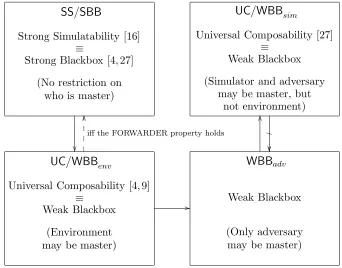
Figure 1: Equivalences and implications between the security notions in SPPC
execution of independent processes. The process equivalence relation gives rise to a relation between protocols and ideal functionalities by allowing a simulator to interact with the ideal functionality, resulting in a relation that we call strong simulatability, SS [16]. The difference between SS and SBB is that in SBB, the environment and the adversary are separated while the SS environment also serves as the adversary.
Contribution of the paper. In this paper, we clarify the relationships between UC, SBB, WBB, SS under different placements of the master process and an additional issue involving the ability to define a “forwarding” process that forwards communication from one process to another. While it seems intuitively reasonable that such a forwarder can be placed between two processes without changing the overall behavior of the system, this may violate complexity bounds if a polynomial-time forwarder must be chosen before the sending or receiving process. If the polynomial-time bound of the sender, for example, exceeds the time bound of the forwarder, then some sent messages may be lost because the time bound of the forwarder has been exhausted. This is relevant to our study because some equivalence proofs require the existence of forwarders that cannot be exhausted.
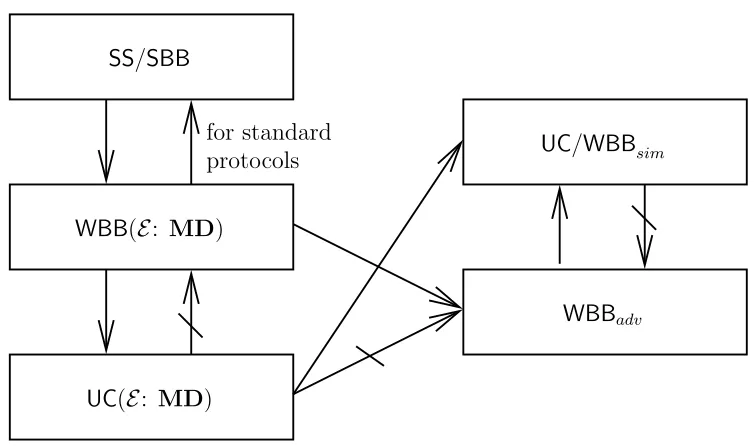
Our main results are summarized in Figure 1. Each of the four boxes in this figure stands for a class of equivalent security notions. Specifically, if a real and ideal protocol are related by one notion in this class, then they are also related by all other notions in this class. A solid arrow from one class to another indicates that relations in the first class imply relations in the second class. The implication indicated by the dashed arrow is contingent on whether the aforementioned forwarding property holds for the processes in question.
rela-tively small set of clearly stated equivalence principles involving processes and distributed systems. This approach gives us results that carry over to a variety of computational models. Our axiomatic system is proved sound for a specific computational model, a sequential probabilistic polynomial-time process calculus (SPPC), developed for the purpose of this study. SPPC is a sequential model, allowing only one process to run at a time. When one process completes, it sends an output in-dicating which process will run next. This calculus is close to PIOA and PITM in expressiveness and spirit, while (1) providing a syntax for writing equations between systems of communicating machines and (2) being flexible enough to capture different variants of security notions, including all variants of SS, SBB, WBB, and UC discussed in this paper. Our results about these security notions formulated over SPPC are:
1. Equivalences between security notions.
(a) The different forms of Strong Simulatability and Strong Blackbox obtained by varying the entity that is the master process are all equivalent. This equivalence class, denoted SS/SBB, is depicted in the top-left box in Figure 1 and includes placements of the master process as considered for Strong Blackbox in [4, 27]
(b) All variants of Universal Composability and Weak Blackbox in which the environment may be the master process are equivalent. This equivalence class, denotedUC/WBBenv, is depicted in the bottom-left box in Figure 1 and includes placements of the master process as considered for Universal Composability in [4, 9].
(c) All variants of Universal Composability and Weak Blackbox in which the simulator and the adversary may be the master process, but not the environment are equivalent. This equivalence class, denotedUC/WBBsim, is depicted in the top-right box in Figure 1 and includes placements of the master process as considered for Universal Composability in [27].
(d) All variants of Weak Blackbox where the adversary may be the master process, but neither the environment nor the simulator may play this role are equivalent. This equiv-alence class, denotedWBBadv, is depicted in the bottom-right box in Figure 1.
2. Implications between the classes.
(a) SS/SBB implies UC/WBBenv. In particular, Strong Blackbox with placements of the master process as considered in [4, 27] implies Universal Composability with placements of the master process as considered in [4, 9].
(b) UC/WBBenv implies WBBadv.
(c) WBBadv implies UC/WBBsim. In particular, Strong Blackbox with placements of the
master process as considered in [4, 27] and Universal Composability with placements of the master process as considered in [4, 9] implies Universal Composability with place-ments of the master process as considered in [27].
3. Separations between the classes.
PIOA model [4], it follows that UC/WBBenv does not imply SS/SBB in these models. This contradicts a theorem claimed in [4]. However, the forwarding property holds in SPPC and the buffer-free PIOA model for most protocols of interest. In these cases, UC/WBBenv implies SS/SBB.
(b) The security notions inUC/WBBsim are strictly weaker than the notions inWBBadv, and
hence, the notions in UC/WBBenv and SS/SBB. In particular, the Universal Compos-ability relation with placements of the master process as considered in [27] does neither imply the Strong Blackbox relations with placements of the master process as considered in [4, 27] nor Universal Composability relations with placements of the master process as considered in [4, 9].
These results all show that the relationship between universal composability and black-box simulatability is more subtle than previously described. One consequence is that when proving compositional security properties by a black-box reduction, care must be taken to make sure that the computational model gives appropriate power to the environment. In particular, the composability theorem of Canetti [9] does not imply that blackbox simulatability is a composable security notion, over any computational model in which the forwarding property (expressed by the FORWARDER axiom) is not satisfied.
Another contribution of this paper is a general composition theorem for SPPC that, similar to the composition theorem in Canetti’s model, allows to compose a polynomial number of copies of protocols, while in SPPC the protocols may be combined in a very flexible way. In addition to demonstrating the suitability of SPPC as a formalism for simulation-based security, this result is interesting in its own right.
We note that the present work concentrates on models for simulation-based security where processes run in polynomial time in the security parameter alone. Recently, several models have been proposed in which the runtime of the processes may depend on the length of their input [8,18, 21]. Many of the results proved in this work, in particular those involving the issue of placements of the master process, carry over to these models, and they have in fact already influenced design decisions made there.
Outline of the paper. Section 2 defines the sequential polynomial-time process calculus SPPC. In Section 3, we show that every system and every part of a system can be turned into a process expression which exactly mimics a single interactive Turing machine. The security notions are defined in Section 4. The main results, i.e., the relationships between the security notions, are proved in Section 5, with consequences for the PIOA and PITM models developed in Section 6. In Section 7, we briefly consider a less prominent security notion, called reactive simulatability in [5] and security with respect to specialized simulators in [10], and relate it to the other notions. In Section 8 we show that protocols that satisfy the FORWARDER property preserve this property when they are composed. General composition theorems are then presented in Section 9. We conclude in Section 10. The appendix contains some further details.
2
Sequential Probabilistic Process Calculus (SPPC)
Guard
Guard
Guard Guard
steps overall computation
≤p(n) PPT x1 · · · xk
input
channels
output
channels
Figure 2: Probabilistic polynomial-time machines in SPPC
and semantics (Section 2.4) of our computational model, we provide an informal description (Sec-tion 2.1) and introduce the no(Sec-tion of a probabilistic func(Sec-tion (Sec(Sec-tion 2.2).
2.1 Informal Introduction of SPPC
Let us first note that the driving philosophy behind the design of SPPC is to specify details of the communication model (such as a specific order of activation of entities, insecure, authenticated, secure channels, specific buffers, synchronous communication, broadcasting, and corruption) as part of the protocol specification itself rather than to explicitly encode, and thus fix, these details in the overall computation model. SPPC is expressive enough to encode such details in the protocol specifications. This makes SPPC relatively simple and flexible. In particular, a variety of security notions can easily be formulated in SPPC.
We start by discussing how individual probabilistic polynomial-time machines are modeled in SPPC and then explain how to build and execute systems of interacting machines. Our exposition parallels that of related models [5, 9, 27].
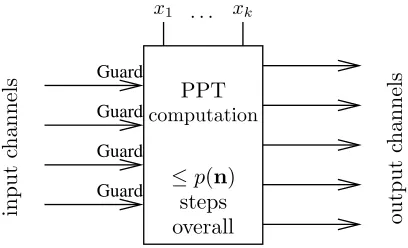
Single probabilistic polynomial-time machines. In SPPC, single machines are of the form as depicted in Figure 2. For the time being, let us ignore the “guards” and the variablesx1, . . . , xk.
Conceptually, a single machine is a black-box with internal state that receives inputs, performs polynomially-bounded computation and then produces outputs. Inputs are received on input chan-nels and outputs are written on output chanchan-nels. More precisely, single machines are restricted to receiving one input and producing at most one output at a time. While this at first might appear to be a restriction, it is not really a problem since any machine that sends multiple messages can be converted to a machine that stores internally—possibly using internal buffers—the messages it wants to send, and then sends the messages one at a time on request. In fact, this style of commu-nication corresponds exactly to the manner in which commucommu-nication is defined in othersequential
models, notably the PIOA and PITM models [9, 27]. Also, just as in these models, the overall runtime of a machine is bounded by a polynomial in the security parameter and does not depend on the number or length of inputs sent to the machine.
will then receive its input from the “tape machines”. In the PIOA model, buffer machines serve a similar purpose. Note that while in SPPC and the PIOA model, the number of input and output channels/ports is not restricted, in Canetti’s PITM model only one pair of input/output and input/output communication tapes is considered.
In SPPC, machines can preprocess their input usingguards (see Figure 2) which are determin-istic polynomial-time machines that are placed on input channels. Given an input on the channel, a guard may accept or reject the input. If rejected, the process does no computation. If accepted, the process receives the output of the guard. This may be different from the input, e.g., a guard can eliminate unnecessary information or transform data. The computation performed by the guard may depend on the current internal state of the process. Its runtime is polynomially-bounded in the security parameter per invocation and is not factored into the overall runtime of the process using the guard. In particular, a guard can be invoked an unbounded number of times. Since guards allow a process to discard messages without incurring a computation cost, attempts to “ex-haust” a process by sending many useless messages to the process can be defeated. Additionally, using guards we can simulate an unbounded number of “virtual” channel names by prefixing each message with a session id and/or party name and then stipulating that the guards accept only those messages with the right header information. Such an ability is required for systems with a polynomial number of machines, e.g., multiparty protocols, or with multiple instances of the same protocol. While mechanisms analogous to guards are absent in other models, notably [9, 27], a newer version of PIOA [6] has a length function that, when set to zero, prevents messages from being received by the machine. This corresponds to a guard which rejects all inputs and so can be used to help avoid exhaustion attacks. However, it does not help in the creation of a mechanism analogous to virtual channels.
As mentioned above, guards can be invoked an unbounded number of times without being exhausted and in every invocation their runtime is bounded by a polynomial in the security parameter—the runtime could even depend on the length of the input. Hence, the runtime of a single machine including the guards is polynomially bounded in the security parameter and the number of invocations. However, the overall runtime of a single machine excluding the guards is polynomially bounded in the security parameter alone, and hence, such a machine can produce at most polynomially many output messages overall in the security parameter. Now, since guards can only be triggered by messages sent by single machines, it follows that in a system of polynomially many machines guards are only invoked a polynomial number of times in the security parameter. As shown in Section 2.4.3, from this we can conclude that such systems can be simulated by a probabilistic polynomial time Turing machine.
In SPPC, a machine may have auxiliary input, just like auxiliary input can be given to the interacting Turing machines in Canetti’s model. This input is written on specific tapes before a (system of) machines is run. If such auxiliary input is used, it results in a non-uniform computa-tional model. The tapes are represented by x1, . . . , xk (see Figure 2). Just like in Canetti’s model,
we only allow the environment machine to use auxiliary input. However, whether the environment machine is uniform or not does not affect the results presented in this paper (except for those in Section 7).
aux-iliary input mentioned above. Therefore, we sometimes writeP(x1, . . . , xk) instead ofP. A process
expression with valueichosen for the security parameter and values →a (the auxiliary inputs) sub-stituted for its free variables →x yields a process P(→a)n←i. A process corresponds to an interacting
Turing machine where the security parameter is written on the security parameter tape and the auxiliary input is written on the input tape. Hence, a process can perform computations as soon as it receives input on the input channels. As an expositional convenience, we will use the terms ‘process expression’ and ‘process’ interchangeably. A process expression is called open if it has free variables, and closed otherwise. Hence, open process expressions correspond to non-uniform machines and closed expressions to uniform ones.
Systems of interacting machines. In SPPC, a system of interacting machines is simply a mul-tiset of single machines where an output channel of one machine connects directly to an identically-named input channel of another machine. The manner in which these machines are wired together is uniquely determined by the channel names since we stipulate that no two machines have the same input and output channel names respectively. After a machineM1 has sent a message on an output channel, the machine waits to receive input on an input channel. The message sent on the output channel is immediately received by the machine M2 that has an identically-named input channel. If the guards on the input channel of this machine accepts the message, then M2 may perform some computation and produce one output message. While M2 now waits for new input on its input channels, the output message (if any) is processed by the next receiving machine, and so on. If there is no receiving machine, or the guard of the receiving machine rejects the message, or no output message is produced, computation would halt since no machine is triggered. To avoid this, in a system of machines, one machine is always declared to be a master machine, also called
master process, and this machine is triggered if no other machine is.
In SPPC, given process expressionsP1, . . . ,Pn, each representing a single machine, the combined
system of machines is denoted by the process expression P1 · · · Pn. Instead of interpreting
P1 · · · Pn as a system of n single machines, one can consider this system as a single machine
(consisting of n sub-machines). This corresponds to the transformation, in the PIOA model, of a system of fixed, finite number of machines into a single machine. However, in SPPC we can apply such transformations to systems containing a polynomial number of machines as well.
With the bounded replication operator !q(n) P, where q(n) is some polynomial in the security
parameter andP is a process expression (representing a single machine or a system of machines), systems containing a polynomial number of machines can be described. The process expression !q(n)P stands for aq(n)-fold parallel compositionP · · · P. Note that in such a system, different
copies of P have the same input and output channels. However, as discussed earlier, guards allow us to send messages to (virtual) channels of particular copies of a protocol. Bounded replication can be combined with parallel composition to build bigger systems such as !q1(n)(P1 P2 !q3(n) P3).
As described earlier, since our execution model is sequential, computation may not proceed if currently executing machine produces no output, or a receiving machine rejects an input. In order to ensure that computation proceeds even in this case, we identify a master process by using a special input channel start. In case no output is produced by a machine, a fixed value is written onstartthereby triggering the master process. The master process is also the first machine to be activated when execution starts.
containing this channel is called the decision process. Given a process expression R(→x) with free variables →x, we denote by Prob[R(→a)n←i
1] the probability that R with security parameter i and substitution of values →a for its variables →x outputs a 1 on decision. Recall that R(→a)n←i
denotes the process obtained from the process expressionRby replacing the security parameter n
by a value iand replacing the variables →x by values →a. Two process expressions P(→x) andQ(→x) are calledequivalent orindistinguishable, writtenP(→x)≡ Q(→x), iff for every polynomialp(n) there existsi0 such that |Prob[P(
→
a)n←i 1]−Prob[Q(→a)n←i 1]| ≤1/p(i) for every i≥i
0 and every tuple →a of bit strings.
We call machines which are neither master nor decision processes regular. A machine which is both master and decision is called a master decision process. In what follows, by R, M, D, and MD we denote the set of all closed regular processes, closed master processes, open or closed decision processes, and open or closed master decision processes, respectively.
2.2 Probabilistic Functions
Aprobabilistic function F fromX toY is a function of the formX×Y →[0,1] which satisfies the following two conditions:
1. The cardinality of the set{y ∈Y |F(x, y)>0} is finite for everyx∈X. 2. Py∈Y F(x, y)≤1 for everyx∈X.
We call F a k-ary probabilistic function ifX =Zk=Z× · · · ×Z for some setZ.
We refer to X as the domain of F, to Y as the codomain of F, and to the set Sx∈X{y ∈ Y | F(x, y)>0}as the range ofF.
If → is a probabilistic function, then instead of writing→ (x, y) =p to say that x is mapped to y with probability p, we often write p =Prob[x→ y] or x →p y and say that x is reduced to y (by→) with probability p.
Let→and⇒ be two probabilistic functions such that the range of→is a subset of the domain of ⇒. Then, the composition → ◦ ⇒ of → and ⇒ defines the following probabilistic function: Prob[x→ ◦ ⇒ y] = PzProb[x →z⇒ y] for all x and y wherez ranges over the range of → and Prob[x→z⇒y] =Prob[x→z]·Prob[z⇒y].
Let→be a probabilistic function such that domain and codomain coincide and leti >0. Then, the probabilistic function (→)i is defined by induction on i as follows: If i= 0, then (→)0 is the identity function, i.e., Prob[x(→)0y] = 1 ify =x and Prob[x(→)0y] = 0 otherwise. For i >0, we defineProb[x(→)iy] =Prob[x→ ◦(→)i−1y].
Let →be a probabilistic function which satisfies the following conditions:
1. Domain and codomain of → coincide, say it is the setX.
2. The directed graph induced by→, i.e., (X,{(x, y)∈X×X |Prob[x→y]>0}) is cycle free accept for self loops.
Now, the transitive closure (→)+ of →is defined to be the following probabilistic function:
Prob[x(→)+y] =X
i>0
X
z1,...,zi−1
zj6=yfor allj
Prob[x→z1 → · · · →zi−1 →y]
for every xand y. Note that in the sums only a finite number of probabilities are different from 0. Note that a probabilistic polynomial time Turing machine withkinput tapes andloutput tapes
realizes a probabilistic function F of the form ({0,1}∗)k×({0,1}∗)l → [0,1] where we define the
size of the input to be the length of the input written on the first tape, i.e., the Turing machine runs in polynomial time in the length of the first component of the function it realizes.
2.3 Syntax of SPPC
We now introduce the syntax of SPPC, in particular, we define process expressions. For this, we first need to introduce terms and channels.
2.3.1 Terms
LetV be an infinite supply ofvariables. Variables are referred to byx, y, z and decorations thereof. We write→x for the sequencex1, . . . , xkof variables. Bit strings, i.e., elements of{0,1}∗, are denoted
by a, b, and decorations thereof. The empty bit string is referred to by ε. We write →a to denote the sequence a1, . . . , ak of bit strings. Letn be the security parameter.
C-terms. AC-term T =T(→x) (“C” being reminiscent of “computation”) is some representation of a probabilistic function of the form ({0,1}∗×({0,1}∗)k)× {0,1}∗ →[0,1] which can be realized by a probabilistic polynomial time Turing machine where the first component, {0,1}∗, in the domain ({0,1}∗ ×({0,1}∗)k) of this function takes the security parametern. The variables →x are called input variables of T(→x) and the set of input variables of T is denoted by varin(T). We write p = Prob[Tn←i(a
1, . . . , ak) ↓ a] or simply p = Prob[T ↓ a] to say that T outputs (reduces
to) the bit string a on input a1, . . . , ak and security parameter i with probability p. We assume
that the class of C-terms is complete in the sense that all probabilistic polynomial time realizable probabilistic functions can be described by some C-term. Obviously we can achieve this by simply taking representations of probabilistic polynomial-time Turing machines to be C-terms.
C-terms will be used in processes of the form out(c, T) to compute a bit string which is then placed on the channelc.
M-terms. An M-term (also called guard) t = t(→x;→y) (“M” being reminiscent of “matching”) with →x= x1, . . . , xk and
→
y= y1, . . . , yl is some representation of a (deterministic) function F of
the form ({0,1}∗ × {0,1}∗×({0,1})k)×({0,1}∗ ×({0,1}∗)l) → {0,1} that can be realized by a
deterministic polynomial time Turing machine where the first component of the domain ({0,1}∗× {0,1}∗×({0,1})k) of this function takes the security parametern. The variables →x are callinput
the first component of the codomain ({0,1}∗×({0,1}∗)l) oft). In case taccepts, it produces lbit
strings (the last lcomponents of the codomain oft) which are substituted for the output variables →
y. In caset rejects, this output is irrelevant. We assume that the class of M-terms is complete in the sense that all deterministic functions F realizable by a deterministic polynomial-time Turing machine can be described by some M-term. Obviously this is possible by taking representations of such Turing machines as M-terms.
For our purposes, M-terms with only one output variable would suffice. However, additional output variables make it more convenient to define certain processes.
M-terms will occur in processes of the form P = in(c, t).P0. If a bit string a is received on channel c, the M-termtallows to parse a (maybe depending on external input) before P actually readsa, and computes substitutions for the output variables in caseais accepted byt. The output variables oft may occur inP0.
Often,tis of the formxwhich we will interpret as an M-term without input variables and output variable x. This M-term accepts any message and this message is substituted for x. The runtime of such an M-term is determined by the bandwidth of c, which is a polynomial in the security parameter (see below). Conversely, since the computation of an M-term is polynomial bounded in the security parameter, this polynomial could be considered the bandwidth of the channel the M-term operates on. Hence, one could dispense with explicitly assigning bandwidth to channels.
The purpose of M-terms was explained in Section 2.1 where M-terms where referred to as “guards”. As explained there, one reason for introducing M-terms is that they allow us to create new virtual channels: An M-term can reject all messages that do not start with a certain bit stringb wherebstands for a session ID, i.e., it can check whether messages are of the form (b, x). When later different instances of a protocol are modeled, which all have there unique SID, then every instance will only accept a message that is prefixed with the correct SID. Also, every message returned by an instance will be prefixed by the SID of the instance. This will allow us to send/receive messages to/from specific instances of protocols without introducing channel variables as inπ-calculus [23,24].
2.3.2 Channels
2.3.3 Sequential Process Expressions and Processes
A sequential process expression P is defined by the following grammar:
P ::= 0 | (termination)
S | (wait for input on different channels)
(P || P) | (parallel composition)
!q(n)P | (bounded replication)
Pout ::= (OL|| OH || P) (process with initial output)
OH ::= out(cH, T) | (output on high channel cH)
0
OL ::= out(cL, T) | (output on low channelcL)
0
S ::= in(cH, t).P | (wait for input on high channel cH)
in(cL, t).Pout | (wait for input on low channelcL)
(S+S) (wait for input on different channels)
where cL and cH stand for low and high channels, respectively, and tand T are M- and C-terms,
respectively. We will require that high channels occurring in a sequential process expression P are internal. Internal and external channels are defined below.
Expressions of the form Pout are called process expressions with initial output. The notion process expression refers to both sequential process expressions and process expressions with initial output.
The set of channels occurring in a process expression P is denoted by C(P). A channel c is called internal in P if it occurs both in an expression of the form in(c, t).P0 and out(c, T); otherwise, it is called external. The set of internal and external channels of P is denoted by Cint(P) and Cext(P), respectively. The set Cext(P) is further partitioned into input (Cin(P)) and output channels (Cout(P)) in the obvious way.
Given a non-negative integer i (represented by a bit string), a process P =Pn←i
of a process expression P is obtained fromP by replacing every occurrence of !q(i)Qn←i
by
q(i)times
z }| {
Qn←i|| · · · || Qn←i.
We call i the parameter associated with P. InP, M-terms and C-terms are evaluated using i as the security parameter.
Note that modulo commutativity and associativity of the parallel composition operator “||”, a processP is of the formP0,out(c, T)||P0, out(c0, T0)||P0, orout(c, T)||out(c0, T0)||P0 whereP0 is a process obtained from a sequential process expression (i.e., without initial output),c is a high channel, and c0 is a low channel. In other words, at most two messages are currently on channels (at most one on a high channel and at most one on a low channel). In what follows, we refer to processes such as P0 by processes without output.
Since process expressions and processes are (formal) terms, we sometimes consider them as finite ordered trees with labeled nodes.
• free(0) =∅,
• free(in(c, t).P) =free(P)\varout(t),
• free(out(c, T)) =varin(T),
• free(P ||Q) =free(P)∪free(Q),
• free(!q(n) P) =free(P),
• free(P +Q) =free(P)∪free(Q).
We writeP(→x) with →x=x1, . . . , xk to say that {x1, . . . , xk} ⊆free(P). A process (expression) P
is called closed iffree(P) =∅.
If P(→x) is a process (expression) and →a is a sequence of bit strings (of the same length as →x), thenP(→a) denotes the process (expression) obtained fromP(→x) by replacing every free occurrence of xi by ai. The M-term and C-terms inP(
→
a) containing a free occurrence of xi will be evaluated
withxi replaced byai.
Let P be a process and t be an M-term. If t accepts a bit string a, then, as explained, it (deterministically) produces bit stringsa1, . . . , ak as output and these bit string are substituted for
the output variablesvarout(t) ={x1, . . . , xk} oft. We write [a/t]P to denote the process obtained
from P by substituting every free occurrence ofxi inP byai.
The communication size comsize(P) of a process P is the number of occurrences of input and output processes inP. For instance,comsize(out(c, T)||out(c, T)||in(c, t).in(c, t)) = 4.
The communication size comsize(P)(n) of a process expression P is a polynomial q(n) such thatq(i) =comsize(Pn←i
) for every i. Clearly, such a polynomial exists.
2.3.4 Contexts
A context C[ ] is a process where exactly one leave is labeled with [ ].
The process C[P] is obtained from the context C[ ] by plugging the process P into the hole of C[ ]. This notation is used to refer to some subprocess P of a given process P0 =C[P].
Given a processP, we call a context C[ ] aninput context forP, if there exists a process of the form in(c, t).Q, called theinput process associated with C[ ], such thatC[in(c, t).Q] = P and on the path from the root of C[ ] to its hole all nodes are labeled with ‘||’ or ‘+’. This implies that P is ready to receive input on channel c(with M-termt).
2.4 Semantics of SPPC
Processes have an interleaving semantics which is defined in terms of reductions. Roughly speaking, given a process P, the reduction is carried out by iteratively performing the following steps until nothing changes:
2. Communication. In the first case (where no message is on any channel), the empty bit string εis put on start which is then read by the process. In case there is only one message on a (high or low) channel, then this message is read. In the last case (where there is one message on a high channel and one on a low channel), the messageaon the high channel cis read by the process. (Note that, by definition of process expressions, after readingaonc, the process does not produce new output and in the next iteration step, the message on the low channel will be read.)
The intuition is that high channels are used to update the current (internal) state of a process (and therefore have priority over low channels) while low channels are intended for communication with external processes or internal subprocesses.
In what follows, every single step is defined formally and the steps are put together in Sec-tion 2.4.3.
2.4.1 C-term Reduction
The reduction of C-terms occurring in a process is defined by the probabilistic function*onclosed
processes. For open processesP(→x), the free variables→x are first substituted by bit strings. Formally, P * Qp is defined by structural induction on P where we assume that the security parameter associated withP is i:
• 0*1 0,
• in(c, t).P *1 in(c, t)P,
• out(c, T)*p out(c, a) ifp=Pb≡amod 2bw(c)(i)−1Prob[T ↓b].
• P ||Q* Pp 0 ||Q0 ifP * Pq 0, Q* Qq0 0, and p=q·q0,
• P +Q* P1 +Q.
For the cases not covered above we define P * Q0 . Note that since we assume P to be closed, all input variables of the C-termT have been substituted by bit strings.
2.4.2 Communication
To define the communication step, we first introduce a probabilistic function →(c,a) on closed processes which describes how a message aon channelcis read by a process.
Formally, we define P →(pc,a) Qiff the following is true: LetN be the number of different input contexts C[ ] of P with associated input processes of the form in(c, t).P0 such that t accepts a. In other words, N is the number of input expressions in P ready to receive input aon channel c. Then,
1. IfN = 0, thenP =Qand p= 1, orP 6=Qand p= 0.
Now, we are ready to define a communication step → on closed processes. We set P →p Q if the following is true:
1. If P = out(decision, a) || P0 for some process P0, then P = Q and p = 1, or P 6= Q and p = 0. (Since in P output was written on the channel decision, no further step shall be taken.) Otherwise:
2. IfP is a process without output, thenp=Prob[P →(start,ε)Q].
3. IfP =out(c, a)||P0 for some process P0 without output, then p=Prob[P0→(c,a) Q]. 4. If P = out(c, a) || out(c0, a0) || P0 where P0 is a process without output and c is a high
channel, thenp=Prob[out(c0, a0)||P0 →(c,a)Q]. In all other cases, we define P →0 Q.
2.4.3 The Complete Reduction of Processes
The probabilistic function⇒ defines the complete reduction of processes. For all processes P, Q, and probabilitiesp we define
P ⇒p Q iffp=Prob[P *◦(→ ◦*)+Q].
The probability p that the decision returned by a closed process P is 1 is written Prob[P 1] or P p 1 and is defined as follows:
Prob[P 1] =X
Q
Prob[P ⇒Q]
where Q ranges over all processes of the formout(decision,1) ||Q0 (modulo commutativity and associativity of ‘||’).
The following theorem tells us that the computation of process expressions can be simulated by a probabilistic polynomial time Turing machine.
Theorem 1. LetP(x1, . . . , xk)be a process expression. There exists a probabilistic polynomial-time
Turing machine that for all processes Q (modulo associativity of ‘+’ and ‘||’) returns Qon input
i,P(x1, . . . , xk), a1, . . . , ak (given on separate input tapes) with probability piff P(a1, . . . , ak)n←i p⇒
Q. The Turing machine runs in polynomial time in the security parameter i.
3
Single Machine Normal Form
In this section, we show that sequential process expressions can be turned into what we call single machine normal form.
carried out. (In this case, the master process is triggered by reading a message on start). The guards are deterministic Turing machines which run in polynomial time in the security parameter. If a process (in SMNF) is open, i.e., has free variables, then this corresponds to a non-uniform PIOA/ITM (with guards), and otherwise to a uniform one.
Guards add additional power to processes (or PIOA and ITM extended by guards). The machine itself could inspect the input and decide whether to accept or reject it, and in the latter case, would simply produce no output. However, the overall run time of machines is bounded by a polynomial in the security parameter and is independent of the number of invocations to a machine. As a consequence, inspecting the input consumes resources. The idea behind the guards is that they are invoked anytime a message is sent on an input channel and that their run time is not added to the run time of the “main machine”. Consequently, using guards, inspecting the input does not consume resources. In other words, guards of processes (or PIOA and ITM extended by guards) are devices of a machine whose run time may depend on the number of invocations (where within one invocation the run time is polynomial in the security parameter).
We will sometimes consider processes in what we call simple single machine normal form (SSMNF) where the guards accept all messages. We refer to the fragment of SPPC where all process are parallel compositions of processes in SSMNF the guard-free fragment of SPPC.
A process expression in single machine normal form works as follows: Before processing a message on an input channel (a low channel), an M-term (the “guard”) on this channel decides whether to accept or reject this message. The message is only processed further if the M-term accepts the message and otherwise the message is dropped. In the former case, the internal state is updated (via a high channel) depending on the current internal state and the current message, and next at most one message is written on an output channel (a low channel). Further intuition is given below. Formally, the single machine normal form is defined as follows.
Definition 2. We say that a sequential process expression P(→z) is in single machine normal form (SMNF) if it is of the following form:
Sinit( →
z)||!q(n)S(
→
z) (1)
where
S(→z) = in(cs, z).
X
c∈Cin(P(→z))
in(c, tin(c, z, →
z;x)). out(cns, Tns(c, x, z, →
z))||
X
c0∈Cout(P(→z))
in(cns, tout(c0;y, v)).
out(cs, y)||out(c0, v)
+
in(cns, tempty(y)).out(cs, y)
!
andSinit( →
z) is defined in the same way except thatin(cs, z) is removed and every occurrence of z is replaced by ε(representing the initial state of P).
The internal channels cs and cns (which carry the current and the updated state, respectively) are defined to be high channels while all other channels are (external, and thus) low channels.
We say that a sequential process expression is in simple single machine normal form (SSMNF)if it is in SMNF and the M-termtin(c, z,
→
SPPC where all processes are parallel compositions of processes in SSMNF the guard-free fragment of SPPC.
Intuitively, the variable z stores the current state of P. The M-term tin(c, z, →
z;x) is the guard which is used to decide whether P accepts or rejects the input on c. This term takes as input the name of the channelc from which input shall be read, the current statez, and the external inputs →
z. Its output is written into x. The C-term Tns(c, x, z, →
z) computes the new state depending on the current statez, the outputxoftin(c, z,
→
z;x), and the free variables →z. The M-termtout(c0;y, v) intuitively accepts an inputa(which is the current state) ifaencodes that the next output, sayb, shall be written onc0. Ift
out(c0;y, v) accepts a, then yis substituted by aandv byb. The M-term
tempty(y) works similarly. It only accepts aifaencodes that nothing shall be written on an output channel.
The following lemma tells us that every sequential process expression can be turned into single machine normal form. The proof of the following lemma is rather simple. Intuitively, the sequential process expressionsP1 andP2 in this lemma are independent processes that may communicate (see also Section 2.1 and 4.1).
Lemma 3. LetP1=P1( →
z) andP2 =P2( →
z) be (possibly open) sequential process expressions such thatC(P1)∩Cint(P2) =∅,Cint(P1)∩C(P2) =∅,Cin(P1)∩Cin(P2) =∅, andCout(P1)∩Cout(P2) =∅.
Then, P1 and P2 can be turned into single machine normal forms P10 and P20, respectively, such
that
Prob[(P1( →
a)|| P2( →
a))n←i 1] = Prob[(P10(→a)|| P2( →
a))n←i 1] = Prob[(P1(
→
a)|| P20(→a))n←i 1] = Prob[(P10(→a)|| P20(→a))n←i 1]
for every i and tuple →a. In particular,
P1 || P2≡ P10 || P2≡ P1 || P20 ≡ P10 || P20. Proof. We prove thatP1can be turned into single machine normal formP0
1 such thatProb[(P1( →
a ) || P2(
→
a))n←i 1] = Prob[(P0 1(
→
a) || P2( →
a))n←i 1] for every i and →a. TurningP
2 into single machine normal form is done in the same way.
To define P0 1(
→
z), we need to specify the C-term Tns(c, x, z, →
z), the M-terms tin(c, z, →
z;x), tout(c0;y, v), andtempty(y), and the polynomialq(n) in (1).
We start with the definition of tin(c, z, →
z;x). The variable z will be substituted by some representation of a processP1. From P1 together with
→
z, tin(c, z, →
z;x) can determine whetherP1 would accept or reject a given inputaon c as follows: First,tin(c, z,
→
z;x) determines fromP1 the set t1, . . . , tl of M-terms occurring in input processes in(c, ti).P10 associated with input contexts of P1. Note that l is polynomially bounded in the security parameter. If l = 0, then this means that P1 does not accept any input on c, and therefore, tin(c, z,
→
z;x) will reject every input on c. Otherwise, given an input a, tin(c, z,
→
z;x) will apply every ti to a. If every ti rejects a, then
tin(c, z, →
z;x) rejectsaas well. Otherwise, tin(c, z, →
z;x) copies ainto the output x. The C-term Tns(c, x, z,
→
z) evaluates z=P1 based onxand →
z. More precisely, ifz=εand the security parameter isi, thenTns(c, a, ε,
→
a) does the following: Tns(c, a, ε, →
a process Q by first applying →(c,a) to P1( →
a)n←i and then, to the result, alternatively applying
* and → until for the current processP1 one of the following is true: a) P1 is a process without output, b) P1 = out(c, a) || P10 for some process P10 without output and an external (i.e., low) channelc, or c) P1 occurred before. (Note that if P1 is a process with output on a high and a low channel, thenTns(c, a, ε,
→
a) further simulates the computation of P1, i.e., haveP1 read the message on the high channel. This results in a process with output only on the low channel.) Analogously to Theorem 1, it is easy to see that this reduction ofP1(
→
a)n←i can be carried out by a probabilistic polynomial time algorithm. If z 6=ε, then z is a process P1. In this case, Tns(c, x, z,
→
z) simulates the reduction of this process in the same way as described above.
The M-termtout(c0;y, v) receives as input a process, say P1. IfP1 is a process without output, tout(c0;y, v) rejects P1. Otherwise, P1 is of the form out(c, a) || P10 for some process P10 without output and an external channel c. If c 6= c0, then again, t
out(c0;y, v) rejects P1. Otherwise, y is substituted byP10 and v by a.
The behavior of the M-term tempty(y) is analogous to the one oftout(c0;y, v). It acceptsP1 iff it is a process without output, and in this case, y is substituted withP1.
We define the polynomial q(n) to be the communication size comsize(P1( →
z)) of P1( →
z). Note that due to the M-termtin(c, z,
→
z;x), the single machine normal form of P1 reads an input aon a channelciffP1 would readaonc. In particular, ifP1 currently can not readaonc(because there is no input process for c or all M-terms rejecta), then the single machine normal form would not read a on c as well, and thus would not be activated in the first place. This guarantees that the single machine normal form is activated by receiving external messages exactly as often asP1, and therefore, it suffices to define q(n) as done above. Without tin(c, z,
→
z;x), the decision whether a can be read by P1 would only be made when evaluating Tns(c, x, z,
→
z). Hence, the single machine normal form would always be activated even ifP1 would reject the input. In this case, the number of activations of the single machine normal form could not be bounded byq(n).
Now, Prob[(P1( →
a)|| P2( →
a)n←i 1] =Prob[(P0 1(
→ a)|| P2(
→
a)n←i 1] is easy to verify.
2
We note that Lemma 3 does not hold for SSMNFs since a process in SSMNF has to process all input messages. For instance, there is no SSMNF equivalent to the process expression P = in(c0, x).in(c1, y).out(c2, y): Assume that there is a processQin SSMNF equivalent toP. Letq(n) be the communication size of this machine. An environmentEcould sendq(n)+1 random messages on c1 before sending a message on c0, and then a random message m on c1. The environment E will output 1 on decisionif m is returned on cout, and otherwise, if E is triggered on start, it
will output 0 ondecision. When interacting with P, the message m will be returned to E on c2. However, when interacting withQ, no message will be returned sinceQ has already terminated as it can only processq(n) messages. Thus,E P 6≡ E Q.
Remark 4. Lemma 3 does not hold, in general, when restricted to SSMNFs.
4
Definition of Security Notions
4.1 Channel Configurations
To define the security notions, we need to specify how different processes (describing the envi-ronment, the real/ideal adversary, the simulator, the real/ideal protocol) can be connected via channels. At the end of this section, we provide an example to illustrate the definitions.
Recall from Section 2 thatC(P) denotes the set of channels ofP andCint(P),Cext(P),Cin(P), and Cout(P) are the sets of internal, external, input, and output channels ofP, respectively.
The set of external channels of a process expression P is further partitioned into the set ofIO channels Cio
ext(P) and the set ofnetwork channels Cnetext(P). Thus, the set of external channels ofP is partitioned into the set of input IO channelsCio
in(P), output IO channelsCioout(P), input network channelsCnet
in (P), and output network channelsCnetout(P). We require that ifdecision∈C(P), then decision∈Cio
out(P). Also, if start∈C(P), thenstart∈Cioin(P).
We say that two process expressionsPandQarecompatible iff they have the same set of external channels and these channels are of the same type, i.e., Cnet
in (P) = Cnetin (Q), Cioin(P) = Cioin(Q),
Cnet
out(P) =Cnetout(Q), andCoutio (P) =Cioout(Q). They areIO-compatible iff they have the same set of IO channels and disjoint sets of network channels, i.e., Cnet
ext(P)∩Cnetext(Q) =∅, Cioin(P) =Cioin(Q), and Cio
out(P) =Cioout(Q).
Given sequential process expressions P and Q, by P Q we denote the parallel composition
P0 || Q0 whereP0 and Q0 are obtained from P and Q by renaming the internal channels ofP and
Q, respectively, in such a way that C(P0)∩C
int(Q0) =∅ and Cint(P0)∩C(Q0) =∅. The intuition is that P and Qare different processes (machines) which communicate via their external channels only as explained in Section 2.1 and 3. They should not interfere on their internal channels. It may help to think ofP andQto be in SMNF (with different high channels). By Lemma 3 this is w.l.o.g. The definition of is generalized to sequential process expressionsP1, . . . ,Pn in the obvious way.
To really match the intuition that different processes communicate, we introduce what we call valid process expressions.
A sequential process expression P is valid for a sequential process expression Q if
Cext(P)∩Cext(Q)⊆
[
x∈{in,out},y∈{net,io}
(Cyx(P)∩Cyx(Q))
where x=in ifx =out, and vice versa. That is, external channels used both in P and Q are of the same “type” w.r.t. being network or IO channels and are of opposite “types” w.r.t. being input or output channels. Note that being valid is a symmetric relation. Given a set Z of sequential process expressions, we denote byZ-Valid(Q) the set of all process expressions inZvalid forQ.
We call P an adversarial (adversarially valid) process expression forQ ifP is valid forQ and Cext(P)∩Cioext(Q) =∅. In other words, an adversarial process expression never connects to another process expression via the IO channels. By Z-Adv(Q) we denote the set of sequential process expressions in Z adversarially valid for Q. We write Z-AdvP(Q) to denote the set of all process expressionsP0 ∈Z-Adv(Q) such thatP0 Qand P are compatible.
We say thatP is anenvironmental (environmentally valid) process expression forQifPis valid for Q and Cext(P)∩Cnetext(Q) = ∅. That is, an environmental process expression never connects to the network channels of a process expression. By Z-Env(Q) we denote the set of all process expressions inZenvironmentally valid forQ.
We call a sequential process expression P
• master ifdecision∈/ C(P),
• decision ifstart∈/C(P), and
• master decision otherwise.
In what follows, byR, M, D, and MDwe denote the set of all closed regular process expressions, closed master process expressions, (open/closed) decision process expressions, and (open/closed) master decision process expressions, respectively. In those cases where it is relevant to distinguish between open and closed process expressions, we explicitly specifyD and MD.
Example: To illustrate the above, let us look at the following typical configuration: E A P
where A is adversarially valid for P and E is environmentally valid for A P. That is, A only connects to (not necessarily all) network channels ofP and E only connects to (not necessarily all) IO channels ofP andA. IntuitivelyE is the environment process,Ais the adversarial process, and
P is the real protocol. Moreover, let us assume that E ∈MD, i.e., E is a master decision process. It is helpful to think ofE andAto be in SMNF. Often,P is the parallel compositionP1 · · · Pn
describing n parties (or machines) running a particular protocol.1 Again, one can think of every Pi to be in SMNF. (One could as well considerP to be in SMNF.)
Let us look at a run of such a system. As E is the master process and initially no other communication is possible (since no other process has produced output yet),E can read a message on the start channel.2 After some computation, E will typically write a message on one of its external channels c (and thus, IO channels3) to A or P, say to P. Then, E will have to wait for new input and by reading the message on c, P will be activated next, in case the guard on cof P, more precisely one of the subprocesses Pi of P, accepts the message. (Otherwise, E as the master
process will be activated again via the start channel.) After some computation, P will typically send a message on some external channel say on a network channel to A, which activates A, and
P has to wait for new input, and so on.
4.2 Indistinguishability of Process Expressions
The indistinguishability of process expressions is defined as expected:
Definition 5. Two sequential process expressions P(→x) and Q(→x) are called equivalent or indis-tinguishable (P(→x)≡ Q(→x)) iff for every polynomial p(n) there exists i0 such that for every i≥i0
and every tuple →a of bit strings we have that
|Prob[P(→a)n←i 1]−Prob[Q(→a)n←i 1]| ≤1/p(i). Obviously, ≡is an equivalence relation on sequential process expressions.
1As mentioned, by using bounded replication it is also possible to specify protocols with a polynomial number of
parties.
2In caseE does not read a message on this channel or the guard rejects the message, nothing will happen, and the
run is completed.
3E could as well write a message on a channel that is declared to be a network channel. However, this channel
4.3 Security Notions
We now define the various security notions. For strong simulatability as well as strong and weak blackbox simulatability we define two variants depending on whether or not the simulator may play the role of the master process.
The first definition will be used if the simulator is a regular process, and thus, not a master.
Definition 6. Let A (adversaries), I (ideal adversaries), E (environments), and S (simulators) be sets of sequential process expressions, and P (the real protocol) and F (the ideal functionality) be IO-compatible sequential process expressions.
Strong Simulatability: SS(S,E)(P,F) iff P and F are IO-compatible and there exists S ∈ S-AdvP(F) (called simulator) such that E P ≡ E S F for every E ∈ E-Valid(P)
(called environment).
Strong Blackbox Simulatability: SBB(A,S,E)(P,F) iff P and F are IO-compatible and there
exists S ∈ S-AdvP(F) (called simulator) such that E A P ≡ E A S F for every
A ∈A-Adv(P) (called adversary) and E ∈E-Env(AP) (called environment).
Weak Blackbox Simulatability: WBB(A,S,E)(P,F) iff P andF are IO-compatible and for every A ∈ A-Adv(P) (called adversary) there exists S ∈ S-AdvP(F) (called simulator) such that
E AP ≡ E AS F for every E ∈E-Env(AP) (called environment). As we will see, equivalently we can require that the simulator S may only depend on the communication size of Ainstead of A itself. In particular, all our results hold for both variants, and we therefore do not distinguish between them explicitly. Necessary adjustments in proofs will be pointed out.
Universal Composability: UC(A,I,E)(P,F) iff P and F are IO-compatible and for every A ∈ A-Adv(P)(called real adversary) there existsI ∈I-AdvAP(F)(called ideal adversary) such
that E AP ≡ E IF for everyE ∈E-Env(AP) (called environment).
In Section 5, we will consider a variety of different instances of the above security notions by defining the sets A, I, S, and E to be one of the sets R, M, D, and MD. One such in-stance is UC(M,M,MD)(P,F): Note that with A ∈ M-Adv(P), I ∈ M-AdvAP(F), and E ∈
MD-Env(AP) as required byUC(M,M,MD)(P,F) it follows that ifAis a master process
expres-sion, i.e., contains start, then E is not allowed to containstart, i.e., E is just a decision process expression, since otherwiseE would not be environmentally valid forA. Conversely, ifAis regular, i.e., does not contain start, thenE may contain start. In other words, it is guaranteed that not both, the adversary and the environment, are master process expressions at the same time. Only at most one of them has this role.
We now define versions of strong simulatability as well as strong and weak blackbox simulatability for the case that the simulator may play the role of the master process. These definitions also apply for the case where the simulator is restricted to be a regular process, and in this case they coincide with the definitions given above. Hence, it would have been enough to provide only one definition. However, since the previous definitions are simpler, we separate the two cases.
Definition 7. Strong Simulatability: SSsim(M,MD)(P,F) iff the following conditions are
• P andF are IO-compatible,
• there exists S ∈M adversarially valid for F and such that P andS F are compatible except that, in addition to the external channels inP, S may containstart as input IO channel and ifstart occurs in S, then start0 may also occur in S as a new output IO channel, and
• E P ≡ E0 S F for every E ∈MD-Valid(P) where E0 =E if start does not occur
in S and where E0 is obtained from E by replacing every occurrence of start by start0
otherwise.
Strong Blackbox Simulatability: SBBsim(M,M,MD)(P,F) iff the following conditions are
sat-isfied:
• P andF are IO-compatible,
• there exists S ∈M adversarially valid for F and such that P andS F are compatible except that, in addition to the external channels inP, S may containstart as input IO channel and ifstart occurs in S, then start0 may also occur in S as a new output IO channel, and
• E AP ≡ E0 A0 S F for every A ∈M-Adv(P) and E ∈MD-Env(AP) where
E0 =E andA0 =A ifstart does not occur in S and where E0 andA0 are obtained from
E andA, respectively, by replacing every occurrence ofstart by start0 otherwise.4
Weak Blackbox Simulatability: WBBsim(M,M,MD)(P,F) iff the following conditions are
satis-fied:
• P andF are IO-compatible,
• for every A ∈ M-Adv(P) there exists S ∈ M adversarially valid for F and such that
P and S F are compatible except that, in addition to the external channels in P, S
may contain startas input IO channel and ifstartoccurs inS, thenstart0 may also occur in S as a new output IO channel, and
• E AP ≡ E0 A0 SF for every E ∈MD-Env(AP) where E0 =E and A0 =A if startdoes not occur in S and where E0 andA0 are obtained fromE and A, respectively,
by replacing every occurrence of start by start0 otherwise.
In the above definition of WBBsim, we could also restrict S to be master only if A is master, i.e.,S may contain start only ifA does. In this case, we can always replace E0 by E. Also, just as for WBB, we can consider a version of WBBsim where the simulator may only depend on the communication size of A. As we will see, all (four) variants are equivalent, and we will not distinguish between them explicitly. However, we point out necessary modifications in proofs.
Variants of SSsim, SBBsim, and WBBsim such as SSsim(M\R,MD)(P,F), SBBsim(M,M,D)(P,F),
and WBBsim(M,M,D)(P,F) are defined in the obvious way.
5
Relationships between the Security Notions
In this section, we examine the relationships between the security notions introduced in the previous section. We prove some expected equivalences between the security notions and observe some surprising differences which would not be apparent without detailed analysis. The proofs are carried out axiomatically. The axiom system is introduced in Section 5.1. We show that all of the axioms are sound, i.e., are satisfied in SPPC, except for one axiom, which is called FORWARDER. In Section 5.2, we show that FORWARDER is anecessary condition on protocols in order for universal composability to imply black-box simulatability or strong simulatability, i.e., if this axiom does not hold, then universal composability does not imply black-box simulatability (strong simulatability). In Section 5.3, we compare the security notions for the cases where the environment may play the role of the master decision process, and in Section 5.4 we restrict the environment to be a decision process. In Section 5.5, we study variants of strong and blackbox simulatability where the simulators may be master processes. All results are summarized in Section 5.6. Based on the FORWARDER axiom, we obtain a complete characterization of the conditions under which universal composability and blackbox simulatability are equivalent. Since the proofs are carried out axiomatically, this enables us to carry over our results to other computational models [9,27] (Section 6). These axioms can also serve as an abstract specification for a “reasonable” computational model for simulation-based security. Furthermore, the counter-examples used to demonstrate that certain notions are strictly stronger than others are quite simple and easily translate into the related models (Section 6).
5.1 The Axiom System
To define the axioms (equational principles), we first introduce four variants of so-called dummy adversaries, which simply forward messages on network channels of protocols and are used to rename network channels and turn network channels into IO channels.
The first dummy adversary, called regular network dummy adversary, simply forwards messages received on channel c∈ Cout to a copy c0 of this channel and messages received on channel c0 for a copy of a channel c ∈ Cin to channel c. The number of messages this dummy can forward is bounded by a polynomial in the security parameter. Formally, aregular network dummy adversary
is defined as follows:
Dnet
R (Cin,Cout, q(n)) = DnetR (2)
= !q(n)
X
c∈Cout
in(c, x).out(c0, x) + X
c∈Cin
in(c0, x).out(c, x) !
where Cin and Cout are disjoint and finite sets of channel names, c0 is a new copy of c, i.e., it has a new name, andq(n) is a polynomial inn. All channels inDnet
R are considered network channels.
Note that Dnet
R ∈R.
The regular IO dummy adversary Dio
R(Cin,Cout, q(n)) is defined just as DRnet(Cin,Cout, q(n)) except that the channels c0 are declared to be IO channels. Again, we have thatDio
R(P)∈R.
The following two dummy adversaries are master process expressions. The first one is called
that it also forwards messages received onstarttostart0. More formally, a master network dummy adversary is defined as follows:
Dnet
M (Cin,Cout, q(n)) = DMnet (3) = !q(n)
X
c∈Cout
in(c, x).out(c0, x) + X
c∈Cin
in(c0, x).out(c, x) +
in(start, x).out(start0, x) !
whereCin, Cout, q(n), and the channels c0 are defined just as in DRnet(Cin,Cout, q(n)). The channel start0 is a new channel and declared to be an IO channel.
The master IO dummy adversary Dio
M(Cin,Cout, q(n)) is defined just as DMnet(Cin,Cout, q(n)) except that the channels c0 are declared to be IO channels.
Now we are ready to state the axioms and equational principles we use. Further explanations follow below.
COM. For all sequential process expressionsP and Q:
P Q ≡ QP. ASC. For all sequential process expressionsP, Q, and R:
P (QR)≡(P Q)R. TRN. For all sequential process expressionP, Q, and R:
P ≡ Q,Q ≡ R =⇒ P ≡ R. SYM. For all sequential process expressionsP and Q:
P ≡ Q =⇒ Q ≡ P.
RENAME. For sequential process expressions P1, . . . ,Pk such that Pi is valid for Pi+1 . . . Pk for every i:
P1 . . . Pk≡ P10 . . . Pk0
where the Pi0 are derived from Pi by consistently (w.r.t. the other Pj0) renaming external
channels (startand decision may not be renamed) and changing network channels to IO channels and vice versa.
RENAME-START
E A ≡ E !q(n) in(start, ε).out(start0, ε)A0