Towards Trustworthy e-Voting using Paper
Receipts
Yunho Lee, Kwangwoo Lee, Seungjoo Kim, and Dongho Won Information Security Group,
Sungkyunkwan University,
300 Cheoncheon-dong, Suwon-si, Gyeonggi-do, 440-746, Korea {leeyh,kwlee,skim,dhwon}@security.re.kr
http://www.security.re.kr
Abstract. Current electronic voting systems are not sufficient to satisfy
trustworthy elections as they do not provide any proofs or confirming evidences of their honesty. This lack of trustworthiness is the main reason why e-voting is not widely spread even though e-voting is expected to be more efficient than the current plain paper voting. Many experts believe that the only way to assure voters that their intended votes are casted is to use paper receipts. In this paper, we propose an efficient scheme for issuing receipts to voters in e-voting using the well-known divide-and-choose method. Our scheme does not require any special printers or scanners, nor frequent observations to voting machines. In addition to that, our scheme is more secure than the previous ones.
Key words:e-voting, voter verifiable e-voting, paper receipts
1
Introduction
Current electronic voting systems require voters to trust them. Voters should believe that the voting machines do not cheat even though they do not provide any proofs or confirming evidences of their honesty. This so called Black-Box Voting is the greatest obstacle to conduct electronic voting.
In [8], R.Mercuri stated that fully electronic systems do not provide any way that the voter can truly verify that the ballot cast corresponds to that being recorded, transmitted, or tabulated as many other experts did. Moreover, any programmer can write code that displays one thing on a screen, records something else, and prints yet another result. There is no known way to ensure that this is not happening inside of a voting system. The most effective way to decrease the trust voters must place in voting machine software is to let voters physically verify that their intent is recorded correctly, for e.g., voter verifiable paper trails.
This work was supported by the University IT Research Center Project funded by the Korea Ministry of Information and Communication.
In 2002, R.Mercuri proposed a method for voter verifiable ballots [11]. In her method, after a voter has finished making selections using a voting machine, the machine prints out a paper ballot that contains the voter’s selections for each choice. The printed ballot is kept behind a window to prevent voters from having any opportunity to tamper with it. If voters examine and approve the ballot, the voting machine drops the printed ballot into an opaque ballot box. While voter verifiable paper ballots eliminate the need to trust the voting machine, the need to support printing and collecting of paper ballots increases the maintenance costs and election complexity for the poll workers [15].
In 2002 and 2004, D.Chaum proposed a method to provide voters with a coded receipt that reflects their vote but does not reveal it to anyone else [10, 14]. In his scheme, the voting machine prints the coded receipt on the two separable layers using visual cryptography [5]. When laminated together, they reveal the voter’s choices, but each separated layer is meaningless dots. The voter verifies the laminated receipt and then selects one of the two layers to retain as receipt. The other layer should be surrendered to a poll worker and shredded. The voting machine could cheat if it knows which layer will be selected by the voter in advance, thus the chance is 1
2. The costs to implement D.Chaum’s scheme is relatively high as it is required that all voting machines to be equipped with special printers.
A.C.Neff and J.Alder proposed another method to provide voters with a coded receipt [12]. In their scheme the receipt is printed with a codes, i.e., en-crypted values, for each selection according to the codebook which is generated by election authority prior to the election.
The printed codes are meaningless to anyone other than the voter, who sees the codes displayed by the voting machine. The validity of the displayed codes can be assured by observers at randomly selected times throughout the election who act as voters and audit the displayed codes. Obviously, observers should have the same codebook and keep its secrecy. Thus, the chance that the voting machine could cheat is l+cc where c and l are the number of observations and the number of voters respectively.
An e-voting scheme should be verifiable by voters whether casting and count-ing ballots are performed correctly or not. A verifiable e-votcount-ing involves the following two distinct checks: [12]
– (Check 1) A voter should be able to satisfy him/herself that the voted ballot is captured correctly (cast-as-intended orindividual verifiability); and – (Check 2) Anyone should be able to satisfy him/herself that the voted ballot
is counted correctly (counted-as-casted oruniversal verifiability).
For the first check of the above mentioned, we argue that an e-voting scheme should satisfy the following two requirements.
– (Requirement 1) No devices or workers in polling places should be trusted.
– (Requirement 2) No decryptions should be performed during voting pe-riod.
There is no need to explain why the requirement 1 is necessary. The decryp-tion in requirement 2 means that any operadecryp-tions which can be misused to prove a voter’s casted vote. Furthermore, for the sake of voter’s confidence, the validity of receipt can be assured not only by prefixed devices or softwares but also by any devices or softwares made by herself at anytime.
In 2005, D.Chaumet el. proposed a practical voter-verifiable election scheme, Prˆet `a Voter[16]. Their scheme provides a number of advantages, for e.g., the voting machine can not learn the voters’ choices and the vote casting process is similar to that of the current paper voting. However, their scheme does not meet the above two requirements.
Our Contribution In this paper, we propose an efficient method for issuing receipt to a voter for voter verifiable e-voting using the well-known divide-and-choose method. Our scheme does not require voting machines to be equipped with special printers, observations to voting machines, and secret codebooks dif-ferent from the D.Chaum’s scheme or A.C.Neff’s scheme. Moreover, our scheme is more secure than the previous ones and voters do not need to trust any devices or election personnel in voting booths.
The advantages of the proposed scheme can be listed as follows.
1. SecurityThe fraud detection probability of a voting machine is more than 1
2.
2. Reliability A voter does not have to trust somebody in order to verify her/his receipt. Anyone can make software for verifying receipts.
3. Efficiency Our scheme does not need election observers to audit voting machines in polling places.
4. Implementation Our scheme is easy to implement because it does not require any special printers or preprocessing.
2
Previous Work
2.1 Y.Lee’s Scheme
In 2005, Y.Leeet al.proposed
D.Chaum, P.Y.A.Ryan, and S.Schneider proposed a practical voter-verifiable election scheme, Prˆet `aVoter[16]. Their scheme uses a more conventional repre-sentation of the vote, i.e., ballot forms with the candidates listed in left column, and the voter choices marked in an adjacent right column.
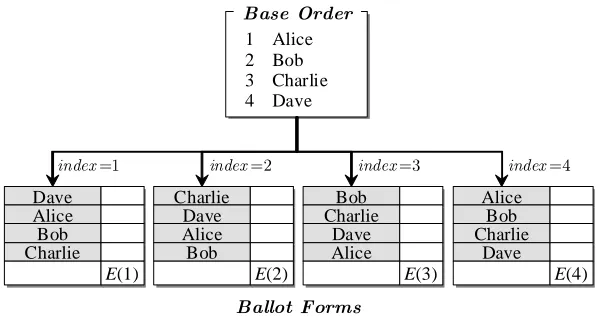
The Election Setup An authority prepares a large number of ballots, signifi-cantly more than the number of the electorate. The candidate order in a ballot should be randomized and unpredictable. A ballot also contains the information from which the candidate ordering can be reconstructed, encrypted by the public key(s) of the predetermined teller(s)(See Fig.1).
index=1 index=2 index=3 index=4
Base Order
1 2 3 4
Alice Bob Charlie Dave
Dave
Dave
Alice
Alice
Bob
Bob
Charlie
Charlie
E(1)
E(1)
Charlie
Charlie
Dave
Dave
Alice
Alice
Bob
Bob
E(2)
E(2)
Bob
Bob
Charlie
Charlie
Dave
Dave
Alice
Alice
E(3)
E(3)
Alice
Alice
Bob
Bob
Charlie
Charlie
Dave
Dave
E(4)
E(4)
Ballot Forms
Fig. 1.Ballot forms
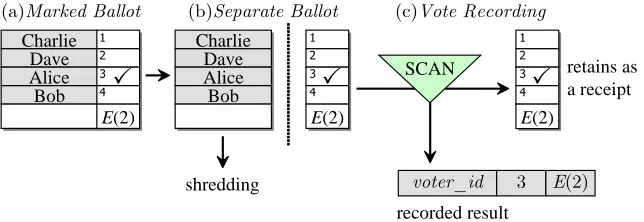
Casting The Vote After registering and authenticating a voter, she is asked to select a ballot form. She marks her ‘√ ’ in the usual way at a voting booth. Suppose that she selects the second ballot(index= 2) and casts her vote to the candidate “Alice”, the ballot will be look like Fig.2-(a).
Charlie
Charlie
Dave
Dave
Alice
Alice
Bob
Bob
E(2)
E(2)
(a)Marked Ballot
Charlie
Charlie
Dave
Dave
Alice
Alice
Bob
Bob
E(2)
E(2)
(b)Separate Ballot
shredding
E(2)
E(2)
retains as a receipt SCAN(c)Vote Recording
1 2 3 4
1 2 3 4
1 2 3 4
voter_id 3 E(2)
recorded result
Fig. 2.Casting the vote
Tallying For tallying, the teller(s) should reconstruct the candidate ordering for each casted votes. The reconstruction of the candidate ordering can be done by decrypting the information. For example, suppose that the casted vote is (3, E(2)), then the voter’s choicev can be calculated by the following equation:
v= 3−D(E(2))(mod 4) = 3−2(mod 4) = 1(Alice).
Auditing the Process Obviously one of the most concerned problem is the discrepancy between the candidate order printed on a form and the buried infor-mation. [16] stated that the most satisfactory method is that a voter gives the information printed on a ballot form, the teller(s) return the candidate ordering. For example, a voter selects b ballot forms at random and nominates b−1 for checking. If theb−1 checks go through okay, the voter can trust the remaining ballot form is well-formed with probability b−b1.
Two serious drawbacks of this auditing method are;
1. the teller(s) should decrypt the transmitted information, and 2. the voter should trust an auditor in the polling station.
Decryption operation should never be performed during the voting period, because the decryption oracle can be misused by voters(attackers) to prove their selections. Furthermore, it is less acceptable that a voter should trust an auditor in order to trust her ballot form’s integrity. In polling station, a voter should never trust any devices or election workers other than herself.
3
Proposed Scheme
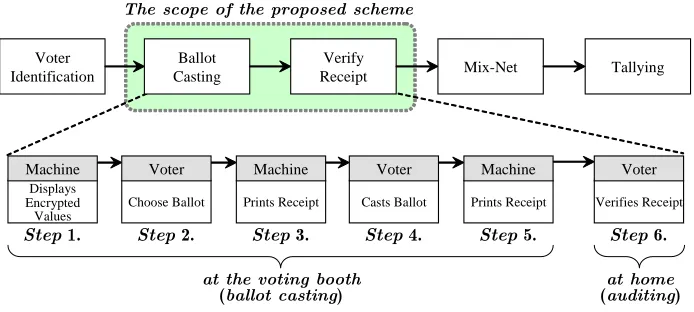
A receipt issued to a voter which can be took out of the polling place increases voter’s confidence that the ballot wascast-as-intended andcounted-as-casted as she can verify the whole processes of election at any time using her receipt.
Voter Identification
Ballot Casting
Verify
Receipt Mix-Net Tallying
Displays Encrypted Values Machine
Choose Ballot Voter
Prints Receipt Machine
Casts Ballot Voter
Prints Receipt Machine The scope of the proposed scheme
Verifies Receipt Voter
at home (auditing) Step1. Step2. Step3. Step4. Step5. Step6.
at the voting booth (ballot casting)
Fig. 3.Overall procedure for e-voting and the scope of the proposed scheme
A voter can be assured that her vote iscast-as-intendedby her own computa-tions of ElGamal encryption or by using a public verification server at anytime. Also a voter can verify that her vote iscounted-as-casted by comparing her en-crypted choice with the result registered to the public web bulletin board and verifying ballot shuffling by mix-net.
3.1 Notations
– n: The number of candidates
– E(·,·),D(·,·) : ElGamal encryption and decryption
– v: voter’s choice(1≤v≤n)
– w: random number for ElGamal encryption – e: encrypted choice (e=E(v, w))
3.2 Ballot Casting
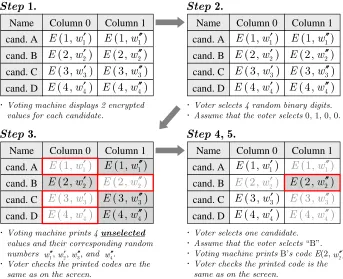
The detailed procedure of the proposed scheme can be described as follows. 1. Voting machine displays n encrypted pairs (ej, ej) = (E(j, wj), E(j, wj))
wherewj andwj are random numbers forj(j= 1, ..., n). 2. Forj = 1, ..., n, a voter randomly selects ej orej for eachj.
3. Voting machine prints nunselected values and their corresponding random numbers on the paper receipt as proofs. Voter should check that thenprinted values are the same as on the screen.
4. Voter casts her ballot by choosing v(v∈ {1, ..., n}).
5. Voting machine prints the vth encrypted value from the selected values in step 2. Voter should check that the printed value is the same as on the screen. Please note that candidates’ codesj(1≤j ≤n) can be replaced by unique numbers that is generated by way of a publicly defined process. For the proposed scheme, the chance that the voting machine’s cheating would go undetected is
1
1
(1,
)
E
w
′
cand. A cand. B cand. C cand. D 1
(1,
)
E
w
′′
Column 0 Column 1 NameVoting machine displays 2 encrypted
values for each candidate.
cand. A
cand. B
cand. C
cand. D
Column 0 Column 1 Name
Voter selects 4 random binary digits.
Assume that the voter selects 0, 1, 0, 0.
cand. A
cand. B
cand. C
cand. D
Column 0 Column 1 Name
Voting machine prints 4 unselected
values and their corresponding random
numbers w12,w21,w32, and w42.
Voter checks the printed codes are the
same as on the screen.
cand. A
cand. B
cand. C
cand. D
Column 0 Column 1 Name
Voter selects one candidate.
Assume that the voter selects “B”.
Voting machine prints B’s code E(2,w22).
Voter checks the printed code is the
same as on the screen.
Step
1.
Step
2.
Step
3.
Step
4, 5.
2
(2,
)
E
w
′
3
(3,
)
E
w
′
4
(4,
)
E
w
′
2
(2,
)
E
w
′′
3
(3,
)
E
w
′′
4
(4,
)
E
w
′′
1
(1,
)
E
w
′
E
(1,
w
1′′
)
2(2,
)
E
w
′
3
(3,
)
E
w
′
4
(4,
)
E
w
′
2
(2,
)
E
w
′′
3
(3,
)
E
w
′′
4
(4,
)
E
w
′′
1
(1,
)
E
w
′′
2(2,
)
E
w
′
E
(2,
w
2′′
)
3(3,
)
E
w
′′
4
(4,
)
E
w
′′
1
(1,
)
E
w
′
E
(1,
w
1′′
)
2
(2,
)
E
w
′
3
(3,
)
E
w
′
4
(4,
)
E
w
′
2
(2,
)
E
w
′′
3
(3,
)
E
w
′′
4
(4,
)
E
w
′′
1
(1,
)
E
w
′
3
(3,
)
E
w
′
4
(4,
)
E
w
′
1
w′′ w2′ w3′′ w4′′ w2′′
3.3 Receipt Verification
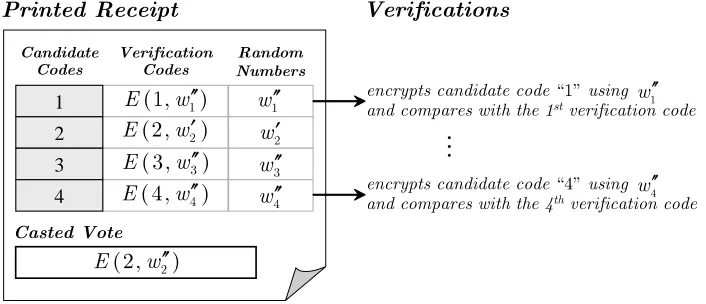
After finishing voting, the voter retains her receipt which is look like the left side of Fig. 5.
1 2 3 4
1
(1,
)
E
w
′′
2
(2,
)
E
w
′
3
(3,
)
E
w
′′
4(4,
)
E
w
′′
1
w
′′
2
w
′
3
w
′′
4w′′
CandidateCodes
Casted Vote
2
(2,
)
E
w
′′
Printed Receipt
encrypts candidate code “1”using w1′′ and compares with the 1stverification code
encrypts candidate code “4”using w4′′ and compares with the 4thverification code
…
Verifications
Verification Codes
Random Numbers
Fig. 5.A sample receipt with 4 candidates and verification procedure.
Here is a brief description of verification of a receipt. A voter encrypts each candidate codej with the corresponding random number printed on the receipt using ElGamal encryption and verifies the encrypted results are equal to the corresponding verification codes. This verification can be done easily by any voters because it requires n simple encryptions and there are numerous open source codes for ElGamal encryption. Thus voters do not have to trust any specific devices or election workers in order to verify their receipts.
Forj = 1, ..., n, if all the encrypted results are equal to the corresponding verification codes, voter can be assured that her vote was casted as intended with the probability of 1− 2n−11 . In Fig. 5, a voter should check whether the following 4 equations hold.
E(1, w1) = the 1st verification code (1) E(2, w2) = the 2nd verification code (2) E(3, w3) = the 3rd verification code (3) E(4, w4) = the 4th verification code (4)
3.4 Mixing and Tallying
4
Security Analysis and Comparisons
The security of a method for voter verifiable receipt can be measured by the chance of detecting a voting machine’s fraud and the receipt-freeness of a receipt.
Receipt-freeness Receipt-freeness means that no one can obtains or is able to construct a receipt proving the content of a ballot.
Theorem 1. If the ElGamal encryption scheme is not secure in the sense of indistinguishability, then there exists a probabilistic polynomial time TM that solves the DDH(Decision Diffie-Hellman) problem with overwhelming probability.
Proof. Please refer to [6].
Theorem 1 implies that the ElGamal encryption scheme is secure because it is highly believed that the DDH problem is intractable. The Lemma 1 follows immediately from the theorem 1.
Lemma 1. If there exists a secure CSPRNG(Cryptographically Secure Pseudo-Random Number Generator) and a voting machine generates random numbers using CSPRNG, then no one can get any partial information about the voter’s choice from a receipt.
Proof. An encryption scheme secure in the sense of indistinguishability is seman-tically secure[2]. Thus ElGamal encryption scheme is semanseman-tically secure and is secure under chosen plaintext attack. LetAbe a set of encrypted values printed on a receipt and B be a set of encrypted values computed by a voter herself. Obviously no one can distinguishAfromB if the voting machine generates ran-dom numbers using CSPRNG. Moreover, there are several secure CSPRNGs for e.g., [4]. Thus an attack trying to obtain any information from a receipt can be thought as a kind of chosen plaintext attack. However, an attacker can not learn any partial information about the voter’s choice because the ElGamal encryption scheme is secure under chosen plaintext attack.
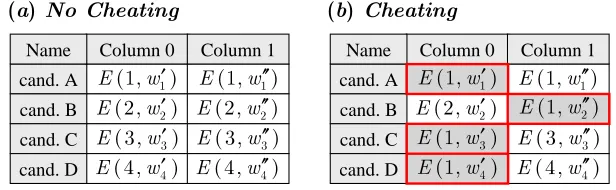
Fraud Detection If a voting machine can predict a voter’s random selection in step 2, it can alter her choice easily without being detected. Assume that there are 4 candidates and a voting machine predicts the voter’s random selection as “0100”(column 0, column 1, column 0, and column 0), then it would simply displays 8 codes as Fig. 6-(b) other than Fig. 6-(a).
cand. A cand. B cand. C cand. D
Column 0 Column 1 Name 1 (1, ) E w′ cand. A cand. B cand. C cand. D 2 (1, ) E w′′ 3 (1, )
E w′
4
(1, ) E w′
Column 0 Column 1 Name
(a) No Cheating (b) Cheating
1
(1, )
E w′ E(1,w′′1)
2
(2, )
E w′
3
(3, )
E w′
4 (4, ) E w′ 2 (2, ) E w′′ 3 (3, ) E w′′
4 (4, ) E w′′ 1 (1, ) E w′′ 2 (2, ) E w′ 4 (4, ) E w′′3
(3, )
E w′′
Fig. 6.Cheating machine’s screen.
1
(1,
)
E
w
′
cand. A cand. B
1
(1,
)
E
w
′′
Column 0 Column 1 Name
2
(2,
)
E
w′
E
(2,
w′′
2)
1
(1,
)
E
w
′′′
Column 2
2
(2,
)
E
w′′′
Fig. 7.Strengthening security in case ofn= 2.
Strengthening Security Suppose that n= 2 which is the minimum number of candidates, then the probability is only 12 which is the same as D.Chaum’s scheme proposed in 2002 and is not so high enough. In this case, we can make it more secure by incorporating additional columns. If we use 3 columns the probability will be increased to 2
3(See Fig. 7).
Table 1 illustrates a comparison of fraud detection probabilities and efficien-cies of the proposed scheme, A.C.Neff’s scheme, and two D.Chaum’s schemes.
Table 1.Comparison of fraud detection probabilities and efficiencies
Proposed A.Neff’s D.Chaum’s Chaum’s Scheme Scheme(2003) Scheme(2002) Scheme(2005) Fraud detection 1−2n−11 1−l+cc 12 b−1b
Preprocessing none codebook none encrypted ballot Special devices none none special printers none Human familiarity normal normal high high Trust assumption none observers none auditors
n: The number of candidates(≥2). l: The number of voters.
c: The number of observations.
5
Future Directions
Though the proposed scheme provides numerous advantages, it also has two drawbacks. The one is that it is not easy to compare verification codes printed on a receipt with the ones displayed on the screen. And the other is that the scheme requires voters to select numerous random selections. In this chapter, we briefly explain how to tackle these drawbacks. These are the subject of current research.
5.1 Making the Receipt Easy to Compare
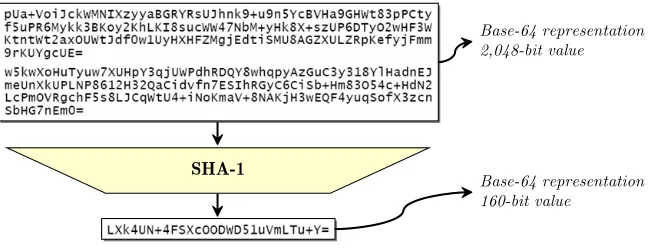
The typical length of a verification code is 1,024 to 2,048 bits. If we use a cryptographically secure hash function such as SHA-1, we can reduce the length of a code to 160 bits. However, it is still not easy to compare 28-character-long codes within seconds(See Fig. 8).
SHA-1
Base-64 representation 2,048-bit value
Base-64 representation 160-bit value
Fig. 8.Making a verification code short for easy compare using SHA-1
A reasonable length of a verification code is 8 to 10 bits which can be rep-resented by up to two characters. However, for security reason, it is well known that a hashed code should be at least 160-bit long. Therefore, we have to find a way to generate much shorter codes without sacrificing its security.
5.2 Minimizing Random Selections
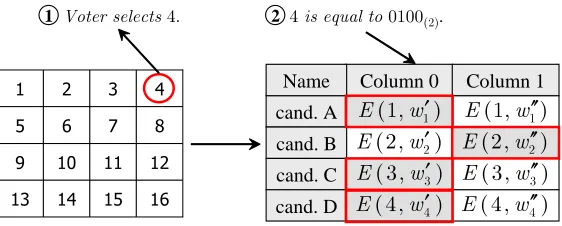
The proposed scheme requires a voter to n random selections of verification codes. Psychologically, it is well accepted that humans are notoriously bad at random selections. For the proposed scheme, n random binary selections can be translated into one random selection of numbers ranging from 20 to 2n. For example, suppose that there are 4 candidates, then a voter selects only one number from 1 to 16(See Fig. 9).
cand. A cand. B cand. C cand. D
Column 0 Column 1 Name
1
(1,
)
E
w
′
E
(1,
w
1′′
)
2(2,
)
E
w
′
3
(3,
)
E
w
′
4
(4,
)
E
w
′
2
(2,
)
E
w
′′
3
(3,
)
E
w
′′
4
(4,
)
E
w
′′
16 15 14 13
12 11 10 9
8 7 6 5
4 3 2 1
Voter selects4.
1 2 4 is equal to0100(2).
Fig. 9.Revised random selection method(16 means 0)
210= 1,024 numbers within a screen. Thus we have to make a more user-friendly and efficient selection method.
6
Concluding Remarks
As many experts said, voter verifiable audit trail is the most effective way to make trustworthy electronic elections. In this paper, we presented an efficient scheme for issuing cryptographic receipts in e-voting. Our scheme does not require any special printers or scanners nor frequent observations to voting machines. In addition to that, our scheme is more secure than the previous ones.
Though our scheme is more secure than the previous ones, there are some issues in our scheme. For e.g., psychologically, it is well accepted that humans are notoriously bad at random selections. Thus, random selections should be elim-inated as possible. As compared with D.Chaum’s scheme, our scheme requires a number of times more random selections. However this can be lessened if we modify the selection method. Another issue is that the comparison of verification codes displayed on the screen and printed on the receipt is difficult as the codes are too long. Even though if we hash the verification codes using SHA-1, the code length is about 160 bits. These issues are the subject of current research.
References
1. D.Chaum, “Untraceable Electronic Mail, Return Addresses, and Digital Pseudonyms,”Comm. of the ACM, vol. 24, no. 2, pages 84–88, Feb. 1981.
2. S.Goldwasser and S.Micali, “Probabilistic Encryption,”Journal of Computer Sys-tem Sciences(JCSS), vol. 28, no. 2, pages 270–299, Apr. 1984.
3. T.ElGamal, “A Public-Key Cryptosystem and a Signature Scheme Based on Dis-crete Logarithms,”IEEE Trans. on Information Theory, vol. IT-31, no. 4, pages 469–472, 1985.
5. M.Naor and A.Shamir, “Visual Cryptography,” Proc. of Advances in Cryptol-ogy(Eurocrypt’94), LNCS 950, pages 1–12, 1995.
6. Y..Tsiounis and M.Yung, “On the Security of ElGamal Based Encryption,”Public Key Cryptography 98(PKC’98), LNCS 1431, pages 117–134, 1998.
7. P.Paillier, “Public-Key Cryptosystems Based on Composite Degree Residuosity Classes,”Proc. of Advances in Cryptology(Eurocrypt’99), LNCS 1592, pages 223– 238, 1999.
8. R.Mercuri, “Rebecca Mercuri’s Statement on Electronic Voting,” http://www.notablesoftware.com/RMstatement.html, 2001.
9. A.C.Neff, “A Verifiable Secret Shuffle and Its Application to E-Voting,” Proc. of the 8th ACM Conference on Computers and Communications Security(CCS-8), pages 116–125, 2001.
10. D.Chaum, “Secret-Ballot Receipt and Transparent Integrity,”working draft, May. 2002.
11. R.Mercuri, “A Better Ballot Box?,” IEEE Spectrum Online, pages 46–50, Oct. 2002.
12. A.C.Neff and J.Adler, “Verifiable e-Voting: Indisputable Electronic Elections at Polling Places,” http://www.votehere.net/vhti/documentation/VH VHTi WhitePaper.pdf, VoteHere Inc., 2003.
13. P.Golle, M.Jakobsson, A.Juels, and P.Syverson, “Universal Re-encryption for Mixnets,”CT-RSA 2004, LNCS 2964, pages 163–178, 2004.
14. D.Chaum, “Secret-Ballot Receipts: True Voter-Verifiable Elections,” IEEE Secu-rity and Privacy Magazine, vol. 2, no. 1, pages 38–47, Jan. 2004.
15. D.Evans and N.paul, “Election Security: Perception and Reality,” IEEE Security and Privacy Magazine, vol. 2, no. 1, pages 24–31, Jan. 2004.
16. D.Chaum, P.Y.A.Ryan, and S.Schneider, “A Practical Voter-Verifiable Election Scheme,” Proc. of 10th European Symposium on Research in Computer Secu-rity(ESORICS2005), LNCS 3679, pages 118–139, 2005.