Comments on two password-based protocols
*Yalin Chen1, Hung-Min Sun2, Chun-Hui Huang3, Jue-Sam Chou4 1 Institute of information systems and applications, National Tsing Hua University
*: corresponding author
2 Institute of information systems and applications, National Tsing Hua University [email protected]
3 Department of Information Management, Nanhua University Chiayi 622 Taiwan, R.O.C [email protected]
4 Department of Information Management, Nanhua University Chiayi 622 Taiwan, R.O.C [email protected]
Tel: 886+ (0)5+272-1001 ext.56536
Abstract
Recently, M. Hölbl et al. and I. E. Liao et al. each proposed an user authentication protocol. Both claimed that their schemes can withstand password guessing attack. However, T. Xiang et al. pointed out I. E. Liao et al.’s protocol suffers three kinds of attacks, including password guessing attacks. We present an improvement protocol to get rid of password guessing attacks. In this paper, we first point out the security loopholes of M. Hölblet al.’s protocol and review T. Xianget al.’s cryptanalysis on I. E. Liao et al.’s protocol. Then, we present the improvements on M. Hölblet al.’s protocol and I. E. Liao
et al.’s protocol, respectively.
Keywords:smart card, password authentication protocol, password change
1. Introduction
Password-based authentication is widely adopted to login the remote server. It can provide authentication between the client and the server in an open network to ensure the legality of a user and the correctness of a server. Many schemes in this area were proposed, such as two-party password authenticated key exchange (2PAKE) protocols for the client-server architecture [1-15], 3PAKE protocols for the client-client-server architecture [16-23], or multi-server PAKE protocols for the client-servers architecture [24-25].
our two improvements are secure and efficient.
The remainder of this paper is organized as follows: In Section 2, we review M. Hölbl
et al.’sand I.E.Liao et al.’sprotocols, respectively. In Section 3, we analyze M. Hölblet al.’sprotocoland T.Xianget al.’sthreeattackson I.E.Liao et al.’sprotocol.We present our two improvements for M. Hölblet al.’sand I.E.Liao et al.’sprotocolsin Section 4. Then, We analyze the security and efficiency of our improvements in Section 5. Finally, a conclusion is given in Section 6.
2. Review of M. Hölblet al.’sand I.E.Liao et al.’sprotocols
In this section, we review M. Hölblet al.’sprotocolin Section 2.1 and I. E. Liaoal.’s protocol in Section 2.2, respectively. The notations used are first described below.
C, S : a client and a server, respectively. E : an adversary/attacker.
ID : the identity of C.
PW : the password of C. p : a large prime number.
g : the primitive element in a Galois field GF(p) where GF(p) is the set of integers {0,1,…,p-1} with arithmetic operations defined on modulo p.
H : a collision-resistant one-way hash function. (a,b) : stringais concatenated with stringb ⊕ : an exclusive-or operation.
△T : the tolerance time for transmission delay.
s :S’ssecretkey.
2.1 Review of M. Hölblet al.’sprotocol
In this section, we review M. Hölblet al.’sauthentication protocolin Section 2.1.1 and password change protocol in Section 2.1.2.
2.1.1 User authentication protocol
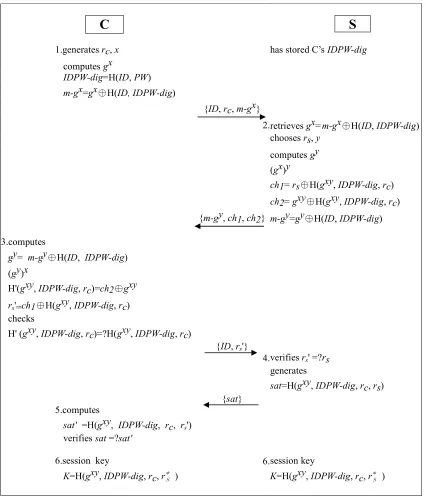
We describe M. Hölbl et al.’suserauthentication protocolasfollowsand also depict it in Figure 1.
In their scheme, a user, C, has to register at server S to become the legal client and S storesC’sIDPW-dig(=H(ID,PW)) instead ofPW. They perform the following steps.
1. C generates a random value rc, chooses a large random integer x, and computes gx
mod p. Then, C masks gx mod p by computing m-gx=gx⊕H(ID, IDPW-dig), where
IDPW-dig=H(ID,PW) and sends a message {ID,rc,m-gx} to S.
C
S
1.generatesrc,x has storedC’sIDPW-dig
computesgx
IDPW-dig=H(ID,PW)
m-gx=gx⊕H(ID, IDPW-dig)
{ID,rc,m-gx}
2.retrievesgx=m-gx⊕H(ID,IDPW-dig) choosesrs,y
computesgy
(gx)y
ch1=rs⊕H(gxy,IDPW-dig,rc)
ch2=gxy⊕H(gxy,IDPW-dig,rc) {m-gy,ch1,ch2} m-gy=gy⊕H(ID,IDPW-dig) 3.computes
gy= m-gy⊕H(ID, IDPW-dig) (gy)x
H'(gxy,IDPW-dig,rc)=ch2⊕gxy rs'=ch1⊕H(gxy,IDPW-dig,rc) checks
H' (gxy,IDPW-dig,rc)=?H(gxy,IDPW-dig,rc)
{ID,rs'}
4.verifiesrs' =?rs generates
sat=H(gxy,IDPW-dig,rc,rs) {sat}
5.computes
sat' =H(gxy, IDPW-dig, rc, rs') verifiessat=?sat'
6.session key 6.session key
K=H(gxy,IDPW-dig,rc,r*
S ) K=H(gxy,IDPW-dig,rc,r * S )
Fig. 1. M. Hölblet al.’suserauthentication protocol
H(gxy, IDPW-dig, rc) and masks gy as m-gy by computing m-gy=gy⊕H(ID,
IDPW-dig). Then, S sends {m-gy,ch1,ch2} to C.
see if the derived H' (gxy, IDPW-dig, rc) is equal to the computed H(gxy, IDPW-dig,
rc). If it is, C then retrievesrs' by computingch1⊕H(gxy,IDPW-dig,rc). Otherwise, S
is not genuine and C terminates the protocol. Then, C sends {ID,rs'} to S.
4. After receiving {ID, rs'}, S verifies if the receivedrs' is the same as his own generated
rs. If they are the same, C is authentic. Next, S generates a authentication token
sat=H(gxy,IDPW-dig,rc,rs) and sends {sat} to C.
5. After receiving {sat}, C computes sat'=H(gxy, IDPW-dig, rc, rs') and verifies if the
receivedsatis equal tosat'. If the verification succeeds, S is authentic.
6. After successful authentication, they can generate the session key as K=H(gxy,
IDPW-dig, rc, r*
S) where r *
S isrs plus some fixed value in order for Kto be different
fromsat.
2.1.2 Password change protocol
C
S
1.generates
IDPW-dig-new=H(ID, new-PW)
mask=H(gxy,rc,rs')
mac= H(gxy,IDPW-dig-new,rc,rs')
m-IDPW-dig-new=mask⊕IDPW-dig-new
{m-IDPW-dig-new,mac}
2.computes H(gxy,rc,rs)
IDPW-dig-new=H(gxy,rc,rs)⊕m-IDPW-dig-new mac'= H(gxy,IDPW-dig-new,rc,rs) checksmac'=?mac
computes
{code} code=H(gxy,IDPW-dig,Flag,rc,rs)
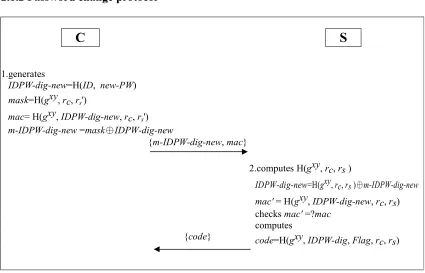
Fig. 2. Password update protocol ofM.Hölbletal.’spassword changeprotocol
In their protocol, when C wants to update his password PW as new-PW, he proceeds with the password update protocol as follows. It is also shown in Figure 2.
1. After authenticating the server, C generates mask=H(gxy, rc, rs'), mac= H(gxy,
IDPW-dig-new, rc, rs') and m-IDPW-dig-new=mask ⊕ IDPW-dig-new, where
IDPW-dig-new=H(ID,new-PW). Then, C sends {m-IDPW-dig-new,mac} to S.
2. After receiving the message, S verifies the validity of the received mac. He retrieves
mac'= H(gxy, IDPW-dig-new,rc,rs) and comparesmac'with the receivedmac. If it is valid, S accepts the password change and replaces IDPW-dig with IDPW-dig-new. Otherwise, he rejects the password change. He then sends a message code=H(gxy,
IDPW-dig,Flag,rc,rs) to C, whereFlag issetto either‘accept’or‘reject’depending upon whether the password change is accepted or rejected.
2.2 Review of I. E. Liaoet al.’sprotocol
C
S
Registration phase
1.choosesIDandPW
calculates H(PW)
{ID, H(PW)}
2. calculates
B=gH(s, ID)+H(PW)
issues C a smart card which containsID,B, p, andg.
Login phase
1. keys ID and PW
{ID}
2. generatesRandy
calculatesB''=gH(s, ID)R
M=gy
H(B'',M) {H(B'',M),R,M}
3.calculatesB'= (B.g−H(PW))R
checks H(B',M) =? H(B'',M) selectsx
calculatesN=gx V= H(T,B',N)
{ID,V,T,N}
Authentication phase
1. checksID
checksT'−T<? △T 2.V'= H(T,B'',N)
checksV=?V'
3. session keyK=M x=gxy 3. session keyK=N y=gxy
Password change phase
1. selects PW'
2. computesY=gH(PW') Z=B.g−H(PW)
β=Y.Z
3. AssignsB=β
In this section, we briefly review I. E. Liao et al.’sscheme. The scheme consists of four phases, registration phase, login phase, authentication phase and password change phase. This four-phase protocol is described as follows and also illustrated in Figure 3.
2.2.1 Registration phase
In this phase, C performs the following steps to register S for obtaining a smart card.
1. C freely chooses hisIDand PW, and calculates H(PW). C then sends {ID, H(PW)} to S through a secure channel.
2. S calculates B = gH(s, ID)+H(PW) mod p. S then issues to C a smart card which
containsID,B, p, andgthrough a secure channel.
2.2.2 Login phase
When C wants to login to S, he inserts his smart card and cooperates with S to perform the following steps.
1. C keys hisIDandPWto smart card and sends {ID} to S.
2. S generates random numbersRand yand calculatesB''=gH(s, ID)Rmod p and M=gy. He then computes H(B'',M) and sends {H(B'',M),R,M} to C.
3. C calculatesB'= (B.g−H(PW))Rmod p and checks to see if H(B',M) is equal to H(B'',
M). If so, S is authentic. C then selects a random numberx, calculatesN=gxmod p and computesV= H(T,B',N), whereTis the timestamp of this login. He then sends {ID,V,
T,N} to S.
2.2.3 Authentication phase
In this phase, S executes the following steps to determine whether C is allowed to login or not.
1. S generates the timestampT', checksIDand compares ifT'−Tis less than △T. If ID is invalid orT'−T>△T, the login request is rejected.
2. S computesV'= H(T,B'',N), and then checks ifVis equal toV'. If it is, C is authentic. Otherwise, S stops the protocol.
3. After successful authentication, S computes the session key as K=N y=gxy and C also has the session key asK=M x=gxy.
2.2.4 Password change phase
This phase will be invoked if C wants to change his password fromPWtoPW'.
1. C selects a new passwordPW'.
old password andBis the variable stored in the smart card. 3. C assignsB=β in the smart card.
3. Security issues of M. Hölblet al.’sand I.E.Liao et al.’sprotocols
In this section, we will show the security loopholes of M. Hölbl et al.’sprotocolin Section 3.1 and review T. Xinget al.’scryptanalysison I.E.Liao et al.’sprotocolin Section 3.2.
3.1 Off-line password guessing attack on M. Hölblet al.’sprotocol
C
S
IDPW-dig=H(ID,PW)
m-gx=gx⊕H(ID,IDPW-dig)
1.{ID,rc,m-gx}
2. E eavesdrops it and stores {ID,rc} 3.computes
m-gy=gy⊕H(ID,IDPW-dig)
ch1=rs⊕H(gxy,IDPW-dig,rc)
ch2=gxy⊕H(gxy,IDPW-dig,rc) {m-gy,ch1,ch2}
4. E eavesdrops it and stores {ch1,ch2} and computesrsg=rs⊕gxy=ch1⊕ch2
5.{ID,rs'} 6. E eavesdrops {ID,rs'}
computes
gxy=rsg⊕rs'
H(gxy,IDPW-dig,rc) =ch1⊕rs'
E launches an off-line password guessing attack
○1 PicksPW'
○2 ComputesIDPW-dig'= H(ID,PW')
H(gxy,IDPW-dig',rc)
○3 Compares H(gxy,IDPW-dig',rc)=?H(gxy,IDPW-dig,rc)
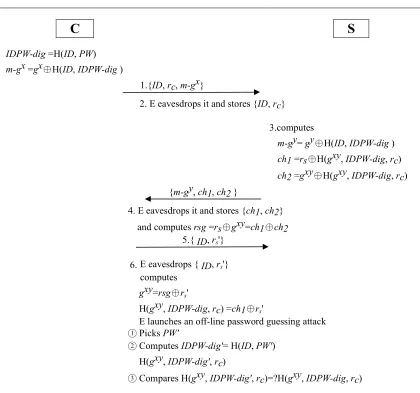
Fig. 4. Off-linepassword guessing attack on M.Hölbletal.’sprotocol
password change protocol is secure against off-line password guessing attacks. However, we found that their improvement is still unable to get rid of such the attack. We describe this as follows and also depict it in Figure 4.
1. C starts the protocol run and sends a message {ID, rc, m-gx} to S, where m-gx=gx⊕
H(ID,IDPW-dig) andIDPW-dig=H(ID,PW).
2. An adversary E eavesdrops it and stores the message {ID,rc}.
3. After receiving the message {ID,rc,m-gx} , S computesm-gy=gy⊕H(ID,IDPW-dig),
ch1 =rs⊕H(gxy, IDPW-dig, rc) and ch2 =gxy⊕H(gxy, IDPW-dig, rc). S sends the message {m-gy,ch1,ch2} to C.
4. Then, E eavesdrops and stores the message {ch1,ch2}. E calculatesch1⊕ch2and gets
rsg=rs⊕gxy.
5. On receipt of the message, C verifies it. After authenticating S to be valid, he sends { ID, rs'} to S, where rs' = rs if all messages have not been modified by another
attacker.
6. Next, E eavesdrops it and computes rsg⊕rs'. E can therefore retrieve gxy and extract
H(gxy,IDPW-dig,rc) fromch1⊕rs'.
Finally, E can launch an off-line password guessing attack and find the password PW
by iterating upon all possible choices ofPW':
○1 Picks a candidate passwordPW'.
○2 ComputesIDPW-dig'= H(ID,PW') and H(gxy,IDPW-dig',rc) . ○3 Compares H(gxy,IDPW-dig',rc) with H(gxy,IDPW-dig,rc) .
3.2 T. Xianget al.’scryptanalysis on I. E. Liaoet al.’sprotocol
In 2006, I. E. Liao et al. proposed a password authentication scheme over insecure networks [11]. They also claimed that their scheme can be extended to support Diffie-Hellman key agreement protocol. However, in 2008, T. Xianget al.[8] pointed out that I. E. Liaoet al.’sschemeis potentially vulnerable to three kinds of attacks, off-line password guessing attack, replay attack and Denial-of-Service attack. We will review these three kinds of attacks in turn.
3.2.1 Off-line password guessing attack
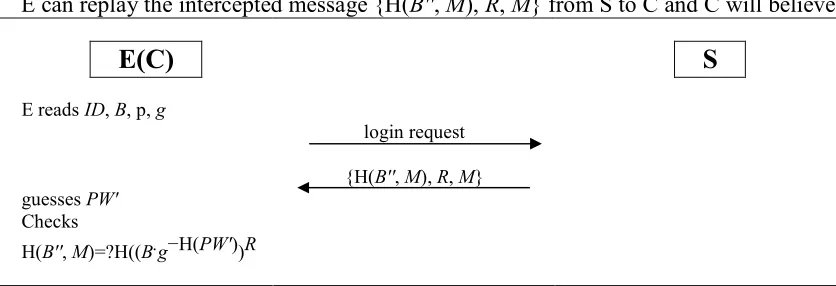
An attackerE getsC’ssmartcard and readsalldata{ID, B, p, g}. E impersonates C and sends the login request to S. S then sends E the message {H(B'', M), R, M}. Now, E can guess the password PW'to compare if the value of H(B'',M) is equal to the value of H((B.g−H(PW'))Rmod p,M). E repeats the way by using all possible choices ofPW'. We show this attack in Figure 5.
E can replay the intercepted message {H(B'',M),R,M} from S to C and C will believe
E(C)
S
E readsID,B, p,g
login request {H(B'',M),R,M} guessesPW'
Checks
H(B'',M)=?H((B.g−H(PW'))R
Fig. 5. Off-line password guessing attack onI.E.Liao etal.’sprotocol
it is from thelegalserverS.However,E can’tgetthelargerandom numbery from M
(=gymod p) because it is a discrete logarithm problem. AndE can’tknow thesession key
K=gxyfromN=gxandM=gybecause it is the Decision Diffie-Hellman problem.
3.2.3 Denial-of-Service attack on password change
Assuming that a user frequently uses the smart card, the card is often inserted to the card reader on line for a long time. An active attacker can eavesdrop, modify, remove and insert messages into the channel. Suppose that an attacker E temporarily gets access to theclientC’ssmartcardand performs the following operations. He randomly selects two different passwords: PW* as the old password and PW' as the new password. Then E sends a password change request to the smart card. The smart card will compute Y = gH(PW') mod p, Z =B.g−H(PW*) mod p, and β= Y.Z = gH(PW').B.g−H(PW*)= gH(PW').gH(s, ID)+H(PW).g−H(PW*)=gH(s, ID)+H(PW)−H(PW*)+H(PW'), then rep-lacesBwithβ.From then on,C can’tauthenticateS and vice versa with his password or his new password changed by himself.
4. Our improved protocols
In this section, we present two improved protocols on M. Hölblet al.’sprotocol and I. E. Liaoet al.’sprotocolin Section 4.1 and Section 4.2, respectively.
4.1 Improvement on M. Hölblet al.’sprotocol
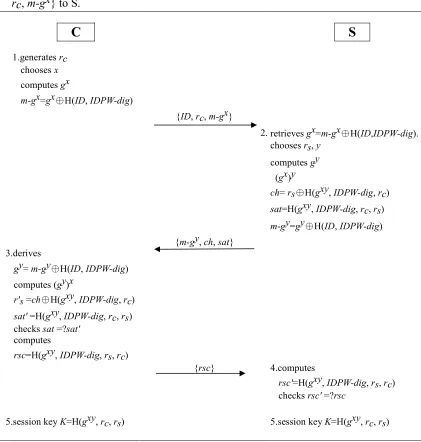
In this section, we describe the improvement on M. Hölbl et al.’s authentication protocol as shown in figure 6.
The improved authentication protocol performs the following steps.
rc,m-gx} to S.
C
S
1.generatesrc
choosesx
computesgx
m-gx=gx⊕H(ID,IDPW-dig)
{ID,rc,m-gx}
2. retrievesgx=m-gx⊕H(ID,IDPW-dig). choosesrs,y
computesgy
(gx)y
ch=rs⊕H(gxy,IDPW-dig,rc)
sat=H(gxy,IDPW-dig,rc,rs)
m-gy=gy⊕H(ID,IDPW-dig) {m-gy,ch,sat}
3.derives
gy=m-gy⊕H(ID,IDPW-dig) computes (gy)x
r's=ch⊕H(gxy,IDPW-dig,rc)
sat'=H(gxy,IDPW-dig,rc,rs) checkssat=?sat'
computes
rsc=H(gxy,IDPW-dig,rs,rc)
{rsc} 4.computes
rsc'=H(gxy,IDPW-dig,rs,rc) checksrsc'=?rsc
5.session keyK=H(gxy,rc,rs) 5.session keyK=H(gxy,rc,rs)
Fig. 6. Improvement onM.Hölbletal.’sauthentication protocol
2. After receiving the message, S retrievesgx by computinggx=m-gx⊕H(ID,IDPW-dig). Then, he chooses a random noncers, a large integer nonceyand computesgymod p. S calculates (gx)ymod p, generatesch=rs⊕H(gxy,IDPW-dig,rc),sat=H(gxy,IDPW-dig,
rc, rs) and masks gy as m-gy by computing m-gy=gy⊕H(ID, IDPW-dig). Then, S sends {m-gy,ch,sat} to C.
computessat'=H(gxy,IDPW-dig,rc,rs) and checks ifsatis equal to the computedsat'. If it is, S is authentic. C then computes rsc=H(gxy, IDPW-dig, rs, rc) and sends {rsc} to S.
4. After receiving {rsc}, S computes rsc'=H(gxy, IDPW-dig, rs,rc) and verifies if rsc'is the same as the receivedrsc. If they are the same, C is authentic.
5. After successful mutual authentication, C and S have the same session keyK=H(gxy,
rc,rs).
4.2 Improvement on I. E. Liaoet al.’sprotocol
For improving I. E. Liao et al.’s protocol,our proposed scheme consists of three phases, registration phase, login phase, and authentication phase. We describe them as follows.
4.2.1 Registration phase
Our registration phase is the same as original scheme described in Section 2.2.1.
4.2.2 Login and authentication phases
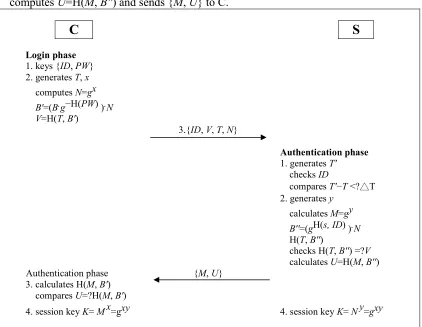
Generally, we login to a server just for doing something. It needs only authentication and seldom for password change. Therefore, for efficiency consideration, our login and authentication phases are divided into two scenarios: (A) for authentication only as shown in Figure 7. (B) for authentication and password change as shown in Figure 8.
(A) For authentication only
(1) Login phase
If C wants to communicate with S without changing his password, C will run the following steps.
1. C inserts his smart card and keys {ID,PW}.
2. C generates the timestamp T and a random nonce x. He then computes N=gx mod p,
B'=(B.g−H(PW) mod p).NandV=H(T,B'). 3. C sends {ID,V,T,N} to S.
(2) Authentication phase
When receiving the message {ID, V, T, N}, S runs the following steps to verify the legitimacy of C and negotiates the session key.
1. S generates the timestampT', checksIDand compares ifT'−Tis less than △T. If ID is invalid orT'−T>△T, the login request is rejected.
2. S generates a random nonce y and calculates M=gymod p, B''=(gH(s, ID) mod p).N
computesU=H(M,B'') and sends {M,U} to C.
C
S
Login phase
1. keys {ID,PW} 2. generatesT,x
computesN=gx B'=(B.g−H(PW) ).N V=H(T,B')
3.{ID,V,T,N}
Authentication phase
1. generatesT'
checksID
comparesT'−T<?△T 2. generatesy
calculatesM=gy B''=(gH(s, ID) ).N
H(T,B'')
checks H(T,B'') =?V
calculatesU=H(M,B'') Authentication phase {M,U}
3. calculates H(M,B') comparesU=?H(M,B')
4. session keyK=M x=gxy 4. session keyK=N y=gxy
Fig. 7. The improvement for authentication only
3. After receiving the message, C calculates H(M,B'), and compares ifUis equal to H(M,
B'). If it is, S is authentic.
4. After successful mutual authentication, S has the session keyK=N y= gxyand C also has the same session keyK=M x= gxy.
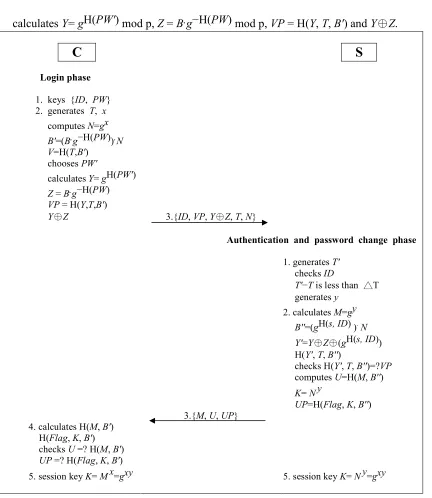
(B) For authentication and password change
(1) Login phase
Although in the password change protocol of I. E. Liao et al., C can change his password without communicating with S. However, T. Xiang et al. found it still suffers from Denial-of-Service as described in Section 3.2.3. In the following, we propose an improvement to resist such an attack.
Assume that C wants to change his passwordPWtoPW'. 1. C inserts his smart card and keys {ID,PW}.
2. C generates the timestamp T, a random nonce x and computes N=gx mod p,
calculatesY=gH(PW') mod p,Z=B.g−H(PW) mod p,VP= H(Y,T,B') andY⊕Z.
C
S
Login phase
1. keys {ID, PW} 2. generates T, x
computesN=gx B'=(B.g−H(PW)).N V=H(T,B')
choosesPW'
calculatesY=gH(PW') Z=B.g−H(PW) VP= H(Y,T,B')
Y⊕Z 3.{ID,VP,Y⊕Z,T,N}
Authentication and password change phase
1. generatesT'
checksID
T'−Tis less than △T generatesy
2. calculatesM=gy B''=(gH(s, ID) ).N Y'=Y⊕Z⊕(gH(s, ID))
H(Y',T,B'')
checks H(Y',T,B'')=?VP
computesU=H(M,B'')
K=N y
UP=H(Flag,K,B'') 3.{M,U,UP}
4. calculates H(M,B') H(Flag,K,B') checksU=? H(M,B')
UP=? H(Flag,K,B')
5. session keyK=M x=gxy 5. session keyK=N y=gxy
Fig. 8. The improvement for authentication and password change
3. C sends {ID,VP,Y⊕Z,T,N} to S.
(2) Authentication and password change phase
When receiving the message {ID, VP, Y⊕Z, T, N} from C, S executes the following steps to identify C, accepts the login request for password change if C is legal and constructs the session key.
T'−T is less than △T. If ID is valid and T'−T < △T, the login request can be continued.
2. S generates a random noncey, calculatesM=gymod p, B''=(gH(s, ID) mod p).Nmod p, Y'=Y⊕Z⊕(gH(s, ID) mod p) and H(Y', T, B''). He checks if H(Y',T,B'') is equal to
VP. If it isn’t, S refuses the request and terminates the protocol. Otherwise, C is authentic and S accepts the password change request. S then computes U=H(M, B'') ,
K=N y mod p, andUP=H(Flag,K,B'') whereFlagissetto ‘accept’afterthepassword change request is accepted.
3. S sends {M,U,UP} to C.
4. After receiving the message, C calculates H(M, B') and H(Flag,K, B'). C compares if
U is equal to H(M, B'). If it is, S is authentic. C then compares UP with the value of H(Flag, K, B'). If they are equal, C can confirm that his password change request is accepted.
5. After successful mutual authentication, S computes the session keyK=N y=gxyand C also can compute the same session keyK=M x=gxy.
5. Security and efficiency analysis for both of the improved protocols on (a) M. Hölblet al.’sprotocoland (b)I.E.Liaoet al.’sprotocol,respectively.
In this section, we first show that both of our improvements can withstand various attacks in Section 5.1. Then, we examine the efficiency of both schemes in Section 5.2. For abbreviation, we make the analysis behind notation (a) to denote that it is for M. Hölblet al.’sprotocoland theanalysisbehind notation (b)to stand foritisforI.E.Liao
et al.’sprotocol.Moreover, notations (1) and (2) following notation (b) stand for they are for authentication only and for authentication and password change, respectively.
5.1 Security analysis
Our improved protocols not only can provide mutual authentication and perfect forward secrecy but also can resist the following attacks: off-line password guessing attack, insider attack, replay attack, on-line password guessing attack, Denial-of-Service attack on the password change phase and user impersonation attack if an attacker obtains the smart card. We show them in turn.
5.1.1 Mutual authentication
(a) For authenticating S, C has to verify the validity of the evidencesat=H(gxy,IDPW-dig,
rc, rs). Conversely, for authenticating C, S must check the validity of rsc=H(gxy,
IDPW-dig, rs, rc). For only S and C can know o deduce the common secret data, gxy,
(b) (1)In order to authenticate C in the phases for authentication only, S has to verify validity of the evidence V=H(T, B'). On the other hand, C must check the validity ofU=H(M,B'') to authenticate S. These evidences are computed with the common secret message B'/B''. Because only C and S know the common secret message
B'/B'', no one else can forge the evidences. When the validity ofVandUis verified by S and C respectively, the mutual authentication between them is achieved.
(2) In order to authenticate C in the phases for authentication and password change, S has to verify validity of the evidenceVP = H(Y,T,B'). On the other hand, C must check the validity ofU=H(M,B'') andUP=H(Flag, K, B'') to authenticate S. These evidences are computed with the common secret message B'/B''. Because only C and S know the common secret messageB'/B'', no one else can forge the evidences. When the validity ofVP, UandUP is verified by S and C respectively, the mutual authentication between them is achieved.
5.1.2 Perfect forward secrecy
In both oftheimproved protocols,acompromised password can’tbeused to construct previous session keys for we use the Diffie-Hellman key agreement protocols which are based on large random nonces. Naturally, it provides perfect forward secrecy.
5.1.3 Preventing the off-line password guessing attack
(a) If an adversary E has eavesdropped on the transmitted messages {ID, rc, m-gx}, { m-gy, ch, sat} and {rsc } between C and S, he can’tknow thevalues of gx, gy
and rsfrom those intercepted messages to perform the off-line password guessing attack for m-gx=gx⊕H(ID, IDPW-dig), m-gy=gy⊕H(ID, IDPW-dig), ch= rs⊕
H(gxy, IDPW-dig, rc), sat=H(gxy,IDPW-dig, rc, rs) and rsc=H(gxy,IDPW-dig, rs,
rc). Without the knowledge ofIDPW-dig, E can not figure out gx andgy. Even he can figure outgxandgy, he can by no means figure outgxywithout the knowledge ofxory. Therefore,E can’timplementtheoff-line password guessing attack.
(b)Supposing thatC’ssmartcard islost,E can read thevalueofB.Buthestill can’tget the value of gH(s, ID) for s is the secret of S. Hence, E can’tlaunch the off-line password guessing attack by guessing password PWasPW'and verifying whether
B.g−H(PW') is equal togH(s, ID).
(1)In the phases of authentication only, assume that E intercepted the message {V, T,
N}, where N= gx, V= H(T, B'), B'=(B.g−H(PW)).N. However, he doesn’tknow both the values of B storedin C’ssmartcard, andC’spassword. Therefore, hecan’t compute the value of H(T, (B.g−H(PW)).N) and compare the intercepted valueV
(2)In the phases of authentication and password change, assume that E intercepted the message {VP,Y⊕Z,T,N}, whereN=gx,Z=B.g−H(PW),Y=gH(PW'),VP= H(Y,
T, B'), B'=(B.g−H(PW)). But he doesn’tknow thevalues of B stored in C’ssmart card, the value ofPWwhich is kept secret by C and the value ofPW'chosen by C. Hence, hecan’tcomputethevaluesofYand H(Y,T,B.g−H(PW)), and compare the
interceptedVPwith this computed result. Therefore, the off-line password guessing attack can’twork.
5.1.4 Preventing the insider attack
(a) If a legal client D wants to impersonate client C to login to S. without the knowledge of C’sIDPW-dig, thegxhe computes would be different with the value S will deduce. Hence, the value rsc which D will produce in pass three would be different from the value rsc’computed by S. That is, he can’t be authenticated by S. Therefore, the insider attack fails.
(b) (1)Similarly, if a legal client D wants to impersonate client C to login to S. Without the knowledge of C’s passwordpw andB, he can not deduceVand be successfully authenticated by S.
(2)With the same reason, if a legal client D wants to impersonate client C to login to S. Without the knowledge of C’s password and B, he can not deduce VP and be successfully authenticated by S.
5.1.5 Preventing the replay attack
(a) We use random nonces rc, rs, x, y to prevent replay attack. An attacker cannot be authenticated by resending previous messages transmitted by a legal client.
(b) Similarly, an adversary cannot be authenticated by resending previous messages transmitted by a legal client for we use random nonces x, y and the timestamp Tto withstand this kind of attack.
5.1.6 Preventing the on-line password guessing attack
The two protocols we proposed are mutual authentication between C and S. We can set both the protocols to tolerant three times of wrong password logins. If this amount of wrong login times is achieved, the system would reject the logins. Under such a setting, both of our schemes can resist on-line password guessing attack.
5.1.7 Preventing Denial-of-Service attack on password change
two improvement schemes can resist against Denial-of-Service attack.
5.1.8 Preventing user’simpersonation attack ifan attackerobtains the smart card
(a)We don’texaminethisprotocol,forthe protocol using no smart cards.
(b) (1)In the phases of authentication only, if E hasgotC’ssmartcardand knows B. He starts the authentication protocol for being authenticated by S. However, he doesn’t know C’s password pw. He can not deduce C’sB'and henceforth Vwhich will be verified by S. Therefore, he couldn’t be authenticated by S successfully.
(2)Similarly, in the phases of authentication and password change, assume that E has got C’ssmartcardand knows B. He starts the authentication protocol for being authenticated by S. However, he faces the same reason as stated in (a) that he doesn’t know C’s passwordpw He can not deduce C’sB'and henceforthVP. That is, he can not authenticated by S.
5.2 Efficiency analysis
(a) M. Hölbl et al.’sprotocolneedsfourpassesto establish thesecure communication channel. However, our improvement needs only three passes. Therefore, our scheme is more efficient than theirs.
(b) I. E. Liao et al.’sprotocolneedsthreepassesto establish thesecurecommunication channel. However, our improvement needs only two passes either for authentication only or for authentication and password change. Consequently, our scheme outperforms theirs in efficiency.
6. Conclusion
We have analyzed the security of M. Hölbl et al.’sprotocol and review the cryptanalysis on I. E. Liao et al.’sprotocol. Although M. Hölbl et al. claimed their protocol can resist against various attacks, we have showed that their protocol is indeed insecure against the password guessing attack. In addition, we have proposed improved protocols for both schemes which not only can provide mutual authentication efficiently, but also can really withstand various attacks.
References
[1]T. H. Chen, W. B. Lee,“A new method for using hash functions to solve remote user authentication”, Computers & Electrical Engineering, Vol. 34, No. 1, pp. 53-62, January 2008.
[2]G. Yang, D. S. Wong, H. Wang, X. Deng,“Two-factor mutual authentication based on smart cards and passwords”, Journal of Computer and System Sciences, In Press, Corrected Proof, Available online 15 May 2008.
On ID-based”, unpublished.
[4]H. S. Rhee, J. O. Kwon, D. H. Lee, “A remote user authentication scheme without using smart cards”, Computer Standards & Interfaces, In Press, Corrected Proof, Available online 5 December 2007.
[5]T. Goriparthi, M. L. Das, A. Saxena, “An improved bilinear pairing based remote user authentication scheme”, Computer Standards & Interfaces, In Press, Corrected Proof, Available online 5 December 2007.
[6]J. Y. Liu, A. M. Zhou, M. X. Gao, “A new mutual authentication scheme based on nonce and smart cards”, Computer Communications, Vol. 31, No. 10, pp. 2205-2209, June 2008.
[7]W. S. Juang, W. K. Nien, “Efficient password authenticated key agreement using bilinear pairings”, Mathematical and Computer Modelling, Vol. 47, No. 11-12, pp. 1238-1245, June 2008.
[8]T. Xiang, K. Wong, X. Liao, “Cryptanalysis of a password authentication scheme over insecure networks”, Computer and System Sciences, Vol. 74, No. 5, pp. 657-661, August 2008.
[9]J. S. Chou, Y. Chen, X. W. Hou, “Cryptanalysis and improvement of Yang-Wang password authentication schemes”, unpublished.
[10]M. Hölbl, T. Welzer, B. Brumen, “Improvement of the Peyravian-Jeffries’s user authentication protocol and password change protocol”, Computer Communications, Vol. 31, No. 10, pp. 1945-1951, June 2008.
[11]I. E. Liao, C. C. Lee, M. S. Hwang, “A password authentication scheme over insecure networks”,Journal of Computer and System Sciences, Vol. 72, No. 4, pp. 727-740, June 2006.
[12]M. Peyravian, C. Jeffries, “Secure remote user access over insecure networks”,
Computer Communications, Vol. 29, No. 5, pp. 660-667, March 2006.
[13]W. S. Juang, S. T. Chen, H. T. Liaw, “Robust and efficient password-authenticated key agreement using smart cards”, IEEE Transactions on Industrial Electronics, Vol. 55, No. 6, pp. 2551-2556, June2008.
[14]C. S. Bindu, P. C. S. Reddy, B. Satyanarayana,“Improved remote user authentication scheme preserving user anonymity”, International Journal of Computer Science and Network Security, Vol. 8, No. 3, pp. 62-65, March 2008.
[15]Y. Lee, J. Nam, D. Won,“Vulnerabilities in a Remote Agent Authentication Scheme Using Smart Cards”,LNCS: AMSTA, Vol. 4953, pp. 850-857, April 2008.
[16]M. L. Das, “On the Security of an efficient and complete remote user authentication scheme”,Cryptography and Security, arXiv:0802.2112v1 [cs.CR], February 2008. [17]H. Guo, Z. Li, Y. Mu, X. Zhang, “Cryptanalysis of simple three-party key exchange
protocol”, Computers & Security, Vol. 27, No. 1-2, pp. 16-21, March 2008.
[18]H. B. Chen, T. H. Chen, W. B. Lee, C. C. Chang, “Security enhancement for a three-party encrypted key exchange protocol against undetectable on-line password guessing attacks”, Computer Standards & Interfaces, Vol. 30, No. 1-2, pp. 95-99, January 2008.
[19]E. J. Yoon, K. Y. Yoo, “Improving the novel three-party encrypted key exchange protocol”,Computer Standards & Interfaces, Vol. 30, No. 5, pp. 309-314, July 2008. [20]J. Nam, Y. Lee, S. Kim, D. Won, “Security weakness in a three-party pairing-based
No. 6, pp. 1364-1375, March 2007.
[21]H. R. Chung, W. C. Ku, “Three weaknesses in a simple three-party key exchange protocol”,Information Sciences, Vol. 178, No. 1-2, pp. 220-229, January 2008. [22]R. C. Phan, W. C. Yau, B. M. Goi,“Cryptanalysis of simple three-party key exchange
protocol (S-3PAKE)”,Information Sciences, Vol. 178, No. 13, pp. 2849-2856, July 2008.
[23]C. C. Chang, J. S. Lee, T. F. Cheng, “Security design for three-party encrypted key exchange protocol using smart cards”,ACM ISBN: 978-1-59593-993-7, pp. 329-333, 2008.
[24]J. L. Tsai, “Efficient multi-server authentication scheme based on one-way hash function without verification table”, Computers & Security, Vol. 27, No. 3-4, pp. 115-121, May-June 2008.