VALUE FOR MONEY OPTIMISATION AND
SUSTAINABILITY IN PFI PROJECTS
Christian Henjewele1, Ming Sun, and Peter Fewings
1 Faculty of Environment and Technology; University of the West of England; Bristol. UK
ABSTRACT
Since 1992, the public sector in the UK has used Private Finance Initiative (PFI) to finance major infrastructure projects and to secure Value for Money. PFI is claimed to have successfully minimised construction risks and delivered projects with high certainty in the time, cost, quality, and client satisfaction. However, recent concerns on poor returns have increased pressure to demonstrate that expectations will be consistent ‘vis-à-vis’ their ability to give long term VFM. This paper is based on a research to explore the VFM uncertainty of PFI projects and establish causes hitherto. The research investigated variations in costs, time, and client requirements from the strategic business case stage through to the operational phase. Data collection methods include a documentary analysis of full business cases of five PFI projects and published reports and a questionnaire survey of 44 PFI projects in the UK. Analysis shows in many PFI projects; VFM results are not always constant because costs, time and client requirements change continuously in the project’s lifecycle. Early warnings on VFM variations are not systematically exploited due to lack of consistent frameworks. The current PFI implementation framework is prescriptive of procedures and assumes the appraisers have the right information to carryout VFM assessment at all recommended stages. The study subsequently proposed a model, which seeks to improve the delivery of PFI projects by optimising value for money and sustaining it throughout the project’s lifecycle
Keywords: Model, Performance, Private Finance Initiative, Uncertainty, Value for money
INTRODUCTION
Since 1992, the public sector in the UK has used Private Finance Initiative (PFI) as a mechanism to involve the private sector in the funding of major capital projects. Through PFI, many public infrastructures, such as schools, hospitals and prisons, and roads have been built. The PFI package includes agreements to provide a fully serviced facility for a period typically of around 25 to 30 years. To the public sector, PFI has offered a solution to the problem of underinvestment by offering a long-term income stream. For its advocators, PFI is credited for superior performance in cost, time, and client satisfaction (HM-Treasury, 2008). It is suggested that PFI has
delivered better Value for Money (VFM) than the counterpart traditional procurement methods because of its focus on appropriate risk allocation, faster project completion,
curtailment in project cost escalation, incentives for innovation, and focus on the whole life costs (Akintoye et al, 2003).
Although PFI has been in use for nearly two decades, it still faces several challenges to provide conclusive proof of VFM. These challenges have persisted for so long because PFI is usually applied to complex and large-scale schemes, which involve long contractual durations. The complexity of PFI projects affects the specification of quality of service, pricing of the facility and services, and defining performance measurements. For the same reason, many projects incur higher cost and take a long time to develop and procure. The actual achievement of VFM cannot be fully assessed until PFI projects become operational. On the other hand, there is a need for
evaluating and optimising the potential VFM of a PFI project during the development stage, because there are limited opportunities to improve its VFM once the project is operational. Due to complexity and lack of appropriate PFI expertise, models and standardised procedures are important to facilitate consistent implementation of PFI projects. However, only a few models and frameworks have been proposed to deal with other issues, which are not specific to whole life VFM optimisation.
DEFICIENCIES OF THE EXISTING VFM ASSESSMENT
FRAMEWORKS
According to the current PFI guidelines, VFM is the optimum combination and balance of cost and quality to meet the client’s needs (HM-Treasury, 2008). It is assessed by comparing two or more options for potential or actual outcomes. Investment decisions and choices for procurement options also depend on the VFM assessment results. Therefore, prior to PFI project approval, business cases are
scrutinised against VFM drivers including risk allocation, output based specifications; competition and contractual negotiations; transaction costs, and management skills (HM-Treasury, 2008).
The statutory framework for VFM assessment is provided by the Treasury’s guidance (HM-Treasury, 2006). The guidance requires investment decisions be assessed for project viability, desirability and achievability. The assessment should consider both qualitative aspects such as fitness for purpose and quantitative aspects such as whole life cost. It should be carried out at three levels: programme level, project level and procurement level. However, quantitative assessment is only considered at the project level and procurement level.
The programme level assessment is carried out during the Strategic Outline Case stage when the investment is being considers. The project level assessment is carried at the Outline Business Case stage before advertising the project on the OJEU (Official Journal of the European Union). At these two levels, the qualitative assessment aims to confirm that PFI is the right choice; and the project will be viable, desirable, and achievable. Qualitative assessment at the procurement level begins immediately after the Outline Business Case and continues through to financial close or Full Business Case. The assessment focuses on the strength of competition, procurement efficiency, and appropriate transfer of risks to preserve VFM.
government. The PSC include project capital outlay and revenue costs, cost of risks retained by the project client and those that can be transferred to the private sector, and other adjustments such as optimism biases. The guidance does not go beyond the procurement stage.
More coverage of lifecycle VFM assessment is provided in the National Audit Office’s framework for the implementation of PFI projects (NAO, 2006). The NAO framework prescribes VFM assessment criteria for six project stages: strategic analysis, tendering, contract completion, pre-operational implementation, and early and mature operational. The framework focuses on five drivers: functional fitness for purpose; appropriateness of PFI, stakeholders support; quality project management, integration of cost, quality and flexibility; and risk allocation. However, the
framework is developed as an audit tool which comes to effect late when the project has passed the key milestones.
PFI guidance and the aforementioned frameworks provide appraisers with strict approval requirements and standardised procedures. They have been criticised for complexity, which leads to extensively reliance on the expertise of external
consultancies (Ball and King, 2006). More specifically, current frameworks have the following deficiencies that affect the optimality and sustainability of VFM.
First, VFM definition, criteria and creation processes are prescriptive. They encourage compliance and subjectivity instead of addressing implementation issues such as process complexity, lengthy negotiation and high transaction costs (Akintoye et al, 2003).
Second, VFM assessment lacks vigorous testing for the robustness. The quantitative assessment template carries out sensitivity analysis of one factor at a time and rarely simulates the interaction of multiple factors occurring at the same time
Third, they provide no tools to monitor VFM in monetary terms when the PSC is discontinued after procurement is completed. As a result, clients completely lose track of VFM during the operational phase when changes to the facility or services are implemented.
Fourth and the most critical issue is the uncertainty of the planned VFM results. Projects experienced continuous variations in cost through all stages from inception through to the operating phase. (Pollock et al, 2007; NAO, 2008). This is contrary to the claim that PFI offers certainty in cost, time and quality; hence good value for money. Since cost variation alone is not
definitive of VFM uncertainty, more variables will be explored in this paper to substantiate the claim.
This research aims at addressing the problem of uncertainty that potentially affects VFM in PFI projects. It is based on the hypothesis that the current VFM frameworks produce inconsistent results, which limit the optimality of VFM and its sustainability for the whole of project’s whole life. The research particularly addressed two
objectives:
1. To substantiate uncertainty about the planned parameters used in the assessment of VFM including clients requirements, time and cost. 2. To propose an improved model for optimum VFM and its sustainability
VALIDATING VFM UNCERTAINTIES
To ascertain VFM uncertainty, Full Business Cases from five PFI projects from the health sector were analysed. The documentary analysis investigated how the planned parameters varied as the project moved from one milestone to the other. No
documents were accessible from other project sectors such as transport, education or defence because these departments did not have a disclosure policy for Full Business Cases. The PFI projects chosen for documentary analysis were:
Brent Emergency Care and Diagnostic Centre (BECaD);
Queen Alexandra Hospital (QAH);
City General and Haywood Hospital (CGHH);
Birmingham New Hospitals Project (BNHP)
New Hospitals Programme for Bart’s and the London NHS Trust (BLH) Results from the documentary analysis were validated using a wider project sample in a questionnaire survey. The survey used a structured questionnaire administered to PFI client teams from healthcare and transport infrastructure projects. The
questionnaire was sent to 80 projects of both development and operational stages. 44 respondents returned completed questionnaires representing a rate of 55%.
Respondents for the development phase were mainly project directors and for the operational phase were contract managers. The received responses were for 10 highways; 2 traffic junctions; 1 railway; 13 street lighting; and 18 buildings, of which 16 were hospitals and two office buildings. The response also covered projects of a different nature and sizes.
Results from the documentary analysis
The five Full Business Cases covered three milestones: Strategic Business Case, Outline Business Case and Full Business Case stages. All projects complied with the current PFI framework. In particular, client’s needs were identified at the Strategic Outline Case Stage based on a review of the current service level and drivers for change. At the Outline Business Case stage, the needs were reviewed, and activities were remodelled. Various project options were presented and compared for costs and benefits. The PSC was developed based on the modelled ‘activity assumptions’ stipulating client’s requirements and costs. During the Full Business Case stage, the PSC was reviewed to reflect the negotiated project solutions. The analysis of VFM uncertainty focused on variations in number of beds and capital cost, which were consistently reported in all documents. The reporting of other client requirements including project scope, equipment, and facilities management (FM) services and timescale varied therefore could not be analysed. The main analysis results are summarised in the following:
The number of beds and capital cost continuously changed. At the Outline Business Case stage, 3 out of the 5 projects increased their client requirements and 2 reduced them. During the Full Business Case stage, 3 projects reduced their requirements and the remaining 2 did not change. Meanwhile, costs constantly increased in all projects. From the Strategic Outline Case stage to Outline Business Case, the largest increase was 412% of the original planned cost. The highest cost increase from the Outline Business Case to Full
Business Case was 109%.
for QAH project. The analysis shows that the BECaD project transferred 65% of total risks to switch VFM from 1.06% poorer to 1.23% better under PFI than the PSC. Similarly, the QAH project transferred 72% of total risks to switch VFM from 10.7% poorer to 3.10% better under PFI than the PSC. Another strategy was to inflate unit costs in the PSC. For example, the BLT project had the PSC unit rates higher than the preferred bidder’s prices, therefore it was able to realise a 1.33% better VFM under PFI before
transferring risks. These results indicate that the public sector appraisers were under pressure to demonstrate VFM.
Sensitivity analysis to demonstrate the robustness of the appraised VFM varied across projects. There was no consistency in identifying the most sensitive factors, and the judgement for the robustness was subjectively done. For example, the increase in service costs by 0.33% would switch VFM for BNHP project, but this was regarded a ‘less likely’ possibility. Similarly, in all
projects, VFM was sensitive to the decrease in the PSC initial capital cost, but the decrease was regarded ‘very unlikely’.
Questionnaire survey results
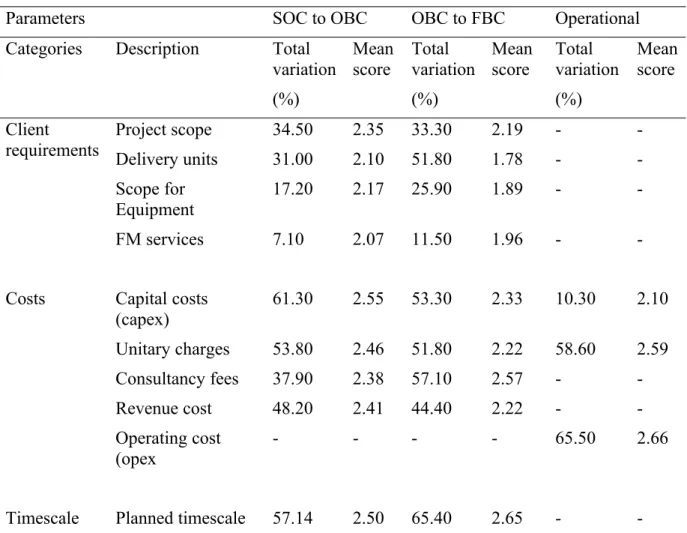
The questionnaire asked variations in three categories of parameters in the surveyed PFI projects: client requirements, including project scope, delivery units, equipment, and FM services; costs items, including capital cost, unitary charges, consultancy fees, revenue cost, and operating cost; and timescale. The analysis looked at
variations at three milestones: from Strategic Business Case to Outline Business Case; then from Outline Business Case to Full Business Case; and finally, during the Operational Phase. Results are presented in the form of total variations and mean scores (MS) as shown in table 2. Mean scores show three trends: MS=2- no change; MS<2 - a decrease; and MS>2 – an increase. Results demonstrate that there were variations in all parameters and at all stages.
Client requirements increased (MS>2) from the Strategic Outline Case to Outline Business Case, but most of them were then decreased (MS<2) from Outline Business Case stage to Full Business Case. It is interesting to note that delivery units, equipment and FM services increased at the Outline Business Case stage and decreased at the Full Business Case stage, while project scope continually increased at both stages. This demonstrates that clients will remain unsure of what they will achieve until the end of procurement.
Cost variations had MS>2.0 through all three review stages - demonstrating that these items continuously increased. At the Outline Business Case stage, capital cost was the most serious problem, while consultancy fee was least problematic. There were slight improvements in costs at the Full Business case stage; but consultancy fee worsened. More escalations happened in during the operational phase. Around two-thirds of the operational projects surveyed overran the operating cost and unitary charges and 10 % overran capital cost. The increase in capital cost indicates that major works were undertaken which also involved capital reinvestment. Meanwhile, the overrun in operating cost and unitary could be due to both minor and major changes.
There were significant time delays (MS>2.0) at both the outline Business Case and Full Business Case stages. Over half of the projects delayed the
Table 1: performance of the planned parameters
Parameters SOC to OBC OBC to FBC Operational
Categories Description Total
variation (%)
Mean score
Total variation (%)
Mean score
Total variation (%)
Mean score
Client requirements
Project scope 34.50 2.35 33.30 2.19 -
-Delivery units 31.00 2.10 51.80 1.78 -
-Scope for
Equipment 17.20 2.17 25.90 1.89 -
-FM services 7.10 2.07 11.50 1.96 -
-Costs Capital costs
(capex)
61.30 2.55 53.30 2.33 10.30 2.10
Unitary charges 53.80 2.46 51.80 2.22 58.60 2.59
Consultancy fees 37.90 2.38 57.10 2.57 -
-Revenue cost 48.20 2.41 44.40 2.22 -
-Operating cost (opex
- - - - 65.50 2.66
Timescale Planned timescale 57.14 2.50 65.40 2.65 -
-Note: SOC- Strategic Outline Case; OBC- Outline Business Case; FBC- Full Business Case
VFM OPTIMISATION AND SUSTAINABILITY MODEL
Following the analysis of VFM uncertainties in PFI projects and evaluation of the existing VFM frameworks, this study developed a new VFM optimisation and
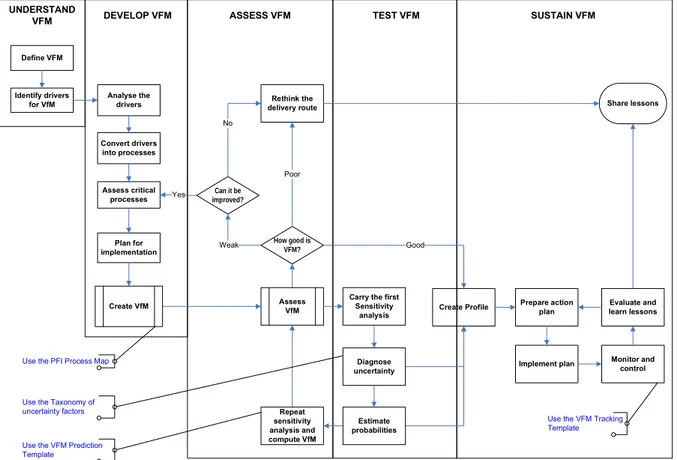
sustainability model. The model stems from the VALiD (Value in Design) concept of lifecycle value analysis (Saxon, 2005). It provides a logical structure to help project teams understand the issues that must be discussed among stakeholders to create an agreed understanding of value for money drivers. It can be viewed as an evolving model that varies with project stages to assist the stakeholders and project teams to define VFM objectives and translate them into implementable processes while allowing for feedbacks.
possible choice has been made; all the uncertainty within the available resources has been eliminated, and the choice is rationalised with objective knowledge. The structure of the proposed model is presented in figure 1. It comprises of five VFM processes: Understand; Develop, Assess, Test, and Sustain.
Assess VfM
Carry the first Sensitivity analysis Diagnose uncertainty Create Profile Estimate probabilities Repeat sensitivity analysis and compute VfM
How good is
VFM? Good Rethink the delivery route Weak Poor Prepare action plan
Implement plan Monitor and control Evaluate and learn lessons Convert drivers into processes Assess critical processes Plan for implementation
Can it be improved? No
Yes
Create VfM
Use the PFI Process Map
Analyse the drivers
DEVELOP VFM ASSESS VFM TEST VFM SUSTAIN VFM
Define VFM Identify drivers for VfM UNDERSTAND VFM Share lessons
Use the VFM Prediction Template Use the Taxonomy of uncertainty factors
Use the VFM Tracking Template
Figure 1: structure of the VFM Optimisation and Sustainability Model
The ‘Understand’ phase is carried out at the Strategic Outline Case stage. During this stage, stakeholders define and agree on the project context and will set criteria for VFM. This aims at creating an agreed understanding of the needs for the project and stakeholders’ expectations. The phase involves two processes: defining VFM in relation with the context of the project and identifying driving factors that will eventually shape the subsequent processes.
At the ‘Develop’ phase, project teams will define and prioritise processes, develop project implementation plans and implement the planned activities. The phase repeats with different activities at every project stage according to the implementation plan. A separate Process Map is developed to help experts convert the stakeholders’ defined drivers into few but most relevant operational processes. To complete this stage, there are 5 steps: analyse driver, define processes, assess and prioritise processes; develop an implementation plan; and implement the plan to create VFM. The ‘create VFM’ process (shown in double box) is a standard process from the current frameworks. This referees to specific tasks carried at relevant milestones such as defining optional appraisal at Outline Business Case stage and procurement at the Full Business Case stage.
proposed to aid the decision on the robustness of the achieved VFM and appropriate measures to take. A repeated sensitivity analysis with few most sensitive variables is recommended to assess the potential impact on VFM could things change. The ‘Assess’ and ‘Test’ iteration comprises of five main tasks: initial assessment of VFM; first sensitivity analysis; diagnosis of potential uncertainty around the most sensitive factors; repeat sensitivity analysis, and reassessment of VFM. A separate ‘VFM Prediction Template’ has been developed to help the testing process. The template also includes a monitoring tool to analyse the implication of cost change on VFM during the operational phase. The project progresses to the next implementation stage only when it provides ‘good VFM’ under the preferred option.
The final step is to ‘Sustain’ the assessed VFM. The step considers both proactive and reactive measure to mitigate uncertainty and monitor VFM. The ‘Sustain’ process includes five sub activities: create uncertainty profile, develop an action plan to mitigate uncertainty, implement the plan; monitoring VFM; and evaluation and lesson learning. A comprehensive breakdown of uncertainties is summarised in a separate ‘Taxonomy of uncertain factors’.
Supporting tools
To implement the model, there are three tools to assist the implementation of the model in practice: (1) Process map for VFM development phase; (2) prediction and tracking template for testing and monitoring of VFM; and (3) Taxonomy of
uncertainty factors as a planning tool.
Process map is developed to streamline PFI processes and maintain
consistency in VFM delivery. It compiles lifecycle processes from the onset through to project implementation. It covers: the Strategic Outline Case, Outline Business Case, Full Business Case and contract management during the implementation phase. It focuses on VFM enhancing activities at the key milestones, their interconnections, and flow of information between them. The mapping integrates prevailing knowledge based on current PFI guidance, the reviewed project case studies and recommendations from published researches. It uses IDEF0 diagrams (Integrated Definition for Functional modelling), which are easy to follow by the multidisciplinary PFI team (Kamara and Anumba, 2000). The process map particularly helps the user to convert VFM drivers into linear processes, which can further be expanded into greater levels of details.
The taxonomy is based on factors identified form a comprehensive review of the published literature. Priority factors causing VFM uncertainty were ranked in the course of the study. It classifies uncertainty factors into 3 categories: Environmental, Technical, and Relational. These are further decomposed by type, group, category, and source to the fourth level. At the elementary level, uncertainty factors have few dependencies, therefore, can be analysed
individually. Project teams can utilise the taxonomy identify uncertainty factors, to categorise and rank them, and create uncertainty profiles and develop a mitigation plan.
The prediction and monitoring template was developed to assist the implementation of mathematical models. The models simulate changes in VFM when the most sensitive factors vary. They take into account
scenarios can be simulated to improve the accuracy of the predicted VFM. For prediction, inputs are established from the VFM appraisal and sensitivity analysis at the Full Business Case stage. For VFM monitoring, the user provides cost changes at the current date. Outputs are illustrated graphically showing the current status of VFM, and time at which VFM is likely to switch to the PSC.
DISCUSSION
Results from both the documentary analysis and questionnaire survey have validated uncertainty in the planned outcomes through all project stages. The frequent variations in client requirements, costs and time determine the uncertainty in value for money of PFI projects. Results also demonstrated that current frameworks have not addressed the issue of robustness of the appraised VFM in case of future variations. The robustness is subjectively concluded and the impact of the interaction between the most sensitive factors is not given adequate attention. The prescriptive nature of the current PFI frameworks provides little incentive for project teams to own the processes; instead they comply to get the project approved.
The study has developed a model to address some of the deficiencies in the current PFI framework. The model and its tools were reviewed by 15 experts: 9 were practitioners from PFI projects in the Healthcare and transport sector and six were academic researchers engaged in relevant areas. Three theoretical case studies were also used to test the template. Reviewer agreed that the model was straight forward and covered key areas required to optimise VFM. It recognises the role of the drivers for VFM and reflects on the key milestones. The sequencing from Understanding, Developing, Assessing, to Testing ensures VFM is consistent whilst allowing for the utilisation of the lessons learned. The ‘Assess and Test’ circle provides robust approach to optimise VFM. It graphically illustrates variations in VFM and warns against any negative trend in the operational phase.
The model is useful as a checklist to optimise VFM especially due to its requirement to review the achieved VFM constantly. Contrary to the current practice, the model helps to detect possible areas of VFM loss, so that the initial assumptions can be reviewed. It can be used as a planning tool for new projects or monitoring tool for those in advanced stages of development. Since projects are not standard, the model gives flexibility to the user to customise value for money criteria and critical processes that suit the particulars of the project. However, the developed templates are based on the PSC approach; therefore its use is limited to similar cases. The template is also limited to assessing VFM based on cost variation assuming quality remains
unchanged.
CONCLUSIONS
highlighted the need for an improved framework that focuses on well-evidenced decision on the robustness of the appraised VFM. This research has developed a model providing a systematic framework, procedures and tools for project teams to define, develop, assess, test and sustain VFM. The model offers a whole life approach to optimise value for money and to monitor progress at different project
implementation stages. The proposed model is not intended as a replacement of existing PFI guidance; rather it addresses specific gaps to improve consistency of the VFM assessment results. Adopting the model has the potential to improve the delivery of VFM through optimisation of the benefits and costs during the project appraisal process, monitor and sustain VFM during the operating phase, and utilise lessons learnt for improvements in the future.
REFERENCES
Akintoye, A., Hardcastle, C., Beck, M., Chinyio, E., and Asenova, D., 2003Achieving best value in private finance initiative project procurement Construction Management & Economics, Vol. 21(5): 461 – 470
Ball, R., and King, D, (2006) the Private Finance Initiative in Local government, Economic Affairs, March 2006; 36-41
Creswell, J. W. (2008) Research design: qualitative, quantitative, and mixed methods approaches, (3rd Ed.); SAGE
HM Treasury (HMT), (2006) ‘Value for Money assessment Guidance’, November 2006; HM-Stationery Office: London
HM Treasury (HMT), 2008 Infrastructure procurement: delivering long-term value; March 2008; HM-Stationery Office: London
Kamara, J.M., and Anumba, C.J. (2000) Process model for client requirements processing in construction, Business Process Management Journal, Vol. 6 (3), pp. 251-279
National Audit Office (NAO) (2006) ‘A Framework for Evaluating the
Implementation of Private Finance Initiative Projects: Volume 1 and 2’, 15 May 2006 National Audit Office (NAO) (2008) ‘Making Changes in Operational PFI Projects’, Report by the Comptroller and Auditor General | HC 205 Session 2007-2008 | 17 January 2008
Pollock, A., Price, D., and Player, S. (2007) An Examination of the UK Treasury’s Evidence Base for Cost and Time Overrun Data in UK Value-for-Money Policy and Appraisal; Public money & management, April 2007
Santos, J. R. A., (1999) Cronbach's Alpha: A Tool for Assessing the Reliability of Scales, Journal of Extension. 37:2