Students Car Use and its Effect on Environmental Attitudes
Dr Steve Melia
University of the West of England Abstract
(Type abstract here (200 words) use body)
This study concerns the relationship between students’ travel behaviour and their attitudes towards environmental issues. Previous studies have shown car use correlated with attitudes towards climate change, and with attitudes towards various policy measures designed to reduce car use. This study aimed to explore these relationships amongst students. 305 questionnaires were completed by undergraduates from several built
environment courses. The findings reveal a surprisingly high level of car availability and use, even amongst first years living on campus with no parking. There is a statistically significant relationship between car availability and level of concern about climate change, though the differences are small. There was no significant relationship between car ownership or use and acceptance of scientific evidence about climate change, although there was a significant gender difference: all of the ‘climate sceptics’ in the sample were male. There were strong associations between car availability/use and support for policies around parking and allocation of road space to pedestrians and cyclists, but not with other measures such as investment in rail and increasing tax on petrol. The conclusions of this paper consider the implications of the findings for teaching of sustainable transport and climate change issues to built environment students.
Keywords:
(please use body for keywords)Introduction
The research project described in this report concerns the relationship between students’ travel behaviour and their attitudes towards environmental issues. It aims to assess the impact – if any – of car ownership and use on students’ attitude towards climate change and policy measures designed to reduce car use. The transport literature, briefly reviewed below, suggests that car ownership and use are associated, in the population at large, with
differences in attitudes towards both of these subjects. The pattern is a complex one, however, and the causal mechanisms are poorly understood.
The United Nations declaration 57/254 for a ‘Decade of Sustainable Education’ beginning in 2005 increased attention on the teaching of principles related to sustainable development in higher education. A substantial body of literature has examined both the pedagogical challenges and some factors which may have a bearing on students’ receptiveness to these principles. There has been relatively little focus on the influence of external circumstances such as those considered in this study.
The University of the West of England has responded to the sustainable education agenda with an objective to expose all students to “the context of sustainable development for their professional lives” (UWE, 2011). The study coincided, and was partly prompted by, the author assuming leadership of a module, Society & the Car, open to undergraduates from a range of built environment programmes, where these issues form part of the curriculum. Prompted partly by broader sustainability objectives, and partly by planning restrictions on its main campus, UWE has implemented a travel plan which aims to reduce commuting by car. First year undergraduates living on campus are not allowed to park on the site, and are discouraged from parking in the surrounding area, where the local authority has been
gradually introducing parking restrictions. This study also aimed to assess the effect of these restrictions on car ownership and use across the three years of undergraduate degrees.
Literature Review
Much of the impetus for the teaching of sustainability has been prompted by concern about climate change. The implications of climate change for transport policy was an important theme for Society & the Car. The students’ own experience of car ownership and/or use, and the influence this might bring to their attitudes towards the material in the module, was discussed in the first session. Whereas the links between car use and their attitudes towards transport policy were apparent from that discussion, whether car use would also affect their attitudes to climate change was unclear.
A report for the Department for Transport (DfT, 2010) illustrates (graphically) that concern about climate change is negatively correlated with the frequency of car use. The dataset from an emerging study (Thornton et al, 2010 recently published online along with the interim report) provide some more detail in this respect. Table 1 presents a statistical analysis (two-tailed ‘t’ tests) performed by the author of this paper on the dataset from Thornton et al (2010).
Table 1 Level of concern about climate change from Thornton et al (2010) [Associations/correlations significant at the 95% level are emboldened]
Very or fairly concerned
Very or fairly
concerned ρ
Drivers 68.3% Non-drivers 72.1% 0.012
Car in household 70.4% No car in household 64.7% 0.003
In full-time education
(16+) 62.4% All others 69.9% 0.010
Aged 20 – 29 65.2% Aged 30+ 71.9% 0.001
Degree educated 83.4% All others 66.0% <0.001
Income quintiles 1 & 2 66.1% Income quintiles 3 – 5 61.5% 0.020
Overall average: 69.4%
The strongest positive relationship is with university education, as expected. Income is also positively correlated. Interestingly, car driving and car ownership show opposite signs: the net positive relationship between car ownership and concern about climate change probably reflects countervailing effects of driving (negative), and of education (positive) which is correlated with income, and hence car ownership. The level of education amongst
suggesting that the relationships shown in Table 1 might not apply, or might apply more strongly amongst undergraduates.
This study also asked whether respondents believed human activity was changing the climate: responses to that question followed a similar pattern to the question on concern about climate change (with 66% answering positively on average).
Concern about climate change increases with age: the age group from which most
undergraduates are drawn exhibits (slightly) less concern than older people. This finding is consistent with DfT (2009), which shed some light on the reasons for this. That project exposed participants to presentations from climate scientists. Unlike the older participants, the 20 – 29s became less convinced that climate change would affect their quality of life by the end of the project, focussing particularly on the suggestion that other parts of the world would be affected more severely than the UK.
When considering transport policies designed to respond to climate change, it may be considered self-evident that car owners would be less likely to support measures to reduce car use than non-owners. A similar comparison might also be made between frequent drivers and infrequent drivers. There has been, however, surprisingly little empirical
evidence from the UK to support, or refute, these assertions – possibly because researchers would consider them insufficiently challenging as research questions.
Several studies which segmented drivers and non-drivers according to their attitudes have given some insight into the validity of those assertions, though none have addressed them directly. These studies, which were mainly concerned about the potential for personal behaviour change, suggest relationships are more complex than the above assertions would suggest (Dudleston et al, 2005, Anable, 2005, Scottish Executive, 1999).
Table 2 Car ownership and use cross-tabulated with responses to the statement: ‘People should be allowed to use their cars as much as they like’
from Thornton et al (2010) Agree or
Strongly agree
Agree or
Strongly agree ρ
Drivers 70.0% Non-drivers 64.6% 0.001
Car in household 69.1% No car in household 64.0% 0.008
Overall average: 68.2%
Both of the comparisons above show the expected signs, although the differences are smaller than might be expected. Due to the large sample size (from 3,923 face-to-face interviews across the UK) they are all statistically significant at the 99% level.
Table 3 shows cross-tabulations for a selection of demographic data of relevance to this study. The attitudes of students, and people aged 20 – 29, are not significantly different from those of the general population. As noted above, the income and education effects act in opposing directions: graduates are less likely to support unrestricted driving, whereas high income earners are more likely. The strong associations between income and education would again suggest that the relatively small differences revealed by the binary comparisons are disguising countervailing influences, which may not apply, or may apply in different ways, to students.
Table 3 Demographic indicators cross-tabulated with responses to the statement: ‘People should be allowed to use their cars as much as they like’
from Thornton et al (2010) Agree or
Strongly agree
Agree or
Strongly agree ρ
In full-time education
(16+) 64.9% All others 68.5% 0.230
Aged 20 – 29 67.1% Aged 30+ 68.2% 0.582
Degree educated 56.9% No degree 71.0% <0.001
Income quintiles 1 & 2 71.1% Income quintiles 3 – 5 64.5% 0.001
libertarian values, influencing both personal behaviour and political beliefs. Dislike of restraints on personal liberty in transport and other areas has contributed, he argued, to scepticism towards, or denial of, the scientific evidence which might suggest their necessity. Thus libertarian views might act as a mediating variable in some or all of the relationships this study set out to test. Although it raised some interesting possibilities, Monbiot’s article was polemical, citing no research evidence to justify his arguments. The literature review revealed no direct evidence to support or refute the implied hypotheses, although several studies have noted that notions of personal freedom are central to ‘car cultures’ (e.g. Sheller and Urry, 2000).
In summary, there is some evidence that higher car use is associated with less support for sustainable transport policies and also with lower levels of (self-reported) concern about climate change. The picture is a complex one, however, and the causal mechanisms are poorly understood. The influence of car ownership is particularly complex with income and education exerting countervailing influences. Very little is known about how any of this applies to students, hence the following research questions.
Research Design
This study aimed to test the relationships, if any, between car ownership and/or car use amongst students, and their attitudes towards climate change, libertarian attitudes, and support for various measures designed to reduce car use.
Error: Reference source not found illustrates the hypotheses to be tested, and the expected signs:
Car ownership Car Use
Acceptance of scientific evidence about climate change – –
Concern about climate change – –
Libertarian attitudes + +
Support for (various) sustainable transport measures – –
Support for more parking on campus + +
Table 4 - Hypotheses to be tested – signs indicate expected correlations
Self-completed questionnaires were distributed at the beginning of lectures to
Some of the questions about attitudes to climate change and policy options were taken from DfT (2010), although many of the policy options in that and other surveys were incomplete: asking about spending increases or new cycle routes, for example, without indicating where the money or the urban space would be taken from. Most of the policy options in the questionnaire were written to test opinions when faced with trade-offs such options might entail.
Using the limitations on car ownership in year 1 as a ‘natural experiment’, the research was originally designed as a quasi-longitudinal study with matched cohorts of year 1 and year 3 students following the same programmes. The intention was to test how the acquisition of cars during years 2 and 3 might impact on the attitudes under study. As described below, the differences in car ownership between the two years proved much smaller than expected – too small to explore those possibilities. The findings were able to provide some other insights into change – or stability – of attitudes over time, however.
Following UWE’s Sustainability Strategy (UWE, 2011) most of the programmes would have included some teaching of sustainability issues (though not necessarily about the science of climate change) raising the possibility that students’ attitudes might have changed as a result. This was tested in two ways. The questionnaires asked students whether their concern about climate change and their attitudes towards ‘policies which reduce car use’ had changed during their time at UWE, as a result of their learning or for other reasons. It would also be possible to compare the results between years 1 and 3, to assess whether those observations were borne out by significant changes in those attitudes.
It was decided not to attempt to construct a comprehensive model of the factors explaining these attitudes, partly because of multi-colinearity expected between many of the relevant factors, and partly because of data collection limitations.
Findings
305 questionnaires were completed. 81% of the respondents were studying full-time, 77% were under 26. 72% were male, reflecting the gender balance in most of the Built
Environment programmes. 87% held full driving licences, including 83% of those under 22 – considerably higher than the national average [the age bands were different but only 64% of those in the 21-29 age group have a full driving licence].
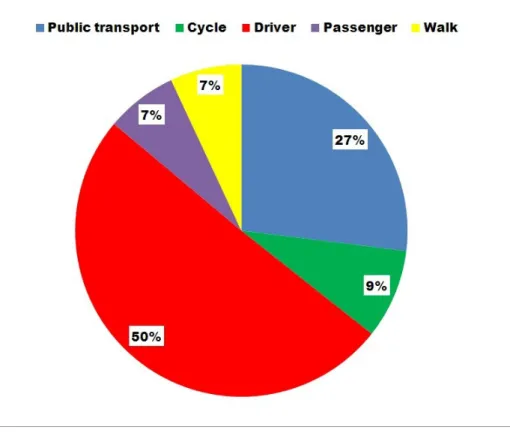
Figure 1 – Normal mode of travel to Campus (excluding campus-based students)
The proportion arriving by car is slightly higher than that of the university’s annual travel survey (which showed 51% of students arriving by car 32% by public transport). UWE’s Frenchay campus is in a suburban location, reasonably well served by bus and rail from most of the locations where students live, so driving would be a choice rather than necessity for most of the respondents.
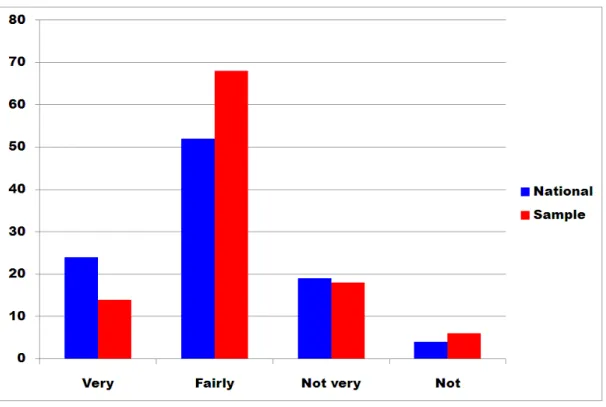
The levels of concern about climate change were slightly lower than the national averages found by DfT (2010), as shown in Figure 2. This is consistent with the lower levels of concern amongst the 20-29 age group found by Thornton et al (2010 – measured on a different scale).
Figure 2 Concern About Climate Change Compared to DfT (2010)
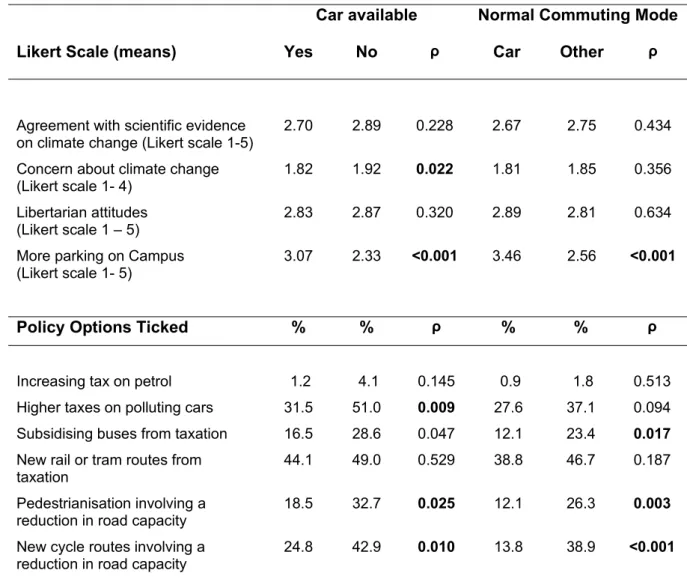
Table 5 shows the attitudes to climate change and policy measures cross-tabulated against availability of a car (in term and/or holiday, sole or shared) and against commuting mode (including campus-based students who walk). The ρ values were derived from Chi-square tests.
Most of the differences show the expected signs, although many are statistically insignificant. This is due to the small magnitude of the differences in most cases, and also (in the
Table 5 Crosstabulations of Attitudes against Car Availability and Commuting Mode
Car available Normal Commuting Mode
Likert Scale (means) Yes No ρ Car Other ρ
Agreement with scientific evidence
on climate change (Likert scale 1-5) 2.70 2.89 0.228 2.67 2.75 0.434 Concern about climate change
(Likert scale 1- 4) 1.82 1.92 0.022 1.81 1.85 0.356
Libertarian attitudes
(Likert scale 1 – 5) 2.83 2.87 0.320 2.89 2.81 0.634
More parking on Campus
(Likert scale 1- 5) 3.07 2.33 <0.001 3.46 2.56 <0.001
Policy Options Ticked % % ρ % % ρ
Increasing tax on petrol 1.2 4.1 0.145 0.9 1.8 0.513 Higher taxes on polluting cars 31.5 51.0 0.009 27.6 37.1 0.094 Subsidising buses from taxation 16.5 28.6 0.047 12.1 23.4 0.017
New rail or tram routes from
taxation 44.1 49.0 0.529 38.8 46.7 0.187
Pedestrianisation involving a reduction in road capacity
18.5 32.7 0.025 12.1 26.3 0.003
New cycle routes involving a
reduction in road capacity 24.8 42.9 0.010 13.8 38.9 <0.001
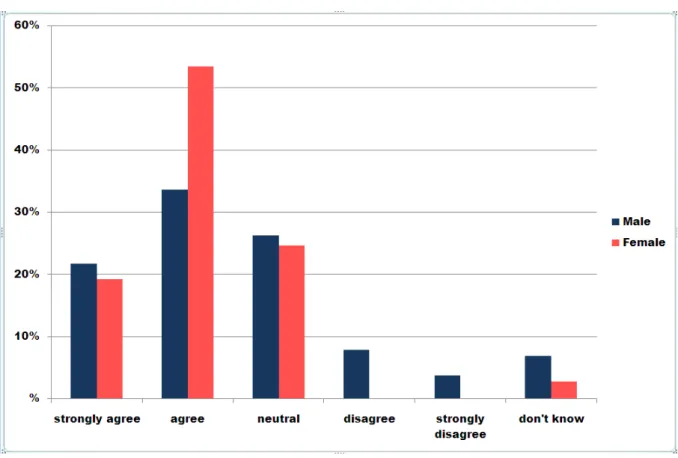
Figure 3 Gender differences in attitudes to scientific evidence on climate change
Cross-tabulating year of study with the variables in Table 5 produced no statistically significant results. 49% of year 3 students stated that their concern about climate change had increased during their time at university: 33% said this was due to what they had learned at UWE. Only 4% said they had become less concerned. In the light of these statements, the level of concern between year 1 and year 3 was compared. It had indeed risen slightly (79% concerned or very concerned in year 3 compared to 71% in year 1) although the difference was not statistically significant. Few year 3 students reported any difference in their attitudes towards sustainable transport measures, and there was no discernable difference in the responses to those questions between the two years.
Discussion
greater number of statistically significant associations in those comparisons was mainly due to the much larger sample sizes.
It was hoped to comment on the direction of causality in these relationships. Had a substantial increase in car ownership between the two years coincided with a significant reduction in concern about climate change and/or agreement with scientific evidence, this would have suggested (though not proved) that changes in car ownership cause changes in those attitudes. This effect may be in addition to the other possibilities: that concern about climate change influences car ownership, or that exogenous factors influence both. Given the surprisingly limited impact of the ‘no parking’ rule on the car availability of campus residents, the findings do not help to differentiate between those possibilities. If car ownership or use does influence attitudes towards climate change, however, then these findings suggest the effect is relatively weak and not a significant pedagogical issue for lecturers in this field.
The gender difference in attitudes towards scientific evidence is intriguing. This was the only discernable difference in the ‘climate sceptic’ group: cross-tabulations with the transport, age and course type variables produced no significant differences. The researcher’s
observations suggest that these views tend to be associated with a certain type of culture amongst young men, who are often amongst the more challenging students to engage in learning more generally. Subsequent questions in lectures revealed that apart from those following Geography courses, the students’ knowledge in this area came almost exclusively from the media and non-academic sources on the Internet. High levels of Internet use and reliance on blogs and unofficial websites for information may contribute to this culture and those attitudes towards climate change.
Although it cannot be considered a definitive refutation, there is no support from this survey for Monbiot’s hypothesis about car use and libertarian political attitudes – at least amongst students. The evidence on attitudes towards transport policy is more mixed. The tiny proportions favouring increased taxation on petrol are consistent with previous studies (e.g.Scottish Executive, 1999) which showed considerable hostility towards measures perceived as financially penalising motorists, even amongst non-drivers.
The clearest differences in attitudes between the drivers and non-drivers (measured by commuting mode or car availability) concern parking on campus and policy measures involving the reallocation of road space to cycle routes or pedestrian areas. These findings are unsurprising. Parking on campus is an issue of contention between the university and staff and student representatives. Partly due to objectives in the sustainability strategy but mainly because of restrictions imposed by the planning authority, parking for students on campus is more likely to be reduced than increased in future.
shown that car owners/drivers are more likely to use rail or light rail than buses, which are generally viewed as a less attractive alternative (e.g. Davison, 2005).
Conclusions
High levels of car ownership and use amongst students is likely to engender scepticism towards measures designed to reduce car use. This survey suggests that constraints on parking on campus, or around student accommodation, will make relatively little difference to this situation. This presents a challenge, but also an opportunity, to lecturers teaching courses with a sustainable transport element. The attitudes of students are generally similar to those of the general population in these respects, bringing into the lecture or tutorial many of the challenges which Built Environment professionals seeking to promote more
sustainable transport are likely to encounter. If handled appropriately, students’ experience of car ownership and use can prove a useful resource, making discussion of these issues more realistic compared to other issues, where the experience of young undergraduates may be very limited. On the other hand, as relatively few students have experience of living without a car, many find it difficult to imagine how this might be possible. The initial difficulties of students in evaluating evidence about carfree development (see: Melia et al, 2011), were similar to those of audiences outside academia to which the author has presented similar material.
The attitudes of students towards climate change, as revealed by this study, are broadly similar to those of the general population. In response to the original hypotheses, car
ownership and use do not appear to exert a particularly strong influence on those attitudes. The proportion of climate sceptics is relatively small and, in this survey, exclusively male, an area which would merit further research. Many more were uncertain about the science of climate change. Whereas climate change mitigation and adaptation feature prominently in most Built Environment courses, without a balanced understanding of the science, the justification for this focus may seem less valid in retrospect, when graduates are grappling with the pressures of professional life. In response to the findings of this study, the author included a session on the science of climate change in Society & the Car. For the future, the science of climate change is now being considered for inclusion in a new core cross-faculty module.
References
Anable, J. (2005) ‘Complacent Car Addicts’ or ‘Aspiring Environmentalists’? Identifying
travel behaviour segments using attitude theory.
Transport Policy
12 (1), pp.65-78.
Dawe, G., Jucker, R. and Martin, S., (2005)
Sustainable development in higher education :
current practice and future developments : a report for The Higher Education Academy.
[online]. Heslington, York: Higher Education Academy.
DfT, (2010)
Public attitudes towards climate change and the impact on transport.
[online:]
www.dft.gov.uk
: Department for Transport. (January).
DfT, (2009)
Exploring public attitudes to climate change and travel choices: deliberative
research.
[online].
www.dft.gov.uk
: Department for Transport.
Dudleston, A., Hewitt, E., Stradling, S. and Anable, J., (2005)
Public Perceptions Of Travel
Awareness - Phase 3.
[Online]:
http://www.scotland.gov.uk/Publications
: Scottish Executive
Research.
Kokkarinen, N. and Cotgrave, A. (2010) Student Attitudes Towards the Environment.
In:
Anon.
Built Environment and Natural Environment Conference, May 2010.
Liverpool John
Moores University, pp 140-148.
Melia, S., Barton, H. and Parkhurst, G. (2011) Potential for Carfree Development in the UK.
Urban Design and Planning
164 (In Press), .
Monbiot, G. (2005) The anti-social bastards in our midst.
The Guardian.
Scottish Executive (1999)
Why people don't drive cars.
Scottish Executive, Central Research
Unit.
Sheller, M. and Urry, J. (2000) The City and the Car.
International Journal of Urban and
Regional Research
[online]. 24 (4), pp.737-757. Available from:
http://dx.doi.org/10.1111/1468-2427.00276
.
Thornton, A., Bunt, K., Dalziel, D. and Simon, A., (2010)
Climate Change and Transport
Choices.
London: Department for Transport. (Contract No. PPRO 04/06/21).
![Table 1 Level of concern about climate change from Thornton et al (2010) [Associations/correlations significant at the 95% level are emboldened]](https://thumb-us.123doks.com/thumbv2/123dok_us/650501.566630/3.892.126.767.578.920/table-concern-climate-thornton-associations-correlations-significant-emboldened.webp)