Experimental Study on the Effects of Communication on
Cooperative Search in Complex Environments
Section 5
Chapter 5-1
Ömer Çayırpunar, Veysel Gazi, and Bülent Tavlı TOBB University of Economics and Technology
Turkey
Enric Cervera Jaume-I University Spain
Ulf Withowski Heinz Nixdorf Institute, University of Paderborn Germany
Jacques Penders Sheffield Hallam University United Kingdom
Abstract: In this study we investigated the benefits of networked communication by experimentally evaluating the results of two search algorithms which are spiral search and informed random search. Both simulations and real experiments are performed in order to get objective results. The robotic experiments were performed in an experimental area containing obstacles where the communication ranges were “simulated” with the help of an overhead camera. Each robot was allowed to keep an occupancy grid based local map of the environment containing also information about the cells it has visited and to exchange this information with the other robots within its communication range. The effect of the size of communication range on the performance of the system defined as the time of completion the search task (i.e, locating the target), was investigated.
Keywords:Multi-robot teams; communication network; cooperative robotic search; transmission range.
1. Introduction
field of coordination of a group of mobile robots to achieve a specific objective/goal. In order to achieve cooperative behavior there is a need for effective (direct or indirect) communication methodologies. The use of a network architecture is one possible form of direct communication and will be very essential in many applications that require information exchange between the robotic agents in a team and the team and human operators. In particular, in search and rescue scenarios by combining the communication network with an appropriate search algorithm, an effective search can be achieved by the robots.
Recent technological advances in control theory, electronics, electromechanical systems, and communication/networking technologies are paving the way for the development and deployment of a large cooperating robot groups (swarms) (Dollarhide and Agah, 2003). Deployment of groups of relatively simple mobile robots has several advantages over a single complex (advanced) robot. These advantages include robustness to failures (the group may still be able to perform the job in case of loss/failure of one or more robots while in the single robots case the job will be aborted, moreover simple agents are less prone to bugs or failures compared to complex agents), flexibility (the group can re-organize/self-organize based on the situation or objective), scalability (based on the objective or task different number of agents can be deployed), and cost (simplicity leads to decrease in the cost of the overall system). Moreover, autonomous robots can assist humans in risky operations during search and/or rescue missions. Furthermore, robots can have the ability to work in environments which are dangerous to humans such as collapsed or unstable buildings, in fire or gas leakages, environments with high nuclear radiation concentration, deep under the sea, etc. Therefore, deployment of systems of multiple cooperating robots will have a great potential in search and rescue operations in the near future.
It is obvious that it is difficult or even impossible to have global information and implement centralized controllers in systems consisting of large number of agents with limited capabilities. Therefore, recent research has concentrated on decentralized approaches. In such systems, the inter-agent communication and networking algorithms are of paramount importance. In other words, for development of effective practical multi-robot systems besides the need for development and verification of effective coordination and control strategies, there is a need for development and verification of robust and scalable communication and networking algorithms and protocols.
In the context of multi-robot systems the definition of communication can be made as the transfer of meaningful information between one agent and another (or the human operator). This definition is very broad and can include all kinds of communication such as information obtained from the sensors (e.g., the position of a significant object), information about the robot itself (e.g., its movements), commands or task/service request messages, etc. A more specific and narrowed definition which includes some form of intentionality can be stated as “The intentional transfer of meaningful information between robotic agents” (Cao et al., 1997).
different agents becomes unavoidable. For example, consider a mission that includes moving a large (and possibly fragile) object by a multi-robot team. Without communication and coordination the robots may try to push the object in different directions which can result in undesired consequences. Second, with communication the robots can exchange valuable information and significantly improve the performance of the system. For example, in heterogeneous multi-robot teams sensory information inquired by a robot with a specific sensor could be exchanged with other robots that do not possess this sensory setup. Similarly, a robot not being able to perform specific task can request that service from another robot that has that capability (a concept called service discovery). Furthermore, different tasks (or objects) can be allocated to different agents thus achieving parallel (and therefore more efficient) operation.
A group of mobile communicating robots constitutes, by its nature, a wireless ad-hoc network. In such a system there are many issues to be resolved for effective operation. First of all, since the agents will be simple, their communication capabilities (such as range, power, processing capability, etc) will also be limited. Therefore, in the case two agents that need to communicate are out of range, they will probably need to communicate through other intermediate agents. Therefore, beside the need for development of appropriate message structures and communication protocols, there is a need for development of effective/cooperative routing/networking protocols as well. A recent survey on the main issues in mobile sensor networks can be found in (Akyildiz et al., 2002).
Performance of a distributed robotic system using shared communication channels is presented in (Rybski et al., 2002). It is shown that for surveillance applications it is extremely important to coordinate the robots through wireless communication channels. Yet, the performance of the system is affected by the capacity of the links and the number of robots sharing the links. It is reported in (Rybski et al., 2004) that adding simple communication capabilities to robots improves the predictability of the task completion times. In (Rekleitis et al., 2004) a multi-robot coverage study is presented. It is shown that by allowing robots to communicate among wireless links better algorithms for the complete coverage problem can be obtained. In (Trianni et al., 2004) it is shown through simulations that use of direct communication (through wireless links) can be beneficial for the effectiveness of the group behavior in performing collaborative tasks.
We can also divide communication in multi-robot systems into global communication and local communication. Global communication is the situation in which every agent can communicate with every other agent, whereas local communication describes the situation in which each robot can communicate only with its local neighbors. In previous studies (Yoshida et al., 1996) the efficiency of global and local communication in mobile robot systems is evaluated based on the analysis of information transmission time and probabilistic methods. However in this study the performance of a cooperative task with multiple mobile robots is studied and the effect of communication on cooperation is directly measured for different communication ranges starting from no communication to global communication.
Global communication is effective for small number of robots in a limited area. However, when the number of robots or the size of the search space increases, this becomes difficult to be realized because of the limited communication capacity and increasing amount of communication to handle. Therefore, it is logical to choose local communication. Let us suppose that each robot has the ability to adjust its range of communication. If it is too large, the efficiency of information transmission decreases because the communication traffic becomes too congested and the robots cannot handle that traffic [Figure 1(a)]. On the other hand, the efficiency is low if output range is too small as well [Figure 1(b)]. In addition, the selection of the communication range effects the power consumption which is very important for a mobile robot. A higher communication range requires more power and as a result consumes the battery much faster. It is therefore essential to develop methodologies for decision of communication range in order to provide efficient information transmission between the agents.
One may think that louder is always better; that is, the wider a robots communication range, the better the performance. However, this is not the case always. For example, in a simulated cooperative foraging task (Arkin, 1998) using homogenous robots, it was demonstrated that social performance can decrease substantially with increases in robots communication radius. The trade-off is that too weak a call for help prevents an agent from being heard, but too strong a call brings an entire colony together and prevents effective exploration of the environment. Loudest is indeed not the best for all tasks.
Figure 1 The effect of the size of communication (Figure taken from (Yoshida et al., 1996)).
A probabilistic approach to determine the optimal communication range for multi-robot teams under different conditions is presented in (Yoshida et al., 1995). In that study the optimal communication area is estimated by using “information transmission probability”, which represents the possibility of successful transmission. This range is determined by minimizing the communication delay time between robots, using probability of successful information transmission, assuming they are moving randomly. Equation (1) (which is taken from (Yoshida et al., 1995)) shows the relationship, where c is the information acquisition capacity, an integer representing the upper limit on the number of robots that can be received at any time without loss of information, and p is the probability of information output for each robot.
X
opt¿
√
cc !
p
c=c
√
c !
p
[1]In this chapter cooperative search by a team of mobile robots using communication to pass information between each other is considered. Firstly simulation based experiments are performed in Matlab environment. Then the same experiments are repeated by using real robots on an experimental set-up. The robotic experiments were performed in an experimental area containing obstacles and using e-puck robots where the communication ranges were “simulated” with the help of an overhead camera. Each robot was allowed to keep an occupancy grid based local map of the environment containing also information about the cells it has visited and to exchange this information with the other robots within its communication range. Consequently, the effects of the communication range in networked communication in a multi-robot cooperative search scenario was investigated by experimentally evaluating the results of two search algorithms which are spiral search and informed random search. In particular, the effect of the size of communication range on the performance of the system defined as the time of completion the search task (i.e, locating the target), was investigated.
2. Experimental set-up
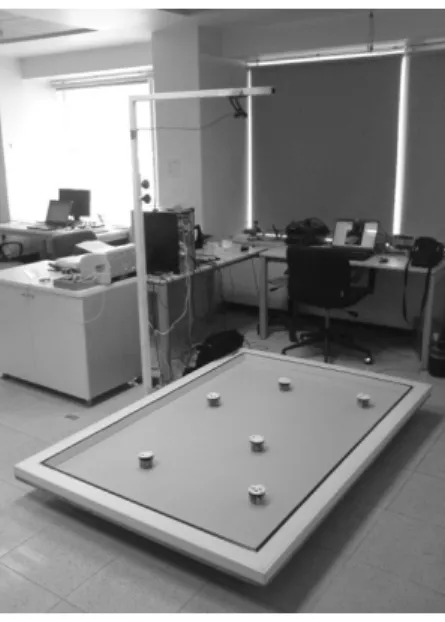
black colored dots placed on the top of the robots. A more detailed description of the set-up can be found in (Samiloglu et al., 2008).
Figure 2 Experimental setup consisting of an arena, robots, PC and overhead camera.
Figure 3 The robot labeling system for six robots.
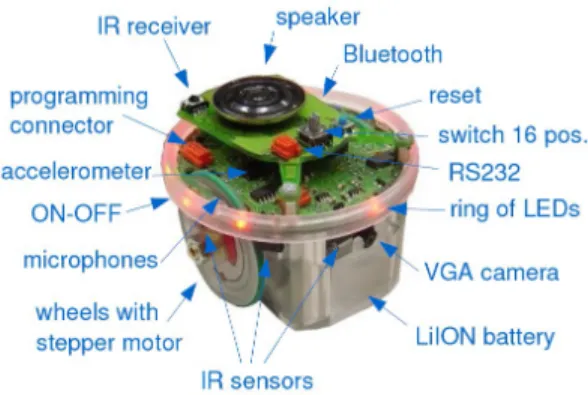
Figure 4 e-puck educational mini mobile robot.
In order to change the transmission range a device capable of adjusting it’s RF output power is necessary. The change on the RF signal output power can be matched to a proportional communication distance. The Bluetooth hardware available in the robots is a class II Bluetooth. That device is having a constant RF output power and therefore could not provide any changeable communication range. Since a communication device capable of adjusting its transmission range is not available at the time of the experiments we had to develop some other methods to simulate this feature.
To model or simulate a realistic RF wireless communication requires comprehensive work. In addition the RF signals have some impairments such as attenuation, distortion, noise, distraction, and multipath refraction which may vary according to the environment and could be very hard to simulate. Although it is a fact that wireless communication cannot be simply represented as an exact distance, it is dependent on the environment and, therefore, varies relative to the changes in the environment. For example with the obstacles around the signal strength will be too weak to support any communication.
This chapter is mainly focused on investigating the effects of communication range on cooperative multi robot search task, thus, in this study we did not consider all the RF impairments and basically focused on and simulated the communication based on the disc communication model. The disk communication model assumes that the communication takes place in a circular area with a constant diameter. Although it is a fact that in reality wireless communication cannot be simply represented as an exact distance and it is dependent on the environment. Disc communication models have been widely used in the literature since they are easy to simulate and analyze, that is the approach we consider here as well.
artificial potential is binded to the target cell to be visited next and a force is applied to the negative direction to the gradient of the potential field. Then, that force is converted to the control outputs as linear and steering angle speeds to be transferred to the robots. All of the nodes of the search space are visited sequentially in that manner. Another option is to program the robots so that they receive their global position (and/or possibly the relative positions of their neighbors or all the other robots) and have their own internal decision making and control. However, we have not implemented such a strategy in this study (since conceptually it does not make much difference). Beside the higher level control by the computer, the robots have an obstacle avoidance behavior running at low-level. In other words, the robot movements are controlled with a weighed sum of the control inputs obtained from the computer and the sensorial information collected from the environment. However, the obstacle avoidance has a higher priority to make sure that the robots do not collide with any obstacles accidentally.
A high quality USB overhead camera is used in the experiment which is directly connected to the computer. A resolution of 640x480 is sufficient for this set-up considering the sizes. The frame rate is not the main criteria in the selection of the camera since the image processing unit cannot process more than 5-6 frames per second.
As was mentioned above, the frames of the arena are grabbed and processed to determine the position, orientation, and identification of the robots. This information set is supplied to the function running behavior algorithms of agents which output the control inputs (the angular and translational speeds) to the robots. The resulting angular and translational speeds of the agents are transferred to the agents via bluetooth communication modules. The main delay in the system occurs due to the image processing. As mentioned before, another control option could be to pass the position and orientation information to the robots and let their internal algorithm to calculate the values of the control inputs which would better model more decentralized and realistic applications. The refresh rate would not be a problem since a robot can fill the gaps between the position updates with it’s internal odometry, thus, a continuous position estimation can be provided. This can be thought as similar to the simultaneous use of global positioning system (GPS) and inertial measurement unit (IMU) for continuous localization at unmanned air vehicles (UAV) or unmanned ground vehicles (UGV). However, here the emphasis is to concentrate on the effect of communication ranges on the search performance of a robot team and not to deal with issues such as localization.
3. Problem Definition
searched areas. In Figure 5(b) a second robot joins the search from a different location. The arrows show the process of successful information sharing between robots 1 and 2. After the exchange of the search database the newly formed search maps are demonstrated in the information bubbles. Similarly, in Figure 5(c) the cooperation of robots 2 and 3 and the resulting search maps are demonstrated. Finally, in Figure 5(c) the communication takes place in between both robots 1-2 and robots 2-3. Therefore, robots 1 and 3 communicate indirectly through robot 2 and the search maps of all of the robots are combined which will make the continuing search more efficient (i.e, the robots will not search on places which are previously searched by the other robots).
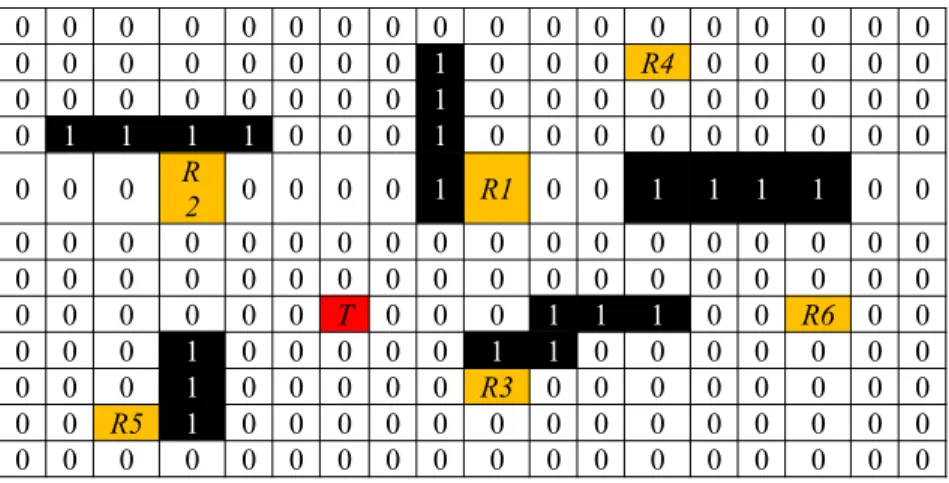
In Figure 6 the map based on our real experimental environment is represented. This map is a grid map in which zeros represent empty spaces and the ones stand for obstacles in the search space. The search only takes place in the empty space places without colliding with any of the obstacles. The search space is divided into a 12 x 18 virtual grids. Six e-puck robots are randomly placed into their initial starting positions within the arena as shown in the figure (R1 through R6). The label T represents the object is to be found.
The information is to be shared between the robots is the occupancy grid maps of the previously searched places. In other words, it is the map of the visited cells. Each robot has it’s own local map of those occupancy cells. At each step the robots use that map in order to decide the next cell to visit and to prevent or at least minimize the search of the same area multiple times.
a) b) c)
Figure 5 Concept of cooperative search by communication.
0 0 0 0 0 0 0 0 0 0 0 0 0 0 0 0 0 0
0 0 0 0 0 0 0 0 1 0 0 0 R4 0 0 0 0 0
0 0 0 0 0 0 0 0 1 0 0 0 0 0 0 0 0 0
0 1 1 1 1 0 0 0 1 0 0 0 0 0 0 0 0 0
0 0 0 R2 0 0 0 0 1 R1 0 0 1 1 1 1 0 0
0 0 0 0 0 0 0 0 0 0 0 0 0 0 0 0 0 0
0 0 0 0 0 0 0 0 0 0 0 0 0 0 0 0 0 0
0 0 0 0 0 0 T 0 0 0 1 1 1 0 0 R6 0 0
0 0 0 1 0 0 0 0 0 1 1 0 0 0 0 0 0 0
0 0 0 1 0 0 0 0 0 R3 0 0 0 0 0 0 0 0
0 0 R5 1 0 0 0 0 0 0 0 0 0 0 0 0 0 0
0 0 0 0 0 0 0 0 0 0 0 0 0 0 0 0 0 0
Figure 6 The search space with obstacles, robots and target.
Initially the robots start their search individually. However, whenever two robots encounter each other, i.e. two robots enter the communication range of each other, they exchange their local occupancy maps. The communication sizes of the robots and whether they are within that range or not are determined from the images taken by the overhead camera system. In other words, the robot communication ranges are “simulated” through the experimental setup. In this way one can easily experiment with different communication ranges and see the effects of communication.
In the experiments the communication sizes are varied between 0 to 200 cm with steps of 20 cm. A communication range of 0 means no communication implying that the robots search individually without cooperation. In contrast, a communication range of 200 means global communication in which each agent can communicate with every other agent.
In the following section the search strategies used in the experiments will be described in more detail.
4. Search Strategies
Two different types of search strategies are used in the experiments. The first one is a spiral search which is using distance transform to calculate an exploration path and the other is informed random search which is a simply random search having the memory of previously searched places.
4.1 Spiral Search
space in an environment in a systematic and efficient manner. For that reason the map of the search space should be known previous to the experiments.
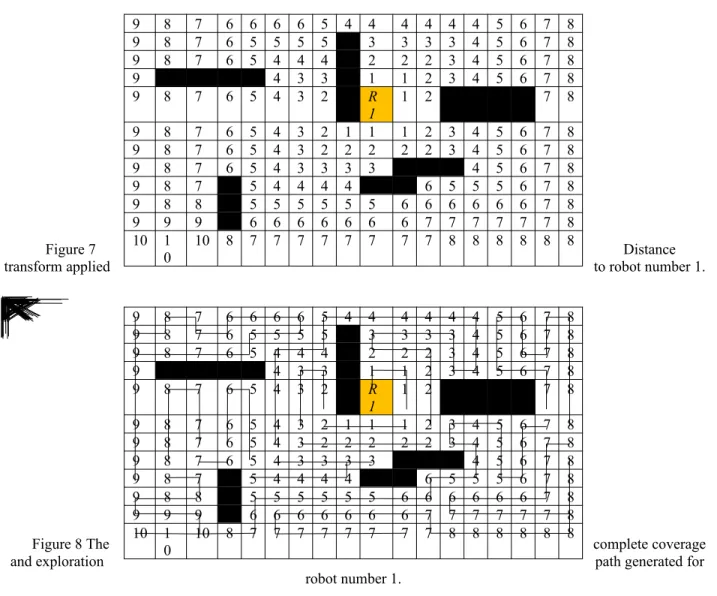
To achieve the complete coverage behavior the robot follows a path which moves away from a starting point keeping track of the cells it has visited. In other words, the robot only moves into a grid cell which is closer to the current cell if it has visited all the neighboring cells which lie further away from the current cell. In order to do this, the search algorithm first calculates the distance transform of all the cells with respect to the starting point then generates a path for complete coverage. In Figure 7 the results of the distance transform applied to robot R1 is shown. Additionally, in Figure 8 the complete coverage and exploration path generated for robot R1 is presented.
Figure 7 Distance
transform applied to robot number 1.
Figure 8 The complete coverage
and exploration path generated for
robot number 1.
Closer observation of the above described path of complete coverage shows that the path of complete coverage produces too many turns. This is because the coverage path follows the “spiral” of the distance transform wave front that radiated from the start point. As a result the search can take longer than expected. In certain configurations of obstacles in an environment this can produce unsatisfactory performance. Therefore, complete coverage paths of the
9 8 7 6 6 6 6 5 4 4 4 4 4 4 5 6 7 8
9 8 7 6 5 5 5 5 3 3 3 3 4 5 6 7 8
9 8 7 6 5 4 4 4 2 2 2 3 4 5 6 7 8
9 4 3 3 1 1 2 3 4 5 6 7 8
9 8 7 6 5 4 3 2 R
1 1 2 7 8
9 8 7 6 5 4 3 2 1 1 1 2 3 4 5 6 7 8
9 8 7 6 5 4 3 2 2 2 2 2 3 4 5 6 7 8
9 8 7 6 5 4 3 3 3 3 4 5 6 7 8
9 8 7 5 4 4 4 4 6 5 5 5 6 7 8
9 8 8 5 5 5 5 5 5 6 6 6 6 6 6 7 8
9 9 9 6 6 6 6 6 6 6 7 7 7 7 7 7 8
10 1
0 10 8 7 7 7 7 7 7 7 7 8 8 8 8 8 8
9 8 7 6 6 6 6 5 4 4 4 4 4 4 5 6 7 8
9 8 7 6 5 5 5 5 3 3 3 3 4 5 6 7 8
9 8 7 6 5 4 4 4 2 2 2 3 4 5 6 7 8
9 4 3 3 1 1 2 3 4 5 6 7 8
9 8 7 6 5 4 3 2 R
1 1 2 7 8
9 8 7 6 5 4 3 2 1 1 1 2 3 4 5 6 7 8
9 8 7 6 5 4 3 2 2 2 2 2 3 4 5 6 7 8
9 8 7 6 5 4 3 3 3 3 4 5 6 7 8
9 8 7 5 4 4 4 4 6 5 5 5 6 7 8
9 8 8 5 5 5 5 5 5 6 6 6 6 6 6 7 8
9 9 9 6 6 6 6 6 6 6 7 7 7 7 7 7 8
10 1
type shown in Figure 8 are somehow difficult to execute on a mobile robot. To overcome such undesirable results in our experiments the path is checked with a secondary algorithm, which looks for dead ends and handles them by changing the path to the nearest unsearched areas.
4.2 Random Search
The second search algorithm is a type of random search that is, the robots move in the search space randomly. However, the robots keep the memory of the previous searched spaces. By this information the robots randomly select their next destination cell from the unvisited cells in the near vicinity. Every grid on the search map is connected to 8 other cells. Therefore, the algorithm randomly chooses the next target from those neighboring 8 cells. In Figure 8 the exploration path generated by this algorithm is demonstrated. In addition, while exploring around, the information about the visited cells at the past are kept on an occupancy grid map. For the later steps the algorithm takes into account the visited cells while randomly choosing the next target. Therefore, the search becomes an informed random search. To overcome unwelcomed results such as in the cases where all of the nearby cells are visited the random algorithm looks for the previous cells and tries to find unsearched areas then selects those empty places for new target destinations.
0 0 0 0 0 0 0 0 0 0 0 0 0 0 0 0 0 0
0 0 0 0 0 0 0 0 1 0 0 0 R4 0 0 0 0 0
0 0 0 0 0 0 0 0 1 0 0 0 0 0 0 0 0 0
0 1 1 1 1 0 0 0 1 0 0 0 0 0 0 0 0 0
0 0 0 R2 0 0 0 0 1 R1 0 0 1 1 1 1 0 0
0 0 0 0 0 0 0 0 0 0 0 0 0 0 0 0 0 0
0 0 0 0 0 0 0 0 0 0 0 0 0 0 0 0 0 0
0 0 0 0 0 0 T 0 0 0 1 1 1 0 0 R6 0 0
0 0 0 1 0 0 0 0 0 1 1 0 0 0 0 0 0 0
0 0 0 1 0 0 0 0 0 R3 0 0 0 0 0 0 0 0
0 0 R5 1 0 0 0 0 0 0 0 0 0 0 0 0 0 0
0 0 0 0 0 0 0 0 0 0 0 0 0 0 0 0 0 0
Figure 9 The exploration path for robot 1 generated by informed random search.
5. EXPERIMENTALRESULTS
In all of the experiments the mission is to find a hidden object in the search space. With this objective the performance is measured as the mission’s completion time (i.e, the time it takes for the robots to locate the position of the target).
intermediate robots, a robot can obtain also information about the cells searched by a robot it has never encountered. Therefore, the communication strategy has some characteristics of multi-hop communication. Because of the nature of multi-hop networking, the information can be shared between the agents although they are not in range of each other. The information can be carried over the other agents on larger distances. Therefore, it is seen that, it is not necessary to have a wide communication range always. In other words, it is not needed to have a global communication between the agents for the best performance.
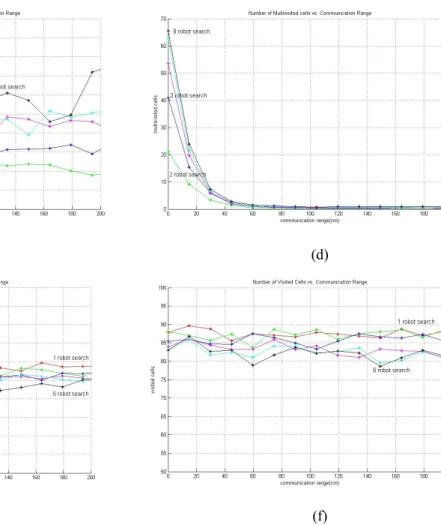
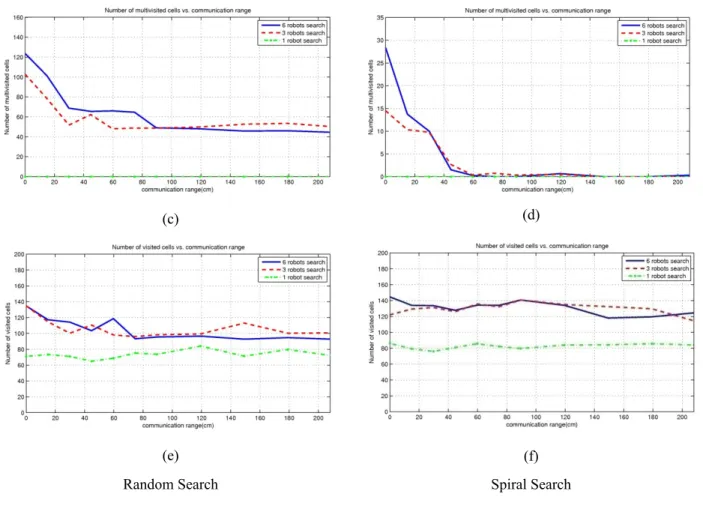
The results of the experiments are given in Figures 10 and 11. In Figure 10 the simulation results are presented. These results are collected over 1000 runs. In each of the runs the robots are started from random initial positions. Only the position of the target cell which is being sought and the positions of the obstacles are kept constant. Similarly Figure 11 shows the results of the robotic experiments performed in the experiment set-up. These are the average results over 6 runs for each communication distance to be tested. More experiments could not be performed as a result of the time it takes for the experiments and because of some temporary problems with the communication software-hardware.
The communication ranges in all of the experiments are distributed between zero communication and global communication. In our experiment setup the maximum distance between two different robots can be approximately 200 cm. Therefore, a communication distance equal to or larger than 200 cm can be described as global communication. Additionally, the search performances of different number of robots are collected. In simulations the experiments are repeated for cooperation of 1 to 6 robots. Similarly, the robotic search experiments are repeated for 6, 3 and 1 robots and the results are presented in the Figures 10 and 11. As it is seen in the results the performance is increasing proportional to the number of the robots as they are cooperating while searching. More robots means more cells to be visited at the same time. Also the effect of the number of cooperating robots is more effective than the effect of the range of communication. Still, one can see that for a fixed number of robots initially there is some increase in the performance of the system as the size of the communication range increases. However, it settles down around 40-60 cm and a higher communication range beyond that distance does not contribute to the performance of the system significantly. For this reason, for the given particular experiment set-up that range seems to be effective and provide satisfactory performance while not requiring high transmission power.
When the experiment results (Figures 10 and 11) are examined in more detail the similarities between the simulations and the robotic experiments can be seen. In both of the experiments the increase in the numbers of the cooperating robots makes the search more efficient. The time taken for the search drops as proportional to the increase in the cooperating robot number in both of the two search strategies.
Also, in spiral search method the number of the multivisited cells (Figure 10(d) and Figure 11(d)) converges to zero as the communication range increases. However in random informed search (Figure 10(b) and Figure 11(b)) there are always more multivisited cells than spiral search. This can be explained with the randomness of the algorithm. If there are no unvisited cells around current cell, because of the algorithms nature the robot should follow the previous visited cells in order to find an unvisited cell. As a result in random informed search the multivisited cell count usually becomes higher than spiral search.
Additionally spiral search tends to be more efficient than the random informed search when the total number of visited cells is examined (Figures 10(e) and 10(f)). In random search the mean of the total visited cells is around 102, however, in spiral search that mean is around 85 cells. That means spiral search finds the target object 17 cell before than the random informed search. This effect can be seen through the simulation step counts in Figures 10(a) and 10(b). Spiral search shows slightly better performance than the random informed search in the simulations. However, in the robotic experiments the random informed search shows better performance than spiral search. The smaller number of the robotic experiments can be a cause for this result. Yet, the simulation results are more reliable because of the more experiments performed.
(c) (d)
(e) (f)
Random Search Spiral Search
Figure 10. Simulation results
(c) (d)
(e) (f)
Random Search Spiral Search
Figure 11. Robotic experiment results
6. CONCLUDING REMARKS
In this study a cooperative search by mobile robots is investigated. The cooperation is provided by the networked communication of the agents. The results of the study are collected both by simulations and real experiments with e-puck mini mobile robots. The performance of two search strategies which are namely a modified version of spiral search and informed random search are measured for different communication ranges and for different number of robots. We observed in the experiments that the performance of the system improves with the increase of the numbers of cooperating robots. As it is seen from the experiment results (Figure 10(a), 11(a)) the performance of the system consisting of 6 robots is better than that of 3 robots and similarly 3 robots search performance is better than 1 robot search.
performance. In other words, it is not needed that the communication range to cover all the search area. Additionally, relatively shorter communication range means lower power consumption, therefore longer mobility of the robots.
Also it is important to point out that the effective communication between the agents is highly dependent on the environmental parameters such as the size of the search space and the number of the robots. Similarly the characteristic of the search algorithm is an important factor affecting the performance of the search. This is consistent with the results in related studies.
Future research can concentrate on developing algorithms for selecting the best communication range dynamically in order to minimize the power usage without significantly affecting the performance of the system. In addition, the effects of unequal communication ranges between the robots can be investigated. At the time of the experiments a communication hardware which can adjust its transmission range was not available. Therefore, we had to simulate this feature. Provided that such hardware is available, more realistic experiments can be conducted as well.
7. REFERENCES
Akyildiz I. F., Su W., Sankarasubramniam Y., Cayirci E. “A Survey on Sensor Networks.” IEEE Commununications Magazine 40.8 (2002): 102–114.
Arkin R. C., "Cooperation without Communication: Multi-agent Schema Based Robot Navigation."Journal of Robotic Systems 9.3, (1992): 351-364.
Arkin R. C., Behavior-Based Robotics, Cambridge, Massachusetts, The MIT Pres, 1998.
Balch T., and Arkin R., “Communication in reactive multi-agent robotic systems,” Autonomous Robots 1.1 (1994): 1-15.
Cao Y. U., Fukunaga A. S., A. B. Kahng, “Cooperative Mobile Robotics: Antecedents and Directions,”
Autonomous Robots 4.1 (1997): 7-27.
Dollarhide R. and Agah A., “Simulation and control of distributed robot search teams,” Computers and Electrical Engineering 29.5 (2003): 625–642.
Rekleitis I., Lee-Shue V., New A. P., and Choset H., “Limited communication, multi-robot team based coverage”
Proceedings of the IEEE international Conference on Robotics and Automation, 2004, 4: 3462- 3468.
Rybski P. E., Stoeter S. A., Gini M., Hougen D. F., and Papanikolopoulos N. P., ”Performance of a distributed robotics system using shared communications channels,” IEEE transactions on Robotics and Automation, 2002 18: 713-727.
Rybski P., Larson A., Veeraraghavan H., LaPoint M., and Gini M.. “Communication strategies in Multi-Robot Search and Retrieval: Experiences with MinDART,” In Proc. Int'l Symp. on Distributed Autonomous Robotic Systems, 2004.
Trianni V., Labella T. H., and Dorigo M., “Evolution of direct communication for a swarm-bot performing hole avoidance,” LNCS, 2004, 3172: 130-141,.
Yoshida, E., Yamamoto, M., Arai, T., Ota, J., Kurabayshi, D. "A design method of local communication area in multiple mobile robot system," Proceedings of theIEEE International Conference on Robotics and Otomation, 1995, 2567-2572.
Yoshida, E., Yamamoto, M., Arai, T., Ota, J., Kurabayshi, D. “Evaluating the Efficiency of Local and Global Communication in Distributed Mobile Robotic Systems.” Proceedings of IROS 1996, 1661-1666
Samiloglu A. T., Cayırpunar O., Gazi V., and Koku A. B., “An Experimental Set-up For Multi-Robot Applications,” International Workshop on Standards and Common Platforms for Robotics (SCPR2008), 2008.