Values Based Supply Chains for Mountain Dairy Products.
The example of Bioalpin in Tyrol/Austria
Markus Schermer, Mountain Agriculture Research Centre, Department of Sociology, University of Innsbruck
Abstract:
Growth processes are often problematic for small-scale farms as they may disturb the delicate balance of basic internal resources, like labor, buildings, machinery, land and animals. Most of these resources cannot be increased in linear processes and the smaller the unit the more problematic the task of realignment of resources becomes. Small-scale farmers often feel growth as enforced by outside factors, e.g. a market partner. Growing enterprises in
processing and trading need more supply and obviously are not eager to deal with more small suppliers, as this tends to mean higher transaction costs and varying qualities. However, we find examples where dedicated supply chain actors actively engage in preserving small scale structures and develop different patterns of growth.
This contribution uses the case study of the cooperative BioAlpin in Austria to examine how such regional networks may be successfully constructed. BioAlpin sells a full range of organic mountain products under their own brand mainly via a family based regional supermarket chain. The initiative exhibits a substantial growth over the last decade and has managed at the same time to support and preserve small-scale regional production structures. We use the concept of netchain analysis to explore the organizational structure and the
mechanisms of horizontal and vertical coordination in this value based supply chain. The results of our analysis may shed light on the options and problems associated with a focus on network growth versus the growth of individual units.
Introduction/background
Some time ago I met a farmer again whom I had not seen for quite some years. He had been one of the pioneers in organic egg production in the mountainous province of Tyrol/Austria. Upon my question how things had been going in the last years, he answered: ”great, I didn’t have to change over the last 15 years.” This statement seemed quite surprising and he explained further: “When I started to deliver to the regional supermarket chain, they said either you grow big or you have to get out. Only when we found some more organic egg producers and grouped together we could remain in business.” This statement made me think about the implications of growth for small-scale farmers and options to preserve small-scale production structures.
Small-scale farms and enterprises in general try to find an optimal equilibrium of the basic resources. Labor input, buildings and machinery have to be in balance with the number of animals they keep and the acreage they work. They often phrase it as” the farm is running smoothly”. Under such conditions growth processes tend to disturb the sensitive
configuration and it takes time to find a balance again. The number of animals for instance cannot be increased linear, at some point new housing is required, which may in consequence need more labor and/or machinery etc. The smaller the unit the bigger the change required and the more problematic the task of realignment of resources. Small-scale farmers often feel growth as enforced by outside factors, e.g. a market partner. Growing enterprises in
suppliers, as this tends to mean higher transaction costs and varying qualities. However, we find examples where dedicated supply chain actors actively engage in preserving small scale structures and develop different patterns of growth.
This contribution uses the case study of the cooperative BioAlpin in Austria to examine how such regional networks may be successfully constructed. BioAlpin sells a full range of organic mountain products under their own brand mainly via a family based regional supermarket chain. The initiative exhibits a substantial growth over the last decade and has managed at the same time to support and preserve small scale regional production structures. The results of our analysis of organizational structure and the mechanisms of horizontal and vertical coordination may shed light on the options and problems associated with a focus on network growth versus the growth of individual units.
The paper is structured as follows:
This introduction is followed by a section on the conceptual framework of mid scale values based food chains and the netchain approach. The next chapter describes the approach and methods used to retrieve the data for this case-study, then we describe the organizational model of the case study and consequently analyse it according to our conceptual framework. After that we take a look at the underlying mechanisms and finally discuss the implications on the model of a network based pattern of growth.
Conceptual framework
In general food production systems in mountain regions are limited by climate and
topography in their range of products as well as in the opportunity to utilize economies of scale, due to high labor requirements and limited options for mechanization. Thus the production remains on a small scale with artisanal processing, resulting in high quality, but with limited market potential. In general, growing markets require the growth of supplying business units in order to comply with the overarching economies of scale. As the logic of economies of scale is questioned and challenged by quality approaches, over the last years a promising development of new forms of dedicated medium scale food retail businesses initiatives emerged all over Europe (e.g. Schermer et al. 2011, Megyesi et al. 2011, Knickel et al. 2006, 2008) and the USA (Lyson 2008). These represent a business model that combines quality and volume in mid-scale values based food chains, based on long-term strategic alliances between business enterprises. They place emphasis on both, the values associated with the food and values associated with relationships and the fair distribution of profits along the chain (Stevenson and Pirog 2008). Stevenson et al. (2011) conclude that successful mid-scale values based food chains are built on three foundations:
1) Appropriate volumes of high-quality, differentiated, market-engaging food products coupled with value-adding stories of people, land, and practices;
2) strategic business partnerships based on trusting, transparent, and win-win relationships; and
3) effective supply chain management and logistics, including product marketing, aggregation, processing, distribution and accounting.
These propositions call for a strong horizontal and vertical coordination of the entire supply chain, as arguable best provided by a federated cooperative structure (Gray 2009).
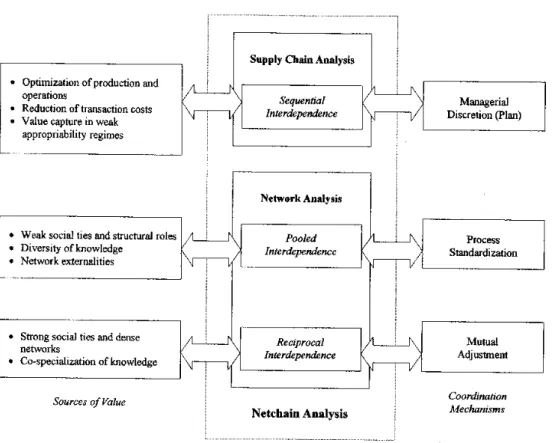
is the case by a number of other authors) but the netchain intends to integrate them,
recognizing that complex organizations involve several types of interdependencies associated with distinct sources of value. Whereas supply chain analysis deals with sequential
interdependencies of actors along the chain, the network analysis focusses on (horizontally) pooled and reciprocal interdependencies. Whereas pooled interdependencies lead to
standardization (like a uniform brand), sequential interdependencies result in coordinated planning, while reciprocal relations are the base for mutual adjustments. Supply chain analysis knows three sources of value creation and capture: cost reduction through
optimization of production and operations, cost reduction through minimizing transaction costs and value capture through appropriation of property rights. The sources of value in network analyses is based on the social structure related to the social embeddedness, learning processes leading to co-specialization and network externalities associated with the extension of the network.
The netchain approach is characterized by a simultaneous consideration of these different aspects. Lazarini et al. (2001:7) define a netchain as “a set of networks, comprises of
horizontal ties between firms within a particular industry, such that these networks) or layers) are sequentially arranged, based on vertical ties between firms in different layers”. The authors present (amongst others) again federated cooperatives as one example of a netchain that disposes of all these relationships and in addition to that forms a social group with a collective spirit, due to the close personal relationships on horizontal and vertical levels. The following case study of our values base netchain involves a federated cooperative structure but is not restricted to it. However, the analyzed supply chain extends beyond this cooperative and includes a mixture of different business actors.
Fig 1: Overview over the Netchain approach
Material and methods
The data collection for this case study was conducted in the frame of the Era-net EU-funded project “HealthyGrowth: from niche to volume with integrity and trust” during 2014. Data sampling included primary sampling and secondary interpretation of material from previous investigations:
a) a number of written materials and video clips: An image-clip (2012) on vimeo, an image-clip on the webpage, commercial clips on youtube, the homepage, the facebook page, publicly available leaflets, several press releases in local media and brochures or flyers which are usually placed at the points of sale for promotion.
b) a number internal documents (turnover charts, minutes of meetings, founding protocol), provided by the initiative supplied
c) three interviews in 2008 collected within the EU-6th framework project “Mountain Agrofood products in Europe, their consumers, retailers and local initiatives” (EuroMARC, 2007-2010).
d) the participation and moderation of an internal workshop (January 31st to February 1st 2014 in Neustift/Brixen in South Tyrol) with the chairman, the manager and three further employees of Bioalpin. Within these two days, the five core responsible persons of the cooperative discussed the visions and strategic developments for the future.
e) Interviews with [1] a representative of the organic farmers in milk delivery
cooperative of Wipptal/Stubai [2] a representative of the milk processing side and [3] the responsible purchaser from the retailing partner MPreis. The chairman and the manager of the cooperative had been appointed as key persons already before the other supply chain actors were interviewed.
f) scientific literature on the case, including conference papers (Steinlechner et al. 2010, Schermer et al. 2010) related to the EuroMARC project and a PhD thesis (Schermer 2003) on the founding history of the cooperative.
All interviews were transcribed verbatim, analyzed and interpreted. The case study BioAlpin
The idea first emerged in the early 2000s as an attempt to establish a cooperation between farmers and the quite important and strong tourism sector in Tyrol in order to promote and market regional food specialties with a particular label, not yet focused on organic.
Simultaneously in one distinct region the idea of launching an “organic region” was discussed between the conventional farmers union and the organic farmers association. During the BSE crisis the demand for organic products increased considerably and at the same time it became apparent that the organic farmers had already a higher degree of professionalization in local and regional marketing. When the major regional retail chain (MPreis) considered
establishing its own organic brand, this coincided with the idea of a regional organic trading platform and led finally to the founding of BioAlpin. With financial start up support of the regional government and logistical support by the family owned supermarket chain in 2002 BioAlpin was founded as a cooperative. Right from the start the cooperative registered their own producer brand ‚Bio vom Berg‘ (organic from the mountain) in contrast to the already existing organic retailer brands. This was meant to increase consumer trust and to prevent exchangeability in the supermarket.
are sourced regionally. The turnover of the cooperative developed from initially 672.000 € to 6.4 million € in 2014. This includes also distribution channels, which do not operate with the ‘Bio vom Berg’ brand. The growth rate was rather constant with a yearly increase of around half a million € in average. The main distribution channel is still the supermarket chain MPreis with a share of about 60-70% of the total turnover. Other sales channels include a regional bakery, a German specialized organic wholesaler, a famous Austrian chocolatier and smaller local shops/markets.
BioAlpin coordinates with a lean organization structure the entire supply chain. The
cooperative organizes production, processing and logistics and negotiates price and quantity with their retail purchasing partners. Besides this vertical coordination, BioAlpin organizes horizontally individual farmers into producer groups. This helps to reduce the number of contact persons and improves the personal relationship between partners along the chain.As a federated cooperative, they coordinate the participating local dairy cooperatives, which allows each dairy specializing on a few products, and at the same time increasing volume and quality of each dairy product.
On an ‘active’ membership level (as of July 2014), the cooperative comprises 49 members + 3 silent shareholders. Out of the 49 members there are the 10 small local dairies (mostly
cooperatives) and processors (i.e. an organic butcher or a producer organization for fruit storage and processing), a number of individual farmers, private persons plus institutional members. Among the latter, there is for instance the city of Innsbruck and a number of professional regional Tyrolian agrarian organizations (the chamber of agriculture, the institute for rural advanced education (LFI), the (conventional) farmers association, the organic farmers association and the cattle breeders association).
The major values BioAlpin is trying to convey besides the fact that the brand Bio vom Berg is owned by farmers, are the support for small-scale structures to produce organic, artisanal and local food items. The chairman of the cooperative describes his vision as follows: “A certified organic and local production is the most sensible way to produce food of incomparable quality in tune with traditional values. With our work, we sustain small-scale Tyrolean mountain farms for future generations and provide valuable, natural products from the region.”
The strategy to fulfill this aspiration is to forge a network of long standing business relations with like-minded partners. As the manager of the cooperative describes: „There are simply people who, due to certain reasons, like what you are doing. Be it the products or how you conduct your business. And there are chains that are able to reflect on a higher price level. There is a kind of harmony and then you either manage to build something constructive for a certain time or you don’t.” BioAlpin found a quite strong and reliable partner in the retailer MPreis with whom they entered an almost symbiotic relationship. BioAlpin depends on the retailer for most of their turnover, while consumers often associate “Bio vom Berg”
completely with MPreis. There is a commitment by MPreis to give preference to BioAlpin over other organic suppliers when taking in new products and BioAlpin would not sell their products to other supermarket chains. Still the cooperative looks actively for appropriate other partners to reduce dependency. Systematically, comparable small partners account for an increasing turnover. Especially for further processing partnerships are not only informed by mutually shared values, but also by structural similarities. It needs for instance small-scale millers to deal with the low quantities of grain BioAlpin may supply or artisanal processors to create hand crafted specialties for a limited market. Furthermore, according to the manager, successful partnerships only emerge if they are mutualy beneficial: ”...business relationships are like intimate relationships. It’s only going to result in something positive, if it is a mutual partnership. A unilateral or one-sided relationship is not productive in my understanding; it’s always about the personal/private matters. It happens between people. Development of sympathy is very important”. This explanation given in an interview in 2008 fits perfectly to what the manager says 6 years later in 2014, when he adds, that while all their retail partners have to be interested in a real partnership, it takes time to establish sympathy in a relationship. Results & Discussion:
The cooperative Bioalpin is a central hub for upstream and downstream as well as for
horizontal coordination. As it markets a substantial amount of the production of each dairy it becomes a focal actor. Furthermore, the dairy cooperatives are members of Bioalpin in a federated structure. We can evaluate the results in different perspectives combined in the netchain analytical framework
Results out of a perspective on interdependencies between netchain actors:
- Pooled interdependencies are necessary on a horizontal level to achieve the volume needed in each dairy and the specialization needed to make use of economies of scale without the necessity to extend production volume. Each of the ten dairies specializes on a limited range of products, thus may deepen existing competences and develop new ones. Collective labelling provides a uniform appearance in the supermarket. Bioalpin as the brand owner has the power to coordinate between the dairies.
- Reciprocal interdependencies between Bioalpin and the downstream dairies as well as upstream towards the retailer allow for mutual adjustments. The long-term relations allow adequate knowledge about the requirements and limitations of the partner on both sides (as the buyer of MPreis testified: “I spend more time with Bioalpin than with a number of other suppliers who have less turnover.”
Results for value creation out of the perspective of supply chain analysis:
- Cost reduction through optimization of production and processing operations is achieved by utilizing the pooled and sequential interdependencies.
- Cost reduction through minimizing transaction costs comes through the knowledge of requirements (reciprocal interdependencies)
- Value capture through appropriation of property rights is tied to the federated cooperative structure, which maintains the power over the brand in the hand of the producers/processors as members of Bioalpin. Moreover the cooperative structure prevents buying out by retail chain partners. The almost symbiotic reciprocal
interdependency between Bioalpin and Mpreis prevents that either of the two partners act as price setter or price taker but the negotiate prices on the basis of cost
calculations.
Results for value creation out of the perspective of network analysis:
- Social embeddedness is created by the long-term partnership of dedicated partners sharing a similar value system (testified by the very similar answers on the question
“what makes the quality of your product” posed to different actors along the chain. The personal relationship (sometimes even friendship) is fostered ba informal meeting spaces (like the annual farmers market)
- Learning processes are characterizes by learning diversity between the dairies and co-specialization within the individual dairy.
- Network externalities occur with network extension as this is the prime mode of growth. However, it needs to preserve the set of shared values, either by careful selection of new entrants and partners of by measured of socialization. The concept of operating a brand which is encompassing a full range of products within certain territorial boundaries, makes a constant extension of the network in combination of horizontal (pooled) and vertical (sequential) coordination necessary. This extension provides the base of growth for the central hub (the Bioalpin) and their services.
Conclusion:
Alternative pattern of growth (by “multiplicative” and not “additive” processes) allows preserving small structures (which provide an added value for rural development) and
artisanal quality products. The case study forms a values based netchain, where the collective spirit manifests itself in a set of shared values, which leads to a situation where independent enterprises move from competition to coordinated action. Multiplicative growth allows optimization processes within the single unit of production /processing as it prevents loss of resource balance and takes the focus away from the constant need to realign resources. At the same time the
Principles, conditions and results:
- Collectively shared values within the entire netchain:
o results in reduction of transaction costs, shared values mean more than coordination of material flows,
- Horizontal coordination of producers/processors:
o needs pooled interdependencies which requires a sort of standardization.
o result: allows co-specialisation and a move from competitors to colleagues, where sharing of experiences an knowledge is possible,
- Vertical coordination from primary production to retail:
o needs trustful long term partnership, sequential interdependenciesallow learning about the “bindings of the other” (in terms of time but also of technology related to value system)
o result: not price taking, not price setting but price negotiation on level ground between the platform and the retail partner.
- Collective brand ownership by producers/processors
o need a federated cooperative structure pooled, sequential and reciprocal interdependencies
o result in value capture by farmers/producers,