Volume 2008, Article ID 672941,13pages doi:10.1155/2008/672941
Research Article
A Window Width Optimized S-Transform
Ervin Sejdi´c,1Igor Djurovi´c,2and Jin Jiang1
1Department of Electrical and Computer Engineering, The University of Western Ontario, London, Ontario, Canada N6A 5B9 2Electrical Engineering Department, University of Montenegro, 81000 Podgorica, Montenegro
Correspondence should be addressed to Jin Jiang,[email protected]
Received 14 May 2007; Accepted 15 November 2007
Recommended by Sven Nordholm
Energy concentration of the S-transform in the time-frequency domain has been addressed in this paper by optimizing the width of the window function used. A new scheme is developed and referred to as a window width optimized S-transform. Two opti-mization schemes have been proposed, one for a constant window width, the other for time-varying window width. The former is intended for signals with constant or slowly varying frequencies, while the latter can deal with signals with fast changing frequency components. The proposed scheme has been evaluated using a set of test signals. The results have indicated that the new scheme can provide much improved energy concentration in the time-frequency domain in comparison with the standard S-transform. It is also shown using the test signals that the proposed scheme can lead to higher energy concentration in comparison with other standard linear techniques, such as short-time Fourier transform and its adaptive forms. Finally, the method has been demon-strated on engine knock signal analysis to show its effectiveness.
Copyright © 2008 Ervin Sejdi´c et al. This is an open access article distributed under the Creative Commons Attribution License, which permits unrestricted use, distribution, and reproduction in any medium, provided the original work is properly cited.
1. INTRODUCTION
In the analysis of the nonstationary signals, one often needs to examine their time-varying spectral characteristics. Since time-frequency representations (TFR) indicate variations of the spectral characteristics of the signal as a function of time, they are ideally suited for nonstationary signals [1,2]. The ideal time-frequency transform only provides information about the frequency occurring at a given time instant. In other words, it attempts to combine the local information of an instantaneous-frequency spectrum with the global in-formation of the temporal behavior of the signal [3]. The main objectives of the various types of time-frequency anal-ysis methods are to obtain time-varying spectrum functions with high resolution and to overcome potential interferences [4].
The S-transform can conceptually be viewed as a hybrid of short-time Fourier analysis and wavelet analysis. It em-ploys variable window length. By using the Fourier kernel, it can preserve the phase information in the decomposition [5]. The frequency-dependent window function produces higher frequency resolution at lower frequencies, while at higher frequencies, sharper time localization can be achieved. In contrast to wavelet transform, the phase information
pro-vided by the S-transform is referenced to the time origin, and therefore provides supplementary information about spectra which is not available from locally referenced phase infor-mation obtained by the continuous wavelet transform [5]. For these reasons, the S-transform has already been consid-ered in many fields such as geophysics [6–8], cardiovascular time-series analysis [9–11], signal processing for mechanical systems [12,13], power system engineering [14], and pattern recognition [15].
Since the bi-Gaussian window is asymmetrical, it also pro-duces an asymmetry in the time-frequency representation, with higher-time resolution in the forward direction. As a re-sult, the proposed form of the S-transform has better perfor-mance in detection of the onset of sudden events. However, in the current literature, none has considered optimizing the energy concentration in the time-frequency domain directly, that is, to minimize the spread of the energy beyond the ac-tual signal components.
The main approach used in this paper is to optimize the width of the window used in the S-transform. The optimiza-tion is performed through the introducoptimiza-tion of a new parame-ter in the transform. Therefore, the new technique is referred to as a window width optimized S-transform (WWOST). The newly introduced parameter controls the window width, and the optimal value can be determined in two ways. The first approach calculates one global, constant parameter and this is recommended for signals with constant or very slowly varying frequency components. The second approach calcu-lates the time-varying parameter, and it is more suitable for signals with fast varying frequency components.
The proposed scheme has been tested using a set of syn-thetic signals and its performance is compared with the stan-dard S-transform. The results have shown that the WWOST enhances the energy concentration. It is also shown that the WWOST produces the time-frequency representation with a higher concentration than other standard linear techniques, such as the short-time Fourier transform and its adaptive forms. The proposed technique is useful in many applica-tions where enhanced energy concentration is desirable. As an illustrative example, the proposed algorithm is used to analyze knock pressure signals recorded from a Volkswagen Passat engine in order to determine the presence of several signal components.
This paper is organized as follows. InSection 2, the con-cept of ideal time-frequency transform is introduced, which can be compared with other time-frequency representations including transforms proposed here. The development of the WWOST is covered inSection 3.Section 4evaluates the performance of the proposed scheme using test signals and also the knock pressure signals. Conclusions are drawn in
Section 5.
2. ENERGY CONCENTRATION IN TIME-FREQUENCY DOMAIN
The ideal TFR should only be distributed along frequencies for the duration of signal components. Thus, the neighbor-ing frequencies would not contain any energy; and the energy contribution of each component would not exceed its dura-tion [3].
For example, let us consider two simple signals: an FM signal, x1(t) = A(t) exp (jφ(t)), where |dA(t)/dt|
|dφ(t)/dt| and the instantaneous frequency is defined as f(t) = (dφ(t)/dt)/2π; and a signal with the Fourier transform given as X(f) = G(f) exp (j2πχ(f)), where the spectrum is slowly varying in comparison to phase |dG(f)/df| |dχ(f)/df|. Further,A(t) andG(t) The ideal
TFRs for these signals are given, respectively, as shown in [16]
ITFR(t,f)=2πA(t)δ
f − 1
2π dφ(t)
dt
, (1)
ITFR(t,f)=2πG(f)δ
t+dχ(f) df
, (2)
where ITFR stands for an ideal time-frequency represen-tation. These two representations are ideally concentrated along the instantaneous frequency, (dφ(t)/dt)/2π, and on group delay−dχ(f)/df. Simplest examples of these signals are the following: a sinusoid withA=const. anddφ(t)/dt= const. depicted in Figure 1(a); and a Dirac pulse x2(t) =
δ(t−t0) shown inFigure 1(b). The ideal time-frequency
rep-resentations are depicted in Figures1(c)and1(d). These two graphs are compared with the TFRs obtained by the standard S-transform in Figures1(e)and1(f).
For the sinusoidal case, the frequencies surrounding (dφ(t)/dt)/2πalso have a strong contribution, and from (1), it is clear that they should not have any contributions. Sim-ilarly, for the Dirac function, it is expected that all the fre-quencies have the contribution but only for a single time in-stant. Nevertheless, it is clear that the frequencies are not only contributing during a single time instant as expected from (2), but the surrounding time instants also have strong en-ergy contribution.
The examples presented here are for illustrations only, since a priori knowledge about the signals is assumed. In most practical situations, the knowledge about a signal is limited and the analytical expressions similar to (1) and (2) are often not available. However, the examples illustrate a point that some modifications to the existing S-transform algorithm, which do not assume a prioriknowledge about the signal, may be useful to achieve improved performance in time-frequency energy concentration. Such improvements only become possible after modifications to the width of the window function are made.
3. THE PROPOSED SCHEME
3.1. Standard S-transform
The standard S-transform of a function x(t) is given by an integral as in [5,7,12]
Sx(t,f)=
+∞
−∞x(τ)w
t−τ,σ(f)exp (−j2π f τ)dτ (3)
with a constraint
+∞
−∞w
−1 0 1
A
m
plitude
0 0.2 0.4 0.6 0.8 1
Time (s) (a)
0 0.5 1
A
m
plitude
0 0.2 0.4 0.6 0.8 1
Time (s) (b)
0 50 100
Fre
q
u
en
cy
(H
z)
0 0.2 0.4 0.6 0.8 1
Time (s) (c)
0 50 100
Fre
q
u
en
cy
(H
z)
0 0.2 0.4 0.6 0.8 1
Time (s) (d)
0 50 100
Fre
q
u
en
cy
(H
z)
0 0.2 0.4 0.6 0.8 1
Time (s) (e)
0 50 100
Fre
q
u
en
cy
(H
z)
0 0.2 0.4 0.6 0.8 1
Time (s) (f)
Figure1: Comparison of the ideal time-frequency representation and S-transform for the two simple signal forms: (a) 30 Hz sinusoid; (b) sample Dirac function; (c) ideal TFR of a 30 Hz sinusoid; (d) ideal TFR of a Dirac function; (e) TFR by standard S-transform for a 30 Hz sinusoid; and (f) TFR by standard S-transform of the Dirac delta function.
A window function used in S-transform is a scalable Gaus-sian function defined as
wt,σ(f)= 1 σ(f)√2πexp
− t2
2σ2(f)
. (5)
The advantage of the S-transform over the short-time Fourier transform (STFT) is that the standard deviationσ(f) is actually a function of frequency, f, defined as
σ(f)=|1
f|. (6)
Consequently, the window function is also a function of time and frequency. As the width of the window is dictated by the frequency, it can easily be seen that the window is wider in the time domain at lower frequencies, and narrower at higher frequencies. In other words, the window provides good lo-calization in the frequency domain for low frequencies while providing good localization in time domain for higher fre-quencies.
The disadvantage of the current algorithm is the fact that the window width is always defined as a reciprocal of the frequency. Some signals would benefit from different win-dow widths. For example, for a signal containing a single si-nusoid, the time-frequency localization can be considerably improved if the window is very narrow in the frequency do-main. Similarly, for signals containing only a Dirac impulse, it would be beneficial for good time-frequency localization to have very wide window in the frequency domain.
3.2. Window width optimized S-transform
A simple improvement to the existing algorithm for the S-transform can be made by modifying the standard deviation of the window to
σ(f)= 1
0 0.1 0.2 0.3 0.4 0.5 0.6 0.7 0.8 0.9 1
N
o
rm
aliz
ed
amplitude
−2 −1.5 −1 −0.5 0 0.5 1 1.5 2
Time (s) p=0.5
p=1 p=2
Figure2: Normalized Gaussian window for different values ofp.
Based on the above equation, the new S-transform can be represented as
Sxp(t,f)
=|f|
p
√ 2π
+∞
−∞x(τ) exp
−(t−τ)
2f2p
2
exp (−j2π f τ)dτ.
(8)
The parameter p can control the width of the window. By finding an appropriate value of p, an improved time-frequency concentration can be obtained. The window func-tions with three different values of pare plotted inFigure 2, where p=1 corresponds to the standard S-transform win-dow. Forp < 1, the window becomes wider in the time do-main, and for p > 1, the window narrows in the time do-main. Therefore, by considering the example fromSection 2, for the single sinusoid, a small value of p would provide almost perfect concentration of the signal, whereas for the Dirac function, a rather large value of p would produce a good concentration in the time-frequency domain. It is im-portant to mention that in the case of 0< f <1, the opposite is true.
The optimal value ofpwill be found based on the con-centration measure proposed in [17], which has some fa-vorable performance in comparison to other concentration measures reported in [18–20]. The measure is designed to minimize the energy concentration for any time-frequency representation based on the automatic determination of some time-frequency distribution parameter. This measure is defined as
CM(p)= +∞ 1
−∞ −∞+∞Spx(t,f)dt df
, (9)
where CM stands for a concentration measure.
There are two ways to determine the optimal value ofp. One is to determine a global, constant value ofpfor the en-tire signal. The other is to determine a time-varying p(t), which depends on each time instant considered. The first ap-proach is more suitable for signals with the constant or slowly varying frequency components. In this case, one value of p will suffice to give the best resolution for all components. The time-varying parameter is more appropriate for signals with fast varying frequency components. In these situations, depending on the time duration of the signal components, it would be beneficial to use lower value of p (somewhere in the middle of the particular component’s interval), and to use higher values of p for the beginning and the end of the component’s interval, so the component is not smeared in the time-frequency plane. It is important to mention that both proposed schemes for determining the parameterpare the special cases of the algorithm which would evaluate the parameter on any arbitrary subinterval, rather than over the entire duration of the signal.
3.2.1. Algorithm for determining the time-invariantp
The algorithm for determining the optimized time-invariant value ofpis defined through the following steps.
(1) For p selected from a set 0 < p ≤ 1, compute S-transform of the signalSxp(t,f) using (8).
(2) For eachpfrom the given set, normalize the energy of the S-transform representation, so that all of the rep-resentations have the equal energy
Sxp(t,f)= S
p x(t,f)
+∞ −∞ −∞+∞S
p x(t,f)
2
dt df
. (10)
(3) For eachpfrom the given set, compute the concentra-tion measure according to (9), that is,
CM(p)= +∞ 1
−∞ −∞+∞Spx(t,f)dt df
. (11)
(4) Determine the optimal parameterpoptby
popt=max p
CM(p). (12)
(5) SelectSxp(t,f) withpoptto be the WWOST
Sxp(t,f)=Sxpopt(t,f). (13)
As it can be seen, the proposed algorithm computes the S-transform for each value of p and, based on the com-puted representation, it determines the concentration mea-sure, CM(p), as an inverse ofL1 norm of the normalized
S-transform for a given p. The maximum of the concentra-tion measure corresponds to the optimal pwhich provides the least smear ofSxp(t,f).
greater than 1 provide a window which may be too narrow in the time domain. Unless the signal being analyzed is a super-position of Delta functions, the value ofpshould not exceed unity. As a special case, it is important to point out that for p =0, the WWOST is equivalent to STFT with a Gaussian window withσ2=1.
3.2.2. Algorithm for determiningp(t)
The time-varying parameterp(t) is required for signals with components having greater or abrupt changes. The algo-rithm for choosing the optimal p(t) can be summarized through the following steps.
(1) For p selected from a set 0 < p(t) ≤ 1, compute S-transform of the signalSxp(t,f) using (8).
(2) Calculate the energy,E1, forp=1. For eachpfrom the
set, normalize the energy of the S-transform represen-tation toE1, so that all of the representations have the
equal energy, and the amplitude of the components is not distorted,
Sxp(t,f)=
E1 S
p x(t,f)
+∞
−∞ −∞+∞Sxp(t,f) 2
dt df
. (14)
(3) For eachpfrom the set and a time instantt, compute
CM(t,p)= +∞ 1 −∞Sxp(t,f)df
. (15)
(4) Optimal value of pfor the considered instantt maxi-mizes concentration measure CM(t,p),
popt(t)=arg max p
CM(t,p). (16)
(5) Set the WWOST to be
Sxp(t,f)=Spopt(t)x (t,f). (17)
The main difference between the two techniques lies in step (3). For the time invariant case, a single value of p is chosen, whereas in the time-varying case, an optimal value of p(t) is a function of time. As it is demonstrated inSection 4, the time-dependent parameter is beneficial for signals with the fast varying components.
3.2.3. Inverse of the WWOST
Similarly to the standard S-transform, the WWOST can be used as both an analysis and a synthesis tool. The inversion procedure for the WWOST resembles that of the standard S-transform, but with one additional constraint. The spec-trum of the signal obtained by averagingSxp(t,f) over time
must be normalized byW(0,f), whereW(α,f) represents the Fourier transform (fromttoα) of the window function, w(t,σ(f)). Hence, the inverse WWOST for a signal,x(t), is defined as
x(t)= +∞
−∞ +∞
−∞ 1 W(0,f)S
p
x(τ,f) exp (j2π f t)dτ df . (18)
In the case of a time-invariant p, it can be shown that W(0,f)=1. In a general case, the Fourier transform of the proposed modified window can only be determined numer-ically.
4. WWOST PERFORMANCE ANALYSIS
In this section, the performance of the proposed scheme is examined using a set of synthetic test signals first. Further-more, the analysis of signals from an engine is also given. The first part includes two cases: (1) a simple case involving three slowly varying frequencies and (2) more complicated cases involving multiple time-varying components. The goal is to examine the performance of WWOST in comparison to the standard S-transform. The proposed algorithm is also compared to other time-frequency representations, such as the short-time Fourier transform (STFT) and adaptive STFT (ASTFT), to highlight the improved performance of the S-transform with the proposed window width optimization technique. In particular, the proposed algorithm can be used for some classes of the signals for which the standard S-transform would not be suitable.
As for the synthetic signals, the sampling period used in the simulations is Ts = 1/256 seconds. Also, the set of p
values, used in the numerical analysis of both test and the knock pressure signals, is given by p= {0.01n:n∈Nand 1≤n≤100}. The ASTFT is calculated according to the con-centration measure given by (9). In the definition of the mea-sure, a normalized STFT is used instead of the normalized WWOST. The standard deviation of the Gaussian window, σgw, is used as the optimizing parameter, where the window
is defined as
wSTFT(t)=
1 σgw
√ 2πexp
− t2
2σ2 gw
. (19)
The optimization for synthetic signals is performed on the set of values defined by
σgw= {n/128 :n∈N, 1≤n≤128} (20)
and both the time-invariant and time-varying values ofσgw
are calculated.
4.1. Synthetic test signals
Example 1. The first test signal is shown inFigure 3(a). It has the following analytical expression:
x1(t)=cos
132πt+ 14πt2+ cos10πt−2πt2
+ cos30πt+ 6πt2, (21)
where the signal exists only on the interval 0≤t <1. The sig-nal consists of three slowly varying frequency components. It is analyzed using the STFT (Figure 3(b)), ASTFT with time-invariant optimum value of σgw (Figure 3(c)),
−5 0 5
A
m
plitude
0 0.2 0.4 0.6 0.8 1
Time (s) (a)
0 50 100
Fre
q
u
en
cy
(H
z)
0 0.2 0.4 0.6 0.8 1
Time (s) (b)
0 50 100
Fre
q
u
en
cy
(H
z)
0 0.2 0.4 0.6 0.8 1
Time (s) (c)
0 50 100
Fre
q
u
en
cy
(H
z)
0 0.2 0.4 0.6 0.8 1
Time (s) (d)
0 0.5 1
A
m
plitude
o
f
C
M
0 0.2 0.4 0.6 0.8 1
Time (s) (e)
0 50 100
Fre
q
u
en
cy
(H
z)
0 0.2 0.4 0.6 0.8 1
Time (s) (f)
Figure3: Test signalx1(t): (a) time-domain representation; (b) STFT ofx1(t); (c) ASTFT ofx1(t) withσopt; (d)Sxp(t,f) ofx1(t) withp=1
(standard S-transform); (e) concentration measure CM(p); (f)Sxp(t,f) ofx1(t) with the optimal value ofp=.57.
optimum value of standard deviation for the ASTFT is calcu-lated to beσopt=0.094. The colormap used for plotting the
time-frequency representations inFigure 3and all the subse-quent figures is a linear grayscale with values from 0 to 1.
The standard S-transform, shown inFigure 3(d), depicts all three components clearly. However, only the first two components have relatively good concentration, while the third component is completely smeared in frequency. As shown inFigure 3(b), the STFT provides better energy con-centration than the standard S-transform. The ASTFT, de-picted inFigure 3(c), shows a noticeable improvement for all three components. The results with the proposed scheme is shown inFigure 3(f)forp=0.57. The value ofpis found ac-cording to (12). For the determined value ofp, the first two components have higher concentration even than the ASTFT, while the third component has approximately the same con-centration.
InFigure 3(e), the normalized concentration measure is depicted. The obtained results verify the theoretical predic-tions fromSection 3.2. For this class of signals, that is, the
signals with slowly varying frequencies, it is expected that smaller values of pwill produce the best energy concentra-tion. In this example, the optimal value, found according to (12), is determined numerically to be 0.57.
Based on the visual inspection of the time-frequency rep-resentations shown inFigure 3, it can be concluded that the proposed algorithm achieves higher concentration among the considered representations. To confirm this fact, a per-formance measure given by
ΞTF= +∞
−∞ +∞
−∞
TF(t,f)dt df −1
(22)
is used for measuring the concentration of the representa-tion, where|TF(t,f)|is a normalized time-frequency repre-sentation. The performance measure is actually the concen-tration measure proposed in (9). A more concentrated rep-resentation will produce a higher value ofΞTF.Table 1
Table1: Performance measure for the three time-frequency trans-forms.
TFR ΞTF
STFT 0.0119
ASTFT 0.0131
Standard S-transform 0.0080
WWOST 0.0136
The value of the performance measure for the standard S-transform is the lowest, followed by the STFT. The WWOST produces the highest value ofΞTF, and thus achieves a TFR
with the highest energy concentration amongst the trans-forms considered.
Example 2. The signal in the second example contains mul-tiple components with faster time-varying spectral contents. The following signal is used:
x2(t)=cos
40π(t−0.5) arctan (21t−10.5)
−20πln(21t−10.5)2+ 1/21 + 120πt + cos40πt−8πt2,
(23)
where x2(t) exists only on the interval 0 ≤ t < 1. This
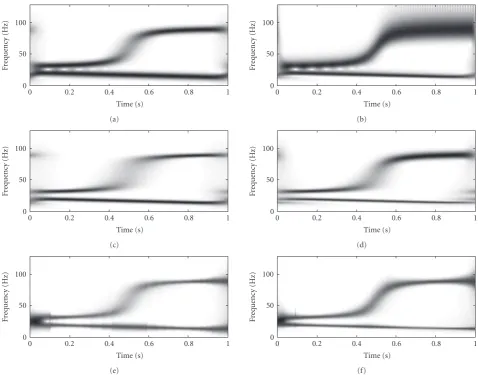
signal consists of two components. The first has a transi-tion region from lower to higher frequencies, and the sec-ond is a linear chirp. In the analysis, the time-frequency transformations that employ a constant window exhibit a conflicting issue between good concentration of the tran-sition region for the first component versus good con-centration for the rest of the signal. In order to numer-ically demonstrate this problem, the signal is again ana-lyzed using the STFT (Figure 4(a)), ASTFT with the opti-mal time-invariant value of σgw (Figure 4(c)), ASTFT with
the optimal time-varying value of σgw (Figure 4(e)),
stan-dard S-transform (Figure 4(b)), the proposed algorithm with both time-invariant (Figure 4(d)), and time-varying p (Figure 4(f)). A Gaussian window is used for the STFT, with σ=0.03. The optimum time-invariant value of the standard deviation for the ASTFT is determined to beσopt=0.055.
The standard deviation of the Gaussian window used should be small in order for the STFT to provide relatively good concentration in the transition region. However, as the value of the standard deviation decreases, so is the concentra-tion of the rest of the signal. To a certain extent, the standard S-transform is capable of producing a good concentration around the instantaneous frequencies at the lower frequen-cies and also in the transition region for the first component. However, at the high frequencies, the standard S-transform exhibits poor concentration for the first component. The WWOST with a time-invariant p enhances the concentra-tion of the linear chirp, as shown inFigure 4(d). However the concentration of the transition region of the first component has deteriorated in comparison to the standard S-transform. The concentration obtained with the WWOST with the time-invariant p for this transition region is equivalent to the poor concentration exhibited by the STFT. Even though the ASTFT with both time-invariant and time-varying optimum
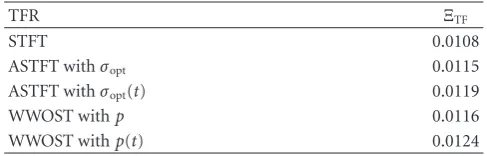
Table2: Performance measures for the time-frequency representa-tions considered inExample 2.
TFR ΞTF
STFT 0.0108
ASTFT withσopt 0.0115
ASTFT withσopt(t) 0.0119
WWOST withp 0.0116
WWOST withp(t) 0.0124
values of standard deviation provide good concentration of the linear FM component and the stationary parts of the sec-ond component, the transition region of the secsec-ond compo-nent is smeared in time.
Figure 4(f)represents the signal optimized S-transform obtained by usingp(t). A significant improvement in the en-ergy concentration is easily noticeable in comparison to the standard S-transform. All components show improved en-ergy concentration in comparison to the S-transform. Fur-ther, a comparison of the representations obtained by the proposed implementation of the S-transform and the STFT shows that both components have higher energy concentra-tion in the representaconcentra-tion obtained by the WWOST with p(t).
As mentioned previously, for this type of signals it is more appropriate to use the time-varying p(t) rather than a single constant pvalue in order to achieve better concen-tration of the nonstationary data. By comparing Figures4(d)
and4(f), the component with the fast changing frequency has better concentration with p(t) than a fixed p, which is calculated according to (12), while the linear chirp has simi-lar concentration in both cases.
It would be beneficial to quantify the results by eval-uating the performance measure again. The performance measure is given by (22) and the results are summarized in Table 2. A higher value of the performance measure for WWOST with p(t) reconfirms that the time-varying algo-rithm should be used for the signals with fast changing com-ponents. Also, it is worthwhile to examine the value of (22) for the STFT and the ASTFT. The time-frequency represen-tations of the signal obtained by the STFT and ASTFT al-gorithms achieve smaller values of the performance measure than WWOST. This supports the earlier conclusion that the WWOST produces more concentrated energy representation than the STFT and ASTFT. The WWOST with the time-invariant value of pproduces higher concentration than the ASTFT with the optimum time-invariant value ofσgw, and
the WWOST with p(t) produces higher concentration than the ASTFT with the optimum time-varying value of the σgw.
Example 3. Another important class of signals are those with crossing components that have fast frequency variations. A representative signal as shown inFigure 5(a)is given by
x3(t)=cos
20πln (10t+ 1)+ cos48πt+ 8πt2 (24)
with x3(t) = 0 outside the interval 0 ≤ t < 1. For this
0 50 100
Fre
q
u
en
cy
(H
z)
0 0.2 0.4 0.6 0.8 1
Time (s) (a)
0 50 100
Fre
q
u
en
cy
(H
z)
0 0.2 0.4 0.6 0.8 1
Time (s) (b)
0 50 100
F
requency
(Hz)
0 0.2 0.4 0.6 0.8 1
Time (s) (c)
0 50 100
F
requency
(Hz)
0 0.2 0.4 0.6 0.8 1
Time (s) (d)
0 50 100
Fre
q
u
en
cy
(H
z)
0 0.2 0.4 0.6 0.8 1
Time (s) (e)
0 50 100
Fre
q
u
en
cy
(H
z)
0 0.2 0.4 0.6 0.8 1
Time (s) (f)
Figure4: Comparison of different algorithms: (a) STFT ofx2(t); (b)Spx(t,f) ofx2(t) withp=1 (standard S-transform); (c) ASTFT ofx2(t)
withσopt=0.055; (d)Sxp(t,f) ofx2(t) withp=0.73; (e) ASTFT ofx2(t) withσopt(t); (f)Sxp(t,f) ofx2(t) with the optimalp(t).
previous example; however, here exists an additional con-straint, that is, the crossing components. The time-frequency analysis is performed using the STFT (Figure 5(b)), the ASTFT with the time-varyingσgw(Figure 5(c)), the standard
S-transform (Figure 5(d)), and the proposed algorithm for the S-transform (Figure 5(f)). In the STFT, a Gaussian win-dow with a standard deviation of 0.02 is used. Due to the time-varying nature of the frequency components present in the signal, the time-varying algorithm is used in the calcula-tion of the WWOST in order to determine the optimal value ofp.
The representation obtained by the STFT depicts good concentration of the higher frequencies, while having rela-tively poor concentration at the lower frequencies. An im-provement in the concentration of the lower frequencies is obtained with the ASTFT algorithm. The standard S-transform is capable of providing better concentration for the high frequencies, but for the linear chirp, the concentra-tion is equivalent to that of the STFT.
From the time-frequency representation obtained by the WWOST, it is clear that the concentration is preserved at
high frequencies, while the linear chirp has significantly higher concentration in comparison to the other represen-tations. It is also interesting to note howp(t) varies between 0.6 and 1.0 as a function of time shown inFigure 5(e). In par-ticular,p(t) is close to 1 at the beginning of the signal in order to achieve good concentration of the high-frequency compo-nent. As time progresses, the value ofp(t) decreases in order to provide a good concentration at the lower frequencies. To-wards the end of the signal,p(t) increases again to achieve a good time localization of the signal.
InSection 3, it has been stated that for the components with faster variations, it is recommended that the time-varying algorithm with the WWOST be used. In order to substantiate that statement, the performance measure imple-mented in the previous examples is used again and the results are shown inTable 3. The optimized time-invariant value of the parameterpoptfor this signal, found according to (12), is
−2 0 2
A
m
plitude
0 0.2 0.4 0.6 0.8 1
Time (s) (a)
0 50 100
Fre
q
u
en
cy
(H
z)
0 0.2 0.4 0.6 0.8 1
Time (s) (b)
0 50 100
Fre
q
u
en
cy
(H
z)
0 0.2 0.4 0.6 0.8 1
Time (s) (c)
0 50 100
Fre
q
u
en
cy
(H
z)
0 0.2 0.4 0.6 0.8 1
Time (s) (d)
0 0.5 1
A
m
plitude
0 0.2 0.4 0.6 0.8 1
Time (s) (e)
0 50 100
Fre
q
u
en
cy
(H
z)
0 0.2 0.4 0.6 0.8 1
Time (s) (f)
Figure5: Time-frequency analysis of signal with fast variations in frequency: (a) time-domain representation; (b) STFT ofx3(t); (c) ASTFT ofx3(t) withσopt(t); (d)S
p
x(t,f) ofx3(t) withp=1 (standard S-transform); (e)p(t); (f)Sxp(t,f) ofx3(t) with the optimalp(t).
Table3: Performance measures for the time-frequency representa-tions considered inExample 3.
TFR ΞTF(noise-free) ΞTF(SNR=25 dB)
STFT 0.0106 0.0100
ASTFT withσopt 0.0121 0.0114 ASTFT withσopt(t) 0.0122 0.0113
WWOST withp 0.0122 0.0110
WWOST withp(t) 0.0126 0.0116
the STFT and its time-invariant (σopt = 0.048) and
time-varying adaptive algorithms are calculated as well. By com-paring the values of the performance measure for different time-frequency transforms, these values confirm the earlier statement which assures that each algorithm for the WWOST produces more concentrated time-frequency representation in its respective class than the ASTFT.
In the analysis performed so far, it was assumed that the signal-to-noise ratio (SNR) is infinity, that is, the noise-free
signals were considered. It would be beneficial to compare the performance of the considered algorithms in the pres-ence of additive white Gaussian noise in order to understand whether the proposed algorithm is capable of providing the enhanced performance in noisy environment. Hence, the sig-nal x3(t) is contaminated with the additive white Gaussian
noise and it is assumed that SNR=25 dB. The results of such an analysis are summarized inTable 3. Even though, the per-formance has degraded in comparison to the noiseless case, the WWOST withp(t) still outperforms the other considered representations.
4.2. Demonstration example
−1 0 1
A
m
plitude
(kP
a)
0 2 4 6
Time (ms) (a)
0 1 2 3
Fre
q
u
en
cy
(k
H
z)
0 2 4 6
Time (ms) (b)
0 1 2 3
Fre
q
u
en
cy
(k
H
z)
0 2 4 6
Time (ms) (c)
0 1 2 3
Fre
q
u
en
cy
(k
H
z)
0 2 4 6
Time (ms) (d)
0 1 2 3
Fre
q
u
en
cy
(k
H
z)
0 2 4 6
Time (ms) (e)
0 1 2 3
Fre
q
u
en
cy
(k
H
z)
0 2 4 6
Time (ms) (f)
Figure6: Time-frequency analysis of engine knock pressure signal (17th trial): (a) time-domain representation; (b) STFT; (c) ASTFT with σopt(t); (d)Spx(t,f) withp=1 (standard S-transform); (e)Sxp(t,f) withp=0.86; (f)Sxp(t,f) with the optimalp(t).
environment pollution, mechanical damages, and reduced energy efficiency [21,22]. In this paper, a focus will be on the analysis of knock pressure signals.
It has been previously shown that high-pass filtered pres-sure signals in the presence of knocks can be modeled as multicomponent FM signals [22]. Therefore, the goal of this analysis is to illustrate how effectively the proposed WWOST can decouple these components in time-frequency represen-tation. A knock pressure signal recorded from a 1.81 Volk-swagen Passat engine at 1200 rpm is considered. Note that the signal is high-pass filtered with a cutofffrequency of 3000 Hz. The sampling rate isfs=100 kHz and the signal contains 744
samples.
The performance of the proposed scheme in this case is evaluated by comparing it with that of the STFT, the ASTFT, and the standard S-transform. The results are shown in Fig-ures6and7. These results represent two sample cases from fifty trials. For the STFT, a Gaussian window, with a standard deviation of 0.3 milliseconds, is used for both cases. The op-timization of the standard deviation for the ASTFT is
per-formed on the set of values defined byσgw = {0.01n :n ∈ Nand 1≤n≤744}milliseconds.
A comparison of these representations show that the WWOST performs significantly better than the standard S-transform. The presence of several signal components can be easily identified with the WWOST, but rather difficult with the standard S-transform. In addition, both proposed algo-rithms produce higher concentration than the STFT and the corresponding class of the ASTFT. This is accurately depicted through the results presented inTable 4. The best concen-tration is achieved with the time-varying algorithm, while the time invariant value pproduces slightly higher concen-tration than the ASTFT with the time-invariant value of σgw(σopt = 0.2 milliseconds for the signal inFigure 6and
σopt=0.19 milliseconds for the signal inFigure 7).
−1 0 1
A
m
plitude
(kP
a)
0 2 4 6
Time (ms) (a)
0 1 2 3
Fre
q
u
en
cy
(k
H
z)
0 2 4 6
Time (ms) (b)
0 1 2 3
Fre
q
u
en
cy
(k
H
z)
0 2 4 6
Time (ms) (c)
0 1 2 3
Fre
q
u
en
cy
(k
H
z)
0 2 4 6
Time (ms) (d)
0 1 2 3
Fre
q
u
en
cy
(k
H
z)
0 2 4 6
Time (ms) (e)
0 1 2 3
Fre
q
u
en
cy
(k
H
z)
0 2 4 6
Time (ms) (f)
Figure7: Time-frequency analysis of engine knock pressure signal (48th trial): (a) time-domain representation; (b) STFT; (c) ASTFT with σopt(t); (d)Spx(t,f) withp=1 (standard S-transform); (e)Sxp(t,f) withp=0.87; (f)Sxp(t,f) with the optimalp(t).
Table4: Concentration measures for the two sample trials.
Trial ΞSTFT ΞASTFTσopt ΞASTFTσopt(t) Ξp=1 Ξpopt Ξpopt(t) 17th trial 0.0057 0.0059 0.0068 0.0054 0.0065 0.0074 48th trial 0.0052 0.0054 0.0060 0.0053 0.0058 0.0069
realizations required by some other time-frequency methods such as Wigner-Ville distribution [23], since the WWOST does not suffer from the cross-terms present in bilinear trans-forms.
4.3. Remarks
It should be noted that, in some cases, when implementing the proposed algorithm, it may be beneficial to window the signal before evaluatingSxp(t,f) in step (1). This additional
step diminishes the effects of a discrete implementation. As shown in [24], wideband signals might lead to some irregular results unless they are properly windowed.
The STFT and the ASTFT are valuable signal decom-position-based representations, which can achieve good en-ergy concentration for a wide variety of signals. However, throughout this paper, it is shown that the proposed opti-mization of the window width used in the S-transform is beneficial, and in presented cases, it outperforms other stan-dard linear techniques, such as the STFT and the ASTFT. It is also crucial to mention that the WWOST is designed to achieve better concentration in the class of the time-frequency representations based on the signal decomposi-tion.
In comparison to the standard S-transform or the STFT, the WWOST does have a higher computational complexity. The algorithm for the WWOST is based on an optimiza-tion procedure and requires a parameter tuning. However, when compared to the transforms of similar group algo-rithms (e.g., ASTFT), the WWOST has almost the same de-gree of complexity.
several publications [5,7,25–27]. The WWOST is a straight-forward extension of the standard S-transform. Therefore, the sampled data version of the WWOST also follows the steps presented in earlier publications.
5. CONCLUSION
In this paper, a scheme for improvement of the energy concentration of the S-transform has been developed. The scheme is based on the optimization of the width of the win-dow used in the transform. The optimization is carried out by means of a newly introduced parameter. Therefore, the developed technique is referred to as a window width opti-mized S-transform (WWOST). Two algorithms for parame-ter optimization have been developed: one for finding an op-timal constant value of the parameterpfor the entire signal; while the other is to find a time-varying parameter. The pro-posed scheme is evaluated and compared with the standard S-transform by using a set of synthetic test signals. The re-sults have shown that the WWOST can achieve better energy concentration in comparison with the standard S-transform. As demonstrated, the WWOST is capable of achieving higher concentration than other standard linear methods, such as the STFT and its adaptive form. Furthermore, the proposed technique has also been applied to engine knock pressure sig-nal asig-nalysis, and the results have indicated that the proposed technique provides a consistent improvement over the stan-dard S-transform.
ACKNOWLEDGMENTS
Ervin Sejdi´c and Jin Jiang would like to thank the Natural Sci-ences and Engineering Research Council of Canada (NSERC) for financially supporting this work.
REFERENCES
[1] L. Cohen,Time-Frequency Analysis, Prentice Hall PTR, Engle-wood Cliffs, NJ, USA, 1995.
[2] S. G. Mallat,A Wavelet Tour of Signal Processing, Academic Press, San Diego, Calif, USA, 2nd edition, 1999.
[3] K. Gr¨ochenig, Foundations of Time-Frequency Analysis, Birkh¨auser, Boston, Mass, USA, 2001.
[4] I. Djurovi´c and LJ. Stankovi´c, “A virtual instrument for time-frequency analysis,”IEEE Transactions on Instrumentation and Measurement, vol. 48, no. 6, pp. 1086–1092, 1999.
[5] R. G. Stockwell, L. Mansinha, and R. P. Lowe, “Localization of the complex spectrum: the S-transform,”IEEE Transactions on Signal Processing, vol. 44, no. 4, pp. 998–1001, 1996.
[6] S. Theophanis and J. Queen, “Color display of the localized spectrum,”Geophysics, vol. 65, no. 4, pp. 1330–1340, 2000. [7] C. R. Pinnegar and L. Mansinha, “The S-transform with
win-dows of arbitrary and varying shape,”Geophysics, vol. 68, no. 1, pp. 381–385, 2003.
[8] C. R. Pinnegar and L. Mansinha, “The bi-Gaussian S-transform,” SIAM Journal of Scientific Computing, vol. 24, no. 5, pp. 1678–1692, 2003.
[9] M. Varanini, G. De Paolis, M. Emdin, et al., “Spectral analy-sis of cardiovascular time series by the S-transform,” in
Com-puters in Cardiology, pp. 383–386, Lund, Sweden, September 1997.
[10] G. Livanos, N. Ranganathan, and J. Jiang, “Heart sound anal-ysis using the S-transform,” inComputers in Cardiology, pp. 587–590, Cambridge, Mass, USA, September 2000.
[11] E. Sejdi´c and J. Jiang, “Comparative study of three time-frequency representations with applications to a novel correla-tion method,” inProceedings of the IEEE International Confer-ence on Acoustics, Speech and Signal Processing (ICASSP ’04), vol. 2, pp. 633–636, Montreal, Quebec, Canada, May 2004. [12] P. D. McFadden, J. G. Cook, and L. M. Forster,
“Decomposi-tion of gear vibra“Decomposi-tion signals by the generalized S-transform,” Mechanical Systems and Signal Processing, vol. 13, no. 5, pp. 691–707, 1999.
[13] A. G. Rehorn, E. Sejdi´c, and J. Jiang, “Fault diagnosis in ma-chine tools using selective regional correlation,”Mechanical Systems and Signal Processing, vol. 20, no. 5, pp. 1221–1238, 2006.
[14] P. K. Dash, B. K. Panigrahi, and G. Panda, “Power quality anal-ysis using S-transform,”IEEE Transactions on Power Delivery, vol. 18, no. 2, pp. 406–411, 2003.
[15] E. Sejdi´c and J. Jiang, “Selective regional correlation for pat-tern recognition,”IEEE Transactions on Systems, Man, and Cy-bernetics, Part A, vol. 37, no. 1, pp. 82–93, 2007.
[16] LJ. Stankovi´c, “Analysis of some frequency and time-scale distributions,”Annales des Telecommunications, vol. 49, no. 9-10, pp. 505–517, 1994.
[17] LJ. Stankovi´c, “Measure of some time-frequency distributions concentration,”Signal Processing, vol. 81, no. 3, pp. 621–631, 2001.
[18] D. L. Jones and T. W. Parks, “A high resolution data-adaptive time-frequency representation,”IEEE Transactions on Acous-tics, Speech, and Signal Processing, vol. 38, no. 12, pp. 2127– 2135, 1990.
[19] T.-H. Sang and W. J. Williams, “R´enyi information and signal-dependent optimal kernel design,” inProceedings of the 20th IEEE International Conference on Acoustics, Speech and Signal Processing (ICASSP ’95), vol. 2, pp. 997–1000, Detroit, Mich, USA, May 1995.
[20] W. J. Williams, M. L. Brown, and A. O. Hero III, “Uncertainty, information, and time-frequency distributions,” inAdvanced Signal Processing Algorithms, Architectures, and Implementa-tions II, vol. 1566 of Proceedings of SPIE, pp. 144–156, San Diego, Calif, USA, July 1991.
[21] M. Urlaub and J. F. B¨ohme, “Evaluation of knock begin in spark-ignition engines by least-squares,” inProceedings of the IEEE International Conference on Acoustics, Speech and Signal Processing (ICASSP ’05), vol. 5, pp. 681–684, Philadelphia, Pa, USA, March 2005.
[22] I. Djurovi´c, M. Urlaub, LJ. Stankovi´c, and J. F. B¨ohme, “Es-timation of multicomponent signals by using time-frequency representations with application to knock signal analysis,” in Proceediongs of the European Signal Processing Conference (EU-SIPCO ’04), pp. 1785–1788, Vienna, Austria, September 2004. [23] D. K¨onig and J. F. B¨ohme, “Application of cyclostationary and time-frequency signal analysis to car engine diagnosis,” in Pro-ceedings of IEEE International Conference on Acoustics, Speech, and Signal Processing (ICASSP ’94), vol. 4, pp. 149–152, Ade-laide, SA, Australia, April 1994.
[25] R. G. Stockwell,S-transform analysis of gravity wave activity from a small scale network of airglow imagers, Ph.D. disserta-tion, The University of Western Ontario, London, Ontario, Canada, 1999.
[26] C. R. Pinnegar and L. Mansinha, “Time-local Fourier analysis with a scalable, phase-modulated analyzing function: the S-transform with a complex window,”Signal Processing, vol. 84, no. 7, pp. 1167–1176, 2004.