Grammatical structures for word-level sentiment detection
Asad B. Sayeed
MMCI Cluster of Excellence Saarland University 66123 Saarbr¨ucken, Germany [email protected]
Jordan Boyd-Graber, Bryan Rusk, Amy Weinberg
{iSchool / UMIACS, Dept. of CS, CASL} University of Maryland
College Park, MD 20742 USA {jbg@umiacs,brusk@, aweinberg@casl}.umd.edu
Abstract
Existing work in fine-grained sentiment anal-ysis focuses on sentences and phrases but ig-nores the contribution of individual words and their grammatical connections. This is because of a lack of both (1) annotated data at the word level and (2) algorithms that can leverage syn-tactic information in a principled way. We ad-dress the first need by annotating articles from the information technology business press via crowdsourcing to provide training and testing data. To address the second need, we propose a suffix-tree data structure to represent syntac-tic relationships between opinion targets and words in a sentence that are opinion-bearing. We show that a factor graph derived from this data structure acquires these relationships with a small number of word-level features. We demonstrate that our supervised model per-forms better than baselines that ignore syntac-tic features and constraints.
1 Introduction
The terms “sentiment analysis” and “opinion mining” cover a wide body of research on and development of systems that can automatically infer emotional states from text (after Pang and Lee (2008) we use the two names interchangeably). Sentiment analysis plays a large role in business, politics, and is itself a vibrant research area (Bollen et al., 2010).
Effective sentiment analysis for texts such as newswire depends on the ability to extract who (source) is saying what (target). Fine-grained sen-timent analysis requires identifying the sources and
targets directly relevant to sentiment bearing expres-sions (Ruppenhofer et al., 2008). For example, con-sider the following sentence from a major informa-tion technology (IT) business journal:
Lloyd Hession, chief security officer at BT Radianz in New York, said that virtualiza-tion also opens up a slew of potential net-work access control issues.
There are three entities in the sentence that have the capacity to express an opinion: Lloyd Hession, BT Radianz, and New York. These are potential opinion
sources. There are also a number of mentioned
con-cepts that could serve as the topic of an opinion in the sentence, ortarget. These include all the sources, but also “virtualization”, “network access control”, “network”, and so on.
The challenging task is to discriminate between these mentions and choose the ones that are rele-vant to the user. Furthermore, such a system must also indicate the content of theopinionitself. This means that we are actually searching for all triples
{source, target, opinion}in this sentence (Kim and
Hovy, 2006) and throughout each document in the corpus. In this case, we want to identify that Lloyd Hession is thesourceof anopinion, “slew of network issues,” about atarget, virtualization. Providing such fine-grained annotations would enrich information extraction, question answering, and corpus explo-ration applications by letting users see who is saying what with what opinion (Wilson et al., 2005; Stoy-anov and Cardie, 2006).
We motivate the need for a grammatically-focused approach to fine-grained opinion mining and situate it
within the context of existing work in Section 2. We propose a supervised technique for learning opinion-target relations from dependency graphs in a way that preserves syntactic coherence and semantic compo-sitionality. In addition to being theoretically sound — a lacuna identified in many sentiment systems1 — such approaches improve downstream sentiment
tasks (Moilanen and Pulman, 2007).
There are multiple types of downstream tasks that potentially require the retrieval of {source, target,
opinion}relations on a sentence-by-sentence basis.
An increasingly significant application area is in the use of large corpora in social science. This area of research requires the exploration and aggregation of data about the relationships between discourses, orga-nizations, and people. For example, the IT business press data that we use in this work belongs to a larger research program (Tsui et al., 2009; Sayeed et al., 2010) of exploring industry opinion leadership. IT business press text is one type of text in which many entities and opinions can appear intermingled with one another in a small amount of text.
Another application for fine-grained sentiment re-lation retrieval of this type is paraphrasing, where attribution of which opinion belongs to which entities may be important for producing useful and accurate output, since source and target identification errors can change the entire meaning of an output text.
Unlike previous approaches that ignore syntax, we use a sentence’s syntactic structure to build a proba-bilistic model that encodes whether a word is opinion bearing as a latent variable. We build a data structure we call a “syntactic relatedness trie” (Section 3) that serves as the skeleton for a graphical model over the sentiment relevance of words (Section 4). This ap-proach allows us to learn features that predict opinion bearing constructions from grammatical structures. Because of a dearth of resources for this fine-grained task, we also develop new crowdsourcing techniques for labeling word-level, syntactically informed
sen-1
Alm (2011) recently argued that work on sentiment anal-ysis needs to de-emphasize the goal of building systems that are “high-performing” by traditional measures, because the field risks sacrificing “opportunities that may lead to a more thorough understanding of language uses and users” in relation to subjec-tive phenomena. The work we present in this paper therefore focuses on extracting meaningful features as an investment in future work that directly improves retrieval performance.
timent (Section 5). We use inference techniques to uncover grammatical patterns that connect opinion-expressing words and target entities (Section 6) per-forming better than using syntactically uninformed methods.
2 Background and existing work
We call opinion mining “fine-grained” when it re-trieves many different {source, target, opinion}
triples per document. This is particularly challenging when there are multiple triples even within a sen-tence. There is considerable work on identifying the source of an opinion. However, it is much harder to find obvious features that tell us whether “virtual-ization” is the target of an opinion. The most recent target identification techniques use machine learning to determine the presence of a target from known opinionated language (Jakob and Gurevych, 2010).
Even when targets are identified we must decide if an opinion is expressed, since not all target mentions will necessarily be accompanied by opinion expres-sions. Returning to the first example sentence, we could say that the negative opinion about virtualiza-tion is expressed by the words “slew” and “issues”.
A system that could automatically make this dis-covery must draw on grammatical relationships be-tween targets and the opinion bearing words. Parsers reveal these relationships, but the relationships are often indirect. The variability of language prevents a complete enumeration of all intervening items that make the relationships indirect, but examples include negation and intensifiers, which change opinion, and sentiment-neutral words, which fill syntactic or stylis-tic needs. In this paper, we cope with the variability of expression by using supervised machine learning to generalize across observations and learn which fea-tures best enable us to identify opinionated language. Existing work in this area often uses semantic frames and role labeling (Kim and Hovy, 2006; Choi et al., 2006), but resources typically used in these tasks (e.g. FrameNet) are not exhaustive. More gen-eral approaches (Ruppenhofer et al., 2008) describe semantic and discourse contexts of opinion sources and targets cannot recognize them.
nature merely identifies targets without providing the syntactic evidence necessary to find domain-relevant opinionated language (Jakob and Gurevych, 2010), relying on lists of opinion keywords. There is also work (Qiu et al., 2011) that uses predefined heuristics over dependency parses to identify both targets and opinion keywords but does not acquire new syntactic heuristics. Other work (Nakagawa et al., 2010) is sim-ilar to ours in that it uses factor graph modeling over a dependency parse formalism, but it assumes that opinionated language is knowna prioriand focuses on polarity classification, while our work tackles the more fundamental problem of identifying the opin-ionated language itself.
Little work has been done to perform target and opinion-expression extraction jointly, especially in a way that extracts features for downstream processing. This dearth persists despite evidence that such infor-mation improves sentiment analysis (Moilanen and Pulman, 2007).
An advantage of our proposed approach is that we can use dependency paths in order to capture situa-tions where the relasitua-tions are non-compositional or semantically motivated. In Section 5, we describe a data set that has the additional property that opinion is expressed in ways that require external pragmatic knowledge of the domain. An advantage of arbi-trary, non-local dependencies is that we can treat this knowledge as part of the model we learn via long-distance chains, which can capture pragmatics.
3 Syntactic relatedness tries
We now describe how we build the syntactic related-ness trie (SRT) that forms the scaffolding for the prob-abilistic models needed to identify sentiment-bearing words via syntactic constraints extracted from a de-pendency parse (K¨ubler et al., 2009).
We use the Stanford Parser (de Marneffe and Man-ning, 2008) to produce a dependency graph and con-sider the resulting undirected graph structure over words. We construct a trie for each possible target word in a sentence (it is possible for a sentence to induce multiple tries if the sentence contains multi-ple potential targets). Each trie encodes paths from the possible target word to other words, and each path represents a sequence of words connected by undirected edges in the parse.
3.1 Encoding Dependencies in an SRT
SRTs enable us to encode the connections between a single linguistic object of interest—in this appli-cation, a possible target word—and a set of related objects. SRTs are data structures consisting of nodes and edges.
This description is very similar to the definition of a dependency parse. The key difference is that while a token only appears once as a node in a de-pendency parse, an SRT can contain multiple nodes that originate from the same token. This encodes the possible connections between an opinion target and opinion-conveying words.
The object of interest is the opinion target, defined as the SRT root node (e.g. in Figure 1 “policy” is a known target, so it becomes the root of an SRT). Each SRT edge corresponds to a grammatical relationship between words and is labeled with that relationship. We use the notationa−→R bto signify that nodeahas the relationship (“role”)Rwithb. We say in this case that nodebis a descendent of nodeawith the role
R. The directed edges constitute a trie or suffix tree that represents the fact that multiple paths may share elements that all provide evidence for the relevance of multiple leaves.2
In the remainder of this section we describe the necessary steps to create a training corpus for fine-grained sentiment analysis. We provide an example of how to create an SRT from a dependency parse and then to attach latent variable assignments to an SRT based on human annotations in a way that respects syntactic constraints.
3.2 Using sentiment flow to label an SRT
Our goal is to discriminate between parts of the struc-ture that are relevant to target-opinion word relations and those that are not. We use the termsentiment flow (shortened to “flow” when space is an issue) for relevant sentiment-bearing words in the SRT and
inertfor the remainder of the sentence. We use the term “flow” because our invariant (section 3.3) con-strains a sentiment flow in a SRT to be a contiguous subgraph; this corresponds to linguistic intuitions that, for example, in the sentence “Linux with Wine
2
the dominant role
the european climate protection policy
has
benefits
our economy
policy
policy
policy
protection
role
role
has
dominant
benefits
Dependency Parse
[image:4.612.116.253.62.251.2]Paths for "policy" SRT
Figure 1: Dependency parse example. A dependency parse (top) is used to generate a syntactic relatedness trie for all possible targets of a sentiment-bearing expression. For the target word “policy”, there are a number of paths (colors are consistent in paths to be added to the SRT and in the dependency parse) that connect it to other words; once extracted, these paths will be inserted into a target-specific SRT.
is very usable”, {“Linux”, “is”, “very”} could not be part of a sentiment flow without also including
{“usable”}.
Now that we have the structure of the model, we need training data: sentences where sentiment bear-ing words have been labeled. We describe how to go from sentiment-labeled words to valid flows using this sentence from the MPQA:
Thedominantrole of the European climate
protectionpolicyhasbenefitsfor our econ-omy.
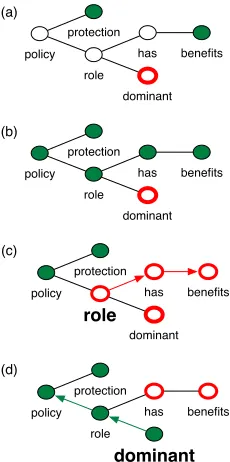
In this sentence, the target word “policy” is con-nected to multiple sentiment-bearing words via paths in the dependency parse (Figure 1). We can represent these relationships using paths through the graph as in Figure 2(a). (For clarity, we do not show some paths.)
Suppose that an annotator decides that “protec-tion” and “benefits” are directly expressing an opin-ion about the policy, but “dominant” is ambiguous (it has some negative connotations). The nodes “protec-tion” and “benefits” are aflow, and the “dominant”
policy protection
role
has benefits
dominant
policy protection
role
has benefits
dominant
policy protection
role
has benefits
dominant
policy protection
role
has benefits
dominant
(a)
(b)
(c)
(d)
Figure 2: Labeled SRTs rooted on the target word “policy”; green-filled nodes represent words that are part of a sentiment flow and nodes with a red outline represent inert nodes. (a) Initial labels for SRT (e.g. as provided by annotators) (b) propagating labels to yield a valid sentiment flow (c) a change of “role” to inert also renders its children inert (d) a change of “dominant” to be part of a sentiment flow also causes
its parents to be part of a flow.
node isinert. However, there is considerable overlap between the “dominant” path and the “benefits” path. That is the motivation for combining them into a trie structure and labeling them in such a way that the path remains aflowuntil there isnopath element that leads to aflowleaf (Figure 2).
In other words, we want the path elements com-mon to a flow path and an inert path to reinforce sentiment flow. The transition fromflowtoinertis learned by the classifier.
We enforce this requirement through the procedure shown in Figure 2, which is equivalent to finding the depth first search tree of the dependency graph and applying the node-labeling scheme as above.
3.3 Invariant
[image:4.612.369.484.71.302.2]Consequently, any node that is part of a sentiment
flowthat follows aninertnode is not reachable along a path and is actually inertitself. We specify this directly as an invariant on the data structure:
Invariant: no node descending from a node labeledinertcan be labeled as a part of a sentimentflow.
This specifies that flowlabels spread out from the root of the SRT. Our inference algorithm requires that we be able to change the labels of nodes for test data, thus we need to define invariant-respecting operations for switching labels fromflowtoflowand vice-versa. Aflowlabel switched toinertwill require all the descendents of that particular node to switch toinertas well as in figure 2(c). Similarly, aninert
label switched toflowwill require all of the ancestors of that node to switch toflowas in 2(d).
4 Encoding SRTs as a factor graph
In this section, we develop supervised machine learn-ing tools to produce a labeled SRT from unlabeled, held-out data in a single, unified model, without per-mitting the sorts of inconsistencies that may be ad-mitted by using a local classifier at each node.
4.1 Sampling labels
A factor graph (Kschischang et al., 1998) is a rep-resentation of a joint probability distribution in the form of a graph with two types of vertices: able vertices and factor vertices. Given a set of vari-ablesZ ={z1. . . zn}, we connect them via factors
F = {f1. . . fm}. Factors are functions that
repre-sent relationships, i.e. probabilistic dependencies, among the variables; the product of all factors gives the complete joint distributionp. Each factorfican
take as input some corresponding subset of variables
Yi from Z. We can then write the relationship as
follows:
p(Z)∝ Qm
k=1fk(Yk)
Our goal is to discover the values for the variables that best explain a dataset. While there are many approaches for inference in statistical models, we turn to MCMC methods (Neal, 1993) to discover the underlying structure of the model. More specifically, we seek a posterior distribution over latent variables
parent
node
child1 child2 child3 h
[image:5.612.373.483.60.164.2]g f
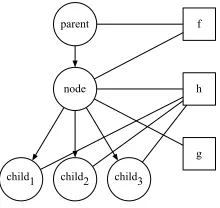
Figure 3: Graphical model of SRT factors
that partition words in a sentence intoflowand in-ertgroups; we estimate this posterior using Gibbs sampling (Finkel et al., 2005).
The sampler requires an initial state that respects the invariant. Our initial setting is produced by iterat-ing through all labels in the SRT forest and randomly setting them as either flow or inert with uniform probability.
A Gibbs sampler samples new variable assign-ments from the conditional distribution, treating the variable assignments for all other variables fixed. However, the assignment of a single node is highly coupled with its neighbors, so a block sampler is used to propose changes to groups nodes that respect the flow labeling of the overall assignments. This was implemented by changing the proposal distribution used by the FACTORIE framework (McCallum et al., 2009).
We can thus represent a node and its contribution to the overall score using the graph in Figure 3. This graph contains the given node, its parent, and a vari-able number of children. The factors that go into the labeling decision for each node are thus constrained to a small, computationally tractable space around the given node. This graph contains three factors:
• grepresents a function over features of the given node itself, or “node features.”
• frepresents a function over a bigram of features taken from the parent node and the given node, or “parent-node” features.
• hrepresents a function over a combination fea-tures on the node and feafea-tures ofallits children, or “node-child” features.
In addition to the latent value associated with each word, we associate each node with features derived from the dependency parse: the word from the sen-tence itself, the part-of-speech (POS) tag assigned by the Stanford parser, and the label of the incoming dependency edge. We treat the edge labels from the original dependency parse as a feature of the node.
We can represent the set of possible observed lin-guistic feature classes as the set of featuresΦ. Fig-ure 3 induces a scoring function with contributions of each node to the score(label|node) =
Y
φ∈Φ
f(parentφ,nodeφ|label)g(nodeφ|label)
h(nodeφ,child1φ, . . . ,childnφ|label)
.
After assignments for the latent variables are sampled, the weights for the factors (which when combined create individual factorsf that define the joint) must be learned. This is accomplished via thesample-rank
algorithm (Wick et al., 2009).
5 Data source
Our goal is to identify opinion-bearing words and tar-gets using supervised machine learning techniques. Sentiment corpora with sub-sentential annotations, such as the Multi-Perspective Question-Answering (MPQA) corpus (Wilson and Wiebe, 2005) and the J. D. Power and Associates (JDPA) blog post cor-pus (Kessler et al., 2010), exist, but most of these annotations are at a phrase level. Within a phrase, however, some words may contribute more than oth-ers to the statement of an opinion. We developed our own annotations to discover such distinctions3. We describe these briefly here; more information about the development of the data source can be found in Sayeed et al. (2011).
5.1 Information technology business press
Our work is part of a larger collaboration with so-cial scientists to study the diffusion of information technology (IT) innovations through society by iden-tifying opinion leaders and IT-relevant opinionated language Rogers (2003). Thus, we focus on a col-lection of articles from the IT professional maga-zine,Information Week, from the years 1991 to 2008.
3To download the corpus, visit http://www.umiacs.
umd.edu/˜asayeed/naacl12data/.
This consists of 33K articles including news bulletins and opinion columns. Our IT concept target list (59 terms) comes from our application. Thus, we con-struct a trie for each appearance of any of these possi-ble target terms. We consider this list of target terms to be complete, which allows us to focus on discover-ing opinion-beardiscover-ing text associated with these targets.
5.2 Crowdsourced annotation process
Our process for obtaining gold standard data involves multiple levels of human annotation including on crowdsourcing platforms Hsueh et al. (2009).
There are 75K sentences with IT concept mentions, only a minority of which express relevant opinions. Hired undergraduate students searched a random se-lection of these sentences and found 219 that contain these opinions. We used cosine-similarity to rank the remaining sentences against the 219.
We then needed to identify which of the words contained an opinion. We excluded all words that were common function words (e.g.,“the”, “in”) but left negations. We engineered tasks so that only a randomly-selected five or six words appear high-lighted for classification in order to limit annotator boredom. We called this group a “highlight group”. The virtualization example would look like this:
Lloyd Hession, chiefsecurityofficer at BT Radianz in New York, said that virtual-izationalsoopensup a slew of potential
network accesscontrolissues.
In the virtualization example, the worker would see thatvirtualizationis highlighted as the IT concept target. Other words are highlighted as candidates that the worker must classify as being opinion-relevant to “virtualization”. Each highlight group corresponds to
a syntactic relatedness trie (Section 3).
Three or more users annotated each highlight group, and an aggregation scheme was applied af-terwards: “ambiguous” answers were rolled into “not opinion-relevant” and ties were dropped. Our qual-ity control process involved filtering out workers who performed poorly on a small subset of gold-standard answers We annotated 30 evaluation units to determine that our process retrieved opinion-relevant words at 85% precision and 74% recall.
Annotators labeled 700 highlight groups for the results in this paper. The total cost of this exercise was approximately 250 USD, which includes the fees charged by Amazon and CrowdFlower. These last highlight groups were converted to SRTs and divided into training and testing groups, 465 and 196 SRTs respectively, with a small number lost to fatal errors in the Stanford parser.
6 Experiments and discussion
During the training phase, we evaluate the quality of a candidate labeling based on label accuracy. We need to identify bothflownodes andinertnodes in order to distinguish between relevant and irrelevant subcomponents. We thus also employ precision and recall as performance metrics.
An example of how this works can be seen by com-paring figure 2(b) to figure 2(d), viewing the former as the gold standard and the latter as a hypothetical system output. If we run the evaluation over that single SRT and treatflow as the positive class, we find that 3 true positives, 1 false positive, 2 false neg-atives, and no true negatives. There are 6 labels in total. That yields 0.50 accuracy, 0.75 precision, 0.60 recall, and 0.67 F-measure.
We run every experiment (training a model and testing on held-out data) 10 times and take the mean average and range of all measures. F-measure is calculated for each run and averagedpost hoc.
6.1 Experiments
Our baseline system is the initial setting of the labels for the sampler: uniform random assignment of flow labels, respecting the invariant. This leads to a large class imbalance in favor ofinert as any switch to
inertconverts all nodes downstream from the root to convert toinert, while a switch toflowcauses only one ancestor branch to convert toflow.
Our next systems involve combinations of our SRT factors with the observed linguistic features. All our experiments include the factorgthat pertains only to the features of the node. Then we add factorf—the parent-node “bigram” features—and finally factorh, the variable-length node-child features. We also ex-periment with including and excluding combinations of POS, role, and word features. We also explored models that only made local decisions, ignoring the consistency constraints over sentiment flows. Al-though such models cannot be used in techniques such as Nakagawa et al.’s polarity classifier, they function as a baseline and inform whether syntactic constraints help performance.
We ran the inferencer for 200 iterations to train a model with a particular factor-feature combination. We use the learned model to predict the labels on the held-out testing data by running the inference algorithm (sampling labels only) for 50 iterations.
6.2 Discussion
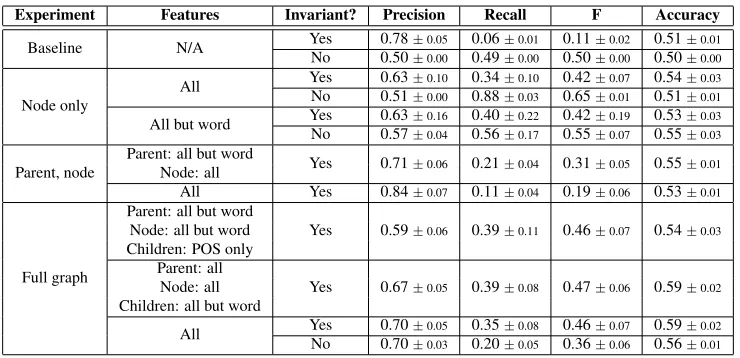
We present a sampling of possible feature-factor com-binations in table 1 in order to show trends in the performance of the system.
Unsurprisingly, the invariant-respecting baseline had very high precision but low recall. Simply includ-ing the node-onlygfactor with all features increases the recall while hurting precision. On removing word features, recall increases without changing precision. This suggests that some words in some SRTs are as-sociated withflowlabels in the training data, but not as much in the testing data.
Including parent-nodef features with theg fea-tures yields higher precision and lower recall, sug-gesting that parent-node word features support preci-sion. Including all features on all factors (f,g, andh) preserves most of the precision but improves recall. Excludinghfeatures increases recall slightly more than it hurts precision. Excluding both word features for all factors and rolehfeatures hurts all measures. The accuracy measure, however, does show over-all improvement with the inclusion of more feature-factor combinations. In particular, the node-childh
Experiment Features Invariant? Precision Recall F Accuracy
Baseline N/A Yes 0.78±0.05 0.06±0.01 0.11±0.02 0.51±0.01 No 0.50±0.00 0.49±0.00 0.50±0.00 0.50±0.00
Node only
All Yes 0.63±0.10 0.34±0.10 0.42±0.07 0.54±0.03 No 0.51±0.00 0.88±0.03 0.65±0.01 0.51±0.01
All but word Yes 0.63±0.16 0.40±0.22 0.42±0.19 0.53±0.03 No 0.57±0.04 0.56±0.17 0.55±0.07 0.55±0.03
Parent, node
Parent: all but word
Yes 0.71±0.06 0.21±0.04 0.31±0.05 0.55±0.01
Node: all
All Yes 0.84±0.07 0.11±0.04 0.19±0.06 0.53±0.01
Full graph
Parent: all but word
Yes 0.59±0.06 0.39±0.11 0.46±0.07 0.54±0.03
Node: all but word Children: POS only
Parent: all
Yes 0.67±0.05 0.39±0.08 0.47±0.06 0.59±0.02
Node: all Children: all but word
[image:8.612.122.492.55.234.2]All Yes 0.70±0.05 0.35±0.08 0.46±0.07 0.59±0.02 No 0.70±0.03 0.20±0.05 0.36±0.06 0.56±0.01
Table 1: Performance using different feature combinations, including some without enforcing the invariant. Mean averages and standard deviation for 10 runs.
almost all of the features.
Our non-invariant-respecting baseline unsurpris-ingly was nearly 50% on all measures. Including the node-only features dramatically increases recall, less if we exclude word features. The word features ap-pear to have an effect on recall just as in the invariant-respecting case with node-only features. With all features, precision is dramatically improved, but with a large cost to recall. However, it underperforms the equivalent invariant-respecting model in recall, F-measure, and accuracy.
Though these invariant-violating models are un-constrained in the way they label the graph, our invariant-respecting models still outperform them. A coherent path contains more information than an incoherent one; it is important to find negating and intensifying elementsin context. Our SRT invariant allows us to achieve better performance and will be more useful to downstream tasks.
Finally, it appears that using more factors and lin-guistic features promotes stability in performance and decreases sensitivity to the initial setting.
6.3 Manual inspection
One pattern that prominently stood out in the testing data with the full-graph model was the misclassifica-tion offlowlabels asinertin the vicinity of Stanford dependency labels such asconj and. These kinds of labels have high “fertility”; the labels immediately following them in the SRT could be a variety of types, creating potential data sparsity issues.
This problem could be resolved by making some features transparent to the learner. For example, if nodeqhas an incomingconj anddependency edge label, thenq’s parent could also be directly connected toq’s children, as a conjunction should be linguisti-cally transparent to the status of the children in the sentiment flow.
There are many fewer incidents ofinertlabels be-ing classified asflow. There are paths through an SRT where aflowcandidate word is the ancestor of aninertcandidate word from the set of crowdsourced candidates. The model sometimes appears to “over-shoot” theflowcandidate. Considering that recall is already fairly low, attempts to address this problem risks making the model too conservative. One poten-tial solution is to prune or separate paths that contain multiple flow candidates.
6.3.1 Paths found
We examined the labeling on the held-out testing data of the best-performing model of the full graph system with all linguistic features. For example, con-sider the following highlight group:
But Microsoft’s informal approach maynot be enough as thenumber ofblogsat the company grows, especially since thelinebetween “personal” Weblogs and those done aspartof the job can be hard todistinguish.
that something that was difficult to distinguish was a problem: the modifier “hard” is what makes it negative. The system found an entirelyflowpath that connected these attributes into a single unit:
Blog:flow prepof
−−−−→ number:flow −−−→nsubj
grows:flow −−−−→ccomp hard:flow −−−−→xcomp
distinguish:flow
In this path, “blog” and “distinguish” are both con-nected to one another by “hard”, giving “distinguish” its negative spin. There are two non-local dependen-cies in this example: xcomp, ccomp. Very often, more than one unique path connects the concept to the opinion candidate word.
7 Conclusions and future work
In this work, we have applied machine learning to produce a robust modeling of syntactic structure for an information extraction application. A solution to the problem of modeling these structures requires the development of new techniques that model complex linguistic relationships in an application-dependent way. We have shown that we can mine these relation-ships without being overcome by the data-sparsity issues that typically stymie learning over complex linguistic structure.
The limitations on these techniques ultimately find their root in the difficulty in modeling complex syn-tactic structures that simultaneously exclude irrel-evant portions of the structure while maintaining connected relations. Our technique uses a structure-labelling scheme that enforces connectedness. En-forcing connected structure is not only necessary to produce useful results but also to improve accuracy. Further performance gains might be possible by en-riching the feature set. For example, the POS tagset used by the Stanford parser contains multiple verb tags that represent different English tenses and num-bers. For the purpose of sentiment relations, it is possible that the differences between verb tags are too small to matter and are causing data sparsity is-sues. Thus, we could additional features that “back off” to general verb tags.
Acknowledgements
This paper is based upon work supported by the US National Science Foundation under Grant IIS-0729459. Additional support came from the Cluster
of Excellence “Multimodal Computing and Innova-tion”, Germany. Jordan Boyd-Graber is also sup-ported by US National Science Foundation Grant NSF grant #1018625 and the Army Research Labora-tory through ARL Cooperative Agreement W911NF-09-2-0072. Any opinions, findings, conclusions, or recommendations expressed are the authors’ and do not necessarily reflect those of the sponsors.
References
Alm, C. O. (2011). Subjective natural language prob-lems: Motivations, applications, characterizations, and implications. InACL (Short Papers).
Bollen, J., Mao, H., and Zeng, X.-J. (2010). Twit-ter mood predicts the stock market. CoRR, abs/1010.3003.
Choi, Y., Breck, E., and Cardie, C. (2006). Joint ex-traction of entities and relations for opinion recog-nition. InProceedings of the Conference on Em-pirical Methods in Natural Language Processing
(EMNLP).
de Marneffe, M.-C. and Manning, C. D. (2008). The stanford typed dependencies representation. In
CrossParser ’08: Coling 2008: Proceedings of the workshop on Framework and
Cross-Domain Parser Evaluation, Morristown, NJ, USA.
Association for Computational Linguistics.
Finkel, J. R., Grenager, T., and Manning, C. (2005). Incorporating non-local information into informa-tion extracinforma-tion systems by gibbs sampling. In
Proceedings of the 43rd Annual Meeting on
Asso-ciation for Computational Linguistics, ACL ’05,
pages 363–370, Stroudsburg, PA, USA. Associa-tion for ComputaAssocia-tional Linguistics.
Hsueh, P.-Y., Melville, P., and Sindhwani, V. (2009). Data quality from crowdsourcing: a study of anno-tation selection criteria. In Proceedings of the NAACL HLT 2009 Workshop on Active
Learn-ing for Natural Language ProcessLearn-ing, HLT ’09,
Stroudsburg, PA, USA. Association for Computa-tional Linguistics.
Jakob, N. and Gurevych, I. (2010). Extracting opin-ion targets in a single and cross-domain setting with conditional random fields. InEMNLP.
corpus for the automotive domain. In 4th Int’l AAAI Conference on Weblogs and Social Media
Data Workshop Challenge (ICWSM-DWC 2010).
Kim, S.-M. and Hovy, E. (2006). Extracting opinions, opinion holders, and topics expressed in online news media text. InSST ’06: Proceedings of the
Workshop on Sentiment and Subjectivity in Text,
pages 1–8, Morristown, NJ, USA. Association for Computational Linguistics.
Kschischang, F. R., Frey, B. J., and andrea Loeliger, H. (1998). Factor graphs and the sum-product algo-rithm. IEEE Transactions on Information Theory, 47:498–519.
K¨ubler, S., McDonald, R., and Nivre, J. (2009). De-pendency parsing. Synthesis Lectures on Human
Language Technologies, 2(1).
McCallum, A., Schultz, K., and Singh, S. (2009). Factorie: Probabilistic programming via impera-tively defined factor graphs. InNeural Information
Processing Systems (NIPS).
Moilanen, K. and Pulman, S. (2007). Sentiment com-position. InProceedings of the Recent Advances in Natural Language Processing International
Con-ference (RANLP-2007), Borovets, Bulgaria.
Nakagawa, T., Inui, K., and Kurohashi, S. (2010). De-pendency tree-based sentiment classification using crfs with hidden variables. InHLT-NAACL.
Neal, R. M. (1993). Probabilistic inference using Markov chain Monte Carlo methods. Technical Report CRG-TR-93-1, University of Toronto.
Pang, B. and Lee, L. (2008). Opinion mining and sentiment analysis. Found. Trends Inf. Retr., 2(1-2).
Qiu, G., Liu, B., Bu, J., and Chen, C. (2011). Opin-ion word expansOpin-ion and target extractOpin-ion through double propagation. Computational linguistics, 37(1):9—27.
Rogers, E. M. (2003). Diffusion of Innovations, 5th Edition. Free Press.
Ruppenhofer, J., Somasundaran, S., and Wiebe, J. (2008). Finding the sources and targets of sub-jective expressions. In Calzolari, N., Choukri, K., Maegaard, B., Mariani, J., Odjik, J., Piperidis, S., and Tapias, D., editors,Proceedings of the Sixth International Language Resources and Evaluation
(LREC’08), Marrakech, Morocco. European
Lan-guage Resources Association (ELRA).
Sayeed, A. B., Nguyen, H. C., Meyer, T. J., and Weinberg, A. (2010). Expresses-an-opinion-about: using corpus statistics in an information extraction approach to opinion mining. InProceedings of the 23rd International Conference on Computational
Linguistics, COLING ’10.
Sayeed, A. B., Rusk, B., Petrov, M., Nguyen, H. C., Meyer, T. J., and Weinberg, A. (2011). Crowd-sourcing syntactic relatedness judgements for opin-ion mining in the study of informatopin-ion technology adoption. In Proceedings of the Association for Computational Linguistics 2011 workshop on Lan-guage Technology for Cultural Heritage, Social
Sciences, and the Humanities (LaTeCH).
Associa-tion for ComputaAssocia-tional Linguistics.
Stoyanov, V. and Cardie, C. (2006). Partially su-pervised coreference resolution for opinion sum-marization through structured rule learning. In
EMNLP ’06: Proceedings of the 2006 Conference on Empirical Methods in Natural Language
Pro-cessing, pages 336–344, Morristown, NJ, USA.
Association for Computational Linguistics.
Tsui, C.-J., Wang, P., Fleischmann, K., Oard, D., and Sayeed, A. (2009). Understanding IT innova-tions by computational analysis of discourse. In
International conference on information systems.
Wick, M., Rohanimanesh, K., Culotta, A., and Mccal-lum, A. (2009). SampleRank: Learning preference from atomic gradients. InNIPS WS on Advances in Ranking.
Wilson, T. and Wiebe, J. (2005). Annotating attribu-tions and private states. InCorpusAnno ’05: Pro-ceedings of the Workshop on Frontiers in Corpus
Annotations II, Morristown, NJ, USA. Association
for Computational Linguistics.