Automatic Parallel Fragment Extraction from Noisy Data
Jason Riesa and Daniel Marcu Information Sciences Institute Viterbi School of Engineering University of Southern California
{riesa, marcu}@isi.edu
Abstract
We present a novel method to detect parallel fragments within noisy parallel corpora. Isolat-ing these parallel fragments from the noisy data in which they are contained frees us from noisy alignments and stray links that can severely constrain translation-rule extraction. We do this with existing machinery, making use of an existing word alignment model for this task. We evaluate the quality and utility of the ex-tracted data on large-scale Chinese-English and Arabic-English translation tasks and show sig-nificant improvements over a state-of-the-art baseline.
1 Introduction
A decade ago, Banko and Brill (2001) showed that scaling to very large corpora is game-changing for a variety of tasks. Methods that work well in a small-data setting often lose their luster when moving to large data. Conversely, other methods that seem to perform poorly in that same small-data setting, may perform markedly differently when trained on large data.
Perhaps most importantly, Banko and Brill showed that there was no significant variation in per-formance among a variety of methods trained at-scale with large training data. The takeaway? If you desire to scale to large datasets, use a simple solution for your task, and throw in as much data as possible. The community at large has taken this message to heart, and in most cases it has been an effective way to increase performance.
[image:1.612.347.508.219.353.2]Today, for machine translation, more data than what we already have is getting harder and harder to come by; we require large parallel corpora to
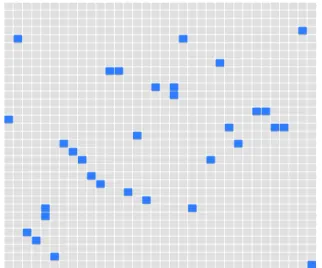
Figure 1: Example of a word alignment resulting from noisy parallel data. The structure of the resulting align-ment makes it difficult to find and extract parallel frag-ments via the standard heuristics or simply by inspection. How can we discover automatically those parallel frag-ments hidden within such data?
train state-of-the-art statistical, data-driven models. Groups that depend on clearinghouses like LDC for their data increasingly find that there is less of a man-date to gather parallel corpora on the scale of what was produced in the last 5-10 years. Others, who di-rectly exploit the entire web to gather such data will necessarily run up against a wall after all that data has been collected.
We need to learn how to do more with the data we already have. Previous work has focused on detecting parallel documents and sentences on the web, e.g. (Zhao and Vogel, 2002; Fung and Che-ung, 2004; Wu and FChe-ung, 2005). Munteanu and Marcu (2006), and later Quirk et al. (2007), extend the state-of-the-art for this task to parallel fragments. In this paper, we present a novel method for de-tecting parallel fragments in large, existing and po-tentially noisy parallel corpora using existing
chinery and show significant improvements to two state-of-the-art MT systems. We also depart from previous work in that we only consider parallel cor-pora that have previously been cleaned, sanitized, and thought to be non-noisy, e.g. parallel corpora available from LDC.
2 Detecting Noisy Data
In order to extract previously unextractable good parallel data, we must first detect the bad data. In doing so, we will make use of existing machinery in a novel way. We directly use the alignment model to detect weak or undesirable data for translation.
2.1 Alignment Model as Noisy Data Detector
The alignment model we use in our experiments is that described in (Riesa et al., 2011), modified to output full derivation trees and model scores along with alignments. Our reasons for using this particu-lar alignment method are twofold: it provides a natu-ral way to hierarchically partition subsentential seg-ments, and is also empirically quite accurate in mod-eling word alignments, in general. This latter quality is important, not solely for downstream translation quality, but also for the basis of our claims with re-spect to detecting noisy or unsuitable data:
The alignment model we employ is discrimina-tively trained to know what good alignments be-tween parallel data look like. When this model pre-dicts an alignment with a low model score, given an input sentence pair, we might say the model is “con-fused.” In this case, the alignment probably doesn’t look like the examples it has been trained on.
1. It could be that the data is parallel, but the model is very confused. (modeling problem)
2. It could be that the data is noisy, and the model is very confused. (data problem)
The general accuracy of the alignment model we employ makes the former case unlikely. Therefore, a key assumption we make is to assume a low model score accompanies noisy data, and use this data as candidates from which to extract non-noisy parallel segments.
2.2 A Brief Example
As an illustrative example, consider the follow-ing sentence pair in our trainfollow-ing corpus taken from LDC2005T10. This is the sentence pair shown in Figure 1:
fate brought us together on that wonderful summer day and one year later , shou – tao and i were married not only in the united states but also in taiwan .
他 来自 于 台湾 , 我 则 是 土生土长 于 纽泽西 州 的 美国人 ; 而 就 在 那 奇妙 的 夏 日 里 , 我 俩 被 命运 兜 在 一起 .
In this sentence pair there are only two parallel phrases, corresponding to the underlined and double-underlined strings. There are a few scattered word pairs which may have a natural correspondence,1but no other larger phrases.2
In this work we are concerned with finding large phrases,3 since very small phrases tend to be ex-tractible even when data is noisy. Bad alignments tend to cause conflicts when extracting large phrases due to unexpected, stray links in the alignment ma-trix; smaller fragments will have less opportunity to come into conflict with incorrect, stray links due to noisy data or alignment model error. We consider large enough phrases for our purposes to be phrases of size greater than 3, and ignore smaller fragments.
2.3 Parallel Fragment Extraction
2.3.1 A Hierarchical Alignment Model and its Derivation Trees
The alignment model we use, (Riesa et al., 2011), is a discriminatively trained model which at alignment-time walks up the English parse-tree and, at every node in the tree, generates alignments by re-cursively scoring and combining alignments gener-ated at the current node’s children, building up larger and larger alignments. This process works similarly to a CKY parser, moving bottom-up and generating larger and larger constituents until it has predicted the full tree spanning the entire sentence.
How-1For example, (I,我) and (Taiwan,台湾)
2The rest of the Chinese describes where the couple is from;
the speaker, she says, is an American raised in New Jersey.
3We count the size of the phrase according to the number of
奇 幻 又
的 真实
a IN
fant astic
yet realis tic JJ CC JJ ADJP
NP
NN
advent ure
[image:3.612.120.244.62.197.2]惊险
[14.2034] PP [9.5130] NP [-0.5130]
with multi-sensory experiences
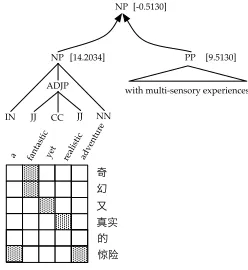
Figure 2: From LDC2004T08, when the NP fragment shown here is combined to make a larger span with a sis-ter PP fragment, the alignment model objects due to non-parallel data under the PP, voicing a score of -0.5130. We extract and append to our training corpus the NP fragment depicted, from which we later learn 5 additional transla-tion rules.
ever, instead of generating syntactic structures, we are generating alignments.
In moving bottom-up along the tree, just as there is a derivation tree for a CKY parse, we can also fol-low backpointers to extract the derivation tree of the 1-best alignment starting from the root node. This derivation tree gives a hierarchical partitioning of the alignment and the associated word-spans. We can also inspect model scores at each node in the deriva-tion tree.
2.3.2 Using the Alignment Model to Detect Parallel Fragments
For each training example in our parallel cor-pus, we have an alignment derivation tree. Be-cause the derivation tree is essentially isomorphic to the English parse tree, the derivation tree repre-sents a hierarchical partitioning of the training ex-ample into syntactic segments. We traverse the tree top-down, inspecting the parallel fragments implied by the derivation at each point, and their associated model scores.
The idea behind this top-down traversal is that al-though some nodes, and perhaps entire derivations, may be low-scoring, there are often high-scoring fragments that make up the larger derivation which are worthy of extraction. Figure 2 shows an ex-ample. We recursively traverse the derivation, top-down, extracting the largest fragment possible at
any derivation node whose alignment model score is higher than some thresholdτ, and whose associated English and foreign spans meet a set of important constraints:
1. The parent node in the derivation has a score less thanτ.
2. The length of the English span is > 3.
3. There are no unaligned foreign words inside the fragment that are also aligned to English words outside the fragment.
Once a fragment has been extracted, we do not re-curse any further down the subtree.
Constraint 1 is acandidate constraint, and forces us to focus on segments of parallel sentences with low model scores; these are segments likely to con-sist of bad alignments due to noisy data or aligner error.
Constraint 2 is a conservativity constraint – we are more confident in model scores over larger frag-ments with more context than smaller ones with min-imal context. This constraint also parameterizes the notion that larger fragments are the type more often precluded from extraction due to stray or incorrect word-alignment links; additionally, we are already likely to be able to extract smaller fragments using standard methods, and as such, they are less useful to us here.
Constraint 3 is a content constraint, limiting us from extracting fragments with blocks of unaligned foreign words that don’t belong in this particular fragment because they are aligned elsewhere. If we threw out this constraint, then in translating from Chinese to English, we would erroneously learn to delete blocks of Chinese words that otherwise should be translated. When foreign words are unaligned ev-erywhere within a parallel sentence, then they can be included within the extracted fragment. Common examples in Chinese are function words such as的, 个, and了. Put another way, we only allow globally unaligned words in extracted fragments.
as-sumption that this is the bottom 10% of the data.4
3 Evaluation
We evaluate our parallel fragment extraction in a large-scale Chinese-English and Arabic-English MT setting. In our experiments we use a tree-to-string syntax-based MT system (Galley et al., 2004), and evaluate on a standard test set, NIST08. We parse the English side of our parallel corpus with the Berkeley parser (Petrov et al., 2006), and tune parameters of the MT system with MIRA (Chiang et al., 2008). We decode with an integrated language model trained on about 4 billion words of English.
Chinese-English We align a parallel corpus of 8.4M parallel segments, with 210M words of En-glish and 193M words of Chinese. From this we extract 868,870 parallel fragments according to the process described in Section 2, and append these fragments to the end of the parallel corpus. In doing so, we have created a larger parallel corpus of 9.2M parallel segments, consisting of 217M and 198M words of English and Chinese, respectively.
Arabic-English We align a parallel corpus of 9.0M parallel segments, with 223M words of En-glish and 194M words of Arabic. From this we ex-tract 996,538 parallel fragments, and append these fragments to the end of the parallel corpus. The re-sulting corpus has 10M parallel segments, consisting of 233M and 202M words of English and Arabic, re-spectively.
Results are shown in Table 1. Using our parallel fragment extraction, we learn 68M additional unique Arabic-English rules that are not in the baseline sys-tem; likewise, we learn 38M new unique Chinese-English rules not in the baseline system for that lan-guage pair. Note that we are not simply duplicat-ing portions of the parallel data. While each se-quence fragment of source and target words we ex-tract will be found elsewhere in the larger parallel corpus, these fragments will largely not make it into fruitful translation rules to be used in the downstream MT system.
We see gains in BLEU score across two differ-ent language pairs, showing empirically that we are
4One may wish to experiment with different ranges here, but
each requires a separate time-consuming downstream MT ex-periment. In this work, it turns out that scrutinizing 10% of the data is productive and empirically reasonable.
Corpus Extracted Rules BLEU
Baseline (Ara-Eng) 750M 50.0 +Extracted fragments 818M 50.4
Baseline (Chi-Eng) 270M 31.5 +Extracted fragments 308M 32.0
Table 1: End-to-end translation experiments with and without extracted fragments. We are learning many more unique rules; BLEU score gains are significant withp<
0.05 for Arabic-English and p < 0.01 for Chinese-English.
learning new and useful translation rules we previ-ously were not in our grammars. These results are significant with p < 0.05 for Arabic-English and p<0.01for Chinese-English.
4 Discussion
All alignment models we have experimented with will fall down in the presence of noisy data. Impor-tantly, even if the alignment model were able to yield “perfect” alignments with no alignment links among noisy sections of the parallel data precluding us from extracting reasonable rules or phrase pairs, we would still have to deal with downstream rule extraction heuristics and their tendency to blow up a translation grammar in the presence of large swaths of unaligned words. Absent a mechanism within the alignment model itself to deal with this problem, we provide a simple way to recover from noisy data without the introduction of new tools.
Summing up, parallel data in the world is not unlimited. We cannot always continue to double our data for increased performance. Parallel data creation is expensive, and automatic discovery is resource-intensive (Uszkoreit et al., 2010). We have presented a technique that helps to squeeze more out of an already large, state-of-the-art MT system, us-ing existus-ing pieces of the pipeline to do so in a novel way.
Acknowledgements
References
Michele Banko and Eric Brill. 2001. Scaling to very very large corpora for natural language disambiguation. In Proc. of the ACL, pages 26–33.
David Chiang, Yuval Marton, and Philip Resnik. 2008. Online large-margin training of syntactic and struc-tural translation features. InProc. of EMNLP, pages 224–233.
Pascale Fung and Percy Cheung. 2004. Mining very non-parallel corpora: Parallel sentence and lexicon extrac-tion via boostrapping and EM. InProc. of EMNLP, pages 57–63.
Michel Galley, Mark Hopkins, Kevin Knight, and Daniel Marcu. 2004. What’s in a translation rule? InProc. of HLT-NAACL, pages 273–280.
Dragos Stefan Munteanu and Daniel Marcu. 2006. Ex-tracting parallel sub-sentential fragments from non-parallel corpora. InProc. of COLING/ACL, Sydney, Australia.
Slav Petrov, Leon Barrett, Romain Thibaux, and Dan Klein. 2006. Learning accurate, compact, and inter-pretable tree annotation. InProc. of COLING-ACL. Chris Quirk, Raghavendra Udupa, and Arul Menezes.
2007. Generative models of noisy translations with ap-plications to parallel fragment extraction. In Proceed-ings of MT Summit XI.
Jason Riesa, Ann Irvine, and Daniel Marcu. 2011. Feature-rich language-independent syntax-based alignment for statistical machine translation. InProc. of EMNLP, pages 497–507.
Jakob Uszkoreit, Jay Ponte, Ashok Popat, and Moshe Du-biner. 2010. Large scale parallel document mining for machine translation. InProc. of COLING, pages 1101–1109.
Dekai Wu and Pascale Fung. 2005. Inversion transduc-tion grammar constraints for mining parallel sentences from quasi-comparable corpora. InProc. of IJCNLP, pages 257–268.