Subword Variation in Text Message Classification
Robert Munro
Department of Linguistics Stanford University Stanford, CA 94305
Christopher D. Manning
Department of Computer Science Stanford University
Stanford, CA 94305
Abstract
For millions of people in less resourced re-gions of the world, text messages (SMS) pro-vide the only regular contact with their doc-tor. Classifying messages by medical labels supports rapid responses to emergencies, the early identification of epidemics and everyday administration, but challenges include text-brevity, rich morphology, phonological vari-ation, and limited training data. We present a novel system that addresses these, working with a clinic in rural Malawi and texts in the Chichewa language. We show that model-ing morphological and phonological variation leads to a substantial average gain of F=0.206 and an error reduction of up to 63.8% for spe-cific labels, relative to a baseline system opti-mized over word-sequences. By comparison, there is no significant gain when applying the same system to the English translations of the same texts/labels, emphasizing the need for subword modeling in many languages. Lan-guage independent morphological models per-form as accurately as language specific mod-els, indicating a broad deployment potential.
1 Introduction
The whole world is texting, but rarely in English. Africa has seen the greatest recent uptake of cell-phones, with an 8-fold increase over the last 5 years and saturation possible in another 5 (Buys et al., 2009). This is a leapfrog technology – for the ma-jority of new users cellphones are theonly form of remote communication, surpassing landlines, (non-mobile) internet access and even grid electricity,
with costs making texts the dominant communica-tion method. This has led social development orga-nizations to leverage mobile technologies to support health (Leach-Lemens, 2009), banking (Peevers et al., 2008), access to market information (Jagun et al., 2008), literacy (Isbrandt, 2009) and emergency re-sponse (Munro, 2010). The possibility to automate many of these services through text-classification is huge, as are the potential benefits – those with the least resources have the most to gain.
However, the data presents many challenges, as text messages are brief, most languages have rich morphology, spellings may be overly-phonetic, and there is often limited training data. We partnered with a medical clinic in rural Malawi and Front-lineSMS:Medic, whose text message management systems serve a patient population of over 2 million in less developed regions of the world. The system allows remote community health workers (CHWs) to communicate directly with more qualified medi-cal staff at centralized clinics, many for the first time.
We present a short-message classification sys-tem that incorporates morphological and phono-logical/orthographic variation, with substantial im-provements over a system optimized on word-sequences alone. The average gain is F=0.206 with an error reduction of up to 63.8% for specific labels. For 6 of the 9 labels this more thandoublesthe accu-racy. By comparison, there isnota significant gain in accuracy when applying the same system to the English translations of the same texts/labels, empha-sizing the need for modeling subword structures, but also highlighting why morphology has been periph-eral in text classification until now.
2 Language and data
Chichewa is a Bantu language with about 13 mil-lion speakers in Southern Africa including 65% of Malawians. We limit examples to the nouns:
odwala‘patient’,mankhwala‘medicine’; verb: fun
‘want’; and the 1st person pronoun/marker:
ndi-‘I’. Chichewa is closely related to many neighbor-ing languages – more than 100 million people could recognizendifunaas ‘I want’.
The morphological complexity is average with about 2-3 morpheme boundaries per word, but this is rich and complex compared to estimates for English, Spanish and Chinese with average of 0.33, 0.85 and 0.01 morpheme boundaries per word. A typical verb is ndimakafunabe, ‘I am still wanting’, consisting of six morphemes,ndi-ma-ka-fun-a-be, expressing: 1st person Subject; present tense; noun-class (gen-der) agreement with the Object; ‘want’; verb part-of-speech; and incompletive aspect.
2.1 Labels
The text messages are coded for 0-9 labels in 3 groupings (with counts):
Administrative: related to the clinic: 1. Patient-related (394)
2. Clinic-admin: meetings, supplies etc (169) 3. Technological: phone-credit, batteries etc (21)
Requests: from Community Health Workers: 4. Response: any action requested by CHW (124) 5. Request for doctor (62)
6. Medical advice: CHW asking for advice (23)
Illness: changes of interest to monitoring bodies: 7. TB: tuberculosis (44)
8. HIV: HIV, AIDS and/or treatments (45) 9. Death: reported death of a patient (30)
The groupings correspond to the three main stake-holders of the messages: the clinic itself, interested in classifying messages according to internal work-practices; the Community Health Workers and their patients, acting as the direct care-givers outside the clinic; and broader bodies like the World Health Or-ganization who are interested in monitoring diseases and early identification of epidemics (biosurveil-lance). The labels are the three most frequent labels required by each of these user groups.
We analyzed 4 months of texts messages with ap-proximately 1,500 labels from 600 messages,
con-sisting of 8,000 words and 30,000 morphemes. While this is small, the final system is being piloted at a clinic in rural Malawi, where users can define new labels at any time according to changing work-practices, new diseases etc. If more than 4 months of manually labeling were required it could limit the utility and user acceptance.
All the messages were translated into English by a medical practitioner, allowing us to make cross-linguistic comparisons of our system.
2.2 Variation
The variation in the data is large. There are >40 forms for ‘patient’ and only32%areodwala. Of the rest,>50% occur only once. The variation results from morphology:ndi-odwala; phonology:odwara,
ndiwodwala, and compounding: ndatindidziwewod-wala. There are also>10 spellings for the English borrowing: patient,pachentietc, and 3 for the syn-onymmatenda.
Similarly, there are >20 forms for ‘medicine’. Forfun‘want’, there are>30 forms with>80% oc-curing only once. There are>200 forms containing
ndiand no one form accounts for more than 5% of the instances.
The co-occurrence ofndiandfunwithin a word is a strong non-redundant predictor for several labels, but>75% of forms occur only once and>85% of the forms are non-contiguous, as above and in the most frequentndi-ma-funa‘I currently want’.
By contrast, in the English translations ‘needing’ occurs just once but all other forms of ‘patient’, ‘medicine’ and ‘(I) want/need’ are frequent.
This brief introduction to the language and data should make it clear that specialized methods are re-quired for modeling variation in text messages, es-pecially in many languages where text messaging is the dominant form of digital communication.
3 Morphological models
We compared language specific and language inde-pendent morphological models, comparing 3 meth-ods (withndimafunaas an example):
Stemmed:{ndi, fun}
Segmented:{ndi, ma, fun, a}
We also looked at character ngrams, as used by Hi-dalgo et al. (2006) for morphological variation in English and Spanish. The results converged with those of the segmented model, which is not surpris-ing as the most frequent features would be simi-lar and increasing data items would overcome the sparcity. We leave more sophisticated character ngram modeling for future work.
3.1 Language specific
For the language specific morphological models we implemented a morphological parser as a set of context-free grammars for all possible prefixes and suffixes according to the formal definitions of Chichewa morphology in Mchombo (2004).
We identified stems by parsing potential prefixes and suffixes, segmenting a word w into n mor-phemes wm,0, . . . , wm,n−1 leaving a stem ws with
lengthlen(ws)and corpus frequency off(ws), such
thatlen(ws) >0(ie, there must be a stem). Where
multiple parses could be applied, we minimized
len(ws), then maximizedn.
3.2 Language independent
For the language independent morphological mod-els we adapted the word-segmenter of Goldwa-ter, Griffiths and Johnson (2009), to morphological parsing (see Related Work for other algorithms we tested/considered). It was suited to our task because a) it is largely nonparametric, meaning that it can be deployed as a black-box before language-specific properties are known b) it favored recall over preci-sion (see the Results for discuspreci-sion) and c) using a segmentation algorithm, rather than explicitly mod-eling morphology, also addresses compounds.
This model uses aHierarchical Dirichlet Process
(HDP) (Teh et al., 2005). Every morpheme in the corpusmiis drawn from a distributionGwhich
con-sists of possible morphemes (the affixes and stems) and probabilities associated with each morpheme. G is generated from a Dirichlet Process (DP) distri-butionDP(α0, P0), with morphemes sampled from
P0 and their probabilities determined by a concen-tration parameter α0. The context-sensitive model whereHmis the DP for a specific morpheme is:
mi|mi−1 =m, Hm∼Hm ∀m
Hm|α1, G ∼DP(α1, G) ∀m
G|α0, P ∼DP(α0, P0)
Note that this part of our model is identical to the bigram HDP in Goldwater et al. (2009), except that we possess a set of morphemes, not words. Because word boundaries are already marked in the major-ity of the messages, we constrain the model to treat all existing word boundaries in the corpus as mor-pheme boundaries, thus constraining the model to morpheme and compound segmentation.
Unlike word-segmentation, not all tokens in the morpheme lexicon are equal, as we want to model stems separately from affixes in the stemmed mod-els. We assume a) the free morphemes (stems and through compounding) are the least frequent and therefore have the lowest final probability,P(m), in the HDP model; and b) each word wmust have at least one free morpheme, the stemws(ws6=∅).1
The token-optimal process for identifying stems is straightforward and efficient. The words are sorted by the argmin probabilities of P(wm,0), . . . , P(wm,n−1). For each word
w, unless ws can be identified by a previously
observed free morpheme, ws is identified as
argmin(P(wm,0), . . . , P(wm,n−1)) and ws is
added to our lexicon of free morphemes. This algo-rithm iterates over the words with one extra pass to mark all free morphemes in each word (assuming that there might be compounds we missed on the first pass). The cost, whereM is the total number of morphemes andW the total number of words, is
O(log(W) +M).
This process has the potential to miss free mor-phemes that only happened to occur in compounds with less-probable stems, but this did not occur in our data.
4 Phonological/Orthographic Models
We compared three models of phonologi-cal/orthographic variation:
Chichewa: Chichewa specific
Script: Roman script specific
Indep: language independent
We refer to these using the term ‘phonology’ very broadly. The majority of the variation stems from
1
the phonology, but also from phonetic variation as expressed in a given writing system, and variation in the writing system itself arising from fluent speakers with varying literacy.
4.1 Chichewa specific
For the language specific normalization, we applied a set of heuristics to the data, based on the varia-tion given in (Paas, 2005) and our own knowledge of how Bantu languages are expressed in Roman scripts. The heuristics were used to normalize all alternates, eg: {iwo→ i∅o}and{r →l}, resulting inndiwodwara→ndiodwala.
The heuristics represented forms for phonemes with the same potential place of articulation (‘c/k’), forms with an adjacent place-of-articulation that are common phonological alternates (‘l/r’, ‘e,i’), voic-ing alternations (‘s/z’), or language-internal phono-logical processes like the insertion of a glide be-tween vowels that the morphology has made adja-cent (like we pronounce but don’t spell in ‘go(w)ing’ in English).
We also implemented hard-coded acronym-recovery methods for acronyms associated with the ‘Illness’ labels: ‘HIV’, ‘TB’, ‘AIDS’, ‘ARV’.
4.2 Script specific
The script specific techniques used the same sets of alternates in the language specific model, but nor-malized such that the heuristic H was applied to a word w in the corpusC resulting in an alternate
w0, iff w0 ∈ C. This method limits the alternates to those whose existence is supported by the data. It is therefore more conservative than the previous method.
For more general acronym identification, we adapted the method of Schwartz & Hearst (2003). We created a set of candidate acronyms by iden-tifying capitalized sequences in non-capitalized contexts and period-delimited single character se-quences. All case-insensitive sequences that were segmented by consistent non-alphabetic characters were then identified as acronyms, provided that they ended in a non-alphabetic character. We could not define a similar acronym-start boundary, as pre-fixes were often added to acronyms, even when the acronyms themselves contained spaces, eg: ‘aT. B.’.
4.3 Language independent
For complete language independence we applied a noise-reduction algorithm to the stream of charac-ters in order to learn the heuristics that represented potential phonological alternates by identifying all minimal pairs of characters sequences (sequences that alternated by one character, include the absence of a character).
Given all sequences of characters, we identified all pairs of sequences of length > l that differed by one character c1, where c1 could be null. We then ranked the pairs of alternating sequences by de-scending length and applied a thresholdt, selecting thetlongest sequences, creating alternating patterns from all pairs. Regardless of l or t, the resulting heuristics did not resemble those in 4.1 or 4.2.
We did not implement any acronym identification methods, for obvious reasons.
5 Results
The results are compared to a baseline system op-timized over word sequences (words and ngrams but no subword modeling). All results presented here are from a MaxEnt model using a leave-one-out cross-validation.
For the English translations of the texts there was no phonological/orthographic variation beyond that resulting from morphology, so we only applied the language independent morphological models.
5.1 Morphology
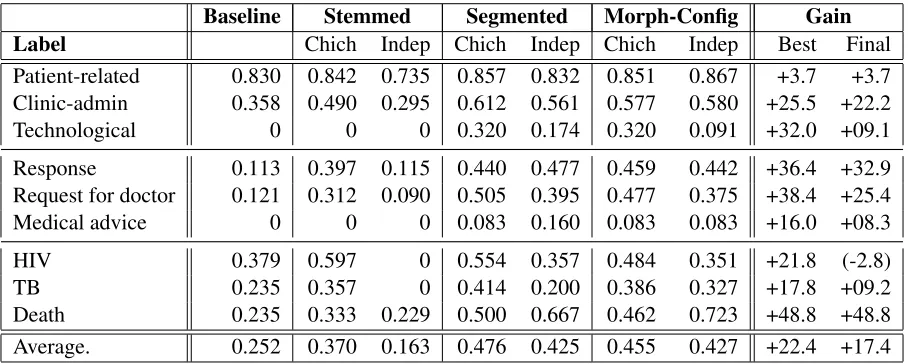
With the exception of the unsupervised stemming, all the morphological models led to substantial gains in accuracy. As Table 1 shows, the most accu-rate system used the language specific segmenta-tion, with an average accuracy of F=0.476, a macro-average gain of 22.4%.
Baseline Stemmed Segmented Morph-Config Gain
Label Chich Indep Chich Indep Chich Indep Best Final
Patient-related 0.830 0.842 0.735 0.857 0.832 0.851 0.867 +3.7 +3.7 Clinic-admin 0.358 0.490 0.295 0.612 0.561 0.577 0.580 +25.5 +22.2 Technological 0 0 0 0.320 0.174 0.320 0.091 +32.0 +09.1
Response 0.113 0.397 0.115 0.440 0.477 0.459 0.442 +36.4 +32.9 Request for doctor 0.121 0.312 0.090 0.505 0.395 0.477 0.375 +38.4 +25.4 Medical advice 0 0 0 0.083 0.160 0.083 0.083 +16.0 +08.3
HIV 0.379 0.597 0 0.554 0.357 0.484 0.351 +21.8 (-2.8)
TB 0.235 0.357 0 0.414 0.200 0.386 0.327 +17.8 +09.2
[image:5.612.80.534.59.241.2]Death 0.235 0.333 0.229 0.500 0.667 0.462 0.723 +48.8 +48.8 Average. 0.252 0.370 0.163 0.476 0.425 0.455 0.427 +22.4 +17.4
Table 1: Morphology results: F-values for leave-one-out cross-validation comparing different morphological models.
Indep= language independent,Chich= specific to Chichewa, ( ) = not significant (ρ >0.05, χ2),Final= Gain of the
‘Morph-Config, Indep’ model over the Baseline.
English, while still relying on the isolation of verb stems, only increased the accuracy by 5.4%.
The unsupervised stemming underperformed the baseline model by 8.9%, due to over-segmentation. Compared to the Chichewa stemmer, we estimate that the unsupervised stemmer had 90-95% recall and 40-50% precision, resulting in over-stemmed to-kens. However, this seemed to be favor the seg-mented and morph-config models, as unnecessary segmentation can be recovered when the tokens are sequenced or re-configured, with the supervised model arriving at the optimal weights for each can-didate token or sequence. This can be seen by com-paring the stemmed and morph-config results for the Chichewa-specific and language independent re-sults. The difference in stemming is 20.7% but for the morph-config models it is only 2.8%. A loss in segmentation recall could not be recovered in the same way, as adjacent non-segmented morphemes will remain one token. This leads us to conclude that recall should be weighted more highly than preci-sion in unsupervised morphological models applied to supervised classification tasks.
5.2 Phonology
For the phonological models the results in Table 2 show that the script-specific model was the most ac-curate with an average of F=0.443, a gain of 19.1% over the baseline.
There are correlations between morphological variation and phonological variation, with the gains similar for each label in Table 1 and Table 2. This is because much phonological variation often arises from the morphology, as inndiwodwala where the glide w is pronounced and variably written be-tween the vowels made adjacent through morphol-ogy. It is also because more morphologically com-plex words are longer and simply have more poten-tial for phonological and written variation. The were greater gains in identifying the ‘TB’ and ‘HIV’ la-bels here than in the morphological models as the result of acronym identification.
The language independent model did not perform well. Despite changing the data considerably, there was little change in the accuracy, indicating that the changes it made were largely random with respect to the target concepts. The most frequent alterna-tions in large contexts were noun-class prefixes dif-fering by a single character, which has the potential to change the meaning, and this seemed to negate any gains from normalization.
Baseline Model Gain
Label Chichewa Script Indep Best Final
Patient-related 0.830 0.842 0.848 0.838 (+1.8) (+1.8) Clinic-admin 0.358 0.511 0.594 0.358 +23.6 +23.6
Technological 0 0.091 0.091 0 +9.1 +9.1
Response 0.113 0.420 0.473 0.207 +36.0 +36.0 Request for doctor 0.121 0.154 0.354 0 +23.3 +23.3 Medical advice 0 0.375 0.222 0.121 +37.5 +22.2
HIV 0.379 0.508 0.492 0.379 +12.9 +11.3
TB 0.235 0.327 0.492 0.235 +25.7 +25.7
Death 0.235 0.333 0.421 0.235 +18.6 +18.6
[image:6.612.126.487.59.241.2]Average 0.252 0.396 0.443 0.264 +19.1 +19.1
Table 2: Phonological results: F-values for leave-one-out cross-validation comparing different phonological models.
Chichewa= Chichewa specific heuristics,Script= specific to Roman scripts,Indep= language independent, ( ) = not significant (ρ >0.05, χ2),Final= Gain of the ‘Script’ model over the Baseline.
Related Work) Arabic data was converted to Ro-man script, and it is likely that the methods could be adapted with some success to any alphabetic script.
5.3 Combined results
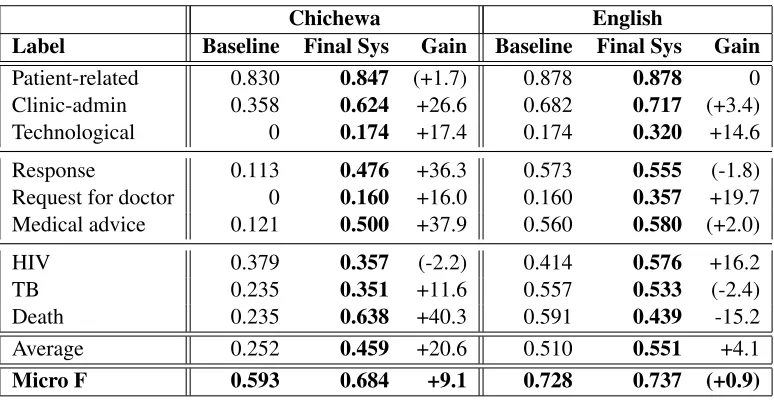
Table 3 gives the final results, comparing the sys-tems over the original text messages and the English translations of the same messages. The most accu-rate results were achieved by applying the phono-logical normalization before the morphophono-logical seg-mentation, giving a (macro) average of 0.459 which is an increase of 20.6% over the baseline. The increase in accuracy was not cumulative – the combined system outperforms both the standalone phonological and morphological systems, but with a comparatively modest gain.
The final English system is 9.2% more accurate than the final Chichewa system, but the Chichewa system has closed the gap considerably as the En-glish baseline system was 25.7% more accurate than the baseline Chichewa system. Assuming that the potential accuracy is approximately equal (given both languages are encoding exactly the same infor-mation) we conclude that we have made substantial gains in accuracy but there are further large gains to be made. Therefore, while we have not solved the problem of text message classification in morpho-logically rich languages, we have been able to make promising gains in an exciting new area of research.
5.4 Practical effectiveness
The FrontlineSMS system currently allows users to filter messages by keywords, similar to many email clients. Because of the large number of variants per word this is sub-optimal in many languages. We de-fined a second baseline to model an idealized version of the current system that assumes oracle knowledge of the keyword/label and the optimal order in which to apply rules created from this knowledge. The only constraint was that we excluded words that occurred only once. In essence, it is a MaxEnt model that in-cludes seen test items and assigns a label according to the single strongest feature for each test item.
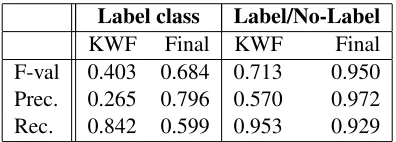
Here, we evaluated the systems according to Micro-F, recall and precision, as these give a bet-ter gauge of the frequency of error per incoming text, and therefore the usability for someone need-ing to correct mislabeled texts. We also calculated the Micro-F for each label/non-label decision to give exact figures per classification decision. The results are in Table 4. The Micro-F is 0.684 as compared to 0.403 for the keyword system. The higher precision is also promising, indicating that when we assign a label we are more often correct. By adjusting the precision and recall through label confidence thresh-olds, 90% precision can be achieved with 35.3% re-call.2 In terms of usability, the Label/no-Label
re-2We confirmed significance relative to confidence by ROC
Chichewa English
Label Baseline Final Sys Gain Baseline Final Sys Gain
Patient-related 0.830 0.847 (+1.7) 0.878 0.878 0 Clinic-admin 0.358 0.624 +26.6 0.682 0.717 (+3.4)
Technological 0 0.174 +17.4 0.174 0.320 +14.6
Response 0.113 0.476 +36.3 0.573 0.555 (-1.8)
Request for doctor 0 0.160 +16.0 0.160 0.357 +19.7 Medical advice 0.121 0.500 +37.9 0.560 0.580 (+2.0)
HIV 0.379 0.357 (-2.2) 0.414 0.576 +16.2
TB 0.235 0.351 +11.6 0.557 0.533 (-2.4)
Death 0.235 0.638 +40.3 0.591 0.439 -15.2
Average 0.252 0.459 +20.6 0.510 0.551 +4.1
[image:7.612.113.500.58.258.2]Micro F 0.593 0.684 +9.1 0.728 0.737 (+0.9)
Table 3: Final Results, comparing the systems in Chichewa and the English translations.
sults are very promising, reducing errors from 1 in 4 to 1 in 20.
The learning rates in Figure 1 show that the learn-ers are converging on accurate models after only see-ing a handful of text messages. This figure also makes it clear that subword processing gives rela-tively little gain to the English translations. The disparity between the final model and the baseline widens as more items are seen, indicating that the failure of the word-optimal baseline model is not just due to a lack of training items.
5.5 Other models investigated
Much recent work in text classification has been in machine-learning, comparing models over constant features. We tested SVMs and joint learning strate-gies. The gains were significant but small and did not closed the gap between systems with and with-out subword modeling. We therefore omit these for space and scope.
However, one interesting result came from ex-tending the feature space with topics derived from
Latent Dirichlet Allocation (LDA) using similar methods to Ramage et al. (2009). This produced significant gains (micro-F=0.029), halving the re-maining gap with the English system, but only when the topics were derived from modeling non-contiguous morpheme sequences, not words-alone or segmented morphemes. We found that the differ-ent surface forms of each word cooccurredlessoften
than chance (0.46 as often as chance for the different forms ofodwala) forming disjunctive distributions. We suspect that this acts as a bias against robust un-supervised clustering of the different forms.
6 Related Work
To our best knowledge, no prior researchers have worked on subword models for text message cate-gorization, or any NLP task with the Chichewa, but we build on many recent developments in computa-tional morphology and NLP for Bantu languages.
Badenhorst et al. (2009) found substantial varia-tion in a speech recognivaria-tion corpus for 9 Southern Bantu languages, where accurate models could also be built with limited data. Morphological segmenta-tion improved Swahili-English machine translasegmenta-tion in De Pauw et al. (2009), even in the absense of gold standard reference segmentations, as was the case here. The complexity and necessity of model-ing non-contiguous morphemes in Bantu languages is discussed by Pretorius et al. (2009).
0.65 0.75
0.45 0.55
10% 100%
Chichewa Baseline Chichewa Final
[image:8.612.328.526.59.130.2]English Baseline English Final
Figure 1: The learning rate, comparing micro-F for the Chichewa and English systems on different training set sizes. A random stratified sample was used for subsets.
the most accurate results in 2008 Morpho Challenge Workshop (Kurimo et al., 2008). ParaMor assumes a single affix and is not easily adapted to more com-plex morphologies, but we were able to test and eval-uate Morfessor and the earlier Linguistica (Gold-smith, 2001). Both were more accurate for segmen-tation than our adapsegmen-tation of Goldwater et al. (2009), but with lower recall. For the reasons discussed in Section 5.3 this meant less accuracy in classification. Goldwater et al. have also used the Pitman-Yor algo-rithm for morphological modeling (Goldwater et al., 2006). In results too recent to test here, Pitman-Yor has been used for segmentation with accuracy com-parable to the HDP model but with greater efficiency (Mochihashi et al., 2009). Biosurveillance systems currently use simple rule-based pre-processing for subword models. Dara et al. (2008) found only mod-est gains, although the data was limited to English.
For text message classification, prior work is lim-ited to identifying SPAM (Healy et al., 2005; Hi-dalgo et al., 2006; Cormack et al., 2007), where specialized algorithms and feature representations were also found to improve accuracy. For written variation, Kobus et al. (2008) focussed on SMS-specific abbreviations in French. Unlike their data, SMS-specific abbreviations were not present in our data. This is consistent with the reports on SMS practices in the related isiXhosa language (Deumert and Masinyana, 2008), but it may also be because the data we used contained professional communi-cations not personal messages.
Label class Label/No-Label
[image:8.612.72.296.59.211.2]KWF Final KWF Final F-val 0.403 0.684 0.713 0.950 Prec. 0.265 0.796 0.570 0.972 Rec. 0.842 0.599 0.953 0.929
Table 4: Micro-F, precision and recall, compared with the oracle keyword system.KWF= Oracle Keyword Filter.
7 Conclusions
We have demonstrated that subword modeling in Chichewa leads to significant gains in classifying text messages according to medical labels, reducing the error from 1 in 4 to 1 in 20 in a system that should generalize to other languages with similar morpho-logical complexity.
The rapid expansion of cellphone technologies has meant that digital data is now being generated in 100s, if not 1000s, of languages that have not previously been the focus of language technologies. The results here therefore represent just one of a large number of potential new applications for short-message classification systems.
Acknowledgements
Thank you to FrontlineSMS:Medic and the health care workers they partner with. The first author was supported by a Stanford Graduate Fellowship.
References
Jaco Badenhorst, Charl van Heerden, Marelie Davel, and Etienne Barnard. 2009. Collecting and evaluating speech recognition corpora for nine Southern Bantu languages. InThe EACL Workshop on Language Tech-nologies for African Languages.
Piet Buys, Susmita Dasgupta, Timothy S. Thomas, and David Wheeler. 2009. Determinants of a digital divide in Sub-Saharan Africa: A spatial econometric analysis of cell phone coverage. World Development, 37(9). Gordon V. Cormack, Jos´e Mara G´omez Hidalgo, and
En-rique Puertas S´anz. 2007. Feature engineering for mobile (SMS) spam filtering. InThe 30th annual in-ternational ACM SIGIR conference on research and development in information retrieval.
Jagan Dara, John N. Dowling, Debbie Travers, Gre-gory F. Cooper, and Wendy W. Chapman. 2008. Evaluation of preprocessing techniques for chief com-plaint classification. Journal of Biomedical Informat-ics, 41(4):613–23.
Ana Deumert and Sibabalwe Oscar Masinyana. 2008. Mobile language choices: the use of English and isiX-hosa in text messages (SMS) evidence from a bilin-gual South African sample. English World-Wide, 29(2):117–147.
John Goldsmith. 2001. Unsupervised learning of the morphology of a natural language. Computational Linguistics, 27(2):153–198.
Sharon Goldwater and David McClosky. 2005. Improv-ing statistical MT through morphological analysis. In
Human Language Technology Conference and Confer-ence on Empirical Methods in Natural Language Pro-cessing.
Sharon Goldwater, Thomas L. Griffiths, and Mark John-son. 2006. Interpolating between types and tokens by estimating power-law generators. Advances in Neural Information Processing Systems, 18.
Sharon Goldwater, Thomas L. Griffiths, and Mark John-son. 2009. A bayesian framework for word segmen-tation: Exploring the effects of context. Cognition, 112(1):21–54.
Matt Healy, Sarah Jane Delany, and Anton Zamolotskikh. 2005. An assessment of case-based reasoning for Short Text Message Classification. InThe 16th Irish Conference on Artificial Intelligence & Cognitive Sci-ence.
Jos´e Mara G´omez Hidalgo, Guillermo Cajigas Bringas, Enrique Puertas S´anz, and Francisco Carrero Garca. 2006. Content based SMS spam filtering. In ACM symposium on Document engineering.
Scott Isbrandt. 2009. Cell Phones in West Africa: im-proving literacy and agricultural market information systems in Niger. White paper: Projet Alphab´etisation de Base par Cellulaire.
Abi Jagun, Richard Heeks, and Jason Whalley. 2008. The impact of mobile telephony on developing country micro-enterprise: A Nigerian case study. Information Technologies and International Development, 4. Mark Johnson and Sharon Goldwater. 2009. Improving
nonparameteric Bayesian inference: experiments on unsupervised word segmentation with adaptor gram-mars. InHuman Language Technologies.
Catherine Kobus, Franc¸ois Yvon, and Ge´eraldine Damnati. 2008. Normalizing SMS: are two metaphors better than one? In The 22nd International Confer-ence on Computational Linguistics.
Mikko Kurimo, Matti Varjokallio, and Ville Turunen. 2008. Unsupervised morpheme analysis. InMorpho
Challenge Workshop, Finland. Helsinki University of Technology.
Carole Leach-Lemens. 2009. Using mobile phones in HIV care and prevention.HIV and AIDS Treatment in Practice, 137.
Sam Mchombo. 2004. The Syntax of Chichewa. Cam-bridge University Press, New York, NY.
Daichi Mochihashi, Takeshi Yamada, and Naonori Ueda. 2009. Bayesian unsupervised word segmentation with nested Pitman-Yor language modeling. In The 47th Annual Meeting of the Association for Computational Linguistics.
Christian Monson, Jaime Carbonell, Alon Lavie, and Lori Levin. 2008. ParaMor: finding paradigms across mor-phology.Lecture Notes in Computer Science, 5152. Robert Munro. 2010. Haiti Emergency Response: the
power of crowdsourcing and SMS. InHaiti Crisis Re-lief 2.0, Stanford, CA.
Steven Paas. 2005. English Chichewa-Chinyanja Dictio-nary. Mvunguti Books, Zomba, Malawi.
Guy De Pauw, Peter Waiganjo Wagacha, and Gilles-Maurice de Schryver. 2009. The SAWA Corpus: a parallel corpus of English - Swahili. In The EACL Workshop on Language Technologies for African Lan-guages.
Gareth Peevers, Gary Douglas, and Mervyn A. Jack. 2008. A usability comparison of three alternative mes-sage formats for an SMS banking service. Interna-tional Journal of Human-Computer Studies, 66. Rigardt Pretorius, Ansu Berg, Laurette Pretorius, and
Biffie Viljoen. 2009. Setswana tokenisation and com-putational verb morphology: Facing the challenge of a disjunctive orthography. InThe EACL Workshop on Language Technologies for African Languages. Daniel Ramage, David Hall, Ramesh Nallapati, and
Christopher D. Manning. 2009. Labeled LDA: A supervised topic model for credit attribution in multi-labeled corpora. InProceedings of the 2009 Confer-ence on Empirical Methods in Natural Language Pro-cessing, Singapore.
Ariel S. Schwartz and Marti A. Hearst. 2003. A sim-ple algorithm for identifying abbreviation definitions in biomedical texts. InThe Pacific Symposium on Bio-computing, University of California, Berkeley. Martha Yifiru Tachbelie, Solomon Teferra Abate, and
Wolfgang Menzel. 2009. Morpheme-based language modeling for amharic speech recognition. InThe 4th Language and Technology Conference.