Volume 2008, Article ID 243153,7pages doi:10.1155/2008/243153
Research Article
How to Solve the Problem of Bad Performance of
Cooperative Protocols at Low SNR
Charlotte Hucher, Ghaya Rekaya-Ben Othman, and Jean-Claude Belfiore
Ecole Nationale Superieure des Telecommunications, 46 rue Barrault, 75013 Paris Cedex 13, France
Correspondence should be addressed to Charlotte Hucher, [email protected]
Received 1 June 2007; Accepted 27 August 2007
Recommended by Ranjan K. Mallik
We propose some new adaptive amplify-and-forward (AF) and decode-and-forward (DF) protocols using a selection. The new selection criterion is a function of the instantaneous capacities of all possible transmission schemes (with or without cooperation). Outage probabilities and simulation results show that the adaptive cooperation protocols solve the problem of bad performance of cooperation protocols at low SNR. Moreover, they improve the asymptotic performance of their corresponding AF and DF protocols.
Copyright © 2008 Charlotte Hucher et al. This is an open access article distributed under the Creative Commons Attribution License, which permits unrestricted use, distribution, and reproduction in any medium, provided the original work is properly cited.
1. INTRODUCTION
Diversity techniques have been developed in order to com-bat fading on wireless channels and improve the reliability of the received message. Recently, cooperation has been pro-posed as a new mean to obtain “space-time” or “coopera-tive” diversity [1,2]. Different nodes in the network coop-erate in order to form a virtual MIMO system and exploit space-time diversity even if their hardware constraints do not allow them to support several antennas. Many cooperative protocols have been proposed [3–6] which can be classified in three main families: amplify-and-forward (AF), decode-and-forward (DF), and compress-decode-and-forward (CF).
In this paper we are interested in the two first families, which are the more natural ones. AF protocols have been studied the most due to their simplicity. Indeed, the relays just amplify the received signals and forward them. DF pro-tocols require a bit more processing: this strategy consists in decoding the received signals at the relays and then forward-ing them. They have interestforward-ing performance, however, and are even essential for multihop systems. Asymptotically, both protocols bring diversity and give better performance than SISO which only uses the direct link. However, it does not match noncooperation at low SNR.
We propose here a new strategy named adaptive cooper-ation which can be applied either to AF or to DF protocols.
This new strategy consists in choosing the best transmission scheme, based on a new selection criterion, a function of the instantaneous capacities of all these possible transmis-sion schemes. Selection between cooperation and noncoop-eration has already been proposed in literature for DF proto-cols [5,7], as well as relay selection [8], but never adapted to AF protocols. Moreover, the usual selection criterion of DF protocol is based only on the source-relay outage probabil-ity, while the proposed selection takes all the channel links into account. Outage probability calculations and simula-tion results prove that the new adaptive AF and DF protocols perform asymptotically better than their corresponding AF and DF protocols, and more interesting, solve the problem of poor performance of cooperation protocols at low SNR.
2. SYSTEM MODEL
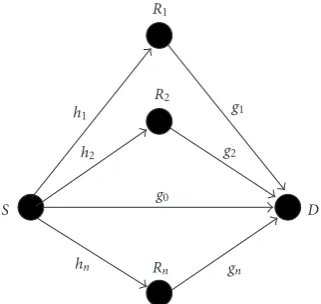
We considerN+ 1 terminals who want to transmit messages to the same destinationD. The channel is shared in a TDMA manner, so each terminal is allocated a different time slot and the system can be reduced to a relay channel with one source,
Nrelays, and one destination (Figure 1). TheN+ 1 terminals play the role of the source in succession while the others are used as relays.
R1
R2
Rn
h1
h2
hn
g2
g1
g0
gn
S D
Figure1: System model : a relay channel with one source,Nrelays, and one destination.
Sand destinationDisg0, the one between sourceSand relay
Riishi, and the one between relayRiand destinationDisgi.
We consider a half-duplex channel; each terminal, and in particular the relays, cannot receive and transmit at the same time. The channel links are Rayleigh, slow fading, so we can consider their coefficients as constant during the transmis-sion of at least one frame.
We suppose that all terminals are equipped with only one antenna; the MIMO case is not considered in this work. We focus here on the protocol. So, for simplicity, we assume a uniform energy distribution between source and relays, with the total power kept constant.
We will see in the following (see Sections3.3and6.2) that channel state information needs to be known only at destina-tion.
3. NEW SELECTION FOR AF PROTOCOLS
AF protocols proposed in literature [3,4,6] bring diversity at high SNR, but their performance at low SNR is poorer than that of the noncooperative scheme. To solve this issue, we in-troduce the adaptive AF strategy where the choice of a trans-mission scheme is based on the channel links quality.
3.1. Presentation of the adaptive AF
The idea leading to the definition of the adaptive AF strategy is to consider all possible transmission schemes and decide which one to select. In order to better understand this strat-egy, the one-relay case is detailed, before the generalization to theN-relay case.
One-relay case
There are only three possible transmission schemes as follows (Figure 2).
(a) AF case: full cooperation scheme is used, symbols are sent using the AF protocol. In case of a full rate proto-col (NAF [9]), the symbol rate is 1 symbol per channel use (1 symb. pcu).
(b) SISO case: only direct link is used, symbols are sent over the source-destination link in a noncoded man-ner, at a rate of 1 symb. pcu.
(c) NLOS case: only nonline-of-sight (NLOS) link is used, in a first phase symbols are sent over the source-relay link in a noncoded manner and forwarded by the re-lay in a second phase. The rate is then 1/2 symb. pcu. Therefore in order to have the same spectral efficiency of 1 symb. pcu case as in the other cases, we need to use a larger constellation. For example, if the other pro-tocols use a 16-QAM constellation, the NLOS scheme must use a 256-QAM.
The principle of this new adaptive AF strategy is to eval-uate the qualities of the three schemes (SISO, AF, and NLOS) and to select the best of them.
Generalization to the N-relay case
This selection can be generalized quite easily to a higher number of relays.
For example, for 2 relaysR1andR2, the number of possi-ble schemes is 7:
(1) full cooperation: symbols are sent using the AF proto-col for 2 relays. With a full rate protoproto-col, the symbol rate is 1 symb. pcu;
(2) cooperation with only relayR1: symbols are sent using the AF protocol for only 1 relay. With a full rate proto-col, the symbol rate is still 1 symb. pcu;
(3) cooperation with only relayR2;
(4) noncooperation: symbols are sent in a noncoded man-ner over the direct link: the symbol rate is 1 symb. pcu again;
(5) NLOS link using only relayR1: symbols are sent in a noncoded manner and the symbol rate is 1/2 symb. pcu;
(6) NLOS link using only relayR2;
(7) both NLOS links: the symbol rate is 1/2 symb. pcu. The number of cases grows with the number of relays. In theN-relay case, there areNk=0N
k
=2N different
cooper-ation cases from the noncooperative one (no relay,k=0) to the full cooperation one (Nrelays,k=N). IfK >2 terminals are transmitting simultaneously, the signal power has to be divided byK, which makes the signals too difficult to decode. That is why we consider only the NLOS cases with one or two relays, which corresponds toN1
+N2
+N(N+ 1)/2 cases. We can remark as well that, in cooperation schemes, even if several relays are used, at each time slot, only two terminals transmit simultaneously. So finally, there are 2N+N(N+1)/2
different transmission schemes to consider.
h g1
g0
S D
R
(a) AF scheme
g0
S D
R
(b) SISO scheme
h g1
S D
R
(c) NLOS scheme
Figure2: Three possible schemes in the 1-relay case.
Moreover, we will show in the example ofSection 4that depending on the chosen AF scheme, some cases can be omitted, which reduces the complexity even more.
3.2. Selection criterion
In the previous subsection we have listed all the 2N+N(N+
1)/2 possible transmission cases. The question is now which criterion to use to select the best one.
We propose to study all these schemes and to select the one which has the largest instantaneous capacity.
Let us number the possible transmission schemes from 1 toNS=2N+N(N+ 1)/2 and noteCi(H) the instantaneous
capacity of theith scheme. The selected transmission scheme is the one offering the maximum instantaneous capacity
arg max
i{1,...,Ns}
Ci(H)
(1)
with
Ci(H)=log2
1 + SNRHHH. (2)
3.3. Implementation constraints
To implement the new adaptive AF strategy, a node in the network has to decide which transmission scheme to use. We suppose that this node is the destination. So it has to estimate the channel coefficientg0of the direct link and the product channelsgiβihifor each relayRi, calculate the instantaneous
capacity of each possible transmission scheme, and deter-mine the one to be used. Then it broadcasts no more than
log2(2N +N(N+ 1)/2) = N+ 1 bits at both source and
relays in order to inform them about its decision.
As we consider a slow fading channel, an estimation is made for several frames and so the transmission strategy re-mains the same. When a new estimation is made and if the strategy has to change, it is effective after a delay of one frame during which the strategy is not optimal.
4. EXAMPLE OF THE ADAPTIVE NAF PROTOCOL
In order to better understand this new selection strategy and its possible simplifications, we develop in this section the ex-ample of the adaptive NAF protocol.
Table1: NAF protocol.
S x11 x12 x21 x22 · · · xN1 xN2
R1 yr1 β1yr1
R2 yr2 β2yr2
...
· · · .
. .
RN yrN βNyrN
D y11 y12 y21 y22 yN1 yN2
4.1. NAF protocol
We consider the nonorthogonal AF (NAF) protocol pro-posed in [4] for the one-relay case and generalized in [5] to
N >1 relays.
This protocol is schematized inTable 1wherexi1,xi2are the signals to be transmitted,yriis the received signal at the
ith relay,yi1,yi2are the received signals at destination, andβi
is the scale factor of theith relay. The source keeps transmit-ting:x11during the first time slot andx12during the second one, and so on. During the first time slot, the first relay lis-tensyr1, and, during the second time slot, retransmits a scale
version of the signalβiyr1.
The optimum value of each scale factorβihas been
cal-culated in [9]:
βi= √ 1
1 + SNRhi2
, (3)
where SNR stands for the signal-to-noise ratio.
An equivalent model of the formY=HX+Wcan be cal-culated for any number of relays. After vectorization and sep-aration of real and imaginary parts of complex expressions, we obtain a lattice representation of the system. So decoding can be performed by using ML lattice decoders, such as the sphere decoder or the Schnorr-Euchner algorithm.
It has been proven in [9] that this protocol is optimal when used with the distributed Golden code [10] for the one-relay case, or a distributed 2N×2Nperfect code [11] for the
N-relay case.
4.2. Adaptive NAF protocol
play exactly the same role and are never used in the same time. By studying the instantaneous capacities of the coop-eration schemes using NAF protocol with different number of relays, we can see easily that the greatest instantaneous ca-pacity will be associated to a one-relay case.
So we can avoid to study all the NAF strategies with sev-eral relays, which reduces considerably the complexity. In-deed, the adaptive NAF protocol is then the result of the se-lection of the best transmission scheme between the SISO scheme, the NAF schemes using only one relay, and the NLOS schemes using either 1 or 2 relays. Finally, we have only 1 +N+N(N+ 1)/2=(1 +N)(1 +N/2) possible transmission cases to study and 4 corresponding decoding algorithms; and so, we can remark that the decoding complexity does not in-crease with the number of relays.
5. PERFORMANCE OF THE ADAPTIVE AF STRATEGY
5.1. Outage probability
The outage probability can be expressed as a function of the instantaneous capacity. For each scheme numbered from 1 toNS=2N+N(N+ 1)/2 as inSection 3.2:
P(outi) =P
Ci(H)< R
, (4)
whereRis the spectral efficiency in bits per channel use (bits pcu).
The principle of the adaptive AF protocol is to choose the transmission scheme that maximizes the instantaneous ca-pacityCi(H) overi. So the instantaneous capacity of the new
adaptive AF protocol is larger than eachCi(H) for a
fixed-channel realizationH. Thus, the selection scheme is in out-age if and only if theNSpossible transmission schemes are all
in outage. So we get
Pout(AAF)≤P(outi) i∈
1,. . .,NS
. (5)
We can calculate and plot the outage probabilities of these different protocols as functions of the SNR thanks to Monte Carlo simulations.
InFigure 3, we plot the outage probabilities of the SISO, NAF, and adaptive NAF protocols for a one-relay scheme and a spectral efficiency of 4 bits pcu. We can note that the adap-tive NAF performs better than the NAF protocol. Indeed, we obtain a 4 dB asymptotic gain. Even more interesting is the fact that the adaptive NAF always performs better than SISO, even at low SNR, which was the main weakness of the NAF protocol without selection.
InFigure 4, we plot the outage probabilities of the SISO, NAF and adaptive NAF protocols for a two-relay scheme and a spectral efficiency of 4 bits pcu. Here again, the enhance-ment of the adaptive NAF over the NAF protocol is verified, as we obtain a 5 dB asymptotic gain and solve the problem of bad performance at low SNR.
10−4 10−3 10−2 10−1 100
Out
ag
e
p
ro
b
ab
il
it
y
0 10 20 30 40
SNR (dB)
SISO NAF Adaptive NAF
Figure3: 1-relay scheme: comparison of the outage probabilities of the noncooperative case, the NAF protocol, and the adaptive NAF for 4 bits pcu.
10−4 10−3 10−2 10−1 100
Out
ag
e
p
ro
b
ab
il
it
y
0 10 20 30 40
SNR (dB)
SISO NAF Adaptive NAF
Figure4: 2-relay scheme: comparison of the outage probabilities of the noncooperative case, the NAF protocol, and the adaptive NAF for 4 bits pcu.
5.2. Simulation results
In Figures5and6, we plot the frame error rate of the SISO, NAF, and adaptive NAF protocols as functions of the SNR for a spectral efficiency of 4 bits pcu.
10−4 10−3 10−2 10−1 100
F
rame
er
ro
r
rat
e
0 10 20 30 40
SNR (dB)
SISO NAF Adaptive NAF
Figure5: 1-relay scheme: comparison of the performance of the noncooperative case, the NAF protocol, and the adaptive NAF for 4 bits pcu.
10−4 10−3 10−2 10−1 100
F
rame
er
ro
r
rat
e
0 10 20 30 40
SNR (dB)
SISO NAF Adaptive NAF
Figure6: 2-relay scheme: comparison of the performance of the noncooperative case, the NAF protocol, and the adaptive NAF for 4 bits pcu.
InFigure 6, the curves for the two-relay scheme are repre-sented. The NAF protocol is implemented with a distributed 4×4 perfect code [11] and a Schnorr-Euchner decoding. The improved performances of the adaptive NAF are here again confirmed with a 7 dB gain over the NAF protocol. Besides, the problem of bad performance of the NAF at low SNR is solved with two relays too, since the adaptive NAF curve is always under the SISO curve.
6. NEW SELECTION FOR DF PROTOCOLS
This new selection working quite efficiently on AF protocols, we propose to adapt it to DF protocols, which have the same
10−4 10−3 10−2 10−1 100
Out
ag
e
p
ro
b
ab
il
it
y
0 10 20 30 40
SNR (dB)
SISO Alamouti DF Adaptive Alamouti DF
Figure7: 1-relay scheme: comparison of the outage probabilities of the noncooperative case, the Alamouti DF protocol, and the adap-tive Alamouti DF for 4 bits pcu.
10−4 10−3 10−2 10−1 100
F
rame
er
ro
r
rat
e
0 10 20 30 40
SNR (dB)
SISO Alamouti DF Adaptive Alamouti DF
Figure8: 1-relay scheme: comparison of the performance of the noncooperative case, the Alamouti DF protocol, and the adaptive Alamouti DF for 4 bits pcu.
problem as the AF protocols: poorer performance at low SNR than SISO.
6.1. Presentation of the adaptive DF
The adaptive DF strategy is based on the same principle than the adaptive AF strategy. However, relays do not amplify the signals but decode them for both DF and NLOS protocols. So there is one more criterion to take into account. Indeed, a DF or NLOS protocol is efficient only if signals are correctly decoded at relays.
relay. On the contrary, if a source-relay link is not in outage, detection without error is possible and we can use either a DF or a NLOS protocol using this relay by assuming that no error occurs during detection.
So a first selection step has to be added to the protocol. In theN-relay case, the strategy of an adaptive DF protocol is as follows:
(1) select only theKrelays whose source-relay link is not in outage,
(2) select the best transmission scheme in the 2K+K(K+
1)/2 possible ones in term of instantaneous capacity.
6.2. Implementation constraints
As in the adaptive AF strategy, it is the destination who has to select the best transmission scheme. However, before con-sidering the possible transmission schemes, it has to know which relays are usable, that is, which source-relay links are not in outage. We propose that each relay estimates its own source-relay link and transmits a single bit to the destination indicating whether it is in outage or not.
Then, the steps are the same as for the adaptive AF: the destination estimates the direct link g0 and the relay-destination linksgifor allK relays which are not in outage.
Estimations of the source-relay links are not necessary as the relays decode the signals. Thanks to these estimations, it can calculate the instantaneous capacities of all possible trans-mission schemes and determine the best one.N+ 1 bits are then necessary to broadcast the information on the chosen scheme to the source and relays.
7. EXAMPLE OF THE ADAPTIVE ALAMOUTI DF PROTOCOL
7.1. Alamouti DF protocol
The Alamouti DF protocol is a DF protocol designed for a 1-relay channel and based on the Alamouti space-time code [12]. It requires 4 channel uses to send 2 symbols: the symbol rate is 1/2 symb. pcu.
As schematized inTable 2, in the first phase, the source sends the first line of the Alamouti codeword: x1 and x2, while the relay listens. In the second phase, the relay sends a decoded version of the first line of the codeword, while the source sends the second line of the Alamouti codeword:−x∗2 and x∗1. The destination keeps listening during the whole transmission.
Assumingx1andx2have been correctly decoded, the re-ceived signals can be written in the formY=√SNRHX+W
with an equivalent channel matrixH being orthogonal. So, linear decoding can be performed as for the original Alam-outi ST code.
However, the Alamouti DF protocol can be used only if the signals are correctly decoded at the relay, which, accord-ing to Shannon’s theorem, is possible only if the source-relay link is not in outage. In the other case, we can not use the re-lay, so signals are sent in a noncoded manner over the direct link.
Table2: Alamouti DF protocol.
S x1 x2 −x∗2 x∗1
x1 x2 R yr1 yr2
D y1 y2 y3 y4
7.2. Adaptive Alamouti DF protocol
The first test is on the source-relay link. Two cases can occur:
(1) either it is in outage, then signals cannot be decoded without error at relay, so we only use the direct link; (2) or it is not in outage, then three different transmission
schemes can be considered:
(a) SISO scheme; (b) Alamouti DF scheme; (c) NLOS scheme.
According to the same selection criterion as in Sec ure??, we choose the one with the greatest instantaneous ca-pacity.
8. PERFORMANCE OF THE ADAPTIVE DF STRATEGY
8.1. Outage probability
The outage probability of the adaptive DF protocols can be proven to be lower than the outage probability of the cor-responding DF protocols in the same manner than for the adaptive AF protocols. It comes directly from the selection criterion which minimizes the instantaneous capacity.
InFigure 7, we plot the outage probabilities of the SISO, Alamouti DF, and adaptive Alamouti DF protocols as func-tions of the SNR, obtained through Monte Carlo simula-tions. We can see that for the DF protocols too, the new se-lection criterion brings a great improvement in asymptotic performance with a 4 dB gain, and solves the problem of bad performance at low SNR.
8.2. Simulation results
We plot the performance simulations of the SISO, Alamouti DF, and adaptive Alamouti DF protocols as functions of the SNR inFigure 8. The improvements due to the new selec-tion criterion are here again confirmed with a 3 dB asymp-totic gain, and better or same performance as SISO for low SNR.
9. CONCLUSION
that the adaptive cooperation enhances the performance of the initial cooperation schemes at high SNR, and solves the problem of poor performance at low SNR.
REFERENCES
[1] A. Sendonaris, E. Erkip, and B. Aazhang, “User cooperation diversity—part I: system description,”IEEE Transactions on Communications, vol. 51, no. 11, pp. 1927–1938, 2003. [2] A. Sendonaris, E. Erkip, and B. Aazhang, “User
cooation diversity—part II: implementcooation aspects and per-formance analysis,” IEEE Transactions on Communications, vol. 51, no. 11, pp. 1939–1948, 2003.
[3] J. Laneman and G. Wornell, “Distributed space-time-coded protocols for exploiting cooperative diversity in wireless net-works,” IEEE Transactions on Information Theory, vol. 49, no. 10, pp. 2415–2425, 2003.
[4] R. Nabar, H. B¨olcskei, and F. Kneub¨uhler, “Fading relay chan-nels: performance limits and space-time signal design,”IEEE Journal on Selected Areas in Communications, vol. 22, no. 6, pp. 1099–1109, 2004.
[5] K. Azarian, H. El Gamal, and P. Schniter, “On the achiev-able diversity-multiplexing tradeoffin half-duplex cooperative channels,”IEEE Transactions on Information Theory, vol. 51, no. 12, pp. 4152–4172, 2005.
[6] S. Yang and J.-C. Belfiore, “Towards the optimal amplify-and-forward cooperative diversity scheme,”IEEE Transactions on Information Theory, vol. 53, no. 9, pp. 3114–3126, 2007. [7] J. Laneman, D. Tse, and G. Wornell, “Cooperative diversity
in wireless networks: efficient protocols and outage behavior,” IEEE Transactions on Information Theory, vol. 50, no. 12, pp. 3062–3080, 2004.
[8] A. S. Ibrahim, A. Sadek, W. Su, and K. J. R. Liu, “SPC12-5: relay selection in multi-node cooperative communications: when to cooperate and whom to cooperate with?” inIEEE Global Telecommunications Conference (GLOBECOM ’06), pp. 1–5, San Francisco, Calif, USA, November-December 2006. [9] S. Yang and J.-C. Belfiore, “Optimal space-time codes for the
MIMO amplify-and-forward cooperative channel,” in IEEE International Zurich Seminar on Digital Communications, pp. 122–125, Zurich, Switzerland, February 2006.
[10] J.-C. Belfiore, G. Rekaya, and E. Viterbo, “The golden code: a 2×2 full-rate space-time code with non-vanishing determi-nants,”IEEE Transactions on Information Theory, vol. 51, no. 4, pp. 1432–1436, 2005.
[11] F. Oggier, G. Rekaya, J.-C. Belfiore, and E. Viterbo, “Perfect space-time block codes,” IEEE Transactions on Information Theory, vol. 52, no. 9, pp. 3885–3902, 2006.