Volume 2007, Article ID 82912,10pages doi:10.1155/2007/82912
Research Article
Separation and Localisation of P300 Sources and Their
Subcomponents Using Constrained Blind Source Separation
Loukianos Spyrou,1Min Jing,1Saeid Sanei,1and Alex Sumich2
1The Centre of Digital Signal Processing, School of Engineering, CardiffUniversity, Queen’s Buildings, P.O. Box 925,
Newport Road, CardiffCF24 3AA, Wales, UK
2The Brain Image Analysis Unit, Institute of Psychiatry, King’s College Hospital, London SE5 8AF, UK
Received 1 October 2005; Revised 31 May 2006; Accepted 11 June 2006
Recommended by Frank Ehlers
Separation and localisation of P300 sources and their constituent subcomponents for both visual and audio stimulations is in-vestigated in this paper. An effective constrained blind source separation (CBSS) algorithm is developed for this purpose. The algorithm is an extension of the Infomax BSS system for which a measure of distance between a carefully measured P300 and the estimated sources is used as a constraint. During separation, the proposed CBSS method attempts to extract the corresponding P300 signals. The locations of the corresponding sources are then estimated with some indeterminancy in the results. It can be seen that the locations of the sources change for a schizophrenic patient. The experimental results verify the statistical significance of the method and its potential application in the diagnosis and monitoring of schizophrenia.
Copyright © 2007 Loukianos Spyrou et al. This is an open access article distributed under the Creative Commons Attribution License, which permits unrestricted use, distribution, and reproduction in any medium, provided the original work is properly cited.
1. INTRODUCTION
Event-related potentials (ERPs) are those electroencephalo-grams (EEGs) which directly measure the electrical response of the cortex to sensory, affective, and/or cognitive events. The fine-grained temporal resolution offered by ERPs allows accurate study of the time course of information process-ing unavailable to other neuroimagprocess-ing techniques. However, spatial resolution has been traditionally limited. In addition, overlapping components of the ERP which represent specific stages of information processing are difficult to distinguish [1,2]. An example is the composite P300 wave, a positive ERP component which occurs with a latency of about 300 milliseconds after novel stimuli, or task relevant stimuli, re-quiring an effortful response on the part of the individual un-der test [1–5]. The P300 wave represents cognitive functions involved in orientation of attention, contextual updating, re-sponse modulation, and rere-sponse resolution [1,3], and con-sists of multiple overlapping subcomponents, two of which are identified as P3a and P3b [2,5]. P3a reflects an automatic orientation of attention to novel or salient stimuli indepen-dent of task relevance [5,6]. Prefrontal, frontal, and anterior temporal brain regions play a major role in generating P3a giving it a frontocentral distribution [1,5]. In contrast, P3b
has a greater centroparietal distribution due to its reliance on posterior temporal, parietal, and posterior cingulate mecha-nisms [1,2]. P3a is also characterised by a shorter latency and more rapid habituation than P3b [2,5].Figure 1illustrates some typical P3a and P3b waveforms from temporal-basal and temporo-superior dipoles [7].
1 P3b
2 P3b
3 P3a
4 P3a
2 1
4 3
Figure1: Some examples for P3b (1 and 2) and P3a (3 and 4) sig-nals and their corresponding typical locations.
separating P300 sources and its subcomponents must be es-tablished [4].
Blind source separation (BSS) has been used to identify the ERP subcomponents [11]. The objective of BSS is to sepa-rate a number of sources (component generators) from their mixtures (electrode signals). This is achieved by using infor-mation only from the sensor signals and, if available, some information about the statistical properties of the sources. Successfully performing BSS is a challenging problem in a variety of real-world applications. Various algorithms have been developed depending on specific applications [11]. A family of BSS algorithms stems from the principle of inde-pendent component analysis (ICA). This method tries to es-timate the sources by assuming that they are statistically in-dependent.
The most common method in detection, highlighting, and visualisation of P300 components used by clinicians is the frame averaging method. The problem has been tackled in more mathematical ways and one of the first approaches was to estimate brain sources, obtained from an electroen-cephalogram (EEG) or magnetoenelectroen-cephalogram (MEG), us-ing a least-squares approach [12,13]. ICA was used later by a number of authors [14,15]. The motivation was to ex-tract sources of electrical activity which represent different brain functions (i.e., they are independent). These authors used the Infomax [16] algorithm which produced satisfac-tory results in terms of source separation. In this paper, we develop a constrained algorithm based on Infomax to sepa-rate P300 sources and their subcomponents. The constraint term is achieved based on a prior knowledge of some measur-able properties of the sources such as their latencies. A simi-lar method has been developed in [17,18] which employs a constrained ICA algorithm using reference signals. However, the type of constraint and they way it is constructed are dif-ferent. Here, we also emphasize on the development an au-tomatic detection and localisation procedure for the P3a and P3b subcomponents.
The paper is structured as follows.Section 2describes the basic BSS model and principles.Section 3describes the pro-posed methods for separation and localisation of the P300 components. Section 4 shows some experimental results
obtained by applying the proposed methods to EEGs recorded from some normal subjects and schizophrenic pa-tients as well as some simulated data.Section 5concludes the paper.
2. BLIND SOURCE SEPARATION
Regarding EEG, the mixing process is assumed instantaneous and the model is defined as follows: there is a numbermof sensor signalsx(t)=[x1(t),x2(t),. . .,xm(t)]T and a number nof source signalss(t)=[s1(t),s2(t),. . .,sn(t)]T. The mixing
system is described by the matrixH∈Rm×nand the relation
between the sensors and the sources is
x(t)=Hs(t). (1)
The element hi j of the matrixH is the mixing coefficient
from the jth source to the ith electrode. All signals are as-sumed zero mean or can be made so by subtracting the mean from them, additive observation noise is assumed insignifi-cant. The aim of BSS is to estimate the original sources using information only from the sensorsx(t). In most cases a ma-trixW=H−1is used to estimate the sources indirectly by
y(t)=s(t)=Wx(t), (2) wheres(t) denotes the estimate ofs(t). In ICA the source sig-nals are treated as random variables and the statistical prop-erties of the signals are used to obtain the unmixing matrix. If each sourcei=1,. . .,nis assumed to have a probability den-sity function (pdf)qi(·), the independence assumption can
be expressed mathematically as follows: the joint pdfq(s) of the source vector sis equal to the product of the marginal pdfs:
q(s)=q1
s1
· · ·qn
sn
= n
i=1 qi
si
. (3)
The ICA algorithm usually depends on the assumption made for the pdfs of the sourcesqi(si). Also, since a closed-form
solution to the ICA equation does not exist or it is gener-ally very difficult to obtain, a cost functionJ(W), which pro-vides a measure of independence, is optimised in an iterative manner using an optimisation technique such as a form of steepest descent or Newton’s method. There are two main problems associated with the ICA method. Firstly, the esti-mated sources can be a scaled version (potentially with a sign change) of the original sources and, secondly, there is no way of knowing the order of the sources. These two problems are known, respectively, as the scaling and permutation ambi-guities. The scaling problem may be mitigated by normal-ising the results with respect to the geometrical dimensions of the head. The permutation problem, however, has negli-gible effect in this application context as will be discussed in
Section 4.
3. PROPOSED METHODS
3.1. Constrained BSS
of EEG signals [14, 15]. The Infomax algorithm attempts to maximise the information flow between the inputs and the outputs of an artificial neural network (ANN). In this case, the inputs are the electrode signals and the outputs are some nonlinear transformation of the estimated sources. It is shown that if the nonlinear functions are selected appro-priately [16], then the information maximisation will corre-spond to the minimisation of the dependence between the estimated sources. The Infomax cost function is
Jm(W)=I(z,x)=H(z)−H
z|x, (4)
wherez ∈ Rn×1 is the output of the neural network (z = f(y),f(·) is the nonlinear activation function applied ele-ment wise toywhich is the estimated source vector),xis the input to the neural network, I(z,x) is the information be-tween the inputs and the outputs of the ANN,H(z) is the entropy of the output andH(z | x) is the conditional en-tropy of the output assuming a known input; note, for con-venience, the time index is dropped. The natural gradient of (4) is
∇WI(z,x)WTW= ∇WH(z)WTW (5)
since H(z | x) is independent of W. Maximisation based on the natural gradient is used to achieve good convergence [19]. The adaptation rule for the unmixing matrix W be-comes
Wt+1=Wt+μ
I+1−2f(y)yTW, (6)
where f(y)=(1+ exp(−y))−1with the assumption of
super-Gaussian outputs andμis the learning rate. The adaptation for an individual weight can be described by the equation (using the gradient ascent method)
Δwi j=
cofwi j
detW +xj
1−2yi
, (7)
where cof represents the cofactor and det the determinant. Thus, each individual weight is adapted in a way that the rows and columns differ from each other, as prescribed by the first term of the right-hand side of the equation. When two rows or columns become similar, the matrix becomes singu-lar, and then detWwill tend to zero forcing the weight ele-ment to change dramatically. This change will be affected by cofwi jwhich shows the relative singularity of the remainder
of the matrix, regardless of the row and column this element belongs to, compared to the whole of the matrix.
ICA in general does not produce unique outputs and we aim to develop an algorithm that ensures that the desired P300 source is one of the estimated sources. This can be achieved by adding a constraint to the original algorithm. La-grange multipliers incorporate the constraint function into the original cost function. This changes the problem into an unconstrained one. The constraint is considered as the Eu-clidean distance between the estimated sources and a refer-ence P300 signal. The referrefer-ence signal is obtained by frame averaging of the ERP obtained from a number of trials. The constrained problem can be written as
maxJm(W) subject toJC(W)=0, (8)
JmandJCare the Infomax and the constrained cost functions,
respectively. The cost function of the CBSSJalgorithm is
J(W,Λ)=Jm(W)−ΛJC(W), (9)
whereΛis the matrix of the Lagrange multipliers. The con-straint function specialised for each column ofWis defined as
JC
wi
= P
t=1
yi(t)−r(t) 2
fori=1,. . .,m, (10)
wherer(t) is the reference signal andyi(t) is theith output
at timet. The unknown parameters in the problem are now two: the matrixWand the matrixΛ. The matrixWis found adaptively via the following relation [20]:
Wt+1=Wt+μ
∇WtJ
Wt,Λ
WTtWt
=Wt+μ
I+1−1 + expWtx −1
Wtx T
−2ΛxWtx−P T
WTtWt,
(11)
Λ=ρdiag(Wx−P)(Wx−P)T, (12)
whereμis the learning rate of the adaptation of the unmixing matrix,ρis a scale factor for the Lagrange multiplier matrix, andPis a matrix whose rows contain the reference P300 sig-nal. If a block algorithm is required, then the data vectorx
becomes a matrix and it should be scaled accordingly. The basic form of the constrained algorithm can be mod-ified to mitigate some inherent problems with this approach. Firstly, the present form of the algorithm tries to producen
outputs that are as close as possible to the P300 reference sig-nal. Although this effect is alleviated partly by the Infomax algorithm which tries to produce different outputs, the con-straint part of the algorithm will try and adjust more those outputs that are further away (in Euclidean distance terms) from the reference signal. Hence, it would be a good idea to try to enforce the constraint in one or a small number of the outputs. This comes from the fact that usually the P300 sig-nal consists of a number of subcomponents in different re-gions of the brain. Secondly, the scaling ambiguity of every ICA algorithm can be a problem since one output could have exactly the same shape as the reference signal but it could be a scaled version of it. The algorithm would change that output (since it violates the constraint) which could dam-age its shape. So, a scaling procedure is used in which the reference signal matches the maximum amplitude of the es-timated sources. Finally, the problem of finding good initial conditions forW,Λ,μ, andρ, can be overcome partly by using a variable which determines the contribution of the two separate cost functions (i.e., main and constraint) to the adaptation ofW. This way, the algorithm can be made to work (by avoiding the rapid divergence of the Frobenius norm ofW) in a variety of situations. This way, the stabil-ity of the algorithm is ensured because the learning is kept bounded especially whenJc(wi) 0. It also functions as a
solution, which produces outputs close to the reference sig-nals. The convergence of the algorithm is stable to the opti-mum point since both parts of the CBSS function have a neg-ative definite Hessian matrix (easy to prove by checking the sign and the nonsingularity of the Hessian). The constrained cost function can take any form that would be suitable for a specific application. A cost function which maximises the inner product between the estimated sources and the refer-ence signals was used but its performance was not as satisfac-tory as the Euclidean distance function. Following the the-ory of constrained optimisation, in cases where the separa-tion needs to be improved over the tradisepara-tional ICA methods, a number of new BSS algorithms can be developed. Other suggested cost functions for the present purpose can be max-imising the spikiness of the output sources around the time of interest (300 milliseconds), estimating the pdf of the P300 sources and forcing the pdfs of the output sources to have a similar form1 or even applying a spatial constraint using
prior knowledge of the possible P300 positions.
A variation of this algorithm which was used to separate the P3a and P3b subcomponents was implemented by using the method of least squares. If the reference signals for P3a and P3b are known, then we can model the EEG system as
r=woptX, (13)
whereris the reference signal,Xis the data matrix, andwopt
(row vector 1×n) is the vector that should producer. Then, the constraint cost function will be
JC
wi
=wi−wopt22, (14)
wherewiis theith row vector of the unmixing matrix. This
vector corresponds to the ith outputyi expected to be the
separated P3a or P3b. The selection of the appropriateyito
enforce the constraint is achieved in terms of which one is closer in terms of the Euclidean distance to the reference sig-nal.woptis found using the common least-squares (LS)
solu-tion:
woptT =
XXT−1XrT. (15)
Also, the gradient of (14) is
∇wiJC
wi
=2wi−wopt
. (16)
Then, this gradient is incorporated within the main Infomax update equation in a similar manner to (11). This constraint is different from those used in [17,18].
3.2. Construction of the reference signals and detection of P300 subcomponents
P3a and P3b are the two P300 subcomponents that overlap at the scalp. A constrained BSS algorithm such as that de-scribed above can be used to extract the P3a and P3b from
1This can be facilitated as part of the original Infomax algorithm where the
activation function should ideally be derived from the pdfs of the sources.
multichannel EEGs. One important factor in applying CBSS is the selection of the proper reference signal. The way we obtain the reference signals is to use prior knowledge of the latencies of the two subcomponents. P3a peaks on average at a latency of 260 milliseconds and P3b on average at 300 milliseconds. However, it is possible that both the P3a and P3b occur with different latencies. The distinctive feature is then that P3a occurs before the P3b. P3a is hence selected by space-time averaging all the electrodes and selecting the first peak that occurs near the time of interest (250 milliseconds– 350 milliseconds) and P3b by selecting the second peak. The two reference signals are then used in the CBSS algorithm. To detect which of the CBSS outputs is the P3a and which is the P3b, we use the correlation function. For two variablesxand
y, the correlation coefficient is defined as
cor(x,y)=cov(x,y)
σxσy , (17)
where σx denotes the standard deviation and cov(x,y) the covariance of the two variables. The covariance of the two variables provides a measure of how strongly correlated these variables are. Because our purpose is to detect P3a and P3b, the source which has the maximum correlation coefficient with the P3a or P3b reference signal is more likely to be P3a or P3b, which will be selected automatically.
3.3. Localisation
Localisation of electrical sources inside the brain has been in-vestigated by a number of people [12,13,21–23]. Unlike the work done in [12] which assumes that the electrical sources are magnetic dipoles, here we assume that they are sources of isotropic propagation. Hence, the head simply mixes and attenuates the signals. Therefore based onFigure 2we have
fk−aj2=dj forj=1, 2, 3, (18)
wherefkis the position of the sourcek,ajare the positions
of the electrodes, anddjare the distances between the source
and the jth electrode. The distancesdjare nonlinearly
pro-portional to the inverse of the correlation between the es-timated source and the electrode signals. This is because a source is attenuated nonlinearly with the distance. Hence, the correlation of the electrodes with a source is nonlinearly pro-portional to the distance [24]:
corX,sk
=X·sk =HSsTk, (19)
whereX=HS,Hdescribes the forward model for which the magnitude of a source attenuates with 1/d2
j, andskis the
vec-tor of all sample values of thekth source. It has to be noted that the sources must be uncorrelated for the method to be efficient. After computing the correlation the values are nor-malised and converted to distances by the following:
dj=√1
Scalp a1
a2 a3
d1
d2
d3
fk
Figure2: Part of the scalp including the electrode locations, a1, a2, and a3, and the location of the sourcek,fk, to be identified.
jrepresents the three electrodes that have maximum corre-lation coefficients with sourcek,k=1, 2,. . .,n, showing the source number. In this equation all the variables exceptfkare
known.
The next step is to convert to a mathematical problem, which is required to calculate the coordinates of an unknown point when both of the coordinates of d points and the distances of the unknown point from the given points are known. This problem is clearly equivalent to finding the in-tersection point(s) ofdspheres inRd. The points are the
so-lution to the following least-squares problem which can be obtained from [25]:
minSfk
, withfk∈Rd, (21)
where
Sfk
= 3
j=1
fk−aj
2−dj 2
. (22)
4. EXPERIMENTAL RESULTS
4.1. Simulated data experiment
The CBSS algorithm was firstly applied to simulated data to test its efficacy. Two sinusoidal sources and one sinc signal (simulating the P300 as inFigure 3) were mixed (Figure 4). The results from the original Infomax algorithm were com-pared with those of the CBSS algorithm. The same learning rate (μ=0.001) and initial conditions (W0 =I) were used
in both cases. Figures5 and6 show, respectively, the esti-mated P300 source using the two algorithms. The original sinc source was used as the reference. The performance was measured with the mean square error:
error=10 log 1
N N
i=1
s(i)−s(i)2, (23)
whereNis the number of samples,s(i) is the obtained source, ands(i) is the original source and the error is given in dB. The P300 obtained from normal Infomax had an error of e = −18.9 dB while that of CBSS had an error of e = −19.8 dB. The CBSS algorithm used was that of (11).
0 1 2 3 4 5
Time 1
0 1
A
m
plitude
0 1 2 3 4 5
Time 1
0 1
A
m
plitude
0 1 2 3 4 5
Time 0.5
0 0.5 1
A
m
plitude
Figure3: A set of synthetic sinusoidal sources with a sinc function emulating the P300 source.
0 1 2 3 4 5
Time 2
0 2
A
m
plitude
0 1 2 3 4 5
Time 5
0 5
A
m
plitude
0 1 2 3 4 5
Time 5
0 5
A
m
plitude
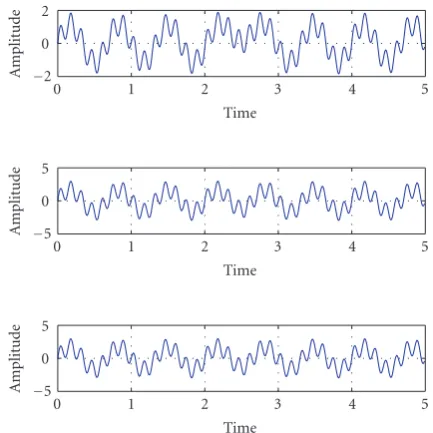
Figure4: The mixtures obtained by mixing the sources ofFigure 3 using a random mixing matrix.
4.2. Separation and localisation of the P3a and P3b
4.2.1. Experiment data
0 0.5 1 1.5 2 2.5 Time (ms)
2 1 0 1 2 3 4 5 6 7
A
m
plitude
Figure 5: The estimated P300 source using the proposed CBSS. CBSS achieves a slightly better representation but with a decrease in mean square error than normal Infomax.
0 0.5 1 1.5 2 2.5
Time (ms) 2
1 0 1 2 3 4 5 6 7 8
A
m
plitude
Figure6: The estimated P300 sources using Infomax. The simu-lated P300 is slightly more distorted than that obtained by CBSS and achieves a higher mean square error.
data were subsequently bandpass filtered (0.1–70 Hz). This frequency range was chosen to be compatible with [26].
The EEG data were recorded for control and schizo-phrenic patients. The Diagnostic and Statistical Manual of Mental Disorders 4th edition (DSM-IV) Axis 1 disorders was used to confirm diagnosis of schizophrenia. Subjects were re-quired to sit alert and still with their eyes closed to avoid any interference. Also, to avoid any muscle artefact, the neck was firmly supported by the back of the chair. The feet were rested on a footstep. The stimuli were presented through ear plugs inserted in the ear. Forty rare tones (1 kHz) were randomly distributed amongst 160 frequent tones (2 kHz). Their in-tensity was 65 dB with 10- and 50-milliseconds duration for
0 200 400 600 800 1000
Time (ms) 5
0 5 10
FZ
0 200 400 600 800 1000
Time (ms) 10
0 10 20
CZ
0 200 400 600 800 1000
Time (ms) 5
0 5 10
PZ
Figure7: Three channel ERP of a schizophrenic patient obtained by averaging 40 related events.
rare and frequent tones, respectively. The subject was asked to press a button as soon as they heard a low tone (1 kHz). The ability to distinguish between low and high tones was confirmed before the start of the experiment. The task is de-signed to assess basic memory processes. ERP components measured in this task included N100, P200, N200, and P3a and P3b.
4.2.2. Separation of P3a and P3b
Firstly, the ERP is obtained by temporally averaging event-related data (40 events), each event producing an EEG of size
n×T, wherenis the number of electrode signals andTis the number of samples of the event. That averaged ERP is also of dimensionsn×T. The advantage of averaging event-related data is not only to enhance the signal, but also to remove non-event-related noise. Secondly, the reference subcompo-nent signal is selected according to the method described in
Section 3.2. Thirdly, CBSS is applied to the ERP (n×T) in order to separate the P300 and its sub-components. Filter-ing (at the Delta range) is applied to the separated sources, based on the knowledge that the main power of the P300 component is in the Delta range [27].Figure 7shows the ERP andFigure 8shows the estimated P3a and P3b sources for a schizophrenic patient.Figure 9shows the ERP andFigure 10
shows the estimated P3a and P3b for a control subject. It can be seen that the P3a component is earlier in latency than the P3b.
4.2.3. Localisation of P3a and P3b
0 100 200 300 400 500 600 700 800 900 1000 Time (ms)
5 0 5
P3a
0 100 200 300 400 500 600 700 800 900 1000 Time (ms)
4 2 0 2 4 6
P3b
Figure8: The separated P3a and P3b from the signals ofFigure 7 using the proposed CBSS algorithms.
0 200 400 600 800 1000
Time (ms) 10
0 10
FZ
0 200 400 600 800 1000
Time (ms) 10
0 10
CZ
0 200 400 600 800 1000
Time (ms) 10
0 10
PZ
Figure9: Three channel ERPs of a control subject obtained by av-eraging 40 related events.
described in Section 3, there may be some trivial solutions (i.e., the points which fall outside the head) which are auto-matically discarded based on geometrical constraints.
The result of the localisation of the P3a and P3b com-ponents is shown inFigure 11for five schizophrenic patients and inFigure 12for five control subjects. It is evident that the P3a and P3b for a schizophrenic patient are closely and irregularly located, whereas for a control subject the P3a and P3b are located in distinct regions.
0 200 400 600 800 1000
Time (ms) 4
2 0 2 4 6
P3a
0 200 400 600 800 1000
Time (ms) 4
2 0 2 4 6
P3b
Figure10: The separated P3a and P3b from the signals ofFigure 9 using the proposed CBSS algorithm.
Figure11: Localisation result for schizophrenic patients. The circles correspond to the P3a and the squares to P3b. The P3a and P3b are closely and irregularly located following no specific pattern.
0 100 200 300 400 500 600 700 800 900 1000 Time (ms)
5 0 5
A
m
plitude
0 100 200 300 400 500 600 700 800 900 1000 Time (ms)
5 0 5 10
A
m
plitude
0 100 200 300 400 500 600 700 800 900 1000 Time (ms)
2 1 0 1 2
A
m
plitude
Figure13: The top figure shows the output obtained by normal Infomax while the middle figure shows the CBSS output and the bottom figure shows the reference signal for a schizophrenic patient.
4.2.4. Comparison between CBSS and Infomax
Some obtained P3a using normal unconstrained Infomax and CBSS is shown here. The results from normal Infomax, CBSS, and the reference signal are shown in Figures13and
14. It is seen that the CBSS produces better results than those of the normal Infomax in terms of highlighting of the rel-evant signals (P3a’s latency is about 260–280 milliseconds). In quantitative terms CBSS can produce results with up to 33% more similarity with the reference signal.2Another
sig-nificance of the proposed CBSS algorithm is that the P3a and P3b are robustly extracted. While Infomax may fail to pro-duce those outputs (due to the nonstationarity of the data and the initialisation procedure), CBSS ensures that the de-sired outputs are always extracted.
4.3. Visual and auditory P300 comparison
The approximate source localisation method described in
Section 3was implemented for audio and visual ERPs sep-arately. This was done to examine any differences in the lo-cations to be further used in diagnosis of the psychiatric dis-orders. A set of EEG was obtained using the same hardware and software but with a 64-electrode cap.
To obtain the visual P300 the experiment consisted of a series of letters displayed successively with a period of 5 sec-onds. The image lasted 100 millisecsec-onds. When a letter was displayed twice in a row, the subject had to press a button,
2In terms of inner product of the output and reference signal of both
meth-ods.
0 100 200 300 400 500 600 700 800 900 1000 Time (ms)
10 5 0 5 10
A
m
plitude
0 100 200 300 400 500 600 700 800 900 1000 Time (ms)
5 0 5 10
A
m
plitude
0 100 200 300 400 500 600 700 800 900 1000 Time (ms)
2 0 2 4
A
m
plitude
Figure14: The top figure shows the output obtained by normal Infomax while the middle figure shows the CBSS output and the bottom figure shows the reference signal for a control subject.
0 0.1 0.2 0.3 0.4 0.5
Time (s) 20
10 0 10 20
A
m
plitude
(mV
)
Figure15: Visual P300 obtained using CBSS.
which should elicit a P3b. Occasionally, a checkerboard was displayed on the screen resulting in a P3a. The experiment lasted about 7 minutes. A similar experiment was performed to obtain the auditory P300. The sounds of different letters were played through ear plugs inserted into the ear. A se-quence of letters was pronounced and when two were pro-nounced in series, the subject had to press a button, which should elicit a P3b. Intermittently, noise sound was played re-sulting in a P3a. The period was again 5 seconds. The exper-iment lasted about 7 minutes. The data which should elicit a P3b were selected for this experiment.
0 0.1 0.2 0.3 0.4 0.5 Time (s)
6 4 2 0 2 4 6
A
m
plitude
(mV
)
Figure16: Auditory P300 obtained using CBSS.
Figure17: Distribution of visual P300 over the scalp electrodes. It can be seen that the P300 is distributed in a different way over the electrodes than the auditory P300.
Figure18: Distribution of auditory P300 over the scalp electrodes. It is seen that the auditory P300 is distributed differently over the electrodes than the visual P300.
data, respectively. Results from two data frames are shown. It is observed that the latency for the visual P300 is longer than for the auditory P300. Another important conclusion is that the projections of the P300 audio and visual sources over the electrode are different. This means that these components are generated in different regions of the brain.
5. CONCLUSIONS
In this paper, a constrained BSS method has been developed to separate and localise the P300 signals and their constituent subcomponents from the EEG/ERP signals. The incorpo-rated constraint minimises the distance between a measured reference signal and the estimated independent components. The proposed CBSS method achieves better performance in terms of extraction of the relevant signals. The algorithm was applied for separation and localisation of both audio and vi-sual P300 sources. The CBSS method was also used to sep-arate and localise the P3a and P3b subcomponents. A num-ber of experiments on healthy subjects and patients suffering from schizophrenia were carried out. As a result, the latency of the P300 for schizophrenic patients was seen to be longer than that of the healthy person. Also, it was concluded that the P3a and P3b subcomponents are often located in com-pletely different regions of the brain for the healthy subject whereas for the schizophrenic patients the sources are closely and irregularly located. Although the localisation algorithm has yet to be modified to mitigate the indeterminacy and to incorporate the nonhomogeneity of the head, the primary outcomes of this work are very valuable for diagnosis, treat-ment, and monitoring certain psychiatric illnesses.
REFERENCES
[1] J. Dien, K. Spencer, and E. Donchin, “Localization of the event-related potential novelty response as defined by prin-cipal components analysis,”Cognitive Brain Research, vol. 17, no. 3, pp. 637–650, 2003.
[2] T. Frodl-Bauch, R. Bottlender, and U. Hegerl, “Neurochem-ical substrates and neuroanatom“Neurochem-ical generators of the event-related P300,”Neuropsychobiology, vol. 40, no. 2, pp. 86–94, 1999.
[3] A. Kok, J. Ramautar, M. De Ruiter, G. Band, and K. Rid-derinkhof, “ERP components associated with successful and unsuccessful stopping in a stop-signal task,”Psychophysiology, vol. 41, no. 1, pp. 9–20, 2004.
[4] J. Polich, “Clinical application of the P300 event-related brain potential,” Physical Medicine and Rehabilitation Clinics of
North America, vol. 15, no. 1, pp. 133–161, 2004.
[5] D. Friedman, Y. Cycowicz, and H. Gaeta, “The novelty P3: an event-related brain potential (ERP) sign of the brain’s evalua-tion of novelty,”Neuroscience & Biobehavioral Reviews, vol. 25, no. 4, pp. 355–373, 2001.
[6] M. Comerchero and J. Polich, “P3a and P3b from typical au-ditory and visual stimuli,”Clinical Neurophysiology, vol. 110, no. 1, pp. 24–30, 1999.
[7] E. Niedermeyer and F. L. da Silva,Electroencephalography,
Ba-sic Problems, Clinical Applications, and Related Fields,
[8] B. Turetsky, E. Colbath, and R. Gur, “P300 subcomponent abnormalities in schizophrenia: I. Physiological evidence for gender and subtype specific differences in regional pathology,”
Biological Psychiatry, vol. 43, no. 2, pp. 84–96, 1998.
[9] B. Turetsky, T. Cannon, and R. Gur, “P300 subcomponent ab-normalities in schizophrenia: III. Deficits in unaffected sib-lings of schizophrenic probands,”Biological Psychiatry, vol. 47, no. 5, pp. 380–390, 2000.
[10] Y.-W. Jeon and J. Polich, “Meta-analysis of P300 and schizophrenia: patients, paradigms, and practical implica-tions,”Psychophysiology, vol. 40, no. 5, pp. 684–701, 2003. [11] A. Cichocki and S.-I. Amari,Adaptive Blind Signal and Image
Processing: Learning Algorithms and Applications, John Wiley
& Sons, New York, NY, USA, 2002.
[12] J. C. Mosher, P. C. Lewis, and R. M. Leahy, “Multiple dipole modeling and localization from spatio-temporal MEGdata,”
IEEE Transactions on Biomedical Engineering, vol. 39, no. 6, pp.
541–557, 1992.
[13] J. C. Mosher and R. M. Leahy, “EEG and MEG source localiza-tion using recursively applied (RAP)music,” inProceedings of the 13th Asilomar Conference on Signals, Systems and Comput-ers, vol. 2, pp. 1201–1207, Pacific Grove, Calif, USA, November 1996.
[14] S. Makeig, A. J. Bell, T.-P. Jung, and T. J. Sejnowski, “Indepen-dent component analysis of electroencephalographic data,” in
Advances in Neural Information Processing Systems, vol. 8, pp.
145–151, MIT Press, Cambridge, Mass, USA, 1996.
[15] S. Makeig, T.-P. Jung, A. J. Bell, D. Ghahremani, and T. J. Sejnowski, “Blind separation of auditory event-related brain responses into independent components,”Proceedings of the
National Academy of Sciences of the United States of America,
vol. 94, no. 20, pp. 10979–10984, 1997.
[16] A. J. Bell and T. J. Sejnowski, “An information-maximization approach to blind separation and blind deconvolution,”
Neu-ral Computation, vol. 7, no. 6, pp. 1129–1159, 1995.
[17] W. Lu and J. C. Rajapakse, “Constrained ICA,” inAdvances
in Neural Information Processing Systems, vol. 13, MIT Press,
Cambridge, Mass, USA, 2000.
[18] W. Lu and J. C. Rajapakse, “Approach and applications of con-strained ICA,”IEEE Transactions on Neural Networks, vol. 16, no. 1, pp. 203–212, 2005.
[19] A. Cichocki, R. Unbehauen, and E. Rummert, “Robust learn-ing algorithm for blind separation of signals,”Electronics Let-ters, vol. 30, no. 17, pp. 1386–1387, 1994.
[20] A. Cichocki and R. Unbehauen,Neural Networks for
Optimisa-tion and Signal Processing, John Wiley & Sons, New York, NY,
USA, 1994.
[21] J. C. Mosher, R. M. Leahy, and P. S. Lewis, “EEG and MEG: forward solutions for inverse methods,”IEEE Transactions on
Biomedical Engineering, vol. 46, no. 3, pp. 245–259, 1999.
[22] N. Von Ellenrieder, C. H. Muravchik, and A. Nehorai, “A meshless method for solving the EEG forward problem,”IEEE
Transactions on Biomedical Engineering, vol. 52, no. 2, pp. 249–
257, 2005.
[23] C.-G. B´enar, R. N. Gunn, C. Grova, B. Champagne, and J. Got-man, “Statistical maps for EEG dipolar source localization,”
IEEE Transactions on Biomedical Engineering, vol. 52, no. 3, pp.
401–413, 2005.
[24] J. Sarvas, “Basic mathematical and electromagnetic concepts of the biomagnetic inverse problem,”Physics in Medicine and
Biology, vol. 32, no. 1, pp. 11–22, 1987.
[25] I. D. Coope, “Reliable computation of the points of intersec-tion of n spheres in n-space,”ANZIAM Journal, vol. 42, no. 5, pp. 461–477, 2000.
[26] B. Karoumi, A. Laurent, F. Rosenfeld, et al., “Alteration of event related potentials in siblings discordant for schizophre-nia,”Schizophrenia Research, vol. 41, no. 2, pp. 325–334, 2000. [27] J. Yordanova and V. Kolev, “The relationship between P300 and event-related theta EEG activity,” Psycoloquy, vol. 7, no. 25, Memory Brain (7), 1996.
Loukianos Spyrou studied for a degree in Electronics with Communications Engi-neering, University of York. He received his M.S. degree in digital signal processing from King’s College London, in 2004. Currently he is at the Centre of Digital Signal Process-ing in CardiffUniversity working towards his Ph.D. His main research interest is signal processing methods for brain signals. His Ph.D. research is focused on the separation,
localisation, and classification of event-related potentials.
Min Jingreceived the M.S. degree in digi-tal signal processing from the King’s College London, University of London, UK, in 2004. Currently she is working towards the Ph.D. degree in signal processing at the Centre of Digital Signal Processing, Institute of Infor-mation System and Integration Technology, CardiffUniversity. Her research interests are in signal processing in biomedical filed. Her Ph.D. research focus is epileptic seizure
pre-diction by fusion of scalp EEG & fMRI, blind source separation, and nonlinear dynamic analysis.
Saeid Saneireceived his Ph.D. degree from Imperial College of Science, Technology, and Medicine, London, in biomedical sig-nal and image processing in 1991. He has been a Member of academic staffin Iran, Singapore, and UK. His major interest is in biomedical signal and image processing, adaptive and nonlinear signal processing, and pattern recognition and classification. He has had a major contribution to
elec-troencephalogram (EEG) analysis such as epilepsy prediction, cog-nition evaluation, and brain computer interfacing (BCI). Within the area of pattern recognition, he has contributed to the design and application of support vector machines (SVMs) and hidden Markov models (HMMs) for classification of signals and images. Currently, he is serving as a Senior Lecturer within the Centre of Digital Signal Processing, CardiffUniversity, UK, and as a Senior Member of IEEE.
Alex Sumichis a Research Psychologist at the Institute of Psychiatry (http://www.iop. kcl.ac.uk). Publications and currently held grants include neuroimaging and neuro-physiological studies of brain dysfunction associated with adult and adolescent psychi-atric illness, specifically schizophrenia, de-pression, ADHD, and conduct disorder. He operates the London-based Brain Resource Company Laboratory, a specialist clinic for