Volume 2007, Article ID 75310,12pages doi:10.1155/2007/75310
Research Article
Efficient MPEG-2 to H.264/AVC Transcoding of
Intra-Coded Video
Jun Xin,1Anthony Vetro,2Huifang Sun,2and Yeping Su3
1Xilient Inc., 10181 Bubb Road, Cupertino, CA 95014, USA
2Mitsubishi Electric Research Labs, 201 Broadway, Cambridge, MA 02139, USA 3Sharp Labs of America, 5750 NW Pacific Rim Boulevard, Camas, WA 98607, USA
Received 3 October 2006; Revised 30 January 2007; Accepted 25 March 2007
Recommended by Yap-Peng Tan
This paper presents an efficient transform-domain architecture and corresponding mode decision algorithms for transcoding intra-coded video from MPEG-2 to H.264/AVC. Low complexity is achieved in several ways. First, our architecture employs direct conversion of the transform coefficients, which eliminates the need for the inverse discrete cosine transform (DCT) and forward H.264/AVC transform. Then, within this transform-domain architecture, we perform macroblock-based mode decisions based on H.264/AVC transform coefficients, which is possible using a novel method of calculating distortion in the transform domain. The proposed method for distortion calculation could be used to make rate-distortion optimized mode decisions with lower complexity. Compared to the pixel-domain architecture with rate-distortion optimized mode decision, simulation results show that there is a negligible loss in quality incurred by the direct conversion of transform coefficients and the proposed transform-domain mode decision algorithms, while complexity is significantly reduced. To further reduce the complexity, we also propose two fast mode decision algorithms. The first algorithm ranks modes based on a simple cost function in the transform domain, then computes the rate-distortion optimal mode from a reduced set of ranked modes. The second algorithm exploits temporal correlations in the mode decision between temporally adjacent frames. Simulation results show that these algorithms provide additional computational savings over the proposed transform-domain architecture while maintaining virtually the same coding efficiency.
Copyright © 2007 Jun Xin et al. This is an open access article distributed under the Creative Commons Attribution License, which permits unrestricted use, distribution, and reproduction in any medium, provided the original work is properly cited.
1. INTRODUCTION
The latest video compression standard, known as H.264/AVC [1], is able to achieve significantly improved compression efficiency over prior standards such as MPEG-2. Due to its superior performance, it is being widely adopted for a broad range of applications, including broadcasting, con-sumer electronics storage, surveillance, video conference and mobile video. As H.264/AVC becomes more widely de-ployed, the number of devices that are capable of decod-ing H.264/AVC bitstreams will grow. In fact, multiformat standard decoder solutions, which have the capability to de-code multiple video compression formats including MPEG-2, H.264/AVC, and VC-1, are becoming available. This will give those in the content delivery chain greater flexibility in the format that video content is authored, edited, transmit-ted, and stored.
However, with the success of MPEG-2 in various appli-cation domains, there exists not only a significant amount of
legacy content, but also equipment for producing MPEG-2 content and networking infrastructure to transmit this con-tent. To minimize the need to upgrade all of this equipment at once and ease the transition to the new H.264/AVC coding format, there is a strong need for efficient transcoding from MPEG-2 to H.264/AVC. This topic has received much atten-tion from the research community in recent years [2–4]. In this paper, we focus on a particular subset of this larger prob-lem, which is the transcoding of intra-coded video.
include tools for coding of 4 : 4 : 4 sampled video and possi-bly lower 4 : 2 : 0 sampling formats as well [6].
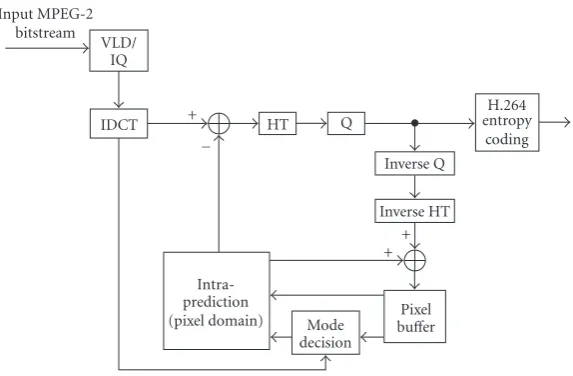
The primary aim of the transcoder in this paper is to pro-vide more efficient network transmission and storage. A con-ventional method of transcoding MPEG-2 intra-coded video to H.264/AVC format is shown inFigure 1. In this architec-ture, the transcoder first decodes an input MPEG-2 video to reconstruct the image pixels, and then encodes the pixels in a frame in the H.264/AVC format. We refer to this architecture as a pixel-domain transcoder (PDT).
It is well known that transform-domain techniques may be simpler since they eliminate the need of inverse transform and forward transform operations. However, in the case of MPEG-2 to H.264/AVC transcoding, the transform-domain approach must efficiently solve the following two problems. The first problem is a transform mismatch, which arises from the fact that MPEG-2 uses a DCT, while H.264/AVC uses a low-complexity integer transform, hereinafter referred to as HT. Therefore, an efficient algorithm for DCT-to-HT coeffi -cient conversion that is simpler than the trivial concatena-tion of IDCT and HT is needed. A number of algorithms that perform this conversion have been recently reported in the literature [7–9]. Since this conversion is an important component of the transform-domain architecture, we briefly describe our previous work [7] and provide a comparison to other works in this paper. The second problem with a transform-domain architecture is in the mode decision. In H.264/AVC, significant coding efficiency gains are achieved through a wide variety of prediction modes. To achieve the best coding efficiency, the rate and distortion for each cod-ing mode are calculated, then the optimal mode is deter-mined. In conventional architectures, the distortion is calcu-lated based on original and reconstructed pixels with a can-didate mode. However, in the proposed transform-domain architecture, this distortion is calculated based on the trans-form coefficients yielded from each candidate mode.
Figure 2 illustrates our proposed transform-domain transcoder, in which the primary areas of focus are high-lighted. InSection 2, we will describe what we refer to as the S-transform, or the DCT-to-HT conversion of transform co-efficients. Its integer implementation is also discussed. Then, in Section 3, we present the architecture for performing a rate-distortion optimized mode decision in the transform domain, including a novel means of calculating distortion in the transform domain. It is noted that the most time con-suming operation in the transcoder is the mode decision pro-cess, which determines the particular method for predictively coding macroblocks.Section 4describes a two fast mode de-cision algorithms that achieve further speedup. Simulation results that validate the efficiency of the various processes and fast mode decision algorithms are discussed inSection 5. Fi-nally, we provide a summary of our contributions and some concluding remarks inSection 6.
2. EFFICIENT DCT-TO-HT CONVERSION
This section summarizes the key elements of our prior work on direct conversion of transform coefficients [7]. We present
the transform matrix itself, review the fast implementation and study the impact of integer approximations. We also dis-cuss some of the related works in this area that have been recently published.
2.1. Transformation matrix
As a point of reference, Figure 3(a) shows a pixel-domain implementation of the DCT-to-HT conversion. The input is an 8×8 block (X) of DCT coefficients. An inverse DCT (IDCT) is applied toXto recover an 8×8 pixel block (x). The 8×8 pixel block is divided evenly into four 4×4 blocks (x1,x2,x3,x4). Each of the four blocks is passed to a corre-sponding HT to generate four 4×4 blocks of transform co-efficients (Y1,Y2,Y3,Y4). The four blocks of transform coef-ficients are combined to form a single 8×8 block (Y). This is repeated for all blocks of the video.
Figure 3(b)illustrates the direct conversion of transform coefficients, which we refer to as theS-transform. LetX de-note an 8×8 block of DCT coefficients, the corresponding HT coefficient blockY, consisting of four 4×4 HT blocks, is given by
Y =S∗X∗ST. (1)
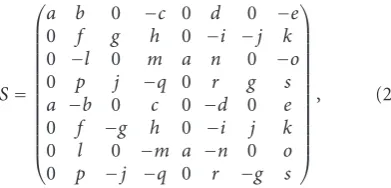
As derived in [7], the kernel matrixSis
S= ⎛ ⎜ ⎜ ⎜ ⎜ ⎜ ⎜ ⎜ ⎜ ⎜ ⎜ ⎜ ⎜ ⎝
a b 0 −c 0 d 0 −e 0 f g h 0 −i −j k 0 −l 0 m a n 0 −o 0 p j −q 0 r g s a −b 0 c 0 −d 0 e 0 f −g h 0 −i j k 0 l 0 −m a −n 0 o 0 p −j −q 0 r −g s
⎞ ⎟ ⎟ ⎟ ⎟ ⎟ ⎟ ⎟ ⎟ ⎟ ⎟ ⎟ ⎟ ⎠
, (2)
where the values a· · ·s are (rounded off to four decimal places)
a=1.4142, b=1.2815, c=0.45, d=0.3007, e=0.2549, f=0.9236, g=2.2304, h=1.7799, i=0.8638, j=0.1585, k=0.4824, l=0.1056, m=0.7259, n=1.0864, o=0.5308, p=0.1169,
q=0.0922, r=1.0379, s=1.975. (3)
2.2. Fast conversion
The symmetry of the kernel matrix can be utilized to design fast implementations of the transform. As suggested by (1), the 2D S-transform is separable. Therefore, it can be achieved through 1D transforms. Hence, we will describe only the computation of the 1D transform.
Intra-prediction
(pixel domain) Mode decision
Pixel buffer +
+ Inverse HT
Inverse Q
HT Q
+
−
IDCT
H.264 entropy
coding VLD/
IQ Input MPEG-2
bitstream
VLD: variable-length decoding (I)Q: (inverse) quantization
IDCT: inverse discrete cosine transform HT: H.264/AVC 4×4 transform
Figure1: Pixel-domain intra-transcoding architecture.
Intra-prediction (HT domain)
Mode decision (HT domain)
Pixel buffer ++ Inverse HT
Inverse Q Q
+
−
DCT-to-HT conversion (S-transform)
H.264 entropy
coding VLD/
IQ Input MPEG-2
bitstream
VLD: variable-length decoding (I)Q: (inverse) quantization
IDCT: inverse discrete cosine transform HT: H.264/AVC 4×4 transform
Figure2: Transform-domain intra-transcoding architecture.
determine Z efficiently from z, which is also shown in
Figure 4as a flow graph,
m1=a×z[1],
m2=b×z[2]−c×z[4] +d×z[6]−e×z[8],
m3=g×z[3]−j×z[7],
m4= f ×z[2] +h×z[4]−i×z[6] +k×z[8], m5=a×z[5],
m6= −l×z[2] +m×z[4] +n×z[6]−o×z[8],
m7=j×z[3] +g×z[7],
m8=p×z[2]−q×z[4] +r×z[6] +s×z[8], Z[1]=m1 +m2,
Z[2]=m3 +m4, Z[3]=m5 +m6, Z[4]=m7 +m8, Z[5]=m1−m2, Z[6]=m4−m3, Z[7]=m5−m6, Z[8]=m8−m7.
Y4
Y3
Y2
Y1
Y1 Y2
Y3 Y4
HT HT HT HT Inverse
DCT x3 x4 x1 x2
x
X
(a)
Y1 Y2
Y3 Y4
Y1
Y2
Y3
Y4
S-transform (Y=S×X×ST)
X
(b)
Figure 3: Comparison between two DCT-to-HT conversion schemes: (a) pixel domain, (b) transform domain.
This method requires 22 multiplications and 22 additions. It follows that the 2D S-transform needs 352(=16×22) mul-tiplications and 352 additions, for a total of 704 operations.
The pixel-domain implementation includes one IDCT and four HT operations. Chen’s fast IDCT implementation [10], which we refer to asthe reference IDCT, needs 256(= 16×16) multiplications and 416(=16×26) additions. Each HT needs 16(=2×8) shifts and 64(=8×8) additions [11]. The four HT then need 64 shifts and 256 additions. It fol-lows that the overall computational requirement of the pixel-domain processing is 256 multiplications, 64 shifts, and 672 additions, for a total of 992 operations.
Thus, the fast S-transform saves about 30% of the oper-ations when compared to the pixel-domain implementation. In addition, the S-transform can be implemented in just two stages, whereas the conventional pixel-domain processing us-ing the reference IDCT requires six stages (four for the refer-ence IDCT and two for the HT). In the following subsection, an integer approximation of the S-transform is described.
2.3. Integer approximation
Floating-point operations are generally more expensive to implement than integer operations, so we also study the
inte-z[8] z[7] z[6] z[5] z[4] z[3] z[2] z[1]
Z[8] Z[4] Z[7] Z[3] Z[6] Z[2] Z[5] Z[1]
−1
−1
−1
−1
p s r
−q
−e k −o g
−j n
−i d
a m h
−c j g
f b
−l a
Figure 4: Fast algorithm for the transform-domain DCT-to-HT conversion.
ger approximation of the S-transform. To achieve an integer representation, we multiplySby an integer that is a power of two, and use the integer transform kernel matrix to perform the transform using an integer-arithmetic. Then, the result-ing coefficients are scaled down by proper shifting. In video transcoding applications, the shifting operations can be ab-sorbed in the quantization. Therefore, no additional opera-tions are required to use integer arithmetic.
Larger integers will generally lead to better accuracy. Typ-ically, the number is limited by the microprocessor on which the transcoding is performed. We assume that most proces-sors are capable of 32-bit arithmetic, so select a number that would satisfy this constraint. However, approximations for other processor constraints could also be determined.
The input DCT coefficients to the S-transform lie in the range of−2048 to 2047 and require 12 bits. The maximum sum of absolute values in any row of S is 6.44, therefore the maximum dynamic range gain for the 2D S-transform is 6.442 = 41.47, which implies log
2(41.47) = 5.4 extra bits or 17.4 bits total to represent the final S-transform re-sults. For 32-bit arithmetic, the scaling factor must be smaller than the square root of 232−17.4, that is, 157.4. The maxi-mum integer satisfying this condition while being a power of two is 128. Therefore, the integer transform kernel matrix isSI=round{128×S}. Similar toS,SIhas the form (2), but with the valuesathroughschanged to the following integers:
a=181, b=164, c=58, d=38, e=33, f =118, g =285, h=228, i=111, j=20, k=62, l=14, m=93, n=139, o=68, p=15, q=12, r=133, s=253.
(5)
Q I J K L
A B C D E F G H a
e i m
b f j n
c g
k o
d h l
p 0
1
3 4
5 6
7
8
Figure5: (a) Neighboring samples “A-Q” are used for prediction of samples “a-p.” (b) Prediction mode directions (except DC Pred).
after the IDCT and for intermediate values within the HT transform itself.
2.4. Discussion
The number of clock cycles required to execute different types of operations are machine dependent. In the above, it is assumed that integer addition, integer multiplication, and shifts consume the same number of clock cycles. However, to make the comparison more complete, let us assume that a multiplication needs 2 cycles and an addition/shift needs 1 cycle, which is the general case for TI C64 family DSP proces-sors. The S-transform would then need 1056(352∗2 + 352) cycles, while the conventional pixel-domain approach would need 1248(256∗2 + 64 + 672) cycles. In addition, the above calculation has not taken into account that the reference IDCT needs floating point operations, which typically is more expensive than integer operations. Therefore, the pro-posed coefficient conversion is still more efficient.
Recently, there have been new algorithms developed for converting DCT coefficients to HT coefficients. One algo-rithm uses a factorized form of the 8×8 DCT kernel ma-trix [8]. Multiplications in the process of matrix multiplica-tions are replaced by addimultiplica-tions and shifts. However, this pro-cess introduces approximation errors and transcoding qual-ity suffers. Following Shen’s method, and taking advantage that the HT transform kernel matrix can be approximately decomposed to the 4×4 DCT transform kernel, a new al-gorithm was proposed in [9], where the conversion matrix is decomposed to sparse matrices. This algorithm is shown to be more efficient and more accurate than [8]. Although this approach has advantage in terms of computational com-plexity, it still has nontrivial approximation errors compared to our approach. More detailed comparison of the above al-gorithms could be found in [9]. Therefore, we believe that our proposed algorithm is preferred for high-quality appli-cations.
3. TRANSFORM-DOMAIN MODE
DECISION ARCHITECTURE
This section describes a transform-domain mode decision architecture, and presents a method of calculating distortion required for cost calculations in the mode decision process.
3.1. Conventional mode decision
Let us first consider the conventional H.264 pixel-domain mode decision (as implemented in the JM reference soft-ware), and in particular, the rate-distortion optimized (RDO) decision for the Intra 4×4 modes.Figure 5(a) illus-trates the candidate neighboring pixels “A-Q” used for pre-diction of current 4×4 block pixels “a-p.” Figure 5(b) il-lustrates the eight directional prediction modes. In addition, DC prediction (DC Pred) can also be used.
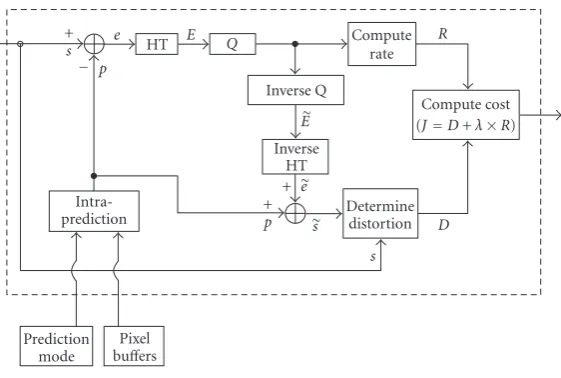
Consider the rate-distortion calculation in a video en-coder withRDO on, the conventional calculation of the La-grange cost for one coding module (in this case for one 4×4 luma block) is shown inFigure 6. The prediction residual is transformed, quantized and entropy encoded to determine the rate,R(m), for a given modem. Then, inverse quantiza-tion and inverse transform are performed and then compen-sated with the prediction block to get the reconstructed sig-nal. The distortion, denoted SSDREC(m), is computed as the sum of squared distance between the original block,s, and the reconstructed block,s(m):
SSDREC(m)= s−s(m) 2
2, (6)
where · pis theLp-norm. The Lagrange cost is computed
using the rate and distortion as follows:
Cost4×4=SSDREC(m) +λM∗R(m), (7)
where λM is the Lagrange multiplier, which may be
calcu-lated as a function of the quantization parameter. The opti-mal coding mode corresponds to the mode yielding the min-imum cost.
Besides this RDO mode selection, a low-complexity algo-rithm, that is, withRDO off, would only calculate the sum of absolute distance of the Hadamard-transformed prediction residual signal:
SATD(m)= Ts−s(m) 1, (8)
wheres(m) is the prediction signal for the modem. In this case, the cost function would then be given by
Cost4×4=SATD(m) +λM∗4∗
1−δm=m∗, (9)
wherem∗is the most probable mode for the block.
3.2. Transform-domain mode decision
The proposed transform-domain mode decision calculates the Lagrange cost for each mode according toFigure 7, which is based on our previous work on H.264 encoding [12]. Com-pared to the pixel-domain approach, the transform-domain implementation has several major differences in terms of computation involved, which are discussed below.
Prediction mode
Pixel buffers
Intra-prediction +
+
p s e
Determine distortion D
Inverse HT
E
Inverse Q
Compute cost (J=D+λ×R)
R
Compute rate
Q E
HT
p s
−
+ e
s
Figure6: Pixel-domain RD cost calculation.
Prediction mode
Pixel buffer Intra-prediction
HT
−
+ S-transform
E
Determine distortion (HT-domain)
D
Inverse Q
E
Compute cost (J=D+λ×R)
R
Determine rate
Q
Figure7: Transform-domain RD cost calculation.
Second, instead of operating on the prediction residual pixels, the HT now operates on the prediction signals. In [12], we have shown that the HT of some intra-prediction signals are very simple to compute. For example, there is only one nonzero DC element in the transformed prediction sig-nal for DC Pred mode. Therefore, additiosig-nal computatiosig-nal saving are achieved.
3.3. Distortion calculation in transform domain
As described in the previous subsection and indicated in
Figure 7, the distortion is calculated in the transform do-main, or HT domain to be precise. Since the HT is not an orthonormal transform, it does not preserve the L2 norm (energy). However, the distortion can still be calculated with proper coefficient weighting [12].
Lets = p+edenote the reconstructed signal, and let s = p+e denote the original input signal, wheree ande
are the prediction residual error signal and the reconstructed residual signal, respectively, and p is the prediction signal. The pixel-domain distortion, SSDREC(m), is given by (6). In the following, we derive the transform-domain distortion calculation.
First, we rewrite (6) in matrix form:
D=trace(s−s)×(s−s)T, (10)
wheres(m) is replaced withsfor simplicity. It follows that
D=trace(e−e)×(e−e)T. (11)
Let E be the HT transformed residual signal and let Ebe the reconstructed HT transform coefficients through inverse scaling and inverse transform. We then have the following:
e=H−1×E×HT−1, (12)
e=Hinv×E× HinvT
1 2 3 4 5 6 7 8 Number of modes
0.75 0.8 0.85 0.9 0.95 1 M o d e p red ict io n accur acy
Fast mode decision algorithm verification
Figure8: Number of test modes versus accuracy.
whereH andHinv are the kernel matrices the forward HT transform and inverse HT transform used in the H.264/AVC decoding process, respectively, and are given by
H= ⎛ ⎜ ⎜ ⎜ ⎝
1 1 1 1 2 1 −1 −2 1 −1 −1 1 1 −2 2 −1
⎞ ⎟ ⎟ ⎟ ⎠, Hinv=
⎛ ⎜ ⎜ ⎜ ⎜ ⎜ ⎜ ⎜ ⎜ ⎜ ⎜ ⎝
1 1 1 1 2 1 1
2 −1 −1 1 −1
2 −1 1 1 −1 1 −1
2 ⎞ ⎟ ⎟ ⎟ ⎟ ⎟ ⎟ ⎟ ⎟ ⎟ ⎟ ⎠ . (14)
Note that in (13), the scaling after inverse HT in the decoding process is already taken care of by the denominator 64. It is easy to verify that
Hinv=H−1×M1,
HinvT =M1×
HT−1, (15)
whereM1 = diag(4, 5, 4, 5). It follows from (12), (13), and (15) that
e−e=H−1×E×HT−1−Hinv×E× HinvT
64
=H−1×
E−M1×E×M1 64
×HT−1
=H−1×E−E⊗W 1
×HT−1,
(16)
where⊗operator represents a scalar multiplication or entry-wise multiplication, andW1is given by
W1= 1 64 ⎛ ⎜ ⎜ ⎜ ⎝
16 20 16 20 20 25 20 25 16 20 16 20 20 25 20 25 ⎞ ⎟ ⎟ ⎟
⎠. (17)
Initial empty buffer
MB0 (0,0) MB0 (1,0) MB0 (0,1) MB0 (1,1) MB0 (0,0) MB1 (1,0) MB0 (0,1) MB1 (1,1) MB0 (0,0) MB1 (1,0) MB2 (0,1) MB1 (1,1) Update buffer
for all MBs in frame
Update buffer for MBs (1, 0) and (1, 1)
Update buffer for MB (0, 1) N N N N Frame 0 R N R N Frame 1 R R N R Frame 2
Figure9: Example of buffer updating process used for mode deci-sion based on temporal correlation.N indicates that a new mode decision has been made, whileRindicates that the mode decision of the previously coded macroblock is reused.
LetΔE=E−E⊗W1, and substituting (16) into (11) gives
D=traceH−1×ΔE×HT−1×H−1×ΔET×HT−1. (18)
DenoteM2 =(HT)−1×H−1 =diag(0.25, 0.1, 0.25, 0.1), we also have (HT)−1=M
2×H, which then gives
D=traceH−1×ΔE×M2×ΔET×M2×H
=traceΔE×M2×ΔET×M2
= ΔE⊗W2 2 2
, (19)
whereW2is given by
W2= ⎛ ⎜ ⎜ ⎜ ⎜ ⎜ ⎜ ⎜ ⎜ ⎜ ⎜ ⎜ ⎜ ⎝ 1 4 1 √ 40 1 4 1 √ 40 1 √ 40 1 10 1 √ 40 1 10 1 4 1 √ 40 1 4 1 √ 40 1 √ 40 1 10 1 √ 40 1 10 ⎞ ⎟ ⎟ ⎟ ⎟ ⎟ ⎟ ⎟ ⎟ ⎟ ⎟ ⎟ ⎟ ⎠ . (20)
ExpandingΔEgives the final forms of the transform-domain distortion:
DHT(m)= E−E(m) ⊗W1
⊗W2 22. (21)
Thus far, we have shown that with weighting matricesW1 andW2to compensate for the different norms of HT, inverse HT and H.264/AVC quantization design, we can calculate the SSD distortion in the HT domain using (21).
In what follows, we analyze the computational complex-ity of the proposed distortion calculation. All following dis-cussions are based on a 4×4 block basis. In (21), to avoid floating point operation in computing (E(m) ⊗W1), we take the 1/64 constant out of theL2-norm operator to yield
DHT(m)= 1
642 64∗E−E(m) ⊗
WI1
whereWI1 = 64∗W1 is now an integer matrix. LetY = 64∗E−E(m) ⊗WI1, and substitutingW2into (22) gives
DHT= 1 642
Y(1, 1)2+Y(1, 3)2+Y(3, 1)2+Y(3, 3)2 16
+Y(2, 2)
2+Y(2, 4)2+Y(4, 2)2+Y(4, 4)2
100
+Y(1, 2)
2+Y(1, 4)2+Y(2, 1)2+Y(4, 1)2
40
+Y(2, 3)
2+Y(3, 2)2+Y(3, 4)2+Y(4, 3)2
40
.
(23)
Compared to the pixel-domain distortion calculation in (6), the additional computations include computingY, specifically 64∗EandE(m) ⊗WI1, 1 shift (/16), and 2 integer divisions. In computingY, 64∗Eneeds 16 shifts, but it only needs to be precomputed once for all modes to be evaluated. ComputingE(m) ⊗WI1requires 16 integer multiplications. Overall, the additional operations at most include 16 multi-plications, 2 divisions, and 17 shifts, for a total of 35 opera-tions.
On the other hand, to calculate the distortion using the pixel-domain method according to (6), inverse transform and reconstruction are necessary to reconstructs. The in-verse transform needs 64 additions and 16 shifts [13] and the reconstruction needs 16 additions (subtractions). Therefore, the additional operations compared to (6) are 80 additions and 16 shifts, for a total of 96 operations.
From the above analysis, it is apparent that the proposed transform-domain distortion calculation is more efficient than the traditional pixel-domain approach. It should also be noted that the proposed mode decision architecture has additional advantages as explained inSection 3.2.
4. FAST MODE DECISION ALGORITHMS
4.1. Ranking-based mode decision
For optimal coding performance, the H.264 coder utilizes Lagrange coder control to optimize mode decisions in the rate-distortion sense. When lower complexity is desired, the SATD cost in (9) is used, which requires much simpler com-putation. Using the SATD cost reduces coding performance since the cost function is only an approximation of the ac-tual RD cost given by (7). In this subsection, we propose a fast intra mode decision algorithm that is based on the fol-lowing observation: although choosing the mode with the smallest SATD value often misses the best mode in the RD sense, the best mode usually contains smaller SATD cost. In other words, the mode rankings according to the two cost functions are highly correlated.
The basic idea is to rank all candidate modes using the less complex SATD cost, and then evaluate Lagrange RD costs only for the few best modes decided by the ranking. Based on the input HT coefficients of prediction residual signal, the algorithm is described in the following.
PDT TDT TDT-C1 TDT-C2 TDT-C3 TDT-R RDOoff
0 10 20 30 40 50 60 70 80 90 100
(%
)
Akiyo Mobile Stefan
Figure 10: Complexity of proposed transcoders (%) relative to PDT. The threshold values used for Akiyo for TDT-C1, TDT-C2, TDT-C3 are 512, 1024 and 2048 respectively, and for mobile and Stefan, they are 12228, 16834, 24576, and 4096, 12228, 16384, re-spectively.
First, we compute the HT domainc1 for all candidate modes based on normalized HT-domain residual coeffi -cients:
c1(m)= (S−S(m)
⊗W2 1+λM∗4∗
1−δm=m∗. (24)
Then, we sort the modes according toc1in ascending or-der, putting the firstksmallest modes in the test setT. Next, we add DC Pred intoTif it is not inTalready. For the modes inT, compute
c2(m)= E−E⊗W1
⊗W2 2 2
+λM∗R(m). (25)
We finally select the best mode according toc2(m).
Note that in calculating (9), instead of using Hadamard transform, the distortion SATD is defined as the SAD of HT coefficients since they are already available in the transform-domain transcoder. The parameterkcontrols the complexity-quality tradeoff. To verify the correlations be-tween rankings usingc1andc2, a simple experiment is per-formed. We collect the two costs for all luma 4×4 blocks in the first frame of all CIF test sequences (see next section) coded with QP=28, and then count the percentage of times when the best mode according toc2is in the test setT. This is called the mode prediction accuracy. The results are plotted inFigure 8askversus accuracy. The strong correlation be-tween the two costs is evident in the high accuracies shown. In this work,kis set to be 3.
4.2. Exploiting temporal correlation
Table1: RD performance comparisons with QP = 27. Bitrate: kbps, PSNR: dB.
Akiyo Foreman Container Stefan
PDT Bitrate 1253.2 1695.48 2213.6 3807.4 PSNR 40.40 37.30 36.24 34.63
TDT Bitrate 1577.4 2229.1 2905.1 4812.1 PSNR 40.38 37.28 36.21 34.63
TDT-R Bitrate 1579.1 2233.3 2907.9 4809.2 PSNR 40.35 37.27 36.18 34.57
Table2: RD performance comparisons with QP = 30. Bitrate: kbps, PSNR: dB.
Akiyo Foreman Container Stefan
PDT Bitrate 1253.2 1659.48 2213.6 3807.4 PSNR 38.63 35.84 34.77 33.26
TDT Bitrate 1258.04 1654.16 2207.19 3795.8 PSNR 38.59 35.83 34.75 33.25
TDT-R Bitrate 1257.72 1656.48 2208.46 3789.8 PSNR 38.59 35.82 34.72 33.19
[14], we proposed a fast mode decision algorithm for intra-only encoding that exploits the temporal correlation in mode decisions of adjacent pictures. In this subsection, we present the corresponding algorithm that could be within the context of the transform-domain transcoding architecture.
One key step to exploit temporal correlations of mac-roblock modes is to first measure the difference between the current macroblock and its collocated macroblock in the previously coded picture. If they are close enough, the cur-rent macroblock will reuse the mode decision of its collo-cated macroblock and the entire mode decision process is skipped. In our earlier work, we measured the degree of correlation between two macroblocks in the pixel domain according to a difference measure that accounted not only for the differences between collocated macroblocks, but also the pixels used for intra-prediction of that macroblock. This pixel-domain distance measure may not be applied in the transform-domain architecture since we do not have access to pixel values. We propose to use a distance measure cal-culated in the transform domain as follows to measure the temporal correlation:
D=S−Scol1, (26)
whereS is the HT coefficients of current macroblock, and Scolis the HT coefficients of the collocated macroblock. Note that we did not try to include the pixels outside of current macroblock that may be used for intra-prediction. These pix-els are difficult to include in the transform-domain distance measure. However, our simulations results show that the ex-clusion of these pixels did not cause noticeable performance penalty.
for all MBs in picture do
ComputeDbetween the current MB and associated MB stored in the buffer based on (26)
ifD > THthen
Perform mode decision for the current MB Update buffer with current MB data else
Reuse mode decision of the collocated MB in the previous picture
end if end for
Algorithm1: Mode decision based on temporal correlation.
The next important element of the proposed algorithm is to prevent accumulation of the distortion resulting from mode reuse. This requires an additional buffer that is up-dated with coefficients of the current input macroblock only when there is a new mode decision. This strategy allows for differences to be measured based on the original macroblock that was used to determine a particular encoding mode. If the differences were taken with respect to the immediately previ-ous frame, then it would become possible that small diff er-ences, that is, less than the threshold, over time would not be detected. In that case, an encoding mode would continue to be reused even though the macroblock characteristics over time have changed significantly.
Figure 9shows the buffer updating process for several frames containing four macroblocks each. For Frame 0, the mode decisions for all four macroblocks are newly de-termined and denoted with an N. The macroblock data from frame 0 {MB0(0, 0),MB0(0, 1),MB0(1, 0),MB0(1, 1)} are then stored in the frame buffer. For Frame 1, the mode decision has determined that the encoding modes for mac-roblocks (0,0) and (0,1) will be reused, which are denoted with anR, while the encoding modes for macroblocks (1,0) and (1,1) are newly determined. As a result, the buffer is up-dated with the corresponding macroblock data from frame 1
{MB1(1, 0),MB1(1, 1)}; data for other macroblocks remain unchanged. For Frame 2, only macroblock (0,1) has been newly determined, therefore the only update to the frame buffer is{MB2(0, 1)}.
It is evident from the above example that the buffer is composed of a mix of macroblock data from different frames. The source of the data for each macroblock repre-sents the frame at which the encoding mode decision was been determined. The data in the buffer is used as a refer-ence to determine whether the current input macroblock is sufficiently correlated and whether the macroblock encoding mode could be reused.
0.8 0.9 1 1.1 1.2 1.3 1.4 1.5 1.6 1.7 1.8 1.9 2 2.1 2.2 Bitrate (Mbps)
34 35 36 37 38 39 40 41 42
PS
NR
-Y
(d
B
)
PDT TDT TDT-C(512)
TDT-C(1024) TDT-C(2048) PDT-RDOoff
(a)
3 4 5 6 7 8 9
Bitrate (Mbps) 26
27 28 29 30 31
PS
NR
-Y
(d
B
)
PDT TDT TDT-C(12228)
TDT-C(16834) TDT-C(24576) PDT-RDOoff
(b)
2 2.5 3 3.5 4 4.5 5 5.5 6 6.5 Bitrate (Mbps)
29 30 31 32 33 34 35 36
PS
NR
-Y
(d
B
)
PDT TDT TDT-C(4096)
TDT-C(12228) TDT-C(16834) PDT-RDOoff
(c)
Figure11: RD performance evaluation of TDT-C transcoder with different thresholds: (a) Akiyo; (b) Mobile; (c) Stefan.
Table3: RD performance comparisons with QP = 33. Bitrate: kbps, PSNR: dB.
Akiyo Foreman Container Stefan
PDT Bitrate 993.2 1249.0 1673.9 2904.8 PSNR 36.72 34.29 33.19 31.59
TDT Bitrate 993.2 1246.6 1671.3 2899.5 PSNR 36.74 34.27 33.18 31.58
TDT-R Bitrate 993.9 1248.0 1673.4 2896.5 PSNR 36.73 34.27 33.16 31.52
5. SIMULATION RESULTS
In this section, we report results to demonstrate the ef-fectiveness of the proposed architectures and algorithms. We compare the coding efficiency and complexity of the pixel-domain transcoder (PDT) to the transform-domain transcoder (TDT) with RDO turned on. The PDT, as shown inFigure 1, uses conventional coefficient conversion method and conventional mode decision algorithm. Chen’s fast IDCT implementation [10] is used in MPEG-2 decoding. In TDT, as shown in Figure 2, the proposed transcoding architecture, integer DCT-to-HT conversion (Section 2.3), and transform-domain mode decision (Section 3) are imple-mented. We also evaluate the performance of the proposed fast mode decision algorithms (Section 4) within the context of the TDT architecture, namely the fast mode decision based on ranking (TDT-R) and the algorithm based on temporal correlation (TDT-C). Comparisons are made to the PDT ar-chitecture with RDO on and off.
The experiments are conducted using 100 frames of stan-dard test sequences at CIF resolution. The sequences are all intra-encoded at a frame rate of 30 Hz and bit-rate of 6 Mbps using the public domain MPEG-2 software [15]. The result-ing bitstreams are then transcoded usresult-ing the various archi-tectures. The transcoders are implemented based on MSSG MPEG-2 software codec and H.264 JM7.6 reference code [16].
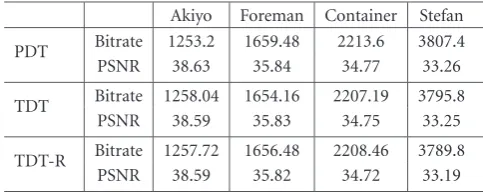
Tables1–3 summarize the RD performance of the ref-erence transcoder, that is, PDT, and proposed transcoders, TDT and TDT-R, whileFigure 10shows the complexity re-sults for two sequences and QP 30. Rere-sults are similar for other sequences and QP values. It is noted that the complex-ity is measured by the CPU time consumed by transcoders. All simulations are performed on a PC running Windows XP with an Intel Pentium-4 CPU 2.4 GHz. The software is com-piled with the Intel C++ Compiler v7.0. Several key observa-tions regarding the results are discussed below.
decision process. Recall that both architectures employ RDO, but the mode decision in the transform-domain architec-ture performs the distortion calculation in the transform-domain, thereby eliminating certain operations.
If we further analyze the performance of TDT-R, we ob-serve that this algorithm saves approximately 50% of the computation compared to the PDT architecture. Compared to the TDT architecture with full RDO, up to 30% savings are achieved. Furthermore, these computational savings are achieved with negligible degradation in PSNR. The results show less than 0.1 dB loss for all test cases.
The simulation results using various threshold values for transcoder TDT-C are shown inFigure 11. In this figure, each RD curve is generated using 5 different QP values: 24, 27, 30, 33, and 36. As references, we plot PDT with RDO on and off, as well as TDT. The complexity comparison is shown in Figure 10. It can be seen that different threshold values provide different tradeoffs of RD performance and computa-tional complexities. Relative to TDT, up to 40% computation can be saved with less than 0.2 dB loss in quality. These results show that turning off RDO provides the lowest complex-ity, but also results in lower quality. For the three sequences shown in the figure, the quality degradation is in the range of 0.2–0.4 dB. The benefits of the TDT-C scheme is that it offers flexible tradeoffs between coding efficiency and complexity.
Both TDT-R and TDT-C provide significant saving in complexity relative to exhaustive RDO algorithm. It appears though that TDT-R is a more effective approach since it in-curs almost no loss in RD performance and achieves compa-rable complexity reduction to TDT-C. Perhaps a combina-tion of the two approaches would yield further complexity reduction and better tradeoff.
6. CONCLUSIONS
We proposed an efficient transform-domain MPEG-2 to H.264 intra-video transcoder. The transform-domain archi-tecture is equivalent to the conventional pixel-domain im-plementation in terms of functionality, but it has signifi-cantly lower complexity with no loss in coding efficiency. We achieved complexity reduction with a transform-domain architecture that utilizes a direct DCT-to-HT coefficient conversion and a transform-domain mode decision. The transform-mode decision is enabled by calculating distortion based on transform coefficients. We also presented two fast mode decision algorithms that are able to operate within the context of the transform-domain architecture. Both of these algorithms demonstrated that further reductions in com-plexity with negligible loss in quality could be achieved.
REFERENCES
[1] “ITU-T Rec. H.264—ISO/IEC 14496-10: Advanced Video Coding,” 2003.
[2] Z. Zhou, S. Sun, S. Lei, and M.-T. Sun, “Motion information and coding mode reuse for MPEG-2 to H.264 transcoding,” in Proceedings of IEEE International Symposium on Circuits and Systems (ISCAS ’05), vol. 2, pp. 1230–1233, Kobe, Japan, May 2005.
[3] X. Lu, A. M. Tourapis, P. Yin, and J. Boyce, “Fast mode deci-sion and motion estimation for H.264 with a focus on MPEG-2/H.264 transcoding,” in Proceedings of IEEE International Symposium on Circuits and Systems (ISCAS ’05), vol. 2, pp. 1246–1249, Kobe, Japan, May 2005.
[4] T. Qian, J. Sun, D. Li, X. Yang, and J. Wang, “Transform do-main transcoding from MPEG-2 to H.264 with interpolation drift-error compensation,”IEEE Transactions on Circuits and Systems for Video Technology, vol. 16, no. 4, pp. 523–534, 2006. [5] K. B. Bruce, L. Cardelli, and B. C. Pierce, “Comparing object encodings,” inProceedings of 3rd International Symposium on Theoretical Aspects of Computer Software (TACS ’97), M. Abadi and T. Ito, Eds., vol. 1281 ofLecture Notes in Computer Science, pp. 415–438, Springer, Sendai, Japan, September 1997. [6] H. Yu, “Joint 4:4:4 Video Model (JFVM) 2,” JVT-R205, 2006. [7] J. Xin, A. Vetro, and H. Sun, “Converting DCT coefficients
to H.264/AVC transform coefficients,” inProceedings of IEEE Pacific-Rim Conference on Multimedia (PCM ’04), vol. 2, pp. 939–946, Tokyo, Japan, November 2004.
[8] B. Shen, “From 8-tap DCT to 4-tap integer-transform for MPEG to H.264/AVC transcoding,” inProceedings of the In-ternational Conference on Image Processing (ICIP ’04), vol. 1, pp. 115–118, Singapore, October 2004.
[9] C. Y. Park and N. I. Cho, “A fast algorithm for the conversion of DCT coefficients to H.264 transform coefficients,” in Proceed-ings of the International Conference on Image Processing (ICIP ’05), vol. 3, pp. 664–667, Genova, Italy, September 2005. [10] W.-H Chen, C. Smith, and S. Fralick, “A fast computation
al-gorithm for the discrete cosine transform,”IEEE Transactions on Communications, vol. 25, no. 9, pp. 1004–1009, 1977. [11] H. S. Malvar, A. Hallapuro, M. Karczewicz, and L. Kerofsky,
“Low-complexity transform and quantization in H.264/AVC,” IEEE Transactions on Circuits and Systems for Video Technology, vol. 13, no. 7, pp. 598–603, 2003.
[12] J. Xin, A. Vetro, and H. Sun, “Efficient macroblock coding-mode decision for H.264/AVC video coding,” inProceedings of the 24th Picture Coding Symposium (PCS ’04), pp. 53–58, San Francisco, Calif, USA, December 2004.
[13] A. Hallapuro, M. Karczewicz, and H. Malvar, “Low complexity transform and quantization—part II: extensions,” JVT-B039, 2002.
[14] J. Xin and A. Vetro, “Fast mode decision for intra-only H.264/AVC coding,” inProceedings of the 25th Picture Coding Symposium (PCS ’06), Beijing, China, April 2006.
[15] “MPEG-2 encoder/decoder v1.2,” 1996, by MPEG Software Simulation Group,http://www.mpeg.org/MPEG/MSSG/. [16] “H.264/AVC reference software JM7.6,” 2003,http://iphome
.hhi.de/suehring/tml/download/.
Jun Xin received the B.E. degree from Southeast University, Nanjing, China, in 1993, the M.E. degree from Institute of Automation, Chinese Academy of Sciences, Beijing, China, in 1996, and the Ph.D. de-gree from University of Washington, Seat-tle, Wash, USA in 2002, all in electrical en-gineering. Since August 2003, he has been with Mitsubishi Electric Research Laborato-ries (MERL), Cambridge, Mass, USA. From
Anthony Vetroreceived the B.S., M.S., and Ph.D. degrees in electrical engineering from Polytechnic University, Brooklyn, NY. He joined Mitsubishi Electric Research Labs, Cambridge, Mass, USA, in 1996, where he is currently a Senior Team Leader and re-sponsible for research related to the encod-ing, transport, and consumption of multi-media content. He has published more than 100 papers and has been an active member
of the MPEG and JVT Standardization Committee for several years. He is currently serving as an Editor for multiview video coding amendment of H.264/AVC. Dr. Vetro serves on the program com-mittee for various conferences and has held several editorial posi-tions. He is currently an Associate Editor for IEEE Signal Processing Magazine and Chair-Elect of the Technical Committee on Multi-media Signal Processing of the IEEE Signal Processing Society, as well as the Technical Committees on Visual Signal Processing and Communications and Multimedia Systems and Applications of the IEEE Circuits and Systems Society. He recently served as a Confer-ence Chair for ICCE 2006 and a Tutorials Chair for ICME 2006, and has been a Member of the Publications Committee of the IEEE Transactions on Consumer Electronics since 2002. Dr. Vetro has also received several awards for his work on transcoding, including the 2003 IEEE Circuits and Systems CSVT Transactions Best Paper Award and the 2002 Chester Sall Award. He is a Senior Member of the IEEE.
Huifang Sun graduated from Harbin En-gineering Institute, Harbin, China, and re-ceived the Ph.D. degree from University of Ottawa, Canada. He joined Electrical Engi-neering Department of Fairleigh Dickinson University as an Assistant Professor in 1986 and was promoted to an Associate Profes-sor before moving to SarnoffCorporation in 1990. He joined SarnoffLab as a mem-ber of technical staffand was promoted to a
Technology Leader of Digital Video Communication later. In 1995, he joined Mitsubishi Electric Research Laboratories (MERL) as Se-nior Principal Technical Staffand was promoted as Vice President and Fellow of MERL and Deputy Director of Technology Lab in 2003. His research interests include digital video/image compres-sion and digital communication. He has coauthored two books and more than 130 journal/conference papers. He holds 43 US patents and has more pending. He received Technical Achievement Award for optimization and specification of the Grand Alliance HDTV video compression algorithm in 1994 at SarnoffLab. He received the Best Paper Award of 1992 IEEE, Transaction on Consumer Elec-tronics, the Best Paper Award of 1996 ICCE, and the Best Paper Award of 2003 IEEE Transaction on CSVT. He is now an Asso-ciate Editor for IEEE Transaction on Circuits and Systems for Video Technology and was the Chair of Visual Processing Technical Com-mittee of IEEE Circuits and System Society. He is an IEEE Fellow.
Yeping Su was born in Rugao, Jiangsu, China. He received his Ph.D. degree (2005) in electrical engineering at the University of Washington, Seattle. He interned for EnGenius Technologies at Bellevue, Wash, USA (2001), Microsoft Research at Red-mond, Wash, USA (2003), and Mitsubishi Electric Research Labs at Cambridge, Mass, USA (2004). He was a member of technical staffat Thomson Corporate Research Lab