Inter-Office (VJem.ornndum
To
CSL, SSL
FromJim Mitchell
Subject
What Mesa needs in an Alto
Virtual Memory Scheme
Date
June 12,1274.
Location
PARC-CSL
Organizlltion
Since there has been much discussion of Virtual Memory (VM) schemes
in the context of Alto "Gold Coins", it seemed appropriate that the
desires of the Mesa group be specified. This memo is a reasonably high
level description of the characteristics which would be helpful to Mesa
in a VM scheme.
Mesa Object Files
A Mesa Object Module (file) is composed of two main parts, each of
which is a contiguous group of pages in the file:
header info
n pages
object code
literals
symbol
tables
pages
Generally, s is larger than n, and sometimes s is twice as large as n.
The action of "loading" a Mesa module requires only that the code
pages be mapped into memory.
The code is never altered in any way - all
external connections (generally procedures and ports) are in the data
associated with a program. A Mesa routine (procedure or coroutine) is
uniquely identified by a frame containing its state and local variables,
and many routines may share the code in an object module. The information
which allows Mesa to associate a symbol table and code with a routine is
kept in a frame called a creator frame. The act of "declaring" an object
'file to Mesa causes a creator frame for that file to be made.
Instances
creator; the result is a new routine. The cost of creating new instances
is roughly comparable with the cost of a procedure call.
The header information in the code block of an object file contains
sufficient information to enable the Mesa loader to manufacture a creator
for it.
Abstractions for Managing (Overlaying) Code Blocks
A contiguous set of file pages is called a
~group in Mesa, and
is identified by three values:
filehandle: some handle on a file by which the pages of the file
can be named (for example, a JFN in Tenex);
pagebase: the page in the file which corresponds to page zero in
the page group;
size: the
numb~rof pages in the group.'
A page group is accessed by a PG-handle (actually a protected [sealed]
pointer) and page groups may be created, destroyed, and swapped into
memory or out. More than one page group may, in principle, be associated
with the same pages in a file. On Tenex this is accomplished by PMAPping
the appropiate file pages into the Tenex VM.
One special kind of page
group, called a Window group, is provided: the pagebase and size
attri-butes of such a group are alterable after it is initially set up, and it
can thus "window" pages of the file to which it is attached.
The code and symbol table parts of a Mesa module are each modelled as
a fixed page group by the Mesa loader, overlaying and debugging software.
The main implication of this is that Mesa code is "svJapped" (overlayed) in
units corresponding to the code in a single module.
Symbol tables, being
separately swappable, only consume VM space when needed by debugging or
dynamic (LISP-like) binding mechanisms.
The following diagram portrays the relationships between the Tenex
page-grouped VM as seen by Mesa, File memory, and Maxc disk storage (see
next page, please):
-2-D:~k
s
CI.) I'v..~-L. One obvious conclusion from this diagram is that the logical grouping
of fi1e pages which Mesa considers useful is not at all maintained at the
level of disk storage. A second observation is that the Tenex-provided VM
is being treated as a real memory into which a much larger VM, composed
of page groups, is mapped.
For obvi ous effi ci ency reasons_ on Tenex, only
Mesa code and symbol tables are considered swappable because pointers to
them can be controlled by software (for not-in-memory traps, etc.).
Mesa/Alto
We would like to propose a VM scheme for Altos which supports a
struc-ture such as the following:
A«o YM
-The main things to notice about this second diagram are the following:
(1) As well as logical page groups in VM, there are real page groups in
files which correspond to real page groups on disk storage;
(2) A physical page group represents an indivisible disk-to-real memory
unit of transfer;
(3) Logical page groups do not have to correspond to physical page groups,
but there can be considerable performance payoffs when they do, or
when they require a small number of physical page groups. This is
because the definition of a physical page group includes the fact that
reading it requires a minimal number of disk head seeks and disk
rotations.
(4)
If all physical page groups are size p, the scheme is very similar to
Tenex's VM, with page size
=
(p*256) words.
Sundry Details
Disk Bad Spots
The disks on Altos do have bad spots. If a bad spot develops in a
physical page group, one could either
(a) change the single page group into (at most) three page groups,
one of which is a newly allocated single disk page to take over for
the page which is unusable;
(b) move the page group as a whole to a new contiguous area and
free the previous area, except for the bad page, which is put into a
file of bad pages called BadSpots.
I favor solution (b) since it uses machinery which will have to exist in
any case, and because there are very few bad spots. Its advantage is that
physical page groups are never fragmented; this might be very valuable if
someone is treating the VM as consisting of fixed size pages as mentioned
previously.
Private Memory
The memory private to a VM should just reside in a PrivateMemory file,
but without all the fiction maintained by Tenex to pretend that the JOBPMF
for a job is really a file when it is not.
Sharing VM
Virtual memory is only sharable by sharing files; i.e.,
bymapping a
file name string into a logical page group in one's own VM.
~-, Inter-Office Memorandum
To:
CSL/SSL
Date:
June 15, 1974
From:
Ed,Satterthwaite
Lac.:
Palo Alto
Subject: f1csa for the
A 1to
Oro.:
PARC/CSL
, On
June 12itnd
13,the group actively involved in the implementation of
Mesa
(Geschke, Mitchell, Satterthwaite, Sweet) met to consider the
,problem
ofcreatinn a version of
~'esafor the Alto.
Our ,conclusions
about tho major steps itS well as time estimates for each afO summarized
below.' ,An attachment summarizes the more important interdependencies of
-thh ~tcps'and indicates a possible division of the work among the members
of
the
grOlJp. . IHo
bel ieve that 'cor'tain additions and Change's to
TENEX"tesa are essential
beforo Mesa cah,be moved to the Alto. Most of these are well undorstood;
"-Ie
propose to implement them
inparallel
''lithdesfon of on· interpretive
system for b9th
HAXCund tho Alto.
TENEX
Mesa
----
----(1) ~m'l
version of the segmentation machinery
(3 weeks).. Ca.) ...
complete and test n'ew
SEGRUNand associated modules
(b)
modify
debugg~r,loader, and bootstrapper
(c)
change the comp,iler to produco modules with nC\'I symbol
table formats, expanded initialization code
(d)
ALSO: extend the compiler to allow arbitrary named
types
(2) Finish control
structur~s(4 weeks)
(a)
implement support for the control primitives
(b)
change compiler's code generators
(3) General cleanup (3 weeks)
(a)
control structures. cleanup
(b)
imp lement
INCLUDEd
program
modu
1e5,
rov1 sed
b 1nd
1ng
mechanism
(c)
in troduc t
ion of simp
1
e cons true tors and of sots as data
types
(4)
Documentation (indefinite)
Alto
HOSil- -
---( 5) 0
e 5 i
9nth
e
in t e r pre t i ve mac
hi n e
(8 \-19e
ks )
(a)
instruction set
'(b)
intorpretive en9ine,
,·(c.) .. Alto microc'ode feasibility' study
(6)
Implement interpretive Mesa (i-Mesa) for
TENEX (8
weeks)
(a)
make an i-Mesa TENEX compiler
(b)
make a TENEX i-Mesa interpretive engine
(e)
nllow i-Mesa and c-Mestl modules to interact
(d) ma~e
a
complete
.i-Mes~system for TENEX
Note that this will not be, Quite identical to nn i-Mesa
system for Alto (e.g.,
36
vs.
16
bit
words~different
operating system services, etc.)
(7)
Move i-Mesa to the Alto'(8 weeks)
(a)
write a simulntor of the Alto operating system interface
for
TENEX
(b)
alter low-level routines of i-Mesa to match the Alto
(c)· mod
ify i -Mesn comp
ilor to produco code' for
the
A 1
to's
interpretive engine
(0)
make' a complote
i-~1esl\system for Alto (runn1ng under
simulation by
TENEX
Mesa)
(f)
write an interpretive engine in
BCPL
(g)
transfer i-Mesa system from
TENEX
io
Alto
(8)
Move i-Mesa interpreter to Alto microcode (indefinite)
Early
inthe design of tho interpretive machine (step
5) we needto
understllnd
thebasic facilities to
beprovided by
tho kernel
operating system for the Alto.
Prior to steps 7a and 7b, we will need a precise definition of
that
operating system's behavior and interfaces.
Prior to step 7f, we
''/111need one or more dedicated Alto"s
withroliable and reasonably complete (but not highly tuned) utilities and
operating system.
Easy access to an Alto for familiarizing ourselves
with
the utilities nnd service routines would be helpful toward the
end of
step5.
Notes
----These time es t; ma tos
twh
ich are thought to be somm·,her"e between
rca1istic nnd optimistic, imply that a
slo~·,but usable version of
Mesa could be running on Altos by the end of 1974.(with some luck and
fe\'! diversions).
They a 1 so imp ly tha t, wi th presen t manpower commi tmen ts, further
investigation of tho substilntive issues in the design of Nesa data
structuring fnci1ities as well as the implementation of any solutions
''Ii11 he pushed \>/e11 into 1975.
ReS
5G\
"n
~~
Sob
-~~'I
*
Sc
/
edt ~
8
R E' S
:
/:. 3<\
~
:
; / ' JCo"', [tis \ , :
2.
-~3b
~3
3c "
RES
,
--~4
~Q
----~f---~~
Ie
/
RES5
~bb
- > b C
- - t >(J - )
b
:U; tA.., EHS J"G M
I
wo(" kr
cd'
I
24-
wee ~J7f
XERO)(
Inter-Office Memorandum
To: Mesa and Alto Groups Date: August 21, 1974
From: Ben Wegbreit, .Chuck Geschke
Loc.:
Palo AltoSubject: The Implementation of Mesa on Alto Org.: PARC/CSL
During the pnst six weeks, a number of measurements have been performed using Tenex Mesa with an eye toward designing and predicting the performance of a Mesa virtual machine emulated by Alto microcode. The purpose of this memo is to outline the method used In this analysis and explain some of the results. The measurements can be divided into two classes: dynamic and static. The static measuremenls were collected as a basis for deciding how to dc·sign a compact representation of Alto-Mesa object code. The rc~ults of this stntic analysis are presented in section VI at the end of this memo. The dynamic statistics were gathered to (1) analyze the compatability of the Mesa virtu .. 1 machine and the virtual memory scheme proposed for Alto by Wegbrcit ct. nl. and (2) to give a
feeling for the performance degradation/improvement in moving from Maxc to an Alto. We begin by giving a brief overview of the essential components of the Mesa virtual machine.
I. The Mesa Virtual Machine
The Mesa machine consists of a number of. system controlled registers used to point nt D progrnm module's global (own) dnta nnd code
and to point at the frame of a currently aclive procedure. In addition the user is allotted some fixed number of registers for pointing at his privately managed data regions. These registers will be implemented via base registers of the virtual memory· hardwnre. A Mesa program module consists of a collection of subroutines and (potentially) a main body. To facilitate subsequent discussion, letts define the following terms:
Greg: pointer to globals of entire program
Creg: pointer to code for main body· and all procedures defined In a module
Dreg: pointer to the "own" data of a program module
Freg: pointer to the "Iocnl" data of the currently active procedure, I.e. the frame pointer
The Implementation of Mesa on Alto August 21, 1974,
Page 2
Given the notion of pClgcgrOlJps In the propo5ed Alto virtual memory scheme, it is desirllble to miniinizc the number of times that various "base" registers must be reloaded in moving betw(!cn pllgegroups. More precisely, a base register will be snld to "fnult" when its, bounds regis ters must be reloaded. Let's assumc thnt the nbove-mentloned Mesn registers are implemented as base registers on the Alto. Further, let's rtssume thllt each Mesa module Is treated as a pagegroup. Then it follows that CIS long as progrom control remains within i;l given module, Creg unci Dreg will not fault. Uregs, of
course, cnn fault nt (lny time. What nbout Freg? Well, if one notes (as Is true in the case of Tenex .Mesa prO{Jram5) that the total active frame space never grows very Inrgc, then a pc1gegrollp con be allocated for frame usage so that Freg seldom, if ever, faults. Of course, when a procedure call occurs, Frcg must be changed so that it bases the new frame. This requires reloading Freg; however, its bounds registers are unchanged and no fault occurs. Indeed, with the observation that module own variables also occupy a limited amollnt of storage in most cases, one can reasonably allocate them from the same pagegroup as frames. Thus Dreg also seldom, if ever, faults. Greg bases data common to the entire program; this includes the transfer vector and other similar data. Since this I~
reasonably small, it should be implemented as a single pag,e group_ Hence, Greg never faults.
II. MetlJo·d of Dynamic Statistics Gathering
Fortunately Tenex Mesa is a reasonable vehicle for measuring the behavior· of such a proposed model. It alrendy exhibits an architecture consisting of Crcg, Freg, and Dreg find allows acceptable analysis of Uregs. A PDP-10 emulator, created at Harvard {md modified at BON to measure Lisp, has been modified to be a suitable instrument for measuring Mesa. Every Instruction fetch and non-instruction-fetch memory access Is trapped in thc emulator's interpretive loop and a call made to the. statistics-gathering routine(s). All the various dynamic measures (while presented scparately) were gathered In parallel.
One of. the first ·observations noted was that rou·ghly 40%' of the instructions being executed, on Mnxc were in subroutine call and return sequences. Clearly
that
points (0 the necessity of micro-emulated call andreturn instructions for Alto-Meso. Those !icquences 0150 introduced a great deal of noise into the data collected. Hence the emulator was re-structured to account for cnll 11l1d return sequences in II specilll mnnner which will be discussed In more detail later on.
The measuring of Uregs
Is,
confused somewhnt by the fact that the present Tcnex-Mesa compilcr allocates U5cr acts in a stack-like fashion. Almost any other allocntion di:;cipline of these six acts would produce better utilization for the, purposes of this model. As a result the Ureg utilization is measured in two ways. The first assumes two acls, one for reading. and the other for writing (as in the Sturgis I3CPL study). The second simply takes. the six PDP-l0 nc's as allocllted In the Tenex objectThe Implementation of Mesa on Alto August 21, 1974 Page 3
nearly no difference in the behavior of the two modes. A more reasonable allocation scheme like
LRU
could be presumed to perform better but there does not nppear to be an easy method to measure Its effect."'. The Mesa machine and address translation
In order to explain the results of the
study
of Mesal Alto-virtual-memory compatnbility, letl!) examine the test data
gathered for two very different Mesa programs. Example A Is the MPL compiler compiling n Inrge (35k chnrncter) source file and example B Is a formatting program
(Ed
Satterlhwaill7) handling a (107k character)text·
file.(A)
CompilingNEWMPLEXP.NLS
Instructions em
lJ1
ri
ted: 1
i166 6
B4 0
Call inst: 6053898
Non-cnll inst: 8612942
Non-call memory refs: 6770596
Intra-call memory refs: 4441902
Module.fnults: 228633
Locnl cnlls: 155130
Params: 499304
Ret vnls: 290715
Total calls: 383763
User:
R
W
Total
RFLT
WFLT
Faults
1282887. 450158 1733045 529626
157911
607537
ACII:
o
1
2 3 '4 5 6R
27360
778790
279231
205313
36
o
o
W2()G859
89722
166488
o
o
o
o
Total mom refs: 20592966
Total
294219
863512
445719'
205313
36
o
'0RFLT
12594
362662
91163
,74233
1o
o
/WFLT
12187
73421
54905
o
o
o
o
Faults on I\C's 0 thru 6 rnemrefs: 1130432
5.53
Faults on 2-cacho
mc~rofs:1144303
5.60
(B) Formatting of ch7
Instructions emulated: 11398563
Call inst: 3286631
Uon-cal1 inst: 8111932
Fnults
24781
436083
11606B
74233
1o
o
Non-call memory refs: 5803251. Int.ra-call memory refs: 2it.15508
~1odule
faults: 141258
Local ca,lls: 54737
Params: 187543 Ret vnls: 94557
I.. , I ' .. '
Totnl calls: 195995
User:
·RW
Total
RFLT
\~FLTFaults
The Implementation of Mesa on Alto Au'gust 21, 1974
Page 4
ACII:
R
WTotal
RFLT
~/rLT F Cllll ts
0
122851
173236 3010B9
11
0~J(>n114648 225616
1
232525
1075 23111100
1(3'132
15G'1
19996
2
25607
95959
121566
212'1
795
2919
3
17699
017699
741
0
741
4
162
0162
1
0 15
0 0 0 0 0 06 0 0
0
0 0 0Total mem
refs:16722681
Faults
onAC's 0 thru 6 mcmttifs: 531789
3.18Faults
on 2~cachcmcmrefs: 494634
2.96
Notes:
(1) The runs chosen were very long because shorter runs (250k instructions) were dominated by Initialization and user interaction with
the
Mesa debugger. The complier WDS run on severnl long sources anddemonstrated very uniform behavior.
(2) Notice that instructions in call/return overhead change from 40%
to
30% between the compiler and formnUer. The compiler uses a Tree Meta parser which translates into long sequences of subroutine calls. The emulator distinuui5hcs those memory references which occur during call/return, from those which do not. The Intra-call/return memory references nrc llccounted for separately as will be described Inter.(3) Procedure calls arc divided into two classes: local calls and module faults (i.e. external ctllls). Parameters and returned values were counted but not used in the antilysis.
(4) The non-Cull/return memory references which are user computed (as opposed to frame references, references to litertlls, and module own references) V'~erc nnnlyzcd in the two ways mentioned carlier. The first (It User:',,) assumes n two-pointer cache, ol1e for reading and one for writing. The second ("AC#:") uses the PDP-10 ACts as allocated by MPl. A fault occurs when a pointer reference occurs to memory and the value which appears in the pointer falls in_ n different pllgcgroup from the preceding reference using that same 'pointer.
(5) "Total mem refs" ar~ computed by summing the following quantltle,s:,
(fl )non-call/return instructions (b )non-c all/return memory refs (c)10*local clllis
The Implementation of Mesa on Alto
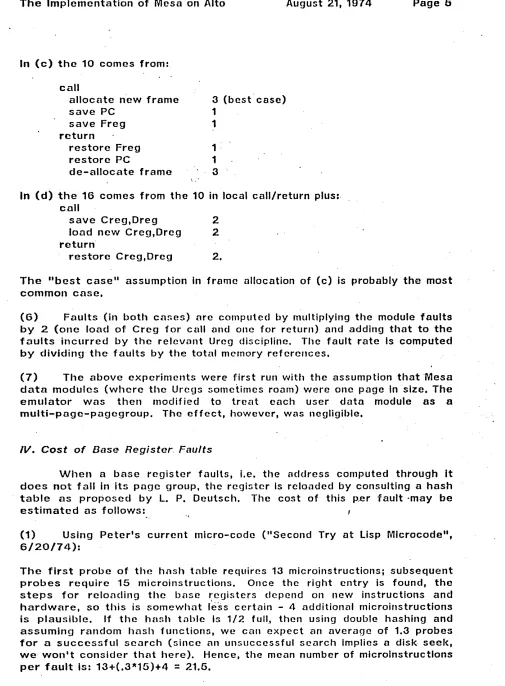
In (e) the 10 comes from:
call
allocate n"cw frame save PC
save Freg return
restore Freg restorc PC
de-allocate frame
3 (best" case)
1
1
1:
1
3
August 21, 1974
In (d) the 16 comes from the 10 in local call/return plus:" cllil
save Cre9,Dreg 2
lond ncw Crc9,Drcg 2 return"
restore Crcg,Dreg 2.
Page 6
The "best casel l assumption in frame allocation of (c) is probably the most
cornmon case.
(6) Faults (in both ca~e5) are computed by multiplying the module faults by 2 (one load of Creg for cull llnd one for return) and adding that to the fnultsinclJrred by the relevant Urcg discipline. The fault rate Is computed by dividing thc faults by the total memory refercnces.
(7) The above experiments were first run with the assumption that "Mesa data modules (where the Urcgs sometimes roam) were one page In size. The emulator was then modified to treat cach user data module as a multi-pngc-pagegroup. The effect, however, was negligible.
IV. Cost of Base Register. Faults
When a base register faults, i.e. the address computed through it
does not f all in its poge group, the register Is reloaded by consulting a hash table as proposed by L. P. Deutsch. The cost of this p..er fault -may be estimated as follows:
(1) Using Peter's current micro-code ("Second Try at Lisp Microcode", 6/20/74):
The Implement.ation of Mesa on Alto August 21, 1974 Page 6
Note: If we lIS.C linenr reprobing Instead of double hashing, then probes
subsequent to the first require only about
n
microinstructions, while the mean number of probes is 1.5. This gives: 13+(.5"8)+4 =21. That Is,· It really doesn't make much difference - the first probe nnd terminal computation are ·domincnt. Henc c, to simplify subsequent discussion, we'll assume linear reprobing anda
mean number of probes of 1.5.(2) Using special hardware:
(a) hardware hash computed ·in the memory Intcrfnce board and supplied on the bus reduces each . probe by G microinstructions (from 7
mierol~structions needed to obtain a hash to 2).
(b) Putting the hash table In RAM - reduces each r~ad of the table by 2
micro-Instructions (from 4 of which one is certainly overlapped to 1).
(e) Putting everything on the memory Interfnce. The best possible probe sequence would seem to be (I) compute Initial probe (ii) start fetch from RAM (iii) get word from RAM (iv) compare against the virtual page number sought. A success would be followed by 2 cycles to reload the bounds and mapping registers.
For those four possible organizations, the number of micro-Instructions needed to handle n fnult nre:
(a)
(b) (a&b)
~c)
8+(.5*10)+4
=
15 11+(.5*3)+4 =19 6+(.5*6)+4=
13 4+(.5*5)+2 :: 8.5From the f £lull rate and number of micro-instructions per fault, the performance dcgrndntion cnuscd by fnults cnn be computed. Simple instructions on the 1\1 to in Nova elllulation mode require about 1200 ns per memory reference (i.e. computation is about 1/3 non-overlapped with memory.) This Is prohably low over tile entire mix, but In the absence of reliable elata, we'll tnke this as typical. The time spent in processing faults per un!
t
of computation time ·Is: f ault:;/mf?nlory ref*
microinstruction/fault)Ie 170 ns/microlnstr
*
memory ref /1200 nSfThe Implementation of Mesa on Alto August 21, 1974 Page 7
FAULT RATE
Or.gan i Zil t i on
5.6
3.0
----
..
_----_
..all microcode
17.0%
9.1r-(a) harch-Illre hash
11.8%
7.3X
(b)
RAN
table
15.0%
B.Or.
(a&b)
10.31-
5.61-(c)
all
hardwilrc
6.7%
3.6i':
Considering the cstimntcs used in vnrious steps, these numbers are best treated as accura~e only to within II f actor of 1.5 or so either
way.
v.
Page FaultsStatistics on the expected number of page faults were gathered using a model similar to H. Sturgis' ("Some Statistics for Virtual Memory Fans, Part 2", 7/3/74). In brief, this models n LRU page replacement algorithm for all possible core buffer size5 as follows:. A. queue of page numbers is rnnintaincd, wi~h the I-th mo~t recently refcrcncd page In the i-th position.. A vector C of integer counts in maintained in parallel. On each memory reference, the queue is searched for the referenced page. Suppose it is found to be the j-lh pnue in the queue; then the j-th position of C is incremented by 1 and the pnge 15 moved to the front of the queue. If an LRU page replacement nl90rltllrn is used with a paging buffer of k pages, then the number of page faults Is the sum C[K+1]
+
C[K+2]+
C[I<+3]
+ •••
Note: This model takes into account none of the following: choice of dirty
vs.
clean pages for replacement, page groups, types of references to memory •.The Implementation of Mesa on Alto
(A) Compiling NEWMPLEXP.NLS
MemC?ry References Considered:· 15,383,534
D.
pages in
buffor
10
20
30 4050
60 70 80 90100
110
120
130140
150160
170IHO
190200
210 .
220
230
(B) Formatting of ch7
/I
page faults
4'1H,HJl
259,51)1
1(;1,611
86,'118
5.6,306
3G,396
22,B03
15,6111
10,713
7,622
5,550
3,657
2,1115
1,160
565310
132
3'1
67·
55
36
23
o
Memory References Considered: 13,915,180
I
pages in buffer
10
20
30 4050
. 60 70 80 90 100 110#
pnge faults
15,404
6,037
3,042
1,335
925392
170
30
14
o
August 21, 1974
fault rate
2.91 10t-2
1.68 101-2
1.05 101-2
5.62 10t-3
3.66 10t-3
2.37 10t-3
1.4910t-3
1.02 10t-3
6.96 10t-'1
'1.9510t-4·
3.61 10t-4
2.3U 10t-4
1.39'10t-4
7 • 0'1· 1
°
t -53.67 10t-5
2.02 10f-5
0.50 lOt - 65.116 10t-6
4.36 101-6
3.58 101-6
2.311
10t-6
1.50 10t-6
°
fault
rate
1.1110t-3
'1.34 101-4
2.1910t-4
9.56 101-5
6.69 10t-5
4.H9
10t-5
2.D2 101-5
1.22 101-5
2.16 10t-6
1.01 10t-6
o
Page 8
Note: Memory References ConsicJcrcd In each· case were the non-call memory references, i.e. the sum' of the clnsscs "Non-call fnstr" and "Non-calf memory refs". This WClS done to maintDin consistency with the
The Implementation of Mesa on Alto August 21, 1974 Page 9
caused by these memory refcrenc'cs then the fault rates would be lowered by about 1/3 for case (1\) find 1/5 in CClse (8).
To a first flpproxlmation, each Maxc page of 512 36-blt words corrcsponci!; roughly to one Alto pllgC of 512 1G-bit words, since Integers fix on one word and it is anticipnted tllnt each instruction will fit In one word. (This neglects characters, rcal numbers, large pointers, etc.) With 60 k of main memory used for buffers, this gives 120 pages.
The effect of the fault' rate on overall performance can be done In two w~ys:
(1) Elapsed time
If a portion of the disk is used for pnrling (like the Maxc "drum"), then the access time on the Model 44 disl< is about 30 015 nnd about 50 on the Model 31. Consider case (A) ilS nn example. Computation time is abou~
(15.10.6)*(1.2.101-6)
=
18 seconds. Given 120 pnges for buffers, the number of fuults is 3,657 and the time spent in poging with a Model 44 Is (3,657)*(30.101-3)=
110 seconds.(2) Comparisofl with Tcnex
A second way of nS5c5sing the eff ccts of page faults in the proposed Mesal Alto machine Is in compari!.on with paging in the current' Mesa' implementation on Tenex. As thc avernge time to access II "drum" page on Tenex is 42 ms, the effective devico speeds mClY be regarded as essentinlly the, Silm'c. CClSCS (A) olld (n) were each rerun twice under
different load averages [lnd the nctual numher of page faults (PGSTAT
'+
1) were obtained.load
<
2 land> 6(A) compiler 432
2987
(B) formatter 487 1006
Whnt conclusions cnn ono draw? A medium-size well-behaved
program slich as the formatter', cX8mplc' (B), ,may'be expected to fit In core
and nevcr pnge f nult. Time wniting for the di~1< Is only that required to, load pages. For the example run of ((3), we have
Alto upper bound of tlmc to"load pages Alto compute time (cstimote)
Tencx time fat' page faults Tcnex compute time (estimnte)
3.3 seconds
10.7 seconds
20.4' seconds 10.7 seconds
The Implementation of Mesn on Alto August 21. 1974
Page 10
The compiler,· (!xarnple (A), Is a Inrgc pro9ram for which there has been, to date, no major· attention to obtnining qood paning properties. As It stands, Its pllgc fault rF.lte implies Cl perrOrmlll1Ce of Tenex with a load average somewhat larger than G. That is, with 120 pllgCS, the number of faults is 3,G57. Observe that with 150 pnges, the fnult rate drops to 565. Considering the ratio of compute time to paging time, there Is a critical knee in the curve nt nround 150 pnues. It is anticipated that with a moderate amollnt of effort, the compiler could be reconfiuured to shift the
curve and bring the knee down to 120. I\t
a
faultrate
of 565, Alto Mesawould be comporablc to Tenex Meso with
a
lond nvernge of less than 2.VI. Static measurements of Mesa Programs
A number of stlltic· measurements have been collected on Mesa programs and sever~lI more remnin to be gathered. The measurements documented here were obtnined (for cfficicncy n~Clsons) by examining the PDP-10 . object code for Mesa progrnms. Marc static measures are being collected by Dick Sweet by metering the compiler but tho5e results arc not yet available. The programs measured consisted of all the Mesa programs
stored on the .<MPS) directory.
(a) Frame References
The Mesa frume Is the locus for parameters, local variables, and (rarely) temporaries (which in this analysis are grouped with locals). The purpose of this study is to determine how many bits of offset from Freg are needed to address variables in the frame. .
Bits· %-of-frame-rcferenccs
1 38.6% 2 60.1%
3 B1.9°f,.
4
95.4%Of course,· the most frequently referenced fnunc variable was not necessnrily the one with smallest offset in the PDP-10 object code. Frame variables are simply allocated in declnrCltion order. So, what hnppens If
those most· frequently accessed nrc. allocated to the smallest offset position? The following tnble shows the results for sorted fr,lme variables.
BHs %-of-frame-references
1 50.3%
2 72.6%
3 8n.Get/.
4 97.4%
The Implementotion of Meso on Alto August 21, °1974 Page 11
(b) Constllnt usage
The usc of constants wns mc,lsLJred in the object code. This
approach had good and bad aspects. On the bad side, one hos to be careful to account for const"nts which nrc implicit in certain PDP-10 opcodes (e.g. AOS, JUMPG, HRROI, ntc.). On the good ~dde, once object code has been produced, the compiler hns olrcndy clone [I fnir nmount of compile-time
evaluation of constnnt expression~. The rnensurerncnt was done ns follows. Constants in the intervnl [-15,14] were counted individually. Since mllny of the mc~sLJred programs did charncter hnndlinu, constants in the range [15,127] were lumped into a sepnrnte bin (coiled CHARS). Finally all constants less than -15 or grenter than 127 were thrown into NEG and POS
bins. respectively. Here are the results:
Constant
NEG
[-15,-2]-1
o
1
2
3 45
[6,14]
CIIAR
.
POS
Totnl
#-of-occlIrrences
105 72
264
11259
1705 422
227
IJ13
122
627 1259 1532
10737
Note that the range [0,1] accounts for 55.5",4 of the occurenccs, [-1,2]
accounts for 61.9%, Clnd that 81.0"10 f nil in the range [O,12"r]. If the domain of constants 15 limited to the rnnge [-15,14], then the interval [0,1] accounts for 75.4 "/,, of the occurrences, the interval [-1,2] accounts for
84.8%, . nnd the Interval [-1,6] nccollnts for 95.3%.
(c) Procedures
A couple of 5tntic".~"Q,)JS~!::!!:·~~<1:;.w~ .. ',;'.Q.. mnde for procedures that can be
compared with dynamic tnet.,surements made e8rlier. Procedure calls were partitioned into local Dnd external cnlls .with thc rcsult:
Locnl calls: 1868 24.5% External calls: 5746, 75.S"/.
This compnrcs with the dynnmic locill/externnl percentages of 40.4%/59,6% and 27.~r/,,/72.1,,/. in eXDmples A Cllld .. B In section III.
, The Implementation of Meso on Alto
I-of-pnrametcrs
i-or-culls
o
1 2 3 4 5 6
1 ~)69
449B
207ft
563165
70
11August 21, 1974
percentage
21.2%
413041-21 .B%
6. Or.
1 •
ar.
0.7%
Or.
Page 12
In dynamic cxnmple A, procedures hnd an average of 1.3 parameters and In exampl,e B an nvernge of .96 pnrnmeters.
A number of other rather PDP-10 sp£!clfic stntic mesaurements were also mndc which arc of little or no interest for Alto-lV1es~. The purpose of