A M e t h o d for N u m e r i c a l S o l u t i o n o f V i b r a t i o n a l R a n d o m R e s p o n s e
o f S t r u c t u r e s a n d Its A p p l i c a t i o n
Ku~elka V~clav, Stengl Miroslav VIDIA-C, Inc., Prague, CZ
ABSTRACT
In this paper the mathematical model of the vibrational response of structures to random exiting forces is applied to explore the influence of fluid flow parameters on the dynamic deformations and behaviour of a cylindrical shell. A physical model of the PWR core barrel, considered as a cylindrical shell supported at both ends, is used to demonstrate by numerical expriments the mentioned influence. The mean velocity vector of the fluid flow is the basis for the aero- hydrodynamic excitation expressed by a coherence function of fluctuating surface pressure both in the axial and circumferential directiOns, stated as the dependence on the values of the correlation lengths. The results of the courses of the generalized spectral loadings, of the ms amplitudes of the displacement and stress distributions are shown at the dependence on the flow parameters.
I N T R O D U C T I O N
Vibrations, and consequently, their deformations induced by fluid flow, are sometimes considered to be a secondary parameter in design, but only until a failure has occurred. Failures resulting from the vibrations of fluidodynamic origin have not been avoided in nuclear reactors [1,2], though extraordinary attention has been given to their safe operation. The problem under discussion has an interdisciplinary character and lies on the interface of several scientific fields. This paper applies the method of the numerical solution of vibrational random structure response to explore, by numerical experiments, the influence of fluid flow characteristics on dynamic deformations and the behaviour of a cylindrical shell representing a simple model of a core barrel surrounded by a fluid flow. The magnitudes and the distributions of the stochastic displacements and stresses are studied in relation to the dependence on the values of the mean flow velocity and on the pressure wave correlation length.
T H E O R E T I C A L B A C K G R O U N D
The cylindrical shell under consideration is replaced by a r-degree-of-freedom system. The /th element of a cylinrical shell is regarded as a continuum. The frequency modal properties of the system including a cylindrical shell with surroundings are known. To simplify the problem, we assume: (1) there is not coupling between individual modes of vibrations, (2) no coupling between the flow excitation and cylindrical shell response is introduced, (3) the flow random excitation, expressed in terms of the fluctuating pressure p ( t ) of the fluid where it is in contact with the cylindrical shell is stationary and ergodic.
Using modal analysis and a Fourier transform to solve the equations of motion, we obtain an expression for the vector S y (co) of dimension r of the power spectral density (psd) of the cylindrical shell displacements. In matrix symbolical form we have [3']:
~ (co) = W I z) H(~)II T (~)l,
(1)
SMiRT 16, Washington DC, August 2001 Paper # 1152
where t~ is the matrix of dimension (r x r z) of modal vectors with elements w (~)w ~) of the associated conservative
system; D H(co) is the diagonal matrix of dimension (r 2 x r z) of generalized spectral compliances with elements H a ,
H/~ (the asterisk indicates a complexly conjugated function); l ( c o ) is the vector of dimension r ' of generalized spectral
loadings given by:
T
where W is the matrix of dimension (r e × r9 of modal vectors with elements w )w )', fi (co) is the vector of
dimension r 2 the elements of which can be expressed by the following expression:
T---~Qo T
p~(t~)pk
(ta)xexp(co(t~ - t2)) d t ~ d t 2 didk, (3)where T is half of the realization time of the random process and St, S k is the contact surface of the /th and kth
elements respectively, of the cylindrical shell. An analytical expression can be gained for ~(co). Then, the
generalized spectral loadings, Lap (co), related to a unit surface are done:
1
(A2)×Gp, (A 1 A2,co) dA 1 dA 2
(4)where A 1 and A 2 are sites on the contact surface S of the cylindrical shell; w a (A 1 ) and wfl (A 2 )are the coeficients
of the distribution of displacement amplitudes of the a and ~ modes, respectively, of vibration at A 1 and A 2
respectively; G p l p 2 (A 1 , A2, co) is the coherence function of the pressure field of the fluid flow at the sites A1, A 2 . Equation (4) represents one of the possible forms of the so-called acceptance integral first introduced by Powell [4]. If the function of the fluctuating contact surface pressure is a separable function then, consequently, the functions of the generalized spectral loadings are also separable functions. So, we have spectral loadings in the axial and in the circumferential directions, and a total generalized spectral loading. To express the coherence fimction of a homogeneous turbulent flow a Bessel function of the first kind of zero order, dependent on fluid flow parameters, was used in the computations. The vector of the amplitude of the root mean square (rms) displacements y of dimension r can be obtained from the psd of the displacements through integration over all the angular frequencies co,
(5)
The distribution of this vector is used for the approximate estimations of the vectors of ms stress amplitudes in the axial, t~x, and hoop, ~ 0 , directions:
( 2)2
( )2
fix = K Y ~ d 2 Y
dx 2 , 0-~= K~ dcp2 (6)
R E S U L T S OF N U M E R I C A L E X P E R I M E N T S
To study the dynamic deformations in a cylindrical shell due to various changes of the exciting fluid flow parameters, the ODEZ 4 code was developed. For the proper computations, a physical cylindrical shell model of the PWR core barrel of dimensions:
t/a=O.046,
a/l=0.231 was used ( a - middle surface radius, t - thickness, l - length). The shell model was considered to be supported at both ends continuously and replaced by the system of 2400 degreesOt ~ ,,
Lns
1.110,2 :I I L2 2
('}1," 2t
•
L33
0 " i ~ ' , .... i ... "'I . . . "'l ... l '
0 3000 (.,J (s 1) 6000
Fig. 1. Axial spectral loadings at parameter (x)3,.
0,4
q2
0
L~ (')X,= 6 t
/~.,,~" L22
L,, --- -
O" • ' ~ ' " l . . . I . . . I . . . • . . . '1 . . .
3000 6.,, (s ~) 6000
Fig. 2. Axial spectral loadings at parameter (x)3,.
of freedom. The frequency spectrum of the model was fixed in both air and water. The values of natural frequencies and of generalized damping ratios were considered for 24 selected vibration modes including the influence of liquid and of limited surroundings [5].
0.2"
Lm,.-. (
o,1
o _ J
0 /Loo
..- Lll
':\1, L22 (*1~1= 2'~'o
A \ /L33 L t \~',...~ ".Lss L
f\,, \ ~
16 L77
1000 ~j (s ~) 2000
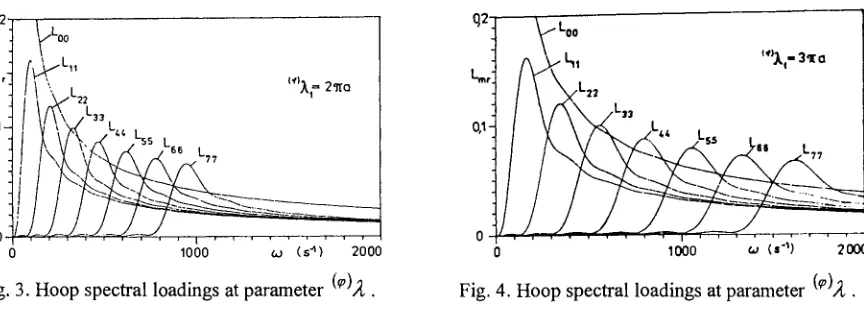
Fig. 3. Hoop spectral loadings at parameter (q')3..
0,2" .
o , 1 ;
0
I
L22
; . . . ,joo' ' ' ; ( , 4 2000
Fig. 4. Hoop spectral loadings at parameter (q')~.
004 ~
• . L 3 3
L a a
t4A. I
" --- k IL.,., I l l - ,, , ) -
r ~ 1,
~'~,=
1/2"~0I / /'lkt> / t-66 L1818
[ ~212 / L2323
0
0
200 ~(s
"~) 400Figs. 5. Total spectral loadings at parameters (@l, (q')~.
oo],
ko~,=,
0,0
Oq 0
L;1 (')X, = 2 [
L 33 (q~,
.Lss
~ L , ~ l, L1212
~
2 22. . . I . . . I . . . . ' 1 " . . . I - v ' ' - ' ' " + " ' '
200 ~ (s "~) 400
Fig. 6. Total spectral loadings at parameters (x))/,, (q,)~.
joined and cross factors at two different correlation lengths are shown in Figs. 1 and 2, while Figs 3 and 4 present the
°
]
0 21t
Fig. 7. Distribution of ms displacement amplitudes
at parameters 0 ) 2 , (~'),~.
z ~ a
"~| /
0 2~r
Fig. 8. Distribution of ms displacement amplitudes
at parameters (x),;L, (¢)]L.
courses of the circumferential spectral loadings. An illustration of obtained values of the total spectral loadings is displayed in Figs. 5 and 6. Comparing the plotted cross loading with the joined one (Fig. 1) it is obvions that the cross terms are smaller and become very quickly damped with increasing frequencies. As for correlation length, we can see
v=Smi'
/
7
1
0 2'n
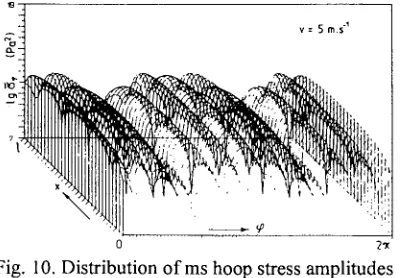
Fig. 9. Distribution of ms axial stress amplitudes at parameter v.
;1
v = Sm.s -~ I,. / " . . . ) l i ,.';
tk
o 2'x
that the spectral loading values are rising and their maxima shit~ to regions of higher exciting frequencies, with its growth.
v = 10 m.s -I . v = l O m.s -~
t l i
0 2 ~
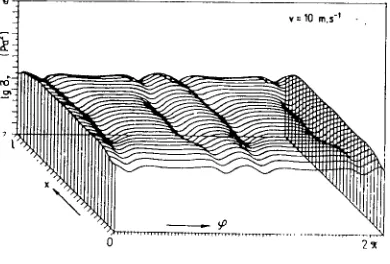
Fig. 11. Distribution of ms axial stress amplitudes at parameter v.
I
0 2 ~
Fig. 12. Distribution of ms hoop stress amplitudes at parameter v.
The graphical expresion of the results of computations of the ms displacements at two different, both axial and
circumferential, correlation lengths are presented in Figs. 7 and 8. It can be seen that the amplitudes of ms
displacements are significantly dependent on the flow parameter changes. A similar statement can be made for the distributions of the ms stress amplitudes according to Figs. 9 to 12 where the mean flow velocity was changed from 5 m
- 1
s (Figs. 9, 10) to 10 m s -1 (Figs. 11, 12).
C O N C L U S I O N S
From the results presented above and the stochastic deformations and dynamic behaviour of a cylindrical shell due to the random excitation of fluid flow at various turbulent parameter levels, we can conclude:
(a) The pressure wave correlation length and the mean flow velocity significantly affect the magnitudes of the dynamic deformations of the cylindrical shell.
(b) The distributions of the ms hoop stress amplitudes are non harmonic with a number of waves around the circumference.
(c) The maximum values of the ms axial stress amplitude are lower by more than one order in comparison with the hoop ones.
(d) The values of the maxima of generalized spectral loadings in the axial and in the circumferential directions are independent of the flow parameters. With groving pressure wave correlation lengths, however, they shil~ into the region of higher exciting frequencies.
(e) The distributions of the ms radial displacement amplitudes are symmetrical to the plane dividing the axis of cylindrical shell in half, non-harmonic, with several waves around the circumference which have sufficiently steep tops. Similar symmetries can be observed in the distributions of the ms stresses.
(f) Symmetries in the ms deformation distributions can be employed to reduce the computing time.
N O M E N C L A T U R E
a
A
Gplp2
H(a))
radius of the cylindrical shell,
place on the contact surface of the cylindrical shell,
coherence function of fluid flow fluctuating pressure,
element of the matrix of general spectral compliances of the cylindrical shell,
l
l (co) L (co)
m s
psd
p (t)
r
r n l s
length of the cylindrical shell,
vector of generalized spectral loadings, dimensionless generalized spectral loandings, mean square,
power spectral density,
fluctuating surface pressure of fluid flbw,
vector of cross (spatial) power spectral density of flow fluctuating surface forces, number of degrees of freedom,
root mean square,
S y
((1))
vector of power spectral density of cylindrical shell displacements,S
t
T
W a
W x Y Y O" co
contact surface of the cylindrical shell, time,
half of the realization time of the random process, mean fluid flow velocity,
coefficient of displacement amplitudes of the ath vibration mode of the cylindrical shell, matrix of modal vectors of the cylindrical shell,
axial coordinate of the cylindrical shell, radial coordinate of the cylindrical shell,
vector of the rms displacements of the cylindrical shell, pressure wave correlation length,
vector of ms stress amplitudes, circumferential angle,
angular fi'equency.
Subscripts / superscripts
D i,k m, r
n~ s
P T
x
Y
diagonal matrix,
applies to considered elements of the cylindrical shell, applies to circumferential vibration mode,
applies to axial vibration mode,
applies to fluctuating pressure of fluid flow, transposition,
applies to axial direction, applies to radial direction, applies to natm'al vibration mode, applies to circumferential direction.
REFERENCES
[1] Corr J.R., Big rock point vibration analysis, Proc. Conf. on Flow-Induced Vibrations of Reactor System Components, Argonne (Argonne National Laboratory Press, 1970) pp. 272-289.
[2] Blevins R.D., Flow-induced vibration in nuclear reactors, Prog. Nucl. Energy 4 (1979) 25-49.
[3] Ku2elka V., A solution of structural random response applied to cylindrical shell in a turbulent flow, Engrg. Comput. 2 (1985) 293-298.
[4] Powell A., On the fatigue failure of structures due to vibrations excited by random pressure field, J. Acoust. Soc. Am. 30 (1958)Am.