Available Online atwww.ijcsmc.com
International Journal of Computer Science and Mobile Computing
A Monthly Journal of Computer Science and Information Technology
ISSN 2320–088X
IMPACT FACTOR: 6.017
IJCSMC, Vol. 6, Issue. 7, July 2017, pg.255 – 264
MOBILE SINK BASED ENERGY
EFFICIENT ADAPTIVE CLUSTERING
HIERARCHY PROTOCOL FOR WSN
Sami Ul Gani, Deepika Rana
Student, ECE Dept., SVIET, Patiala, Punjab HOD, ECE Dept., SVIET, Patiala, Punjab
ABSTRACT:
In wireless sensor networks, the confinement of imperativeness and save space of centres and the multi-hop transmission shakiness will genuinely interfere the execution of standard data aggregation traditions. On a very basic level coordinating traditions are proposed for compelling use of imperativeness resources. WSNs shape battery-fuelled centres, which are related with the beds base station to for a couple of activities or errand. As sensor focus focuses are battery-controlled i.e. can be dead after the utilization of the battery that is additionally called cross of WSNs. In this paper, an Energy Adaptive Clustering Hierarchy, which uses a versatile sink, has been proposed for WSNs with non-uniform centre point allotment. The entertainment occurs exhibit that: differentiated and standard data amassing plots, the strategy abridges the moving partition of the adaptable base station, enhances the network life cycle reduces the essentialness use, and has the shorter deferment of the data.
I. INTRODUCTION
A wireless sensor network (WSN) is a wireless network comprising of spatially conveyed self-sufficient gadgets utilizing sensors to screen physical or natural conditions. A WSN framework consolidates a passage that gives wireless availability back to the wired world and circulated nodes.
WSN Network Topologies:
WSN nodes are commonly composed in one of three sorts of network topologies. In a star topology, every node interfaces straightforwardly to a passage. In a group tree network, every node interfaces with a node higher in the tree and after that to the door, and information is steered from the most reduced node on the tree to the entryway. At long last, to offer expanded dependability, work networks include nodes that can associate with various nodes in the framework and go information through the most solid way accessible. This work connection is frequently alluded to as a switch.
Figure: Common WSN Network Topology
Components of a WSN Node:
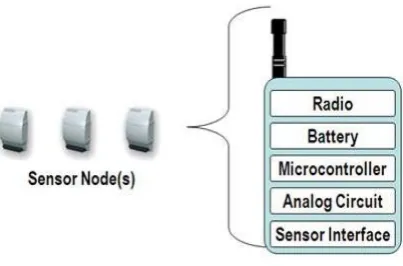
A WSN node contains a few specialized segments. These incorporate the radio, battery, microcontroller, simple circuit, and sensor interface. When utilizing WSN radio innovation, you should make imperative exchange offs. In battery-fueled frameworks, higher radio information rates and more continuous radio utilize expend more power. Regularly three years of battery life is a prerequisite, so a large portion of the WSN frameworks today depend on ZigBee because of its low-control utilization. Since battery life and power administration innovation are continually developing and on account of the accessible IEEE 802.11 data transfer capacity, Wi-Fi is a fascinating innovation.
The second innovation thought for WSN frameworks is the battery. Notwithstanding long life necessities, you should consider the size and weight of batteries and in addition worldwide principles for transportation batteries and battery accessibility. The minimal effort and wide accessibility of carbon zinc and basic batteries settle on them a typical decision.
preparing speed exchange off is a key concern while choosing a processor for WSNs. This makes the x86 design a troublesome choice for battery-controlled gadgets.
Figure: WSN Sensor Node Components
Mobile Sink:
In a sensor network with mobile sink, sinks are equipped for development and sensor nodes transfer information to the mobile sinks with practically no buffering. A mobile sink is utilized to accumulate detected information by going around the network. We expect that exclusive at specific areas, the sink can speak with the outside network and after that convey stored information to clients. For instance, because of impedance and security issues, for a sensor network conveyed in the front line for the reconnaissance mission, it is sensible that the sink can associate with the base camp just at specific areas utilizing wireless procedures like WiMAX or LTE. These areas are spoken to by squares in the figure. The sink has a greatest speed Vmax (in m/s). We accept that while the sink is moving, sensors1 will support their recently produced information. Just when the sink remains at one of sink locales, sensors will begin transmitting information to the sink through multihop steering. The mobile sink booking plan is upgraded to bolster huge size networks. We take note of that utilizing a mobile sink not at all like a stationary sink is the best approach for amplifying the lifetime of a wireless sensor network (WSN). With the current WSN foundation, the mobile sink can be acknowledged by mounting the stationary sink to a mobile robot which is controlled remotely.
LEACH Protocol
Low-energy adaptive clustering hierarchy "LEACH" is a TDMA-based MAC convention which is coordinated with clustering and a straightforward steering convention in wireless sensor networks (WSNs). The objective of LEACH is to lower the energy utilization required to make and keep up groups with a specific end goal to enhance the life time of a wireless sensor network.
Protocol explanation
LEACH is a progressive convention in which most nodes transmit to group heads, and the bunch heads total and pack the information and forward it to the base station (sink). Every node utilizes a stochastic calculation at each round to decide if it will end up being a bunch head in this round. LEACH expect that every node has a radio sufficiently effective to straightforwardly achieve the base station or the closest group head, yet that utilizing this radio at full power all the time would squander energy.
into a group head once more. Toward the finish of each round, every node that is not a bunch head chooses the nearest group head and joins that group. The bunch head then makes a timetable for every node in its group to transmit its information.
All nodes that are not group heads just speak with the bunch head in a TDMA mold, as per the timetable made by the bunch head. They do as such utilizing the base energy expected to achieve the group head, and just need to keep their radios on amid their schedule opening.
LEACH likewise utilizes CDMA so that each bunch utilizes an alternate arrangement of CDMA codes, to limit impedance between groups.
TDMA Scheduling
TDMA is one of timetable based MAC convention which is a subject of a dynamic and expansive research. TDMA gives impact free transmission from nodes or connections since an arrangement of vacancies are prearranged. Subsequently, TDMA can adjust well to different network densities and offered loads. A productive TDMA calendar can spare energy by allowing nodes to turn on the radio just amid the booked transmission times of their neighbors, without squandering energy because of sit still tuning in and catching not at all like conflict based plans. It is notable that sit out of gear listening expends as much as energy as accepting. Besides, as TDMA does not require any control message trades for correspondence (e.g., RTS/CTS), it constrains overhead in correspondence.
II. RELATED WORK:
Jin Wang, Menglin Wu and Jeong-Uk Kim [01], Wireless sensor networks commonly consist of a large number of tiny sensor nodes that are deployed either inside the target area or very close to it to cooperatively monitor the target area. Energy efficiency and network lifetime are two challenges that most of researchers deal with. In this paper, to improve the performance of sensor networks, we propose an energy-efficient competitive clustering algorithm for wireless sensor networks using a controlled mobile sink. Clustering algorithm can effectively organize sensor nodes and the use of a controlled mobile sink node can mitigate hot spot problem or energy holes. The selection of optimal moving trajectory for sink nodes is an NP-hard problem. In our algorithm, we firstly study an competitive clustering algorithm in which cluster heads are rotated in each round and selected mainly based on their competition range and their residual energy. Besides, we use mobile sink node instead of fixed sink node. The mobile sink node moves at a certain speed along a predefined path and sojourn at some park position to collect data packets. Simulation results validate that competitive clustering algorithm outperforms LEACH and the use of mobile sink node significantly improve the performance of the sensor network.
Archana B Biradar, V.V.Ayyannavar [03], Wireless Sensor Networks consist of hundreds of tiny, inexpensive, resource constrained sensor nodes. Routing is a challenging task in such environment mainly due to the unique constraints the wireless sensor networks suffer from. Wireless sensor network consisting of a large number of sensors is effective for gathering data in a variety of environments. Since the sensors operate on battery of limited power, it is a challenging task to design an efficient routing scheme which can minimize the delay while offering high energy efficiency and long network lifetime. In this paper we propose an energy efficient routing protocol. The proposed protocol is hierarchical and cluster based. The selection procedure is carried out in two stages. In the first stage, all candidate nodes for becoming CH are listed, based on the parameters like relative distance of the candidate node from the Base Station, remaining energy level, probable number of neighbouring sensor nodes the candidate node can have, and the number of times the candidate node has already become the Cluster Head. Simulation results show that the proposed routing scheme significantly reduces energy consumption and increases the lifetime of sensor network compared to other hierarchical routing schemes such as Low-Energy Adaptive Clustering Hierarchy (LEACH).
Gurpreet Kaur, Dr. Sandeep Sharma [04], The quick escalations in network multimedia devices have permitted extra concurrent digital services: video conferencing, online playoffs as well as remote learning to nurture for conform e-net jobs. WSNs have become major area of research in computational theory due to its wide-ranging applications. But due to limited battery power the energy expenditure has become key drawback of WSNs protocols. Although several protocols has been proposed so far to improve the energy efficiency more however still a lot enhancement can be done. GSTEB has shown fairly significant results over the on hand WSN protocols. The general purpose of this work is to find the problems of the former techniques for WSNs. At the end of this paper appropriate future guidelines are given to further improve this work.
Harleen kaur, Dr.Tanupreet singh [05], Wireless sensor networks (WSNs) are becoming popular in real life applications. Because of the top features of the resource-constrained and battery-aware sensors, in WSNs energy utilization has found to be always a major interesting subject of research. WSNs compose battery-powered nodes, which are linked to the beds base station to for many actions or task. As sensor nodes are battery-powered i.e. can be dead after the consumption of the battery that is also called duration of WSNs. So utilizing the energy in well-organized way, may end in prolonging the duration of the WSNs. Sensor nodes possess a negative characteristic of limited energy, which pulls back the network from exploiting its peak capabilities. Hence, it is essential to gather and transfer the data in a optimized way which reduces the vitality dissipation. In this paper, a survey on various mobile sink based clustering protocols is presented. From the survey, it has been concluded that none of the technique performs effectively in all fields.
Shipra Sharma, Kanika Sharma [07], WSN is the emerging and fast growing field which consist of low cost, battery operated and multi-functional sensor nodes. In wireless sensor network improving lifetime of the network is the main challenge. With static sink energy whole problem or hot spot is a major problem in WSN. The sensor nodes which are located near to the sink, act as relay for those of the nodes which are far apart from the sink. This causes the lifetime of the network reduced. The concept of mobile sink solves the problem of energy hole problem and also does the load balancing in the wireless sensor network. In this paper we propose to improve the lifetime of the wireless sensor network by using mobile sink based energy efficient adaptive threshold clustering hierarchy algorithm. Here we use hybrid routing protocol APTEEN which gives overall snapshot of the network at periodic intervals and also react to time critical situations. The results obtained from the proposed algorithm have been compared with that obtained from MSIEEP protocol. It can be accessed from results that the proposed algorithm works better than MSIEEP. The simulation result is performed in MATLAB.
Kalyani Khanke, Mamta Sarde [08], A wireless sensor network (WSN) is a collection of nodes organized into a cooperative network, which are small energy constrained devices The efficient use of energy source in a sensor node is most desirable criteria for prolong the life time of wireless sensor network. In WSN, sensors near the static sink have to relay the data of the nodes away from the sink and as a result they drain their energy very quickly. It result in network partitioning and can significantly limit the network lifetime, problem is termed as hotspot problem. So designing efficient routing for reducing energy consumption is the important factor. Recently, mobile sink approach has been used to address the hotspot problem but it increase end to end delay which is not acceptable for delay sensitive application. In this paper, to solve the above problem the consumption of energy during the transmission of data from sensor nodes to the sink has been calculated. Routing protocols in WSNs along with the most energy efficient protocol named LEACH ( low energy adaptive clustering hierarchy) and AODV protocol is used. the proposed protocol incurs less end to end delay and is energy efficient. Intensive Simulations are carried out to evaluate the performance of the proposed strategy.
K. Padmanabhan, Dr. P. Kamalakkannan [09], Wireless Sensor Networks (WSNs) is a network of an inexpensive low coverage, sensing, and computation nodes. The foremost difference between the WSN and the traditional wireless networks is that sensors are extremely sensitive to energy consumption. Energy saving is the crucial issue in designing the wireless sensor networks. Many researchers have focused only on developing energy efficient protocols for continuous-driven clustered sensor networks. In this paper, we propose a modified algorithm for Low Energy Adaptive Clustering Hierarchy (LEACH) protocol. Our modified protocol called “Energy-Efficient Adaptive Protocol for Clustered Wireless Sensor Networks (EEAP)” is aimed at prolonging the lifetime of the sensor networks by balancing the energy consumption of the nodes. EEAP makes the high residual energy node to become a cluster-head. The elector nodes are used to collect the energy information of the nearest sensor nodes and select the cluster-heads. We compare the performance of our EEAP algorithm with the LEACH protocol using simulations.
S. Balaji, Y. Harold Robinson, M. Rajaram [11], Wireless sensor networks applications involve a position of inaccessible metropolitan vicinity enclosed by wireless sensor nodes (WSNs)-monitors environmental parameters like battle field surveillance, home applications like fire alarm, health monitoring, etc. Energy plays a vital role in Wireless sensor networks. So, we have to concentrate more on balanced energy consumption for maximizing the network lifetime. Minimizing the whole network overhead and vigor disbursement coupled with the multi-hop data reclamation process that ensuring balanced energy consumption among SNs which results in prolonged network lifetime. This can be achieved by forwarding the sensed data to their cluster heads and then filtering the data before sending it to their tryst nodes, which is located in proximity to MS’s trajectory. Sleep and awakening of nodes periodically helps to retain their energy for some more time. The events occurring in any part of the network should be identified by the nodes, while arrangements sleep and active among the nodes. (i.e.) the nodes should be scheduled to sleep, so that the outstanding nodes can take care of the whole network. The eXtensible Randomized Matrix Arithmetic Coding (XRMAC) Technique has been used to enhance the security among all the nodes in the network. Simulation results show that our Proposed Scheme can have better Lifetime, improved throughput, reduced delay compared to other existing methods.
Injong Rhee and Jangwon Lee [12], Lack of scalability and channel efficiency is often touted as the main drawback of TDMA for wireless sensor networks. However, the results of this paper dictate otherwise. In the paper, a new distributed TDMA scheduling algorithm, called DRAND, is employed that gives a channel schedule as efficient as RAND - a commonly used centralized channel allocation scheme, but does so only in the expected running time and message complexity of O(±)where ± is the maximum number of contending neighbors. This is the first distributed, scalable implementation of RAND. As the running time of DRAND does not depend on the total size of the input network, it is highly scalable, thus apt for large-scale sensor networks.
Anagha K, Dr.Binu GS [13], Wireless sensor networks (WSN) consist of many sensor nodes deployed in a large area for sensing the events occurring in that environment. The main source of energy consumption in sensor networks is the data collection process. Data collection should be done with minimum energy expenditure, latency and packet collision. Overcoming these issues is a challenging task in WSN. This paper presents a survey of various techniques used for data collection with minimum energy consumption.
Rahul Goyal [15], Wireless Sensor Network depends on nodes have limited energy, memory, computational power, range and it is important to increase energy efficiency by saving the battery power so as to extend the life time of the given WSN deployment. In WSN, data is measured by nodes and same is send to Base Station at regular interval. Different protocols are used for energy consumption, in wireless sensor network. In this paper for energy consumption in wireless sensor network we study about LEACH protocol, EEUC protocol and zone-divided and energy-balanced clustering routing protocol (ZECR) which divides the area into several zones according to the distance and uses the clustering method among these zones. The key idea of these protocols is that within a cluster there is a cluster-head‖ which receive the data from remaining nodes and such data is sent to base station
III. PROPOSED METHODOLOGY:
In the network model described in previous section some assumptions have been made for the sensor nodes as well as for the network. Hence the assumptions and properties of the network and sensor nodes are:
• Sensor Nodes are uniformly randomly deployed in the network.
• There is one Base Station which is located at the center of the sensing field.
• Nodes always have the data to send to the base station.
• Nodes are location-unaware, i.e. not equipped with GPS-capable antennae.
• All nodes have similar capabilities in terms of processing and communication and of equal significance.
This motivates the need for extending the lifetime of every sensor. Sensor nodes have heterogeneity in terms of energy i.e., different energy levels. All nodes have different initial energy; some nodes are equipped with more energy than the normal nodes.
We proposed an Adaptive threshold algorithm based on a query system which allows three types of queries: historical, on-time, and constant which can be used in a hybrid network.
In adaptive threshold algorithm the cluster head first broadcasts the following parameters:
• Attributes -interested physical parameters.
• Thresholds -hard threshold value and soft threshold value.
• Schedule -time slot using TDMA.
• Count time -Maximum time period between two successive reports sent by a node.
In our proposed we will concern with following performance criteria and compare with previous protocols
1. Stability 2. Throughput
3. Lifetime of network
Our proposed system has three phases first one is Initial phase, Processing phase, and termination phase. In initial phase sink and sensor nods will be initialized and region will be divided. All information about sensor nodes like energy, id, and position will be transferred to sink node. Second Phase is processing phase in this phase cluster node will be decided by Energy efficient adaptive algorithm and information broadcast to the sensor node and its contain iteration process to cover up all nodes according to TDMA scheduling. In termination process check about whole network by cluster head for dead and alive node and iteration continuously take place.
IV. Result Analysis / Implementation:
Figure: Simulation Result
V. CONCLUSION:
This paper proposes a Mobile Sink based Energy Adaptive Clustering Hierarchy to constrain the imperativeness usage of sensor centre points. Imperativeness Adaptive Clustering Hierarchy displays the possibility of versatile sink which accumulates the data from the bunch heads by taking after the pre-described ways. With constraining the imperativeness whole issue, Energy Adaptive Clustering Hierarchy computation gives better soundness period and framework lifetime than one of a kind Energy Adaptive Clustering Hierarchy. The re-enactment result comes to fruition have shown that flexible sink based Energy Adaptive Clustering Hierarchy plays out all around appeared differently in relation to practically identical strategies. In addition, the suggestion has less moving division of MS than that in the other two computations and has purposes of enthusiasm on the framework life cycle and ordinary imperativeness use.
REFERENCES
[01] Jin Wang, Menglin Wu and Jeong-Uk Kim, “An Energy-efficient Competitive Clustering
Algorithm for Wireless Sensor Networks using Mobile Sink”, International Journal of Grid and Distributed Computing Vol. 5, No. 4, December, 2012,
[02] S.Suganyadevi and N.Subhashini, “Lifetime and Stability Enhancement of Wireless Sensor
[03] Archana B Biradar, V.V.Ayyannavar, “Energy Efficient Cluster Based Routing Protocol for Wireless Sensor Networks”, Proceedings of 11th IRF International Conference, 15th June-2014, Pune, India, ISBN: 978-93-84209-27-8,
[04] Gurpreet Kaur, Dr. Sandeep Sharma, “COMPARATIVE ANALYSIS OF GSTEB
PROTOCOL FOR WSNs”, International Journal of Computer Science and Mobile Computing, ISSN 2320–088X, IJCSMC, Vol. 4, Issue. 6, June 2015, pg.552 – 561,
[05] Harleen kaur, Dr.Tanupreet singh, “Evaluating the Clustering Protocols for Mobile Sink Based Wireless Sensor Networks”, An international journal of advanced computer technology, 4 (5), May-2015 (Volume-IV, Issue-V), ISSN:2320-0790,
[06] Gurpreet Kaur, Dr. Sandeep Sharma, “A Novel Analytical Approach to Clustering Based
GSTEB for Mobile Sink”, International Journal of Innovative Research and DevelopmentFebruary, 2016, Vol 5 Issue 3,
[07] Shipra Sharma, Kanika Sharma, “Improved Lifetime by Mobile Sink based Energy Efficient
Adaptive Threshold Clustering Hierarchy Algorithm for WSN”, International Advanced Research Journal in Science, Engineering and Technology Vol. 3, Issue 10, October 2016, ISSN (Print) 2394-1588, DOI 10.17148/IARJSET.2016.31014,
[08] Kalyani Khanke, Mamta Sarde, “An Energy Efficient and QoS Aware Routing Protocol for
Wireless Sensor Network”, International Journal of Advanced Research in Computer and Communication Engineering, Vol. 4, Issue 7, July 2015, ISSN (Print) 2319-5940, DOI 10.17148/IJARCCE.2015.4781,
[09] K. Padmanabhan, Dr. P. Kamalakkannan, “Energy Efficient Adaptive Protocol for Clustered Wireless Sensor Networks”, IJCSI International Journal of Computer Science Issues, Vol. 8, Issue 5, No 1, September 2011, ISSN (online) : 1694-0814,
[10] Deepak Kumar, Deepali, “Routing Protocols in Wireless Sensor Network Using Mobile
Sink”, International Journal of Electrical & Electronics Engg. Vol. 2, Spl. Issue 1 (2015) e-ISSN: 1694-2310 | p-ISSN: 1694-242,
[11] S. Balaji, Y. Harold Robinson, M. Rajaram, “SCSBE: Secured Cluster and Sleep Based
Energy-Efficient Sensory Data Collection with Mobile Sinks”, Circuits and Systems, 2016, 7, 1992-2001, http://dx.doi.org/10.4236/cs.2016.78173,
[12] Injong Rhee and Jangwon Lee, “Distributed Scalable TDMA Scheduling Algorithm”,
[13] Anagha K, Dr.Binu GS, “Energy Efficient Data Collection Methods in Wireless Sensor
Networks: A Survey”, 2015 International Journal Of Engineering Development And Research | Volume 3, Issue 2 | ISSN: 2321-9939
[14] D. David Neels Pon Kumar, K.Arun Kumar, M.S.Arthy, “An Overview of Mobile Sink and Static Access Node Replication Attacks in WSN”, International Journal of Engineering Science and Innovative Technology (IJESIT) Volume 1, Issue 2, November 2012 ISSN: 2319-5967, ISO 9001:2008 Certified,
[15] Rahul Goyal, “A review on energy efficient clustering routing protocol in wireless sensor