Available Online at www.ijcsmc.com
International Journal of Computer Science and Mobile Computing
A Monthly Journal of Computer Science and Information Technology
ISSN 2320–088X
IMPACT FACTOR: 5.258
IJCSMC, Vol. 5, Issue. 7, July 2016, pg.164 – 170
DIGITAL CAMERA IMAGE FUSION
ALGORITHM USING NSCT
D. SRILATHA
M. Tech(DSCE)
[email protected]
KITS, HUZURABAD,KARIMANAGAR
P. SURESH
Assist. Prof in ECE Dept
[email protected]
KITS, HUZURABAD,KARIMANAGAR
Abstract-- a novel hybrid multifocus image fusion method. First, the source multifocus images are decomposed using the nonsubsampled contourlet transform (NSCT). The low-frequency sub-band coefficients are fused by the sum-modified-Laplacian-based local visual contrast, whereas the high-frequency sub-band coefficients are fused by the local Log-Gabor energy. The initial fused image is subsequently reconstructed based on the inverse NSCT with the fused coefficients. Second, after analyzing the similarity between the previous fused image and the source images, the initial focus area detection map is obtained, which is used for achieving the decision map obtained by employing a mathematical morphology postprocessing technique. Finally, based on the decision map, the final fused image is obtained by selecting the pixels in the focus areas and retaining the pixels in the focus region boundary as their corresponding pixels in the initial fused image
Keywords-- Image Fusion, Discrete Wavelet Transform (DWT), Principal Component Analysis (PCA).
I. INTRODUCTION
Image Fusion is a process of combining the relevant information from a set of images of the same scene into a single image and the resultant fused image will be more informative and complete than any of the input images. Input images could be multi sensor, multimodal, multifocus or multi temporal. There are some important requirements for the image fusion process [1]:
- The fused image should preserve all relevant information from the input images - The image fusion should not introduce artifacts which can lead to a wrong diagnosis
One of the important pre-processing steps for the fusion process is image registration. Image registration is the process of transforming different sets of data into one coordinate system. Image fusion find application in the area of navigation guidance, object detection and recognition, medical diagnosis, satellite imaging for remote sensing, military and civilian surveillance, etc. Image fusion algorithms can be categorized into different levels: pixel, feature, and decision levels. Pixel level fusion works directly on the pixels of source images while feature level fusion algorithms operate on features extracted from the source images.
II. TYPES OF IMAGE FUSION
2.1. Intensity-hue-saturation (IHS) transform based
Fusion It is an improved Intensity-Hue-Saturation Method for IKONOS Image Fusion. This technique is used in various applications of remote sensing involves the fusion of panchromatic (Pan) and multispectral (MS) satellite images. The fusion of a panchromatic (Pan) image with a high spatial and low spectral resolution or multispectral (MS) images with a low spatial and high spectral resolution has become a powerful tool in many remote sensing applications that require both high spatial and high spectral resolution, such as feature detection, change monitoring, urban analysis, land cover classification, and recently GIS-based applications.
In general, the IHS fusion method converts a color image from the red, green, and blue (RGB) space into the HIS color space. The intensity (I) band in the IHS space is replaced by a high-resolution Pan image and then transformed back into the original RGB space together with the previous hue (H) band and the saturation (S) band, resulting in an IHS fused image. However the HIS method can be easily implemented by the procedure in which the fused images can be obtained by adding the difference image between Pan and I images to the MS images, respectively. This method is called the fast HIS fusion method.
Steps for obtaining IHS transform fusion image:
The IHS fusion for each pixel can be formulated.
The intensity component I is replaced by the Pan image.
The fused image [F(R); F(G); F(B)]T can be easily obtained from the original image [R;G;B]T simply by using addition operations.
An improved IHS transform effectively transforms an image from the Red-Green-Blue (RGB) domain into spatial (I) and spectral (H,S) information with color distortion reduction. There are various models of HIS transformations available. Smith’s triangular model is suitable for IHS sharpening. The multispectral image is transformed from the RGB color space into the HIS domain. The intensity component is replaced by the panchromatic image and then transformed back into the original RGB space with the previous hue and saturation components. The IHS fusion introduces color distortion when dealing with IKONOS images [16].
2.2. Principal Component Analysis (PCA) based fusion
PCA is a mathematical tool which transforms a number of correlated variables into a number of uncorrelated variables. The PCA is used extensively in image compression and image classification. The PCA involves a mathematical procedure that transforms a number of correlated variables into a number of uncorrelated variables called principal components. It computes a compact and optimal description of the data set.
In [7], using PCA algorithm, color components are considered as features from which a representative set is derived. This technique is used to reduce the number of components to a small number of components based on the respective weights of the corresponding Eigen values.
An elliptical model classifier is used for classification of skin and non-skin pixels for skin detection.
For face recognition, the important step is to select the features [8]. The most extensively used classifier is principal component analysis which serves two purposes:
feature extraction and classification or recognition. It is one of the extensively used classifiers which has low time complexity.
Feature extraction from human faces using PCA [9], proposes facial feature extraction step prior to performing PCA analysis which helps to address two requirements for this system. Firstly, the search for faces does not need to be carried out at every pixel location in the image since a small search space can be obtained using the detected facial feature points. Secondly, the face detection process can be carried out in one cycle over a normalized search space, thereby avoiding the requirement of processing the image at multiple scales.
2.3. MULTI SCALE TRANSFORM BASED FUSION
2.3.1. BROVEY TRANSFORM
Pixel level image fusion is done by using Brovey transform. Brovey performs a transformation using three multispectral and the panchromatic satellite image scene channels. Brovey transform is also called the color normalization transform because it involves a red-greenblue (RGB) color transform method. The Brovey transformation was developed to avoid the disadvantages of the multiplicative method. It is a simple method for combining data from different sensors. It is a combination of arithmetic operations and normalizes the spectral bands before they are multiplied with the panchromatic image. It retains the corresponding spectral feature of each pixel, and transforms all the luminance information into a panchromatic image of high resolution.
2.3.2 HIGH-PASS FILTERING METHOD
Gaussian blur, inverting, and then blending with the original layer using capacity (say 50%) . The unsharp masking, or sharpening, operation used in image editing software is a high-boost filter, a generalization of highpass filtering scheme.
2.3.3. IMAGE PYRAMID APPROACHES- (PYRAMID METHOD)
An image pyramid consists of a set of low pass or band pass copies of an image, each copy representing pattern information of a different scale. Typically, in an image pyramid every level is a factor two smaller as its predecessor, and the higher levels will concentrate on the lower spatial frequencies. An image pyramid does contain all the information needed to reconstruct the origina l image.
a) GAUSSIAN PYRAMID
The Gaussian pyramid consists of low-pass filtered, reduced density (i.e., downsampled) images of the preceding level of the pyramid, where the base level is defined as the original image. The technique involves creating a series of images which are weighted down using a Gaussian average and scaled down. When this technique is used multiple times, it creates a stack of successively smaller images, with each pixel containing a local average that corresponds to a pixel neighborhood on a lower level of the pyramid.
b) NSCT FUSION
NSCT (fundamental tool in image processing) of an image is a set of band pass images; in which each is a band pass filtered copy of its predecessor. Band pass copies can be obtained by calculating the difference between low pass images at successive levels of a Gaussian pyramid. In this approach, the NSCTs for each image component (IR and Visible) are used. A strength measure is used to decide from which source what pixels contribute at each specific sample location. Take the average of the two pyramids corresponding to each level and sum them. The resulting image is simple average of two low resolution images at each level. Decoding of an image is done by expanding, then summing all the levels of the fused pyramid which is obtained by simple averaging. The NSCT is derived from the Gaussian pyramid representation, which is basically a sequence of increasingly filtered and downsampled versions of an image.
The process of face detection is accomplished by using simple and efficient algorithm for multi-focus image fusion called NSCT algorithm. Multiresolution signal decomposition scheme is efficiently used for further applications like gestures, texture, pose and lighting conditions while taking an image [1].
A kind of fusion approach is highly helpful for applications like Hand Gesture. Hand gestures play a significant role in Human Computer Interaction. They serve as primary interaction tools for gesture based computer control
c) GRADIENT PYRAMID
Gradient pyramid Fusion- the Gaussian pyramid is a sequence of images in which each member of the sequence is a low pass filtered version of its predecessor. Gradient pyramid Fusion method uses Gradient pyramids instead of Laplacian with Gradient pyramids.
d) RATIO OF LOW PASS PYRAMID
Ratio of Low Pass Fusion- Ratio of Low Pass Pyramid is another pyramid in which at every level the image is the ratio of two successive levels of the Gaussian pyramid.
e) CONTRAST PYRAMID
Contrast Pyramid is similar to the ratio of Low Pass Pyramid approach. Contrast itself is defined as the ratio of the difference between luminance at a certain location in the image plane and local background luminance. Luminance is defined as the quantitative measure of brightness and is the amount of visible light energy leaving a point on a surface in a given direction.
f) FILTER-SUBTRACT-DECIMATE FUSION
Filter-Subtract-decimate (FSD) Pyramid technique is a more computationally efficient variation of the Gaussian Pyramid. This is similar to Laplacian fusion, the difference being in using FSD pyramid instead of NSCTs.
g) MORPHOLOGICAL PYRAMID FUSION
2.4. WAVELET BASED METHODS
Wavelet methods are also a way to decompose image into localized scale specific signals. Wavelet transforms are linear and square integrable transforms whose basis functions are called wavelets.
2.4.1. DISCRETE WAVELET TRANSFORM
In the traditional wavelet based fusion once the imagery is decomposed via wavelet transform a composite multi-scale representation is built by a selection of the salient wavelet coefficients. The selection can be based on choosing the maximum of the absolute values or an area based maximum energy. The final stage is an inverse discrete wavelet transform on the composite wavelet representation. Different wavelet transform algorithms have been developed and applied to a variety of applications such as noise suppression, filtering, image restoration, image compression, and astronomical applications.
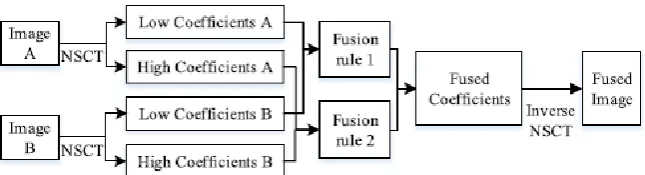
In wavelet image fusion scheme, the source images I1 (a, b) and I2 (a, b) are decomposed into approximation and detailed coefficients at required level using DWT. The approximation and detailed coefficients of both images are combined using fusion rule f. The fused image could be obtained by taking the inverse discrete wavelet transform (IDWT) as shown in figure 1[21].The fusion rule used simply averages the approximation coefficients and picks the detailed coefficient in each sub band with the largest Magnitude.
III. NSCT
Figure1: flow chart
Figure 2: Schematic diagram of NSCT-based fusion algorithm
“pattern selective” approach to image fusion, so that the composite image is constructed not a pixel at a time. The basic idea is to perform a pyramid decomposition on each source image, then integrate all these decompositions to form a composite representation, and finally reconstruct the fused image by performing an inverse pyramid transform. one, the combination processes selects the component pattern from the source and copy it to the composite pyramid, while discarding the less pattern. In the second one, the process averages the sources patterns. This averaging reduces noise and provides stability where source images contain the same pattern information.
IV. RESULTS
A. Techniques
Techniques for performing image fusion vary widely depending on the specific application, imaging modality, and other factors. Each imaging modality has its own idiosyncrasies with which to contend. There is currently no single fusion method that yields acceptable results for all types of applications. The present research work proposes an algorithm that is more general and can be applied to a variety of image data. The performance of the proposed research work was analyzed using various experiments and the results obtained were compared with its existing base counterparts, NSCT and SF combined with Wavelet based fusion algorithms. This section presents the experimental results obtained during performance analysis.
B. RMSE
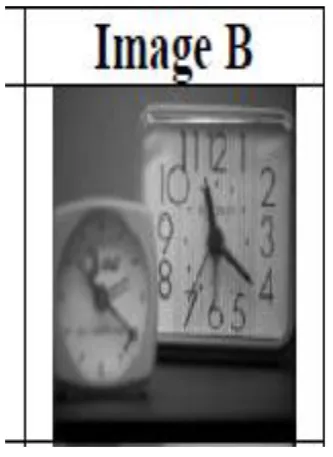
From the results projected, it is clear that the proposed method shows significant improvement in terms of Root Mean Square Error (RMSE) when compared with its traditional NSCT and SF combined with wavelet models. It could further noticed, that the algorithm produce best result for satellite image, indicating that the algorithm is best suited for remote sensor image fusion applications. Following this, the clock and pepsi images showed better RMSE values, showing that it is well-suited for depth-focus camera images also. The performance of the algorithm slightly degrades for weapon detection application. While considering RMSE, the proposed algorithm showed 36.01% and 24.08% efficiency gain over NSCT and SF+wavelet fusion algorithm.
C. Peak Signal to Noise Ratio (PSNR)
Fig 3: Image a and Image b Are input images
Fig : 4 the fused image.
V. CONCLUSION
The present work considers the amalgamation of two frequently used techniques, namely, NSCT fusion algorithm and wavelet-based fusion algorithm combined with spatial frequency for combining two images. The main aim is to perform image fusion to enhance the resultant image. The results from the various experiments show that the proposed hybrid model is an improved version and is on par with the performance of the existing algorithms for image fusion. In future, the work is planned to be extended to use classifiers for more accurate results.
REFERENCES
[1] Allen M. Waxman, Alan N. Gove, David A. Fay, Joseph P. Racamato, James E. Carrick, Michael C. Seibert and Eugene D. Savoye, Color Night Vision: Opponent Processing in the Fusion of Visible and IR Imagery.
[2] Deepu Rajan and Subhasis Chaudhuri, Generalized Interpolation and Its Application in Super-Resolution
Imaging, Image and Vision Computing, Volume 19, Issue 13, , Pages 957-969, 1November 2001
[3] Demin Wang and Limin Wang, Global Motion Parameters Estimation Using a Fast andRobust Algorithm,
[4] G. Simone, A. Farina, F. C. Morabito, S. B. Serpico and L. Bruzzone, Image Fusion Techniquesfor Remote Sensing Applications, Information Fusion, Volume 3, Issue 1, Pages 3-15, March 2002
[5] Hui Li, B.S. Manjunath, Sanjit K. Mitra H. Li, B. S. Manjunath and S. K. Mitra, Multisensor Image Fusion Using the Wavelet Transform, Proc. First international conference on image processing, ICIP 94, Austin, Texas,
[6] J. Núñez, X. Otazu, O. Fors, A. Prades, V. Palà, and R. Arbiol, Multiresolution-Based Image Fusion with
Additive Wavelet Decomposition, IEEE Transactions on Geoscience and Remote Sensing, vol.
37, no. 3, Pages. 1204-1211, May 1999
[7] Jorge Núñez, Xavier Otazu, Octavi Fors and Albert Prades, Simultaneous Image Fusion And Reconstruction
Using Wavelets; Applications to SPOT + LANDSAT Images, Vistas in Astronomy, Volume 41, Issue 3, Pages
351- 357, 1997
[8] L. J Chipman., T.M. Orr, L.N. Graham, Wavelets and Image Fusion, Proceedings International Conference
on Image Processing, vol. 3, Pages 248-251, 1995
[9] M. Antonini, M. Barlaud, P. Mathieu, and I. Daubechies, Image Coding Using the Wavelet Transform, IEEE
Trans on Image Processing, 2(2) , Pages 205-220, April 1992
[10] Yaonan Wang, Multisensor Image Fusion: Concept, Method and Applications, Faculty of Electrical and Information Engineering, Hunan University, Changsha, 410082, China
[11] Zhong Zhang and Rick S. Blum, A Categorization of Multiscale- Decomposition-Based Image Fusion
Schemes with Performance Study for A Digital Camera Application, Information Fusion, Pages 135-149, June
2001