End-to-End Secure Mobile Group Messaging
with Conversation Integrity and Deniability
Michael Schliep
University of Minnesota [email protected]
Nicholas Hopper
University of Minnesota [email protected]
Abstract
In this paper, we describe Mobile CoWPI, a deployable, end-to-end secure mobile group messaging application with proofs of security. Mobile CoWPI allows dynamic groups of users to participate in, join, and leave private, authenticated conversations without requiring the participants to be simultaneously online or maintain reliable network connectivity. We identify the limitations of mobile messaging and how they affect conversational integrity and deniability. We define strong models of these security properties, prove that Mobile CoWPI satisfies these properties, and argue that no protocol that satisfies these properties can be more scalable than Mobile CoWPI. We also describe an implementation of Mobile CoWPI and show through experiments that it is suitable for use in real-world messaging conditions.
I. INTRODUCTION
Texting and social media-based messaging applications have become nearly as common as face-to-face commu-nications for conversation between individuals and groups. The popularity of these messaging applications stems in part from their convenience, allowing users to communicate even in a mobile and asynchronous setting, where their network availability may be unreliable and they may come online and go offline at different times. In response to increasing privacy concerns, some of the most widely deployed messaging applications, including WhatsApp [24], Google Allo [15], Facebook [14], and Signal [21], have been deploying end-to-end encryption to protect the confidentiality and integrity of messages in users’ conversations.
However, message confidentiality and integrity are not sufficient to protect a conversation. While current applications protect the integrity of individualmessages— an adversary cannot modify a message while in transit from Alice to Bob — they do not protect the integrity of the conversation. Consider the following conversation between Alice and Bob, in which the order that messages are displayed can drastically affect the meaning of the conversation, even if the individual messages cannot be modified:
Alice’s View:
Alice:Are you going to the protests? Alice:Have you had lunch yet? Bob:No... Yes.
Bob’s View:
Alice:Have you had lunch yet? Alice:Are you going to the protests? Bob:No... Yes.
We refer to the security property that a conversation must be displayed consistently to all participants as
conversation integrity. This is an example of an additional security property we deem necessary for any future protocols to achieve end-to-end secure messaging.
Another example of such a property we focus on in this work is deniability. Consider the following conversation:
Reporter:What is your company doing illegally? Whistleblower:They are dumping poison into the water.
Whistleblower:My SSN is 123-45-6789. Reporter:What is your company doing illegally? Whistleblower:They are dumping poison into the water.
A protocol that provides message deniability allows the whistleblower to argue that they did not author the messages. But only the whistleblower knows their social security number so a protocol must also provide message unlinkability, guaranteeing there is no cryptographic proof to a third party that both messages were authored by the same participant.
Finally, most deployed secure messaging applications are based on the Signal two-party protocol, which is non-trivial to extend to group settings. Recently, multiple vulnerabilities [18], [19] have been discovered in the way these applications implement end-to-end secure messaging for groups. These vulnerabilities allow an adversary to drop or reorder messages in two-party and group conversations. Other messaging applications ignore end-to-end security of group conversations entirely. We consider group conversations just as important as two-party conversations and future deployable protocols must be designed with that in mind.
On the other hand, secure messaging protocols appearing in the research literature [3], [8], [13], [20], [5] make assumptions that are not realistic in the modern mobile internet which makes them unrealistic for practical deployments. Most of these works require synchronous communication or provide little to no guarantees about conversation integrity.
In this paper we address the problem of designing a deployable, end-to-end secure mobile group messaging application. Our contributions include:
• We identify key constraints of the mobile end-to-end secure messaging model as well as describe the security properties a protocol should provide. We also identify a real-world threat model a protocol must provide these properties under (Section II).
• We describe a relatively simple and provably secure protocol for Mobile Conversations With Privacy and Integrity (Mobile CoWPI) in Section III. We show in Section IV that Mobile CoWPI provides the desired security properties.
• We then analyze the security properties of our mobile messaging model and show the restrictions they impose on any mobile end-to-end secure messaging protocol (Section VI). We argue that under these restrictions, Mobile CoWPI is within a constant factor of optimal in terms of message size.
• We implement Mobile CoWPI as a Java server and library and show that it performs well in a realistic internet environment (Section V).
II. BACKGROUND
In this section we layout the system model of modern secure messaging applications and show how this model is insufficient to provide conversation integrity. We then detail our system model and discuss how it enforces conversation integrity. We also overview all of the security properties we provide in our protocol along with the threat model used for each property.
A. Mobile Messaging Model
All popular mobile messaging applications provide the same core features using a consistent system model. The key feature is providing a conversation for two or more participants. These applications allow participants to start a new conversation and send messages even while other participants are offline. When the offline participants return they are updated with all missed messages in the conversation. To improve conversation flow with offline participants the members of the conversation are notified when other participants have received the messages. This informs the author of a message not to expect a response until the recipients have received the message.
Alice’s and Bob’s View:
Alice:Lets go to the protest if 3 people want to? Alice:I want to go.
Bob:I cannot make it.
Charlie’s and Dave’s View:
Alice:Lets go to the protest if 3 people want to? Alice:I want to go.
Charlie:I am in. Dave:Yes, me too.
To avoid this conversation integrity attack the system model of Mobile CoWPI consists of a routing/caching service provider with multiple mirror service providers. Users register with the service providers out-of-band. The users register long-term and single use pre-keys with the providers. The single use pre-keys allow for conversation setup while some users are offline. When sending a message in a conversation the user uploads it to the routing service provider. The routing provider sends the message to the mirror providers. After that, the routing and mirror providers send the message to the participants. The participants wait until they have received the message from the routing provider and all mirror providers before processing it and only process messages if it has been received in the same order from all providers. The routing provider is asked to send protocol messages in the same order to all mirrors and all providers are asked to send all messages to the participants in the same order. The protocol enforce that messages are handled in an order that preserves the integrity of the conversation. It is only important that at least one provider send all messages in the same order to all participants. Since this is an any trust model we believe a single routing provider and a single mirror provider is sufficient to provide practical conversation integrity. We discuss some limitations of this model in Section VI.
B. Service Availability
Service availability is not a security goal of Mobile CoWPI. When discussing the protocol we describe multiple service providers. We do not necessarily expect each service to be provided by a single machine, but require each service to be provided by a separate entity. Standard techniques for achieving high availability can be deployed to ensure the service is reliably available.
Denial of Service protection is also a non-goal of Mobile CoWPI. It is trivial for a service provider to deny service to a client by not forwarding messages to the victim. It is possible for a malicious provide to behave incorrectly and send malformed or incorrect messages to a client and cause a denial of service. This is equivalent to not sending the messages at all. All messaging applications that rely on a service provider are vulnerable to this type of denial of service. We discuss this in more detail in Section VI. Additionally, if any participants are offline or cannot process a message, all other participants can still progress the conversation. They are not blocked on the offline/denial of serviced participants.
C. Security Properties
Besides the system goals of offline users and message receipts we now discuss the security goals of secure mobile messaging. Unger et. al. [23] provide a comparison of security goals of different secure messaging applications. We relate our security goals to the goals of their work where appropriate. In Section IV we provide sketches of the security proofs for these properties and provide the full proofs in Appendix A.
Message Confidentiality: Only conversation participants can read a message.
Message Integrity: Messages are guaranteed to not have been modified in transit.
Message Authentication: Conversation participants can verify the author of a message. Message authentication implies message integrity.
Forward Secrecy: Past messages are confidential even if future key material is revealed.
Backward Secrecy: Future messages are confidential if past key material is revealed, also know as future secrecy or post-compromise secrecy.
Participant Authentication: Participants can verify other participants are really who they claim to be.
Conversation Integrity: All participants see the same conversation. This includes the order of messages in a conversation and the order of participant changes in a conversation. In relation to Unger et. al. this goal implies speaker consistency, causality preservation, and a global transcript.
Deniability: Participants must be able to deny taking part in a conversation. Unger et. al. refer to this as participant repudiation. They also discuss two additional deniability properties; message repudiation and message unlinkability. Participant repudiation implies message repudiation. Message unlinkability is the property that if a distinguisher can be convinced a user authored one message this should not prove the authorship of any other message.
Anonymity Preserving: The protocol should not undermine the anonymity features of the underlying transport.
Computation and Trust Equality: All users perform similar computations and no user is trusted more than any other.
Untrusted Service Provider: Any individual service provider is not trusted to provide any of the security properties.
Dynamic Groups: Participants can be added and removed from conversations without restarting the protocol.
D. Threat Model
The security provided by Mobile CoWPI needs to withstand strong adversaries. We consider an adversary that may compromise multiple service providers and multiple users. The adversary also has full network control and may drop, modify, and reorder the network traffic. Each security property is provided under the strongest adversary that cannot trivially break the property. We now detail the exact capabilities of the adversary for each security property.
Message Confidentiality: The adversary has full network control and can insert, drop, and reorder network mes-sages. The adversary is allowed to compromise any or all of the service providers. The adversary may compromise any participant in a non-target session. The adversary is not allowed to compromise any participant in the target session as that would trivially allow them to trivially reveal the plaintext of the message.
Message Integrity and Authentication: The adversary considered for message integrity and authentication is the same as for message confidentiality.
Forward and Backward Secrecy: The adversary for forward and backward secrecy is similar to the message con-fidentiality adversary. This adversary is also allowed to compromise any or all participant in the target conversation but is not allowed to impersonate a participant in the target conversation. The adversary is also not allowed to compromise a participant at the time a target message is being processed as this would trivially break the secrecy.
Participant Authentication: The adversary is allowed to compromise the service providers and has full network control. The adversary is allowed to compromise non-target participants. We assume there is an authenticated side-channel between the target participants. This may be pre-shared secrets or in person face-to-face communication.
Participant Consistency: The adversary has full network control and is allowed to compromise all of the service providers. The adversary is allowed to compromise any participant in any session. The adversary is not allowed to compromise all of the service providers and a participant in the target session. This would allow the adversary to forge and deliver inconsistent participant changes to participants.
Conversation Integrity: The adversary has full network control and is allowed to compromise any participant in any session. The adversary is allowed to compromise all but one of the service providers. If the adversary compromised all service providers, the adversary could then fork the conversation as discussed earlier.
Anonymity Preserving: The adversary is a passive network adversary such as an Internet Service Provider. The adversary is not allowed to compromise any of the service providers or users of the messaging service. The goal of the adversary is to link a session to the long-term key or identity of a participant. The goal of Mobile CoWPI is to not reduce the anonymity provided by the underlying transport, e.g. Tor [22].
Deniability: We model deniability similar to Di Raimondo et. al. [6]. A protocol is said to be deniable if a distinguisher can not distinguish between a real protocol transcript and a simulated transcript. We only consider the protocol deniable if any user can produce a simulated transcript that is indistinguishable from a real transcript. The simulator must only take as input information that is known to a user, e.g. identities, long-term public keys, the users secret keys. The distinguisher is given access to the long-term private information of users, i.e. long-term secret keys.
III. DESIGN
A. Overview
At a high level Mobile CoWPI is designed as follows. Users register with the routing service provider out-of-band. This registration links a user identity, a long-term public key, and multiple single use pre-keys. The routing provider shares this registration information with the mirror service providers. When messages are sent as part of a conversation they are uploaded to the routing provider and distributed to the mirror providers. All service providers then send the messages to the participants. The participants do not process a message until it has been received from the routing service provider and all mirror providers in the same order. As long as a single provider is honest conversation integrity and participant consistency are enforced.
Users of Mobile CoWPI communicate with each provider using a two-party secure channel. The two party channels provide all of the security properties described in the previous section. We describe this channel in Section III-K.
When Alice wishes to set up a new conversation with Bob and Charlie she first fetches Bob’s and Charlie’s long-term public keys and a single use public pre-key for each of Bob and Charlie. She then uploads a setup
message of the form:
Sid,“SET U P”, Alice, P, cab, cac, authas1, . . . , authasm
to the routing provider.Sidis a unique session identifier for the session.P is the set of participants.ca∗are per-user
ciphertext blocks that authenticate the message and contain future key material for Bob and Charlie, described in Section III-E. Theautha∗blocks are authentication blocks for the providers detailed in Section III-F. The providers
then distribute the following to Alice, Bob and Charlie respectively.
Sid,“SET U P”, Alice, P Sid,“SET U P”, Alice, P, cab Sid,“SET U P”, Alice, P, cac
Alice, Bob, and Charlie do not process a message until they have received it from every provider. All protocol messages have a similar form, with a data block followed by per-user and per-provider blocks. This allows sending only the data block and a single per-user block to the participants.
After receiving the setup message, Charlie sends areceiptacknowledging Charlie has accepted the setup message from Alice. He first fetches the long-term public key and a single ephemeral public pre-key for Bob; he already has the necessary key material for Alice from the setup message. Charlie then uploads a protocol message of the form:
Sid,“RCP T”, Charlie, cca, ccb, authcs1, . . . , authcsm
wherecc∗ andauthc∗ authenticates both the setup message with Alice, Bob, and the providers respectively.
For Bob to send abroadcastmessagem, Bob uploads a protocol message of the form:
Sid,“M SG”, Bob, c, cba, cbc, authbs1, . . . , authbsm
wherecis an authenticated encryption with associated data (AEAD) ciphertext of the messagemunder a random key.cbaandcbcare AEAD encryptions of random key material that authenticate for Alice and Charlie respectively, and authb∗ authenticates the message for the providers. The term broadcast is used to indicate this is a group
conversation message that is meant to be displayed to the user, it has no relation to broadcast messaging.
The final message type isgroup update for changing the participants of the conversation. When Alice wishes to add Dave to the conversation she fetches Dave’s long-term and ephemeral key material and uploads a message of the form:
Sid,“U pdate”, Alice, P, cab, cac, cad, authas1, . . . , authasm
whereP is the new set of participants andca∗ andautha∗authenticates the message for every participant and the
B. Message Order
We now detail the rules enforcing message order.
1) A protocol message must be received from all providers before processing. The protocol messages must also be processed in the order they are received.
2) All conversations start with a setup message.
3) When Alice sends a receipt, it must acknowledge all setup, broadcast, and group update messages prior to the receipt that she has not yet acknowledged. Typically they are sent shortly after every message is received.
4) Prior to Alice sending a broadcast or group update, Alice must have sent a receipt.
5) When Alice sends a receipt, she acknowledges messages with every participant and the providers separately. If Bob has just joined the conversation she only acknowledges the messages that she and Bob have in common.
6) When Alice sends a broadcast or group update message, she must acknowledge the most recent prior setup, broadcast or group update message. She must also acknowledge all receipts received after that prior message in order.
7) If Alice receives an invalid protocol message from the providers she terminates the conversation on her client and does not process any future messages.
Rule (1) implies that even the author of a message must wait until they have received it from all providers before processing it. Otherwise, if two users sent a message at the same time, both users would think their message would come first, causing an order inconsistency.
Rule (6) implies strong ordering of setup, broadcast, and group update messages but not receipts. This was a design choice as requiring receipts to acknowledge receipts would cause significant overhead and excess network traffic. We describe why we made this decision in more detail in Section VI.
Rules (3) and (4) restrict the amount of time a message is vulnerable if the keys used to encrypt it are compromised. We discuss this more as it relates to forward and backward secrecy in Section IV
C. Primitives
We assume standard cryptographic primitives. Letlbe the security level in bits of Mobile CoWPI. All primitives are assumed to provide at least l bits of security. Let G be a group of prime order pgenerated by g where the decisional Diffie-Hellman assumption is hard.
We assume a hash function and three key derivation functions:
H :{0,1}l×Zp7→Zp∗
KDF1:S×G×G×G×U×U 7→ {0,1}l
KDF2:{0,1}l7→ {0,1}l
KDF3:G7→ {0,1}l
WhereH andKDF1 are used for two-party NAXOS [11] key agreements,KDF2 is used to produce a random
symmetric key from an input string, and KDF3 is used for anonymous Diffie-Hellman. S is the set of possible
session identifiers and U is the set of possible participant identifiers. These functions are modeled as random oracles. We choose NAXOS as it has the property that to distinguish between a random key and a NAXOS key the distinguisher must know both the long-term and ephemeral secret keys of one of the participants.KDF1is a minor
modification of the NAXOSKDF that also includes the session identifier of the current Mobile CoWPI session.
We assume a symmetric authenticated encryption with associated data (AEAD) scheme. AEAD consists of two functions, Enck(m, d) 7→ c, and Deck(c, d) 7→ m, or ⊥ if c and d do not authenticate with key k. The AEAD scheme must provide indistinguishable from random chosen-plaintext-attack security (IN D$−CP A) [17] and integrity of ciphertext security (IN T −CT XT) [2]. We choose AES-GCM with random IVs for our AEAD scheme.
D. Registration
To register with the providers Alice generates a long-term public private key pair:
She also generates a list of ephemeral pre-keys wherei is the id of the pre-key:
eska[i]←R{0,1}l epka[i]←gH(eska[i],lska)
Alice registers her identity, public long-term keylpka and public ephemeral pre-keysepka with the providers
out-of-band. Alice should generate enough pre-keys to support as many conversations as she expects to start while she is offline. She can always upload new pre-keys in the future. Each pre-key may only be used for a single session. The participants must enforce this rule.
E. Two Party Ciphertext Blocks
All protocol messages contain pairwise ciphertext blocks cab where a is the sender and b is the receiving participant. These blocks are used to send additional key information and authenticate the protocol message. They are computed using a simple key ratchet where the initial block uses a pre-key to perform a NAXOS authenticated key agreement and then utilizes AEAD to encrypt and authenticate the message; All subsequent blocks after the initial block use ephemeral keys sent in the previous block to derive a new NAXOS key and then encrypt with AEAD as in the initial block. In this section we describe how to compute these ciphertext blocks in terms of Alice sending to Bob.
Here we describe how Alice computes the initial ciphertext block cab to send to Bob in session Sid. This ciphertext block encrypts messagemand authenticates associated datad.m is only used when sending broadcast messages, in which case it is random symmetric key material. When sending setup, receipt, and group update messagemis empty.
First, Alice fetches Bob’s long-term public keylpkb and an ephemeral pre-key epkb from the providers where idb is the id ofepkb. Alice generates a new ephemeral key:
eskab← {0,1}l epkab←gH(eskab,lpka)
Then Alice computes a symmetric key:
ki1←epkblska ki2←lpk
H(epkab,lska)
b
ki3←epk
H(epkab,lska)
b
k←KDF1(Sid, ki1, ki2, ki3, a, b)
Alice generates her next ephemeral key pair:
id0ab←1
eskab0 ←RZp∗
epk0ab←gH(esk0ab,lska)
She computes the ciphertext block as:
cab←epkab, idb, Enck((m, id0ab, epk0ab), d)
When Bob receives cab =epkab, idb, c from the providers he first fetches Alice’s long-term public key lpka
and looks up the ephemeral secret keyeskb associated with idb and computes the symmetric key as:
ki1←lpkHa(eskb,lskb) ki2←epkablskb ki3←epk
H(epkb,lskb)
ab
k←KDF1(Sid, ki1, ki2, ki3, a, b)
Then he verifiesc anddwithkand decrypts:
and storesid0abandepk0abfor latter use. Note that the implicit authentication of NAXOS key exchange authenticates that the message originated from someone with knowledge of Alice’s long-term secret key.
All subsequent ciphertext blocks are generated and processed in the same manner as the initial ciphertext block replacing the pre-keys with the ephemeral keys received in the previous block. The users do not send the ephemeral public keys in the clear in subsequent ciphertext blocks. That is the ciphertext block has the form:
cab←id0b, Enck0((m, id00ab, epk00ab), d)
Alice and Bob may try to initialize the two-party key ratchet at the same time. If this happens the providers will enforce an order to the messages and future ciphertext blocks should use the most recently initialized key ratchet.
These ciphertext blocks are what provide message integrity and authentication. This is due to the NAXOS key agreement implicitly authenticating the symmetric keys.
F. Provider Authentication Block
Every conversation message that Alice sends contains a provider authentication blockauthaj for every provider
j∈SwhereSis the set of providers. The authentication blocks are necessary since Alice only uploads the message to the routing provider. The routing provider then forwards the message to the mirror providers. The authentication blocks allow the providers to verify that the message is from Alice.
These blocks are simple AEAD ciphertexts that authenticate the message d as associated data. When Alice comes online she simply sends to every providerj∈S a symmetric key kaj ←R{0,1}l. Then when Alice sends
a protocol messagedshe first generates her next keykaj0 ←R{0,1}l, then computes the authentication block: authaj ←Enckaj(kaj0 , d)
Providerj verifiesdand decrypts the next symmetric key k0aj.
G. Setup Message
All conversation messages are similar in format. For Alice to setup a conversation she generates a randomSid
and computes the setup message:
data0←Sid, Alice,“SET U P”, P
Next, Alice computes the two party ciphertext block cai for every participant i ∈ P \ {Alice} as described in
Section III-E, wheredata0 is the associated data to authenticate in those ciphertext blocks. Letn=|P|and :
data1←data0, ca0, . . . , can−1
Next, Alice computes the provider authentication blockauthaj for every providerj∈Sas described in Section III-F wheredata1 is the associated data to authenticate. Alice then sends to the routing provider:
data1, autha0, . . . , authas
wheres=|S|.
The routing provider sends to each mirror providerj the messagedata1, authaj. Each provider can verify the
messagedata1is from Alice. Then every provider sends to participanti∈P\{Alice}the messageAlice, data0, cai.
Every user verifies that data0, cai is from Alice as detailed in Section III-E. The providers send data0 to Alice
and she verifies it is thedata0 she sent.
H. Receipt Message
Participants send receipts after they have accepted any setup, broadcast, or group update message. If multiple messages are sent while Alice is offline she sends a single receipt that acknowledges all messagesmiwith participant i∈P\ {Alice}. The messages to acknowledge depend on the participant they are being acknowledged to.mi is composed of all protocol message excluding receipts that have not been acknowledge previously and have been sent after participant i has been added to the conversation. This is becausei cannot acknowledge messages they have not seen.mi should be a list of alldata0 blocks from the messages to acknowledge in order. Letmbe a list
of all of the unacknowledged setup, broadcast, and group update messages.
A receipt is similar to a setup message. When Alice generates a receipt for messages she computes:
data0←Sid, Alice,“RCP T”
Then she computes the two party ciphertext blockcaifor every participanti∈P{Alice}as detailed in Section III-E with the associated data to authenticated as data0, mi. Let
data1←data0, ca0, . . . , can−1
She then computes the provider authentication blocks as detailed in Section III-F with the associated data as
data1, m. Finally, she sendsdata1 and the authentication blocks to the routing provider.
The providers can verify that all unacknowledged messages are acknowledged in their respective provider authentication block. If the receipt does not acknowledge all unacknowledged messages it is dropped. The providers then senddata0, ci to participanti. Every participant can verify all of Alice’s unacknowledged messages with their
respective ciphertext block. Alice verifiesdata0 is the message she uploaded. If the message does not verify the
conversation is terminated.
I. Broadcast Message
Broadcast messages are similar to receipts except they contain a ciphertext. Let pm be a list of all protocol messages up-to and including the last setup, broadcast, or group update message in a conversation. When Alice wants to send the broadcast message m. She first generates a random symmetric key input ka ←R {0,1}l then
computes the symmetric keyk←KDF2(ka). Let
data0←Sid, Alice,“M SG”, Enck(m)
She then generates the ciphertext block cai for everyi∈P \ {Alice} as detailed in Section III-E withka as the
message to encrypt and data0, pm as the associated data. Let
data1←data0, ca0, . . . , can−1
She then computes the provider authentication blocks as detailed in Section III-F with the associated data as
data1, pm. Finally, she sendsdata1 and the authentication blocks to the routing provider.
Each provider verifies the message and sendsdata0, caito participanti. After receiving the message from every
provider each participant verifies and then displays the message. If the message does not verify the conversation is terminated.
J. Group Update Message
To change the set of participants in a conversation a member of the conversation can send a group update message. Who is allowed to send the messages as well as what modifications they are allowed to make is out-of-scope of this paper. However, group modifications must be enforceable by the providers since they need to forward messages.
Group update messages are similar to broadcast messages except that the broadcast message ciphertext is replaced with a list of participants. Again let pmbe a list of all protocol messages up-to and including the last setup, broadcast, or group update message in the conversation. When Alice wishes to change the participants of a conversation to P0 she creates a message:
data0←Sid, Alice,“U P DT”, P0
She then creates the ciphertext blockcaifor participanti∈(P∪P0)\ {Alice} as described in Section III-E where
data0, pmis the associated data for the ciphertext blocks. Let
Alice then creates the provider authentication block authaj for provider j ∈S as detailed in Section III-F with
data1as the associated data. She uploadsdata1along with the provider authentication blocks to the routing provider
and the routing provider distributes the message to the other mirror providers.
Each provider checks that Alice is allowed to make the desired group modification and sendsdata0, cai to all i∈(P∪P0)\ {Alice} and sends data0 to Alice. Each participant verifies the messages is authentic from Alice
and updates their participant list after they have received the message from every provider. If the message does not verify the session is terminated.
This message authenticates the group change to all old and new participants which leaks any new participants to participants that have been removed. To avoid this leakage it is up to the implementation to send a separate group update message removing users before sending a message adding the new users.
K. Two Party Channels
All communication between the clients and providers and between providers is performed over a two-party channel that supplies all of the security properties discussed in Section II. The mirror providers act as clients when communicating with the routing provider. This is a synchronous channel that is setup by first performing an anonymous Diffie-Hellman key agreement followed by a NAXOS key agreement to provide authentication to the channel. Then all messages are secured by using a NAXOS key agreement with keys being ratcheted on every message. Algorithm 1 details the algorithm for setting up the channel from the initiator. Line 1 generates the DH
Algorithm 1 Client To Provider Channel Setup
1: function C2SCHANNELSETUP(C, S, lpks, lskc) 2: eskc[0]←RZp∗,eskc[1]← {0,1}
l
3: epkc[0]←geskc[0],epkc[1]←gH(eskc[1],lskc)
4: k0←KDF3(lpk
eskc[0]
s )
5: c0←Enck0(C, epkc[1])
6: SEND(S, epkc[0], c0)
7: epks[0], c1← RECV(S)
8: km1←lpk
H(eskc[1],lskc)
s 9: km2←epks[0]lskc
10: km3←epks[0]H(eskc[1],lskc) 11: k1←KDF1(km1, km2, km3, S, C)
12: t, epks[1]←Deck1(c1)
13: eskc[2]←RZp∗,epkc[2]←geskc[2] 14: km4←epks[1]lskc
15: km5←lpk
H(eskc[1],lskc)
s
16: km6←epks[1]H(eskc[1],lskc) 17: k1←KDF1(km4, km5, km6, C, S)
18: c2=Enck2(t, epkc[2])
19: SEND(S, c2)
20: returneskc, epks
keys for the anonymous DH key agreement and line 2 generates the ephemeral NAXOS keys. Lines 5-6 encrypts the clients identity and NAXOS ephemeral key and send it to the provider. Line 7 receives the provider’s response and line 8-9 compute the shared NAXOS key and decrypt the provider’s next ephemeral public key and a challenge. Line 10 generates the clients next ephemeral keys. Finally, Lines 11-13 ratchets the channel keys and sends the challenge back.
Algorithm 2 details setting up the channel from the provider. Lines 2-4 compute the anonymous DH shared secret using the provider’s long-term key and decrypt the clients identity and NAXOS ephemeral public key. Line 5 looks up the long-term public key of the client and line 6-8 compute the NAXOS shared key. Lines 9-11 encrypt the challenge and the providers next ephemeral DH key and send it to the client. Lines 12-18 decrypt the clients response and check that the client’s response matches the challenge.
Algorithm 2 Provider To Client Channel Setup
1: function S2CCHANNELSETUP(S, C, lsks) 2: epkc[0], c0←RECV(C)
3: k0←KDF3(epkc[0]lsks) 4: C, epkc[1]←Deck0(c0)
5: lpkc←LOOKUPUSER(C)
6: esks[0]←0,1l, epks[0]←gH(esks[0],lsks) 7: esks[1]←Zp∗, epks[1]←gesks[1]
8: km1←epkc[1]lsks
9: km2←lpk
H(eskc[0],lsks)
c
10: km3←epkc[1]H(esks[0],lsks)
11: k1←KDF1(km1, km2, km3, S, C)
12: ts←R{0,1}l
13: c1←Enck1(ts, epks[1])
14: SEND(C, epks[0], c1)
15: c2← RECV(C)
16: km4←lpk
H(esks[1],lsks)
c 17: km5←epkc[1]lsks
18: km6←epkc[1]H(esks[1],lsks)
19: k3←KDF1(km4, km5, km6, C, S)
20: tc, epkc[2]←Deck2(c1)
21: ifts=tc then
22: return(C, esks, epkc) 23: else
24: return⊥
Algorithm 3 Channel Send
1: function SECURESEND(S, R, m, lsks, esks, lpkr, epkr)
2: ns← |eskr| 3: nr← |epkr|
4: km1←epkr[nr−1]lsks
5: km2←lpkr[nr−1]H(esks[ns−1],lsks) 6: km3←epkr[nr−1]H(esks[ns−1],lsks) 7: k←KDF1(km1, km2, km3, S, R)
8: esks[ns]←Zp∗, epks[ns]←gesks[ns]
9: c←Enck(m, epks[ns])
10: SEND(R, nr−1, c)
11: return(esks, epkr)
next ephemeral public key. Finally, line 7 sends the encrypted message along with the id of the receivers public key used to encrypt it.
Algorithm 4 Channel Receive
1: function SECURERECV(R, S, eskr, epks)
2: ns← |epks| 3: nr, c←RECV(C)
4: km1←lpk
H(eskr[nr−1],lskr)
s
5: km2←epks[ns−1]lskr
6: km3←epks[ns−1]H(eskr[nr−1],lskr)
7: k←KDF1(km1, km2, km3, S, R)
8: m, epks[ns]←Deck(c)
9: return(eskr, epks)
4 computes the shared key and line 5 decrypts the message and the senders next ephemeral public key.
L. Long-term Key Verification
The ability for Alice to verify that Bob is actually Bob is a challenging problem in messaging systems. This is enforced in Mobile CoWPI by verifying the real Bob knows the private key associated with the long-term public key Alice retrieves from the providers. Mobile CoWPI does not necessitate a specific mechanism for verifying these keys and identities but some such mechanism is required to provide participant authentication. In practice key fingerprints can be compared in person or with an interactive scheme such as the Socialist Millionaire Protocol (SMP) as applied by Alexander and Goldberg [1].
IV. SECURITY
In this section we discuss the security provided by Mobile CoWPI. We argue that it provides all of the desired security properties discussed in Section II. We provide full proofs in Appendix A. We model our hash function (H) and key derivation functions (KDF1, KDF2, KDF3) as random oracles. We also assume the decisional
Diffie-Hellman problem is hard. We utilize the fact distinguishing between a random key and a key generated with the NAXOS key agreement is hard if the adversary does not know the long-term and ephemeral secret keys of one of the parties in the key agreement as shown by the NAXOS authors. We assume our AEAD scheme provides
IN D$−CP A andIN T −CT XT security. Finally, we assume all participants in a conversation have verified their long-term keys either manually or with SMP.
A. Message Confidentiality
Message confidentiality is the property that only participants of a conversation can read a message. We provide message confidentiality against a powerful adversary that may corrupt any or all of the providers, may control any user that is not a participant in the target conversation, and may reveal the long-term and ephemeral keys of any participant on any non-target message.
To compromise the confidentiality of a message:
Sid,“M SG”, A, EncKDF2(ka)(m), ca1, . . . , autha1, . . .
The adversary must be able to distinguish between EncKDF2(ka)(m) and a random string. If an adversary can
make this distinction they must be able to do one of the following:
1) Compute a two-party NAXOS key without being one of the parties allowing them to decrypt one of the ciphertext blocksc∗ and retrieve the key inputka, thus decrypting them.
2) Decrypt one of thec∗ ciphertext blocks without knowing the symmetric key and learn ka, thus breaking
theIN D$−CP Asecurity of the AEAD scheme.
3) Distinguish the ciphertextEN CKDF2(ka)(m)from random without knowingka, thus breaking theIN D$−
CP Asecurity of the AEAD scheme.
B. Message Authentication and Integrity
Message authentication implies message integrity. Message authentication provides the property that when Bob receives a message from Alice in sessionSid, Alice must have sent that message. Mobile CoWPI provides message authentication against a strong adversary that may control any or all of the providers and any users or sessions. As long as Alice and Bob have not had their long-term keys and ephemeral keys of sessionSidcompromised, all messages received by Bob from Alice are authentic.
For an adversary to forge a message from Alice to Bob the adversary must create a message:
Sid,“M SG”, A, EncKDF2(ka)(m), cab, . . . , autha1, . . .
If the adversary can forge the message they must be able to do one of the following:
1) Compute a two party NAXOS key without knowing Alice’s or Bob’s long-term and ephemeral keys, allowing the adversary to create the ciphertext blockcab.
2) Forge a valid ciphertext blockcab from Alice to Bob without knowing the symmetric key, thus breaking
C. Forward Secrecy
Forward secrecy is the property that past messages are confidential even if future key material is revealed. Mobile CoWPI provides forward secrecy of a messagemafter every useri∈P has processed the receipt of every userj∈P acknowledgingm. Forward secrecy assumes the same adversary as message confidentiality.
LetP be the set of participants in sessionSidand let
ma←Sid,“M SG”, A, EncKDF2(ka)(m), ca1, . . . , autha1, . . .
be a message sent from userA∈P. The adversary cannot distinguishEncKDF2(ka)(m)from random after every
participant i ∈ P has processed a receipt from A, acknowledging ma, and A has processed a receipt form i
acknowledgingma. First we show that every ephemeral private keyeskiaused to compute ciphertext blockcaiwill never be used again and thus can be deleted. Then we show that without eskia the adversary cannot distinguish EncKDF2(ka)(m)from random similar to message confidentiality.
The ciphertext blockcaiis computed usinga’s ephemeral private keyeskaiandi’s ephemeral public keyepkia. In cai,adistributes a new ephemeral public keyepk0aiand can safely deleteeskai, so all eskai have been deleted
after sendingma.
Now we show eskia can be deleted after i has sent a receipt that acknowledges ma and processed a receipt
fromaacknowledging ma. Let the receipt fromibe:
ri←Sid,“RCP T”, I, ci1, . . . , authi1, . . .
Ciphertext block cia is generated using ephemeral private key eskia and ephemeral public key epk0ai. In cia, i
distributes a new ephemeral public key epk0ia. Let ra be the receipt from a acknowledging ma. The ephemeral
private keyeskia can be deleted after i processes bothri and ra. Since receipts do not enforce an order, amay use eskia when sendingra. After a sends ra she may only send a broadcast message or group update message, which acknowledgesri and thus usesepkia0 . This shows thateskai andeskia can be deleted afteraandiprocess the receiptsra andri.
After keys have been ratcheted Mobile CoWPI provides the same message confidentially property as discussed previously.
D. Backward Secrecy
Backward secrecy is the property that compromising prior long-term and ephemeral key material does not break the confidentiality of future messages. If Alice’s long-term or ephemeral state are revealed, all broadcast messages following Alice’s next receipt provide backward secrecy. Similar to forward secrecy we need to show that Alice’s compromised ephemeral private keys are not used in the next broadcast message.
Leteskaibe Alice’s compromised ephemeral key used for the two-party ciphertext block with useri. We show
that after Alice’s next receipt, the following broadcast message does not useeskai. Let Alice’s receipt be:
ra←Sid,“RCP T”, Alice, ca1, . . . , autha1, . . .
Recall that the ciphertext block cai is encrypted with a key generated from eskai and contains a new ephemeral keyesk0ai. Letc0aibe the ciphertext block of the broadcast message. Since all messages must acknowledge all prior receipts,c0ia must use Alice’s ephemeral keyepk0aifrom her receipt.
Similar to forward secrecy, after keys have been ratcheted Mobile CoWPI provides message confidentiality as discussed previously.
E. Participant Consistency
F. Conversation Integrity
Conversation integrity is the property that all honest participant in a conversation see the same conversation. That is all honest participants agree on the order of all setup, broadcast, and group change messages. Conversation integrity considers an adversary that controls the network, can compromise all but one provider, and can compromise participants in the conversation. The adversary is not allowed to compromise all the providers, otherwise breaking conversation integrity is trivial, irregardless of the protocol. If all of the providers are compromised the adversary can simply partition the group.
Consider a conversation between Alice, Bob, and Charlie. After Alice sets up the conversation the adversary can partition the conversation by never forwarding messages from Charlie to Alice or Bob, and similarly never forwarding any messages, after the setup message, from Alice or Bob to Charlie. Alice and Bob will believe Charlie has never come online and continue the conversation, while Charlie will believe Alice and Bob are always offline and continue the conversation alone. Thus, at least one provider must be honest.
If at least one provider is honest, to break conversation integrity the adversary must send a message:
Sid,“M SG”, A, EncKDF2(ka)(m), c∗, . . . , auth∗, . . .
where two honest users (Alice and Bob), decrypt different key inputs values from their respective ciphertext that both decryptEncKDF2k∗(m)to different valid plaintext. Letc, dbe arbitrary strings; then the probabilityint that
Deck(c, d)6=⊥for a random key k must be negligible, since an adversary can win the IN T −CT XT game by
simply submittingc, das a ciphertext query. This holds even whenc=Enck0(m, d)for some fixedk0. Thus if the adversary makes at most q queries toKDF2, the probability of finding a k0 =KDF2(k)breaking conversation
integrity in this way is at mostqint.
If the adversary cannot find a valid ciphertext under two random keys, to break conversation integrity the adversary must convince two participants to accept different messages as theithmessage of conversationSid. The
honest participants only accept a message after receiving it from all providers and an honest provider will forward all messages in a consistent order to all participants. The adversary must be able to send a message to an honest participantA as if it came from honest providerS. If the adversary can inject such a message, it must be able to do one of the following:
1) Compute a two-party NAXOS key betweenAandS in their two-party channel, allowing the adversary to send any message toA.
2) Break the INT-CTXT property of the AEAD scheme of the two-party channel betweenAandS.
G. Deniability
Recall deniability as discussed in Section II. Deniability is provided if a single user can run a simulator and produce a simulated transcript that is indistinguishable from transcript of a real protocol execution. The simulator must only take as input information that is known to a single user. The distinguisher is given all of the long-term secret information and any secret state information of the simulating user. This requires the simulator to also output any state information of the user.
We now detail the simulator. Let Alice be the party running the simulator. She acts as all parties in the conversation and behaves as normal expect when performing NAXOS key agreements. The NAXOS key agreements are the only part of the Mobile CoWPI protocol that Alice cannot perform honestly as she does not have the secret key material of all participants. Their are two cases of the NAXOS key agreement she needs to simulate:
1) When she is a participant of the NAXOS key agreement. 2) When she is not a participant of the NAXOS key agreement.
In the first case let Bob be the other participant. Alice may have a valid ephemeral public key of the other participant if she is sending the SETUP message. Otherwise she generates an ephemeral key epkb for the other
participant as a random group element. She then computes the NAXOS key as she normally would.
If she has a valid ephemeral key for Bob the NAXOS key agreement is a real key agreement. If she generates a random key from Bob the distinguisher must distinguish between the random key and a real NAXOS ephemeral keyepkb←gH({0,1}l,lsk
b). SinceH is modeled as a random oracle the distinguisher can only win if it queries the
random oracle on all2l possible ephemeral secret keys with Bob’s long-term secret key. Thus the adversary cannot
0
10
20
30
40
50
Group Size
0
50
100
150
200
Time (ms)
Wall Time
CPU Time
Send Protocol Message Time
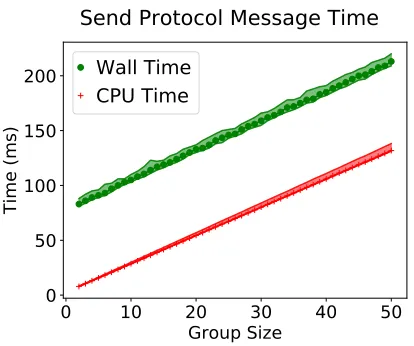
Fig. 1: The wallclock and cpu time (25th, 50th, and 90th percentile) to send a protocol message.
In the second case let Bob and Charlie be the two participants. Alice will have a valid ephemeral public key for one of them if they are sending a SETUP message. Alice will generated any ephemeral keys she does not have as random group elements as before. She then generates the NAXOS key as a random symmetric key.
As before, the distinguisher cannot tell if the randomly generated ephemeral keys are real with less than 2l
oracle queries. Since the distinguisher does not know the ephemeral secret key of either party it cannot distinguish between a random key and a real NAXOS key.
Using these NAXOS simulators, Alice can simulate all parties of a Mobile CoWPI protocol session and produce a simulated transcript that is indistinguishable from a real transcript. Thus, Mobile CoWPI provides message and participant deniability.
1) Message Unlinkability: Message unlinkability is the property that proving authorship of any one message does not prove authorship of any additional message. This property has not been formally defined previously. It was first discussed in relation to mpOTR [8], as mpOTR is considered not to provide message unlinkability. This is due to mpOTR using the same ephemeral signing key to sign every message. Thus, the distinguisher having knowledge of the ephemeral verification key can verify every message sent by a user. Since Mobile CoWPI does not use signatures and all authentication material is only used for a single message Mobile CoWPI provides message unlinkability. In Appendix A, we prove a stronger version of message unlinkability that provides the distinguisher with a protocol message from a real transcript but can still not distinguish the full transcript from a simulated transcript.
H. Anonymity Preserving
A protocol preserves anonymity if the protocol does not undermine any anonymity features of the underlying transport protocol. The adversarial model for this property is that of a passive network adversary, e.g. the user’s internet service provider. Mobile CoWPI preserves anonymity as it does not reveal the identity or long-term key of a user in plaintext. This is achieved by using anonymous Diffie-Hellman to initiate the connections between the clients and providers.
If an adversary can break the anonymity preserving property they must be able to do one of the following:
1) Compute the anonymous DH shared secret between the client and provider. 2) Break the IND$-CPA property of the AEAD scheme.
V. EVALUATION
0
10
20
30
40
50
Group Size
2000
4000
6000
Bytes
Send Protocol Message Sizes
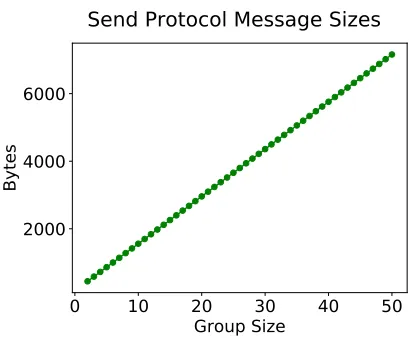
Fig. 2: The message size in bytes to send a message.
on a desktop computer with an Intel Core i7-6700K processor. The client recording measurements was running on a desktop computer at the University of Minnesota, with an Intel Xeon processor. The network round-trip-time between all locations is 31ms. We ran the measurements with 2 to 50 participants in a conversation and sent 100 messages for each size of conversation. These measurements show Mobile CoWPI is practical for real world deployments.
Figure 1 shows the time in milliseconds that it takes for a user to send a protocol message and receive a protocol message. This represents the time it takes to display the message. Figure 2 shows the outgoing message size in bytes when sending a message. All outgoing messages areO(n+s)in size where nis the number of participants andsis the number of servers. This is due to the authentication being pairwise with all receivers. We discuss why this overhead is necessary in Section VI. Pairwise ciphertext blocks does allow for very little overhead to receive a message. Broadcast and receipt messages are constant size while setup and group update message must beO(n) in size to distribute the list of participants. The overhead of Mobile CoWPI for incoming messages is less than 300 bytes.
VI. LIMITATIONS
In this section we detail the limitations of Mobile CoWPI along with restrictions enforced by the system model.
A. Pairwise Ciphertext Blocks
The pairwise ciphertext blocks attached to every protocol message cause the most overhead in Mobile CoWPI. We use these pairwise ciphertext blocks to provide deniable message author authentication. We argue that the pairwise nature of our solution seems to be an inherent result of the system properties of deniability and authorship authentication. In particular, we now sketch a proof that a scheme in which each user uses a single public and private key pair to deniably authenticate messages to the full group is impossible.
Consider the system model property that a participant should be able to authenticate the author of a message even when all other participants are offline. This means message authentication must be non-interactive. Also recall that deniability requires a user to be able to simulate a conversation even if the distinguisher has access to the long-term private keys of all participants. It must be the case that a user can simulate an authorship authentication that the distinguisher will accept but a real user will reject. However, the distinguisher has the real users’ secret keys and can use the same verification method to distinguish the simulated authorship authentication from a real one. A more detailed discussion is provided in Appendix A
B. Multiple Providers
Requiring multiple providers for conversation integrity adds difficulty to deploying Mobile CoWPI. However, if this requirement cannot be met the conversation integrity property could be modified to include a time aspect. Most users are expected to only be offline for short periods of time, for example less than one week. It is also the case that after Alice receives a receipt from Bob, she can be confident that Bob’s transcript provides conversation integrity with her transcript. Thus, if every user sends a receipt after every message, we can add a time constraint to the conversational integrity property and warn users after a time limit (one week) of not having seen a receipt from every other participant. We chose to require multiple providers for Mobile CoWPI as it provides much stronger conversation integrity for every message. (And at least one providers is required for offline participants to receive messages)
C. Denial of Service
Mobile CoWPI does not protect against denial of service attacks from compromised servers: a server can simply not forward conversation messages to a participant. Since the participant must receive the message from every server, the participant will simply keep waiting and not make progress. A potential solution to this problem would be to have multiple servers perform a byzantine agreement on the messages of a conversation and then participants could process a message after receiving it from a majority of servers. This changes the trust model from a single honest server to a majority of honest servers and it is not straight forward how this modification would affect the deniability properties of the conversation.
Mobile CoWPI also does not offer denial of service protection against a compromised participant. A compro-mised participant can send an invalid ciphertext block c∗ to a victim. The victim will terminate the session and
all non-victims will not know of the attack. The implementation should warn the user of the attack allowing them to notify the other participants out-of-band. It may be possible to mitigate this issue by modifying the ciphertext blocks to provide zero knowledge proofs of correctness that the servers can verify. However, we do not know of an efficient mechanism that would allow for this and also preserve message deniability and unlinkability.
These denial of service limitations are not unique to Mobile CoWPI. All existing protocols in the literature and in wide deployment are also vulnerable to denial of service by the server or participants.
D. Receipt Ordering
As described in Section III, receipts do not acknowledge other receipts. To explain why we made this decision, consider the case where receipts are required to acknowledge all previous receipts. Upon receiving a broadcast message, all users will attempt to send a receipt immediately but only one receipt will be accepted. The remaining
n−1will be rejected as they do not acknowledge the accepted receipt. Then the remainingn−1users will attempt to send the another receipt with only one being accepted. This issue continues until all users have a receipt accepted and creates a significant amount of wasted traffic which delays conversation progress.
VII. RELATEDWORK
Off-The-Record (OTR) [3] is the first academic work to look at providing private instant messaging. OTR provides message confidently, integrity, authentication, repudiation, and unlinkability. However OTR does not provide participant repudiation or conversation integrity. The main limitation of OTR is it only supports conversations between two individuals. There is not a straight forward mechanism to apply OTR in a group setting.
Group Off-The-Record (GOTR)[13] utilizes a “hotplugable” Bermister-Desmedt GKA to provide secure mes-saging for dynamic groups. To set up a conversation all the users first set up secure pairwise channels. Then over those channels the participants execute the GKA. When sending a message Alice encrypts the message with her sending key generated by the GKA. Then periodically the participants perform a transcript consistency check to verify all users have seen the same conversation. The details of the consistency check are not addressed in the paper. GOTR only works in the synchronous model as all users must be online to execute the GKA and consistency checks, making it not suitable for mobile communication.
SYM-GOTR [20] is a recent proposal for synchronous end-to-end secure group conversations with the same properties as our work. SYM-GOTR works with existing XMPP servers and a client plugin. Similar to GOTR, participants first setup pairwise secure channels between all participants. Then the participants share symmetric key inputs and verification keys. When Alice sends a message she first computes a symmetric encryption key by hashing all of the symmetric key input material from all the other participants and encrypts the message. She broadcast the ciphertext to all participants. After receiving a ciphertext all participants perform a two phase consistency check of the ciphertext over the pairwise secure channels. The first phase verifies all users have received the ciphertext and the second phase identifies any users who have misbehaved in the first phase. Modifying the participants of the conversation is as simple as distributing new symmetric key inputs and verification keys. The main limitations of SYM-GOTR is that it requires all participants to be online at the same time and the two phase interactive consistency check causes additional delay in message processing.
Signal [21] (formerly TextSecure) is the most widely deployed protocol for secure mobile messaging. However it has only recently received formal analysis of its security properties [7], [4], [9]. With [19], [18] identifying multiple participant consistency and conversation integrity vulnerabilities in two-party and group conversations. We now quickly describe the group conversation protocol of Signal. When Alice registers with the Signal server she uploads pre-keys allowing other users (Bob) to execute an X3DH [16] two-party key agreement with her while she is offline. When Bob wants to start a conversation with Alice and Charlie he fetches a pre-key for each of them, then executes the X3DH key agreement and sends each a secure “Group Setup” message. Conversation messages are sent in the same fashion, setting up or ratcheting forward a two-party symmetric key with every pair of users, then sending an encryption of the conversation message to each user individually. When Alice receives a group message from Bob she sends a receipt of the message back to Bob. When Bob’s phone receives the first receipt of a messages it indicates to Bob the message was delivered. Signal lacks conversation consistency of messages and receipts, Charlie can not verify if Alice has received Bob’s message and no order of messages is enforced.
Asynchronous Ratcheting Trees (ART) [5] describes a group key agreement protocol with forward and backward— Post Compromise—secrecy. The protocol is asynchronous in that it allows a single user to set up the group key while the other users are offline. ART is only a group key agreement and not a full messaging protocol like Mobile CoWPI. It does not provide authentication of the author of a message, support for dynamic groups, or conversation integrity. ART works by bootstrapping on secure two-party channels similar to our NAXOS two-party channels. When setting up a group all participants are added one at a time. The group key agreement forms a DH tree where the root node is the group key. Setting up a group with ART isO(n)but performing a single user key ratchet is
O(log(n))wherenis the number of users in the group.
VIII. CONCLUSION
In this work we addressed the problem of practical end-to-end secure mobile messaging with support for group conversations. We identified a mobile messaging model and showed that (1) multiple servers must be used to provide strong conversation integrity and (2) to provide message unlinkability, messages must be O(n) in size and must provide pairwise unlinkability. We then showed that given an any-trust multiple-server model, a relatively simple protocol, Mobile CoWPI, can achieve these strong security properties while being practically efficiency. We provide proofs of the security of Mobile CoWPI, and analyze the performance of a Java implementation with groups of varying size to show the protocol performs well with realistic internet latencies.
REFERENCES
[1] C. Alexander and I. Goldberg, “Improved user authentication in off-the-record messaging,” inProceedings of the 2007 ACM workshop on Privacy in electronic society. ACM, 2007, pp. 41–47.
[2] M. Bellare and C. Namprempre, “Authenticated encryption: Relations among notions and analysis of the generic composition paradigm,”
J. Cryptol., vol. 21, no. 4, pp. 469–491, Sep. 2008. [Online]. Available: http://dx.doi.org/10.1007/s00145-008-9026-x
[3] N. Borisov, I. Goldberg, and E. Brewer, “Off-the-record communication, or, why not to use pgp,” inProceedings of the 2004 ACM workshop on Privacy in the electronic society. ACM, 2004, pp. 77–84.
[4] K. Cohn-Gordon, C. Cremers, B. Dowling, L. Garratt, and D. Stebila, “A formal security analysis of the signal messaging protocol,” in
[5] K. Cohn-Gordon, C. Cremers, L. Garratt, J. Millican, and K. Milner, “On ends-to-ends encryption: Asynchronous group messaging with strong security guarantees,” inProceedings of the 2018 ACM SIGSAC Conference on Computer and Communications Security. ACM, 2018, pp. 1802–1819.
[6] M. Di Raimondo, R. Gennaro, and H. Krawczyk, “Deniable authentication and key exchange,” inProceedings of the 13th ACM conference on Computer and communications security. ACM, 2006, pp. 400–409.
[7] T. Frosch, C. Mainka, C. Bader, F. Bergsma, J. Schwenk, and T. Holz, “How secure is textsecure?” inSecurity and Privacy (EuroS&P), 2016 IEEE European Symposium on. IEEE, 2016, pp. 457–472.
[8] I. Goldberg, B. Ustao˘glu, M. D. Van Gundy, and H. Chen, “Multi-party off-the-record messaging,” inProceedings of the 16th ACM conference on Computer and communications security. ACM, 2009, pp. 358–368.
[9] N. Kobeissi, K. Bhargavan, and B. Blanchet, “Automated verification for secure messaging protocols and their implementations: A symbolic and computational approach,” inIEEE European Symposium on Security and Privacy (EuroS&P), 2017.
[10] F. Laguillaumie and D. Vergnaud, “Multi-designated verifiers signatures,” inInternational Conference on Information and Communications Security. Springer, 2004, pp. 495–507.
[11] B. LaMacchia, K. Lauter, and A. Mityagin, “Stronger security of authenticated key exchange,” inProvable Security. Springer, 2007, pp. 1–16.
[12] linode,linode, https://linode.com/.
[13] H. Liu, E. Y. Vasserman, and N. Hopper, “Improved group off-the-record messaging,” inProceedings of the 12th ACM workshop on Workshop on privacy in the electronic society. ACM, 2013, pp. 249–254.
[14] M. Marlinspike, “Facebook messenger deploys signal protocol for end to end encryption,” 2016. [Online]. Available: https://whispersystems.org/blog/facebook-messenger/
[15] ——, “Open whisper systems partners with google on end-to-end encryption for allo,” 2016. [Online]. Available: https: //whispersystems.org/blog/allo/
[16] M. Marlinspike and T. Perrin, “The x3dh key agreement protocol,” 2016. [Online]. Available: https://whispersystems.org/docs/ specifications/x3dh/
[17] P. Rogaway, “Nonce-based symmetric encryption,” inInternational Workshop on Fast Software Encryption. Springer, 2004, pp. 348–358. [18] P. R¨osler, C. Mainka, and J. Schwenk, “More is less: On the end-to-end security of group chats in signal, whatsapp, and threema,” 2018. [19] M. Schliep, I. Kariniemi, and N. Hopper, “Is bob sending mixed signals?” inProceedings of the 2017 on Workshop on Privacy in the
Electronic Society. ACM, 2017, pp. 31–40.
[20] M. Schliep, E. Vasserman, and N. Hopper, “Consistent synchronous group off-the-record messaging with sym-gotr,”Proceedings on Privacy Enhancing Technologies, vol. 2018, no. 3, pp. 181–202, 2018.
[21] O. W. Systems,Open Whisper Systems, https://whispersystems.org/.
[22] P. Syverson, R. Dingledine, and N. Mathewson, “Tor: The secondgeneration onion router,” inUsenix Security, 2004.
[23] N. Unger, S. Dechand, J. Bonneau, S. Fahl, H. Perl, I. Goldberg, and M. Smith, “Sok: Secure messaging,” inSecurity and Privacy (SP), 2015 IEEE Symposium on. IEEE, 2015, pp. 232–249.
Fig. 3: IND$-CPA Game
function INITIALIZE(l)
k←R{0,1}l b←R{0,1}
function TEST(m, data)
c0←Enck(m, data)
c1←R{0,1}|c0|
returncb
function FINALIZE(d) return(d=b)
Fig. 4: INT-CTXT Game
function INITIALIZE(l)
k←R{0,1}l S← {}
function ENC(m, d)
c←Enck(m, d)
S←S∪ {c} returnc
function VF(c)
m←Deck(c, d)
ifm6=⊥andc /∈S then
win←true
return(m6=⊥) function FINALIZE(d)
returnwin
APPENDIX
A. Security Assumptions
We assume our symmetric AEAD scheme ciphertext are indistinguishable from random bit strings (IND$-CPA) detailed in Figure 3 and provides integrity of ciphertext detailed in Figure 4. The advantage of an adversary M
winning each of the games is defined asAdvIN D−CP A(M) =P r[M wins]−1 2,Adv
IN T−CT XT(M) =P r[Mwins]
respectively.
We assume the NAXOS protocol is a secure authenticated key agreement. Figure 5 describes the game used by the original authors modified to include an addition bit string ({0,1}l) into the E
PHEMERALKEYREVEALand TESTqueries that is included in the input of KDF2 of NAXOS. This modification is to allow the Mobile CoWPI
session idSid to be incorporated into the KDF and does not affect the security of NAXOS. The NAXOS session id is
sid= (role, ID, ID∗, comm1, . . . , commn)
whereID is the identify of the executing party andID∗ is the identities of the other party, role∈ {I, R} is the role of initiator or responder, andcommi is theithcommunication sent by the parities. This preservers the session
matching of NAXOS.
An adversary wins if if it issues TESTon a clean session and guess the correctly in FINALIZE. Letsidbe the NAXOS session between parties AandB. Letsid∗ be the matching session of sidexecuted byB,sid∗ may not
exist. A session is notclean if any of the following hold:
• Aor B is an adversary-controlled party • REVEALis queried on sidor sid∗
Fig. 5: NAXOS Game
function INITIALIZE(U)
Initialize PKI for all users inU. function SEND(A, B, comm)
SendcommtoAon behalf of B
This query allowsAto start a NAXOS AKE with B. returnA’s communication to B
function LONG-TERMKEYREVEAL(A) returnLong-term private key ofA
function EPHEMERALKEYREVEAL(sid)
returnReturns the ephemeral private key of a possibly incomplete sessionsid.
function REVEAL(sid, Sid)
returnSession key of completed NAXOS sessionsidwith Mobile CoWPI session id Sid
function TEST(sid, Sid)
b←R{0,1}
ifb= 0then
C←REVEAL(sid, Sid) else
C←R{0,1}l
returnC
function FINALIZE(d) return(d=b)
• sid∗ does not exist and the long-term key ofB was reveled or both the long-term and ephemeral key of
Awas revealed
An adversary M’s advantage at winning the NAXOS game is defined asAdvN AXOS(M) =P r[M wins]−1 2.
B. Message Confidentiality
Message Confidentiality is the property that only conversation participants can read a message. The adversary we consider controls the network and is allowed to register malicious users and reveal the long-term keys and ephemeral keys of users. When discussing message confidentiality we consider the confidentiality of individual (target) messages in a session. The adversary is only limited to avoid trivially breaking message confidentially. Message confidentiality is captured by the game in Figure 6.
First the adversary INITIALIZEs with a set of honest user identities. The challenger sets up the public key infrastructure (PKI) and generates long-term keys for the honest users. The adversary is allowed to register additional users and long-term keys with the PKI. SEND is called by the adversary to send network messages from entity S to entity R. The adversary is also allowed to instruct users to SETUP, SENDGROUPMESSAGE, and UPDATEPARTICIPANTS, to setup a session, send group messages, and update the set of participants in a session. Additionally, the adversary is allowed to reveal the long-term and ephemeral secret keys of any participant or server with REVEALLONGTERMKEYSand REVEALEPHEMALKEYS. The adversary may issue a single TESTquery where the challenger flips a coin and sends either the encrypted message or a random ciphertext. Finally, the adversary calls FINALIZESproviding its guess of the bit. The adversary wins if it guesses correctly.
To prevent the adversary from trivially wining it is not allowed to:
• Control a participant in the target session at the time of the target message.
• Call REVEALLONGTERMKEYS and REVEALEPHEMERALKEYS of the sender P and a receiving partic-ipantR 6=P in sessionSid. This does allow the adversary to compromise the long-term and ephemeral keys between receivers.
The advantage of adversary M is defined asAdvconf(M) =P r[Mwins]−1 2.