SpaceMint: A Cryptocurrency Based on Proofs of Space
∗
Sunoo Park
1, Albert Kwon
1, Georg Fuchsbauer
2,
Peter Gaˇ
zi
3, Jo¨
el Alwen
4, and Krzysztof Pietrzak
41
MIT
2
Inria, ENS, CNRS, and PSL
3IOHK
4
IST Austria
Abstract
Bitcoin has become the most successful cryptocur-rency ever deployed, and its most distinctive feature is that it is decentralized. Its underlying protocol (Nakamoto consensus) achieves this by using proof of work, which has the drawback that it causes the consumption of vast amounts of energy to maintain the ledger. Moreover, Bitcoin mining dynamics have become less distributed over time.
Towards addressing these issues, we propose SpaceMint, a cryptocurrency based onproofs of space
instead of proofs of work. Miners in SpaceMint ded-icatedisk space rather than computation. We argue that SpaceMint’s design solves or alleviates several of Bitcoin’s issues: most notably, its large energy con-sumption. SpaceMint also rewards smaller miners fairly according to their contribution to the network, thus incentivizing more distributed participation.
This paper adapts proof of space to enable its use in cryptocurrency, studies the attacks that can arise against a Bitcoin-like blockchain that uses proof of space, and proposes a new blockchain format and transaction types to address these attacks. Our pro-totype shows that initializing 1 TB for mining takes about a day (a one-off setup cost), and miners spend on average just a fraction of a second per block mined. Finally, we provide a game-theoretic analysis
mod-∗In an early version, our proposal was called “Spacecoin.”
We changed it to “SpaceMint” due to name conflicts.
eling SpaceMint as an extensive game (the canoni-cal game-theoretic notion for games that take place over time) and show that this stylized game satis-fies a strong equilibrium notion, thereby arguing for SpaceMint’s stability and consensus.
1
Introduction
E-cash was first proposed by Chaum [8] in 1983, but did not see mainstream interest and deployment until the advent of Bitcoin [28] in 2009. With a market cap of over 300 trillion US dollars by December 2017, Bitcoin has given an unprecedented demonstration that the time was ripe for digital currencies.
On the flip side, Bitcoin’s dramatic expansion has provoked serious questions about the currency’s long-term sustainability. Bitcoin miners produce proofs of work (PoW) to add blocks to theblockchain, the pub-lic ledger of all transactions. For each block added, there is a reward of newly minted coins. One con-cern is that proofs of work deplete large amounts of natural resources: by some estimates from De-cember 2017, the Bitcoin network consumed over 30 terawatt-hours per year, which exceeds Denmark’s energy consumption. Moreover, most mining is cur-rently done by specialized ASICs, which have no use beyond Bitcoin mining.
One of the original ideas behind basing Bitcoin min-ing on computmin-ing power was that anyone could par-ticipate in the network by dedicating their spare CPU cycles, incurring little cost as they would be repur-posing idle time of already-existing personal comput-ers. However, modern Bitcoin mining dynamics have become starkly different [37]: the network’s mining clout is overwhelmingly concentrated in large-scale mining farms using special-purpose hardware for Bit-coin mining, often in collaboration with electricity producers. As a result, mining with one’s spare CPU cycles today would result in netloss due to electric-ity costs. This phenomenon undermines the stabilelectric-ity and security intended by the original decentralized design.
In light of these issues, there has been increas-ing interest in cryptocurrencies based on tives to proofs of work. The most explored alterna-tive isproofs of stake (PoStake), in which a miner’s probability of successfully creating a block increases with the amount of currency he holds, rather than the amount of computation he performs. This con-cept has several incarnations, from ad-hoc implemen-tations in existing cryptocurrencies [22, 36] to de-signs with rigorous security proofs in various mod-els [23, 21, 9, 10]. While these are innovative propos-als, the early constructions have variously suffered from attacks that arise due to the inexpensive na-ture of mining. On the other hand, the more re-cent proposals are fairly complex, usually running some kind of Byzantine agreement protocol among a sufficiently large subset of stakeholders, and thus diverge substantially from the simplicity of the orig-inal Nakamoto design. Such schemes also typically fail in case of low participation (i.e., if stakeholders are not mostly online).
In this paper, we propose SpaceMint, a cryptocur-rency that usesproofs of space (PoSpace) [14, 34, 4] to address the aforementioned issues that occur in Bitcoin and alternatives such as PoSpace-based cur-rencies. To mine blocks in SpaceMint, miners invest
disk space instead of computing power, and dedicat-ing more disk space yields a proportionally higher ex-pectation of successfully mining a block. SpaceMint has several advantages compared to a PoW-based blockchain like Bitcoin, summarized below.
• Ecological: Once the dedicated space for mining is initialized, the cost of mining is marginal: a few disk accesses with minimal computation. • Economical: Unused disk space is readily
avail-able on many personal computers today, and the marginal cost of dedicating it to SpaceMint min-ing would be small (by the previous point).1 We thus expect that space will be dedicated towards mining even if the reward is much smaller than the cost of buying disk space for mining. In con-trast, in PoW-based blockchains rational miners will stop mining if the reward does not cover the energy cost.
• Egalitarian: Bitcoin mining is done almost en-tirely on application-specific integrated circuits (ASIC) and by large “mining farms,” to the point that small-scale participation (e.g., based on general-purpose hardware) is impossible. We believe SpaceMint to be less susceptible to spe-cialized hardware than Bitcoin, as discussed in §6.
Another cause of centralization of mining power in Bitcoin is mining pools. This paper does not address that problem directly, but an ele-gant and simple idea [26] to discourage mining pools in PoW-based blockchains — namely, hav-ing the minhav-ing process require the secret key to redeem the block reward – can be straightfor-wardly adapted for SpaceMint.2
1.1
Challenges and Our Contributions
In order to “replace” PoW by PoSpace to achieve consensus on the blockchain, the following problems must be addressed.
• Interactivity: PoSpace, as originally defined [14], is an interactive protocol. Although the same is true for the original definition of PoW [13], there the interaction was very simple (i.e., a two-message, public-coin protocol). PoSpace
re-1By marginal cost we mean the cost of using disk space that
otherwise would just sit around unused.
2In a PoW this can be achieved by, e.g., not applying the
quires more interaction, thus it is more challeng-ing to adapt PoSpace to the blockchain settchalleng-ing. • Determine the winner: In a PoW-based blockchain like Bitcoin, the probability of a miner being the first to find an eligible next block increases with its hashing power. The Bitcoin protocol prescribes that once an eligible next block is announced, all miners should ap-pend that block to the blockchain and continue mining on the new longest chain. Generating a PoSpace, on the other hand, is deliberately com-putationally cheap. We thus need some way to determine which of many different proofs “wins”. Moreover, the probability of any miner winning should be proportional to the space it dedicates, and we want a miner to learn if he is a likely winner without any interaction.
• “Nothing-at-stake” problems: When replacing PoW by proofs that are computationally easy to generate (such as PoStake or PoSpace), a se-ries of problems arise known asnothing-at-stake problems [16].3 The computation-intensive na-ture of Bitcoin mining is a key property that, in-formally, ensures that all miners are incentivized to concentrate their mining efforts on a single chain, which leads to consensus. When mining is computationally cheap however, miners can intuitively (1) mine on multiple chains simulta-neously, not just the one the protocol specifies, and (2) try creating many different blocks with a single proof (of space or of stake) by altering the block contents slightly (e.g., by using differ-ent transaction sets) before choosing the most favorable one to announce. The latter behavior is known as “(block) grinding”. Those issues are undesirable as
1. they slow down consensus;
2. they potentially allocate a greater reward to cheating miners
3. they potentially enable double-spending at-tacks by an adversary controlling much less than 50% of the space.
3Although PoSpace-based currencies share some of the
is-sues PoStake-based currencies have, they are robust to others, in particular, PoSpace does not share the trickyparticipation
problem of PoStake.
• Challenge grinding: Yet another issue arises when the content of past blocks can influence which blocks are added to the blockchain in fu-ture. Then it may be possible for a miner to generate a long sequence of blocks whose ear-lier blocks might have proofs of low quality, but are generated in a biased way (by “grinding” through all the possible proofs) so that the miner can create high quality proofs later in the quence. The problem arises when the overall se-quence is of higher quality than would be ex-pected from the miner’s disk space size, due to the disproportionately high quality of later blocks. Challenge grinding may be considered a nothing-at-stake problem, but we state it sepa-rately as, unlike the other nothing-at-stake prob-lems, we have not encountered it in other con-texts.
To tackle the interactivity problem, SpaceMint uses the Fiat-Shamir paradigm (a standard technique to replace a public-coin challenge with a hash of the previous message, already used to adapt PoW for Bitcoin); additionally, we leverage the blockchain it-self to record messages of the PoSpace protocol (con-cretely, we use a special type of transaction to record the commitment to its space a prover needs to send to the verifier in the initialization phase of the PoSpace). Todetermine the winner, we define aquality func-tion, which assigns a quality value to a PoSpace proof. This function can be computed by the miner locally, and is designed such that the probability of a miner having the highest-quality proof in the network is proportional to the space it dedicates.
Finally, to address challenge grinding, SpaceMint prescribes that past blocks influence the quality of
short sequences of future blocks, thus exponentially driving down the probability that a miner could gen-erate a sequence of blocks of disproportionately high quality by exploiting the relationship between past and future blocks.
The idea of making the challenge for a block a de-terministic function of a unique credential of the re-source that “won” a previous block – in combination with having a quality function by which miners can locally decide if they are likely winners – has been used in subsequent blockchain proposals like Algo-rand [23] or the Chia Network [3].
We also implement and evaluate the modified PoSpace to demonstrate the effectiveness of our scheme. Even for space larger than 1 TB, we show that (1) miners need less than a second to check if they are likely to “win” and therefore should gener-ate a candidgener-ate next block, (2) block generation takes less than 30 seconds, and (3) verifying the validity of a block takes a fraction of a second. Moreover, these numbers grow logarithmically with larger space.
Finally, we provide a game-theoretic analysis of SpaceMint modeled as anextensive game. To do this, we formally specify a stylized model of SpaceMint mining and show that adhering to the protocol is a sequential equilibrium for rational miners in this game (i.e., deviating from the protocol does not pay off). Our analysis works in a simplified model that serves to rule out certain classes of attacks (i.e., prof-itable deviations based on a simplistic set of possible actions), but does not capture all possible attack vec-tors by real miners.4 To our knowledge, this is the first analysis of a cryptocurrency mining as an ex-tensive game with the corresponding game-theoretic equilibrium concepts; though the model is simplistic, we hope that this framework for rigorously ruling out certain classes of attacks will serve as a useful base upon which to build more nuanced game-theoretic models to rule out larger classes of attacks, in this and other similar cryptocurrencies.
4For example, “selfish mining” [17] or block withholding is
not captured by our simplified model, and SpaceMint is in fact susceptible to block withholding attacks to a similar extent to Bitcoin.
1.2
Related Work
We have already discussed proofs of stake above. Here, we briefly mention other related proposals. A more detailed discussion can be found in the full ver-sion [31].
Proof of storage/retrievability[18, 7, 6, 19, 12, and many more] are proof systems where a verifier sends a file to a prover and later requests a proof that the prover really stored the file. Proving storage of a (random) file does show that one dedicated space, but the verifier must send the entire file first. In contrast, PoSpace requires verifier computation and communication to be polylogarithmic in the prover’s storage size.
Proof of secure erasure (PoSE), one-time com-putable functions [33, 15, 20, 5] are proof systems where a prover convinces the verifier that is has access to some space. Additionally one can require that the proof implies that the space also was erased [33, 20], or some function can only be computed in forward direction [15]. Those protocols have only one phase, and thus cannot be used as a PoSpace, i.e., to effi-ciently prove space usage over time.
Permacoin [25] is a cryptocurrency proposal that uses proofs of retrievability with a novel variant of PoW. While solutions to Bitcoin’s PoW puzzles carry no intrinsic value, Permacoin makes proof-of-work mining serve a useful purpose: miners are incen-tivized to store useful data and thus the network serves as a data archive. Permacoin is however still fundamentally a PoW-based scheme. In contrast, in SpaceMint the dedicated storage does not store any-thing useful, but we completely avoid PoW and the associated perpetual computation.
Burstcoin [1] is the only cryptocurrency we are aware of in which disk space is the primary min-ing resource. However, Burstcoin’s design allows
min-ers must hash over 8 million blocks to verify another miner’s claim. The details on this attacks can be found in Appendix B of the full version [31].
Chia Network [3] is a very recent proposal of a blockchain based on PoSpace in combination with proofs of sequential work. In a nutshell, the better the quality of the PoSpace, the faster the block can be “finalized” by a proof of sequential work, and this proof tuple then can be used to create a block. By us-ing proofs of sequential work on top of PoSpace, Chia is even more similar to Bitcoin than SpaceMint in several respects: for example, it requires no synchro-nization/clocks (except, as in Bitcoin, time-stamped blocks for the occasional re-calculation of the min-ing difficulty), while retainmin-ing the efficiency of a pure PoSpace-based currency. The PoSpace that was de-veloped for Chia [4] is based on ideas completely dif-ferent from the PoSpace [14] we use. It has worse asymptotic security guarantees, but unlike [14], it has a non-interactive initialization phase and extremely short and efficient proofs.
Outline.
• Cryptocurrency from proofs of space: In (§§2–3) we modify PoSpace [14] for the blockchain set-ting and present SpaceMint, a cryptocurrency based purely on proofs of space.
• Addressing the “nothing-at-stake” problems: Af-ter describing attacks that arise from nothing-at-stake problems and challenge grinding, we describe how our design uses novel approaches to overcome them (§4). Our solutions extend to other blockchain designs based on easy-to-generate proofs.
• Evaluation of proof of space: We evaluate our modified PoSpace in terms of time to initialize the space, to generate and verify blocks, and block size (§6).
• Game theory of SpaceMint: We model
SpaceMint as an extensive game, and show that adhering to the protocol is anε-sequential Nash equilibrium (§7).
2
Proof of Space in SpaceMint
A PoSpace [14] is a two-phase protocol between a prover P and a verifier V. After an initialization phase,P stores some dataSγ of sizeN, andV stores
a short commitmentγ toSγ. Then, in theexecution phase,Vsends a challengectoP, who returns a short answeraafter reading a small fraction of Sγ.
The PoSpace from [14, 34] are specified a family of “hard-to-pebble” directed acyclic graphs of increas-ing size. The prover picks a graph G= (V, E) from this family depending on the amount of space it wants to dedicate. P then stores a label li for each node i∈V, which is computed as
li :=hash(µ, i, lp1, . . . , lpt), (1)
where p1, . . . , pt are the parents of node i and hash
is a hash function (sampled byV). In [14] two graph families are suggested, one for which any success-ful cheating prover must either use Ω(|V|/log(|V|)) space between the initialization and execution phase, or use Ω(|V|/log(|V|)) space during execution. The other graph family enforces either Θ(|V|) space be-tween the phases (i.e., the same as the honest prover, up to a constant), or Θ(|V|) time during execution.
Formally, [14] specifies a PoSpace by a tuple of al-gorithms {Init,Chal,Ans,Vrfy}, which specify a two-phase protocol between a verifierV and a proverP.
Init is used to initialize the space, Chal generates a challenge, Ans computes the response to a chal-lenge and Vrfy verifies the response. The initializa-tion phase consists of running Algorithm 1, where P commits to its space, followed by Algorithm 2, where P proves that the commitment is computed “mostly correct”. In the execution phase, given by Algorithm 3,V simply opens some of the committed labels to prove it has stored them.
The algorithms we give here are already made par-tially non-interactive for our blockchain application – in the actual PoSpace the challenges in Algorithm 2 and 3, as well asµin Algorithm 1 are sampled byV and sent toP.
5The nonce just ensures that the same space cannot be used
for two different proofs [14]; thus in a single-verifier setting,P
Algorithm 1Space commit
Common input: A hard-to-pebble graph G with n
nodes and a functionhash:{0,1}∗→ {0,1}L.
1. P generates a unique nonce µ and then com-putes and stores (γ, Sγ) :=Init(µ, n), and sends
the nonce5 µ and the commitment γ to V. S
γ
contains the labels of all the nodes of G com-puted using Eq. (1) andγ is a Merkle-tree com-mitment to thesen labels. The total size ofSγ
isN = 2·n·L(graph + Merkle tree).
Algorithm 2Prove commit
Initial state: V holds commitment γ and nonce µ; P stores Sγ and µ. Both are given the challenges c= (c1, . . . , ckv) to be used.
1. P computes openings b:= (b1, b2, . . .) of all the labels of the nodes{ci}i∈[kv]and of all their par-entsand sends them toV. This is done usingAns
whereAns(µ, Sγ, c) returns the Merkle inclusion
proof of labellc w.r.t.γ.
2. V verifies these openings using Vrfy, where
Vrfy(µ, γ, c, a) = 1 iffa is a correct opening for
c. It then checks for alli= 1, . . . , kv if the label lci is correctly computed as in Eq. (1).
3
SpaceMint Protocol
3.1
Mining
The mining process consists of two phases: initializa-tion and mining.
Initialization. When a miner first joins the SpaceMint network and wants to contribute N bits of space to the mining effort, it first generates a pub-lic/secret key pair (pk, sk) and runs Algorithm 1 as P, with nonceµset topk, to generate
(γ, Sγ) :=Init(pk, N).
The miner stores (Sγ, sk) and announces its space
commitment (pk, γ) via a special transaction. We require miners to commit (pk, γ) to prevent a type of grinding attack: the problem is that the PoSpace we use [14] have the property that by making minor changes one can turn (pk, γ) into many other space commitments that re-use most of the space.
Algorithm 3Prove space
Initial state: V holds commitment γ and nonce µ; P stores Sγ and µ. Both are given the challenges c= (c1, . . . , ckp) to be used.
1. P computes openings{ai:=Ans(µ, Sγ, ci)}i∈[kp]
and sends them toV.
2. V verifies these openings by executing
Vrfy(µ, γ, ci, ai).
Once this transaction is in the blockchain, the miner can start mining.
Mining. Similar to Bitcoin, SpaceMint incentivizes mining (adding new blocks) through block rewards (freshly minted coins per block) and transaction fees. Once initialized, each miner attempts to add a block to the blockchain every time period. For time period
i, a miner proceeds as follows:
1. Retrieve the hash value of the last block in the best chain so far, and a challenge c (we dis-cuss how c is derived in §3.4), which serves as a short seed from which we derive two long ran-dom strings $p,$v.
2. Compute challenges (c1, . . . , ckp) :=
Chal(n, kp,$p) for use in Algorithm 3.
3. Compute the proof of space a = {a1, . . . , akp}
using Algorithm 3.
4. Compute the quality Quality(pk, γ, c, a) of the proof (details of the quality function are given in§3.5).
5. If the quality is high enough, so that there is a realistic chance of being the best answer in periodi, compute the proof of correct commit-mentb ={b1, . . . , bkv} using Algorithm 2; then
create a block and send it to the network in an attempt to add it to the chain. This block con-tains the proofs aand b computed above and a set of transactions; the exact specification is in given§3.2 below.
sig-nificantly larger thanaor γ) must only be recorded in the blockchain once the corresponding space has actually been used to mine a block. Another more subtle advantage is that now the challenge for Algo-rithm 2 changes with every block; thus a cheating miner (who computed some of the labels incorrectly) will only know if he was caught cheating at the same time when he generates a potentially winning proofa
(and ifb does not pass, he cannot usea). This allow us to tolerate a much larger soundness error in Al-gorithm 2, which means we can choose a smaller kv
(concretely, it’s ok if he passes the proof with large probabilityp, as long as this requires using at least a
ptimes the space an honest miner would use).
3.2
Blockchain Format
A blockchain in SpaceMint is a sequence of blocks
β0, β1, . . .which serve as a public ledger of all trans-actions. Each block βi = (ϕi, σi, τi) consists of
three parts, called “sub-blocks”, which contain the indexithat specifies the position of the block in the blockchain. The structures of sub-blocks are as fol-lows:
• Thehashsub-blockϕi contains
– the current block indexi,
– the miner’s signature ζϕ onϕi−1, the (i−1)th
hashsub-block, and
– a “space proof” containing the miner’spk. • Thetransactionsub-blockτi contains
– the current block indexiand – a list oftransactions (§3.3).
• Thesignaturesub-blockσi contains
– the current block indexi,
– the miner’s signatureζτ onτi, theith
transac-tionsub-block, and
– the miner’s signature ζσ on σi−1, the (i−1)th
signaturesub-block.
The links between blocks in a blockchain are illus-trated in Fig. 1. We will refer to the hash sub-blocks as theproof chain, and the signature sub-blocks with the transactions as the signature chain. While the signature and transaction sub-blocks are all linked,
... ...
Block iβi
hash ϕi
signature σi
transactionτi
Block i+1
hash signature transaction
PC SC
Figure 1: Our blockchain consists of a proof chain PCthat does not allow for grinding, and a signature chainSCthat binds transactions to the proof chain.
the hash sub-blocks are only linked to each other and not to any signature or transaction sub-blocks.
This design may seem to prevent any kind of con-sensus, as now we can have arbitrary many signa-ture chains containing different transactions consis-tent with the same proof chain. The key observa-tion is that once an honest miner adds theith block (honest in the sense that he will only sign one block and keep its secret key secret), the transactions cor-responding to this proof chain up to block i cannot be changed any more even by an adversary who con-trols all secret keys from miners that added the first
i−1 blocks.
3.3
Transactions in SpaceMint
There are three types of transactions in SpaceMint: (1) payments, (2) space commitments, and (3) penal-ties. Every transaction is signed by the user gener-ating the transaction, and sent to the miners to be added to the blockchain. Here, we specify the three types of transactions.
Payments. Coins in SpaceMint are held and trans-ferred by parties identified by public keys. A payment transaction transfers coins from m benefactors to n
beneficiaries and has the form
ctx= (payment,txId, ~in, ~out).
• txId: A unique, arbitrarytransaction identifier. That is, no two transactions in a blockchain can have the same identifier.
• in~: A list of input coins to the transaction. Specifically, in~ = (in1, . . . , inn), a list of n benefactors, each comprised of a triple: inj =
(txIdj, kj, sigj), where:
– kj is an index that specifies a beneficiary pkkj of the transactiontxIdj,
– sigj is a signature of (txId,txIdj, kj, ~out),
which verifies under keypkkj proving
own-ership of the thekjth beneficiary of
transac-tiontxIdj and binding the coin to the
ben-eficiaries.
• out~ : A list of beneficiaries and the amount they receive. Specifically,out~ = (out1, . . . , outm) with outi= (pki, vi), where:
– pki specifies abeneficiary, and
– vi is the number of coins thatpki is to be
paid.
For a transaction to be valid, we require that (1) all signatures inin~ verify correctly; (2) no benefactor is referenced by more than one subsequent transaction in the blockchain (to prevent double-spending); (3) the sum of the input values to the transaction is at least the sum of the amounts paid to beneficiaries.
Space commitments. A space-commitment transaction
ctx= (commit,txId,(pk, γ))
consists of pk, a public key, and γ which was com-puted as (γ, Sγ) := Init(pk, N). Thus, ctx is a space
commitment to a space of sizeN.
Penalties. A penalty transaction
ctx= (penalty,txId, pk,prf)
consists of pk, the public key of the transaction cre-ator, andprf, a proof of penalty-worthy behavior by another miner. These transactions serve to penal-ize miners that engage in malicious behavior. The primary usage of penalties in SpaceMint is to disin-centivize mining on multiple chains (e.g., the proof would contain two blocks of the same index signed by the same miner), but penalty transactions can be used to discourage other types of (detectable) behav-ior in blockchain-based currencies.
3.4
Where the Challenge Comes From
In Bitcoin, the PoW challenge for block i is sim-ply the hash of block i−1. For SpaceMint, using block i−1 for the challenge can slow down consen-sus: If there are many different chains, miners can
get different challenges for different chains. A ra-tional miner would thus compute answers for many different chains (since it is easy to do), and if one of them is very good, try to add a block to the corre-sponding chain, even if this chain is not the best chain seen so far. If all miners behave rationally, this will considerably slow down consensus, as bad chains get extended with blocks of quality similar to the current best chain, and it will take longer for lower-quality chains to die off.
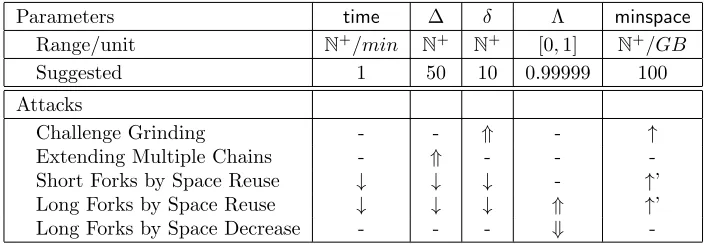
Instead, we derive the challenge for block i from the hash of block i−∆, for a reasonably large ∆: the probability of multiple chains surviving for more than ∆ blocks decreases exponentially as ∆ increases. Moreover, in contrast to Bitcoin, we only hash the block from the proof chain, but not the signature chain (Fig. 1): this serves to prevent block-grinding attacks, since there is nothing to grind on (the proof chain is fixed regardless of the set of transactions in the block). Finally, we will use the same challenge not just for one, but for δ consecutive blocks. This is done to prevent challenge-grinding attacks, as we explain in§4.
3.5
Quality of Proofs and Chains
Quality of a proof. The block to be added to the chain at each time step is decided by a qual-ity measure on the PoSpace proof included in each proposed block. For a set of valid proofs π1 = (pk1, γ1, c1, a1), . . . , πm = (pkm, γm, cm, am), we
re-quireQuality(πi) to be such that the probability that πihas thebestquality amongπ1, . . . , πmcorresponds
to the ith miner’s fraction of the total space in the network. The probability is over the choice of the random oraclehash, which we use to hash answera. We require:
Pr hash
∀j6=i : Quality(πi)>Quality(πj)
= Nγi Pm
j=1Nγj ,
whereNγi is the space committed to byγi.
LetDN be a distribution that samplesN values in
[0,1] at random and outputs the largest of them:
DN ∼max
r1, . . . , rN :ri←[0,1], i∈[N] . (2)
randomnessτ. For valid proofs we now define
Quality(pk, γ, c, a) :=DNγ(hash(a)). (3)
TheQualityof an invalid proof is set to 0.
It remains to show how to efficiently sample from the distribution DN for a given N. Recall that
if FX denotes the cumulative distribution function
(CDF) of some random variable X over [0,1]. If the inverse FX−1 exists, then FX−1(U) for U uniform over [0,1] is distributed asX. The random variable
X sampled according to distribution DN has CDF FX(z) = Pr[X ≤z] =zN, since this is the
probabil-ity that all N values ri considered in (2) are below z. Therefore, if we want to sample from DN, we
can simply sampleFX−1(U) forU uniform over [0,1], which is U1/N. In (3) we want to sample D
Nγi
us-ing randomnesshash(ai). To do so, we normalize the
hashoutputs in {0,1}L to a value in [0,1], and get DNγi(hash(ai)) := hash(ai)/2L
1/N .
Quality of a chain. In order to decide which of two given proof-chain branches is the “bet-ter” one, we also need to define the quality of a proof chain (ϕ0, . . . , ϕi), which we denote by
QualityPC(ϕ0, . . . , ϕi). Each hash sub-block ϕj
con-tains a proof (pkj, γj, cj, aj), and the quality of the
block is vj = DNj(hash(aj)). For any quality v ∈
[0,1], we define
N(v) = min
N ∈N : Prw←DN[v < w]≥1/2 ,
the space required to obtain a proof with quality bet-ter thanvon a random challenge with probability1/2. This quantity captures the amount of space required to generate a proof of this quality.
In order to prevent challenge-grinding attacks, it is desirable for the chain quality to depend multi-plicatively on constituent block qualities (described in more detail in §4), and moreover it is useful to weight the contribution of the jth block for a chain of length i by a discount factor Λi−j. From these motivations we derive the following quality function. Note that we have used a sum of logarithms, rather than a product, to achieve the multiplicativity.
QualityPC(ϕ0, . . . , ϕi) =P i
j=1log(N(vj))·Λi−j .
(4)
4
Nothing-at-Stake
Problems
and Solutions
In this section we discuss the “nothing-at-stake” is-sues, which were already mentioned in the introduc-tion. We describe them here in more detail, and out-line how SpaceMint defends against them.
Recall that the difficulty arises due to the ease of computing multiple candidate blocks: in a PoSpace (or PoStake) based currency, a miner can compute
many proofs (either extending different chains, or computing different proofs for the same chain) at lit-tle extra cost. Deviating from the protocol like this can be rational for a miner as it might lead to higher expected rewards. PoW-based blockchains also suffer from such “selfish mining” attacks [17], and basing the blockchain on efficiently computable proofs like PoSpace or PoStake can further aggravate this prob-lem. Such behavior can significantly slow down con-sensus as well as push the scheme to follow energy expenditure trends similar to PoW-based schemes, which arise whenever there is an advantage to be gained by doing extra computation.
An even more serious issue is double-spending at-tacks, which become possible if a miner can create a sufficiently long chain in private which has better quality than the honestly mined chain. In all known blockchain proposals, a miner controlling more than half of the mining resources (hashing power, stake or space) can do this. But it is considered problem-atic if a blockchain is susceptible to double spending by adversaries with significantly less than half of the network resources.
I. Grinding blocks. The problem: In Nakamoto-style blockchains, the challenge for the proof com-puted by the miners (like PoW in Bitcoin or PoSpace in SpaceMint) is somehow derived from previous blocks. If it is computationally easy to generate proofs, a miner can try out many different blocks (for example by including different transactions) until it finds an advantageous one that will allow him to gen-erate good proofs for future blocks. This is an issue for selfish-mining and double-spending attacks.
block grinding, as now challenges depend only on the
proof chain. Moreover, our PoSpace are “unique” in that a prover can generate at most one valid proof per challenge. Hence, the only degree of freedom that a miner has in influencing future challenges is to either publish its proof (so it might end up in the chain), or to withhold it.
II. Mining on multiple chains. The problem:
In Bitcoin, rational miners will always work towards extending the longest known chain. However, when mining is computationally easy, it can be rational to mine onall (or at least many) known chains in paral-lel, to “hedge one’s bets” across all chains that might eventually become part of the public ledger. Again, this is an issue for selfish-mining and double-spending attacks.
The solution: To address this problem in the context of selfish-mining attacks (we discuss double-spending later), we derive the challenge for blockifrom block
i−∆ for some parameter ∆ (§3.4). Note that for any given challenge, there is a single proof (i.e., the proof is deterministic given the challenge). Then, we im-pose a penalty, via the penalty transactions of§3.3, for any pair of identical proofs published in two can-didate blocks: half of the block reward for such a “misbehaving” block is allocated to the creator of the penalty transaction, and the other half simply disappears.6 Let us consider two cases, depending on whether mining is done on two or more chains that forkedmore orless than ∆ blocks in the past.
Case 1: chains forked less than ∆ ago. In this case, the miner will get the same challenge for both chains. SpaceMint uses penalties (§3.3) to disincen-tivize miners from extending multiple chains in this case; without the penalties, a rational miner with a good-quality PoSpace proof could announce blocks on multiple chains to maximize his chances of winning. Concretely, suppose a miner pk0 attempts to mine concurrently on two chains whose most recent blocks areβj and βj0, by announcing βj+1 andβ0j+1 (which have the same quality and were mined using the same space). Then anyone who observes this can generate a transaction (penalty, txId, pk,{pk0, βj+1, β0j+1}) to
6This is to disincentivize penalizing oneself.
penalize pk0. This transaction can be added to a chain extending βj+1 (or βj0+1), and its meaning is that half of the reward (block reward and transac-tion fees) that should go to the miner who announced
βj+1, is now going topk(the “accuser”) instead, and
the other half of the reward is destroyed, i.e., cannot be redeemed by any party. We destroy half of the re-ward so the penalty hurts even if the cheating miner can be reasonably sure to be able to accuse itself. For this to work, mining rewards can only be transferred by a miner some time after the block was added, so that there is enough time for other miners to claim the penalty.7
Case 2: chains forked more than ∆ ago. In this case the miner receives different challenges for differ-ent chains, leading to proofs of differdiffer-ent quality for the two chains. In this case, even with our penalty scheme in place, a rational miner can still get an ad-vantage by deviating: instead of only trying to ex-tending the highest-quality chain, it also generates proofs for the lesser chain. As the challenges differ, so will the two proofs, and if the proof on the lesser chain has very high quality, the rational miner would publish it, hoping that this chain will become the best chain and survive.
We address this problem by arguing that it is extremely unlikely (the probability is exponentially small in ∆) that this case occurs, as a weaker branch of the chain would have to “survive” for ∆ blocks de-spite a strong incentive (via our punishment scheme) for miners to only extend the chain of highest quality.
III. Grinding challenges. The problem: Chal-lenge grinding is a type of attack that can be used for double-spending, by generating a long chain in pri-vate that is of higher quality than what would result when using one’s resources honestly. It arises from the fact that an adversary can split its space intom
smaller chunks. As discussed in§3.5, the quality of a block is purposely designed such that splitting a fixed amount of space into smaller chunks and choosing the
7The idea of penalizing miners for extending multiple chains
goes back at least to slasherhttps://blog.ethereum.org/2014/
01/15/slasher-a-punitive-proof-of-stake-algorithm.
highest-quality block among them doesnot affect the expected quality of the block generated. However, a miner can examine all possible chains of some given length, and then pick the chain that gives it the most favorable challenges for future blocks.
Concretely, consider our setting, where the chal-lenge for block i is determined by block i−∆. An adversary can generate a sequence of length 2∆ where the first half of the blocks is chosen to provide the most favorable challenges for the later half of the se-quence.8 Note that the first half of this sequence would be of even poorer quality than the expected quality from honest mining given the adversary’s to-tal amount of space; however, the benefit gained in the second half of the sequence can outweigh this loss in quality in the first half. The adversary can then release this high-quality chain (all at once) in an at-tempt to overtake the current best chain.
Note that in this attack the adversary explores multiple chains in parallel, which we have addressed already using a penalizing scheme. But penalizing does not protect against double-spending attacks in which the adversary never actually published two proofs for the same slot. And even he would, a double-spending attack can be profitable even if one loses some mining rewards due to the penalizing scheme.
The solution: As mentioned in§3.5, the problem with this attack is exacerbated if the metric for determin-ing the quality of a chain is a sum or any other linear function. Thus, to prevent this attack, (1) we define the quality of a chain as theproduct of the amounts of space needed for the proofs in it, rather than their
sum; and (2) we use the same block to derive chal-lenges forδfuture blocks (i.e., usehash(βi, nonce) for nonce ∈ [1, δ] as challenges for time i+ ∆ through
i+ ∆ +δ).
Intuitively, (1) makes it harder for the adversary to find a good chain of length 2∆, as worse blocks are weighted more; and (2) is helpful because it means that a challenge-grinding adversary would have to
8As for each of the ∆ blocks there aremdistinct challenges,
the search space here is of huge sizem∆. Consequently, this
attack might seem artificial, but by pruning and just consid-ering the most promising sub-chains at every level, one will probably not miss the best one.
choose “early” blocks to optimize their chances over sequences of δ future challenges rather than just a single future challenge, thus making it exponentially harder (in δ) to find a “good” challenge that will yield δhigh-quality blocks at once. Another way to see this is that by the Chernoff bound, the average of
δindependent random variables deviates less from its expectation asδ grows. So for largeδ, even the abil-ity to select between multiple challenges (each giving a sample of the average of δ i.i.d. variables) is not very useful to find one where this value deviates by a lot from its expectation. A more detailed discus-sion of this attack and our defense is given in the full version [31].
5
Parametrization
We now discuss and justify some suggested param-eter choices for SpaceMint. A more detailed discus-sion on parameters, their interplay, and their impact on various attacks is given in §D due to space con-straints.
Determining challenges. To minimize the prob-ability of forks surviving for more than ∆ blocks (which is necessary to prevent the “mining on multi-ple chains” issue described in §4), we should choose a large ∆. On the other hand, a smaller ∆ increases other security features of SpaceMint (detailed in§D). We suggest ∆ = 50, which makes it highly unlikely that a fork survives for ∆ steps (since the probability of a fork surviving is exponentially small in ∆), and yet the value is not large enough to introduce signif-icant negative impacts to other aspects (see §D for further discussion).
gener-ate the signature chains using the previous block. In Bitcoin, blocks propagate to over 95% of the miners within 40 seconds [11], so we believe that time = 1 minute would be a reasonable frequency of block gen-eration for SpaceMint.
Quality discount factor. As discussed in §3.5, we use a discount factor Λ to define each block’s con-tribution to overall chain quality. The value of Λ is determined by the pace at which the total storage in the network increases. For instance, if we assume that storage stays roughly in the same order of mag-nitude for two-month periods, we can set Λ as large as 0.99999.9 Such a high Λ is helpful when we argue about the hardness of generating long forks. Detailed analysis is given in§D.
Confirmation time. To confirm a transaction, we must be sure that there is consensus regarding the transaction being on the chain, in order to prevent double spending. Bitcoin, to this end, only confirms transactions after 6 blocks are added, at which point users are reasonably confident of consensus. Their analysis [35] assumes the adversary has less than 10% of total hashing power and gives an upper-bound of 0.001 on the probability of double-spending. Assum-ing a 10% adversary as in the Bitcoin analysis (with Λ = 0.99999 as discussed above), in SpaceMint after 6 blocks we have on upper-bound of 2−16≈0.000015 on the probability that a block will remain in the chain. This also takes only 6 minutes compared to the 1 hour of Bitcoin. This analysis only applies to the proof chain, but to avoid double spending we must be sure that the transaction also remains in the signature chain, for this reason one should wait for a few extra blocks, so one can be reasonably sure that at least one of those blocks was added by an honest miner (who will not sign another list of transactions for this block).
Even assuming a stronger adversary who controls 33% of the total space (and Λ = 0.99999 as before), after 93 blocks a block in the proof chain will be safe with failure probability bounded by 2−32. For further details see§D.
9In this case, the contribution of a block decreases by a
factor 1/e≈0.37 every 1/(1−Λ) = 100.000 blocks, which for
time= 1 minute is roughly 69 days.
6
Evaluation
To evaluate SpaceMint, we have implemented a prototype in Go, using SHA3 in 256-bit mode as the hash function. The prototype uses the graphs from [32], and forces a cheating prover to store at least Ω(N/log(N)) bits in order to efficiently gener-ate proofs. Given that the network infrastructure is very similar to Bitcoin, we are mainly interested in three quantities: time to initialize the space (graph), size of the proof, and time to generate and verify the proof. The experiments were conducted on a desk-top equipped with an Intel i5-4690K Haswell CPU and 8 GB of memory. We used an off-the-shelf hard disk drive with 2 TB of capacity and 64 MB of cache.
Time to initialize. To start mining SpaceMint, the clients must first initialize their space, as de-scribed in §3.1. Concretely, this involves computing all the hashes of the nodes, and computing the Merkle tree over the hashes. In Figure 2a, we show the ini-tialization time for spaces of size 8 KB to 1.3 TB. As expected, the time to initialize grows linearly with the size of the space; at 1.3 TB, it takes approximately 41 hours to generate and commit the space. While expensive, this procedure is done only once when a miner first joins the SpaceMint network, and the ini-tialized space will be used over and over again. In fact, space initialization should take non-trivial time because an extremely fast space initialization would make re-using the same space for different commit-ments a viable strategy.
Size of the proof. A proof in SpaceMint consists of the Merkle inclusion proof for a set of node labels. For the PoSpace that we implemented, the number of nodes we have to open is λ·log(n) + 1 (as kv = λ·log(n) in Algorithm 2 andkpkvin Algorithm 3),
Fig-0 200 400 600 800 1000 1200 1400 File Size (GB)
0 500 1000 1500 2000 2500 3000
Time (min)
Graph Setup Generate Merkle Tree
(a)Time to initialize space.
0 200 400 600 800 1000 1200 1400 File Size (GB)
0 500 1000 1500 2000 2500 3000
Size (KB) λlog(n) nodes
0 20 40 60 80 100 120
λ nodes
(b) Proof size for varying space sizes with
λ= 30. The left and right vertical axes rep-resent proof size when openingλlog(n) and
λnodes (respectively).
0 200 400 600 800 1000 1200 1400 File Size (GB)
0 5 10 15 20 25
Time to Prove (s)
Prove
0.00 0.02 0.04 0.06 0.08 0.10Time to Verify (s)
Verify
(c) Time for a miner to prove and verify whenλlog(n) nodes are opened forλ= 30.
Figure 2: Results of evaluation
ure 2b demonstrates the size of the proof when we openλlog(n) nodes vs. justλnodes forλ= 30.
Time to generate/verify the proof. In SpaceMint, assuming a miner is storing the space cor-rectly, the miner needs to only open a smallkp
num-ber of nodes in the Merkle tree to check the quality of its solution (§3.1), which takes just a fraction of a second; it takes<1 ms to read a single hash from the disk. Only in the rare case where the miner believes its answer is of very good quality will it generate the full proof, which still takes less than 30 seconds. As for every space-commitment, a miner must open kp
nodes for every time-slot, we want this value to be as small as possible, in practicekp= 1 seems secure,
though one might set it to some small constant to be on the safe side.
Our proofs are substantially bigger than Bitcoin’s and require more than just one hash evaluation to verify. However, for an active currency, we still ex-pect the size and verification time for the proofs added with every block to be marginal compared to the size of the transactions added with every block or the time required to verify that the transactions are consistent. Figure 2c indeed shows that even though it takes seconds to generate the proof, verification takes only a fraction of a second.
Energy estimates. Though our prototype was evaluated using a full CPU which wastes a lot of en-ergy, a cost-conscious miner could mine on a much more energy-efficient device (e.g., Raspberry Pi [2]). An efficient microcontroller consumes less than 10 W of power, and most miners will only open a few nodes per time step since the quality of their answers will
usually be bad. To get an upper bound on the power requirement, suppose there are 100 000 miners, each with 1 TB of space, and about 1% of the miners mine “good” answers for which they will generate a full an-swer. Then we have
10W·100 000·0.01s+ 10W·1000·20s
= 210 000J/block
which translates to 210 kJ/min if we add one block every minute. In contrast, Bitcoin on average uses 100 MW, so it consumes 6 GJ/min, which is several orders of magnitude larger. We note that the 1% figure is a very conservative bound, so the difference could be even larger in practice.
The required frequency is so low that speed is a non-issue: cheap,slow random access is what SpaceMint miners are after.
7
Game Theory of SpaceMint
Intuitively, SpaceMint mining is modeled by the fol-lowing n-player strategic game. Game-play occurs over a series of discrete time steps, in each of which a block is added to the blockchain. At each time step, each player (miner) must choose a strategy, specified by: (1) which blocks to extend (if any), and (2) which extended blocks to publish (if any).
Showing that adhering to the protocol is an equilib-rium of such a game means that rational miners are not incentivized to deviate from the protocol when playing the game. From this, it follows that rational miners will reach consensus on a single chain, and will not be able to get an advantage by using a “cheating” strategy.
We remark that game-theoretic analyses inherently start by defining a game which models reality, and prove properties of the game in this model. It is al-most never possible for a model to captureall aspects
of a real-world situation, and it is moreover desirable to have a model which is simple enough to allow for a rigorous analysis of incentives, while still being close to reality.
Let us stress that our analysis herein is intended as a basic framework to model blockchain-based cryp-tocurrencies using the standard game-theoretic no-tion of anextended game, and does not claim to com-prise an exhaustive modeling of all possible attack vectors. In particular, our stylized model does not capture some important aspects, most notably block withholding, which is used in “selfish mining.” Nev-ertheless, we believe that our simple modeling frame-work for cryptocurrency as an extended game may be of value as a base upon which to build more nuanced game-theoretic models, and thus we have chosen to include it in this exposition.
7.1
Informal overview of results
The standard game-theoretic notion for a strategic game which occurs over multiple time steps (rather than in “one shot”) is the extensive game. An ex-tensive game takes place over discrete time steps. In each time step, one or more players take an action from a well-defined set of possible “moves”. At any point, the sequence of all moves made by all play-ers so far is called ahistory. In some games, players do not necessarily know all the moves made by other players. For any history, an extensive game defines a set of possible actions that each player can take at that history. If all of these sets are empty, then the game is considered to have ended, and such a history is called aterminal history.
Each player has autility functionthat assigns real-valued utilities to each terminal history. For example, in a simple two-player game like rock-paper-scissors, each player’s utility function might assign utility 1 to histories in which they won, and utility −1 to histo-ries in which they lost. When modeling SpaceMint, the utility that a player (i.e., a miner) assigns to a history depends on the amount of currency he has earned by successfully adding blocks to the chain.
In order to model the probabilistic aspects of the SpaceMint protocol (e.g. the unpredictable bea-con), we considerextensive games with chance moves, which is the standard game-theoretic notion to cap-ture extensive games which involve exogenous uncer-tainty. Essentially, we model the beacon as an ad-ditional player, called Chance, which makes random moves.
Equilibrium concepts. The most widely known equilibrium concept for a strategic game is the Nash equilibrium [29]. Intuitively, in a Nash equilibrium, each player’s strategy is abest response to the strate-gies of the other players.
are not “stable” in the sense that given the ability to adaptively switch strategies during the game, no rational player would stick with his Nash-equilibrium strategy all the way to the end of the game.
Thus, for extensive games, the alternative (stronger) notion of sequential equilibrium is the standard equilibrium notion in game theory. This stronger concept ensures players are making the best decision possibleat each history during game-play.
We remark that while informal analyses have been presented that argue that Bitcoin mining constitutes a Nash equilibrium, we are not aware of any prior analyses that model a cryptocurrency as an exten-sive game or consider sequential equilibria. Since protocols inherently occur over time, we strongly be-lieve that extensive games are the appropriate game-theoretic formalism for analyzing stability of cryp-tocurrencies, and accordingly that sequential equilib-rium is the right equilibequilib-rium concept for cryptocur-rencies.
7.1.1 SpaceMint as an extensive game
In the “SpaceMint Game”, every player (including Chance) makes an action at every time step. A player’s action consists of choosing whether and how to extend the blockchain, and the action of Chance determines the value of the unpredictable beacon for the next time step. Players do not necessarily know all actions taken by other players: the information known to each player at any point comprises all the moves that he himself has taken, together with the information in the blockchain. Based on this infor-mation, each player decides his action in each time step, aiming to maximize his utility, i.e., his expected reward from adding blocks to the chain.
Due to the rather extensive definitional preliminar-ies required to state our results formally, we now give an informal theorem statement together with a proof sketch. Rigorous theorems and proofs are given in §7.2.
Theorem 7.1. It is a sequential equilibrium of the SpaceMint game (Definition 7.2, §7.2) for all com-putationally bounded players to adhere to the mining protocol, provided that no player holds more than50%
of all space.
Proof sketch. Our proof proceeds in two main steps, showing the following.
1. Adhering to the protocol is a Nash equilibrium of the SpaceMint game.
2. Adhering to the protocol is moreoversequentially rational at each history during game-play. To prove item 1, we consider the information avail-able to an arbitrary player at any given time step. At the start of his turn, the player has an expected util-ity based on all the information he knows (e.g., if he has mined some blocks that have been added to the blockchain, his utility is high). Since a miner’s utility function is simply his expectation of reward from adding blocks to the chain, a utility-maximizing miner can choose an action to take in each time step as a function just of the blockchain (i.e., he need not separately take into account the full sequence of moves he has made in the past, as these only af-fect his expected utility if they have impacted the blockchain). In a given turn, the player will choose the action that yields the highest expectation of fu-ture reward: his action consists of mining a set of blocks (locally), and then announcing a set of blocks to the network. Based on SpaceMint’s penalty trans-actions and the fact that any given miner’s block quality is fixed in each time step, we are able to argue that mining and announcing exactly one block is an optimal strategy. Moreover, this strategy adheres to the protocol.
To prove item 2, it is necessary to show that there exist a system ofconsistent beliefsof the players over the entire duration of the game, under which each player is not incentivized to deviate from the protocol at any point during game-play. We show that such a belief system can be derived by applying Bayes’ rule to the Nash equilibrium strategy which consists of adhering to the protocol. This concludes the proof sketch; for the full proof see§7.2.
7.2
Formally
modeling
SpaceMint
mining as an extensive game
In order to analyze the game-theoretic properties of SpaceMint mining, we define an extensive game,
SpaceMint, which models the actions that miners can take, and the associated payoffs.
The SpaceMint mining game. Let Π =
{Init,Chal,Ans,Vrfy} be a proof of space. Let B de-note set of all blocks as defined in §3.2, and for any
`∈N, let B` denote the set of all blocks with index `.10 Let B` denote the set of blocks with index at
most`, i.e. B` =S`
`0=0B`0. LetBgen be the genesis
block; note thatB0={Bgen}.
For a blockB ∈ B and a challenge c ← Chal, we defineExti(B, c) to be the block generated by player iwhen mining the next block afterB using PoSpace challenge c (see §3.2 for exact block format). For
`∈Nand challenge c, define: ˜
B`,i,c=
(B, B0)∈ B`−1× B`:B0=Exti(B, c)
and let ˜B`,i,c=S
`0∈{0,...,`}B˜`0,i,c.
Remark. To simplify exposition, we do not explic-itly model the amount of the space that each player has in the game defined below. A standard way to model this would be to assign each player a type ti,
representing player i’s amount of space. Our expo-sition keeps the types implicit; our theorems require that no player has more than 50% of the space com-mitted by active miners.
Definition 7.2 (The SpaceMint Game). Let Π = {Init,Chal,Ans,Vrfy} be a proof of space. For any number of players N ∈N, any number of time steps
K∈N, any consensus-delay Ψ∈N, and any reward
function ρ:N→N, we define the extensive game
SpaceMintΠ,K,ρ =hN, H, fC, ~I, ~ui as follows:
• The setH of histories is defined inductively.
◦ The action set of the Chance player AC(h) =
{0,1}m is the same for every historyh.
◦ The empty sequence () is in H, and Ai(()) =
{(∅,∅)} for eachi∈[N].
10The index denotes the block’s position in the blockchain.
In§3.2,iis used to refer to the block index, but in this section we use`to avoid confusion with the player indices.
◦ For any non-terminal historyhand anyi∈[N], the action setAi(h)of player iathis:
Ai(h) =P
B|h|× B|h|+1× PB|h|× B|h|+1.
An action ai ∈ Ai(h) is a pair of sets ai =
(T,A). T is the set of blocks that player i tries
extending in this time step, and A ⊆ T is the set of blocks that playeriannouncesin this time step. An element inT (orA) is a pair of blocks
(B0, B)∈ B|h|× B|h|+1 where B0 is the existing block which playeriwishes to extend, andB∈ B
is the extended block.
The probability measuref(·, h)is uniform on{0,1}m.
• For each i ∈ [N], we define the partition Ii by an equivalence relation ∼i. The equivalence relation
∼i is defined inductively as follows (we write [h]i to denote the equivalence class ofhunder ∼i):
◦ [()]i={()}, that is, the empty sequence is equiv-alent only to itself.
◦ [(h,((T1,A1), . . . ,(TN,AN), aC))]i=
{(h0,((T10,A01), . . . ,(TN0 ,A0N), a0C))∈H :
h∼ih0∧Ti=T0i∧Ai=A0i∧aC =a0C
∧∀i06=i, Ai0 =A0i0},
wherehandh0 are histories of equal length, and the pairs (Ti0,Ai0) and (Ti00,A0i0) are actions of player i0. That is, two histories are equivalent under∼i if they are identical except in the “first components”Ti0 of the actions(Ti0,Ai0)taken by players other than i.
• ~u= (u1, . . . , uN), where eachui:Z→Ris defined
as described below. For a history h, let C(h)denote the sequence of actions taken by the Chance player in h. Let B.chal denote the challenge c within the proof of space of a blockB. Recall that the functions
Quality(B) and QualityPC(B~) were defined in §3.5. We define a new function
Quality(B, c) = (
Quality(B) ifB.chal =c
0 otherwise .
QualityPC((B1, . . . , BL))whenever
∀`∈[L], B`.chal =c` andB`∈ B` and
∀`∈[L], ∃i∈[N]s.t. (B`−1, B`)∈B˜`,i,c` and equal to0 otherwise. For any historyh, letA(h)
be the set of all blocks announced by any player in history h:
A(h) =
B:∃i∈[N],A
0 s.t. (·, B)∈A0 and playeri took action(·,A0)in h
. Let blocks(h)be the “winning block sequence” at any h∈H:
blocks(h) = arg max
~
B∈(A(h))|h|
QualityPC(B,~ C(h)) .
Let blocks`(h) denote the`th block in the chain. Let
win`(h) be the player who announced the winning block blocks`(h) for index `.11 Recall that a history h= (~a1, . . . , ~aJ)is a sequence of J ≤K action pro-files. For j ∈ [J], let (Ti,j,Ai,j) be the action of playeriin~aj. Letone`(i, h)be an indicator variable for the event that player i announces at most one block with index`, i.e.
n
B:B∈ B` and(·, B)∈Sj∈[J]Ai,j
o ≤1 .
Finally, the players’ utility functions are defined as follows: for a terminal history hof lengthK,
ui(h) =
X
`∈[K−Ψ]
δi,win`(h)·one`(i, h)·ρ blocks`(h)
,
where δi,j is the Kronecker delta function.That is, a player’s utility is the sum of the rewards he has re-ceived for announcing a winning block, up to index K−Ψ.
By Definition 7.2, for anyi∈[N], for any histories
h, h0 in the same information set I ∈ Ii, it holds
that blocks(h) = blocks(h0). Thus, we can associate a unique blockchain with each information set: we defineblocks(I) to be equal toblocks(h) for anyh∈I. Similarly, C(h) =C(h0) for any h, h0 ∈I in the same information set I, so we define C(I) to be equal to
C(h) for anyh∈I.
For a block B ∈ B and a challenge c ← Chal, we define Exti(B, c) to be the block generated by
player i when mining the next block after B using
11We can assume that the winning block is unique at each
time step, andQualityimposes a total order on blocks.
the PoSpace challengec(see§3.2 for exact block for-mat).
Theorem 7.3. Let
Π ={Init,Chal,Ans,Vrfy}
be a proof of space. For any number of players N, any number of time steps K ∈ N, and any reward function ρ: N → N, let ~α = (α1, . . . , αn) be a pure strategy profile ofSpaceMintΠ,K,ρ, defined as follows: for eachi∈[N], for any information set I∈ Ii such thatI6={()},
αi(I) ({blocksj(I)},{Exti(blocksj(I),Cj(I))})
= 1, where j ≥ 1 is the length of the histories in infor-mation set I12. That is, player i’s next action at information set I is
ˆ
αi= {blocksj(I)},{Exti(blocksj(I),Cj(I))}. Then~αis a Nash equilibrium of SpaceMintΠ,K,ρ.
Proof. Take any playeri∈[N]. By the definition of
Ext, for any information setI∈ IiwithI6={()}, the
qualityv of the extended blockchain
v=QualityPC (blocks(I),Exti(B,Cj(I))),C(I)
is the same for any block B which was announced at time step j. Therefore, no utility can be gained by choosing any blockB over any other blockB0 to extend: that is,ui(α~)≥ui(α0i, ~α−i) for any strategy αi0 which distributes probability over actions of the form (S, T) where|S|= 1.
Moreover, not extending any block or extending multiple blocks precludes a player from being the “winner” and receiving the reward in this time step, so extending a block is preferable to not extending any block. That is,ui(α~)≥ui(α0i, ~α−i) for any
strat-egyα0i which assigns non-zero probability to any ac-tion of the form (S, T) where|S| 6= 1.
We have shown that ui(α~) ≥ ui(α0i, ~α−i) for all
strategiesα0i of playeri. The theorem follows.
7.3
Analyzing the SpaceMint game
In this section, we prove that honest mining is anε -sequential Nash equilibrium of the SpaceMint game.
By Definition 7.2, for anyi∈[N], for any histories
h, h0 in the same information set I ∈ Ii, it holds
that blocks(h) = blocks(h0). Thus, we can associate a unique blockchain with each information set: we defineblocks(I) to be equal toblocks(h) for anyh∈I. Similarly, C(h) =C(h0) for any h, h0 ∈I in the same
information set I, so we define C(I) to be equal to
C(h) for anyh∈I.
First, Theorem 7.4 defines an ε-Nash equilib-rium of the SpaceMint game, and then Theorem 7.5 shows that this Nash equilibrium is, moreover, anε -sequential equilibrium.
Theorem 7.4. Let Π = {Init,Chal,Ans,Vrfy} be a proof of space. For any number of players N, any number of time stepsK∈N, and any reward function
ρ: N → N, let ~α = (α1, . . . , αn) be a pure strategy profile ofSpaceMintΠ,K,ρ, defined as follows: for each i ∈ [N], for any information set I ∈ Ii such that I6={()},
αi(I) ({blocks`(I)},{Exti(blocks`(I),C`(I))})= 1, where`≥1 is the length of the histories in informa-tion setI. That is, playeri’s next action at informa-tion setI is
ˆ
αi= {blocks`(I)},{Exti(blocks`(I),C`(I))}
. Let
ξ= maxPi∈[N]ti
i∈[N]ti
be the maximum fraction of space possessed by a sin-gle player,13 and suppose ξ < 0.5. Then ~α is an
ε-Nash equilibrium ofSpaceMintΠ,K,ρ, where
ε= exp
− 1
2K ·E[diff1]
2 ·
K−1 X
j=0 Λ2j
2 ,
Λ is the discount factor defined in §3.5 and diff1 is
defined as in §D.
Proof. Fix any playeri ∈ [N]. By the definition of
Ext, for any information setI∈ IiwithI6={()}, the
qualityv of the extended blockchain
v=QualityPC (blocks(I),Exti(B,C`(I))),C(I)
is the same for any block B which was announced for block index `. Therefore, no utility is gained
13Recall that t
i is the amount of space that player i has
(defined in the remark just before Definition 7.2).
by choosing any block B over any other block B0
to extend: i.e., ui(α~)≥ui(α0i, ~α−i) for any strategy αi0 which distributes probability only over action se-quences ((Ti,1,Ai,1), . . . ,(Ti,K,Ai,K)) such that
∀`∈[K−Ψ], |Ai∩ B`|= 1,
whereAi=Sj∈[K]Ai,j.
Moreover, for any given block index `, not an-nouncing any block or announcing multiple blocks precludes a player from being the “winner” and receiving the reward at index `, so announcing exactly one block per index is preferable to an-nouncing any other number of blocks. Hence, for any strategies α00
i, α0i such that α00i announces
ex-actly one block per index with probability 1, and
αi0 assigns non-zero probability to action sequences ((Ti,1,Ai,1), . . . ,(Ti,K,Ai,K)) such that
∀`∈[K−Ψ], |Ai∩ B`| 6= 1,
(whereAi =Sj∈[K]Ai,j as above), it holds that
ui(ui(α00i, ~α−i))≥ui(α0i, ~α−i).
We can now restrict our attention to strategies which announce exactly one block per index. Fix any time stepj ∈[K]. Letα0ibe any strategy in which the probability that playeri announces a blockBj ∈ Bj
at time stepj is less than 1.
Suppose playeridoes not announce a blockB ∈ Bj
at time step j. Since we are assuming that i an-nounces exactly one block per index, we know i
announces a block Bi,j ∈ Bj at some time step j0 > j. If the other players use strategies ~α−i
(i.e. they announce exactly one block with index
j at each time step j), then no player (other than
i) will extend player i’s block Bi,j. Let B~0 =
(Bgen, B01, . . . , Bj−0 1, Bi,j) be the unique (length-j)
blockchain induced by Bi,j. If player i does not
ex-tend his own blockBi,j, then he will gain no utility
after time step j. Thus, the only way player i can gain any utility in time steps after j is if he extends his own blocks all the way up to time stepK:
Bi,j+1=Exti(Bi,j,Cj(Ii,j)) . . .
Bi,K =Exti(Bi,K−1,Cj(Ii,K−1))
where Ii,j denotes playeri’s information set at time
higher quality than any chain produced by others: i.e., at the terminal historyh,
QualityPC (B~0, Bi,j+1, . . . , Bi,K),C(Ii,K)
= arg max
~
B∈(A(h))|h|
QualityPC(B,~ C(h))
. (5)
By Theorem D.2, the probability that (5) holds is at most
exp
− 1
2K ·E[diff1]
2 ·
K−1 X
j=0 Λ2j
2 .
We conclude that ui(~α) ≥ ui(α0i, ~α−i)−ε for all
strategiesα0i of playeri. The theorem follows.
We now show that honestly following the SpaceMint protocol is anε-sequential equilibrium of the SpaceMint game.
Theorem 7.5(formal version of Theorem 7.1,§7.1). LetΠ ={Init,Chal,Ans,Vrfy}be a proof of space. For any number of players N, any number of time steps K∈N, and any reward functionρ:N→N, let(~α, ~µ)
be an assessment ofSpaceMintΠ,K,ρ where:
• ~αandαˆi are defined as in Theorem 7.4, and for each n ∈ N, we define ~αn to be the completely
mixed strategy profile which (at history h) as-signs probability 1/|Ai(h)|n to every action ex-ceptαˆi, and assigns all remaining probability to
ˆ
αi.
• ~µis derived fromα~ using Bayes’ rule in the fol-lowing way: ~µ = limn→∞~µn, where for each n∈N,~µn is derived from ~αn using Bayes’ rule. Let
ξ= maxPi∈[N]ti
i∈[N]ti
be the maximum fraction of space possessed by a sin-gle player, and supposeξ <0.5. Then (α, ~~ µ)is anε -sequential Nash equilibrium ofSpaceMintΠ,K,ρ where
ε= exp
− 1
2K ·E[diff1]
2 ·
K−1 X
j=0 Λ2j
2 ,
Λ is the discount factor (§3.5) anddiff1 is defined as
in§D.
Proof. Fix any player i ∈ [N]. Let I ∈ Ii be any
information set of playeriinSpaceMintΠ,K,ρ, and let
L be the length of histories in I. It follows from Definition 7.2 that the expected utility of playeriat
I isui((~α, ~µ)|I) =
X
j∈[L]
δi,winj(h)·onej(i, h)·ρ blocksj(h)
+u0i (~α, ~µ) ,
where u0i is the utility function of player i in the game SpaceMintΠ,K−L,ρ. Since win, one, and blocks
are invariant over histories within any given infor-mation set, the suminfor-mation term can be computed explicitly by playeri at I. Hence, in order to maxi-mize his expected utility at I, the player needs sim-ply to maximizeu0i((α, ~~ µ)). Let (~α|K−L, ~µ|K−L)
de-note the assessment (~α, ~µ) for the first K−L time steps of the game. By Theorem 7.4, ~α|K−L is an ε-Nash equilibrium of SpaceMintΠ,K−L,ρ. Since ~µ
is derived from α~ by Bayes’ rule, it follows that
ui((~α, ~µ)|I) ≥ ui(((α0i, ~α−i), ~µ)|I) for any strategy αi0 of player i. Applying this argument for every I, we conclude that (~α, ~µ) is ε-sequentially rational in
SpaceMintΠ,K,ρ.
By construction, limn→∞α~n = α~ and ~µ =
limn→∞~µn. Hence, (~α, ~µ) is consistent. The
theo-rem follows.
Acknowledgements. We would like to thank Andrew Miller and Bram Cohen for bringing the challenge-grinding attack to our attention. We thank Srini Devadas for useful feedback on draft versions of this paper, and Ethan Heilman for an interesting dis-cussion about costs of modern Bitcoin mining.
Sunoo’s research is supported by the follow-ing grants: NSF MACS (CNS-1413920), DARPA IBM (W911NF-15-C-0236), and SIMONS Investiga-tor Award Agreement Dated June 5th, 2012. Georg is supported by the French ANR EfTrEC project (ANR-16-CE39-0002). Jo¨el and Krzysztof are sup-ported by the European Research Council (ERC) consolidator grant 682815 - TOCNeT.
References
[1] Burstcoin. http://burstcoin.info.