© 2014, IJCSMC All Rights Reserved
993
Available Online atwww.ijcsmc.com
International Journal of Computer Science and Mobile Computing
A Monthly Journal of Computer Science and Information Technology
ISSN 2320–088X
IJCSMC, Vol. 3, Issue. 3, March 2014, pg.993 – 998
RESEARCH ARTICLE
Cloud Security Tracking, Log
Maintenance and Notification System
for Net Banking Cloud Applications
Miss. Bhagyashree A. Dhamande
1, Mr. Amit Sahu
21
(Department of computer science and Engg, G.H. Raisoni College of Engineering & mgt, Amravati, Maharashtra, India)
2
(Department computer science and Engg, G.H. Raisoni College of Engineering & mgt, Amravati, Maharashtra, India)
1
[email protected]; 2 [email protected]
Abstract— Cloud computing offers an innovative business model for organizations to adopt IT services without upfront investment. It advantages are scalability, resilience, flexibility, efficiency and outsourcing non-core activities. Our system is intended to develop an application which is multi tenant cloud based and mission critical. Security is one of the major issues which hamper the growth of cloud. This paper introduces a detailed analysis of the cloud computing security issues and challenges focusing on the cloud computing types and the service delivery types. To develop a cloud based system that demonstrates tracking of activities, maintaining log of events and notifying the users about probable threats.
Keywords— Cloud Computing; Cloud Security; Service Provider; SaaS
I.
INTRODUCTION
Multi tenant cloud based and mission critical application having special measures to protect the application from the attacks and threats. Some of them will be like Login tracking, Log maintenance, Transaction notification through SMS and email, Account locking system, Better session and history management, Password management.
Banking Management System thus ensures smooth operation of the Real-Estate management tasks as well as keeps the information about the employees and their salary. Bank is the place where customers feel the sense of safety for their property.
II.
CLOUD COMPUTING© 2014, IJCSMC All Rights Reserved
994
consumers and businesses to use applications without installation and access their personal files at any computer with internet access. This technology allows for much more efficient computing by centralizing data storage, processing and bandwidth. A simple example of cloud computing is Yahoo email, Gmail, or Hotmail etc. All you need is just an internet connection and you can start sending emails.
There are 3 types of cloud computing:
SaaS -Software as a Service
PaaS -Platform as a Service
IaaS -Infrastructure as a Service
III. SOFTWARE AS A SERVICE (SAAS)[3]
In the SaaS model, cloud providers install and operate application software in the cloud and cloud users access the software from cloud clients. This type of cloud computing delivers a single application through the browser to thousands of customers using a multitenant architecture. The cloud users do not manage the cloud infrastructure and platform on which the application is running.
Cloud Security – Service Provider Priorities
Effectively meet the advertised SLA, while optimizing cloud resource utilization.
Offer tenants capabilities for self-service, and achieve scaling through automation and simplification.
Computing clouds are changing the whole IT , service industry, and global economy. Clearly, cloud computing demands ubiquity, efficiency, security, and trustworthiness
Effective trust management, guaranteed security, user privacy, data integrity, mobility support, and copyright protection are crucial to the universal acceptance of cloud as a ubiquitous service.
Ensure confidentiality, integrity, and availability in a multi-tenant environment.
IV.
EXISTING SYSTEM
In the existing system, each bank have their own server and own database so that maintenance cost is high. So sometimes performance get slowdown. Storage capacity problems may present there in the existing system so causes higher software and hardware cost. Better than paying for similar commercial software which alone may be justification for switching to cloud applications. We are switching to proposed due to the reasons:
Higher maintenance cost. High cost of ownership. More resources required. Limitation in storage space.
V. EXPERIMENTAL SETUP
Hardware Interfaces
CPU: Pentium4
Ram 1GB
Software Interfaces
1. Deployment Platform: Windows 2. Web Server: IIS
3. Development Technology (Serverside): ASP.NET 4.0 4. Languages : C#
© 2014, IJCSMC All Rights Reserved
995
6. Services Database technologies: MS SQL Server 2012,ADO.NET 7. Web Development: XML,HTML, DHTML, Javascript, AJAX, JQuery 8. Development Tool: Visual Studio 2010
Our system is intended to develop an application which is multi tenant cloud based and mission critical. Cloud computing offers an innovative business model for organizations to adopt IT services without upfront investment. To develop a cloud based system that demonstrates tracking of activities, maintaining log of events and notifying the users about probable threats.
Our system has following feature:
Reduced cost of ownership (COO) and increased Return on investment (ROI) Multitenant – pay per use
Sharing of centralized resources Device and location independence Scalability and Elasticity
VI. MODULES
I. Cloud based application
There are various users in the cloud based application are as follows: Cloud Administrator
Client Administrator
Client Users.
A centralized database feature denotes that on the cloud there is one administrator and one database for all the users. We can store large data on that centralized database. Multi-tenant users use the application at the same time.
II. Administration Module
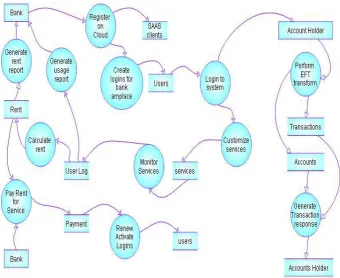
Multiple tenants such as banks request cloud for services. If one the bank such as SBI wants the service of cloud then this bank have to send request to cloud for registration, then cloud verify the bank and approve its request and can login it. Then this cloud provides number of services to the bank and also play important role in monitoring those services. Usage Log contains all the transaction and services used by the bank, all those information stored in usage log table. Then it calculates rent and generates report and depending upon the rent bank has to pay.
III. Tracking and Log maintenance module
This monitors every activity and maintains log of events. If we have to send fund to the third party then third party has to register it’s account first and then can perform further transaction.
If one of the bank does not pay the rent regularly hen cloud can lock it’s account. If SBI is locked then all the branches of SBI are also locked and no user of SBI can log-in. This tracking keeps all details when user log-in and log-out, all transaction information and so on.
IV. Notification
Sent notification to the concerned users and suggest corrective measures. If invalid user tries to access the account then this notification is updated to the database.
© 2014, IJCSMC All Rights Reserved
996
Fig 6.1: Transaction logins DFD
VII. SCREENSHOTS OF GUI IMPLEMENTATION
Screenshot No. 7.1: Home Page
This is Home Page of the Project .In this Page there are four link are available
© 2014, IJCSMC All Rights Reserved
997
Screenshot No. 7.2: Cloud Admin Home PageThis is the home Page of cloud admin. He possesses six authorities.
Screenshot No. 7.3: Unauthorised access Report
Unauthorized Access Report: - If people attempting to violet your security then this link maintaining the log with ipaddress for unauthorized users.
VIII.CONCLUSION
In cloud security tracking and notification system we use the cloud multitenant centralised database for storing net banking related information with various security constraints such as password mechanism for every user and administrator. Notification is given to user on behalf of security purpose. The main purpose of our application is to provide more security in net banking with the help of cloud.
ACKNOWLEDGMENT
I am very grateful to Mr. Amit Sahu Asstt. Professor, for his support to write this paper I am very thankful to Mr. Nitin Chopde, the Head of Department of Computer science in G.H.Raisoni College of Engineering & Mgt, for his motivation and support during the paper.
REFERENCES
[1].Force.com, ―The Force.com Multitenant Architecture Understanding the Design of Salesforce.com’s Internet Application Development Platform‖, White paper
[2].Qihong Shao ―Towards Effective and Intelligent Multi-tenancy SaaS‖ ,UMI Dissertation publishing, May 2011
[3].UNDERSTANDING The Cloud Computing Stack SaaS, Paas, IaaS, © Diversity Limited, 2011 Non-commercial reuse with attribution permitted.
[4].Volume 2, Issue 1, January 2012 ISSN: 2277 128X International Journal of Advanced Research in Computer Science and Software Engineering.
© 2014, IJCSMC All Rights Reserved
998
[6].Haitham Yaish, Madhu Goyal, George Feuerlicht, ‖An Elastic Multi-tenant Database Schema for Software as a Service‖, 2011 Ninth IEEE International Conference on Dependable, Autonomic and Secure Computing.
[7].Wonjae Lee, Min Choi,‖ A Multi-tenant Web Application Framework for SaaS‖, 2012 IEEE Fifth International Conference on Cloud Computing
[8].Lei Ju, Bikram Sengupta,Abhik Roychoudhury,‖ Tenant Onboarding in Evolving Multi-tenant Software-as-a-Service Systems‖, 2012 IEEE 19th International Conference on Web Services.
[9].Krishna Reddy, B. Thirumala Rao, Dr. L.S.S. Reddy and P. Sai Kiran , Research Issues in Cloud Computing, Global Journal of Computer Science and Technology, Vol. 11 No. 11 July 2011