On the Existence of Three Round
Zero-Knowledge Proofs
Nils Fleischhacker1,2???, Vipul Goyal1?, and Abhishek Jain2?? 1
Carnegie Mellon University, Pittsburgh, USA 2 Johns Hopkins University, Baltimore, USA
Abstract. We study the round complexity of zero-knowledge (ZK)proof systems. While five round ZK proofs for NPare known from standard assumptions [Goldreich-Kahan, J. Cryptology’96], Katz [TCC’08] proved that four rounds are insufficient for this task w.r.t. black-box simulation. In this work, we study the feasibility of ZK proofs usingnon-black-box simulation. Our main result is thatthree round private-coin ZK proofs forNPdo not exist (even w.r.t. non-black-box simulation), under cer-tain assumptions on program obfuscation. Our approach builds upon the recent work of Kalai et al. [Crypto’17] who ruled out constant round public-coinZK proofs under the same assumptions as ours.
1
Introduction
The notion of zero-knowledge (ZK) proofs [32] is fundamental in cryptography. Intuitively, ZK proofs allow one to prove a statement without revealing anything beyond the validity of the statement.
An important measure of efficiency of ZK protocols is round complexity. Ever since the introduction of ZK proofs nearly three decades ago, an exten-sive amount of research has been dedicated towards minimizing their round-complexity. Protocols with smaller round complexity are more desirable so as to minimize the effect of network latency, which in turn decreases the time com-plexity of the protocol.
Round-Complexity of ZK.In this work, we study the exact round complexity of ZK proofs that achieve soundness even against computationally unbounded adversarial provers (as opposed toargumentsthat achieve soundness only against polynomial-time adversarial provers). While initial constructions of ZK proofs required a polynomial number of rounds, the seminal work of Goldreich and Kahan [29] constructed a five round ZK proof system forNPbased on collision-resistant hash functions.
In the negative direction, two-round ZK arguments for NP were ruled out by Goldreich and Oren [31]. Later, Goldreich and Krawcyzk [30] ruled out three
?We acknowledge the generous support of Northrop Grumman. ??
round ZK arguments for NP where the ZK property holds w.r.t. a black-box simulator. More recently, Katz [37] proved that four round ZK proofs with black-box simulation only exist for languages whose complement is inMA.
The above state of the art motivates the following intriguing question:
Does there exist a three or four round ZK proof system forNPusing non-black-box simulation?
In this work, we investigate precisely this question.
Private-coin vs Public-coin. In the study of ZK proofs, whether or not the verifier makes its random coins public or keeps them private has a strong bearing on the round-complexity. Indeed, constructingpublic-coin ZK proofs is viewed as a harder task. Very recently, Kalai, Rothblum and Rothblum [36] ruled out constant round public-coin ZK proof systems for NP, even w.r.t. non-black-box simulation, assuming the existence of certain kinds of program obfuscation [7]. However, their approach breaks down in theprivate coinsetting, where a verifier may keep its random coins used during the protocol private from the prover. This is not surprising, since five round private-coin ZK proofs are already known [29]. In this work, we investigate the feasibility of constructing private-coin ZK proofs (via non-black-box techniques) in less than five rounds. We remark that a candidate construction of three-round (private-coin) ZK proof system was given by Lepinski [40] based on a highly non-standard “knowledge-type” assumption; we discuss the bearing of our results on Lepinski’s protocol (and the underlying assumption) below.
1.1 Our Results
We revisit the round complexity of zero-knowledge proof systems. As our main result, we rule out the existence of three round private-coin ZK proofs for lan-guages outsideBPP, under certain strong assumptions.
Theorem 1 (Informal).Three round ZK proofs against non-uniform verifiers and distinguishers only exist for languages inBPP, assuming the following:
– Sub-exponentially secure one-way functions.
– Sub-exponentially secure indistinguishability obfuscation for circuits [7, 25].
– Exponentially secure input-hiding obfuscation for multi-bit point functions
[5, 11].
Our result relies on the same assumptions as those used in the recent work of Kalai et al. [36]. In their work, Kalai et al. use these assumptions to instantiate the Fiat-Shamir heuristic [24] and then rely upon its connection with public-coin ZK proofs [22] to rule out constant round public-coin ZK proofs. Naturally, this approach does not extend to the private coin setting. Nevertheless, we are able to build upon their techniques to obtain our result in Theorem 1.
On our assumptions. Starting with the work of [25], several candidate con-structions of indistinguishability obfuscation (iO) have been proposed over the last few years (see, e.g., [45, 27, 47, 4, 15, 2, 41, 44, 26, 3, 42, 43]). During this time, (sub-exponentially secure) iO has also led to numerous advances in theoret-ical cryptography (see, e.g., [25, 46, 13, 21]). Nevertheless, no iO scheme whose security is based on standard cryptographic assumptions is presently known.
Our second assumption on program obfuscation concerns with the notion of input-hiding obfuscation [5] for the class of multi-bit point functionsIα,β, where Iα,β(α) =β and 0, otherwise. Roughly speaking, an input-hiding obfuscator for this family is said to beT-secure, if any PPT adversary can succeed in guessingα with probability at mostT−1. For our purposes, we requireT to be exponential in the security parameter. Candidate constructions of such obfuscation based on a strong variant of the DDH assumption are known from the works of [19, 11] (see Section 2 for a more detailed discussion.)
Pessimistic Interpretation. While it is natural to be somewhat skeptical about the obfuscation assumptions we make, we note that our result implies that constructing three-round zero-knowledge proofs would require overcoming significant technical barriers. In particular, it would require disproving the ex-istence of sub-exponentially secure iO, or the exex-istence of exponentially secure input-hiding obfuscation for multi-bit point functions (or, less likely, disproving the existence of sub-exponentially secure one-way functions).
What about four rounds?Our result in Theorem 1 also extends to a specific relaxation of ZK, referred to as-ZK [14]. In this relaxed notion, the simulator’s running time may grow polynomially with the distinguishing gap, which is al-lowed to be an inverse polynomial (unlike standard ZK, where the distinguishing gap must be negligible).
In a recent work, Bitansky, Kalai and Paneth [14] construct a four round private coin-ZK proof system forNP, assuming the existence of keyless multi-collision-resistant hash functions (MCRH) [14, 9, 39]. Multi-multi-collision-resistant hash functions weaken the standard notion of collision-resistant hash functions by only guaranteeing that an adversary cannot find many (rather than two) inputs that map to the same image. Presently, no constructions of keyless MCRH based on standard assumptions are known; however, unlike collision-resistant hash functions that cannot be secure against non-uniform adversaries in the keyless setting, keyless MCRH are meaningful even in the non-uniform setting if the number of required collisions are larger than the non-uniform advice to the adversary.
Their result serves as evidence that our techniques are unlikely to extend to the four round case, since otherwise it would imply the non-existence of keyless MCRH. While this is not implausible based on current evidence, in our eyes, it would be a rather surprising outcome.
1.2 Technical Overview
In order to rule out the existence of three-round zero knowledge proofs, we need to show that for any imaginable three round proof system, there exists a non-uniform adversarial verifier whose view cannot be efficiently simulated by any non-black-box simulator. Since a non-black-box simulator has access to the adversary’s code, an immediate challenge is to “hide” the random coins of the adversarial verifier from the simulator.
Our starting approach to address this issue is to use program obfuscation. LetΠ be any three-round private-coin proof system. To prove thatΠ is not ZK, we construct a “dummy” adversarial verifierV∗ who receives as auxiliary input aux, an obfuscation of the next-message function of the honest verifier algorithm ofΠ. More concretely, the auxiliary inputauxconsists of an obfuscated program that has a keykfor a pseudorandom function (PRF) hardwired in its description:
1. Upon receiving a message α from the prover, the program computes a message β of the honest verifier (as per protocol Π) using randomness r=PRFk(α).3
2. Upon receiving a protocol transcript (α, β, γ), it recomputes the randomness rused to computeβ. Using the randomnessrand the transcript, it honestly computes the verifier’s output (i.e., whether to accept or reject the proof).
The adversarial verifier’s code does not do anything intelligent on its own, and simply uses its auxiliary inputauxto compute its protocol message.
Ruling out Rewinding Simulators.The above strategy for hiding the ran-dom coins of the verifier runs into the following problem: a simulator may fix the first two messages (α, β) of the protocol, and then observe the verifier’s output on many different third messages to learn non-trivial information about the pri-vate randomness of the verifier. Indeed, it was recently shown in the work of Jain et al. [35] that in certain protocols, a simulator can learn the verifier’s random tape by observing whether the verifier accepts or rejects in multiple trials.
A naive approach to address this problem is to simply modify the adversary and remove the protocol output from adversary’s view. This can be achieved by deleting the second instruction in the obfuscated program aux. This approach, however, immediately fails because now a simulator can simply simulate a “re-jecting” transcript and succeed in fooling any distinguisher.
We address this problem by using non-uniform distinguishers, in a manner similar to Goldreich and Oren [31] and the recent work of [1]. Specifically, we modify the adversarial verifier to be such that it simply outputs the protocol transcript at the end of the protocol. The revised auxiliary input auxonly con-tains the first instruction described above. The PRF key k used to compute the verifier’s randomness inside auxis given as non-uniform advice to the dis-tinguisher. Note that this information is not available to the simulator. Now, givenkand the protocol transcript, the distinguisher can easily decide whether
3
or not to accept the transcript. Therefore, a simulator can no longer fool the distinguisher via a rejecting transcript.
How to rule out any Simulator?Of course the main problem remains. While the above approach constitutes a meaningful first step, we still need to formally argue that there does not exist any efficient simulator for the aforementioned adversarial verifier.
In prior works such as [31], this is achieved by showing that any efficient simulator algorithm can be used by a cheating prover to break the soundness of candidate protocol, which leads to a contradiction. It is, however, not immedi-ately clear how to implement this strategy in our setting since a cheating prover does not have access to the code of the verifier (which is required for running the simulator algorithm).
We instead show that the existence of an efficient simulator can be used to disprove the computational soundness of a different protocol that is provably sound, leading to a contradiction.
Contradiction via Round Compression.We implement a compiler for com-pressing any three round private coin proof system into a two roundargument
system. Our round compression strategy is in fact very similar to the one de-veloped in the recent work of Kalai et al. [36] in the context of public-coin ZK proofs. We then show that a simulator for the three round proof w.r.t. the afore-mentioned non-uniform verifier can be used to construct a cheating prover for the two round argument system.
We now elaborate on the round compression strategy. Consider the prover and verifier of the three-round proof to be two-stage algorithms. That is, P1 produces the prover’s first messageα,V1 is the verifier’s next message function that on input α outputs the verifier’s message β, P2 on input β produces the prover’s second message γ and finally V2 is the decision procedure which uses the random tape to decide whether (α, β, γ) is an accepting transcript. The compressed two-roundargument works as follows:
1. In the first round, the verifier obfuscates the code of a slightly modifiedV1 that upon inputα, computes its messageβ using randomnessr=PRFk(α) generated via a hardcoded PRF keyk. The verifier then sends the obfuscated program to the prover.
2. The prover now runsP1 to getα, evaluates the obfuscated program onαto receiveβ and finally runs P2 onα, β to getγ. The prover then sendsα, β, γ to the verifier.
3. Finally, the verifier can use k to recompute the random tapePRFk(α) and runV2 to validate the transcript.
A minor variant of the above strategy was recently used by Kalai et al. [36] in the case of public-coin ZK proofs. In their case, the obfuscated program simply corresponds to a PRF algorithm since it suffices to implement the strategy of a public-coin verifier.4
4
Now, using the above round compression strategy, we can compress any three-round proof systemΠ into a two-round argument systemΠ0. Now suppose that there exists an efficient zero-knowledge simulatorSimforΠw.r.t. the adversarial verifier V∗ with auxiliary inputaux, as described earlier. It is easy to see that such a simulatorSimcan be used to construct an efficient cheating proverP∗for Π0. Indeed, the view ofSiminΠ againstV∗ withauxis the same as the view of P∗ against an honest verifier inΠ0.
Thus, the main challenge now is to prove that our round-compression strategy indeed yields two-round arguments.
How to prove Soundness? To prove computational soundness of the two-round protocol, we proceed in two main steps:
1. First, we establish that there exists only a very small set of “bad” first messagesαfor which the cheating prover can even hope to be successful. 2. Second, we prove that the obfuscation sufficiently hides this small set to
ensure that the cheating prover cannot find such anα.
Below, we elaborate on each of these steps.
Step 1: Upper bounding Bad α’s. Imagine for a moment, that the three-round proof system is public coin. Then, for anyx6∈ Land anyα, there can only exist a negligible fraction of random tapes (and thereforeβ) for which an accept-ingγeven exists. This is true because otherwise the computationally unbounded prover could simply exhaustively search for thisγ once they receive β. Now, if the random tape, as in the two-round argument, is chosen pseudorandomly as a function ofα, then only a very small set of α’s will lead to such bad random tapes. This is because a distinguisher against the pseudorandom function can test for bad α’s by exhaustively enumerating γ’s because the PRF is assumed to be 2n-secure. This small set would then be the set of bad α’s. Clearly any successful cheating prover must use a bad α, since those are the only ones for which an acceptingγ even exists.
In a private coin protocol, however, this notion of badα’s does not work. In fact in a private coin protocol, for any α and any random tape, an accepting
γ may alwaysexist! Indeed, any three-round proof system can be transformed into another proof system that has this property: the verifier in the new protocol acts exactly as the original verifier, except that it also chooses a randomγ∗that it keeps private. Now, once it receives γ from the prover in the third round, the verifier accepts if either the original verifier accepts or γ = γ∗. Clearly in this protocol, there always exists an accepting γ but the protocol nevertheless remains sound. To break soundness, a prover must either break soundness of the original protocol or guess γ∗ which is only possible with negligible probability,
because the entire transcript is independent ofγ∗.
prover can hope to use to break the soundness of the protocol are those that, for a fixed β, are accepted bymany consistent random tapes.
We use this key observation to derive our new notion of badα’s. For anyα there exists only a negligible fraction of random tapes that are consistent with aβ such that there exists aγ that is accepted with high probability over all the random tapes consistent withβ. This is true, because otherwise an unbounded prover could choose a randomαand after receivingβ, exhaustively search for all consistent random tapes and then search for theγ accepted by many of them. And then again, if the random tape, as is done in the two-round argument, is chosen pseudorandomly as a function ofα, then only a very small set ofα’s will lead to suchbad random tapes.
However, must a cheating prover in the two-round protocol necessarily use such a bad α to convince a verifier? While in the public coin case this was a trivial fact, this is not at all obvious in the more general private-coin case.Since even for “good” random tapes accepting γ’s may exist, it is necessary to show that these remain hidden and cannot be used to cheat.
Here indistinguishability obfuscation comes to the rescue. Using iO and punc-turable PRFs, we can show that a cheating prover must remain oblivious about which consistent random tape was used to computeβ. This allows us to argue that a cheating prover cannot make use ofγ’s that are only accepting for a small number of consistent random tapes. Therefore, with overwhelming probability, a successful cheating prover must use a badα.
Step 2: Hiding Bad α’s. Now, it remains to argue that this set of bad α is hidden by the obfuscation. Once we have established that a cheating prover must output a bad α, the most obvious idea would be to try and lead this to a contradiction with the soundness of the three-round proof. However, to translate this into an attack, we need to use the security of the PRF. And while using iO, that means we need to puncture. Since the puncturing must be done
before we learn αused by the cheating prover, we would incur an exponential loss in the success probability of the hypothetical three-round cheating prover. We can therefore only bring this to a contradiction if the three-round proof is exponentially sound, which would severely weaken the result. Instead, we follow the same approach as Kalai et al. [36] and “transfer” the exponential loss to another cryptographic primitive.
The idea is to use the security of another primitive to argue that badα’s are hidden. Since the goal is to argue that bad inputs to a circuit remain hidden a natural candidate for this primitive is input-hiding obfuscation. And indeed, sufficiently strong input-hiding obfuscation for multibit point functions allows to lead the existence of a cheating prover to a contradiction. Some technical issues arise in this proof due to the distribution of bad α’s not being uniform. However, using a clever trick of a “relaxed” verifier it is possible to show that the distributions are sufficiently close. In this part of the proof, we are able to adapt the elegant strategy of Kalai et al. [36] with only minor modifications.
is still successful in breaking soundness of the two-round argument, even if our starting point is an-ZK simulator instead of a regular ZK simulator.
Towards this, we note that the-ZK simulator, for every noticeable function , is required to output a distribution that is -indistinguishable from the real distribution. Thus, we can choose any small noticeable function, and then this means that, while the cheating prover against the two-round argument is no longer successful with all but negligible probability, it is still successful with probability 1−. This is sufficient to break soundness and our main theorem therefore extends to-ZK proofs.
1.3 Implications to Lepinski’s Protocol
Lepinski’s 3-round ZK proof protocol [40] is based on a clever combination of the three round honest-verifier ZK protocol of Blum [16] for Hamiltonian Graphs and a special kind of oblivious transfer. While Lepinski chose to give a more direct description of his protocol, a more modular high-level construction is implicit in his thesis. His construction makes use of two building blocks:
1. The three round honest-verifier ZK protocol of Blum for Hamiltonian Graphs. 2. A three round string OT protocol with the following properties:
– The protocol is “delayed input” on the sender’s side. I.e., the first round of the OT can be computed independently of the sender’s inputs (m0, m1). – The protocol achieves indistinguishability based security against a
com-putationally unbounded malicious sender.
– The protocol achieves simulation based security against a malicious poly-nomial time receiver.
Based on these assumptions a three-round ZK proof can be constructed as de-scribed below. In the description we focus on soundness 1/2. For this specific protocol, smaller soundness error can be achieved by parallel repetition without affecting the ZK property.
1. In the first round, the prover sets up the OT by sending the first message. 2. In the second round, the verifier sends the OT receiver message
correspond-ing to their random challenge for Blum’s protocol. I.e. the Blum challenge is used as the selection bitbin the OT.
3. In the third round the prover sends the first message of Blum’s protocol. Additionally he sends the sender message of the OT, corresponding to the two possible prover responses to the (as of yet unknown) challenge. I.e. the prover setsmb in the OT to be the response to challengeb.
4. Finally the verifier receives the the OT message, thus learningmband verifies thatmb is a valid response in Blum’s protocol.
successful with probability 1/2. The soundness of this protocol is uncontested by our result.
To prove that the above protocol is also zero-knowledge, one can leverage the simulation-based security of the OT against malicious receivers. In particular, the ZK simulator uses the OT simulator to learn the OT selection bit, and then uses it to invoke the honest-verifier ZK simulator for Blum’s protocol. This part is disputed by our result. Since the security of Blum’s protocol is not in question, this means that our result disputes the existence of an OT protocol with the properties described above.
However, Lepinski implicitly gives a number-theoretic construction of such an OT protocol using a very specific “knowledge-type” assumption that is referred to as the “proof of knowledge assumption (POKA)” in this thesis. This assump-tion essentially states that a specific three-round public-coin proof of knowledge protocol remains a proof of knowledge even if the verifier’s challenge is computed using a fixed hash function. This assumption is necessary to facilitate extraction of the receiver’s selection bit in his OT protocol, which is the key to proving simulation-based security against malicious receivers.
The question, of course, remains how this protocol and the underlying as-sumption exactly relate to our impossibility result. For that, we should first note that Lepinski does not explicitly prove his protocol to be zero-knowledge relative to non-uniform verifiers. Since our impossibility result only rules out three-round ZK with non-uniform verifiers, our result – taken literally – does not directly ap-ply to the protocol as stated. However, it is easy to see that Lepinski’s protocol does, in fact, achieve ZK against non-uniform verifiers if the POKA assumption is suitably augmented so that it holds even against provers with arbitrary auxil-iary input. This augmented assumption is therefore what is specifically refuted by our result.
In a bit more detail, what does it mean exactly to apply our result to Lep-inski’s protocol? As mentioned earlier, the soundness of the protocol is not in question. Therefore, the round compression part of our proof works exactly as stated, i.e., we are able to compress Lepinski’s three-round proof into a two round argument. It is the second part of our result, where we show that the soundness of the two round argument and the zero-knowledge property of the three-round proof contradict each other, where we get the refutation of the POKA assump-tion.
a malicious prover who is capable of running the ZK-simulator for the 3-round proof. For Lepinski’s construction to work, this simulator must be able to extract the selection bit in the OT from the verifier’s message. This means that we are constructing an algorithm capable of extracting the selection bit of the receiver while acting as a malicious sender in the OT protocol. Clearly, this immediately implies that the OT is broken.
1.4 Related Work
There is a large body of work dedicated to the study of round complexity of zero-knowledge protocols. Below, we provide a brief (and incomplete) summary of some of the prior work in this area.
ZK Proofs.Five-round ZK proofs are known based on collision-resistant hash functions [29], and four-round-ZK proofs were recently constructed based on keyless multi-collision-resistant hash functions [14]. Both of these constructions require the verifier to use private coins. There also exists a candidate for a three-round ZK proof due to Lepinski [40], which ultimately clashes with our result. Lepinski’s protocol is based on a highly non-standard knowledge-type assump-tion which our result refutes. We explain the exact relaassump-tionship and imlicaassump-tions in Section 1.3
Dwork et al. [22] (and independently, Hada and Tanaka [33]) established an intimate connection between the Fiat-Shamir paradigm [24] and constant-round public-coin ZK proofs. Using their result, [36] recently ruled out the existence of constant-round public-coin ZK proofs, under the same assumptions as in our work. Previously, such protocols were only ruled out w.r.t. black-box simulation by [30]. We refer the reader to [36] for further discussion on public-coin ZK proofs.
ZK Arguments.Four-round ZK arguments are known based on one-way func-tions [8, 23]. Goldreich and Krawcyzk [30] ruled out the existence of three-round ZK arguments forNP w.r.t. black-box simulation. While three-round ZK argu-ments with non-black-box simulators were unknown for a long time, some recent works have studied them w.r.t. weaker adversaries such as uniform provers [10], or uniform verifiers [12], while finally Bitansky, Kalai, and Paneth [14] were very recently able to construct general three round ZK arguments for non-uniform provers and verifiers based on keyless multi-collision-resistant hash functions.
2
Preliminaries
We denote by n ∈ N the security parameter that is implicitly given as input to all algorithms in unary representation 1n. We denote by {0,1}` the set of all bit-strings of length`. For a finite setS, we denote the action of samplingx uniformly at random fromSbyx←$S, and we denote the cardinality ofSby|S|.
parameter. IfAis randomized then byy← A(x;r) we denote thatAis run on input xand with random coinsr and produced output y. If no randomness is specified, then it is assumed thatAis run with freshly sampled uniform random coins, and write this asy←$A(x). For a circuitCwe denote by|C|the size of the
circuit. A functionnegl(n) is negligible if for any positive polynomialpoly(n), there exists anN ∈N, such that for alln > N, negl(n)≤poly1(n).
2.1 Interactive Proofs and Arguments
An interactive proof for an NP language L is an interactive protocol between two parties, a computationally unbounded prover and a polynomial-time verifier. The two parties receive a common inputxand the prover tries to convince the verifier that x∈ L. Intuitively the prover should (almost) always be successful ifxis indeed inL, but should be limited in its ability to convince the verifier if x6∈ L. An interactive proof, as formally introduced by Goldwasser, Micali, and Rackoff [32] is defined as follows.
Definition 1 (Interactive Proof ). An r-round 2-Party protocol hP,Vi be-tween a polynomial-time verifier Vand an unbounded proverPis an interactive proof with soundness errorfor languageLif the following two conditions hold:
1. Completeness: For all x ∈ L it holds that PrP,V[1← hP(x),V(x)i] = 1− negl(n).
2. Soundness: For all x∗ 6∈ L and all computationally unbounded malicious proversP∗ it holds thatPrP∗,V[1← hP∗,V(x∗)i]≤.
An interactive argument is very similar to an interactive proof, except that soundness is only required to hold relative to polynomial time malicious provers. Since also the honest prover is required to run in polynomial time, it receives anNPwitness forxas an additional input. Formally, this leads to the following definition.
Definition 2 (Interactive Argument). An r-round 2-Party protocol hP,Vi
between a polynomial-time verifier V and a polynomial-time prover Pis an in-teractive argument with soundness errorfor languageLwith associated relation
Rif the following two conditions hold:
1. Completeness:For all(x, w)∈ Rit holds thatPrP,V[1← hP(x, w),V(x)i] = 1−negl(n).
2. Soundness:For allx∗ 6∈ L and all polynomial-time malicious provers P∗ it holds thatPrP∗,V[1← hP∗,V(x∗)i]≤.
knowledge of anNPwitness forx– simulating any interaction a malicious ver-ifier might have with the prover. This implies that anything the verver-ifier learns from a protocol execution it could have also learned without interacting with the prover. To obtain a contradiction in the main proof in Section 3 we will use the notion of non-uniform zero-knowledge, where both the malicious verifier as well as the distinguisher may be non-uniform.
Definition 3 (Non-Uniform Zero-Knowledge with Auxiliary Input).
LethP,Vibe a 2-Party protocol.hP,Viis said to be non-uniformly zero-knowledge with auxiliary input, if for all (possibly malicious)PPTalgorithmsV∗there exists a PPT simulator Sim, such that for all PPT distinguishers D and all auxiliary inputsauxandaux0, it holds that for all statements x
Pr[D(hP(x, w),V∗(x,aux)i,aux0) = 1] −Pr[D(Sim(x,aux),aux0) = 1]
≤negl(n).
2.2 Puncturable Pseudorandom Functions
The notion of puncturable pseudorandom functions was independently intro-duced in [17, 18, 38]. A puncturable pseudorandom function allows to puncture
a keykon some fixed inputx. This punctured key should still allow to correctly evaluate the PRF on any input other than x. However, the value of the func-tion on input xshould be indistinguishable from a unform random value,even given the punctured key. We define a strong notion of puncturable pseudorandom functions in the following.
Definition 4 (T-Secure Puncturable Pseudorandom Functions). A pair of probabilistic polynomial time algorithms (PRF,Puncture) is aT-secure punc-turable pseudorandom function with key lengthκ(n)input lengthi(n)and output lengtho(n)if the following conditions hold:
1. Functionality Preserved Under Puncturing: For every n ∈ N, every key k←${0,1}κ(n), every input x ∈ {0,1}i(n), every punctured key k{x}, and
every inputx0∈ {0,1}i(n)\xit holds that PRF
k(x0) =PRFk{x}(x0).
2. Pseudorandomness:For any fixed x∈ {0,1}i(n) it holds that for every
dis-tinguisherD that runs in time at mostpoly(T(n))it holds that
Pr k,Puncture
[D(Puncture(k, x), x,PRFk(x)) = 1]
− Pr
k,Puncture,y
[D(Puncture(k, x), x, y) = 1]
≤negl(T(n))
2.3 Obfuscation
Our impossibility result uses two different kinds of obfuscation, indistinguisha-bility obfuscation and input-hiding obfuscation for multi-input point functions. Indistinguishability obfuscation (iO) was first suggested as a notion by Barak et al. [7] as a weaker form of obfuscation. The security guarantee of iO is that the obfuscation of two functionally equivalent circuits should result in indistin-guishable output distributions. That is, any polnomial-time reverse engineering cannot detect which of two equivalent implementations was the the source of an obfuscated program. This security may seem rather weak at first glance. However, following the introduction of a first candidate construction by Garg et al. [25] it has been shown in several works that even this seemingly weak notion of obfuscation is a very powerful tool. We formally define indistinguishability obfuscation below.
Definition 5 (T-Secure Indistinguishability Obfuscation). Let C be a
family of polynomial size boolean circuits. Let iO be a probabilistic polynomial time algorithm, which takes as input a circuit C ∈ C and a security
parame-ter 1n, and outputs a boolean circuitB (not necessarily in C).iOis aT-secure
indistinguishability obfuscator if the following two conditions hold:
1. Correctness: For every n ∈ N, every circuit C ∈ C with input length `,
every obfuscated circuitB ← iO(C,1n) and every x∈ {0,1}` it holds that B(x) =C(x).
2. Indistinguishability: For every n ∈ N, every pair of circuit C1,C2 ∈ C
with identical input length ` and |C1| = |C2|, and every poly(T(n))-time
distinguisherDit holds that
Pr iO,D
[D(iO(C1,1n)) = 1]− Pr iO,D
[D(iO(C2,1n)) = 1]
≤negl(T(n))
Our impossibility result uses a strong notion of 22n-secure indistinguishability obfuscation for general circuits. This notion is implied by any subexponentially secure indistinguishability obfuscator by instantiating the security parameter withκ(n) =n2.
The second form of obfuscation used in our result is input-hiding obfuscation for multi-bit point functions. The notion of input-hiding obfuscation was first suggested by Barak et al. in [5]. An input-hiding obfuscator for a family of circuitsCguarantees that, given an obfuscation of a circuitC drawn uniformly at random from C it is hard for an adversary to find any input on which the circuit doesn’t output 0.
Definition 6 (T-Secure Input-Hiding Obfuscation). Let C={Cn}n∈N be
a family of polynomial size boolean circuits, whereCnis a set of circuits operating
on inputs of length n. A polynomial time obfuscator hideO is a T-secure input hiding obfuscator forCif the following two conditions hold:
2. Input Hiding:For every n∈N, and all probabilistic polynomial time adver-saryAit holds that
Pr
C←Cn,hideO,A
[C(A(hideO(C,1n)))6= 0]≤T−1(n).
Note that this security definition differs from previous definitions ofT-security in so far as it requires the adversary to run in polynomial time (inn). Our result specifically uses input-hiding obfuscation for bit point functions. A multi-bit point function is characterized by two values xand y and is defined as the function that on inputxoutputsy and outputs 0 on all other inputs.
Definition 7 (T-Secure Input-Hiding Obfuscation for Multi-Bit Point Functions). Let Ix,y denote the multi-bit point function with Ix,y(x) =y and
Ix,y(x0) = 0for allx0 6=xand letk be a functionk:N→N. A polynomial time
obfuscator hideOis aT-secure input hiding obfuscator for (n, k)-multi-bit point functions if it is aT-secure input-hiding obfuscator for all circuit familiesCfor
which the following properties hold.
1. All circuits in C ={Cn}n∈N describe point functions with n-bit input and k(n)-bit output. I.e.,Cn⊆
Ix,y
x∈ {0,1}n∧y∈ {0,1}k(n) .
2. The marginal distribution on x is uniform for a uniformly sampled circuit
Ix,y←$Cn.
This notion was first studied by Bitansky and Cannetti in [11]. They also showed that an earlier candidate construction by Cannetti and Dakdouk [19] can be proven secure in the generic group model based on a strong variant of the DDH assumption. Our impossibility result requires 2n-secure input hiding obfuscator for multi-bit point functions. This may on first glance seem problematic, since DDH (and thereby the instantiation due to Cannetti and Dakdouk [19]) can be broken in time less than 2n even in the generic group model. However, in Def-inition 6 we explicitly – and in contrast to the other defDef-initions in this section – require that the adversary runs in polynomial time. And known subexponen-tial time attacks do not imply a polynomial time attack that is successful with probability greater thanpoly(n)/2n.
3
Impossibility of Three-Round Zero-Knowledge Proofs
In this section we will prove our main result, i.e., that under the stated assump-tions, zero-knowledge 3-round interactive proof systems for non-trivial languages cannot exist. Our result is formally stated in Theorem 2.
Theorem 2. Let Πˆ be a 3-round interactive proof system for a language L 6∈ BPP with negligible soundness error µ. Assume the existence of a 22n-secure
puncturable pseudorandom function, a22n-secure indistinguishability obfuscator,
and aµ·2npoly(n)-secure input-hiding obfuscator for multi-bit point functions.
Proof (Theorem 2). Let ˆΠ = hPˆ,Viˆ be a 3-round interactive proof system as described in Theorem 2. We consider the prover and verifier as two-stage algo-rithms, ˆV= ( ˆV1,Vˆ2), ˆP= (ˆP1,Pˆ2). The first stage of the proverα←Pˆ1(x, w;r) on input the statement x, witness w and random coins r outputs the prover’s first messageα. The first stage of the verifierβ ←Vˆ1(x, α;s) on input the state-ment x, the prover’s first message α and random coinss outputs the verifier’s messageβ. The second stage of the proverγ←Pˆ2(x, w, β;r) on input the state-ment x, witness w, the verifier’s message β and random coins r outputs the prover’s second messageγ. The second stage of the verifierb←Vˆ2(x, α, γ;s) on input the statementx, the prover’s messagesα, γand random coinssoutputs a bit bindicating whether the proof is accepted of not. Note that without loss of generality we assume that the second stages do not take their own messages as input and instead recompute them when necessary.
First we slightly modify the protocol ˆΠ into the protocol Π =hP,Vi. The protocol behaves exactly as ˆΠ, except thatV1takes as its random coinss=σkˆs with |σ|=
logµ−1
and after running ˆβ ←V1(x, α; ˆs) outputs β :=σkβˆ. The prover’s second stageP2 then again behaves exactly as ˆP2, and ignoresσ. The following claim is immediately apparent.
Claim 3. If Πˆ is a 3-round interactive proof system with negligible soundness errorµ, thenΠ is also a 3-round interactive proof system for the same language with the same negligible soundness errorµ.
This modification is therefore without loss of generality and will allow us to cleanly define a relaxed version of the verifier later in the proof, leading to a much simpler proof.
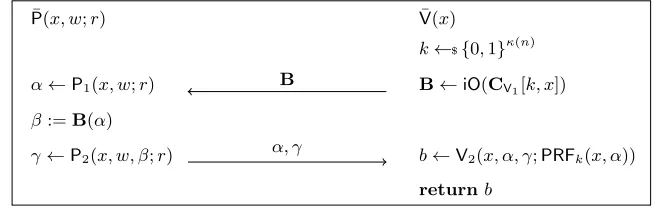
¯
P(x, w;r) V¯(x)
k←${0,1}κ(n)
α←P1(x, w;r) B B←iO(CV1[k, x])
β:=B(α)
γ←P2(x, w, β;r) α, γ b←V2(x, α, γ;PRFk(x, α))
returnb
Fig. 1. The two-round argument system ¯Π =hP¯,V¯i resulting from compressing the three-round proof system Π = hP,Vi into two rounds. The round compression is achieved by sending an obfuscated version of the verifier’s own code to the prover as a first message. This allows the prover to compute the verifier’s response to their first message without additional interaction. This construction is proven sound in Lemma 4.
CV1[k, x](α)
s:=PRFk(α)
β:=V1(x, α;s)
returnβ
To prove Theorem 2 we will now use the following two lemmas proven in Section 3.1 and Section 3.2 respectively.
Lemma 4. Let Πˆ be a 3-round interactive proof system with negligible sound-ness error µ as in Theorem 2. Let Π be the modified 3-round interactive proof system as described above. Assume thatPRFis a22n-secure puncturable
pseudo-random function, and iOis a22n-secure indistinguishability obfuscator. Further
assume thathideOis a2n-secure input-hiding obfuscator for multi-bit point
func-tions. Then Π¯, described in Figure 1 is a 2-round interactive argument system with negligible soundness errorµ¯.
Lemma 5. LetΠ be a 3-round interactive proof system for a languageL 6∈BPP. Let Π¯ be the transformed 2-round argument system described in Figure 1 with soundness errorµ¯. Ifµ¯≤negl(n) thenΠ is not non-uniformly zero-knowledge with auxiliary input.
Theorem 2 now follows as a simple corollary from combining Lemma 4 and Lemma 5. By our assumption,Π has a negligibly small soundness errorµ, which by Lemma 4 also implies a negligible soundness error ¯µfor ¯Π. Since a negligible soundness error of ¯Π implies thatΠ is not non-uniformly zero-knowledge with
auxiliary input, the theorem trivially follows. ut
3.1 Proof of Lemma 4
Fix a modified 3-round interactive proof systemΠ =hP,Vi. Letµ≤negl(n) be the soundness error ofΠ. We assume without loss of generality, that all messages of the protocol have length n.
Assume towards contradiction that there exists a cheating PPT prover P∗ breaking the soundness of ¯Π for some x∗ 6∈ L with probability ν = 1/poly(n). I.e., we have that
Pr k,iO,P∗
[V2(x∗, α, γ;PRFk(α)) = 1 : (α, γ)←P∗(iO(CV1[k, x]))]≥ν. (1)
To obtain a contradiction we analyze a variant of the protocol Π that works with a relaxed verifierV0. The relaxed verifierV0 works exactly asV, except that in addition to accepting whenever V does, it also accepts if β = 0dlogν/µekβ0
for some arbitrary β0. Remember, that β =σkβˆ with |σ| =
logµ−1
. I.e., V0
also accepts if the firstdlogν/µebits ofσare zero. In particular sinceV0 always accepts ifVaccepts, it remains true that
Pr k,iO,P∗
Further, using a union bound, we can bound the soundness errorµ0of the relaxed 3-round protocolhP,V0ito be
µ0 ≤µ+ 2−dlogν/µe≤µ+µ ν ≤
2µ
ν . (3)
In particular, for any negligibleµ, µ0 remains negligible. LetSα,β={s|V0
1(x∗, α;s) =β}denote the set of all random tapes that given αlead to the second messageβ. We define the following set of pairs (α, β), for which a maliciousγexists that will be accepted by the verifier for a large fraction of the random tapes that givenαlead toβ.
ACC=
(
(α, β)
∃γ: Pr s0←$Sα,β
[V20(x∗, α, γ;s0) = 1]≥ ν 2
)
.
Observe, that membership inACCcan be tested in time 22n·poly(n) =O(22n) by enumerating all messages γ and all random tapess, checking whether β = V01(x∗, α;s) andV02(x∗, α, γ;s) = 1 and then computing the probability.5 Given the cheating proverP∗, there exists an efficient algorithmAthat outputsα, such that (α,V01(α;PRFk(α)))∈ACCwith high probability. Formally this is stated in the following claim that is proven in Section 3.1.1.
Claim 6. If there exists a malicious proverP∗as assumed above, then for the
ef-ficient algorithmAthat on inputiO(CV1[k, x
∗])runs(α, γ)←P∗(iO(C
V1[k, x ∗])),
discards γ and outputsαthe following holds:
Pr k,iO,A
[(α,V01(x∗, α;PRFk(α)))∈ACC:α← A(iO(CV1[k, x
∗]))]≥ ν
2 −2
−n
Now consider the punctured version of the verifier circuit Cpct defined follows:
Cpct[k, α∗, β∗](α)
if α=?α∗
β:=β∗
else
s:=PRFk(α)
β:=V10(x, α;s)
returnβ
We will use the following claim, which essentially states that, when given an obfuscation of the verifier’s circuit punctured at α∗, the A from Claim 6 will outputα∗ with a probability slightly above random chance. The claim is proven in Section 3.1.2
5
Claim 7. If PRFis22n-secure andiOis22n-secure, then it must hold that
Pr
k,α∗,s∗,iO,A
h
AiO Cpct[k{α∗}, α∗,V01(x∗, α;s∗)]
=α∗
α∗,V01(x∗, α;s∗)
∈ACCi
≥ 1 8·2
−n·ν2 µ0.
This property ofAcontradicts the security of the input hiding obfuscatorhideO as shown in the following. We claim that
Pr
k,α∗,s∗,hideO,iO,A
h
AiO Chide[k,hideO(α∗, s∗)]
=α∗
α∗,V01(x∗, α;s∗)∈ACCi
≥ Pr
k,α∗,s∗,iO,A
h
AiO Cpct[k{α∗}, α∗,V01(x∗, α;s∗)]
=α∗
α∗,V10(x, α;s∗)∈ACCi
− Pr α∗,s∗
h
α∗,V01(x∗, α;s∗)∈ACCi·negl 22n
(4)
≥ Pr
k,α∗,s∗,iO,A
h
AiO Cpct[k{α∗}, α∗,V01(x∗, α;s∗)]=α∗
α∗,V10(x, α;s∗)∈ACCi
−2−2n (5)
≥1 8·2
−nν 2 µ0 −2
−2n ≥ 1 16·2
−nν 2
µ0, (6)
whereChide[k,B] is a circuit that defined as follows
Chide[k,B](α∗)
s∗:=B(α∗)
if s∗=⊥
s∗:=PRFk(α
∗
)
β∗:=V01(x∗, α∗;s∗)
returnβ∗
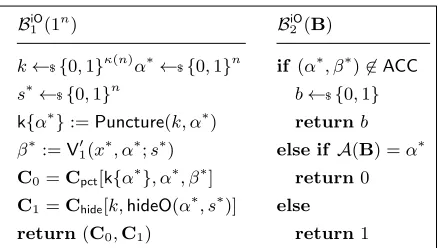
Equation 4 follows by reduction to the 22n security of the indistinguishability obfuscator as depicted in Figure 2. Clearly, the two circuits are functionally equivalent. Further, if it holds that (α∗, β∗) ∈ ACCthen the two cases of the security definition of indistinguishability obfuscation directly correspond to the two cases of Equation 4. The reductionBiO runs in timeO 22n
and therefore, Equation 4 follows. Equation 5 then follows simply by upper bounding the prob-ability with 1 and the negligible function by 2−2n. Finally Equation 6 follows directly from Claim 7 and the last inequality follows by loosely upper bounding the negligible function 2−2n.
BiO
1(1n)
k←${0,1}κ(n)α∗←${0,1}n s∗←${0,1}n
k{α∗}:=Puncture(k, α∗)
β∗:=V01(x∗, α∗;s∗)
C0=Cpct[k{α∗}, α∗, β∗]
C1=Chide[k,hideO(α∗, s∗)]
return(C0,C1)
BiO
2(B)
if (α∗, β∗)6∈ACC
b←${0,1}
returnb
else if A(B) =α∗
return0
else return1
Fig. 2.The reduction from the claim of Equation 4 to the 22nsecurity of the indistin-guishability obfuscator.
Formally, we define two distributions. LetD0 be the distribution over pairs (α∗, β∗) defined by uniformly sampling (α∗, β∗)←$ACC. LetD1be the distribu-tion over pairs (α∗, β∗) defined by uniformly samplingα∗←${0,1}n and then
uniformly samplingβ∗←${β|(α∗, β)∈ACC}. We denote byDb[α∗, β∗] the prob-ability of the pair (α∗, β∗) by distributionD
b.
Claim 8. For any (α∗, β∗)∈ {0,1}n× {0,1}2n it holds that
D1[α∗, β∗]≥ ν 4D0[α
∗, β∗]
It follows from Claim 8 that by drawing from D1 instead of D0, the probabil-ity of A outputtingα∗ can decrease at most by a multiplicative factor of 4/ν. Therefore, Claim 8 and Equation 6 imply that there exists aPPT algorithmA such that
Pr (α∗,β∗,hideO,A)←$D
1,hideO,A
[A(hideO(Chide[α∗, β∗])) =α∗]
≥ν 4 ·(
1 16 ·2
−n · ν
2 µ0) =
1 642
−n ·ν
3 µ0 ≥µ
−1
·2−n· ν 3 128
Since the distribution of α∗ drawn from D1 is uniform, and ν is an inverse polynomial, this contradicts theT =µ·2n·poly(n) security of the input hiding
obfuscator and Lemma 4 follows. ut
It remains to show that the various claims used in the above proof actually hold. The proofs for these claims are detailed in the following sections.
3.1.1 Proof of Claim 6 By definition ofAwe specifically need to show that
Pr k,iO,P∗
[(α,V01(x∗, α;PRFk(α)))∈ACC: (α, γ)←P∗(iO(CV1[k, x
∗]))]≥ν
2 −2
−n.
would accept with almost the same probability if the random tape were replaced with a randomly chosens←$Sα,β.
Claim 9. If PRF is22n-secure and iOis 22n-secure, then it must hold for any
malicious proverP∗ as assumed above, that
Pr
k,iO,P∗
V02(x∗, α∗, γ∗;PRFk(α∗)) = 1 :
(α∗, γ∗)←P∗(iO(CV1[k, x ∗]))
β∗←V0
1(x∗, α∗;PRFk(α∗))
− Pr
k,s,iO,P∗
V
0
2(x
∗, α∗, γ∗;s0) = 1 :
(α∗, γ∗)←P∗(iO(CV1[k, x∗])) β∗←V01(x∗, α∗;PRFk(α∗))
s0←$Sα∗,β∗
≤2−n.
We observe the following
ν = Pr k,iO,P∗
[V02(x∗, α, γ;PRFk(α)) = 1 : (α, γ)←P∗(iO(CV1[k, x
∗]))] (7)
≤ Pr
k,s0,iO,P∗
V02(x∗, α, γ;s0) = 1 :
(α, γ)←P∗(iO(CV1[k, x ∗])
β←V0
1(x∗, α,PRFk(α)) s0←
$Sα,β
+ 2−n (8)
= Pr
k,s0,iO,P∗
V
0
2(x
∗, α, γ;s0) = 1 :
(α, γ)←P∗(iO(CV1[k, x∗]) β←V10(x∗, α,PRFk(α))
s0←$Sα,β
(α, β)∈ACC
| {z }
≤1 · Pr
k,iO,P∗
[(α,V01(x∗, α;PRFk(α)))∈ACC: (α, γ)←P∗(iO(CV1[k, x ∗]))]
+ Pr
k,s0,iO,P∗
V
0
2(x
∗, α, γ;s0) = 1 :
(α, γ)←P∗(iO(CV1[k, x∗]) β←V10(x∗, α,PRFk(α))
s0←$Sα,β
(α, β)6∈ACC
| {z }
≤ν/2 · Pr
k,iO,P∗
[(α,V01(x∗, α;PRFk(α)))6∈ACC: (α, γ)←P∗(iO(CV1[k, x ∗]))]
| {z }
=1−Prk,iO,P∗[(α,V10(x∗,α;PRFk(α)))∈ACC:(α,γ)←P∗(iO(CV1[k,x∗]))]
+ 2−n
(9)
≥1−ν 2
Pr k,iO,P∗
[(α,V01(x∗, α;PRFk(α)))∈ACC: (α, γ)←P∗(iO(CV1[k, x ∗]))]
+ν 2 + 2
−n (10)
Equation 10 upper bounds the probability of the verifier accepting in the two cases.
The above observation gives us
Pr k,iO,P∗
[(α,V01(x∗, α;PRFk(α)))∈ACC: (α, γ)←P∗(iO(CV1[k, x ∗]))]
≥ν− ν 2−2
−n
1−ν 2
≥ν−ν 2 −2
−n= ν 2 −2
−n
as claimed. ut
Proof of Claim 9.Letδbe any function such that
Pr
k,s0,iO,P∗
V20(x∗, α∗, γ∗;PRFk(α∗)) = 1 :
(α∗, γ∗)←P∗(iO(CV1[k, x∗])) β∗←V01(x∗, α∗;PRFk(α∗))
s0←$Sα∗,β∗
− Pr
k,s0,iO,P∗
V20(x∗, α∗, γ∗;s0) = 1 :
(α∗, γ∗)←P∗(iO(CV1[k, x ∗]))
β∗←V01(x∗, α∗;PRFk(α∗)) s0←$Sα∗,β∗
> δ(n).
In this case, we also have that for a uniformly chosen valueα,
Pr
k,s0,α,iO,P∗
V02(x∗, α∗, γ∗;PRFk(α∗)) = 1
∧α∗=α :
(α∗, γ∗)←P∗(iO(CV1[k, x∗])) β∗←V01(x∗, α∗;PRFk(α∗))
s0←$Sα∗,β∗
− Pr
k,s0,α,iO,P∗
V02(x∗, α∗, γ∗;s0) = 1 ∧α∗=α :
(α∗, γ∗)←P∗(iO(C
V1[k, x ∗]))
β∗←V01(x∗, α∗;PRFk(α∗)) s←$Sα∗,β∗
>2−n·δ(n).
Now consider the punctured version of the verifier circuit defined as before. By the 22n security of the obfuscator, the fact that the two circuits CV1[k, x∗] and Cpct[k{α}, α,V01(α;PRFk(α))] are functionally equivalent and the fact that s←$Sα∗,β∗ can be sampled in time O(2n), it follows that
Pr
k,s0,α,iO,P∗
V02(x∗, α∗, γ∗;PRFk(α∗)) = 1
∧α∗=α :
β ←V01(x∗, α;PRFk(α)) (α∗, γ∗)←P∗(iO(Cpct[k{α}, α, β]))
s0←$Sα∗,β
− Pr
k,s0,α,iO,P∗
V02(x∗, α∗, γ∗;s0) = 1 ∧α∗=α :
β ←V01(x∗, α;PRFk(α)) (α∗, γ∗)←P∗(iO(Cpct[k{α}, α, β]))
s0←$Sα∗,β
>2−n·δ(n)−negl 22n
.
Further, by the 22n security of the pseudorandom function and the fact that s←$Sα∗,β∗ can be sampled in time O(2n), it follows that
Pr
k,s,s0,α,iO,P∗
V0
2(x∗, α∗, γ∗;s) = 1 ∧α∗=α :
β←V0
1(x∗, α;s)
(α∗, γ∗)←P∗(iO(Cpct[k{α}, α, β])) s0←$Sα∗,β
− Pr
k,s,s0,α,iO,P∗
V20(x∗, α∗, γ∗;s0) = 1 ∧α∗=α :
β←V10(x∗, α;s)
(α∗, γ∗)←P∗(iO(Cpct[k{α}, α, β])) s0←$Sα∗,β
≥2−n·δ(n)−negl 22n
−negl 22n≥2−n·δ(n)−2−2n,
where the last inequality is obtained by loosely upper bounding the negligible functions. The circuitCpct[k{α}, α, β] no longer contains any information about s besides the fact that s ∈ Sα∗,β∗. In the case where α∗ = α, s and s0 are,
therefore, distributed identically and the two probabilities must in fact also be identical. Therefore, 2−n·δ(n)−2−2n ≤0, giving usδ(n)≤2−n. The claim thus
follows. ut
3.1.2 Proof of Claim 7 By definition of conditional probability, we have that
Pr
k,α∗,s∗,iO,A
h
AiO Cpct[k{α∗}, α∗,V01(x∗, α;s∗)]
=α∗
α∗,V01(x, α;s∗)
∈ACCi
=
Prk,α∗,s∗,iO,A
AiO Cpct[k{α∗}, α∗,V01(x∗, α;s∗)]
=α∗ ∧α∗,V01(x, α;s∗)∈ACC
Prα∗,s∗
h
α∗,V0
1(x∗, α;s∗)
∈ACCi
,
where we can easily bound Prα∗,s∗[(α∗,V01(x∗, α;s∗))∈ACC]≤2µ0/νusing the
soundness errorµ0 ofhP,V0i. This is due to the fact that otherwise a (computa-tionally unbounded) malicious prover could simply send a randomly sampledα∗. Upon receiving β∗, it would hold that (α∗, β∗)∈ACC with probability greater than 2µ0/ν. In this case, the prover could exhaustively search for a messageγ∗ that would lead many verifiers to accept. By definition of ACC, such a prover would win with probability greater than (2µ0/ν)·(ν/2) =µ0, contradicting the soundness of the underlying protocol. It remains to bound the numerator, which we will do in two hops.
Pr
k,α∗,s∗,iO,A
A(iO(Cpct[k{α∗}, α∗,V01(x∗, α;s∗)])) =α∗ ∧(α∗,V0
1(x∗, α;s∗))∈ACC
≥ Pr
k,α∗,iO,A
A(iO(Cpct[k{α∗}, α∗,V01(x∗, α∗;PRFk(α∗))])) =α∗ ∧(α∗,V01(x∗, α∗;PRFk(α)))∈ACC
−negl 22n
(11)
≥ Pr
k,α∗,iO,A
A(iO(CV1[k, x
∗])) =α∗
∧(α∗,V01(x∗, α∗;PRFk(α∗)))∈ACC
−negl 22n−negl 22n (12)
≥ Pr
k,α∗,iO,A
A(iO(CV1[k, x∗])) =α∗ ∧(α∗,V01(x∗, α∗;PRFk(α∗)))∈ACC
−2−2n (13)
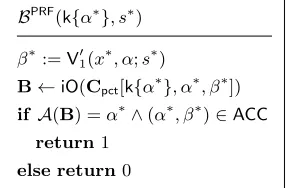
Equation 11 follows by reduction to the 22n security of the puncturable pseudo-random function as depicted in Figure 3. Clearly, the two cases of the security
BPRF(k{α∗ }, s∗)
β∗:=V01(x
∗ , α;s∗)
B←iO(Cpct[k{α∗}, α∗, β∗])
if A(B) =α∗∧(α∗, β∗)∈ACC
return1
else return0
Fig. 3.The reduction from the claim of Equation 11 to the 22n security of the punc-turable pseudorandom function.
definition for puncturable pseudorandom functions directly map to the two cases of Equation 11. Further, the reductionBPRFruns in timeO(22n) and therefore, Equation 11 follows.
Equation 12 follows by reduction to the 22n security of the indistinguishabil-ity obfuscator as depicted in Figure 4. Clearly, the two circuits are functionally
BiO
1 (1n)
k←${0,1}κ(n), α∗←${0,1}n
k{α∗}:=Puncture(k, α∗)
β∗:=V01(x∗, α∗;PRFk(α
∗
))
C0=Cpct[k{α∗}, α∗, β∗]
C1=CV1[k, x ∗
]
return(C0,C1)
BiO
2(B)
if A(B) =α∗∧(α∗, β∗)∈ACC
return1
else return0
equivalent and the two cases of the security definition for puncturable pseudo-random functions directly map to the two cases of Equation 11. The reduction BiOruns in timeO(22n) and therefore, Equation 12 follows. Finally, Equation 13 then follows by the fact that the sum of two negligible functions is negligible and by loosely upper bounding the resulting negligible functions (note that 2−2n is an inverse polynomial in 22n).
Using basic probability theory and Claim 6, we get
Pr k,α∗,iO,A
[A(iO(CV1[k, x∗])) =α∗∧(α∗,V10(x∗, α∗;PRFk(α∗)))∈ACC]
= Pr
k,α∗,iO,A
" [
α
A(iO(CV1[k, x])) =α∗
∧(α∗,V01(x∗, α∗;PRFk(α∗)))∈ACC∧α∗=α
#
=X
α Pr
k,α∗,iO,A
A(iO(CV1[k, x])) =α∗
∧(α∗,V01(x∗, α∗;PRFk(α∗)))∈ACC∧α∗=α
=2−nX α
Pr
k,α∗,iO,A
A(iO(CV1[k, x])) =α∗ ∧ (α∗,V01(x∗, α∗;PRFk(α∗)))∈ACC
=2−n Pr k,iO,A
[(α,V01(x∗, α;PRFk(α)))∈ACC:α← A(iO(CV1[k, x ∗]))]
≥2−n·ν 2 −2
−n .
Combining this with Equation 13, we get
Pr
k,α∗,s∗,iO,A
A(iO(Cpct[k{α∗}, α∗,V10(x∗, α;s∗)])) =α∗ ∧(α∗,V01(x∗, α;s∗))∈ACC
≥2−nν 2 −2
−n
−2−2n = 2−nν 2 −2
−n
−2−n≥2−n· ν 4
where the last inequality follows by loosely upper bounding the negligible func-tion 21−n by the inverse polynomialν/4. Finally Claim 7 follows by
Pr
k,α∗,s∗,iO,A
h
AiO Cpct[k{α∗}, α∗,V01(x∗, α;s∗)]
=α∗
α∗,V01(x∗, α;s∗)
∈ACCi
=
Prk,α∗,s∗,iO,A
AiO Cpct[k{α∗}, α∗,V01(x∗, α;s∗)]
=α∗ ∧α∗,V01(x∗, α;s∗)∈ACC
Prα∗,s∗
h
α∗,V0
1(x∗, α;s∗)
∈ACCi
≥ 2
−n·ν 2 µ0 =
1 2 ·2
−n ν µ0
3.1.3 Proof of Claim 8 For any α∗ denote by Bα∗ :={β|(α∗, β)∈ACC}.
By construction of the relaxed verifier we have thatBα∗ contains at least aµ/ν
fraction of allβ. On the other hand, soundness of the protocolhP,V0iguarantees, thatBαdoes not contain more than a 2µ0/ν≤4µ/ν2fraction of allβ. Thus, we have
µ ν ≤
|Bα∗|
22n ≤ 4µ ν2 In particular, for anyαandα∗, we have that
|Bα| ≥ ν 4 |Bα∗| which gives us
D0[α∗, β∗] = 1 ACC =
1
P
α∈{0,1}n|Bα|
≤ 2
2n· |Bα∗| = 4 νD1[α
∗, β∗].
u t
3.2 Proof of Lemma 5
Consider the following malicious verifier V∗ = (V∗1,V∗2). The first stage V∗1 on input the statementx, the prover’s first messageαand auxiliary inputauxsimply interprets the auxiliary input as a circuit, evaluates it on x, α, and outputs the resultβ←aux(x, α). The second stageV∗
2on input the statementx, the prover’s messagesα, γand auxiliary inputauxrecomputesβ ←aux(x, α) and then simply outputsα, β, γ.
Now, assume towards contradiction, thatΠ is zero-knowledge, i.e., in par-ticular forV∗as described above there exists aPPTsimulatorSimsuch that for allPPTdistinguishersD, all auxiliary inputsauxandaux0, and all statementsx it holds that
Pr[D(hP(x, w),V∗(x,aux)i,aux0) = 1] −Pr[D(Sim(x,aux),aux0) = 1]
≤negl(n).
We will use said simulator to construct a malicious prover P∗ against ¯Π as follows: On input x and the verifier’s message B=iO(CV1[k]), P∗ invokes the simulatorSimonxand auxiliary inputB. The simulator will produce a transcript α, β, γ thatP∗ also outputs.
If x ∈ L, then the zero-knowledge property and the completeness guaran-tee that ¯V2 will accept the proof with probability 1−negl(n), since otherwise we could easily construct a successful distinguisher against Simas follows. The distinguisher D on input (α, β, γ) and auxiliary input aux0 simply runs ¯V
2 on (α, γ) and random coinsaux0 and outputs b←V¯2((α, γ);aux0). Further, even if x6∈ L, ¯V2 must still accept with all but negligible probability, since otherwise the combination ofP∗and ¯Vcould be used to decideL, implying thatL ∈BPP. Therefore,P∗ succeeds in convincing ¯Vof false statements with all but negli-gible probability. Since this contradicts the premise that ¯µ≤negl(n),Simcannot
4
Extending the Lower Bound to
-Zero Knowledge
In [14] Bitansky, Kalai, and Paneth introduced a weaker notion of zero-knowledge they called-zero-knowledge. In this weaker notion, the outputs of the simulator may be distinguishable with non-negligible probability, but the distinguishing advantage is upper bounded by any inverse monomial in the length of the state-ment. In this section we prove that our lower bound extends to this weaker notion of zero-knowledge. This is particularly interesting because Bitansky, Kalai, and Paneth [14] are able to construct a 4-round-zero-knowledge proof protocol from keyless multi-collision-resistant hash functions (MCRH). This provides evidence that our technique is unlikely to be extend to the case of 4-round proofs, since that would rule out MCRHs.
We start by defining-zero-knowledge. The definition is almost identical to regular zero-knowledge, except that the advantage of the distinguisher is not bounded by a negligible function.
Definition 8 (Non-Uniform -Zero-Knowledge with Auxiliary Input).
LethP,Vibe a 2-Party protocol.hP,Viis said to be non-uniformly-zero-knowledge with auxiliary input, if for all (possibly malicious)PPTalgorithmsV∗there exists a PPT simulator Sim, such that for all PPT distinguishers D and all auxiliary inputs aux and aux0, it holds that for all statements x with |x| = λ and every noticeable function(λ) =λ−O(1 )
Pr[D(hP(x, w),V∗(x,aux)i,aux0) = 1]
−PrhD(Sim(11/(λ), x,aux),aux0) = 1i
≤(λ).
Next, we state our generalized lemma about 3-round -zero-knowledge proofs. This lemma is a straightforward adaption of Lemma 5 to the -zero-knowledge case.
Lemma 10. Let Π be a 3-round interactive proof system for a language L 6∈ BPP. LetΠ¯ be the transformed 2-round argument system described in Figure 1 with soundness error µ¯. If µ¯ ≤ negl(n) then Π is not non-uniformly -zero-knowledge with auxiliary input.
From combining Lemma 4 and Lemma 10 a statement equivalent to Theorem 2 for-zero-knowledge follows as a simple corollary.
4.1 Proof of Lemma 10
Just like the lemma itself, the proof is a straightforward adaption of the proof for Lemma 5. We only need to make sure that the weaker requirement on the simu-lator does not cause the success probability of the cheating prover to deteriorate too much.
simply interprets the auxiliary input as a circuit, evaluates it onx, α, and outputs the result β ← aux(x, α). The second stage V∗2 on input the statement x, the prover’s messages α, γ and auxiliary input aux recomputes β ← aux(x, α) and then simply outputsα, β, γ.
Now, assume towards contradiction, thatΠ is-zero-knowledge, i.e., in par-ticular forV∗as described above there exists aPPTsimulatorSimsuch that for allPPTdistinguishersD, all auxiliary inputsauxandaux0, all statementsxand all noticeable function(λ) =λ−O(1 ) it holds that
Pr[D(hP(x, w),V∗(x,aux)i,aux0) = 1]
−PrhD(Sim(11/(|x|), x,aux),aux0) = 1i
≤(|x|).
We will use said simulator to construct a malicious prover P∗ against ¯Π as follows: On input x and the verifier’s message B=iO(CV1[k]), P
∗ invokes the
simulatorSimon 1/(λ),xand auxiliary inputB. The simulator will produce a transcriptα, β, γ thatP∗ also outputs.
Ifx ∈ L, then the zero-knowledge property guarantees that ¯V2 will accept the proof with probability greater than 1− |x|−c for any constant c∈N, since otherwise we could easily construct a successful distinguisher against Sim as follows. The distinguisher D on input (α, β, γ) and auxiliary inputaux0 simply runs ¯V2 on (α, γ) and random coinsaux0 and outputsb←V¯2((α, γ);aux0). This distinguisher would therefore be able to distinguish between a real transcript and a simulated transcript with probability greater than|x|−cfor some constant c ∈N, thus clearly clearly contradicting the fact that Simis a valid simulator. Further, even ifx6∈ L, ¯V2 must still accept with probability at least 1− |x|−
c − negl(n), since otherwise the combination of P∗ and ¯V could be used to decide L, implying that L ∈BPP.
Therefore,P∗ succeeds in convincing ¯Vof false statements with probability greater than 1− |x|−c−negl(n) for any constant c ∈N, which is clearly non-negligible. Since this contradicts the premise that ¯µ≤negl(n),Simcannot exist
and thereforeΠ is not zero-knowledge. ut
References
1. Ananth, P., Jain, A.: On secure two-party computation in three rounds. In: Kalai, Y., Reyzin, L. (eds.) TCC 2017: 15th Theory of Cryptography Conference, Part I. Lecture Notes in Computer Science, vol. 10677, pp. 612–644. Springer, Heidelberg, Germany, Baltimore, MD, USA (Nov 12–15, 2017) 1.2
2. Ananth, P., Jain, A., Sahai, A.: Indistinguishability obfuscation from functional en-cryption for simple functions. Cryptology ePrint Archive, Report 2015/730 (2015),
http://eprint.iacr.org/2015/730 1.1
4. Applebaum, B., Brakerski, Z.: Obfuscating circuits via composite-order graded en-coding. In: Dodis, Y., Nielsen, J.B. (eds.) TCC 2015: 12th Theory of Cryptography Conference, Part II. Lecture Notes in Computer Science, vol. 9015, pp. 528–556. Springer, Heidelberg, Germany, Warsaw, Poland (Mar 23–25, 2015) 1.1
5. Barak, B., Bitansky, N., Canetti, R., Kalai, Y.T., Paneth, O., Sahai, A.: Obfusca-tion for evasive funcObfusca-tions. In: Lindell, Y. (ed.) TCC 2014: 11th Theory of Cryp-tography Conference. Lecture Notes in Computer Science, vol. 8349, pp. 26–51. Springer, Heidelberg, Germany, San Diego, CA, USA (Feb 24–26, 2014) 1, 1.1, 2.3 6. Barak, B., Goldreich, O., Goldwasser, S., Lindell, Y.: Resettably-sound zero-knowledge and its applications. In: 42nd Annual Symposium on Foundations of Computer Science. pp. 116–125. IEEE Computer Society Press, Las Vegas, NV, USA (Oct 14–17, 2001) 3
7. Barak, B., Goldreich, O., Impagliazzo, R., Rudich, S., Sahai, A., Vadhan, S.P., Yang, K.: On the (im)possibility of obfuscating programs. In: Kilian, J. (ed.) Ad-vances in Cryptology – CRYPTO 2001. Lecture Notes in Computer Science, vol. 2139, pp. 1–18. Springer, Heidelberg, Germany, Santa Barbara, CA, USA (Aug 19– 23, 2001) 1, 1, 2.3
8. Bellare, M., Jakobsson, M., Yung, M.: Round-optimal zero-knowledge arguments based on any one-way function. In: Fumy, W. (ed.) Advances in Cryptology – EUROCRYPT’97. Lecture Notes in Computer Science, vol. 1233, pp. 280–305. Springer, Heidelberg, Germany, Konstanz, Germany (May 11–15, 1997) 1.4 9. Berman, I., Degwekar, A., Rothblum, R.D., Vasudevan, P.N.: Multi collision
re-sistant hash functions and their applications. Cryptology ePrint Archive, Report 2017/489 (2017),http://eprint.iacr.org/2017/489 1.1
10. Bitansky, N., Brakerski, Z., Kalai, Y.T., Paneth, O., Vaikuntanathan, V.: 3-message zero knowledge against human ignorance. In: Hirt, M., Smith, A.D. (eds.) TCC 2016-B: 14th Theory of Cryptography Conference, Part I. Lecture Notes in Computer Science, vol. 9985, pp. 57–83. Springer, Heidelberg, Germany, Beijing, China (Oct 31 – Nov 3, 2016) 1.4
11. Bitansky, N., Canetti, R.: On strong simulation and composable point obfuscation. In: Rabin, T. (ed.) Advances in Cryptology – CRYPTO 2010. Lecture Notes in Computer Science, vol. 6223, pp. 520–537. Springer, Heidelberg, Germany, Santa Barbara, CA, USA (Aug 15–19, 2010) 1, 1.1, 2.3
12. Bitansky, N., Canetti, R., Paneth, O., Rosen, A.: On the existence of extractable one-way functions. In: Shmoys, D.B. (ed.) 46th Annual ACM Symposium on The-ory of Computing. pp. 505–514. ACM Press, New York, NY, USA (May 31 – Jun 3, 2014) 1.4
13. Bitansky, N., Goldwasser, S., Jain, A., Paneth, O., Vaikuntanathan, V., Waters, B.: Time-lock puzzles from randomized encodings. In: Sudan, M. (ed.) ITCS 2016: 7th Innovations in Theoretical Computer Science. pp. 345–356. Association for Computing Machinery, Cambridge, MA, USA (Jan 14–16, 2016) 1.1
14. Bitansky, N., Kalai, Y.T., Paneth, O.: Multi-collision resistance: A paradigm for keyless hash functions. Cryptology ePrint Archive, Report 2017/488 (2017),http: //eprint.iacr.org/2017/488 1.1, 1.4, 4
15. Bitansky, N., Vaikuntanathan, V.: Indistinguishability obfuscation from functional encryption. In: Guruswami, V. (ed.) 56th Annual Symposium on Foundations of Computer Science. pp. 171–190. IEEE Computer Society Press, Berkeley, CA, USA (Oct 17–20, 2015) 1.1