Victoria University of Technology
RISK APPORTIONING
IN
ENGINEERING AND BUILDING
CONTRACTS IN AUSTRALIA
BY
V^A. YOUNG
i i
TITLE OF THESIS: Risk Apportioning in Engineering and Building Contracts in Australia.
STUDENT'S NAME: William Arthur Young
STUDENT NUMBER: 9000151
COURSE TITLE: Master of Engineering
DEPARTMENT: Civil and Building Engineering
Victoria University of Technology, Footscray
SUPERVISORS: Chandra Bhuta - Director, Project Management Courses VUT
Chris Farrell - Partner, Dan/all McCutcheon Solicitors
DATE OF SUBMISSION: December 1992
DECLARATION: This is a minor thesis submitted as partial fulfilment of the
STA ARCHIVE
30001001256116
Young, William Arthur,
1867-1955
ACKNOWLEDGEMENTS
I extend my personal thanks to the companies and their staff who provided the many
contracts that made this research possible.
I particularly thank Mr. Chandra Bhuta of Victoria University of Technology and Mr.
Christopher Farrell of Darvall McCutcheon Solicitors, for their guidance and assistance
throughout the research and preparation of this thesis.
ABSTRACT
This thesis is an investigation of current practice in respect of risk apportioning in engineering and building construction contracts in Australia.
Current literature on this topic suggests effective and responsible risk apportioning is not taking place but rather that parties controlling contracts have adopted a philosophy of risk shifting. Risk shifting is a practice carried out by the party initiating the contract where an identified risk is shifted onto the other party to the contract, regardless of whether it can influence or control the risk.
The thesis details a study conducted on 50 industry contracts that, through an examination of risk provisions, determined that a high level of risk shifting was being practised in the engineering and building construction industries in Australia. A comparative study on North American experience was also reviewed to gain an understanding of the broad extent of such practice.
The thesis also reviews current literature on this topic and provides a brief summary of literature items found to be particularly relevant to the study undertaken.
Recommendations are presented from the findings of the study, along with general recommendations from the literature reviewed.
CONTENTS
1.0
2.0
INTRODUCTION
1.1 1.2
Outline of Thesis Objectives of Thesis
DEFINITIONS
2.1 2.2 2.3 2.4 2.5 2.6 2.7
Risk Owner Contractor
Lump Sum Contract Cost Plus Contract Engineering Industry
Building Construction Industry
3.0 EXPLANATION OF RISK PROVISIONS
3.1 Design
3.2 Discrepancies In Documents 3.3 Quality Management
3.4 Security/Retention 3.5 Insurances
3.5.1 Workers Compensation and Employer's Liability 3.5.2 Public Liability
3.5.3 General Property and Works 3.5.4 Professional Indemnity Insurance
3.6 Owners Liability and Indemnity
3.7 Force Majeure
3.8 Latent Conditions 3.9 Industrial Relations
3.9.1 Industrial Relations Disputes In General
3.9.2 Strikes or Lockouts Beyond Control of Contractor
3.10 Inclement Weather
3.10.1 Costs Due to Inclement Weather 3.10.2 Delays Due to Inclement Weather 3.11 Delays In Reaching Practical Completion 3.12 Termination and Suspension
3.13 Default
4.0 LITERATURE REVIEW
4.1 Belev (1989) 4.2 Bhuta (1991) 4.3 Casner Jr. (1988)
4.4 Frankel and Lazaruk (1991) 4.5 Konarsky (1990)
4.6 Korman and Setzer (1991) 4.7 Kozek and Hebberd (1989) 4.8 NPWC/NBCC (1990) 4.9 Uher (1991)
5.0 STUDY OF CURRENT AUSTRALIAN PRACTICE
5.1 Outline of Study 5.2 Methodology
5.2.1 Data Collection
6.0 ANALYSIS OF STUDY RESULTS
6.1 Discussion of Results
6.2 Risk/Obligation Allocation Model 6.3 Assessment Rating
6.4 Findings Between Parties A & B 6.5 Findings Between Parties A & C/D
6.6 Comparison of Risk Apportionment Studies
6.6.1 Outline
6.6.2 Findings of Comparison
6.7 Summary of Overall Study Findings
7.0 RECOMMENDATIONS
7.1 Specific Recommendations 7.2 General Recommendations
7.3 Recommendations for Further Study
8.0 CONCLUSION
9.0 REFERENCES
10.0 BIBLIOGRAPHY
APPENDIX 1 CONTRACTS REVIEWED - SUMMARY
LIST OF TABLES
TABLE 1: Classification of Contracts Studied
TABLE 2: Risk Apportionment Schedule
TABLE 3: Risk Apportionment % Summary Between Parties A and B
TABLE 4: Risk/Obligation Allocation Model
TABLE 5: Results Assessment Between Parties A and B
TABLE 6: Risk Apportionment % Summary Between Parties A and C/D
TABLE 7: Results Assessment Between Parties A and C/D
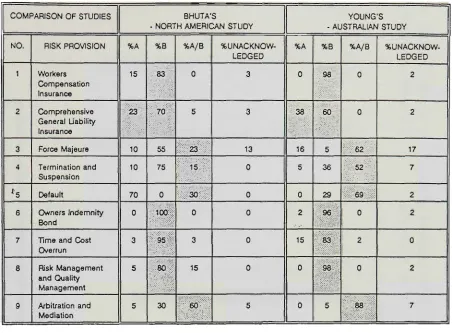
TABLE 8: Comparison of Studies
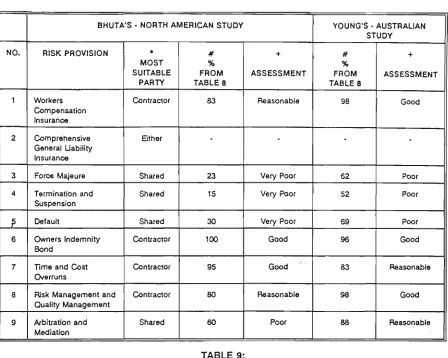
TABLE 9: Comparative Review - Results Assessment
LIST OF FIGURES
FIGURE 1: Percentage of Risk Provisions Apportioned to Party A or B or A/B or
Unacknowledged i
1.0 INTRODUCTION
Both the engineering and building construction industries have evolved in terms of their development of conditions of contract. This evolution has been influenced by commercial practices, technology and the law. This is particularly the case over the last two decades where prior to this period most contracts were developed in-house by company employees or legal firms with experience in this area. Over the latter period many standard form contracts have emerged developed by such representative groups as, the Standards Association of Australia, the Master Builders Federation of Australia, the Royal Australian Institute of Architects and others. Most of these contracts have been progressively modified as a result of commercial and legal developments with the aim to improve their effectiveness for the parties using them.
Apart from these efforts little attempt has been made to guide parties in respect of suitable risk apportionment.
Current literature on this topic suggests Australian industry, like a number of similar overseas industries, is conducting itself poorly in respect of suitable risk apportionment. Risks are either being allocated to a party not capable of adequately controlling them or the risk is not being specifically addressed.
Risks poorly allocated can reduce their chance of being minimised, increase project costs and cause time delays. They may also heighten the potential for disputes and increase the volatility of a project.
Contracts where risks have not been acknowledged and hence unapportioned appear to be developed by parties who are either ignorant of their potential or are prepared to leave the risk lie and only act if it eventuates. This action is not usually one of accepting the consequences If the risk does eventuate but often develops into a dispute as some of the damage is attempted to be offset onto the other party to the contract.
Effective risk apportionment begins with a full assessment of all applicable risks associated with a particular contract, followed by an assessment of the most suitable party capable of controlling or influencing each risk. The assessment may be influenced by each parties experience, capability, resources and attitude to the risk.
1.1 OUTLINE OF THESIS
This thesis is an investigation of current Australian practice in respect of risk apportionment in engineering and building contracts.
The thesis primarily consists of a study of 50 recently used contracts applicable to the engineering and building construction industries.
It commences with definitions of the terms used throughout the thesis as well as an explanation of risk provision terms associated with the contracts studied.
The thesis covers a review of current literature on risk apportionment and although it does not present a detailed analysis of this literature it does provide a brief summary of literature items found to be particularly relevant to the study undertaken.
The methodology used in the study is explained. It includes the following:
• How the study was conducted in terms of data collection, etc.
• Study limitations.
• Areas that require further study.
• Method of analysis of study results.
• Criteria of results assessment, including an explanation and the use of the NPWC/NBCC Risk/Obligation Allocation model.
Results of the study have been presented in a number of tables and graphs to facilitate comparison and aid analysis.
An analysis is made of:
• Contracts between owners and contractors.
• Contracts between owners and consultants, including project/construction managers.
• A comparative study (Bhuta's North American Study).
1.2 OBJECTIVES OF THESIS
The primary objective of the thesis was to study the practice of risk apportionment in Australian engineering and building construction contracts with the view to determining whether risks are being apportioned in a suitable manner. The criteria of suitability is explained in Section 6.
The study primarily reviews lump sum fixed price contracts but also includes several cost plus contracts. No distinction is made between these types of contracts as the study investigates a series of risk provisions that relate equally to both styles of contract. Likewise various combinations of contracts were included, such as: 'design only', 'construct or supply only' and 'design and construct'. Contract parties incuded, owners, contractors, consultants and project/construction managers.
A secondary objective was to carry out a comparison of the results of the study conducted in this thesis with results of a similar study conducted by Bhuta in Canada and the USA in 1991. The comparison of results was of particular interest because of the similar engineering and building construction environments of the countries studied,
2.0 DEFINITION OF TERMS
The following common terms have been used in this thesis and in reference to the analysis of the contracts in the study conducted. The terms have been defined by the author in respect of their general meaning and context to this thesis.
2.1 RISK
A risk may be defined as the probability of an event occurring coupled with the consequence if it does occur. Within the context of this study risk is primarily considered as a negative attribute. In real life however, along with negative risks positive risks, with positive outcomes may also occur. For example, as a result of a design review a better and more economic design may result.
In this thesis the terms Obligations/Responsibilities and Risk of a particular item are used interchangedly. The obligations/responsibilities reviewed in this thesis are associated with or meant to include risk arising out of these actions.
2.2 OWNER
Owner, Principal, Client refers to the party who generally initiates the contract and therefore the party for whom the execution of the contract is being effected.
2.3 CONTRACTOR
Contractor refers to the party generally bound in contract to execute the work under the contract.
2.4 LUMP SUM CONTRACT
A lump sum contract refers to a contract where an agreed price has been determined for the execution of the work and performance of the obligations by the parties before the execution of the contract.
Lump sum contracts are predominantly used where a clear scope of work, whether it be design and construct or construction only, is available and agreed between parties.
There are two kinds of lump sum contracts:
• Fixed Price Contracts
This type of contract has no facility for Rise and Fall or cost adjustment.
• Lump Sum Contracts, subject to Rise and Fall
2.5 COST PLUS CONTRACT
A cost plus contract where the execution of the contract work is reimbursed to the party carrying out the work either on the basis of a fee or percentage over and above the final cost of all expenses incurred. Expenses include costs of labour, materials, on and off site work and related overheads, costs of hiring equipment, etc.
2.6 ENGINEERING INDUSTRY
Engineering Industry refers to that area of industry generally involved in civil and mechanical engineering projects. Design and construction of projects such as roads, bridges or dams and process chemical manufacturing plants.
2.7 BUILDING CONSTRUCTION INDUSTRY
3.0 EXPLANATION OF RISK PROVISIONS
The terms outlined below have been used to describe risk provisions in the contracts studied. The nature of the risk is explained for each provision.
It is difficult ascribing one explanation or definition when, in a number of cases these terms within a variety of contracts, may be given different meanings. In a legalistic sense, the only way of dealing with this would be to ascribe each term a definition in accordance with its actual meaning to a particular contract. In the context of this thesis and in trying to understand the nature of risk apportionment, this would both be onerous and unhelpful.
In order to account for differences between the various contracts analysed a generalised explanation has been ascribed to each term. Explanations have been, where possible, derived in meaning from standard condition contracts such as AS2124-1986 and NPWC Ed 3 - 1981.
3.1 DESIGN
The nature of risk in this provision is in respect of whether the design will satisfy the requirements specified in the contract in terms of adequately carrying out the function intended. Design normally includes specifications as well as plans and drawings. It generally, involves the provision of specialist professional services from a range of disciplines.
3.2 DISCREPANCIES IN DOCUMENTS
The nature of the risk in this provision is in respect of the consequences that may result from discrepancies, ambiguity, omissions or errors found in contract documents, including drawings and specifications, and any other contract documents. Consequences may include increased costs and or delaying contract program.
3.3 QUALITY MANAGEMENT
The nature of risk in this provision is in respect of the party executing the works conforming to the standards of material and workmanship specified in the contract.
3.4 SECURITY/RETENTION
The nature of the risk in this provision is in respect of whether security shall be provided to ensure due and faithful performance of the contract.
Security/Retention is most commonly in the form of a Bank Guarantee or the holding of Retention Monies.
Although normally provided by the contractor, in some contracts, these roles may be reversed and the owner may have to submit a Bank Guarantee to the contractor/consultant to ensure it will provide sufficient contract funding.
Retention Money is a form of security in which the owner retains a percentage of each progress payment made in the contract during the course of the work. A percentage of this retainer is released upon practical completion and the balance is released upon the expiration of the maintenance or warranty period.
3.5 INSURANCES
The nature of risk in this provision is in respect qi the proper and sufficient provision of the applicable insurance coverage.
3.5.1 Workers Compensation and Employer's Liability
Workers Compensation and Employer's Liability - refers to that insurance that provides cover to the insured (usually a contractor and most often nominated to cover sub-contractors) against liability, loss, damage, claim, demand, action, suit or proceeding, costs and expenses as a result of personal injury or the death of any person employed by the contractor or by any sub-contractor in or about the execution of the work under the contract or the performance of the contract.
3.5.2 Public Liability
Public Liability - is insurance that covers liability to the public in respect to personal injury to or death arising by accident of any person whomsoever (apart from workers covered under Workers Compensation) and in respect of any loss or damage whatsoever arising by accident to any property real or personal where the accident arises out of or is caused by the execution of the works.
3.5.3 General Property and Works
3.5.4 Professional Indemnity Insurance
Professional Indemnity Insurance - covers any claim arising out of or incidental to any negligent act, error or omission by a consultant/contractor, its agents, employees, sub-contractors throughout the execution of the work.
Professional Indemnity Insurance in the context of the industries studied primarily relates to parties, such as design consultants, who provide a design function.
3.6 OWNERS LIABILITY AND INDEMNITY
The nature of the risk in this provision is in respect of the owner being exposed to:
i) Loss of or damage to property of the owner, including existing property in or upon which the work under the contract is being carried out.
ii) Claims by any person against the owner in respect of personal injury or death or loss of or damage to any property.
There are normally provisions attached to such clauses in contracts, including:
• The contractors liability to indemnify the owner shall be reduced proportionally to the extent that the act or omission of the owner may have contributed to the loss or damage.
• Damage which is the unavoidable result of the construction of the works in accordance with the contract.
3.7 FORCE MAJEURE
The nature of the risk in this provision is in respect of a force majeure event occurring. Force Majeure events are events or circumstances that are normally regarded beyond the reasonable control of the party executing the Works of the contract, usually the contractor. They generally include the following events, but do vary to some degree, particularly with in-house contracts.
a) Fire and/or explosion outside the control of the contractor.
b) Strikes or lockouts or other labour disturbances beyond the control of the contractor.
c) Acts of statutory authorities or Governments in Australia.
d) Acts of Governments outside Australia.
f) Hostilities or acts of war whether declared or not.
g) Civil commotion.
h) Acts of the public enemy.
i) Delays caused by the owner or its representatives.
The primary purpose of a Force Majeure provision is to provide, in the case of a Force Majeure event, an extension of time to the date of practical completion of the contract.
3.8 LATENT CONDITIONS
The risk in this provision is in a latent condition occurring.
"Latent Conditions are:
(a) Physical conditions on the Site or its surroundings, including artificial things but excluding weather conditions at the Site, which differ materially from the physical conditions which should reasonably have been anticipated by the contractor at the time of the contractor's tender, if the contractor had:
i) examined all information made available in writing by the owner to the contractor for the purpose of tendering; and
11) examined all information relevant to the risks, contingencies and other circumstances having an effect on the tender and obtainable by the making of reasonable enquiries; and
ill) inspected the Site and its surroundings; and
(b) Any other conditions which the Contract specifies to be Latent Conditions" AS2124 -1986.
3.9 INDUSTRIAL RELATIONS
The risk in the following provisions is in respect of the occurrence of industrial relations disputes or actions that cause disruption to the performance of the contract execution.
Industrial relations disputes can affect a project in causing an extension of time to the project and or cause delay costs.
3.9.1 Industrial Relations Disputes in General
3.9.2 Strikes or Lockouts Beyond Control of Contractor
Strikes or Lockouts Beyond Control of Contractor - any strikes or lockout (not arising from any act or omission of the contractor or not arising whether directly or indirectly from the Works) in respect to any National issue directly affecting the works or by virtue of any strike whatsoever directly caused by the acts or omissions of the owner in a manner which might reasonably be expected to result in a delay in the Works reaching completion.
3.10 INCLEMENT WEATHER
The risk in the following provisions are the occurrence of inclement weather or the effects of inclement weather.
Inclement weather may be defined in a contract as weather conditions or effect of weather conditions that are outside what would normally be predicted for the time and location of the Works.
3.10.1 Costs Due to Inclement Weather
This provision is associated with delay costs that result from an extension of time being given to a project due to inclement weather or the effects of inclement weather.
3.10.2 Delays Due to Inclement Weather
This provision is associated with the granting of an extension of time being given to a project due to inclement weather or the effects of inclement weather.
3.11 DELAYS IN REACHING PRACTICAL COMPLETION
The risk in this provision is in not reaching practical completion in accordance with the date of practical completion specified in the contract, due to a cause not covered under the provisions of the contract.
"Practical completion is that stage in the execution of the vyork under the Contract when, generally speaking:
a) The Works are complete except for minor omissions and minor defects...
b) Those tests which are required by the contract have been carried out and passed.
c) Documents and other information required by the Contract have been completed" AS2124 -1986.
3.12 TERMINATION AND SUSPENSION
The risk in this provision is in respect of disrupting the execution of the contract or completely terminating the contract
It refers to one or both parties right to terminate or suspend the works in the contract. Such terminations or suspensions do not generally reduce the rights and liabilities of the parties to recover damages.
3.13 DEFAULT
The risk in this provision is in respect of each party performing its duties and obligations in accordance with the contract.
If a party breaches or repudiates the contract they are committing an act of default.
On the part of the contractor such breaches may include but are not limited to:
a) Suspension of work without due cause.
b) Failing to proceed with due expedition and without delay.
c) Failing to use the materials or standards of workmanship required by the contract.
d) Failing to comply with a direction of the superintendent.
e) Failing to provide evidence of insurance.
On the part of the owner such breaches may include but are not limited to:
a) Failing to make a payment.
b) Failure by the superintendent to issue a Certificate of Practical Completion.
c) Failing to produce evidence of insurance.
d) Failing to give the contractor possession of sufficient of the Site.
3.14 MEDIATION AND ARBITRATION
The risk in this provision is the occurrence of a dispute arising between parties to a contract, in the absence of a formalised dispute resolution mechanism.
4.0 LITERATURE REVIEW
A variety of current national and international literature was reviewed on the topic of risk apportionment in contracts.
The aim in reviewing this literature was to see what other studies had been done in this area and consider what was being suggested by practitioners in this field as best practice.
Two recent studies were found, one by Bhuta (1991) and the other by Uher (1990). A comparison of the findings of Bhuta's study was made with findings of the study in this thesis. This was possible because of the similar styles of both studies. Uher's study, specifically of Australian sub-contract conditions of contract was not directly comparable because of the different natures of the studies. However, Uher's findings were of interest in terms of what it suggested is currently being practised in risk apportionment in sub contracts.
What follows is a summary, generally in point form, of that literature regarded as most relevant to the research in this thesis.
4.1 BELEV (1989)
Belev in a paper entitled "Minimising Risk In High Technology Programs" discusses the need for minimising risk from a cost engineer's perspective.
Risk has to do with uncertainty, probability, and the need for contingency planning. The management of risk (and its minimisation) is the preparation for possible adverse events in advance (the pro-active approach) rather than responding when they occur (the reactive approach).
Uncertainties in most programs are numerous and also often interrelated. This tends to result in underestimation of risk and makes it difficult to be confident in identifying and prioritising the risks.
He defines risk as the probability of an event occurring and the significance of the consequence. Risk is a function of both the probability and the consequence of failure.
There is a high degree of subjectiveness in evaluating risk. It is highly dependant upon an individual's perception of what is personally acceptable.
A prerequisite to developing a high level of control over a project is to establish a contracting policy and risk philosophy. These requirements translate into program management procedures and contract provisions.
The contract type is extremely important and therefore the selection should not be underestimated. The major consideration in the selection of the contract type is whether or not the service can be performed or the item made.
The following factors will provide guidelines as to the type of contract:
The Nature of the Work - A high ratio of development and fabrication tends to create a higher degree of risk.
Experience - Confidence in the cost estimate is proportional to the experience in estimating costs for similar work.
Neootiation Environment
Time Available - Confidence in the estimate increases in proportion to the time allowed in its preparation.
Risk Philosophv - relates to risk sharing or risk shifting.
Specifications/data inaccurate or ambiguous can result in costly and time consuming problems during contract performance.
One reason engineers/contract administrators feel frustrated with the concept of risk is the failure to recognise the breadth of the concept.
Assessment Ground Rules:
• Risk should be quantified.
• The consequence of the risk should be determined as a direct cost. • Risk should be taken only where there is an opportunity for gain and
if the opportunity measurably exceeds the risk.
• Definitive risk assessment must surface the root cause of concern. • There are three ways to mitigate risk:
1) Accept it 2) Transfer it 3) Reduce it
Types of Risk:
Technical Risk - High risk programs are by definition on the leading edge of technology where the only certainty is uncertainty.
Design Risk - Caused by intangible design requirements.
Cost and Schedule Risk - Cost and schedule growth is the difference between the estimated program cost and schedule, and the actual cost and schedule.
Fundino Risk
• External Risks - Regulatory, environmental, socio economic impacts.
Problems with high technology projects arise due to proceeding into production with:
• designs that are not stable (high engineering change rates) • designs that are difficult to produce
• inadequate or incomplete production planning • inefficient manufacturing processes or equipment • unproven manufacturing processes.
• unsatisfactory performance from suppliers.
Risk Handlino Techniques:
• Avoidance - selecting the low risk choice represents a risk avoidance decision.
• Risk Control - recognition of the risk and a need to minimise its effects through the process of monitoring and correcting the condition. It requires planning.
• Risk Assumption - conscious decision to accept the consequences of a risk.
• Risk Transfer - involves sharing or complete transferring through contract conditions, ie. type of contract, warranties, insurance.
Risk Assessment Model - a five step methodology may be used as a decision - aiding device (not a decision making device). It provides a mechanism for evaluation.
1) Breaking down the tasks to be accomplished into manageable components or attributes. A work breakdown structure.
2) Estimating the utility factor, that is the relative importance of the specific attribute to the overall project.
3) Developing a utility function or curve which describes the utility values as a function of some descriptive variable (i.e. reliability in terms of mean time between failure).
5) Developing options to avoid or overcome obstacles to success and to compare alternative paths, solutions, or concepts.
Steps 1-3 develops hierarchial matrix with weights assigned to various attributes of the matrix.
Step 4 alternative concepts, design or schedules are scored through use of the matrix to help decide which are best. These assessments can take the form of point estimates or probability distributions.
Step 5 effective accomplishment will depend on the engineers skills and abilities. This step may involve accepting an increased risk in areas where the pay off will be greater or even to assume greater total overall risk if the potential benefits outweigh the possible consequences of failure.
4.2 BHUTA (1991)
In a paper entitled "Management of Risk In Projects" Bhuta discusses the nature of risk apportionment in respect of a study conducted in the United States and Canada in 1991. His study included the review of 45 contracts ranging in value from just over $1 million to more than $300 million. He reviewed Design and construction contracts related to the Building and Oil Industries.
Bhuta's preliminary analysis indicated:
a) Most pre 1988 contracts were biased against contractors, by them having been assigned the majority of risks in the contracts studied.
b) In respect of insurance: 9% of owners expected each main contractor and subcontractor to provide all insurances i.e. some projects ended up being covered 4 or 5 times.
Some progressive contracts had the owner cover all insurances. Each contractor only had to cover their own staff and equipment.
Piecemeal contracting kept the owner in doubt if not ignorant of the nature/extent and quality of cover.
c) Enlightened project managers and owners said they never liked to take a contractor to the court whether they were right or wrong.
• Owner may tarnish business image.
• Lose attracting good reliable contractors and the owner would ultimately have to pay higher on future projects.
Bhuta suggests:
The owner must take a lead role in risk apportionment because the owner initiates and determines the project's nature and scope. It also commits the land to a long term use. The owner may well be hoisted with most of the risks of unsatisfactory end results. However, the owner also has the unique ability to transfer or allocate most of the risks.
Recommendations that resulted from his study include carrying out the following procedure to facilitate effective and equitable apportionment.
a) List and classify all possible risks that may arise in a specific project
b) Assign each particular risk to the party best equipped to bear it.
c) Develop clear and concise contracts and unambiguously divide the responsibilities.
d) Conduct a buildability review before the tender process or finalisation of the selected contractor's tender price.
e) incorporate a mechanism for quick dispute resolution between the parties up front.
f) Plan channels for communications within the project team as well as with other outside parties.
g) Pre-plan for permits/authority approvals.
h) Recognise that the cost of design preparation is a very small component of cost, yet the design and documentation is a very large determinant of the cost.
Bhuta suggests, if property managed, the distribution of risk among the project team (the owner, architect, including consultants, contractors and project/construction manager) could be shared so that the owner's ultimate cost would be reduced. An improved risk apportionment (allocation) would
benefit all members of the project team. i
4.3 CASNER JR. (1988)
"In a perfect worid the Engineer never alters his drawings, the owner never changes his mind, the contractor always operates at 100% efficiency and mother nature behaves herself. Unfortunately, this worid does not exist. In the real world the engineer, owner, contractor and mother nature combine to make change". Casner Jr.
Claims Preventions
Prudent Management - in drafting of contract documents.
• Many owners still view harsh contract clauses as the best defence against claims.
• Harsh and unfair contracts discourage responsible bidders but attract bidders willing to take any chance and who expect to make up their losses via claims.
• Additionally, ambiguous language or exculpatory clauses almost always result in conflict.
A good contract will cleariy define the roles and responsibilities of both parties and will assign risk to the party best able to assume and control that risk.
Assigning risks to the contractor that it cannot control often leads to claims, and a court may even deem that the assignment is unenforceable.
Defective and deficient contract documents.
• Responsibility traditionally lies with those who developed them.
• Contract documents are never perfect, however they should be reasonably free of error, although this may be a subjective judgement.
What is the Contractor's responsibility regarding ambiguity or errors in contract documents?
• The Contractor has a duty to seek clarification of an ambiguity only when it is obvious.
• The Contractor is not normally required to seek out possible ambiguities or errors.
Owner to prevent deficient contract documents:
f
• Care in preparation of drawings/specifications.
• Give adequate lead time for good design.
• Avoid lump sum contracts if the design is incomplete.
• Select a design firm that is well experienced and that can demonstrate an effective internal quality assurance system.
4.4 FRANKEL & LAZARUK (1991)
Frankel & Lazaruk are involved in the area of Risk Management and in a recent paper entitled "Preventing Legal Problems During Construction" suggested some ways in which risks could be minimised.
They have suggested that the contractual phase of a project is the best time for risk managers to deal with construction risks. Delays, cost over-runs, change orders, design omissions and errors are just some of the liability concerns associated with construction projects.
Ambiguities and lack of proper coordination prompt disputes and litigation.
They emphasised the need for the Risk Manager to have a clear understanding of the following issues:
a) Whether the party assuming the risk burden is capable of handling it?
• Does the firm have the proper insurance coverage? • Is it financially secure?
• Are human resources stable?
• Has the firm successfully completed the design and construction of other projects of a similar scope?
By contractually assigning risks to entities that cannot assume such responsibility, the Risk Manager may be creating a false sense of security.
b) During contract negotiations the following terms must be cleariy defined:
• Scope of Services; • Fees;
• Degree of responsibility accepted by each party for each
risk.
c) Dispute resolution is an important issue that shoulcf not be over looked. After all disputes are an inevitable part of every construction project normally arising over ambiguities in design drawings and contact documents.
Contractors looking for change orders to increase revenue can seize upon alleged ambiguities in contracts as a means to achieve this. To avoid costly, lengthy, and protracted litigation to resolve disputes a mediation clause should be included in each contract:
• It does not require extensive preparation that is often needed for arbitration or litigation.
• It is an attempt to assist parties to reach a settlement by focusing on the issues.
• It can make recommendations that forge the parties toward resolution.
4.5 KONARSKY (1990)
In a brief article on Risk Management Konarsky reminds the Risk Manager of the need to read the fine print in contractual agreements.
Effectively identifying, defining and transferring risks to reduce or control them necessitates the use of various types of contracts and commercial leases. Konarsky suggests that neariy every business transaction requiring a written agreement between parties has incidental language that shifts some exposure or financial responsibility to another party.
4.6 KORMAN & SETZER (1991)
Korman and Setzer in a paper on risk apportionment entitled "Sticking It To The Other Guy" claim that unabashed risk-shifting is flourishing in construction contracts in the USA. With jobs growing scarcer in some markets, companies are torn between working or walking away from one-sided contract terms covering delays, indemnification and differing site conditions.
The amount and type of risk-shifting varies widely depending on the nature of the job and location.
They discuss different government agencies in the USA and suggest State and Local Public Works agencies are more likely to say "take it or leave it" than their counterparts in federal agencies or the private sector. "Many agencies take the attitude that when you buy the job, you buy all the risk connected with the job", says Art Prado, executive director of the Contractors Association of Western Pennsylvania, Pittsburgh. They claim that Government risk-shifting reached its zenith in 1989 with the circulation of draft model contracts written by the National Association of Attorneys General. Designers and contractors saw the document series as a naked attempt to shift liability to them. For designers, the risks included those associated with job site safety which generally is considered outside the designers control and therefore not included in most standard contracts. The NAAG subsequently withdrew the series but the language continues to appear in agreements developed by state and local agencies around the
country. ?
Korman & Setzer suggest model documents are part of the means for setting up more equitable contracts. However, the model contracts are only a starting point. Many attorneys treat the modification process as a contest, says Justin Sweet, Professor of Law at the University of California at Berkeley. He claims that "if they have the power to put risk onto the other party they will".
4.7 KOZEK & HEBBERD (1989)
Kozek and Hebberd in a paper entitled "Share The Risk" suggest that owners sharing construction risks with their contractors, may be able to ward off large dollar claims and obtain lower contract bids.
They cite the American Environmental Protection Authority as an organisation who has embodied this philosophy of risk sharing.
They suggest pure risk shifting involves causing the other contracting party to bear the full consequences of unanticipated events. In risk shifting the owner attempts to limit its costs and time exposure to the price and time stated in the contract. In doing so, the owner must assume that it is likely to be paying a contingency premium built into the price. The contingency is the price paid to avoid future risk of additional costs.
Effective risk sharing means an owner is willing to assume the risk of increased costs in the future due to unanticipated events in exchange for a contract price (today). That price is, in theory, lower since the contractor did not have to include a contingency in the contract price for the unanticipated event. Many of the EPA model sub-agreement clauses fall into this category.
Many contracts contain a site investigation clause specifying that the contractor must view the site. Then with a disclaimer on the owners part the burden of investigation is put on the bidder. As a result the bidder may increase its bid to cover the possibility of a differing site condition.
The owner in essence is paying the contractor for differing site conditions regardless of whether or not they were encountered.
4.8 NPWC/NBCC (1990)
In May 1990 a report titled 'No Dispute' was published by a Joint Working Party of the NPWC and NBCC after extensive research of the Australian construction industry. The Joint Working Party comprised senior representatives from all major groups within the industry, with the aim to propose changes to current practices that would achieve a reduction in claims and disputes among parties.
General Recommendations:
The following is a brief summary of the issues in the report under the heading of Risk Allocation. It does not do justice to the report in terms of detailing many of its more specific recommendations.
General recommendations suggested in respect of risk apportionment are:
• Owners should not ask a contractor to price unquantifiable risk that is within its control. It could negotiate, however, with a contractor in respect of the contractor baring responsibility of a neutral risk.
• The industry should use the methodology adopted by the Risk/Obligation Allocation Model to facilitate a rationale assessment of risks/obligations.
• Standard Form Contracts should where possible be used and where amended, such amendments, should be cleariy identifled.
• General Conditions of Contract should be seen as allocating "obligations" rather than "risks".
• Obligations and/or risks within the control (owner/contractor) should be borne by the respective party.
Claims Administration:
Delay costs implications should be identified by a pre-statement of known costs i.e. a resource schedule, hire rates.
Each obligation put on the contractor should be paid for by the owner.
If the owner requires the contractor to take a risk or carry an obligation, the owner must ensure that the contractor has the authority to control or influence that risk or obligation. There should be no discrepancy between responsibility and authority.
Objectives:
The objectives of the sub-committee on Risk Allocation of the NPWC/NBCC were to:
• "Develop principles to allow parties to make informed decisions by assisting them to:
1) Identify and understand their obligations and any consequent risks.
2) Decide which party is best able to manage each of those
obligations and/or risks. '
3) Facilitate that party to assume each obligation and/or risk for proper reward".
Allocation Principles:
The basic principles of allocating obligations and/or risks for all projects, adopted by the sub-committee, are those expounded by international construction lawyer Max Abrahamson. They are as follows:
A party to a contract should bear a risk where:
• The risk is within the party's control.
• The party can transfer the risk e.g. insurance.
• To place the risk upon the party in question is in the interests of efficiency, including planning, incentive and innovation.
• If the risk eventuates, the loss falls on that party in the first instance and it is not practical, or there is no reason to cause expense and
uncertainty by attempting to transfer the loss to another.
Standard Form Contracts:
"Standard forms of contract are preferred by the industry to contracts that are individually drafted for each project, if for no other reason than that as both parties are more likely to be familiar with the obligations assumed by each party using a standard form, they will thereby reduce incidences of dispute caused by concealing obligations in unfamiliar documents.
Similariy, standard form contracts should preferably be used without amendments, but where amendments are incorporated they should be cleariy identified by:
• Making hand-written amendments to the standard printed form or;
• By filling out an annexure to the Conditions of Contract; or
• By specifying Special Conditions of Contract in the specification.
Standard form contracts that have been developed through consensus by industry bodies representative of the whole industry are preferred to contract forms that have not been negotiated with industry bodies because:
• They are recognisable;
• Precedents exist as to their interpretation;
• They appeal to the widest range of contractors and owners; and
• They generally have an equitable share of obligations and/or risks.
Given the wide range of contract strategies available, and the special requirements of particular projects, it is considered that a standard allocation of obligations and/or risks for all projects is inappropriate. It is therefore inappropriate to aim for a standard General Conditions of Contract which is rigid in allocating each obligation and/or risk to a particular party. The General Conditions are required to be flexible so that the obligation and/or risks can be allocated to suit the particular circumstances of the project.
Risk Allocation Model:
The risk/obligations allocation model is intended to be used as a starting point about which parties may establish those best suited to manage a risk/obligation. The model is not exhaustive and certainly capable of a range of views. It does however allow parties to a proposed contract to assess whether:
i) the allocations are appropriate to the particular project, or
11) once each of the obligations and/or risks has been priced, the owner may wish to assume greater risk, or
ill) the contract documentation reflects the bargain struck by the parties.
The model is primarily based on the allocation of risks/obligations between a contractor and owner in a traditional construction only contract Further work is required to make it more applicable to other types of contracts e.g. project management, or design and construct type contracts.
The model lists the items (events, acts or omissions) along with a particular score in respect to that level of control over the item by the owner or contractor.
Refer to Appendix 3 for a fuller explanation of this model.
4.9 UHER (1991)
Uher has carried out research in the area of risk apportionment and completed a number of studies in Australia particulariy in respect to sub-contract sub-contracts. He has written a number of papers on this topic.
Uher provides the following advice in respect of contracts in general:
• To succeed contractual arrangements must be clear, fair and equitable to ensure effective and dispute free contractual
performance. '
A contract should state the:
rights
responsibilities
description of extent of works timing
• Projects hampered by delays/cost overruns are generally caused by contract conditions that are:
Unclear Contradictory Ambiguous Incomplete
Such contracts create and promote:
protracted disputes
further frustrate and cause delays/costs
Onerous subcontract conditions can increase client risk of:
Insolvency of sub contractor
Increased level of claims and disputes
Cost cutting measures that decreases quality of work
As most construction activities are performed by subcontractors, the smooth execution of subcontracts is an important factor in the overall development
Uher's 1990 survey of sub contracts indicate that a risk allowance of up to 7.6% of contract price is included in sub contractors tenders.
In respect of sub contract agreements clients generally:
Distance themselves in terms of responsibility Unaware of onerous clauses
Ignorant of what is taking place
Inequitable contractual arrangements between general contractor and sub contractor will impact on performance of the project being executed.
Uher provides the following advice in respect of sub-contract contracts:
• Conditions of Subcontract should cleariy state:
Terms of payment
Security deposits and retentions
Times for commencement and completion
Variations procedure
Delay implications and costs of delays
• Conditions of sub contract should be framed, such that:
They are equitable to both parties in terms of risk allocation
They have rights and obligations cleariy described
If non performance occurs the injured party should be able to make a claim
They have a satisfactory procedure for dispute resolution
Uher and Rinneson (1984) from a study conducted suggest sub contractors have an arduous task in negotiating fair conditions and even harder task getting them applied.
Uher's (1990) survey suggests sub contractors are very aware of the onerous conditions placed on them. In summary; 67% of sub contractors labelled conditions as unfair - 83% expressed concern about the impact on their profitability.
The most feared sub contract conditions (in order of importance):
1) Terms of Payment
'Pay when paid' - no guarantee as to when payment is to be made.
Also head contractors right to withhold, reduce or defer payment of any sums due, if 'valid' reason given (abused). (Moss 1986: Humphrey, 1985).
2) Extension of Time
Commonly entitled only to EOT delays to date of practical completion of head contract works. If the head contractor is granted EOT, this is often denied to the sub contractor.
However sub contractors were particulariy successful in securing
EOT for: r
variations (87% success)
inclement weather (83%)
industrial disputes (60%)
clients (55%)
architects (53%)
authorities (51%)
3) Rise and Fall
Theoretically, where a 'rise and fall' clause is deleted from the sub contract conditions, the prudent contractor will assess the risk associated with likely causes of delays, etc., however, generally they are unable to assess accurately the magnitude of the risk (and also minimise its effect).
Uher 1990 survey found the majority contained no rise and fall clauses. Escalation of labour and material costs due to inflation were borne by the sub contractor.
The client ultimately pays for escalation costs. By excluding rise and fall from head contract (and hence sub contract) the client denies itself the opportunity to control costs.
Risk of paying too much if contractors and sub contractors made allowance in excess of inflation.
Increase risk level of contractors and sub contractors under estimating allowance - resulting in bankruptcies - poor quality, etc.
Risks should be assigned and borne by those parties who are able to control them.
On short term contracts (6 months) both contractors and sub contractors should be able to predict quite accurately rate of inflation, etc. but longer than this it may become very difficult and hence the client should provide a rise and fall provision.
4) Liquidated Damages
Appears practically in all sub contracts to compel the sub contractor to complete the work by the completion date in the sub contract.
Uher (1987) examined 267 contracts. All contaiijied liquidated damages clauses and 95% were delayed (1/3 covered by sub contractors). Surprisingly only once was a liquidated damages clause used against an offender.
5) Delav and the Cost of Delays
Common practice for the general contractor to delete clauses which impose upon it any obligations to compensate a sub contractor for delays. At the same time other clauses that operate in reverse condition are left in.
Uher's (1990) survey identified:
industrial matters (including safety)
competency of general contractor
inclement weather
as main causes of risk.
Sub contractor made allowances between 0% to 4.1%.
Bromilow (1970) and Levido et al (1981) found a major cause of delays were variations.
6) Other Subcontract Conditions
Other conditions that raised sub contract risks:
Completeness of contract documents. Lack of information during bidding. They do not get an understanding of the full picture and hence need to make some risk allowance.
Acceptance of responsibility. Unsuspecting sub contractors may be manoeuvred into accepting responsibility for the work normally performed by the general contractor.
Negative variations whether done deliberately or not reduce the value of sub contractors works.
Retention not released. It is used as a form of security but it also provides an incentive for the sub contractor to complete the works on time and quality. It is common practice for general contractors to hold retention on sub contractors regardless of the nature of the works.
5.0 STUDY OF CURRENT AUSTRALIAN PRACTICE
5.1 OUTLINE OF STUDY
The study involved the review of 50 contracts used in the engineering and building construction industries over the last five years.
The contracts were investigated to determine the method of risk apportionment between the following parties:
Owners (Principals)
Contractors (including, sub contractors)
Consultants (including, architects, etc)
Project/Construction managers.
The study was based on eighteen commonly encountered risk provisions applicable to the parties above.
A determination of apportionment practice was made using a risk/obligation model. An assessment rating was applied to each provision in order to judge whether it had been effectively apportioned.
The study was aimed at viewing general risk apportioning practices across the industries outlined both on large scale and small scale projects.
Findings of the study are outlined in Section 6.0.
5.2 METHODOLOGY
By its nature the study is a limited sample of industry contracts.
To make the study most effective the contracts used were selected to ensure the sample was:
a) As random as possible. Contracts studied were,from thirteen separate organisations. Each of these organisations provided a variety of contract types.
The aim in seeking participation from as many organisations as possible was to avoid biasing the sample.
b) Not weighted in a particular area i.e.
Commercial
Government
Majority large in value
c) As current as possible. To enable this to be achieved only contracts used since 1987 were studied. The majority of contracts were post 1989.
5.2.1 Data Collection
In order to carry out this study a number of organisations were approached and asked to provide contracts for analysis. This led to the collection of 50 contracts from both commercial and government enterprises.
A profile of each contract reviewed appears in Table 1. This table classifies each contract in terms of its:
Date of execution
Approximate contract value
Industry
Nature of contract (i.e. lump sum, cost plus)
Basis of contract (i.e. standard form, in-house)
A brief outline of each contract studied appears in Appendix 1.
After classifying, each contract was examined in terms of the specific risk provisions detailed in Table 2.
The nature of risk apportioned to each party in respect of specific provisions, was then tabulated.
in CM CM CO CM ?;i ?j 8 0> CO I V <o I in •«• CO CM ^ o c» CO N (O lO T CO CM -CONTRAC T NUMBE R z o O 111
1-i
1 -z X X K CO X ' X X X X en X X X X X X Xi
X X X X X Xs
X X X X X CM ili $1-i
z o X X X X 8 X X X X X X fc.« X X 2 X X X X X X X X X X X X 2 o X X X X 2 o 8 4 » X X 22 CO 1 —
6.0 ANALYSIS OF STUDY RESULTS
6.1 DISCUSSION OF RESULTS
Apportionment data collected in the study is tabulated in Table 2. This table indicates which party actually bore responsibility of each risk provision for the 50 industry contracts studied.
From this table the results of the study were broken into two distinct categories for evaluation:
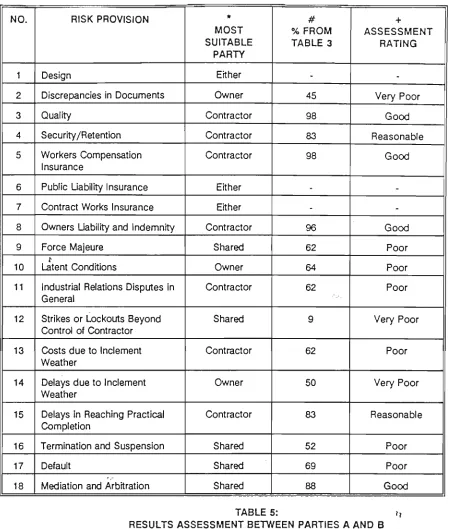
a) Contracts between Owners and Contractors (A & B parties). Refer to Table 3.
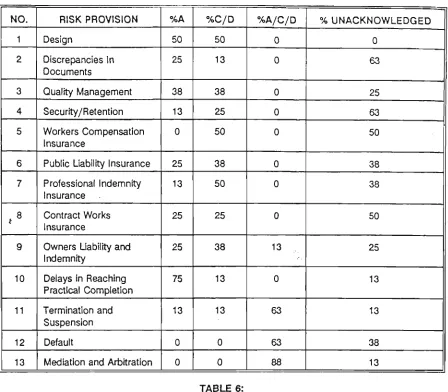
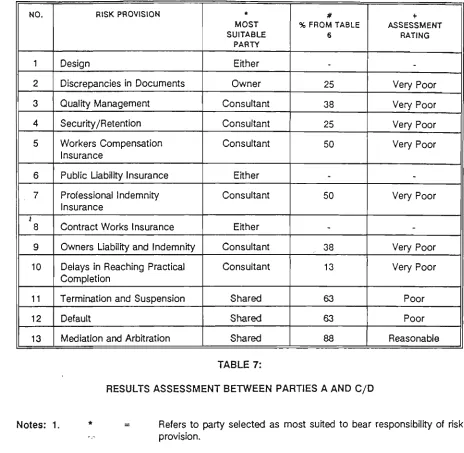
b) Contracts between Owners and Consultants, including Designers and Project/Construction Managers (A & C, A & D parties). Refer to Table 6.
The distinction was necessary to provide a more accurate analysis.
Approximately 80% of contracts studied were between owners and contractors while the remaining 20% were between owners and designers/consultants or owners and project/construction managers.
There are a number of risk provisions that are not applicable to both groups. For example, the majority of contracts between owners and designers, such as architects, did not contain provisions such as Force Majeure or Industrial Disputes as part of their contracts. Likewise, contracts between owners and contractors did not include the provision of Professional Indemnity Insurance as it is a provision not normally applicable to these parties.
Therefore to include the both groups within the same analysis would only serve to bias the results of some provisions.
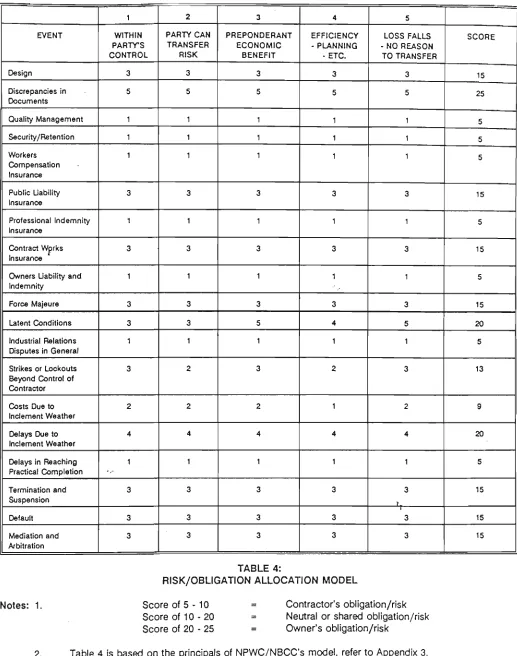
6.2 RISK/OBLIGATION ALLOCATION MODEL
The first stage of the analysis made an assessment as to which party would best be apportioned each risk provision. ?
The principles of a Risk/Obligation Allocation model developed by NPWC/NBCC joint working party was used in concept as the main criteria of this assessment This model gives an initial arithmetic weighting of risk in favour of one or other parties assuming the risk associated with specifled risk provisions.
The principles of the model were confirmed by the findings of the literature review in this thesis as a suitable basis for establishing an apportionment strategy.
A model based on the NPWC/NBCC model, but that includes the specific risks reviewed in this study, including those associated with consultants, was developed and appears in Table 4.
All assessments have been made on a general basis, not considering in detail project particulars, such as, design parameters, cost breakdowns, resource capabilities of parties, that could have an effect on the risk assessment in certain cases. Therefore the circumstances of a particular project, or negotiation between parties, may have led to results different from those suggested in this assessment.
An explanation of the NPWC/NBCC model as described in 'No Dispute', has been copied with permission and appears in Appendix 3.
The assessment criteria that the model of this study is based on is:
a) Whether the risk is within the parties control.
b) Whether the party could transfer the risk.
c) Which party would gain the preponderant economic benefit
d) Which party is most suited in terms of efficiently handling and planning minimising risk.
e) If loss falls there would be no reason to transfer risk as it is best endured by selected party.
* * * * * in CM «r CM S? fM
a
CM 8 CO P; CO in T eo .-o s «r CO T NUMBE R O O < < < < CQ m CD CO !• CD o < < < < CQ < CO CD CD CO CO < < CQ CD <" < < < CO CD CD CD < < < CD CO CD CD CD <• CD < s I n Documen t < o ID CD CD a CQ CO CD CD CD O CQ CQ CD < CO CD CD CD CD CO CD CD CO Managemen t CO CD Q CO CQ CD CD CQ O CQ CQ CO < CO -.-ID CD CO ffi CD CD n a CQ CD Q CD CQ CQ CQ CO O CD 03 CQ O CD CD ID CO CQ CD CD CD s Compensatio n in s CO < o CO CD CD < CD o < < < o CO < < CO CQ CD CO < a y insuranc e O o o CO o CO CD l Indemnit y Ins . CD CO < Q 00 ID CO < 00 < < < o CD < CD < as CO < < t Work s Insuranc e o CO CD CO o CD < CQ CD CD O CO CQ CD O ffi O ffi m ffi ffi m ffi ffi £> c Uabiiit y an d Inde m < A/ B ffi < • Q <"m < < <"m^ f f i
^ m ffi <^ m ^ < ffi ^ m < ffi <" ffi ffi < • ffi < • ffi < e < < < ffi o < < ffi < ffl ffi < < < ffi < < m CQ < < s < ffi m < • o ffi ffi ffi ffi ffi ffi ffi ffi ffi ffi ffi m ffi ffi _c l Relation s Disput e l < ffi < o < ffi ffi ffi ffi < ffl < ffl < < ffi < < < r Lockout s beyon d f Contracto r < ffi Q <"ffi ffi ffi ffi ffi ffi ffi ffl ffi ffi < ffi m m m e t o Inclemen t r < < a < < m ffi ffl ffl ffl ^ ffl ffi < < m ffi ffl < e t o Inclemen t r < o < ffi ffi < <"m < ffi ffi ffl < ffl ffi ffl < ffi ffi ffl ffi a ffl ffi ffi ffi n Reachin g Practica l n <"o o ^ ffi ^ ffl ffl ffl < ffi ffi o <"ffl <"ffi ffl <"o ffi ^ ffi < ffi ? db ffi ffi m ffl ^ ffl c n an d Suspensl o O <^ ffi <• ffl ffi <"m <-m < ffi <"m < ffl ^ o ffl ffl ffl ffl < • ffi < ffl ffi < ffi < • ffl m ffl < ffl < <"o o ^ ffl ^ A/ B ffl ^ ^ Q <"ffl
^ f f l
<"ffl <"m <"ffl ^ o <"ffl <"ffi ffl < • ffi ^ ffl < • ffl <^ ffl <" ffl < • ffl ffl < ffl < • ffl < n an d Arbitratio n CO c o Sect ! o efe r cc teg o CO
o
c iewe d 1 s Re v ntrac t o O II * nage r Io n M a o p 'Con s 4 ^ o roj e •. IIo
*^ C